Citroen SpaceTourer (2016 year). Instruction - part 21
 

  Index      Citroen     Citroen SpaceTourer - instruction 2016 year in english


Search            


Content   ..  19  20  21  22   ..


Citroen SpaceTourer (2016 year). Instruction - part 21


319

8

In the event of a breakdown

Spacetourer-VP_en_Chap08_En-cas-de-panne_ed01-2016

Do not force the lever as locking will 
not be possible if the clamp is not 
positioned correctly; start the procedure 
again.

Disconnecting the battery

In order to maintain an adequate state 
of charge for starting the engine, it is 
recommended that the battery be disconnected 
if the vehicle is taken out of service for a long 
period.
Wait 2 minutes after switching off the ignition 
before disconnecting the battery.
F  close the windows and the doors before 

disconnecting the battery,

F  switch off all electrical consumers (audio 

system, wipers, lighting, ...),

F

  switch off the ignition and wait for 

four minutes.

Having exposed the battery, it is only 
necessary to disconnect the (+) terminal.

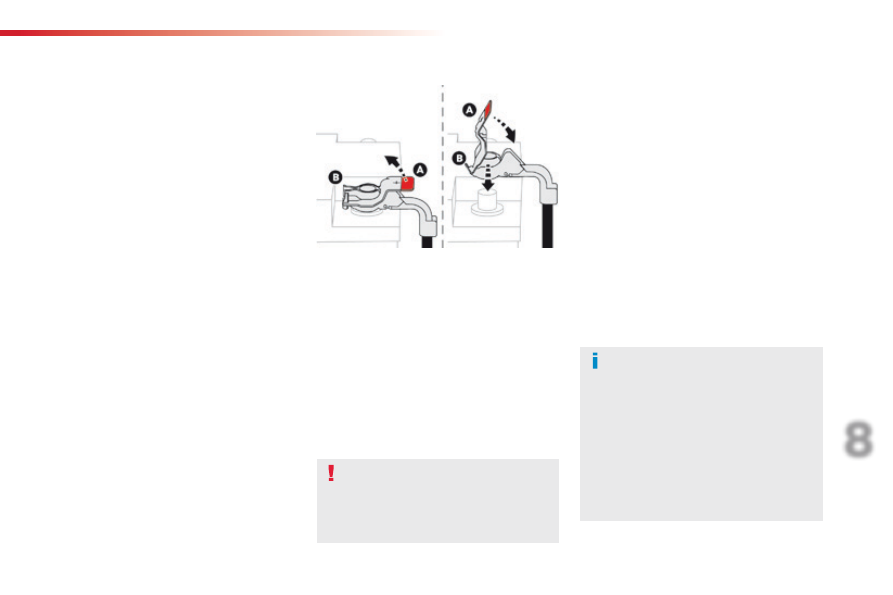
Quick release terminal

Disconnecting the (+) terminal

F  Raise the lever A fully to release the 

clamp B

.

Following reconnection of the battery

Reconnecting the (+) terminal

F  Position the open clamp B of the cable on 

the positive post (+) of the battery.

F  Press down on the clamp to position it 

correctly on the battery post.

F

  Lock the clamp by lowering the lever A.

After reconnecting the battery, switch on the 
ignition and wait 1 minute before starting to 
allow initialisation of the electronic systems.
However, if minor problems persist following 
this operation, contact a CITROËN dealer or a 
qualified workshop.
Referring to the corresponding section, you 
must yourself reinitialise or reset certain 
systems, such as:
-  the remote control or electronic key 

(depending on version),

the electric windows,

the date and time,

-  the radio preset stations.

The Stop & Start system may not be 
operational during the trip following the 
first engine start.
In this case, the system will only be 
available again after a continuous 
period of immobilisation of the vehicle, 
a period which depends on the ambient 
temperature and the state of charge of 
the battery (up to about 8 hours).

320

In the event of a breakdown

Spacetourer-VP_en_Chap08_En-cas-de-panne_ed01-2016

Battery capacity

Vehicle length

Rating in Ah 

(Ampere hours)

Compact (L1)

480

Standard (L2)

640

Long (L3)

720 / 800

Always replace the battery by one of 
equivalent specification.

Towing

Access to the tools

The towing eye is stowed in the tool box.

For more information on the Tool box
refer to the corresponding section.

Procedure for having your vehicle towed or 
for towing another vehicle using a removable 
towing eye.

If your vehicle is fitted with a manual 
gearbox, put the gear lever into neutral.

If your vehicle has an automatic or 
electronic gearbox, place the gear 
selector at position N

.

The failure to observe this special point 
may lead to damage to components 
of the braking system and the lack of 
braking assistance on restarting the 
engine.

321

8

In the event of a breakdown

Spacetourer-VP_en_Chap08_En-cas-de-panne_ed01-2016

F  On the front bumper, press the cover (as 

shown above) to unclip it.

F

  Screw the towing eye in fully.

F

  Install the towing arm.

F

  Switch on the hazard warning lamps on the 

towed vehicle.

F

  Move off gently and drive slowly over a 

short distance only.

Towing your vehicle

F  On the rear bumper, press the cover (as 

shown above) to unclip it.

F

  Screw the towing eye in fully.

F

  Install the towing arm.

F

  Switch on the hazard warning lamps on the 

towed vehicle.

F

  Move off gently and drive slowly over a 

short distance only.

Towing another vehicle

General 
recommendations

Observe the legislation in force in your 
country.
Ensure that the weight of the towing 
vehicle is higher than that of the towed 
vehicle.
The driver must remain at the wheel of 
the towed vehicle and must have a valid 
driving licence.
When towing a vehicle with all four 
wheels on the ground, always use an 
approved towing arm; rope and straps 
are prohibited.
The towing vehicle must move off gently.
When towing a vehicle with the engine 
off, there is no longer any power 
assistance for braking or steering.
In the following cases, you must always 
call on a professional recovery service:
-  vehicle broken down on a motorway 

or fast road,

four-wheel drive vehicle,

when it is not possible to put the 
gearbox into neutral, unlock the 
steering, or release the parking 
brake,

-  towing with only two wheels on the 

ground,

-  where there is no approved towing 

arm available...

322

In the event of a breakdown

Spacetourer-VP_en_Chap08_En-cas-de-panne_ed01-2016

On vehicles fitted with Diesel engines, the fuel 
system must be primed if you run out of fuel.
For all versions other than BlueHDi, refer to the 
corresponding engine compartment view.

Running out of fuel (Diesel)

For more information on Diesel misfuel 
prevention

, refer to the corresponding 

section.

F  Add at least five litres of Diesel fuel to the 

tank.

F

  Open the bonnet.

F

  If necessary, unclip the styling cover for 

access to the priming pump.

F

  Squeeze and release the priming pump 

repeatedly until resistance is felt (there 
may be resistance at the first press).

F

  Operate the starter to start the engine 

(if the engine does not start at the first 
attempt, wait around 15 seconds before 
trying again).

F

  If the engine does not start after a few 

attempts, operate the priming pump again 
then start the engine.

F

  Refit the styling cover and clip it in place.

F

  Close the bonnet.

1.6 HDi engine

(except BlueHDi)

If the engine does not start first time, 
don't keep trying but start the procedure 
again from the beginning.

BlueHDi engine

F

  Fill the fuel tank with at least five litres of 

Diesel.

F

  Switch on the ignition (without starting the 

engine).

F  Wait around 6 seconds and switch off the 

ignition.

F

  Repeat the operation 10 times.

F

  Operate the starter to run the engine.

Other engines

F  Add at least five litres of Diesel fuel to the 

tank.

F

  Open the bonnet.

F

  If necessary, unclip the styling cover for 

access to the priming pump.

F

  Squeeze and release the priming pump 

repeatedly until resistance is felt (there 
may be resistance at the first press).

F

  Operate the starter to start the engine 

(if the engine does not start at the first 
attempt, wait around 15 seconds before 
trying again).

F

  If the engine does not start after a few 

attempts, operate the priming pump again 
then start the engine.

F

  Refit the styling cover and clip it in place.

F

  Close the bonnet.

323

9

Technical data

Spacetourer-VP_en_Chap09_caracteristiques-techniques_ed01-2016

Mirrors folded

Side-hinged doors

Tailgate

Compact (L1)

Standard (L2)

Long (L3)

* Increased payload.
** Payload increased with high body.
*** Depending on the country of sale.

Dimensions (in mm)

These dimensions have been measured on an unladen vehicle.

324

Technical data

Spacetourer-VP_en_Chap09_caracteristiques-techniques_ed01-2016

Engines

Engine characteristics

The engine characteristics (capacity, maximum 
power, maximum power speed, fuel,  
CO

2

 emissions...) for your vehicle are given in 

the registration document, as well as in sales 
brochures.
These characteristics correspond to the values 
type-approved on a test bed, under conditions 
defined in European legislation  
(Directive 1999/99/EC).
For more information, contact a CITROËN 
dealer or a qualified workshop.

Weights

The kerb weight is equal to the unladen 
weight + driver (75 kg).
The GTW and towed load values indicated 
apply up to a maximum altitude of 
1 000 metres; the towed load mentioned 
must be reduced by 10 % for every additional 
1 000 metres..
The weight of the braked trailer can be 
increased, within the GTW limit, on condition 
that the GVW of the towing vehicle is reduced 
by the same amount.
The recommended nose weight is the vertical 
load on the towbar ball (removable with or 
without tools).

High ambient temperatures may result 
in a reduction in the performance of the 
vehicle to protect the engine; when the 
ambient temperature is higher than  
37 °C, limit the towed weight.

If the ambient temperature is high, it 
is recommended that the engine be 
allowed to idle for 1 to 2 minutes after 
the vehicle comes to a stop, to facilitate 
its cooling.

Towing with a lightly loaded vehicle can 
adversely affect roadholding.
Braking distances are increased when 
towing a trailer.
Never exceed 60 mph (100 km/h) when 
towing (comply with the legislation in 
force in your country).

GVW: 

 gross vehicle weight, the maximum authorised 
vehicle weight.

GTW:

 gross train weight, the maximum authorised weight of vehicle plus trailer.

Weights and towed loads

The maximum weights and towed loads for your 
vehicle are given are given in the registration 
document, as well as in sales brochures.
These values are also present on the 
manufacturer's plate or label.
For more information, contact a CITROËN 
dealer or a qualified workshop.

325

9

Technical data

Spacetourer-VP_en_Chap09_caracteristiques-techniques_ed01-2016

EURO 6 Diesel engines

* Increased payload.

Engine

Engine 

code

Gearbox

Engine oil capacity with 

filter replacement  

(litres)

Length

Unbraked trailer 

weight (kg) 

 8-9 seats

Trailer nose  

weight (kg) 

 8-9 seats

1.6 litre 

BlueHDi 95

BHV 

(DV6FDU)

Manual

(5-speed)

5.6

L1, L2, L3

750

72

L2*, L3*

80

1.6 litre 

BlueHDi 95 

S&S

BHS 

(DV6FDU)

ETG6 

electronic
(6-speed)

5.6

L1, L2, L3

72

L2*, L3*

80

1.6 litre 

BlueHDi 115 

S&S

BHX

(DV6FCU)

Manual

(6-speed)

5.6

L1, L2, L3

72

L2*, L3*

80

326

Technical data

Spacetourer-VP_en_Chap09_caracteristiques-techniques_ed01-2016

* Increased payload.

Engine

Engine 

code

Gearbox

Engine oil capacity with 

filter replacement  

(litres)

Length

Unbraked trailer 

weigt (kg) 
 8-9 seats

Trailer nose  

weight (kg) 

 8-9 seats

2 litre BlueHDi  

150 S&S

AHX

(DW10FD)

Manual

(6-speed)

6.1

L1, L2, L3

750

92

L2*, L3*

100

2 litre BlueHDi 

180 S&S

AHH

(DW10FC)

EAT6 

automatic
(6-speed)

5.1

L1, L2, L3

80

L2*, L3*

88

327

9

Technical data

Spacetourer-VP_en_Chap09_caracteristiques-techniques_ed01-2016

Identification markings

Various visible markings for the identification of your vehicle.

A.  Vehicle Identification Number (VIN) 

under the bonnet. 


This number is engraved on the chassis 
near the right hand front wheel arch.

The tyre pressures must be checked 
when the tyres are cold, at least once 
a month.

If the tyre pressures are too low, this 
increases fuel consumption.

B.  Vehicle Identification Number (VIN) on 

the windscreen lower cross member. 


This number is indicated on a self-
adhesive label which is visible through the 
windscreen.

C.  Manufacturer's label. 
 

This self-destroying label on the middle 
door pillar, right or left hand side, contains 
the following information:
-  the manufacturer's name,
-  the European whole vehicle type 

approval number,

-  the vehicle identification number (VIN),
-  the maximum authorised weight (gross 

vehicle weight),

-  the maximum authorised weight with 

trailer (gross train weight),

-  the maximum front axle weight,
-  the maximum rear axle weight.

D.  Tyre/paint label. 
 

This label on the middle door pillar, driver's 
side, contains the following information:
-  the tyre inflation pressures, laden and 

unladen,

-  the tyre sizes (including the tyre load 

index and speed rating),

-  the inflation pressure for the spare 

wheel,

-  the paint colour code.

328

Audio and Telematics

Spacetourer-VP_en_Chap10a_BTA_ed01-2016

Emergency or assistance call

If an impact is detected by the airbag 
control unit, and independently of 
the deployment of any airbags, an 
emergency call is made automatically.

Localised Emergency Call

In an emergency, press this 
button for more than 2 seconds.
Flashing of the green indicator 
lamp and a voice message 
confirm that the call has 
been made to the "Localised 
Emergency Call"* centre.

Pressing this button again immediately cancels 
the call.
The green indicator lamp goes off.
At any time, pressing this button for more than 
8 seconds cancels the call.

The green indicator lamp remains on (without 
flashing) when communication is established.
It goes off at the end of the call.

This call is dealt with by the "Localised 
Emergency Call" centre, which receives 
locating information from the vehicle and 
can send a detailed alert to the appropriate 
emergency services.
In countries in which a centre is not 
operational, or when the locating service 
has been expressly declined, the call is dealt 
with directly by the emergency services (112) 
without the vehicle location.

*  These services are subject to conditions and 

availability.

  Consult a CITROËN dealer.

If you benefit from the CITROËN 
Connect Box offer with the SOS and 
assistance pack included, there are 
additional services available to you in 
your MyCITROËN personal space, via 
the Internet website for your country.

.

329

Audio and Telematics

Spacetourer-VP_en_Chap10a_BTA_ed01-2016

Localised Assistance Call

If you purchased your vehicle outside 
the CITROËN dealer network, we 
invite you to have a dealer check the 
configuration of these services and, if 
desired, modified to suit your wishes.
In a multi-lingual country, configuration 
is possible in the official national 
language of your choice.

For technical reasons, particularly 
to improve the quality of Telematic 
services to customers, the 
manufacturer reserves the right to 
carry out updates to the vehicle's on-
board telematic system.

The fault with the system does not 
prevent the vehicle being driven.

Press this button for more than 
2 seconds to request assistance 
if the vehicle breaks down.
A voice message confirms that 
the call has been started*.

Pressing this button again immediately cancels 
the request.
The cancellation is confirmed by a voice 
message.

Geo-location

You can deactivate geo-location by 
simultaneously pressing the "Localised 
Emergency Call" and "Localised Assistance 
Call" buttons, followed by a press on "Localised 
Assistance Call" to confirm.

To reactivate geo-location, simultaneously 
press the "Localised Emergency Call" and 
"Localised Assistance Call" buttons again, 
followed by a press on "Localised Assistance 
Call" to confirm.

The orange indicator lamp is on fixed: the back-
up battery should be replaced.
In both cases, the emergency and assistance 
calls service may not work.
Contact a qualified repairer as soon as 
possible.

Operation of the system

When the ignition is switched on, 
the green indicator lamp comes 
on for 3 seconds indicating that 
the system is operating correctly.

The orange indicator lamp 
flashes then goes off: the system 
has a fault.

*  These services are subject to conditions and 

availability.

  Consult a CITROËN dealer.

.

331

Audio and Telematics

Spacetourer-VP_en_Chap10b_NAC-1_ed01-2016

CITROËN Connect Nav

GPS satellite navigation - Connectivity - Multimedia audio - Bluetooth

®

 telephone

Contents

First steps 

332

Steering mounted controls 

334

Menus 

335

Voice commands 

336

Navigation 

342

Connected navigation 

358

Connectivity 368
Radio Media 

378

Telephone 

390

Settings 

402

Frequently asked questions 

412

The system is protected in such a way that it will only operate in 
your vehicle.

The link below gives access to OSS (Open Source Software) 
codes for the system.
http://www.psa-peugeot-citroen.com/oss

As a safety measure and because it requires sustained attention 
by the driver, the pairing of a Bluetooth mobile telephone with 
the Bluetooth hands-free system of your audio system must be 
done with the vehicle stationary

 and the ignition on.

The display of the energy economy mode message signals that 
a change to standby is imminent. For more information on the 
Energy economy mode

 refer to the corresponding section.

332

FM/87.5 MHz
87.5MHz

12:13

23 °C

87.5 MHz

Audio and Telematics

Spacetourer-VP_en_Chap10b_NAC-1_ed01-2016

First steps

With the engine running, a press 
mutes the sound.
With the ignition off, a press turns the 
system on.

Volume.

Use the buttons either side of the touch screen 
for access to the menus, then press the virtual 
buttons in the touch screen. All of the touch 
areas of the screen are white.
Each menu is displayed in one or two pages 
(primary page and secondary page).

Secondary page

Primary page

The touch screen is of the 
"capacitive" type.
To clean the screen, use a soft,  
non-abrasive cloth (spectacles cloth) 
with no additional product.
Do not use sharp objects on the 
screen.
Do not touch the screen with wet 
hands.

.

333

12:13

23 °C

531 kHz

Audio and Telematics

Spacetourer-VP_en_Chap10b_NAC-1_ed01-2016

Select the audio source (depending on 
version):
-  FM / DAB* / AM* stations.
-  Smartphone via MirrorLink

TM

 or CarPlay

®

.

-  USB memory stick.

Media player connected to the auxiliary 
socket (jack, cable not supplied).

Telephone connected by Bluetooth* and 
using Bluetooth* audio streaming.

* Depending on equipment.

Short-cuts: using the virtual buttons in the 
upper band of touch screen, it is possible to 
go directly to the selection of audio source, 
the list of stations (or titles, depending on 
the source), message notifications, emails, 
mapping updates and, depending on services, 
navigation notifications.

In very hot conditions, the volume may 
be limited to protect the system. It may 
go into standby (screen and sound off) 
for at least 5 minutes.
The return to normal takes place when 
the temperature in the passenger 
compartment drops.

In the "Settings" menu you can create 
a profile for just one person or a group 
of people with common points, with 
the possibility of entering a multitude 
of settings (radio presets, audio 
settings, navigation history, contact 
favourites, ...); these settings are taken 
into account automatically.

334

Audio and Telematics

Spacetourer-VP_en_Chap10b_NAC-1_ed01-2016

Steering mounted controls

Media

 (short press): change the 

multimedia source.
Telephone

 (short press): call.

Call in progress

 (short press): 

access to telephone menu.
Telephone

 (long press): reject an 

incoming call, end call, access to 
telephone menu.

Decrease volume.

Voice commands

:

Short press, system voice 
commands.
Long press, smartphone voice 
commands via the system.

Mute / Restore the sound.

Radio

 (rotate): automatic search for 

the previous / next station.
Media

 (rotate): previous / next track, 

move in a list.
Short press

: Confirm a selection. 

Other than selection, access to 
presets.

Radio

: display the list of stations.

Media

: display the list of tracks.

Radio, press and hold

: update the 

list of stations received.

Increase volume.


Content   ..  19  20  21  22   ..