Acura RLX HYBRID (2020 year). Manual in english - page 26
 

  Index      Manuals     Acura RLX HYBRID (2020 year). Manual in english


Search            copyright infringement  


Content      ..     24      25      26      27     ..


Acura RLX HYBRID (2020 year). Manual in english - page 26


uu

When Driving

u

Road Departure Mitigation (RDM) System

418

Driving

The system becomes ready to start searching for lane markings when all the 
following conditions are met:

The vehicle is traveling between 45 and 89 mph (72 and 144 km/h).

The vehicle is on a straight or slightly curved road.

The turn signals are off.

The brake pedal is not depressed.

The wipers are not in continuous operation.

The system makes a determination that the driver is not actively accelerating, 
braking or steering.

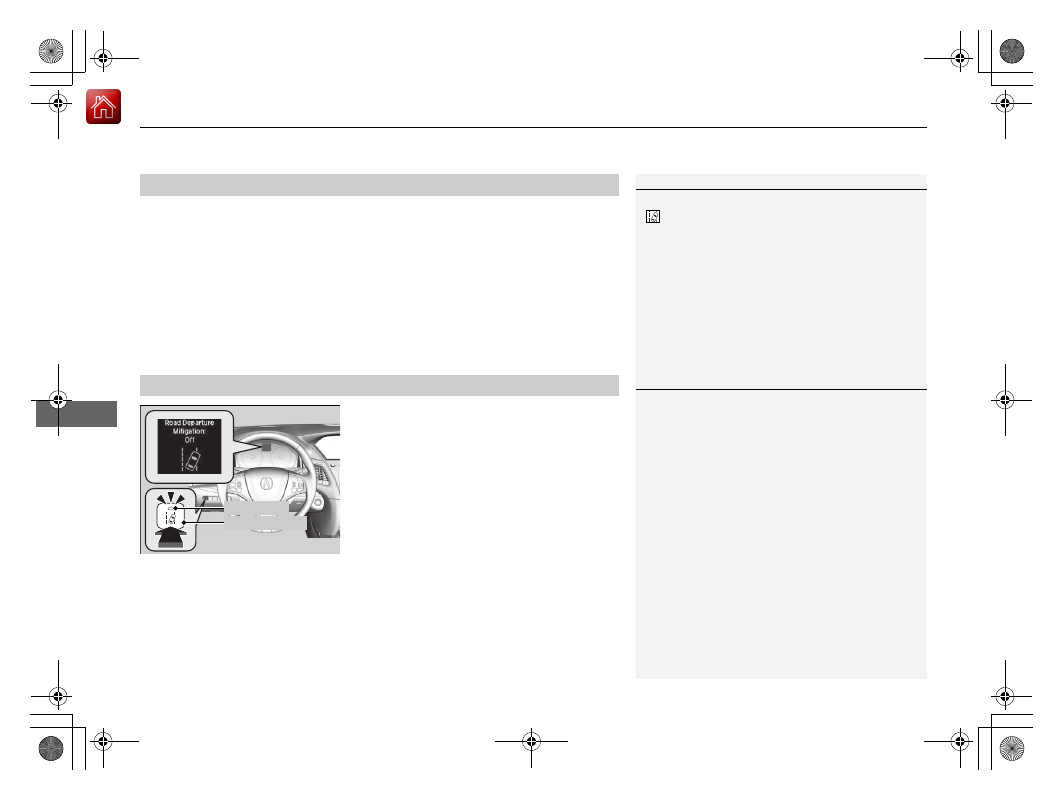
Press the RDM button to turn the system on 
and off.

u

The indicator in the button comes on and 
the message appears on the multi-
information display when the system is 
on.

How the System Activates

RDM On and Off

1

How the System Activates

The RDM system may automatically shut off and the 

 indicator comes and stays on.

2

Indicators

 P. 76

RDM system function can be impacted when the 
vehicle is:

Not driven within a traffic lane.

Driven on the inside edge of a curve, or outside of 
a lane.

Driven in a narrow lane.

1

RDM On and Off

When you have selected 

Warning Only

 from the 

customized options using the audio/information 
screen, the system does not operate the steering 
wheel and braking.

2

Customized Features

 P. 295

RDM Button

Indicator

-------------------------------------------------------------------------------------------------------------------------------------------------------------

419

uu

When Driving

u

Road Departure Mitigation (RDM) System

Continued

Driving

The system may not properly detect lane markings and the position of your vehicle 
under certain conditions. Some examples of these conditions are listed below.

Environmental conditions

Driving in bad weather (rain, fog, snow, etc.).

Sudden changes between light and dark, such as an entrance or exit of a tunnel.

There is little contrast between lane lines and the roadway surface.

Driving into low sunlight (e.g., at dawn or dusk).

Strong light is reflected onto the roadway.

Driving in the shadows of trees, buildings, etc.

Shadows of adjacent objects are parallel to lane markings.

Roadway objects or structures are misinterpreted as lane markers.

Reflections on the interior of the windshield.

Driving at night or in a dark condition such as a tunnel.

RDM Conditions and Limitations

-------------------------------------------------------------------------------------------------------------------------------------------------------------

420

uu

When Driving

u

Road Departure Mitigation (RDM) System

Driving

Roadway conditions

Driving on a snowy or wet roadway (obscured lane marking, vehicle tracks, 
reflected lights, road spray, high contrast).

Driving on a road with temporary lane markings.

Faint, multiple, or varied lane markings are visible on the roadway due to road 
repairs or old lane markings.

The roadway has merging, split, or crossing lines (e.g., such as at an intersection 
or crosswalk).

The lane markings are extremely narrow, wide, or changing.

The vehicle in front of you is driving near the lane lines.

The road is hilly or the vehicle is approaching the crest of a hill.

Driving on rough or unpaved roads, or over bumpy surfaces.

When objects on the road (curb, guard rail, pylons, etc.) are recognized as white 
lines (or yellow lines).

Driving on roads with double lines.

The road has ruts.

Vehicle conditions

Headlight lenses are dirty or the headlights are not properly adjusted.

The outside of the windshield is streaked or blocked by dirt, mud, leaves, wet 
snow, etc.

The inside of the windshield is fogged.

The camera temperature gets too high.

An abnormal tire or wheel condition (wrong sized, varied size or construction, 
improperly inflated, compact spare tire

*

, etc.).

The vehicle is tilted due to a heavy load or suspension modifications.

When tire chains are installed.

* Not available on all models

-------------------------------------------------------------------------------------------------------------------------------------------------------------

421

uu

When Driving

u

Lane Keeping Assist System (LKAS)

Continued

Driving

Lane Keeping Assist System (LKAS)

Provides steering input to help keep the vehicle in the middle of a detected lane and 
provides tactile and visual alerts if the vehicle is detected drifting out of its lane.

1

Lane Keeping Assist System (LKAS)

Important Safety Reminders

The LKAS is for your convenience only. It is not a 
substitute for your vehicle control. The system does 
not work if you take your hands off the steering 
wheel or fail to steer the vehicle.

2

Multi-Information Display Warning and 
Information Messages

 P. 94

Do not place objects on the instrument panel. 
Objects may reflect on the front windshield and 
prevent correct detection of the traffic lanes.

The LKAS only alerts you when lane drift is detected 
without a turn signal in use. The LKAS may not detect 
all lane markings or lane departures; accuracy will 
vary based on weather, speed, and lane marker 
condition. It is always your responsibility to safely 
operate the vehicle and avoid collisions.

The LKAS is convenient when it is used on freeways.

The LKAS may not work properly or may work 
improperly under the certain conditions:

2

LKAS Conditions and Limitations

 P. 426

You can read about handling information for the 
camera equipped with this system.

2

Front Sensor Camera

 P. 400

When you operate the turn signals to change lanes, the system is suspended, and 
resumes after the signals are off.
If you make a lane change without operating the turn signals, the LKAS alerts 
activate, and torque is applied to the steering.

Front sensor 
camera

Monitors the lane 
lines

Tactile and visual alerts

Rapid vibrations on the steering 
wheel and a warning display alert you 
that the vehicle is drifting out of a 
detected lane.

Steering input assist

The system applies torque to the steering to keep the vehicle between the left and 
right lane lines. The applied torque becomes stronger as the vehicle gets closer to 
either of the lane lines.

-------------------------------------------------------------------------------------------------------------------------------------------------------------

uu

When Driving

u

Lane Keeping Assist System (LKAS)

422

Driving

Provides assistance to keep the vehicle in the center of the lane. When the vehicle 
nears a white or yellow line, steering force of the electric power steering will become 
stronger.

When the vehicle enters the warning area, the LKAS alerts you with slight steering 
wheel vibration as well as a warning display.

Lane Keep Support Function

1

Lane Keeping Assist System (LKAS)

The LKAS may not function as designed while driving 
in frequent stop and go traffic, or on roads with 
sharp curves.

When it fails to detect lanes, the system will 
temporarily be canceled. When lane is detected, 
system will recover automatically.

Lane Departure Warning Function

Warning Area

Warning Area

-------------------------------------------------------------------------------------------------------------------------------------------------------------

Continued

423

uu

When Driving

u

Lane Keeping Assist System (LKAS)

Driving

The system can be used when the following conditions are met.

The lane in which you are driving has detectable lane markers on both sides, and 
your vehicle is in the center of the lane.

The vehicle speed is between 45 and 89 mph (72 and 144 km/h).

You are driving on a straight or slightly curved road.

The driver is gripping the steering wheel.

How to activate the system

1.

Press the 

MAIN

 button.

u

The 

LKAS

 indicator comes on in the 

multi-information display.
The system is ready to use.

2.

Press the LKAS button.

u

Lane outlines (dotted outer lines) appear 
on the multi-information display.
The system is activated.

When the System can be Used

1

When the System can be Used

If the vehicle drifts toward either left or right lane line 
due to the system applying torque, turn off the LKAS 
and have your vehicle checked by a dealer.

1

How to activate the system

You can have the head-up display show you the 
current state of Traffic Jam Assist.

2

Head-Up Display

 P. 119

MAIN

 Button

LKAS Button

-------------------------------------------------------------------------------------------------------------------------------------------------------------

uu

When Driving

u

Lane Keeping Assist System (LKAS)

424

Driving

3.

Keep your vehicle near the center of the 
lane while driving.

u

The dotted outer lines change to solid 
ones once the system starts operating 
after detecting the left and right lane 
markings.

To cancel the LKAS:
Press the 

MAIN

 or LKAS button.

The LKAS is turned off every time you turn the 
power system off, even if you turned it on the 
last time you drove the vehicle.

To cancel

1

To cancel

Pressing the 

MAIN

 button also turns ACC with Low 

Speed Follow on and off.

MAIN

 Button

LKAS Button

-------------------------------------------------------------------------------------------------------------------------------------------------------------

425

uu

When Driving

u

Lane Keeping Assist System (LKAS)

Continued

Driving

The system operation is suspended if 
you:

The wipers are set to 

HI

.

u

Turning the wipers off resumes the 
LKAS.

Decrease the vehicle speed to about 40 
mph (64 km/h) or less.

u

Increasing the vehicle speed to about 45 
mph (72 km/h) or more resumes the 
LKAS.

Depress the brake pedal.

u

The LKAS resumes and starts detecting 
the lane lines again once you release the 
brake pedal.

Your vehicle is driving to the right or the left 
of the lane.

The LKAS may automatically be suspended when:

The system fails to detect lane lines.

The steering wheel is quickly turned.

You fail to steer the vehicle.

Driving through a sharp curve.

Driving at a speed in excess of approximately 89 mph (144 km/h).

Once these conditions no longer exist, the LKAS automatically resumes.

When the LKAS is suspended, 
the lane lines on the multi-
information display change to 
dotted lines, and the beeper 
sounds (if activated).

-------------------------------------------------------------------------------------------------------------------------------------------------------------

426

uu

When Driving

u

Lane Keeping Assist System (LKAS)

Driving

The LKAS may automatically be canceled when:

It is possible that under any of the following circumstances, dotted outer lines will 
appear on the multi-information display, a buzzer will sound, and LKAS will be 
canceled automatically.

The camera temperature gets extremely high or low.

The camera behind the rearview mirror, or the area around the camera, including 
the windshield, gets dirty.

The ABS or VSA

®

 system engages.

The beeper sounds if the LKAS is automatically canceled.

The system may not detect lane markings and therefore may not keep the vehicle in 
the middle of a lane under certain conditions, including the following:

Environmental conditions

Driving in bad weather (rain, fog, snow, etc.).

Sudden changes between light and dark, such as an entrance or exit of a tunnel.

There is little contrast between lane lines and the roadway surface.

Driving into low sunlight (e.g., at dawn or dusk).

Strong light is reflected onto the roadway.

Shadows are cast across the lane lines (e.g., trees, buildings, guardrails, vehicle, 
etc.).

Roadway objects or structures are misinterpreted as lane markers.

Reflections on the interior of the windshield.

Driving at night or in a dark condition such as a tunnel.

LKAS Conditions and Limitations

-------------------------------------------------------------------------------------------------------------------------------------------------------------

427

uu

When Driving

u

Lane Keeping Assist System (LKAS)

Driving

Roadway conditions

The lines are not very distinguishable from the surface of the road.

Driving on a snowy or wet roadway (obscured lane marking, vehicle tracks, 
reflected lights, road spray, high contrast).

Driving on a road with temporary lane markings.

Faint, multiple, or varied lane markings are visible on the roadway due to road 
repairs or old lane markings.

The roadway has merging, split, or crossing lines (e.g., such as at an intersection 
or crosswalk).

The lane markings are extremely narrow, wide, or changing.

The vehicle in front of you is driving near the lane lines.

The road is hilly or the vehicle is approaching the crest of a hill.

Driving on rough or unpaved roads, or over bumpy surfaces.

When objects on the road (curb, guard rail, pylons, etc.) are recognized as white 
lines (or yellow lines).

Driving on roads with double lines.

Vehicle conditions

Headlight lenses are dirty or the headlights are not properly adjusted.

The outside of the windshield is streaked or blocked by dirt, mud, leaves, wet 
snow, etc.

The inside of the windshield is fogged.

The camera temperature gets too high.

An abnormal tire or wheel condition (wrong sized, varied size or construction, 
improperly inflated, compact spare tire

*

, etc.).

The vehicle is tilted due to a heavy load or suspension modifications.

The tires are equipped with snow chains.

* Not available on all models

-------------------------------------------------------------------------------------------------------------------------------------------------------------

428

uu

When Driving

u

Traffic Jam Assist

Driving

Traffic Jam Assist

The traffic jam assist system uses a radar sensor mounted inside the front grille and 
a camera mounted to the upper portion of the windshield to detect and monitor left 
and right white (yellow) traffic lane lines as well as any vehicle ahead. Based on 
inputs from the radar sensor and camera, the system adjusts the speed of your 
vehicle to maintain a set interval between your vehicle and the one detected ahead. 
It also applies steering torque to keep your vehicle in the center of the detected lane 
when you are driving in heavy traffic.

How Traffic Jam Assist works

If you are in heavy traffic and Adaptive Cruise Control with Low Speed Follow is 
active, the traffic jam assist system, upon detecting the traffic lane lines and a vehicle 
ahead, will apply steering torque to help keep your vehicle in the center of the lane.
The system adjusts the speed of your vehicle to maintain a set interval between your 
vehicle and the one detected ahead.

1

Traffic Jam Assist

3

WARNING

Improper reliance on Traffic Jam Assist can 
cause a crash resulting in injury or death.
Always maintain full control over your 
vehicle even when this system is active. and 
only use when on expressways or freeways.
Traffic Jam Assist is not an autonomous 
driving system:

3

WARNING

Failure to securely park vehicle when 
stopped using Adaptive Cruise Control with 
Low Speed Follow is active can allow the 
vehicle to roll away, resulting in an crash 
causing injury or death.
Never stop the vehicle and exit it without 
placing it in Park and setting the parking 
brake.

-------------------------------------------------------------------------------------------------------------------------------------------------------------

Continued

429

uu

When Driving

u

Traffic Jam Assist

Driving

When the driver takes direct control of steering, the steering assist function is 
temporarily canceled.
The torque applied to steering may not be noticeable when the driver has direct 
control of steering, or when the surface of the road is rough or uneven.

Front Sensor Camera

Detects vehicle 
ahead

Detects left and right 
white (yellow) traffic 
lane lines

Radar Sensor

When you use the turn signal to indicate a lane change, Traffic Jam Assist is 
temporarily deactivated. It is reactivated once the vehicle is traveling in the 
center of the lane and the system has detected the traffic lane lines and a 
vehicle ahead.

1

Traffic Jam Assist

You can read about handling information for the 
camera equipped with this system.

2

Front Sensor Camera

 P. 400

Traffic Jam Assist may not always be able to detect 
lane division lines or a vehicle traveling ahead. 
Depending on weather and road conditions and 
other factors, Traffic Jam Assist may not function 
normally. Always be aware of your surroundings and 
the road conditions, and conduct yourself in a 
manner conducive to safe driving. Traffic Jam Assist 
may not function properly when you are driving 
through a sharp curve or repeatedly accelerating and 
decelerating.

Traffic Jam Assist may not work properly under the 
certain conditions:

2

Traffic Jam Assist: Conditions and 
limitations

 P. 434

-------------------------------------------------------------------------------------------------------------------------------------------------------------

uu

When Driving

u

Traffic Jam Assist

430

Driving

Traffic Jam Assist is activated when all of the following circumstances exist:

LKAS is activate.

ACC with Low Speed Follow is active.

The vehicle speed is between 0 and 45mph (0 and 72km/h) and there is a vehicle 
detected traveling ahead.

The lane in which you are driving has detectable lane markers on both sides, and 
your vehicle is in the center of the lane.

You are driving on a straight or slightly curved road.

The driver is gripping the steering wheel.

Do not use Traffic Jam Assist in any of the following situations:

You are traveling on a road with sharp curves.

u

The system may not allow your vehicle to respond in a manner best suited for 
the road conditions.

You are entering a toll booth, interchange, service area, or parking area.

u

If the vehicle ahead disappears from the travel path of your vehicle, your 
vehicle may suddenly accelerate to resume the set speed.

You are driving in adverse weather (rain, fog, snow, etc.).

u

The system may not be able to correctly determine the interval between your 
vehicle and the one ahead.

The surface of the road is slippery, for example, it is icy or covered with snow.

u

The tires may slip, causing you to lose control of the vehicle.

You are driving in a HOV lane and motorcycles are passing you to the side, or you 
are required to keep your vehicle to the right or the left of the lane.

u

The system may not be able to correctly determine the vehicle ahead.

Traffic Jam Assist Activation

1

Traffic Jam Assist Activation

Refer to the following page for proper handling of 
the Adaptive Cruise Control with Low Speed Follow:

2

Adaptive Cruise Control (ACC) with Low 
Speed Follow

 P. 402

Refer to the following page for proper handling of 
the Lane Keeping Assist System (LKAS):

2

Lane Keeping Assist System (LKAS)

 P. 421

Refer to the following page for steering buttons and 
displays:

2

How to Operate the Buttons on the 
Steering Wheel

 P. 399

-------------------------------------------------------------------------------------------------------------------------------------------------------------

Continued

431

uu

When Driving

u

Traffic Jam Assist

Driving

When a vehicle is traveling ahead

When a vehicle ahead of yours is detected entering the Traffic Jam Assist detection 
area, Traffic Jam Assist adjusts the speed of your vehicle to maintain the selected 
interval between your vehicle and the one ahead. It also applies steering torque to 
keep your vehicle in the center of the detected lane.

Keep your vehicle near the center of the lane 
while driving.

u

Traffic Jam Assist will be activated once 
the camera has detected the white 
(yellow) traffic lane lines on either side of 
the lane and the radar sensor and 
camera have detected a vehicle driving 
ahead.
The dotted outer lines change to solid 
ones and a vehicle icon appears on the 
multi-information display.

How Traffic Jam Assist Works

1

How Traffic Jam Assist Works

If your vehicle veers too far to the right or the left of 
the white (yellow) traffic lane lines while Traffic Jam 
Assist is active, deactivate Traffic Jam Assist and have 
an authorized Acura dealer inspect your vehicle.

In some cases the system cannot properly detect the 
traffic lane lines and, as a result, will not provide 
steering assistance.

2

Traffic Jam Assist: Conditions and 
limitations

 P. 434

If the driver takes his or her hands off the steering 
wheel or does not adequately maintain control of 
steering, the warning below will appear.

If the driver does not grip the steering wheel after the 
warning above has repeatedly appeared, a warning 
buzzer will sound and Traffic Jam Assist will be 
canceled.

You can have the head-up display show you the 
current state of Traffic Jam Assist.

2

Head-Up Display

 P. 119

Traffic Jam Assist has a detection range of 197 ft. (60m)

-------------------------------------------------------------------------------------------------------------------------------------------------------------

uu

When Driving

u

Traffic Jam Assist

432

Driving

When no vehicle is traveling ahead

If the vehicle detected ahead disappears from 
the travel path of your vehicle (for example, it 
changes lanes), Traffic Jam Assist will be 
deactivated temporarily and your vehicle will 
gradually accelerate until it reaches the set 
speed, after which it will maintain that speed.

1

How Traffic Jam Assist Works

If the vehicle detected ahead suddenly slows down, 
or if another vehicle is detected cutting in front of 
yours, a warning buzzer will sound, and a warning in 
the multi-information display and head-up warning 
will appear.

Depress the brake pedal and take direct control of 
steering.

Beep

Head-up Warning

The dotted outer lines and a 
vehicle icon with a dotted-line 
contour appear on the multi-
information display.

-------------------------------------------------------------------------------------------------------------------------------------------------------------

Continued

433

uu

When Driving

u

Traffic Jam Assist

Driving

To cancel Traffic Jam Assist, you can do any of the following:

Press the 

MAIN

 button.

Press the LKAS button.

When the ACC with Low Speed Follow is deactivated.

When Traffic Jam Assist may automatically be suspended when:

The system is temporarily canceled automatically under the following circumstances.

The system fails to detect lane lines.

The vehicle ahead of you cannot be detected.

The steering wheel is turned quickly.

You fail to steer the vehicle.

The vehicle in front of you is driving near the lane lines.

The wipers are set to high.

The interval between your vehicle and the one traveling ahead is over 197 feet 
(60m).

Once these conditions no longer exist, the Traffic Jam Assist automatically resumes.

Canceling Traffic Jam Assist

1

How Traffic Jam Assist Works

If you are traveling slower than the vehicle detected 
ahead or a vehicle that is detected cutting in front of 
you and the interval between your vehicle and the 
detected vehicle gradually increases, your vehicle will 
continue to follow that vehicle without emitting any 
warning, even if the interval between the vehicle is 
minimal.

1

When Traffic Jam Assist may automatically be suspended when:

You are traveling over 45mph (72km/h).

u

When the speed of the vehicle reaches 45mph 

(72km/h), Traffic Jam Assist is deactivated and LKAS 
is activated instead. Once the speed of the vehicle 
drops to under 42mph (68km/h), Traffic Jam Assist 
is reactivated.

-------------------------------------------------------------------------------------------------------------------------------------------------------------


Content      ..     24      25      26      27     ..