FANUC Series 30i/300i/300is-MODEL A. Machining Center System. User's manual - page 197
 

  Index      Manuals     FANUC Series 30i/300i/300is-MODEL A. Machining Center System. User's manual (B-63944EN/03)


Search            copyright infringement  


Content      ..     195      196      197      198     ..


FANUC Series 30i/300i/300is-MODEL A. Machining Center System. User's manual - page 197


12.SETTING AND DISPLAYING DATA

 OPERATION 

B-63944EN/03


- 1532 - 

12.2.14 

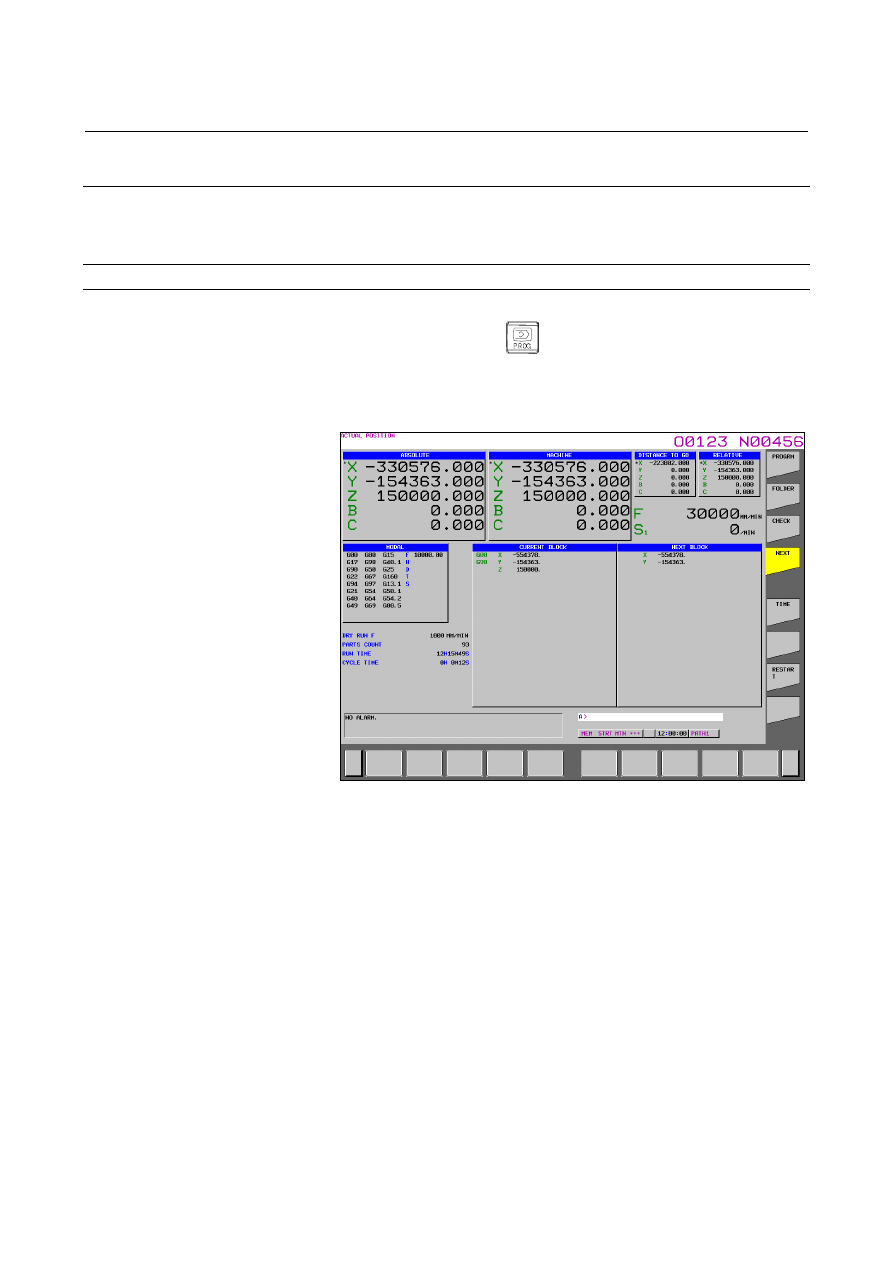
Next Block Display Screen (15-inch Display Unit) 

 
Displays the block currently being executed and the block to be 
executed next. 
 

Procedure for displaying the next block display screen 

Procedure 

Press function key 

Press vertical soft key [NEXT].   
The G codes, addresses, command values specified in the block 
currently being executed and the next block are displayed. 


Fig. 12.2.14 (a) Next block display screen (15-inch) 


B-63944EN/03

 OPERATION 

12.SETTING AND DISPLAYING DATA


- 1533 - 

12.2.15 

Program Check Screen (15-inch Display Unit) 

 
Displays the program currently being executed, current position of the 
tool, and modal data. 
 

Procedure for displaying the program check screen 

Procedure 

Press function key 

Press vertical soft key [CHECK].   
The program currently being executed, current position of the 
tool, and modal data are displayed. 


Fig. 12.2.15 (a) Program check screen (15-inch) 


Explanation 
 - Program display 

The program currently being executed is displayed. 
The block being executed is displayed in reverse video. 
 

  - Current position display 

The current position in the relative coordinate system, workpiece 
coordinate system, and machine coordinate system, and the remaining 
amount of travel are displayed. 
 

  - Modal G codes 

Up to 24 modal G codes are displayed. 

12.SETTING AND DISPLAYING DATA

 OPERATION 

B-63944EN/03


- 1534 - 

12.2.16 

Background Editing (15-inch Display Unit) 

 
Editing one program during execution of another program is referred 
to as background editing.    You can perform the same edit operations 
in the background as those in normal editing (foreground editing). 
 
On a 10.4-inch or 15-inch display, you can perform background 
editing for the programs displayed in multiple tiled windows. You can 
switch from a program displayed in one of the tiled windows to 
another to perform copy, paste, and other edit operations, which 
allows you to edit programs efficiently. 
You can edit two programs simultaneously on a 10.4-inch display or 
four programs on a 15-inch display. 
 

Function 

 - Background editing 

A program other than the currently selected program can be edited. 
Background editing can be performed in any mode. 
 

  - Program selected in the foreground 

If the program selected in the foreground is specified as a program to 
be edited in the background, background editing is started in the 
read-only mode. The text at an arbitrary position of the program 
currently being executed can be checked. 
 

  - Switching from the program directory screen to the editing screen 

By selecting a program from the program folder screen, background 
editing can be started.   
On the program folder screen, move the cursor to a program to be 
edited in the background, then press the MDI key 

. The screen 

display switches to the background editing screen. 
Background editing can be started without entering a program name. 
 

  - Background editing on a multi-path system 

Background editing does not depend on the path. 
Even if the path to be operated is changed using the path selection 
signal, the background editing currently being executed is just 
continued. 

B-63944EN/03

 OPERATION 

12.SETTING AND DISPLAYING DATA


- 1535 - 

Display 

When background editing starts, the ordinary program editing screen 
switches to the background editing screen. 
When two or more programs are edited in the background, the screen 
is split to display these programs. For a 10.4-inch display, you can edit 
two programs simultaneously; for a 15-inch display, you can edit four 
programs simultaneously. 
 

 - Word editing 

Fig. 12.2.16 (a) shows background word editing performed 
simultaneously for two programs (right and left programs).    On the 
status line at the top of the window for each program, the program 
name and “BG-EDIT” (indicating background editing in progress) are 
displayed. 
The status line of the program being edited is displayed in reverse 
video. 


Fig. 12.2.16 (a) Background editing screen (word editing) (15-inch) 


12.SETTING AND DISPLAYING DATA

 OPERATION 

B-63944EN/03


- 1536 - 

 - Character editing 

Fig. 12.2.16 (b) shows background character editing performed 
simultaneously for two programs (right and left programs).    Similarly 
to word editing, at the top of the window for each program, the status 
line is displayed.  In addition, the current input mode (INSERT 
MODE or OVERWRITE MODE) is displayed at the upper right of 
the screen for character editing. 
The status line of the program being edited is displayed in reverse 
video. 


Fig. 12.2.16 (b) Background editing screen (character editing) (15-inch) 


 - Editing status 

The following items are displayed on the status line and program 
editing area according to the background editing status. 
 

Editing status 

Displayed items 

No program 

selected 

(BG-EDIT) 

“NO PROGRAM” is displayed in the editing area. 

Program opened 

program-name + (BG-EDIT) 

Read-only program 

opened 

program-name + (BG:READ ONLY) 

The contents of the program are displayed in green. 


B-63944EN/03

 OPERATION 

12.SETTING AND DISPLAYING DATA


- 1537 - 

Starting background editing from the editing screen 

Procedure 

Method (only for word editing) 
1  Press function key 

2  Press vertical soft key [PROGRAM].   
3  Key in the name of a program to be edited in the background. 
4  Press horizontal soft key [BG EDIT].   
 
When background editing has already started and editing start 
operation is performed again, the program being edited and newly 
specified program are edited simultaneously. 
 

Explanation 

When a program name is input in the key-in buffer, background 
editing for the program starts.  When the specified program is not 
found, a new program is created and background editing starts. 
When background editing is started with no program name specified, 
new background editing starts in the no program state.  Perform a 
program search or create a new program. 
When character editing is selected, background editing starts in the no 
program state first. Perform a program search or create a new 
program. 
 

12.SETTING AND DISPLAYING DATA

 OPERATION 

B-63944EN/03


- 1538 - 

Starting background editing from the program folder screen 

By selecting a program from the program folder screen, background 
editing can be started. The cursor is used to select a program. You do 
not need to enter a program name. 
 

Procedure 

1  Press function key 

2  Press vertical soft key [FOLDER].   
3  Move the cursor to a program to be edited. 
4  Press the MDI key 

. The screen display is switched to the 

background editing screen. 


Background editing operation 

 - Editing operation 

 The same editing operations as performed in the foreground can be 
performed. 
 

  - Switching from a program to another for editing 

To switch from a program to another for editing when editing multiple 
programs simultaneously in the background, press 

 key, then 

 or 


  - Editing operation in the read-only mode 

Cursor movement and page switching are possible.  However, 
program editing is disabled. 
 

  - Copying and pasting text between programs 

Text in a program selected and copied during program editing is kept 
held after the program to be edited is changed.    You can paste text in 
a program onto another program. 
 

B-63944EN/03

 OPERATION 

12.SETTING AND DISPLAYING DATA


- 1539 - 

Background editing end operation 

Background editing can be ended using the procedure described 
below. 
The procedure for ending background editing of one program and that 
for ending all background editing of multiple programs are shown 
below. 
 

  - Ending editing of one program 

1  Press function key 

2  Press vertical soft key [PROGRAM].   
3  Select a program for which to end editing. 
4  Press horizontal soft key [BG END].   
 

  - Ending editing of all programs 

1  Press function key 

2  Press vertical soft key [PROGRAM].   
3  Press horizontal soft key [BG ALL END].   
 
To return to ordinary foreground editing, end all background editing. 
If at least one program is being edited in the background, you cannot 
return to foreground editing. 


Content      ..     195      196      197      198     ..