Scion iQ. Service Manual - part 8
 

  Index      Manuals     Scion iQ. Service Manual


Search            copyright infringement  


Content      ..     6      7      8      9     ..


Scion iQ. Service Manual - part 8


136

2-3. Operating the lights and wipers

Windshield wipers and washer

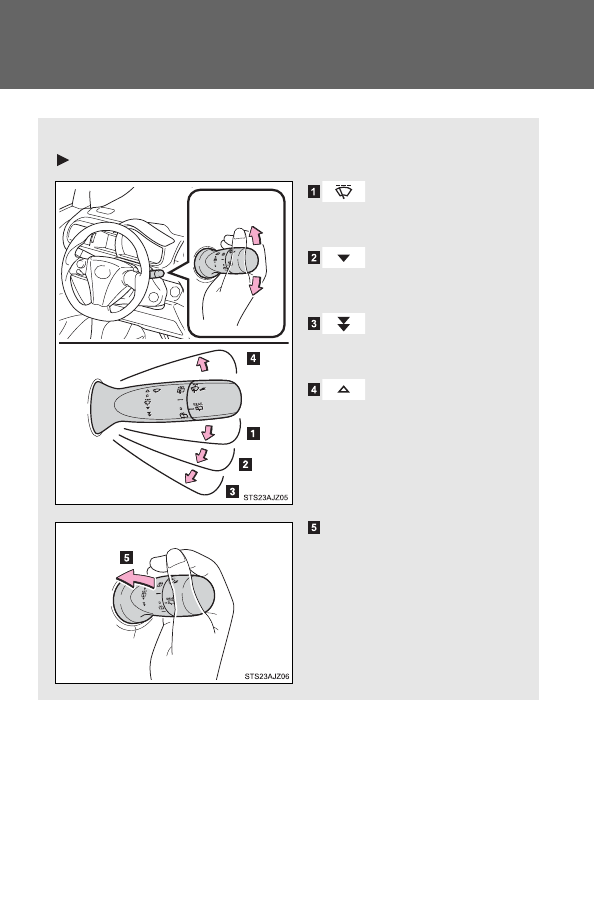
Intermittent wiper

Type A

Intermittent wind-
shield wiper opera-
tion

Low speed wind-
shield wiper opera-
tion

High speed wind-
shield wiper opera-
tion

Temporary operation

Washer/wiper dual opera-
tion

Wipers will automatically oper-
ate a couple of times after the
washer squirts. 

-------------------------------------------------------------------------------------------------------------------------------------------------------------

137

2-3. Operating the lights and wipers

2

Wh

en drivin

g

The windshield wiper and washer can be operated when

The engine switch must be in the ON position.

If no windshield washer fluid sprays

Check that the washer nozzles are not blocked and if there is washer fluid in
the windshield washer fluid reservoir.

Type B

Intermittent wind-
shield wiper opera-
tion

Low speed wind-
shield wiper opera-
tion

High speed wind-
shield wiper opera-
tion

Temporary operation

Washer/wiper dual opera-
tion

Wipers will automatically oper-
ate a couple of times after the
washer squirts. 

-------------------------------------------------------------------------------------------------------------------------------------------------------------

138

2-3. Operating the lights and wipers

NOTICE

When the windshield is dry

Do not use the wipers, as they may damage the windshield.

When there is no washer fluid spray from the nozzle

Damage to the washer fluid pump may be caused if the lever is pulled
toward you and held continually.

When a nozzle becomes blocked

Do not try to clear it with a pin or other object. The nozzle will be damaged.

-------------------------------------------------------------------------------------------------------------------------------------------------------------

139

2-3. Operating the lights and wipers

2

Wh

en drivin

g

Rear window wiper and washer

Type A

Normal window wiper
operation

Washer/wiper dual
operation

Washer operation

-------------------------------------------------------------------------------------------------------------------------------------------------------------

140

2-3. Operating the lights and wipers

The rear window wiper and washer can be operated when

The engine switch must be in the ON position.

NOTICE

When the rear window is dry

Do not use the wipers, as they may damage the rear window.

Type B

Normal window wiper
operation

Washer/wiper dual
operation

Washer operation

-------------------------------------------------------------------------------------------------------------------------------------------------------------

141

2

Wh

en drivin

g

2-4. Using other driving systems

Driving assist systems

To help enhance driving safety and performance, the following sys-

tems operate automatically in response to various driving situations.

Be aware, however, that these systems are supplementary and

should not be relied upon too heavily when operating the vehicle.

ABS (Anti-lock Brake System)

Helps to prevent wheel lock when the brakes are applied suddenly, or if
the brakes are applied while driving on a slippery road surface.

Brake Assist

Generates an increased level of braking force after the brake pedal is
depressed, when the system detects a panic stop situation.

VSC (Vehicle Stability Control)

Helps the driver to control skidding when swerving suddenly or turning
on slippery road surfaces.

TRAC (Traction Control)

Maintains drive power and prevents the front wheels from spinning
when starting the vehicle or accelerating on slippery roads.

EPS (Electric Power Steering)

Employs an electric motor to reduce the amount of effort needed to turn
the steering wheel.

Enhanced VSC (Enhanced vehicle stability control)

Provides cooperative control of the ABS, TRAC, VSC and EPS. 
Helps to maintain directional stability when swerving on slippery road
surfaces by controlling steering performance.

-------------------------------------------------------------------------------------------------------------------------------------------------------------

142

2-4. Using other driving systems

When the TRAC/VSC systems are operating

The slip indicator will flash while
the TRAC/VSC systems are
operating.

To disable TRAC and/or VSC systems

If the vehicle gets stuck in fresh snow or mud, TRAC and VSC sys-
tems may reduce power from the engine to the wheels. You may
need to turn the system off to enable you to rock the vehicle in order
to free it.

Turning off TRAC

To turn the TRAC system off,
quickly press and release the
button.

The TRAC OFF indicator will
come on.

Press the button again to turn the
system back on.

-------------------------------------------------------------------------------------------------------------------------------------------------------------

143

2-4. Using other driving systems

2

Wh

en drivin

g

Turning off TRAC and VSC systems

Press and hold the button for
more than 3 seconds while the
vehicle is stopped to turn off both
TRAC and VSC systems.

The TRAC OFF and VSC OFF
indicators will come on.

Press the button again to turn
both systems back on.

When the TRAC OFF indicator comes on even if the VSC OFF switch
has not been pressed

TRAC system cannot be operated. Contact your Scion dealer.

Sounds and vibrations caused by the ABS, TRAC, VSC and brake
assist system

A sound may be heard from the engine compartment when the engine is
started or just after the vehicle begins to move. This sound does not indi-
cate that a malfunction has occurred in any of these systems.

Any of the following conditions may occur when the above systems are
operating. None of these indicates that a malfunction has occurred.

• Vibrations may be felt through the vehicle body and steering.
• A motor sound may be heard after the vehicle comes to a stop.
• The brake pedal may pulsate slightly after the ABS is activated.
• The brake pedal may move down slightly after the ABS is activated.

Automatic reactivation of TRAC and VSC systems

After turning the TRAC and VSC systems off, the systems will be automati-
cally reactivated in the following situations:

When the engine switch is turned off

If only the TRAC system is turned off, the TRAC will turn on when vehicle
speed increases
If both the TRAC and VSC systems are turned off, automatic reactivation
will not occur when vehicle speed increases.

-------------------------------------------------------------------------------------------------------------------------------------------------------------

144

2-4. Using other driving systems

If the slip indicator comes on

There is a malfunction in the TRAC and VSC systems. Contact your Scion
dealer and have your Scion inspected.

EPS operation sound

When the steering wheel is operated, a motor sound (whirring sound) may
be heard. This does not indicate a malfunction.

Reduced effectiveness of the EPS system

The effectiveness of the EPS system is reduced to prevent the system from
overheating when there is frequent steering input over an extended period of
time. The steering wheel may feel heavy as a result. Should this occur,
refrain from excessive steering input or stop the vehicle and turn the engine
off. The EPS system should return to normal within 10 minutes.

CAUTION

The ABS does not operate effectively when

The limits of tire gripping performance have been exceeded (such as
excessively worn tires on a snow covered road).

The vehicle hydroplanes while driving at high speed on the wet or slick
road.

Stopping distance when the ABS is operating may exceed that of nor-
mal conditions

The ABS is not designed to shorten the vehicle’s stopping distance. Always
maintain a safe distance from the vehicle in front of you, especially in the fol-
lowing situations.

When driving on dirt, gravel or snow-covered roads

When driving with tire chains

When driving over bumps in the road

When driving over roads with potholes or uneven roads

When VSC is activated

The slip indicator flashes. Always drive carefully. Reckless driving may
cause an accident. Exercise particular care when the indicator flashes.

-------------------------------------------------------------------------------------------------------------------------------------------------------------

145

2-4. Using other driving systems

2

Wh

en drivin

g

CAUTION

TRAC may not operate effectively when

Directional control and power may not be achievable while driving on slip-
pery road surfaces, even if TRAC is operating. 
Do not drive the vehicle in conditions where stability and power may be lost.

When TRAC and VSC systems are turned off

Be especially careful and drive at a speed appropriate to the road condi-
tions. As these are systems to help ensure vehicle stability and driving force,
do not turn off TRAC and VSC systems unless necessary.

Replacing tires

Make sure that all tires are of the same size, brand, tread pattern and total
load capacity. In addition, make sure that the tires are inflated to the appro-
priate tire pressure level.

The ABS and VSC systems will not function correctly if different tires are fit-
ted on the vehicle.

Contact your Scion dealer for further information when replacing tires or
wheels.

Handling of tires and suspension

Using tires with any kind of problem or modifying the suspension will affect
the driving assist systems, and may cause the system to malfunction.

-------------------------------------------------------------------------------------------------------------------------------------------------------------

146

2-5. Driving information

Cargo and luggage

Capacity and distribution

Cargo capacity depends on the total weight of the occupants.

(Cargo capacity) = (Total load capacity) 

 (Total weight of occupants)

Steps for Determining Correct Load Limit—

(1) Locate the statement “The combined weight of occupants and

cargo should never exceed XXX kg or XXX lbs.” on your vehicle’s
placard.

(2) Determine the combined weight of the driver and passengers that

will be riding in your vehicle.

(3)Subtract the combined weight of the driver and passengers from

XXX kg or XXX lbs.

(4) The resulting figure equals the available amount of cargo and lug-

gage load capacity.

For example, if the “XXX” amount equals 1400 lbs. and there will
be five 150 lb passengers in your vehicle, the amount of available
cargo and luggage load capacity is 650 lbs. (1400 

 750 (5  150)

= 650 lbs.)

(5) Determine the combined weight of luggage and cargo being

loaded on the vehicle. That weight may not safely exceed the
available cargo and luggage load capacity calculated in Step 4.

Take notice of the following information about storage precau-

tions, cargo capacity and load.

● Stow cargo and luggage in the luggage compartment whenever

possible.

● Be sure all items are secured in place.
● Be careful to keep the vehicle level. Placing the weight as far for-

ward as possible helps maintain vehicle balance.

● For better fuel economy, do not carry unnecessary weight.

-------------------------------------------------------------------------------------------------------------------------------------------------------------

147

2-5. Driving information

2

Wh

en drivin

g

(6) If your vehicle will be towing a trailer, load from your trailer will be

transferred to your vehicle. Consult this manual to determine how
this reduces the available cargo and luggage load capacity of your
vehicle. 

Scion does not recommend towing a trailer with your vehicle. Your
vehicle is not designed for trailer towing.

Calculation formula for your vehicle

Cargo capacity

Total load capacity (vehicle
capacity weight) (

P. 320)

When 2 people with the combined weight of A lb. (kg) are riding in
your vehicle, which has a total load capacity (vehicle capacity weight)
of B lb. (kg), the available amount of cargo and luggage load capacity
will be C lb. (kg) as follows:

B

*

2

 lb. (kg) 

 A

*

1

 lb. (kg) = C

*

3

 lb. (kg)

*

1

: A = Weight of people

*

2

: B = Total load capacity

*

3

: C = Available cargo and luggage load

In this condition, if 2 more passengers with the combined weight of
D lb. (kg) get on, the available cargo and luggage load will be reduced
E lb. (kg) as follows:

C lb. (kg) 

 D

*

4

 lb. (kg) = E

*

5

 lb. (kg)

*

4

: D = Additional weight of people

*

5

: E = Available cargo and luggage load

-------------------------------------------------------------------------------------------------------------------------------------------------------------

148

2-5. Driving information

As shown in the above example, if the number of occupants
increases, the cargo and luggage load will be reduced by an amount
that equals the increased weight due to the additional occupants. In
other words, if an increase in the number of occupants causes an
excess of the total load capacity (combined weight of occupants plus
cargo and luggage load), you must reduce the cargo and luggage on
your vehicle.

CAUTION

Things that must not be carried in the luggage compartment

The following things may cause a fire if loaded in the luggage compart-
ment.

Receptacles containing gasoline

Aerosol cans

Storage precautions

Observe the following precautions. 
Failing to do so may result in death or serious injury.

Stow cargo and luggage in the luggage compartment whenever possi-
ble.

Do not stack cargo and luggage in the luggage compartment higher
than the seatbacks. 
Such items may be thrown about and possibly injure people in the
vehicle in the event of sudden braking or in an accident.

Do not place cargo or luggage in or on the following locations as the
item may get under the brake or accelerator pedal and prevent the
pedals from being depressed properly, block the driver’s vision, or hit
the driver or passengers, causing an accident.

• Driver’s feet
• Front passenger or rear seats (when stacking items)
• Instrument panel
• Dashboard
• Auxiliary box or tray that has no lid

Secure all items in the occupant compartment, as they may shift and
injure someone during emergency braking, sudden swerving or an
accident.

-------------------------------------------------------------------------------------------------------------------------------------------------------------

149

2-5. Driving information

2

Wh

en drivin

g

CAUTION

Storage precautions

Never allow anyone to ride in the luggage compartment. It is not
designed for passengers. They should ride in their seats with their seat
belts properly fastened. Otherwise, they are much more likely to suffer
serious bodily injury, in the event of emergency braking, sudden
swerving or an accident.

Capacity and distribution

Do not exceed the maximum axle weight rating or the total vehicle
weight rating.

Even if the total load of occupant’s weight and the cargo load is less
than the total load capacity, do not apply the load unevenly. Improper
loading may cause deterioration of steering or braking control which
may cause death or serious injury.

-------------------------------------------------------------------------------------------------------------------------------------------------------------

150

2-5. Driving information

Vehicle load limits

Total load capacity and seating capacity

These details are also described on the tire and loading information
label. (

P. 230)

CAUTION

Overloading the vehicle

Do not overload the vehicle. 
It may not only cause damage to the tires, but also degrade steering and
braking ability, resulting in an accident.

Vehicle load limits include total load capacity, seating capacity,

towing capacity and cargo capacity.

Total load capacity (vehicle capacity weight): (

P. 320)

Total load capacity means the combined weight of occupants,
cargo and luggage.

Seating capacity: 4 occupants (Front 2, Rear 2)

Seating capacity means the maximum number of occupants
whose estimated average weight is 150 lb. (68 kg) per person.

Even if the number of occupants are within the seating capacity,
do not exceed the total load capacity.

Towing capacity

Scion does not recommend towing a trailer with your vehicle.

Cargo capacity

Cargo capacity may increase or decrease depending on the
weight and the number of occupants.

-------------------------------------------------------------------------------------------------------------------------------------------------------------

151

2-5. Driving information

2

Wh

en drivin

g

Winter driving tips

Carry out the necessary preparations and inspections before driving

the vehicle in winter. Always drive the vehicle in a manner appropri-

ate to the prevailing weather conditions.

Pre-winter preparations
● Use fluids that are appropriate to the prevailing outside tem-

peratures.

• Engine oil
• Engine coolant
• Washer fluid

● Have the vehicle fitted with four snow tires or purchase a set

of tire chains for the front tires.

Ensure that all tires are the same size and brand, and that chains
match the size of the tires.

Before driving the vehicle

Perform the following according to the driving conditions.

● Do not try to forcibly open a window, scrape an outside rear

view mirror surface or move a wiper or outside rear view mir-
ror that is frozen. Pour warm water over the frozen area to
melt the ice. Wipe away the water immediately to prevent it
from freezing.

● To ensure proper operation of the climate control system fan,

remove any snow that has accumulated on the air inlet vents
in front of the windshield.

● Remove any ice that has accumulated on the vehicle chassis.
● Periodically check for and remove any excess ice or snow

that may have accumulated in the wheel well or on the
brakes.

-------------------------------------------------------------------------------------------------------------------------------------------------------------


Content      ..     6      7      8      9     ..