MG GS. Service Manual - part 15
 

  Index      Manuals     MG GS. Service Manual


Search            copyright infringement  


Content      ..     13      14      15      16     ..


MG GS. Service Manual - part 15


STARTING & DRIVING

1 Off: Function in Off state

2 Standby: Function in Stand by state, it is then activated

when the vehicle is brought to a stop and the brake
pedal is released.

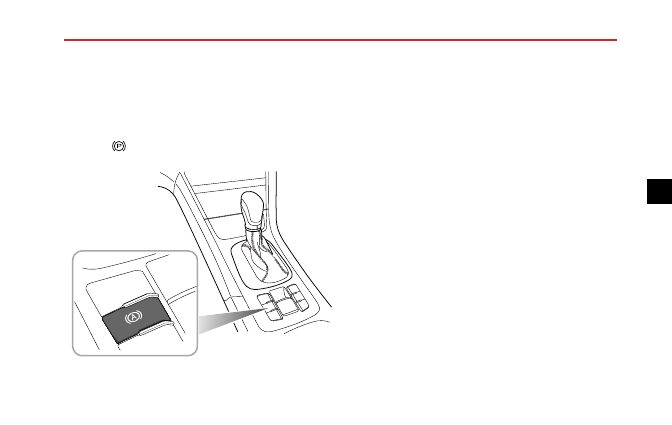
3 Parking: Function in Parked state. In this state the

green

indicator in the instrument pack illuminates.

A

With the driver's seat belt fastened, the door closed and
the engine running, press the auto hold switch to switch
the auto hold function from Off to Standby state.

With the brake pedal firmly pressed and the vehicle
completely stopped, the auto hold function will switch
from the Standby state to the Parking state.

When the auto hold is in the Parking state, engaging D or R
and pressing the accelerator will automatically release the
auto hold function.

With the auto hold in the Parking state, it will result in
the electronic parking brake being applied and the system
exiting the Parking state in some cases (such as removing
the seat belt, stalling or switching off the engine and
stopping for a certain time etc.)

Note: With the brake pressed, press the switch to
switch off the auto hold function, but the electronic
parking brake will not be applied.

Note: It is recommended to turn off the auto hold
function when reversing into the garage.

225

4

-------------------------------------------------------------------------------------------------------------------------------------------------------------

STARTING & DRIVING

Anti-lock Brake System (ABS)

ABS

cannot

overcome

the

physical

limitations of stopping the car in too short
a distance, cornering at too high a speed, or
the danger of aquaplaning, i.e. where a layer
of water prevents adequate contact between
the tyres and the road surface.

The purpose of the anti-lock braking system (ABS) is to
prevent the wheels from locking while braking, thereby
enabling the driver to retain steering control of the car.

The fact that a car is fitted with ABS must never tempt
the driver into taking risks that could affect his/her safety
or that of other road users.

In all cases, it remains

the driver's responsibility to drive within normal safety
margins, having due consideration for prevailing weather
and traffic conditions.

Under normal braking conditions, ABS will not be
activated. However, once the braking force exceeds the
available adhesion between the tires and the road surface,
thereby causing the wheels to lock, ABS will automatically

come into operation. This will be recognisable by a rapid
pulsation felt through the brake pedal.

Braking in an Emergency

DO NOT pump the brake pedal at any time;
this will interrupt the operation of ABS and
may increase the braking distance.

If an emergency situation occurs, the driver should apply
full braking effort even when the road surface is slippery.
ABS will ensure that the wheels do not lock and that the
car is brought to a halt in the shortest possible distance for
the prevailing road surface conditions.

Note: On soft surfaces such as powdery snow, sand
or gravel, the braking distance produced by the ABS
system may be greater than that for a non-ABS system,
even improved steering would be experienced. This is
because the natural action of locked wheels on soft
surfaces is to build up a wedge of material in front of
(or to the side of, if steering) the tyre contact patch.
This effect assists the car to stop when braking or to
change direction when steering.

226

-------------------------------------------------------------------------------------------------------------------------------------------------------------

STARTING & DRIVING

No matter how hard you brake, you are still able to
continue steering the vehicle as normal.

IMPORTANT

ABS can not reliably make up for the driver's
mis-operation or lack of experience.

ABS Malfunction Indicator Lamp

Refer to "Warning Lamps and Indicator Lamps" in
"Instruments and Controls" section.

Note: The normal (non-ABS) braking system remains
fully operational and is not affected by partial or
full loss of ABS. However, the braking distances may
increase.

Electronic Parking Brake (EPB)

In the event of EPB malfunction where EPB
release is not possible, DO NOT tow the
vehicle with all four, or rear wheels in contact
with the road surface. Damage may occur.

In the event of a discharged battery, start
the engine prior to attempting to release the
EPB. Failure to do this may result in damage
to the EPB system.

In the event of EPB malfunction where EPB
release is not possible, please consult an MG
Authorised Repairer in order to carry out an
emergency manual release of the parking
brake.

227

4

-------------------------------------------------------------------------------------------------------------------------------------------------------------

STARTING & DRIVING

Applying the EPB

While the vehicle is stationary, the EPB can be applied.
Ensure the EPB is applied every time the vehicle is left or
parked.

• Pull the EPB switch upward until the indicator in the EPB

switch illuminates.

• Simultaneously, the EPB indicator

will illuminate in

the instrument pack. When the indicator in the EPB

switch and the EPB indicator are illuminated, it indicates
that the EPB is applied.

• If the EPB failure warning lamp

P

in the instrument

pack illuminates, it indicates that a fault has been
detected. Please contact an MG Authorised Repairer
immediately.

Note: An audible motor noise may be heard when
applying or releasing the EPB.

Note:

If the EPB is not used for a long period,

the system may perform an automatic inspection
operation that will emit an audible motor noise when
applied.

228

-------------------------------------------------------------------------------------------------------------------------------------------------------------

STARTING & DRIVING

IMPORTANT

• In the event of a flat battery or power failure it is

not possible to apply or release the EPB. If using
'jump leads' to temporarily supply power please see
'Emergency Starting' in the Emergency Information.

• In the event of a power interruption or flat battery,

the EPB will not operate and the warning lamp will
illuminate. To restore normal operation, press brake
pedal, press EPB switch and then pull EPB switch,
(this may have to be repeated) the warning lamp will
extinguish and normal operation will resume.

Releasing the EPB

• Place the ignition switch in position II, press the brake

pedal, and press the EPB switch.

• If the indicator in the EPB switch and the indicator

in the instrument pack are extinguished, the EPB is

released.

Start Assist

The

EPB

can

predict

the

driver's

intention

and

automatically release the EPB.

If the driver's seat belt is fastened, clutch pedal fully
pressed, forward or reverse gear selected and the clutch
pedal lifted whilst pressing the accelerator, the EPB will
automatically release.

Emergency Braking Function

Inappropriate use of the electric park brake
can lead to accidents and injuries. Do not
apply the electric park brake for vehicle
braking, unless in emergency.

During emergency braking using the EPB, DO
NOT insert or remove the ignition key, this
could result in serious injury.

In the event of normal brake failure, emergency braking
using the EPB can be initiated by pulling and holding the
EPB switch upward.

• If the SCS can respond actively to the request form

the EPB, at speeds in excess of a predetermined limit
the SCS will activate and apply all 4 brakes. At speeds
below the predetermined limit the EPB will only activate
the rear brakes.If the SCS is unable to respond to the

229

4

-------------------------------------------------------------------------------------------------------------------------------------------------------------

STARTING & DRIVING

request from the EPB, then the EPB will only activate
the rear brakes.

• During emergency braking using EPB, a continual audible

warning will sound. To cancel the emergency braking
process, release the EPB switch or press the accelerator.

230

-------------------------------------------------------------------------------------------------------------------------------------------------------------

STARTING & DRIVING

Stability Control System (SCS) and
Traction Control System (TCS)

Stability Control System (SCS)

SCS is designed to assist the driver in control of driving
direction.

The SCS is automatically activated after the

engine is started.

When SCS detects that the vehicle is not moving in the
intended direction, it will intervene by applying brake force
to selected wheels or through the engine management
system to prevent sliding and assist in bringing the car back
to the right direction.

Traction Control System (TCS)

The purpose of electronic traction control is to aid
traction, thereby helping the driver to maintain control
of the car in situations where one or both of the driving
wheels are spinning (for example, if one wheel is on ice
and the other on tarmac). The traction control system
monitors the driving speed of each wheel individually. If
spin is detected on one wheel, the system automatically
brakes that wheel, transferring torque to the opposite,

non-spinning wheel.

If both wheels are spinning, the

system will reduce engine speed in order to regulate wheel
rotation until traction is regained.

Switching On/Off

SCS and TCS are automatically switched to standby when
the ignition switch placed in ON position

231

4

-------------------------------------------------------------------------------------------------------------------------------------------------------------

STARTING & DRIVING

• Briefly press the SCS switch (less than 2 seconds).

TCS is disabled, and the traction control indicator will
illuminate. Traction Control System Off and the TCS
icon will appear in the information centre.

• Press the SCS switch (more than 2 seconds). TCS and

SCS are both disabled. The traction control System
indicator will illuminate and Traction Control Off and
the TCS icon will appear in the information centre,
followed by the message Stability Control System Off
and the SCS icons displayed.

• Briefly press the SCS switch (less than 2 seconds) again,

SCS and TCS will resume, and warning lamps extinguish.

Note:

Disabling SCS and TCS will not affect the

operation of ABS. Always disable TC when driving
with snow chains fitted.

Note: Activation of the SCS/TCS switch in excess of 10
seconds will be regarded as a mis-operation.

Stability Control/Traction Control Warning

Lamps

Refer to "Warning Lamps and Indicator Lamps" in
"Instruments and Controls" section.

232

-------------------------------------------------------------------------------------------------------------------------------------------------------------

STARTING & DRIVING

Tyre Pressure Monitoring System
(TPMS)

*

TPMS can not replace routine maintenance
and checks of the tyre condition and
pressure.

Note: TPMS only warns of low tyre pressures, it does
not re-inflate the tire.

System Operation

The system is controlled by the SCS system,

which constantly monitors the speed of each wheel. If,
during normal driving conditions with the brakes not
applied, the SCS detects that one wheel is rotating faster
than the others, it deduces that the pressure of that tyre
has fallen below the predefined limit of the system. As
a result, the warning light on the instrument pack will
illuminate (always yellow).

Check your tyres at the earliest opportunity and reinflate
to the correct pressures. Refer to ‘Tyre Pressures (Cold)’.

System Malfunction

This system is self-monitoring, if a malfunction is detected,
the TPMS warning lamp (yellow) on the instrument pack
will flash for 90 seconds first and then illuminate.

Note: When a puncture is detected, the system will
require some time to analise information prior to
illuminating the warning lamp.

Under certain conditions the warning light may illuminate
when a fault is not present. these conditions include:

• Driving on icy or wet surfaces.

• Front axle slip or excessive lateral acceleration.

• Snow chains fitted.

• A non recommended tyre fitted (including spare tyre).

• TPMS not reset after tyre replacement.

• TPMS not reset after tyre pressure adjustment.

• Rough terrain driving for excessive periods.

• Bending or mountain type terrain driving for excessive

periods.

• Excessive luggage weight change from when last reset

carried out.

• TPMS will not respond immediately if a tyre 'blows out'.

233

4

-------------------------------------------------------------------------------------------------------------------------------------------------------------

STARTING & DRIVING

Tyre Pressure Monitoring System Reset

If replacement tyres are fitted or tyre pressures changed, a
TPMS reset is required - refer to TPMS reset in Instruments
and Controls.

Note: Inflate tyres to recommended pressures and
check prior to reset.

Note:

Always carry out a TPMS reset after tyre

pressure adjustment.

The TPMS carries out a self

learning process after a reset and therefore may not
react immediately after a reset.

234

-------------------------------------------------------------------------------------------------------------------------------------------------------------

STARTING & DRIVING

Stop/Start —Intelligent Fuel Saving
System

2

3

1

L

O C K

1 Instrument Pack Indicator

2 Main Switch

3 Switch Indicator Lamp

Engine Stop/Start has been incorporated into vehicles in
an effort to reduce emissions. As the name suggests the
system will allow the engine to be switched off when engine
power is not required and then automatically be restarted
when it is.

This system defaults “on” at ignition switch position II, the
switch indication light is on (3 shown in fig ) and can be
turned off by pressing the main switch (2 in the fig). The
lamp in the switch will extinguish.

Note:

If vehicle is driving through deep water,

please use Stop/Start intelligent fuel saving system
main switch (2 in diagram) to shut down Stop/Start
intelligent fuel saving system.

235

4

-------------------------------------------------------------------------------------------------------------------------------------------------------------

STARTING & DRIVING

Automatic Shutdown of Engine

Although the engine is not running after an
automatic stop, the system is prepared to
auto start therefore the following actions
could be dangerous:

1 Leaving the vehicle while the seat belt is

still buckled, or there is a substitute seat
belt buckle inserted.

2 Vehicles with automatic transmission:

Leaving the vehicle while the gear
selector

is

still

in

Drive

position

(R/D/S/W/Tiptronic).

3 Carrying out work or checks in the engine

compartment.

4 Refuelling the vehicle, the ignition must

be switched “OFF” or the key removed
from the switch.

Engine Auto Stop Conditions

Engine Auto Stop Conditions (Under Stop Start Control,
warning lamp on, figure 1 in illustration)

• Vehicle is stationary, i.e. speed =0 mph or km/h.

• The vehicle speed prior to stopping exceeded 6 mph

(10 km/h).

• Gearbox must be in neutral and clutch pedal is released

(manual).

• Transmission

in

Drive

with

footbrake

pressed

(automatic)

• The driver’s door is closed and seat belt is secured.

• The bonnet is closed.

• No demands on the steering (auto only).

Stop/Start Prohibited

Stop Start will not operate if:

• Coolant temperature is below a preset limit (4 segments

on gauge).

• Front defrost is on.

• Battery power is below a preset limit.

• Cabin

temperature

versus

ambient

temperature

difference is more than 5˚C.

• A/C blower speed is set to speed 4 or above in manual

mode.

236

-------------------------------------------------------------------------------------------------------------------------------------------------------------

STARTING & DRIVING

• Temperature Hi - Hi is selected.

• Temperature Lo - Lo is selected.

• The vacuum in the braking system is below a preset

limit.

• Starter motor temperature is above a preset limit.

• Reverse gear selected or has been selected prior to

parking.

• Vehicle is standing at excessive angles (auto only).

Automatic Engine Start

With the engine stopped in the automatic stop/start
condition, the following driver actions will cause an
automatic restart, at this time the instrument pack
indicator lamp is off.

• Models with manual transmission and in Neutral

position: press the clutch pedal or accelerator pedal.

• Models with automatic transmission and in D position:

release the brake pedal, or shift out of Drive position.

With the engine stopped in the automatic stop/start
condition, the following actions will cause an automatic
restart.

• Defrost is selected.

• Battery power falls below a preset limit.

• Cabin temperature falls causing ambient temperature

difference to be more than 5˚C.

• Manual A/C blower speed increased to speed 4 or

above.

• Temperature Hi - Hi is selected.

• Temperature Lo - Lo is selected.

• The vacuum in the braking system falls below a preset

limit.

• The vehicle begins to move.

• The Stop/Start master switch is pressed

At this time the Stop/Start fuel saving system indicator
on the instrument will extinguish to indicate engine start
phase. (1in figure):

Start Inhibition

Note:

When a vehicle fitted with a manual

transmission is under automatic Stop/Start control
and the engine is required to restart, but neutral is
not selected, the engine will restart when neutral is
selected.

237

4

-------------------------------------------------------------------------------------------------------------------------------------------------------------

STARTING & DRIVING

If any of the following conditions occur during automatic
engine stop, the engine can only be restarted using the
key, during this time the instrument pack indicator will
extinguish.

• The driver side seat belt is unbuckled.

• The driver side door is open.

• Bonnet is open.

At this time the Stop/Start fuel saving system indicator
on the instrument will extinguish to indicate engine start
phase.(1 in figure):

Stall Assist

Once Stop/Start intelligent fuel saving system is enabled
without inhibition conditions.

On manual vehicles, if the engine cuts out, or is stalled
whilst Stop/Start is enabled, selection of neutral and
pressing the clutch pedal will automatically restart the
engine.

Note: Extremely low battery power may result in the
engine not re-starting automatically, or even using
the handset key. In this instance, external power is

needed to start the engine or the battery will require
re-charging. See the section ‘Emergency Starting’ in
the ‘Emergency Information’ Chapter.

Battery

When charging the battery, starting the car
with an external power source or supplying
power from the vehicle, the negative cable
must be connected to a suitable position on
the vehicle body. Failure to do this will result
in inaccurate battery power calculation
which

will

effect

automatic

Stop/Start

control.

DO NOT disconnect the battery sensor unless
absolutely necessary. removal will result in
inaccurate battery power calculation which
will effect automatic Stop/Start control.

Note:

Failure to operate within the following

guidelines

will

effect

battery

performance

and

automatic Stop/Start control:

238

-------------------------------------------------------------------------------------------------------------------------------------------------------------

STARTING & DRIVING

1 After power interruptions (battery disconnection)

the

automatic

Stop/Start

function

will

be

suspended until the vehicle is left in a locked state
for at least 4 hours whilst the system relearns the
state of the battery.

2 If the vehicle is run continually for more than 100

hours uninterrupted, the Stop/Start function will
be suspended until the vehicle is left in a locked
state for at least 4 hours whilst the system relearns
the state of the battery.

3 If the battery requires replacement, ALWAYS use a

genuine part to the manufacturers specification.

Failure to adhere to this can affect the automatic
Stop/Start system.

Stop/Start Intelligent Fuel Saving System
Failure

In the event of a Stop/Start Intelligent Fuel Saving System
failure, contact an MG Authorised Repairer.

The Stop/Start Intelligent Fuel Saving System can be
effected by faults within other vehicle systems - in the
event of failure contact an Authorised MG Repairer.

Starter

Inoperative,

Serious

Battery

Capacity Loss

In the case of serious battery power loss, automatic
Stop/Start and key start may not be possible. In this case
refer to the Emergency Information chapter, Emergency
Starting section for further details.

239

4

-------------------------------------------------------------------------------------------------------------------------------------------------------------

STARTING & DRIVING

Cruise Control System

SE

T

OFF

ON

RE

SU

ME

CAN

CE

L

• Acceleration (1)

• Deceleration (2)

• Cruise Cancel (3)

• Cruise Standby (4)

• Cruise Resume (5)

• Cruise Set (6)

• ASL In Standby (7)

Cruise control enables the driver to maintain a constant
road speed without using the accelerator pedal.

This

is particularly useful for motorway cruising, or for any
journey where a constant speed can be maintained for a
lengthy period.

Cruise Control System Activation

Cruise control system is operated with a lever located, at
the left side of the steering wheel underneath the lighting
stalk switch.

With the ignition switch in position II, if the lever switch
is in the 'ASL Standby' position (7 in figure), then the
cruise control is OFF. To set the cruise control to 'Standby'
pull the lever switch to 'Cruise Standby' (4 in figure), the
green indicator lamp in the instrument pack will illuminate
indicating the system is in 'Cruise Standby' mode.

With the system in 'Standby' when the current vehicle
speed is above 25mph (40km/h),(the operating range is 25 -
125mph (40 - 200 km/h) press the 'Set' button (6 in figure).
The indicator in the instrument pack will change to yellow
and the cruise control will enter and activated state.

The target speed of the cruise system will be set at the
current speed, and the cruise system will take effect. At

240

-------------------------------------------------------------------------------------------------------------------------------------------------------------


Content      ..     13      14      15      16     ..