HUAWEI OptiX OSN 8800 T64/T32 Intelligent Optical Transport Platform. Product Description - part 2
2.1 Positioning
The OptiX OSN 8800 T32 and OptiX OSN 8800 T64 are mainly applicable to the backbone
core layers. They are also applicable to the core layers and metropolitan convergence layers.
The OptiX OSN 8800 T32 and OptiX OSN 8800 T64 can be used with the metropolitan DWDM
equipment, SDH equipment, and data communication equipment at the backbone layer to
provide a large-capacity transport channel for services and network egresses. The OptiX OSN
8800 T32 and OptiX OSN 8800 T64 apply to the long-distance and large-capacity transmission
of nation-level trunk and inter-province trunk to maximally meet the requirements of large-
capacity and ultra-long haul transmission for carriers. In addition, the OptiX OSN 8800 T32 and
OptiX OSN 8800 T64 provide carriers with a stable platform for multi-service operation and
future network capacity expansion.
The OptiX OSN 8800 T32 and OptiX OSN 8800 T64 use dense wavelength division
multiplexing (DWDM) technologies to achieve transparent transmission with multiple services
and large capacity. It not only provides service grooming at the optical layer on a wavelength
basis by using the ROADM technology, but also provides sub-wavelength grooming based on
ODUflex/ODU3/ODU2/ODU1/ODU0. This improves the flexibility in service grooming and
bandwidth utilization to a great extent.
The OptiX OSN 8800 can interconnect with the OptiX OSN 6800/OptiX OSN 3800/OptiX OSN
1800 to form an end-to-end OTN network. Also, they can interconnect with the OptiX BWS
1600G to form a WDM network. Typically, the OptiX OSN 8800 is applied to the OTN network.
In addition, the OptiX OSN 8800 can interconnect with the NG SDH/PTN or data
communication equipment to form a hybrid network, realizing a complete transport solution.
This is usually applied to the OCS network. Figure 2-1 and Figure 2-2 show the position of the
OptiX OSN 8800 T32 and OptiX OSN 8800 T64 in the overall network hierarchy.
4
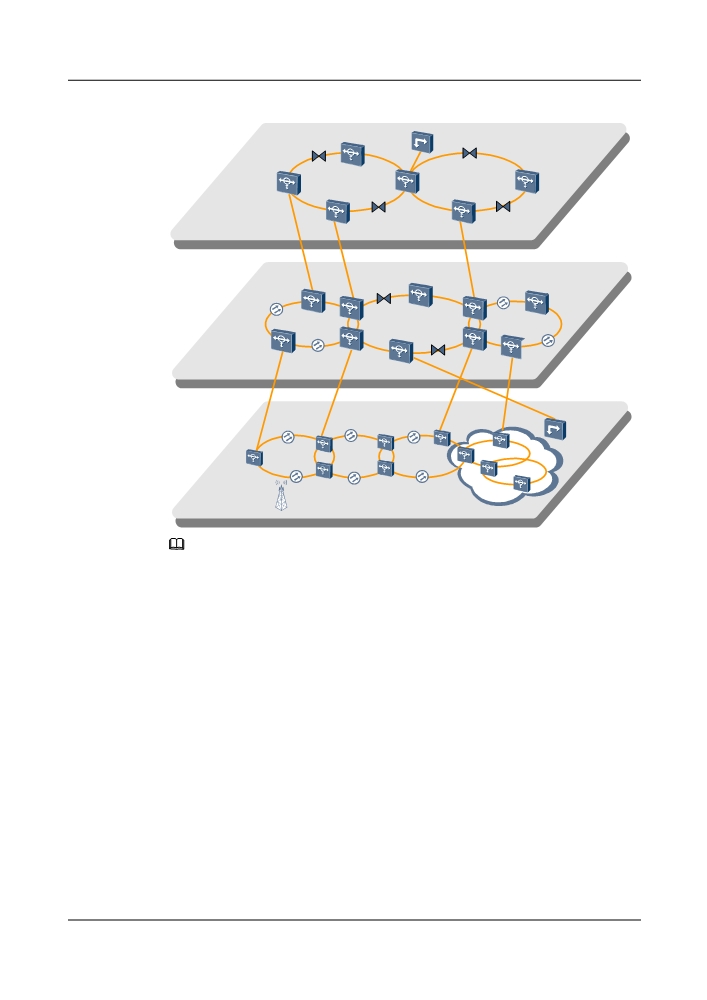
Figure 2-1 Position of the OptiX OSN 8800 in the network hierarchy (OTN network)
OptiX OSN
OptiX
8800 T32
BWS 1600G
OptiX OSN
8800 T32
OptiX OSN
80-wavelengths
80-wavelengths
8800 T64
OptiX OSN
8800 T64
Backbones
OptiX OSN
OptiX OSN
8800 T64
8800 T64
core layers
OptiX OSN
OptiX OSN
6800
OptiX OSN
OptiX Metro
OptiX OSN
8800 T32
3500
6100
7500
40-wavelengths
STM-16
STM-64
OptiX OSN
3500
OptiX Metro
OptiX OSN
Convergence
OptiX OSN
6100
OptiX OSN
8800 T32
layers
8800 T16
7500
OptiX OSN
OptiX OSN
OptiX OSN
OptiXOSN
3500
3800
3800
1800
STM-16
STM-4
STM-4/1
STM-4/1
STM-4/1
OptiX OSN
OptiX OSN
3500
OptiX OSN
OptiX OSN
3800
3500
3800
Access
OptiX OSN
7500
layers
NOTE
The OptiX OSN 8800 provides OptiX OSN 8800 T64 subracks, OptiX OSN 8800 T32 subracks and OptiX
OSN 8800 T16 subracks.
5
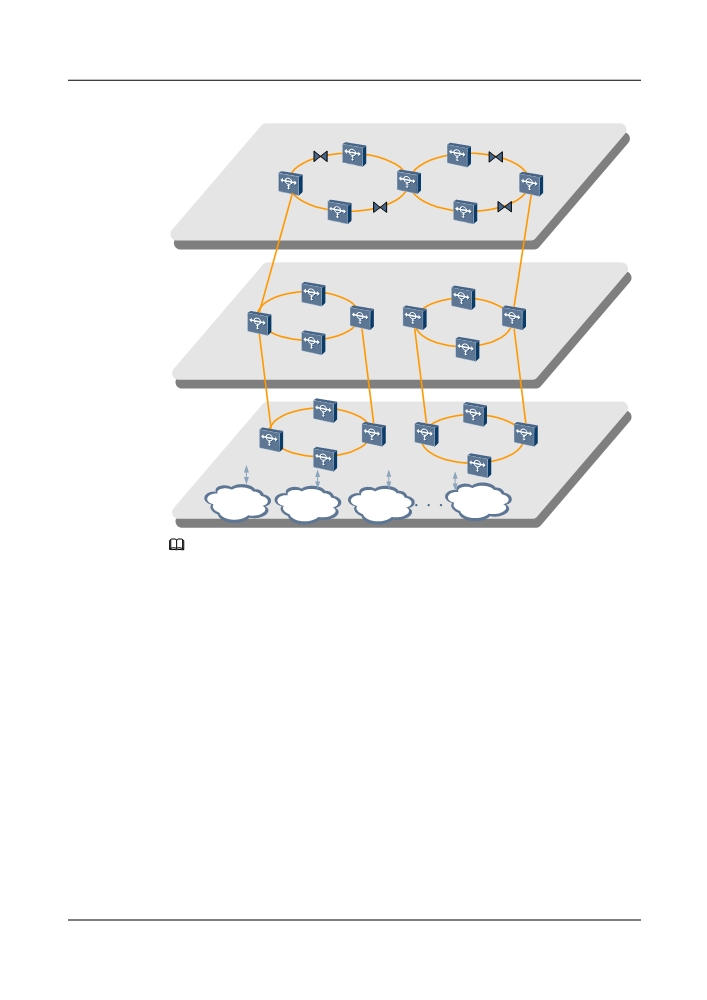
Figure 2-2 Position of the OptiX OSN 8800 in the network hierarchy (OCS network)
OptiX OSN
OptiX OSN
8800 T64
8800 T32
OptiX OSN
8800 T64
OptiX OSN
STM-64
STM-64
8800 T32
OptiX OSN
8800 T64
OptiX OSN
OptiX OS
Backbones
8800 T64
8800 T32
core layers
OptiX OSN 2500
OptiX OSN 3500
OptiX OSN
OptiX OSN
2500
OptiX OSN
3500
3500
STM-16
STM-16
OptiX OSN
2500
OptiX OSN 2500
OptiX OSN 3500
Convergence
layers
OptiX OSN
OptiX OSN
1500
OptiX OSN
2500
2500
STM-4/1
OptiX OSN
STM-4/1
2500
OptiX OSN
OptiX OSN
1500
1500
OptiX OSN
OptiX OSN
2500
1500
GSM/CDMA
PSTN
Ethernet
ATM
Access
layers
NOTE
The OptiX OSN 8800 provides OptiX OSN 8800 T64 subracks and OptiX OSN 8800 T32 subracks.
2.2 Product Features
As a one-box product (OTN+OCS), the equipment integrates functions such as WDM
transport, ROADM, 40G, electrical T-bit cross-connection, cross-connections of any granularity
in the range of 100M to 40G, ASON, and rich management and protection.
Transmission Equipment with High Integration and Ultra Capacity
The equipment is of high integration, which enables flexible service configuration. A network
built with the equipment is easy to design, to expand, and to maintain, and requires a smaller
number of spare parts.
The equipment supports access of massive services and centralized cross-connections and
management of the services. This avoids assembly of multiple subracks. The equipment is of
high integration. For example, one PID chip is integrated with tens of photoelectric components
to achieve 12 x 10G transmission.
When used as an 80/40-channel system, the OptiX OSN 8800 supports:
6
l Service access over one channel of 2.5 Gbit/s, 10 Gbit/s, 40 Gbit/s.
l Transmission of 10 Gbit/s services over a distance of 5000 km, 40 Gbit/s services over a
distance of 2000 km without electrical regeneration.
l Ultra long-haul transmission of 10 Gbit/s services over a 1 x 82 dB single span.
The OptiX OSN 8800 CWDM systems support service access over eight wavelengths. Each
wavelength supports a maximum rate of 2.5 Gbit/s.
The ASIC and PID technologies enable design of a board with high density and help reduce
power consumption of each port. Ultra cross-connections help reduce bridging at many ODF
and also save space in telecommunications rooms.
The OptiX OSN 8800 T32 supports centralized cross-connections through a cross-connect
board. The OptiX OSN 8800 T32 provides one type of cross-connection boards, that is, XCH.
It supports hybrid cross-connections of ODU0, ODU1, ODU2, ODU3, and ODUflex signals,
and supports a 1.28 Tbit/s cross-connect capacity to the maximum.
The OptiX OSN 8800 T64 provides three types of cross-connect boards, that is, XCT, SXH and
SXM. The XCT must be used together with SXH or SXM. The OptiX OSN 8800 T64 supports
hybrid cross-connections of ODU0, ODU1, ODU2, ODU3, and ODUflex signals, and supports
a 2.56 Tbit/s cross-connect capacity to the maximum.
Dynamic Optical-Layer Cross-Connections
Dynamic intra-ring grooming and inter-ring grooming can be realized using the ROADM board.
Dynamic optical layer grooming can be classified into intra-ring grooming and inter-ring
grooming, or into two-dimensional grooming and multi-dimensional grooming.
Dimension refers to transmission direction. Two-dimensional grooming refers to wavelength
grooming in two transmission directions. Multi-dimensional grooming refers to wavelength
grooming in multiple transmission directions.
Full Service Access over Shared 10G and 40G Channels
The ODUk sub-wavelengths can be flexibly combined to share 10G/40G line bandwidth for
transmission. This enables uniform carrying of any services over one wavelength and therefore
improves wavelength utilization to a great extent.
Bandwidth is tailored for services. This improves the efficiency of transmission bandwidth and
achieves "zero waste" of bandwidth.
Hybrid O/E Cross-Connections and Quick Service Deployment
Hybrid O/E cross-connections achieve flexible cross-connections of wavelength or sub-
wavelength services. Quick service deployment helps reduce CapEx. On a flattened network,
services are easy to plan, deploy, and expand. Much less time needs to be taken to provision a
service.
High Reliability
The tributary/line separated structure maximizes the return on investment and reduces the
number of spare parts. When service type changes, users only need to replace the tributary boards
but fully reuse the existing line boards. The use of independent line and tributary boards reduces
7

the number and type of spare parts from N x M to N + M (N, M > 2), thereby helping operators
reduce construction costs.
Rich OAM, Easy Maintenance, and Lower OpEx
The rich O/E overhead information on OTN equipment leads to a more transparent network,
facilitates fault identification, and helps reduce maintenance costs.
The PRBS function enables quick self-check of OTUs, quick assessment of channel
performance, and quick fault identification.
The "5A" auto-adjustment function:
l Automatic level control (ALC) function effectively resolves the problem of attenuation of
fibers operating over a long term.
l Automatic gain control (AGC) enables adaptation to transient changes in the number of
wavelengths.
l Automatic power equilibrium (APE) enables auto-optimization of OSNR specification of
each channel.
l Intelligent power adjustment (IPA) avoids personal injuries (to eyes or bodies) resulting
from laser radiation in case of anomalies such as a fiber cut.
l The optical power adjust (OPA) is made to ensure that the input power of the OTU board
and OA board meet the commissioning requirements.
Support monitor channel power, central wavelength, OSNR, and overall optical spectrum, and
also supports remote real-time measurement of optical spectrum parameters.
2.3 Service Access
The OptiX OSN 8800 T64/8800 T32 supports synchronous digital hierarchy (SDH) service,
synchronous optical network (SONET), Ethernet service, storage area network (SAN) service,
optical transmission network (OTN) service, video service and others.
2.3.1 Service Types
The OptiX OSN 8800 supports synchronous digital hierarchy (SDH) services, synchronous
optical network (SONET) services, Ethernet services, storage area network (SAN) services,
optical transmission network (OTN) services, and video services.
Table 2-1 and Table 2-2 lists the service types and rates that the OptiX OSN 8800 supports.
Table 2-1 Service types and rates that the OptiX OSN 8800 supports
Service
Service Type
Service Rate
Reference Standard
Category
SDH
STM-1
155.52 Mbit/s
ITU-T G.707
ITU-T G.691
STM-4
622.08 Mbit/s
ITU-T G.957
STM-16
2.5 Gbit/s
ITU-T G.693
STM-64
9.95 Gbit/s
ITU-T G.783
ITU-T G.825
8

Service
Service Type
Service Rate
Reference Standard
Category
STM-256
39.81 Gbit/s
SONET
OC-3
155.52 Mbit/s
GR-253-CORE
GR-1377-CORE
OC-12
622.08 Mbit/s
ANSI T1.105
OC-48
2.5 Gbit/s
OC-192
9.95 Gbit/s
OC-768
39.81 Gbit/s
Ethernet
FE
125 Mbit/s
IEEE 802.3u
service
GE
1.25 Gbit/s
IEEE 802.3z
10GE WAN
9.95 Gbit/s
IEEE 802.3ae
10GE LAN
10.31 Gbit/s
SAN service
ESCON
200 Mbit/s
ANSI X3.296
ANSI X3.230
FICON
1.06 Gbit/s
ANSI X3.303
FICON Express
2.12 Gbit/s
FC100
1.06 Gbit/s
FC200
2.12 Gbit/s
FC400
4.25 Gbit/s
FC800
8.5 Gbit/s
FC1200
10.51 Gbit/s
FICON4G
4.25 Gbit/s
FICON8G
8.5 Gbit/s
ISC 1G
1.06 Gbit/s
IBM GDPS
( Geographically
ISC 2G
2.12 Gbit/s
Dispersed Parallel
Sysplex) Protocol
ETR
16 Mbit/s
CLO
16 Mbit/s
InfiniBand 2.5G
2.5 Gbit/s
InfiniBand TM
Architecture Release
InfiniBand 5G
5 Gbit/s
1.2.1
FDDI
125 Mbit/s
ISO 9314
OTN service
OTU1
2.67 Gbit/s
ITU-T G.709
ITU-T G.959.1
OTU2
10.71 Gbit/s
9

Service
Service Type
Service Rate
Reference Standard
Category
OTU2e
11.10 Gbit/s
OTU3
43.02 Gbit/s
Video service
HD-SDI
1.485 Gbit/s
SMPTE 292M
DVB-ASI
270 Mbit/s
EN 50083-9
SDI
270 Mbit/s
SMPTE 259M
3G-SDI
2.97 Gbit/s
SMPTE 424M
Table 2-2 Service types that the OptiX OSN 8800(OCS) supports
Service Category
Service Type
Reference Standard
SDH
l SDH standard services: STM-1/
l ITU-T G.707
STM-4/STM-16/STM-64
l ITU-T G.691
l SDH standard cascaded services:
l ITU-T G.957
VC-4-4c/VC-4-16c/VC-4-64c
l ITU-T G.783
l SDH services with FEC:
STM-64
l ITU-T G.825
Ethernet service
l GE services
l IEEE 802.3u
l 10GE services
2.3.2 Capability of Service Access
Table 2-3 lists the capability of service access when the OptiX OSN 8800 T64/8800 T32
functions as the equipment in the OCS system. Table 2-4 lists the capability of service access
when the OptiX OSN 8800 T64/8800 T32 functions as the equipment in the OTN system.
Table 2-3 Capability of service access in the OCS system
Service Type
Maximum of
Maximum of
Maximum of
Service Amount
Service Amount
Service Amount
for a Board
for an 8800 T32
for an 8800 T64
Subrack
Subrack
STM-1
16
512
1024
STM-4
16
512
1024
STM-16
8
256
512
STM-64
4
128
256
GE
16
512
1024
10

Table 2-4 Capability of service access in the OTN system
Service Type
Maximum of
Maximum of
Maximum of
Service Amount
Service Amount
Service Amount
for a Board
for an 8800 T32
for an 8800 T64
Subrack
Subrack
FE
22
448
896
GE
22
336
672
10GE LAN
4
64
128
10GE WAN
4
64
128
STM-256/OC-768
1
16
32
STM-64/OC-192
4
64
128
STM-16/OC-48
16
256
512
STM-4/OC-12
16
400
816
STM-1/OC-3
16
448
896
OTU1
16
256
512
OTU2/OTU2e
4
64
128
OTU3
1
16
32
ESCON
16
448
896
FC100/FICON
16
336
672
FC200/FICON
16
336
672
Express/InfiniBand
2.5G
FC400/FICON4G/
2
64
128
InfiniBand 5G
FC800/FICON 8G
1
100
204
FC1200
1
32
64
ISC 1G
8
256
512
ISC 2G
4
128
256
ETR/CLO
8
128
256
HD-SDI
8
256
512
FDDI
8
256
512
DVB-ASI/SDI
16
448
896
3G-SDI
8
256
512
11
3
Networking and Applications
About This Chapter
The OptiX OSN 8800 T32 and OptiX OSN 8800 T64 support the point-to-point networking,
chain networking, ring networking, and mesh networking. It can be networked with other
WDM and SDH equipment to realize a complete transport solution.
3.1 Basic Networking Modes
The OptiX OSN 8800 supports point-to-point networking, chain networking, ring networking,
and mesh networking. It can be networked with other WDM and SDH or SONET equipment to
realize a complete transport solution.
3.2 Typical OTN Networking
The OptiX OSN 8800 can be jointly used not only with the OptiX OSN 6800 or OptiX OSN
3800 to form a complete OTN end-to-end network, but also with the OptiX BWS 1600G or
OptiX Metro 6100 to form a WDM network. The OTN or WDM network is then used to transmit
the services from the NG SDH/PTN or data communication equipment. In this manner, the OptiX
OSN 8800 T32 and OptiX OSN 8800 T64 implement a complete transport solution.
3.3 Typical OCS Networking
12
3.1 Basic Networking Modes
The OptiX OSN 8800 supports point-to-point networking, chain networking, ring networking,
and mesh networking. It can be networked with other WDM and SDH or SONET equipment to
realize a complete transport solution.
Different networking modes are applied to different application scenarios. You need to select
the required networking mode according to the service requirements.
Point-to-Point Network
A point-to-point network is the basic application. It is used for end-to-end service transmission.
The other networking modes are based on point-to-point networking mode, which is the basic
network. A point-to-point network is generally used to transmit common voice services, private
line data services, and storage services.
Chain Network
The chain network with OADM(s) is suitable for a scenario where wavelengths need to be added/
dropped and passed through. A chain network has similar service types as a point-to-point
network, but the chain network is more flexible than the point-to-point network. It can be
applicable not only to the point-to-point service but also applicable to the convergence service
and broadcast service dedicated for simple networking.
Ring Network
Network security and reliability are key factors that indicate the quality of the services provided
by network operators. Because of the high survivability, ring network is a dominant networking
mode in MAN DWDM network planning. The ring network has the widest application range.
It can be applicable to the point-to-point service, convergence service, and broadcast service. It
can diversify into complex network structures such as tangent rings, intersecting rings, and ring
with chain.
Mesh Network
A large number of nodes are connected by straight routes on a mesh network. Mesh networks
have no node bottleneck and ensure unblocked services through alternative routes during
equipment failure. In a mesh network, more than one route is available between two nodes. Thus,
the mesh network has high service transmission reliability, and the mesh topology is a
mainstream networking mode for ASON networks. The mesh networking features flexibility
and scalability. It is widely used in ASON networks.
3.2 Typical OTN Networking
The OptiX OSN 8800 can be jointly used not only with the OptiX OSN 6800 or OptiX OSN
3800 to form a complete OTN end-to-end network, but also with the OptiX BWS 1600G or
OptiX Metro 6100 to form a WDM network. The OTN or WDM network is then used to transmit
the services from the NG SDH/PTN or data communication equipment. In this manner, the OptiX
OSN 8800 T32 and OptiX OSN 8800 T64 implement a complete transport solution.
13
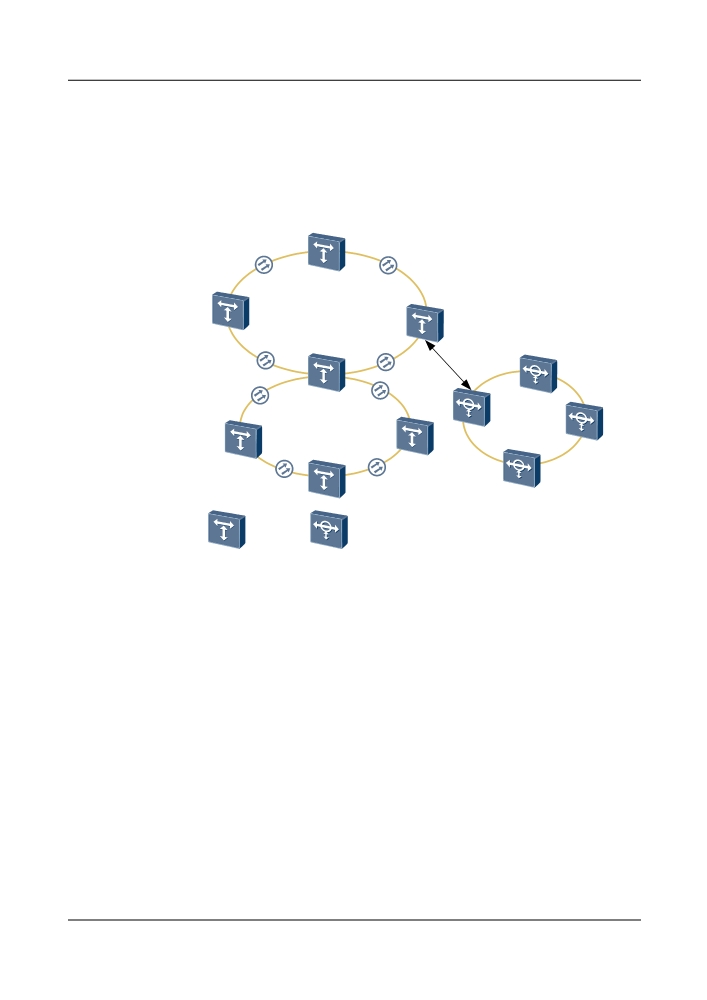
Typical OTN Networking
When working with the OptiX OSN 6800, the OptiX OSN 8800 T32 and OptiX OSN 8800
T64 can form an OTN network or a DWDM ring to transport or add/drop services on the WDM
line. Figure 3-1 shows the typical OTN networking.
Figure 3-1 Typical OTN networking
OptiX OSN
8800 T16
OptiX OSN
6800
OptiX OSN
DWDM Ring
8800 T32
OptiX OSN
OptiX OSN
Interconnection
8800 T64
3500
at client side
OptiX OSN
3500
OptiX OSN
SDH Ring
OptiX OSN
DWDM Ring
6800
OptiX OSN
6800
OptiX OSN
3500
6800
OptiX OSN
3500
:OADM
:ADM
3.2.1 WSS Grooming Solution
ROADM in wavelength selective switch (WSS) mode is applicable to intra-ring grooming and
inter-ring grooming.
At a network node, ROADM in WSS mode can freely change the add/drop status or pass-through
status of a wavelength, and does not interrupt a service in the change process. ROADM can work
with tunable lasers to flexibly groom wavelengths.
WSS enables output of any wavelength through any port. A port in WSS mode can be used as
either a port for local wavelength adding or dropping or a multi-directional MS port. WSS can
work with WSS or a coupler to build ROADM, as shown in Figure 3-2.
14