Национальный доклад «Молодежь Казахстана – 2014» - часть 12


  Главная      Учебники - Разные     Национальный доклад «Молодежь Казахстана – 2014»


поиск по сайту            правообладателям  


содержание      ..     10      11      12      13     ..


Национальный доклад «Молодежь Казахстана – 2014» - часть 12


-------------------------------------------------------------------------------------------------------------------------------------------------------------
Scientific-Research
National Report
Center "Youth"
«Youth of Kazakhstan - 2014»
189
youth age groups, which are based on the extent of
28 age group - 19.2% and 18.7% respectively (Fig. 1.6b).
involvement in socio-economic relations and psycho-
At the beginning of 2014, 1,149,757 young men and
physiological features. The most common is the
1,208,965 young women resided in the cities of the
approach, according to which young people can be
country, which constituted 26.8% and 28.2% of the total
young people in the country, respectively.
divided into 3 age groups: juvenile - 14-18 years old;
The increase of young people in cities of Kazakhstan
post-juvenile - 19-23 years old; and an older group - 24-
is related to educational and employment strategies of
28 years old.
school, college and university graduates.
At present, the older age group is the biggest in the
structure of the Kazakhstan youth (Fig. 1.5).
Significant disparities in the number of young people
Fig. 1.6
in age groups is associated with the birth rate increase in
the second half of the 1980s and gradual decline due to
Youth gender distribution of the Republic
the socio-economic crisis in the 1990s (Fig.1.5b, Fig.1.5c).
of Kazakhstan at the beginning of 2014,
% out of total youth population
1.2. SEX-AGE STRUCTURE OF YOUTH
Gender distribution of population aged 14-29 shows
50.23%
49.77%
that there are slightly more males. Young population
Males
Females
of the country consists of 2,156,754 males and 2,136,599
females (Fig. 1.6).
Source: the Statistics Committee
The largest number of women and men are in the 24-
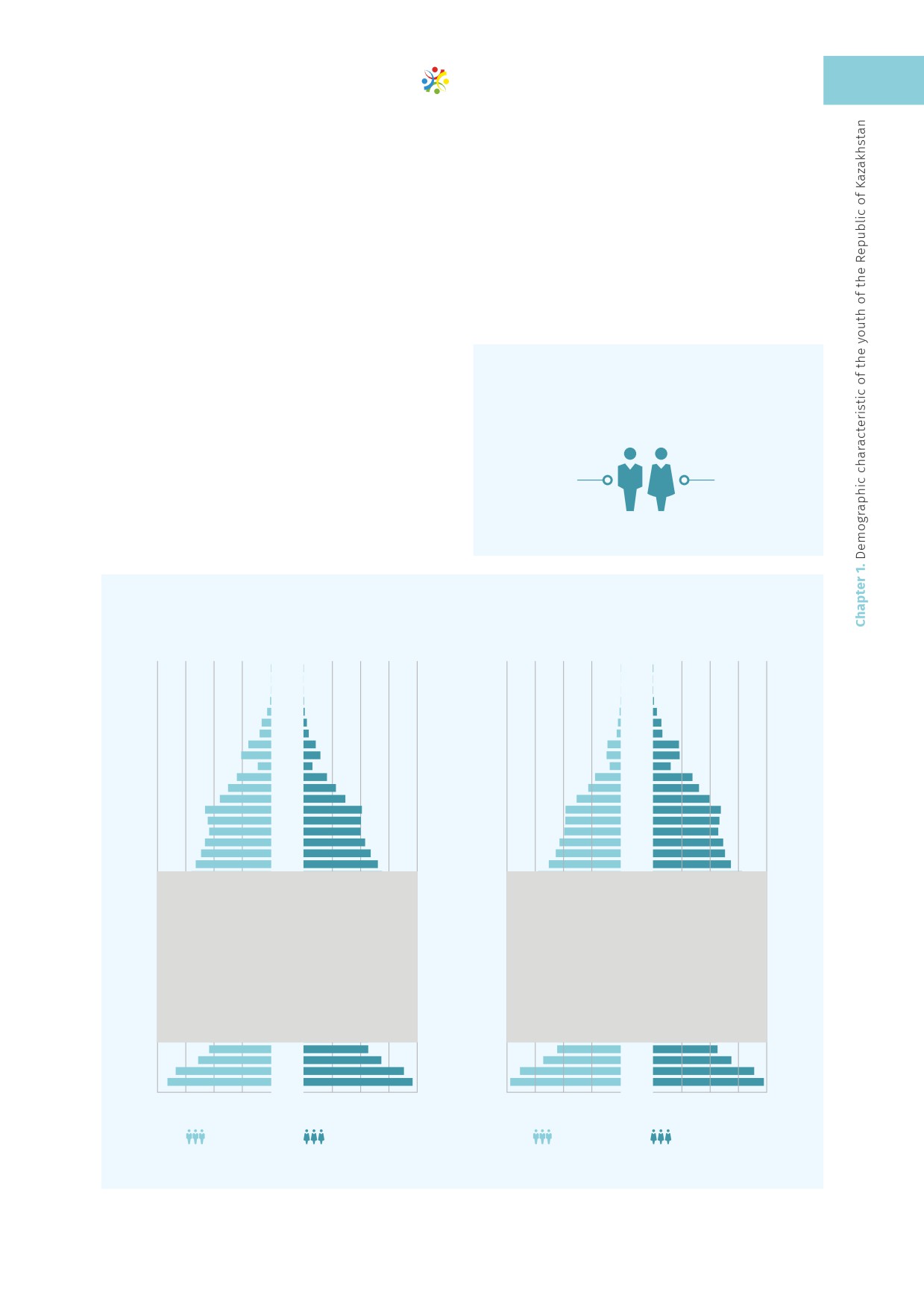
Fig. 1.5c
Population by age and gender at the end of 2012, 2013
At the end of 2012
At the end of 2013
100+
100+
99
99
96
96
92
92
88
88
84
84
80
80
76
76
72
72
68
68
64
64
60
60
56
56
52
52
48
48
44
44
40
40
36
36
32
32
12
12
8
8
4
4
0
0
200
150
100
50
0
0
50
100
150
200
200
150
100
50
0
0
50
100
150
200
Population, thousand
Males
Females
Males
Females
Source: the Statistics Committee

-------------------------------------------------------------------------------------------------------------------------------------------------------------

National Report
Scientific-Research
190
«Youth of Kazakhstan - 2014»
Center "Youth"
Fig. 1.7
Fig. 1.8b
Demographic structure of youth, people,
Youth age-specific fertility rates
at the beginning of 2014
per 1,000 women in 2013
804,214
822,129
754,956
742,639
19.01
597,584571,831
15-18 years
19-23 years
24-28 years
164.28
141.03
Source:
14-18 years
19-23 years
24-28 years
the Statistics Committee
Males
Females
Source: the Statistics Committee
1.3 BIRTHS, MARRIAGES AND DIVORCES
Fig. 1.9
AMONG YOUTH
Fertility rates of young people by youth age
In general, youth fertility rates are significantly higher
groups and regions (the number of births
than that of other groups of reproductive age (Fig. 1.8a).
per 1,000 women), 2013
The most populous age group of women (24-28 years
old) has the highest fertility rate (164.28 births per 1,000
19.85
122.74
147.32
women) (Fig. 1.8b).
Akmola region
Regionally the highest number of births in the 24-28
17.81
118.99
163.10
Aktobe region
years old age group are in the South Kazakhstan (230.45);
21.94
161.88
179.05
Kyzylorda (216.57) and Zhambyl (209.86) regions.
Almaty region
The smallest number of births in this age group were
31.41
193.27
196.80
recorded in Almaty city (104.27), Kostanay (106.53) and
Atyrau region
East Kazakhstan (130.15) regions (Fig. 1.9).
15.53
104.38
130.15
Fertility rate of rural young women of the country is
East Kazakhstan region
higher than that of urban women in all youth age groups
26.99
195.93
209.86
(Fig. 1.10).
Zhambyl region
The South Kazakhstan region (data for 2013) occupied
16.87
130.64
157.58
West Kazakhstan region
the first place among regions by the youth fertility rate
19.53
115.40
136.63
in rural areas (age group 24-28 years - 241.44 births per
Karaganda region
1,000 women, age group 19-23 years - 237.43 births per
17.29
96.14
106.53
1,000 women).
Kostanay region
13.76
167.82
216.57
Kyzylorda region
30.27
205.90
209.99
Fig. 1.8а
Mangystau region
19.15
113.72
131.84
Age-specific fertility rates
Pavlodar region
per 1,000 women in 2013
16.64
118.24
133.86
North Kazakhstan region
Fertility rates
17.93
217.97
230.45
South Kazakhstan region
158.13157.12
15.91
109.37
153.62
108.13
Astana city
61.02
8.51
53.60
104.27
33.64
Almaty city
14.97
0.77
15-19
20-24
25-29
30-34
35-39
40-44
45-49
15-18 years
Age groups of mothers
19-23 years
Source: the Statistics Committee
24-28 years
Source: the Statistics Committee

-------------------------------------------------------------------------------------------------------------------------------------------------------------

Scientific-Research
National Report
Center "Youth"
«Youth of Kazakhstan - 2014»
191
Fig. 1.10
Fig. 1.11
Marriages, number of people, 2013
Fertility rate by the youth age groups and
urban-rural split (the number of births
Married
per 1,000 women), 2013
Never married
Widows
185.09
176.04
Divorced
151.02
Unknown marital status
116.55
Grooms
<18
101
101
0
0
0
17.93
20.00
18-19
3,612
3,592
2
3
15
15-18 years
19-23 years
24-28 years
20-24
57563
56,705
117
704
37
Urban population
Rural population
25-28
52,986
49,847
142
2,953
44
Source: the Statistics Committee
Brides
<18
1,392
1,390
0
0
2
MARRIAGES
18-19
19,707
19,545
27
36
99
In the country 20-24 and 25-28 years old youth age
groups have the highest marriage percentages (Fig. 1.11).
20-24
79,862
78,087
200
1,471
104
In 2013, the highest number of marriages in Kazakhstan
25-28
33,151
29,617
195
3,308
31
was recorded among youth of the 20-24 age group
(79,862 females and 57,563 males).
Source: the Statistics Committee
DIVORCES
Fig. 1.12а
In 2013, the highest divorce rate in the country was
observed in the 25-28 age group, for both males and
Divorces by age of former spouses, 2013
females (Fig. 1.12a).
Across the regions, the highest number of divorces
was observed in Astana city, Almaty city, Almaty and
Males
8,661
Karaganda regions (Fig. 1.12b).
1.4. MORTALITY AMONG YOUNG ADULTS
3,427
A youth mortality rate is a ratio of the total number
34
of deaths (aged 14-28 years) in the reporting year to the
population, expressed in per mille (‰), i.e. out of 1,000
1
18-19
20-24
25-28
people.
<18
years old
years old
years old
years old
The highest mortality rate in 2013 was observed among
young men of the country - 1.70 ‰. The highest mortality
Females
rate was observed in the older youth age group (24-28
10,839
years) -2.47 ‰. (Fig. 1.13a).
In terms of gender and settlement type the mortality
7,455
rates are higher among rural males (Fig. 1.13b).
By regions the highest rates of mortality are observed
in Akmola (1.75 ‰), North Kazakhstan (1.73 ‰) and East
370
Kazakhstan (1.56 ‰) regions (Fig. 1.13c).
13
In 2013, the main causes of death among young people
<18
18-19
20-24
25-28
were accidents, poisoning and injuries, blood circulation
years old
years old
years old
years old
system diseases and neoplasms (Fig. 1.13d).
Source: the Statistics Committee

-------------------------------------------------------------------------------------------------------------------------------------------------------------

National Report
Scientific-Research
192
«Youth of Kazakhstan - 2014»
Center "Youth"
Fig. 1.12b
Divorces by sex and regions, people, 2013
Males
Females
Akmola region
581
889
Aktobe region
636
914
Almaty region
1,235
1,949
Atyrau region
520
714
East Kazakhstan region
1,081
1,664
Zhambyl region
586
976
West Kazakhstan region
470
729
Karaganda region
1,254
1,946
Kostanay region
827
1,209
Kyzylorda region
382
635
Mangystau region
458
635
Pavlodar region
710
1,110
North Kazakhstan region
439
669
South Kazakhstan region
1,006
1,693
Astana city
653
1,062
Almaty city
1,285
1,883
Source: the Statistics Committee
1.5. EXTERNAL AND
Fig. 1.13а
INTERNAL MIGRATION OF YOUTH
Mortality rates of young people by sex,
Analysis of the external migration of country’s young
per mille
people data show that the peak rates of mobility are
among the 24-28 years old age group, manly females
In total:
(Fig. 1.14).
Males
1.70
0.65
In 2013 a positive balance of youth external migration
Females
was recorded in Mangystau (1,286 people) and Almaty
(1,119 people) regions. A negative balance was recorded
in East Kazakhstan (-574) and North Kazakhstan (-555)
0.79
14-18
0.44
regions, which is caused by migration from the border
1.63
19-23
0.64
regions of Kazakhstan to Russia (Fig. 1.15).
2.47
24-28
0.83
In migration exchange between Kazakhstan and CIS
countries in 2013 the largest number of youth arrival
Source: the Statistics Committee
to our country was recorded in Mangystau (1,223) and
South Kazakhstan (780) regions. The negative balance
According to the survey results, urban youth has more
of external migration was observed in East Kazakhstan
desire to change a place of residence (26.7%).
(-665) and North Kazakhstan (-520) regions (Fig. 1.16).
Youth of Zhambyl (59%), Pavlodar (39%) and Kyzylorda
Kazakhstan had weak migration activity with other
(38%) regions show higher potential of migration
countries. In 9 out of 16 regions a positive balance of
mobility (Fig. 1.19).
external migration was recorded (Fig. 1.17).
Young people of Kazakh ethnicity rarely think about
moving at all. Mostly youth of Russian ethnicity express
MIGRATION SENTIMENT AMONG YOUTH
willingness to move in the event of certain circumstances
(Fig. 1.20a). Youth of other ethnic groups show readiness
The results of the survey show that the majority
and willingness to change place of residence more often.
of young people (55.7%) had no intentions to relocate
Analysis of the aspirations to migrate among young
(Fig. 1.18).

-------------------------------------------------------------------------------------------------------------------------------------------------------------

Scientific-Research
National Report
Center "Youth"
«Youth of Kazakhstan - 2014»
193
Fig. 1.13b
Fig. 1.13d
Mortality rates among age groups, 2013
Mortality rates of youth
(by main groups of death causes,
number of people), 2013
Males
Blood circulation
Femles
system diseases
Urban
Rural
14-18 years
0.61
0.95
0.41
0.46
3,402
331
271
1.47
1.82
19-23 years
0.54
0.78
2.37
2.61
24-28 years
Accidents,
0.82
0.84
Neoplasms
poisoning and injuries
Source: the Statistics Committee
Fig. 1.14
Fig. 1.13c
Immigrants and emigrants among
Youth mortality rates by regions
youth in 2013, %
and age groups, 2013, per mille
Males
Females
0.78
1.81
2.51
1.75
14-18 years
Immigrants
38.4
44.1
Akmola region
19-23 years
17.5
0.45
1.10
1.63
1.13
24-28 years
15.4
41.1
Aktobe region
45.0
Total
0.58
1.34
1.78
1.30
14-18
19-23
24-28
Almaty region
0.56
1.28
1.33
1.09
years
years
years
Atyrau region
36.5
42.0
0.83
1.35
2.26
1.56
22.0
East Kazakhstan region
Emigrants
19.3
35.5
45.1
0.74
1.09
1.85
1.23
Zhambyl region
0.75
0.96
2.03
1.30
Source: the Statistics Committee
West Kazakhstan region
0.60
1.32
2.04
1.39
Karaganda region
people of all age groups revealed a pattern: the older
0.80
1.40
1.96
1.46
the age of young person, the less he/she expresses a
Kostanay region
desire to move (Fig. 1.20b).
0.52
1.22
1.55
1.09
Kyzylorda region
Those respondents who reported a specific
0.85
1.16
1.32
1.13
destination, 77% are set for internal migration. The main
Mangystau region
youth migration flows are directed from rural areas to
0.42
1.22
2.11
1.36
cities, mainly Astana and Almaty cities (Fig. 1.20c).
Pavlodar region
Most often, young people relocate for personal
0.57
1.59
2.81
1.73
reasons (Fig. 1.20d).
North Kazakhstan region
0.61
1.10
1.34
1.01
South Kazakhstan region
***
0.60
0.62
0.83
0.72
Astana city
Thus, according to statistics, every fourth resident of
0.31
0.47
0.75
0.56
the country is a representative of population between
Almaty city
14-29 years old.
The greatest number of people in the youth age
Source: the Statistics Committee
structure of Kazakhstan are in the 24-28 age group. High

-------------------------------------------------------------------------------------------------------------------------------------------------------------

National Report
Scientific-Research
194
«Youth of Kazakhstan - 2014»
Center "Youth"
Fig. 1.15
Fig. 1.17
Balance of external migration (total), 2013
Balance of external migration (other countries)
Positive balance
Positive balance
Negative balance
Negative balance
Akmola region
-333
Akmola region
33
Aktobe region
475
Aktobe region
-6
Almaty region
1,119
Almaty region
735
Atyrau region
106
Atyrau region
106
East Kazakhstan region
-574
East Kazakhstan region
91
Zhambyl region
230
Zhambyl region
-12
West Kazakhstan region
-99
West Kazakhstan region
8
Karaganda region
-259
Karaganda region
-14
Kostanay region
-396
Kostanay region
-47
Kyzylorda region
12
Kyzylorda region
0
Mangystau region
1,286
Mangystau region
63
Pavlodar region
-448
Pavlodar region
-35
North Kazakhstan region
-555
North Kazakhstan region
-35
South Kazakhstan region
784
South Kazakhstan region
4
Astana city
587
Astana city
125
Almaty city
211
Almaty city
85
Source: the Statistics Committee
fertility rates are observed among women of the same
age group.
Fig. 1.18
Share of rural youth is slightly smaller than that of
urban youth.
Willingness of young people to relocate, %
Fig. 1.16
5.42.3
Balance of external migration (CIS countries),
2013
34.3
18.7
Positive balance
Negative balance
Akmola region
587
Aktobe region
481
Almaty region
735
21.4
Atyrau region
103
17.9
East Kazakhstan region
-665
Zhambyl region
242
West Kazakhstan region
-107
No, I am not going to move anywhere
Karaganda region
-245
Not yet, only in certain circumstances
Kostanay region
-349
I didn’t think about it
Kyzylorda region
12
I would like to move,
Mangystau region
1,223
but there is no such possibility
Pavlodar region
-413
Yes, I am getting ready to move
North Kazakhstan region
-520
within the next two years
South Kazakhstan region
780
Cannot say
Astana city
462
Almaty city
126
According to the data of SRC “Youth”,
respondents could choose several options
Source: the Statistics Committee

-------------------------------------------------------------------------------------------------------------------------------------------------------------

Scientific-Research
National Report
Center "Youth"
«Youth of Kazakhstan - 2014»
195
Fig. 1.19
Fig. 1.20а
Willingness of young people to relocate
(by regions), %
(by ethnicities), %
59%
17.7
Zhambyl region
2.6
39%
5.6
Pavlodar region
38%
23.3
Kyzylorda region
22.0
17.2
Kazakh
28%
Akmola region
27%
56.9
East Kazakhstan region
27%
Karaganda region
34.9
26%
South Kazakhstan region
26%
Kostanay region
22.8
20%
4.0
Almaty region
18%
26.8
West Kazakhstan region
20.1
Russian
18%
Almaty city
25.4
17%
47.8
Astana city
16%
North Kazakhstan region
27.7
9%
Atyrau region
7%
Aktobe region
23.4
5%
3.2
4.3
Mangystau region
According to the data of SRC “Youth”
27.7
13.8
14.9
Other
ethnicities
The youth of the country 20-28 years old have the
highest marriage rate. The highest divorce rate is typical
54.2
observed among the older age group of young people.
In
2013, the major causes of death among young
40.4
people of all age groups were accidents, poisoning and
injuries.
Older female youth age group is more mobile in
I would like to move,
comparison with other youth age groups.
but there is no such possibility
The number of young people, which is at present 25%
Yes, I am getting ready to move
of the country’s total population and will decrease over
within the next two years
the next 10 years, mandates the state to take action for
the development of social programs to support this
Not yet, only in certain circumstances
group of population.
No, I am not going to move anywhere
I didn’t think about it
Cannot say
According to the data of SRC “Youth”

-------------------------------------------------------------------------------------------------------------------------------------------------------------

National Report
Scientific-Research
196
«Youth of Kazakhstan - 2014»
Center "Youth"
Fig. 1.20b
Willingness of young people to relocate (by age categories), %
14-17
18-20
21-23
24-26
27-29
28
26
26
31
25
35
years
years
years
20
years
38
20
years
40
Want to move
According to the data of SRC “Youth”
Do not want to move
Fig. 1.20с
Fig. 1.20d
Reasons for the planned relocation
Willingness of young people to relocate
of young people, %
within the country, %
34.5
Personal reasons
40.9
24.3
Do not see the personal prospects
4.6
21.3
Poor environment
20.0
I cannot find a job here /
20.9
found work in another city
18.1
I want to obtain an education
33.6
10.6
I do not see prospects for the people
To Astana city
of my ethnic group
To Almaty city
8.3
To other city in the RK
Not enough schools / hospitals /
To other village in the RK
roads / kindergartens etc.
7.7
According to the data of SRC “Youth”
Large distance from district /
regional center
4.2
High crime rate
3.6
I want to return to historical homeland
13.2
Cannot say
According to the data of SRC “Youth”

-------------------------------------------------------------------------------------------------------------------------------------------------------------

CHAPTER 2
STATE YOUTH POLICY
IMPLEMENTATION

-------------------------------------------------------------------------------------------------------------------------------------------------------------

National Report
Scientific-Research
198
«Youth of Kazakhstan - 2014»
Center "Youth"
Institutional infrastructure of the national youth policy
2.1. MAIN TRENDS OF THE STATE
is developing as well. The work with youth is taking
YOUTH POLICY OF THE REPUBLIC
place within large industrial enterprises and national
OF KAZAKHSTAN
companies.
For example, in 2014 JSC "NC "KazMunayGas" has set up
In 2014, the efforts were made to continue realization
its Youth Affairs Council. The chairpersons of the youth
of the tasks that were given by the President of the
cells that represent the interests of the youth at council
country - the Leader of the nation, N.A. Nazarbayev, at
meetings were identified. Currently, youth councils are
the II Congress of the Youth Wing "Zhas Otan" and in
functioning at JSC "Exploration Production "KMG", LLP
the Concept of national youth policy until 2020. These
"Atyrau Refinery", LLP "Pavlodar Petrochemical Plant",
documents define the essence of the current national
JSC "KazTransGas". Work on creation of youth councils in
youth policy [1]. There is a search for the most appropriate
other subsidiaries is ongoing.
forms and methods of interaction with young people,
In such big companies as JSC "NC "Kazakhstan Temir
taking into account national interests, characteristics of
Zholy", "KEGOC", "NAC "Kazatomprom", "Kazpost" the
youth policy in the regional and global context.
Youth Councils are functioning since 2013.
The managerial hierarchy in the youth field is
In the group of companies "Samruk-Energo" function
entrenching. The Council for Youth Policy under the
12 youth organizations with total membership of 4,537
President of the Republic of Kazakhstan membership
people. The membership has increased by 213 persons
list was renewed. Since 2012 the field sessions have
compared to the same period of 2013.
been held. In 2014 the Council meetings devoted special
The youth organization "Zhastelecom" functions for
attention to employment and youth employment
the third year in JSC "Kazakhtelecom", at each branch
measures, progress of the projects "Youth Internship",
of JSC "Kazakhtelecom" youth councils are established.
"Zhasyl el", "With diploma to the village!”.
The main activities of the youth councils at large
Usually the councils conduct quarterly meetings, on
companies are development of youth priorities,
which they review the current problems of the state
formulation and implementation of a comprehensive
youth policy and the course of its implementation in the
policy regarding young workers, assistance in matters
region.
of training, professional and career development,
Regional (Oblast) Councils on Youth Policy and the
participation in socially significant events and other.
Councils on Youth Policy of Astana and Almaty cities
In
2014 the Youth Resource Centers (hereinafter -
are led by the governors (akims), in accordance with
YRC) network expanded and developed. If in 2013 in
the President's order, and composed of different youth
the country functioned 125 YRC, in 2014 their number
organizations leaders. This approach allows paying closer
reached 198. To fund the YRC activities the local and
attention to the young people’s problems and enables
national budgets in 2014 allocated 2 billion 235 million
the public and young people to directly participate in
tenge.
decision making processes.
Activities of the YRC aim to create the conditions for
In the North Kazakhstan region only in the first half of
self-realization and socialization of young people. The
2014 year 31 youth policy councils meetings at various
YRC are the bridge between the state and the youth,
levels were held, which considered
100 questions
they are entrusted with significant tasks: to form a vision
concerning the youth. In the South Kazakhstan region
for the development of young people in the region, to
in 2013 year, 52 meetings were chaired by governors of
implement the projects, to actualize the implementation
regions, districts and cities; since the beginning of 2014
of youth policy in the region.
year 32 meetings took place. In 2014 the composition of
The analysis showed that in general young people
the East Kazakhstan regional youth council was renewed,
give positive feedback to the new state youth policy
comprising of 34 people, working in 6 different groups in
institutional structure - Youth Resource Centers (Fig. 2.1).
different directions.
The majority of respondents consider that the YRC work
The council agenda is characterized by particularities
is effective in different areas: 62.3% - note organizational
of the region’s development. For example, the Council
and practical work; 61.8% - public awareness campaigns;
on Youth Policy of Astana city in 2014 reviewed the
60.5% - patriotic education work; 60.2% - sufficient
development of volunteerism and youth involvement
provision of methodological literature.
in preparation of the "Expo-2017" international
However, the YRC potential is not completely
exhibition. The Council on Youth Policy of Almaty City
exhausted, their work is fraught with difficulties (high
decided to continue work on signing of agreements
employee turnover rate, low wages, not clear strategic
and memorandums with employers about provision
vision of regional youth problems, low capacity and
for university students’ internships at the enterprises
other).
of the city and the revival of the professional
The sociological survey revealed that young people
mentoring principle. In the South Kazakhstan region
in general have an idea about the state youth policy
the Commissions to monitor the programs "Affordable
institutions
(Fig.
2.2), but very small share of them
Housing - 2020", "Employment - 2020", as well as the
participate in work of the Councils on Youth policy of
implementation of the project "With diploma to the
regional administrations, cities of Astana and Almaty
village!" were established.
only 2.8%; in Regional Offices on Youth Policy - 2.9% of

-------------------------------------------------------------------------------------------------------------------------------------------------------------

Scientific-Research
National Report
Center "Youth"
«Youth of Kazakhstan - 2014»
199
Fig. 2.1
Fig. 2.2
Awareness of young people about
Effectiveness of YRC in young
youth policy institutions, %
people’s opinion, %
Participated
Effective
Heard, but didn’t participate
Not effective
Don't know /didn’t hear
Cannot say
Cannot say
60.2
Provision with methodological
27.4
12.4
literature (booklets, books,
guidelines and other)
3.7
54
40.7
1.6
Public awareness campaigns
61.8
(publications in media,
Department on youth policy of the Ministry
25.5
12.7
meetings with youth,
of Education and Science
informational campaigns
and other)
62.3
Organizational and practical
3.2
53.6
41.4
1.8
2.8
48.5
46.1
2.6
work (organization of events,
24.7
13
seminars, round tables,
Council for youth policy
Council on youth
flashmobs and other)
under the President
affairs under
of the Republic
regional administration
57.8
Work with target youth
of Kazakhstan
groups (rural, unemployed,
28.3
13.9
marginalized, employed,
students and other)
2.9
45.5
48.9
2.7
3.6
45.1
48.5
2.8
59.8
Consultation services
26.8
(on housing, employment,
Regional Offices
Youth Resource
13.4
assistance to young
on youth policy
Centers
families and other)
60.5
According to the data of SRC “Youth”
25.8
13.7
Patriotic education work
51.4
Nonformal meetings
the first half of 2014.
32.9
with youth (meetings
According to official data of the Ministry of Health
15.7
on the market, dormitories,
(now - the Ministry of Health and Social Development),
construction sites and other)
modern means of communication are actively employed
in the youth policy field. For instance, video and audio
According to the data of SRC “Youth”
messages promoting healthy lifestyle and offering
psychosocial support are widely broadcasted on the
Russian radio, HitTV and actively uploaded and watched
young people; Youth Resource Centers - 3.6% of young
by youth on www.youtube.com.
people, i.e. we can note weak representation of the
The Ministry of Culture of the Republic of Kazakhstan
youth in youth policy institutions.
(now - the Ministry of Culture and Sports of the Republic of
It is worth to note improvement of systematic work
Kazakhstan) annually publishes more than 300 books for
on the implementation of state youth policy by central
young readers on socio-political, historical, educational,
government authorities is also evident.
scientific and popular topics. At least 20 books of the
According to the official data of the Ministry of Labor
series "Жас толқын" (New Wave) are published by the
and Social Security (now - the Ministry of Health and
Ministry in order to support young talents.
Social Development of the Republic of Kazakhstan),
The Ministry of Defense of the Republic of Kazakhstan
within the framework of "Employment Roadmap - 2020"
(hereinafter - MD) organized a series of military-patriotic
8,275 young people took part in internships, 5,052 of
events in the first half of 2014 attended by 74 thousand
them were later employed;
18,404 people received
young people within more than 60 military units and
consultations through "Youth labor exchange" portal in
2,600 institutions of education. In comparison with 2013

-------------------------------------------------------------------------------------------------------------------------------------------------------------

National Report
Scientific-Research
200
«Youth of Kazakhstan - 2014»
Center "Youth"
sphere. In all regions, over 700 information advocacy
Fig. 2.3
groups work in order to ensure development of religious
literacy and prevention of religious extremism. In the
Awareness of young people
first half of
2014 year regional information advocacy
groups conducted 5,635 activities with young people
about state programs
reaching 402,201 people.
and other programs, %
Unfortunately, despite the measures taken by
state authorities to address the youth problems, the
Participated
sociological studies show poor awareness of Kazakh
Heard, but didn't participate
youth about ongoing government and departmental
Didn't hear/don't know
programs
(Fig.
2.3). It is clearly visible that small
Cannot say
percentage of young people took part in implementation
of the mentioned programs (from 2.6% to 7.6%). On
the one hand, such data indicate poor outreach of
government agencies to youth. On the other hand, social
2,6
1,6
inertia of the youth can be noted.
One of the most important task that was given by
the Head of State is to introduce indicators of youth
policy into the strategic plans of all ministries, regional
development programs of all regions, Astana and
Almaty cities. This work was actively carried out in the
State education
Salamatty
first half of 2014. Interdepartmental working group on
development
Kazakhstan
the development and introduction of youth policy
program 2011-2020
2011-2015
indicators in the strategic plans of the central and local
government bodies has been set up by the order of the
Minister of Education and Science on February 6, 2014. A
list of indicators/targets was agreed with seven central
and sixteen local governments.
1,6
1,3
Some parameters and indicators associated
with youth were included in the
2011-2015 regional
development programs of territories. Indicator like “the
satisfaction of the population aged 14 to 29 years old
with state youth policy” plays a key role. The satisfaction
level varies in the regional context: in Kostanay region
Business
Employment
- 81.9%, West Kazakhstan region - 78.9%, Akmola region
roadmap - 2020
roadmap- 2020
- 43%. There are some other prominent examples. In
North Kazakhstan region - the indicator "level of social
optimism among young people" (63%), in the Karaganda
region - "satisfaction of the youth with conditions created
2,2
1,3
for the implementation of their rights and guarantees"
(61.5%), "the level of patriotism among youth" (76%).
During
2014 the "Evaluation of state youth policy
efectiveness: regional aspect" regional seminars and
trainings were held, in which issues of development
and implementation of youth policy indicators were
Monocities
Affordable
discused.
development program
housing - 2020
Introduction of indicators relevant to the youth
into the strategic plans of government institutions
According to the data of SRC “Youth”
and regional development programs is anticipated.
Consequently, this will give a new impetus to the state
youth policy realization.
the total number of schools covered by the military-
The current situation is characterized by a gradual
patriotic and mentoring programs increased by 23%.
increase in the budget allocated for the implementation
According to the order given by the Head of State at the
of state youth policy at the regional level (Fig. 2.4). In
XX Session of the Assembly of People of Kazakhstan in
2014, on implementation of the state youth policy at the
April 2013, the MD is establishing centers of patriotic
regional level more than 4 billion tenge were allocated,
education for youth.
which is 460 million tenge more than in 2013.
Agency for Religious Affairs (now - the Ministry of
While regional administrations of Atyrau, Karaganda,
Culture and Sports of the Republic of Kazakhstan)
Pavlodar and South Kazakhstan regions reduced the
conducts public awareness campaign in religious
funding for youth policy. At the same time in 2014 the

-------------------------------------------------------------------------------------------------------------------------------------------------------------

Scientific-Research
National Report
Center "Youth"
«Youth of Kazakhstan - 2014»
201
Mayor's Office of Astana city almost doubled funding
decrease of funding is observed, while in Aktobe region
(more than
270 million tenge); administration of
almost 3 fold decrease of funding. In the Almaty city
Kyzylorda region increased by more than 100 million
budget for the 2013-2014 years the state social order is
tenge; administration of Almaty region by approximately
not present at all.
100 million tenge.
Data on funding demonstrates the lack of local
administrative bodies attention to the problems of
Fig. 2.5
young people, there is no common understanding of the
Information on the level of funding
state youth policy implementation problems.
One of the important mechanisms to support youth
for implementation of the state
movements and initiatives is through the state social
social order (by regions,
order, which could intensify the processes of youth self-
thousands tenge)
organization.
The analysis shows that there is a large spread in
27,391
2013
the budget allocations for the state social order at the
14,593
2014
regional level (Fig. 2.5). If for the whole country we can
Akmola region
note a slight increase: 2014 year - 917,961,000 tenge,
111,287
2013 year - 875,844,300 tenge (an increase of more than
27,200
40 million tenge), in Akmola, Aktobe, Pavlodar regions
Aktobe region
10,000
30,000
Fig. 2.4
Almaty region
60,000
Information on the amount of funding
68,000
dedicated for the implementation
Atyrau region
of the State Youth Policy, including
10,595
the state social order (by regions,
22,985
thousands tenge)
East Kazakhstan region
2013
Source: Ministry
54,300
2014
of Education
60,800
and Science RK
Zhambyl region
Administration of region:
77,800
85,850
93,300
Akmola
121,687
West Kazakhstan region
160,460
Aktobe
197,300
66,180
209,304
79,723
Almaty
303,825
Karaganda region
537,280
34,943
Atyrau
352,655
42,231
215,680
East Kazakhstan
Kostanay region
223,261
349,466
74,905
Zhambyl
390,300
100,061
113,818
Kyzylorda region
West Kazakhstan
130,212
35,000
343,600
Karaganda
40,787
297,500
Mangystau region
135,561
Kostanay
173,933
111,202
199,271
74,546
Kyzylorda
307,472
Pavlodar region
182,480
Mangystau
35,414
214,916
300,776
33,215
Pavlodar
266,901
North Kazakhstan region
71,692
103,828
North Kazakhstan
113,922
131,720
253,800
South Kazakhstan
South Kazakhstan region
241,656
63,000
162,105
Almaty city
98,800
180,000
Astana city
318,000
Astana city
588,458
Source: Ministry of Education and Science RK

-------------------------------------------------------------------------------------------------------------------------------------------------------------

National Report
Scientific-Research
202
«Youth of Kazakhstan - 2014»
Center "Youth"
Certainly, the state social order is the most effective
employment. 44.7% of respondents believe that the
form of youth organizations support. However, various
state’s most important aim is promotion of healthy
stakeholders, including leaders of youth organizations,
lifestyle, improving health care.
representatives of youth resource centers, government,
Unfortunately, the Kazakh youth does not see its
deputies of all levels, in conversations via media, online
potential in the development of other important areas
are unanimous in their opinion about the need to
of youth policy such as, tourism, volunteering and
improve the mechanism.
social patronage. Accordingly, only 9.2%, 7.5%, 5.1% of
Kazakh youth is concerned with many problems that
respondents reported them as priority measures of the
the state can resolve. The results of sociological study
state youth policy.
show (Fig. 2.6) that for most of Kazakh youth (61.4%) the
In general, the data of the sociological research show
state’s primary important aim is to provide affordable
that Kazakh youth are satisfied with the implementation
and quality education. Young people understand that in
of the state youth policy (Fig. 2.7). It is noteworthy that
order to be competitive and highly demanded members
74.6% of respondents (31.7% - "yes, effectively" and
of the society, it is necessary to be educated and trained
42.9% - "likely yes, than no") appreciate the state youth
experts.
policy progression, i.e. we may note social optimism
Half of the respondents
(51.1%) believe that the
among young people, their faith in effective work of
state’s primary task is to create conditions for obtaining public authorities.
Fig. 2.6
Youth consider as priority state measures (not more than 5 options), %
61.4%
Provision of affordable and quality education
51.1%
Provision of employment conditions
44.7%
Promotion of healthy lifestyle, improvement of medical services
42.1%
Development of affordable housing system
22.9%
Improvement of legal culture
20.9%
Prevention of drug, alcoholism, substance abuse among young people
19.2%
Stimulating civil participation among youth
18.7%
Adoption of special programs targeting specific categories of youth
15.6%
Development of youth policy institutions
15.3%
Adoption of a new Law "On the state youth policy of the Republic of Kazakhstan"
14.8%
Organization of systematic work on youth criminality prevention
14.8%
Exposure to national, cultural and spiritual values
12.6%
Measures to prevent religious radicalization and extremism
12.6%
Increase of funding from national and local budgets
on youth projects and programs implementation
12.6%
Development of youth entrepreneurship
9.2%
Tourism development
7.5%
Volunteering development
5.1%
Development of social patronage (private funding of youth projects)
1.9%
Development of road infrastructure
1.1%
Cannot say
According to the data of SRC “Youth”

-------------------------------------------------------------------------------------------------------------------------------------------------------------

Scientific-Research
National Report
Center "Youth"
«Youth of Kazakhstan - 2014»
203
international datasets.
2.2. YOUTH OF KAZAKHSTAN
According to Youth Wellbeing Index calculations
IN INTERNATIONAL RANKINGS
Kazakhstan has an overall score of 0.59 (Fig. 2.8), and
when compared with the original YWI scores, it would
In search for the new forms of work with youth
rank 10th out of 31 countries, tied with Thailand and
international experience is important, which allows to
Vietnam, behind Saudi Arabia. The score is slightly above
see the internal problems and prospects for further
the overall score average of 0.58, and Kazakhstan scores
development, while using positive global achievements.
better than most other upper-middle income countries,
According to the “State of youth policy 2014” report
including Peru, Colombia, China, Brazil, Mexico, Jordan
[2], 122 countries of the world out of 198 had national
and Turkey (Fig. 2.9).
youth policy, which is 50% more than in 2013.
The Youth Development Index (YDI) is a global index
The novelty is the emergence of two global youth
featuring 170 countries [6]. The index focuses on five
indices measuring the levels of youth wellbeing and
domain areas, with 15 indicators. 1) Education (mean
development. The Commonwealth Youth Development
years of schooling; education as
% of GDP; youth
Index
(YDI)
[3] was published in
2013, the Youth
literacy); 2) Health & wellbeing (youth mortality; cannabis
Wellbeing Index (YWI) [4] was published in April of 2014.
use; teenage pregnancy; HIV prevalence; tobacco use);
The emergence of two international indices concerning
3) Employment (youth unemployment; youth to total
youth policy topic attests to the raising significance and
employment ratio);
4) Political participation
(youth
importance of youth in global perception.
policies and representation; voter education; expression
The YWI covered 30 countries. The youth wellbeing is
of political views); 5) Civic participation (volunteering;
assessed on a scale from 0 to 1, with a number closer
helping a stranger).
to 1 demonstrating higher levels of youth wellbeing.
The youth development is also calculated on a scale
Australia topped the index with a score of 0.752, and
from 0 to 1. Topping the global list are Australia (0.856),
Nigeria placed last with a score of 0.375. The comparative
Canada (0.820) and South Korea (0.809). At the bottom
analysis of index results with countries’ income levels
of the index are Cote D’Ivoire (0.229), Central African
demonstrates correlation. The countries with high-
Republic
(0.228) and ranking last, the Democratic
income levels demonstrate better wellbeing. Such
Republic of Congo (0.173).
countries are Australia, Sweden and South Korea
-
Kazakhstan is placed highly on the index (0.741) and
leaders of the index. Countries with lower than average
ranking 27th above many high-income countries such as
income levels, such as Tanzania, Uganda and Nigeria
France, Russia, Sweden and Turkey. Kazakhstan scores
demonstrate the lowest youth wellbeing.
higher than the global averages in terms of “education”,
International experts simulated YWI calculations
“health and wellbeing”, and
“employment”. In the
for Kazakhstan using the methodology outlined in the
employment domain Kazakhstan scored 0.925, which is
"Global Youth Wellbeing Index: Methodology Report"
higher than Australia, Canada and South Korea, which are
[5]. In addition, additional sources of information were
the top three ranking countries overall. At the same time
used, including: the Kazakhstan National Youth Online
“political participation” (0.167) and “civic participation”
Consultations, conducted by the Scientific Research
(0.280), were the lowest scoring domains for Kazakhstan,
Center “Youth”, which was the initiative of the Mazhilis of
and were lower than the global averages.
Parliament of the RK and UNICEF, in September/October
Thus, Kazakhstan scores highly in the world community
2014; the data of SRC Youth, Kazakhstan National Centre
by looking at the welfare and development of young
for the Prevention and Control of AIDS, and alternate
people and has a similar trajectory of development
with other countries. Actions of the Government of
Fig. 2.7
Kazakhstan are in line with the Lisbon Declaration on
Youth Policies and Programmes adopted in 1998 and
Effectiveness of the state youth policy
supported by the World Programme of Action for Youth
implementation in opinion of young people, %
[7], adopted in 1996 and amended in 2007.
Key areas of Kazakhstan youth policy are consistent
with international standards and principles, which was
5.5
9.0
Yes, effectively
visible at the first Global Forum on Youth Policy (Baku, 28-
Likely yes, than no
30 October 2014). The state youth policy of the Republic
31.7
10.9
Likely no, than yes
of Kazakhstan guarantees equal rights and opportunities
Not effectively
for every young person, creates the conditions for active
42.9
Cannot say
participation of youth in decision-making processes,
provides an integrated approach to youth development,
based on scientific knowledge and evidence, the
According to the data of SRC “Youth”
principles reflected in the Baku Declaration of the Global
Forum on Youth Policy.

-------------------------------------------------------------------------------------------------------------------------------------------------------------

National Report
Scientific-Research
204
«Youth of Kazakhstan - 2014»
Center "Youth"
Fig. 2.8
Fig. 2.9
Score of Kazakhstan according to the Youth
Global Youth Wellbeing Index Rankings
Wellbeing Index
by World Bank Income Classification
0.47
0.52
1
Australia
16
Mexico
out of 1.00
out of 1.00
2
Sweden
17
Jordan
Citizen
Economic
3
South Korea
18
Turkey
Participation
Opportunity
4
United Kingdom
19
Indonesia
5
Germany
20
Morocco
Youth
6
United States
21
Ghana
0.71
Wellbeing
0.57
out of 1.00
Index
out of 1.00
7
Japan
22
Philippines
Information
Education
8
Spain
23
South Africa
0.59
and Technology
out of 1.00
9
Saudi Arabia
24
Egypt
10
Thailand
25
Russia
Safety
11
Vietnam
26
India
Health
and Security
12
Peru
27
Kenya
0.69
0.60
13
Columbia
28
Tanzania
out of 1.00
out of 1.00
14
China
29
Uganda
15
Brazil
30
Nigeria
2.3. INTERNATIONAL EXPERIENCE OF THE
High income
Upper-middle income
STATE YOUTH POLICY IMPLEMENTATION
Lower-middle income
It is interesting to consider the implementation of
Low income
the state youth policy in different regions of the world
with different levels of socio-economic development.
The subsection provides examples of the 10 countries
regarding measures and policy for young people.” [10]
demonstrating various approaches to youth policy.
The presence of a strong national youth council, with
Effective national youth policies are based on
a large membership and annual budget, ensures that
democratic principles. Sweden enshrines the principles
the integrated model has been successful, alongside an
of democracy and participation in 2014 Youth Bill [8],
entrenched and active democratic culture.
which mandates that civil society organizations should
It is important to coordinate the efforts of
be invited to participate in the implementation and
stakeholders. Ecuador has a youth law [11], a youth policy
monitoring of policies. The Bill identifies stakeholders
[12] and has guaranteed young people’s rights as part of
as key strategic partners, which influence the youth
its Constitution [13]. The legislative protections provide
policy through Youth Policy Council. The Bill also
a foundation on which youth policy is built. The lead
prioritizes a study on youth democratic participation
Ministry is presiding over an inter-ministerial and inter-
and empowerment in formal decision-making processes
agency body. Government structures don’t guarantee
and proposes measures to strengthen young people’s
a coherent approach to youth policy, but they attempt
influence and participation in all spheres of public
to achieve a long-term mandate for youth provision -
policy.
particularly in difficult political environments.
The cross-sectoral policy adopts holistic approach
The Kyrgyzstan youth policy review enlists a number
to the development of young people. For instance, the
of youth policies, laws, regulations and conceptual
Ministry of Youth, Sports and Culture in Botswana [9] has
documents adopted over the past decade [14]. However,
outlined 12 strategic areas in its national youth policy,
few have been able to genuinely improve young people’s
with actions, indicators and named lead agencies. The
wellbeing, as they were not effectively implemented and
youth policy is defined by special agency and coordinated
policies remaining mostly lip service.
by cross-sectoral committees on youth programs.
An important place in modern youth policy occupies
Denmark is a unique example and has no specific youth
research and evidence-base. The Uruguay national
policy document. The government has instead adopted
youth policy enshrines the important role of research on
a fully integrated approach throughout government and
youth [15]. The National Youth Institute (INJU) [16] closely
across multi-level agencies and state bodies to ensure
cooperates with the Social Indicators and Monitoring
that, “every sector has its own field of responsibility
Program within the Ministry of Social Development [17].

-------------------------------------------------------------------------------------------------------------------------------------------------------------

Scientific-Research
National Report
Center "Youth"
«Youth of Kazakhstan - 2014»
205
Many countries devote significant funding on
***
implementation of the youth policy. The government
of Ireland has an allocated budget of EUR 449.0 million
Summarizing the state youth policy development in
(USD 617.7 million) for the ministry responsible for youth
Kazakhstan in 2014, we can note positive developments:
and youth policy, the Department of Children and
work on the inclusion of youth policy indicators in the
Youth Affairs. This includes €414 million for on-going
government agencies strategic plans; creation of youth
expenditure and
€35 million in capital expenditure.
policy councils at large enterprises; increase of the state
However, the National Youth Council of Ireland (NYCI)
youth policy budget financing; quick expansion of a
[18] has been very critical of the government noting that
youth resource centers network; recognition of the high
youth services were cut since the onset of the financial
Kazakhstan position in the global youth development
crisis [19].
index and other.
Often the youth work does not receive recognition
At the same time, we can note problematic aspects in
as a profession and/or professional development
the state youth policy implementation.
opportunities are limited. At the same time European
- there is a weak interagency and cross-sectoral
Union and Council of Europe Quality set standards for
collaboration of the state youth policy actors.
youth work and youth sector professionals. According
- insufficiently realized the potential of advisory
to the Estonian Youth Work Strategy [20], the Estonian
bodies. Youth is underrepresented in the councils.
Youth Work Centre is the national government agency
- not at all major enterprises Councils on Youth
for youth work, and promotes “the acquisition and
Policy were established. The large state JSC "National
development of the attitudes, knowledge and skills
Holding "KazAgro" did not establish a Council on Youth
necessary for quality youth work and for its successful
Policy. All the work with young people is reduced to
performance.” [21]
implementation of the memorandum signed with YW
The 2008-2015 National Youth Policy of Nauru lays out
"Zhas Otan" supporting the project "Сәтті қадам".
a comprehensive framework of reporting, monitoring
- universal establishment of the YRC is not accompanied
and evaluation [22]. The policy is structured such that
by adequate preparatory work, the development of clear
for each of its five policy objectives, there is an outcome,
instructions on their operation, strategic goals. There
several strategies relating to that outcome, a number of
is significant staff turnover associated with the lack of
performance indicators for each strategy, as well as which
funding, lack of youth work skills.
governmental ministry or body is responsible for its
- the youth policy indicators/indices don’t cover all
implementation. Second, the policy mandates a regular
state agencies; developed indicators do not address all
reporting schedule. All stakeholders are to produce a
aspects of the young generation life;
report upon completion of any activity submitted to the
- the financing of state youth policy, especially at the
Directorate of Youth Affairs, which produces quarterly
regional and district levels, is problematic.
reports to the Minister of Youth Affairs. Yearly reports
- not all activities carried out for youth are efficient.
are to be published, as well as financial statements.
Young people are poorly informed about the youth
Every two years, an independent impact assessment is
policy of the state.
to be conducted by external evaluators.
An exemplar experience of open and freely accessible
LIST OF REFERENCES:
youth policy is when Mexico’s National Youth Program
2008-2012 [23] expired. Mexico’s youth agency and the
1. Выступление Президента Республики Казахстан,
Mexican Institute of Youth, underwent a nation-wide
Председателя НДП «Нур Отан» Н.А.Назарбаева на
public consultation in preparation of a new youth policy
II съезде Молодежного крыла
«Жас Отан». Режим
[24]. Throughout 2013, young people as well as those
that work with youth were invited to participate in the
prezidenta-respubliki-kazakhstan-predsedatelya-ndp-
National Youth Consultation through six mechanisms:
2. YouthPolicy.org. The state of youth policy in
public forums held in each state; an online survey; mobile
2014. Режим доступа: http://www.youthpolicy.org/
consultation units, which travelled across the country
blog/2014/05/state-of-youth-policy-2014/
to disseminate the survey in print; a video submission
3. CSIS. The Global Youth Wellbeing Index. Режим
contest where young people could express where they
see themselves in five years; roundtable discussions
4. Commonwealth Youth Programme. Commonwealth
with stakeholders (civil society, government, academia,
Youth Development Index. Режим доступа: http://www.
international NGOs); online discussion boards. It was
youthdevelopmentindex.org/views/index.php#OVER
the first time that the federal government conducted
5. The Global Youth Wellbeing Index (2014). Режим
a youth consultation of this scale, which informed the
development of the National Youth Program 2014-2018
6. YouthPolicy.org. 2013 YDIresults. Режим доступа:
[25].
Thus, the youth policy worldwide is characterized
uploads/library/2013_YDI_Results_Report_Eng1.pdf
by differences in the structure, thematic focus,
7. Режим доступа: http://www.un.org/esa/socdev/
implementation and evaluation of results.
unyin/documents/wpay2010.pdf


содержание      ..     10      11      12      13     ..


источники информации - http://www.akorda.kz/ru