XCMG XE210C Hydraulic Excavator. Operating & Maintenance Manual (2011) - page 5
r
85
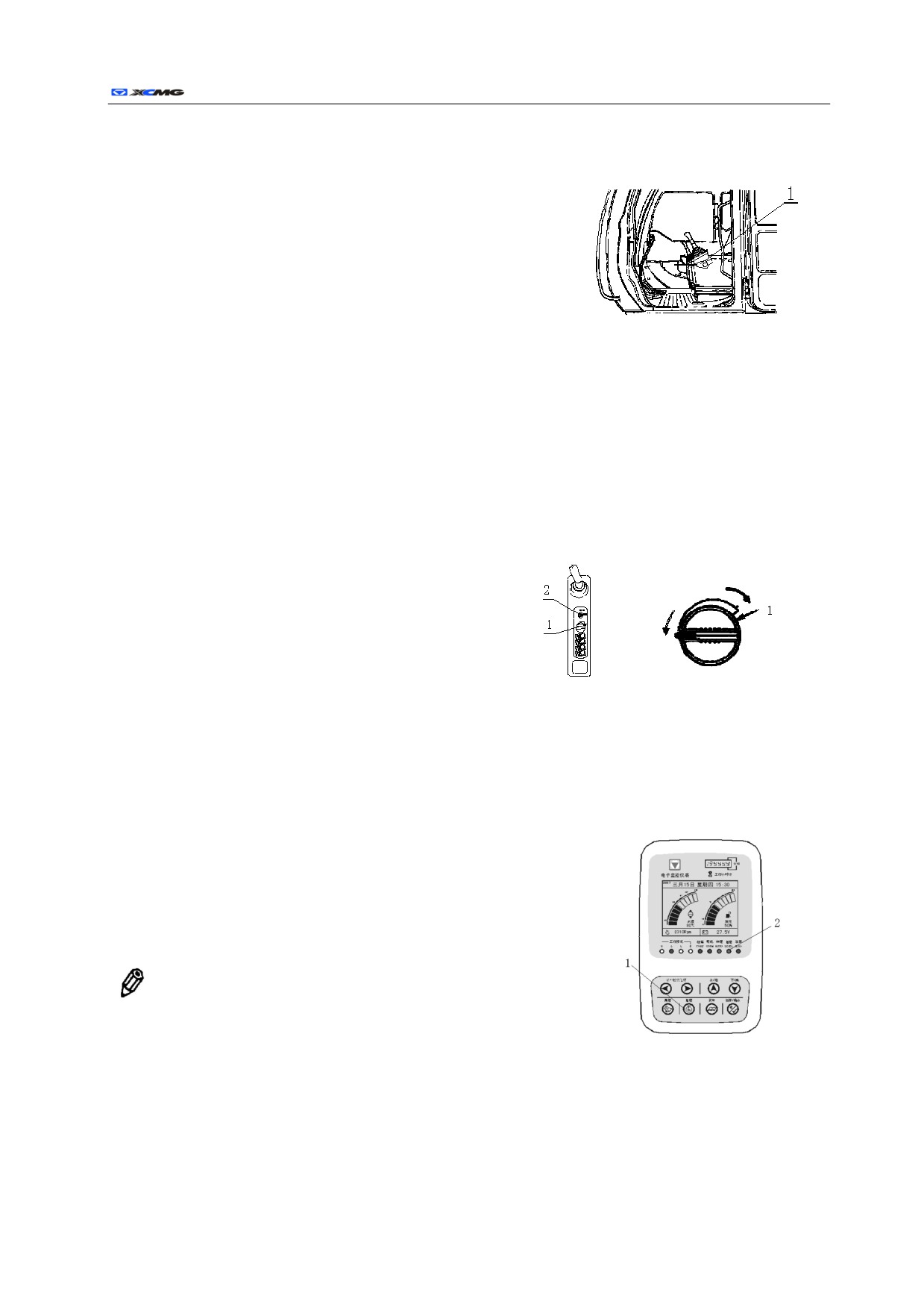
3) Always verity the following cases to ensure safe locking lever has been pulled to LOCK position.
When transporting the machine;
When leaving the machine after the duty.
The operation of safe locking lever:
a)
Before leaving the machine:
1)
Place it on level ground, lower the bucket on ground, return all
the control levers to middle position and shut off the engine
correctly.
Fig.1-66
2)
Pull the safe locking lever to full LOCK position.
1-safe locking lever
b)
Before starting the engine, confirm that safe locking lever is located at LOCK.
c)
After starting the engine, confirm that all the control levers and pedals are in middle position and
there is no movement in all parts of machine, then lower the safe locking lever to release position.
d)
When all the control levers are in middle position, lower the safe locking lever to release position, if
some part of machine moves, it means there is a failure. At this moment, you should pull the safe
locking lever back to LOCK position and stop the engine. Then you can carry out a repair or contact
with appointed dealer.
High speed
z
Engine’s speed control
Low speed
Fig.1-67
1-knob of engine speed
2-key switch
According to this picture, increase or decrease engine speed through engine speed knob on right control box,
a)
Increase engine speed by turning the engine speed knob clockwisely; on the contrary, decrease engine
speed by turning the engine speed knob counter-clockwisely.
b)
Before stopping the engine, always turn the engine speed
knob counter-clockwisely to the bottom (low-speed idling
setting), run the engine for 5 min. to cool it, then turn the key
switch to OFF position to stop the engine.
Note: in every working mode, the highest speed of engine can
only reach the max. one designed by this mode.
z
Self-idling speed
Fig.1-68
In self-idling state, if all the control levers return to middle position,
1-button of canceling self idling
then after about 4 seconds,
2-self idling indicator
Engine speed will reduce to designed self-idling speed to save the
fuel consumption. If any control lever is operated, engine speed will immediately increase to the designed
one on engine speed knob.
r
86
Attention: always verity the brightness of self-idling indicator before the operation. If it is on,
showing the self-idling is functioning.
a)
Self-idling function is on: self-idling indicator is on.
b)
Self-idling function is off: self-idling indicator goes out.
c) When self-idling function is on, it can be released by pressing the button of canceling self-idling.
d)
When restarting the engine, self- idling function will restore.
z
Boost
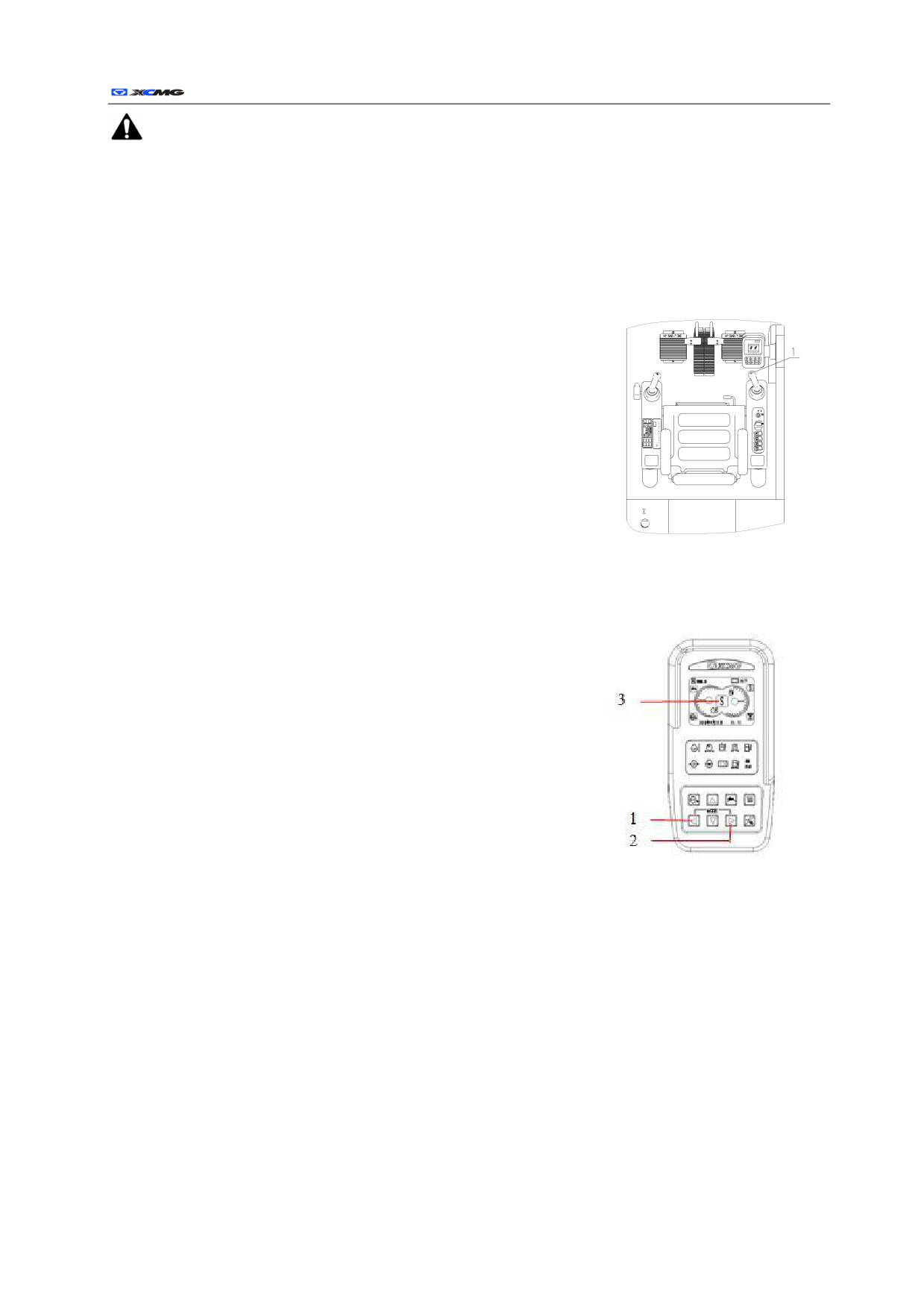
Boosting switch is at the top of right control lever, it can be used
to get the max. excavating force. By pressing this switch, working
machine will achieve a boosted force of about 8 seconds.
Fig.1-69
1-Boosting switch
z
Working mode
through working mode switch, one of the following 4
modes namely H、S、L、B can be chosen for work.
a)
Mode S (standard excavating mode)
It can save fuel consumption best and should be adopted in
normal work. When it works, mode S indicator shines.
b)
Mode L (weak excavating mode and mode of leveling up
ground )
In this mode, engine speed may be reduced, but excavation
force remains the same with mode S. although the output
Fig.1-70
is little less than that of mode S, but the fuel consumption
1、2-working mode button
and noise have been reduced for the machine to do some
3-mode-H indicator
light-duty work such as leveling up ground. In this mode,
indicator of mode L shines.
c)
Mode H (strong excavating mode)
It is suitable for excavating hard ground in short time. It can give full play the max. power of engine
to enhance the working efficiency. When this mode works, indicator for mode H is on.
d)
Mode B (knapping hammer mode)
It is suitable for the work of hydraulic knapping hammer. When this mode works, indicator for mode
B is on.
Important: if the machine is equipped with knapping hammer, then this mode must be adopted or the
r
87
machine will be damaged.
Note: after the start of machine, the default working mode is S.
z
Operation of counter-shoveling
a)
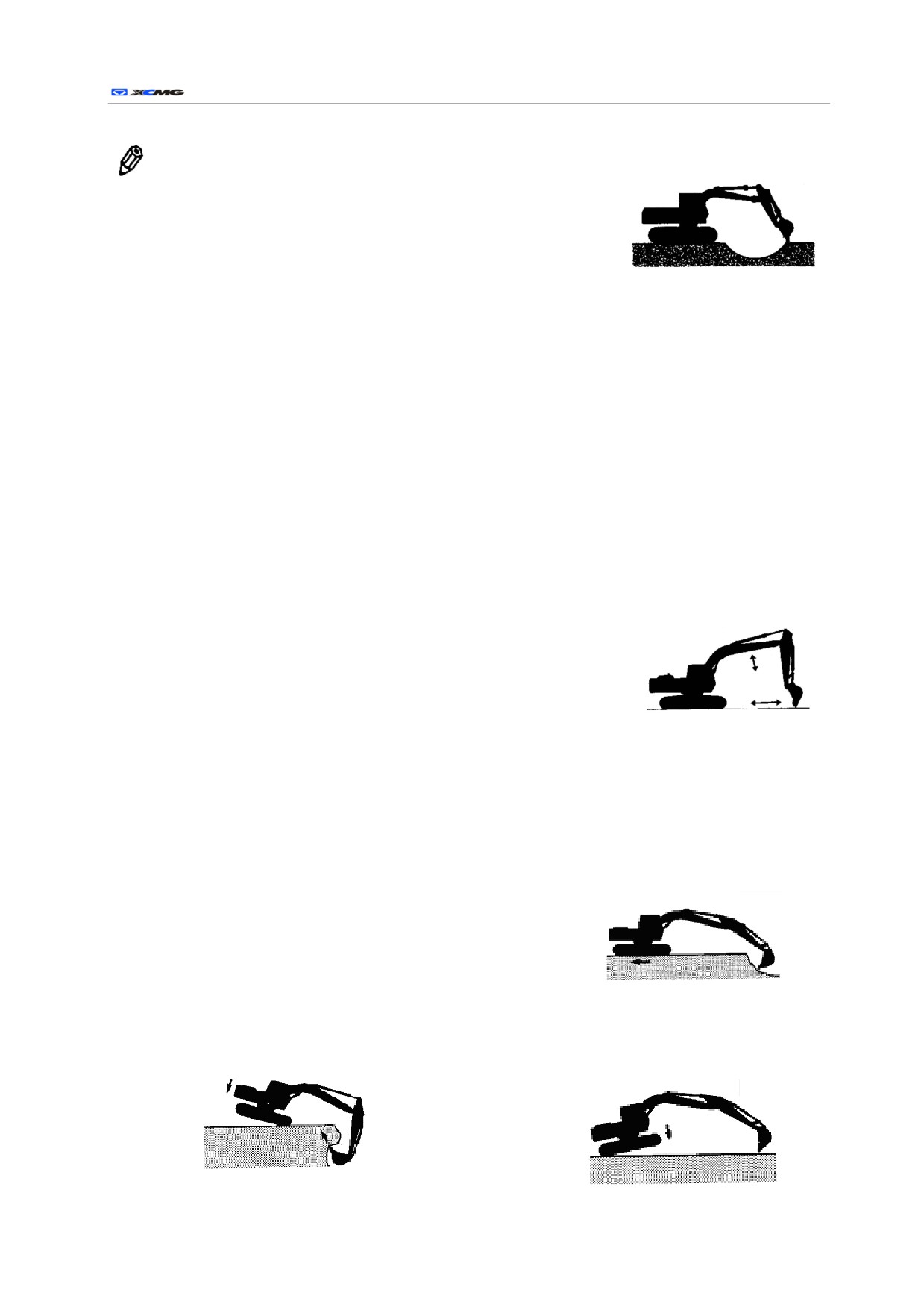
Let the bottom of bucket be 45°with ground, and place the bucket
teeth on ground.
b)
Take the bucket lever as a main excavation force to pull the bucket
Fig.1-71
towards the machine.
c)
When the soil is attached on bucket, dump away The soil in a way of moving bucket lever and (or)
bucket to and fro quickly.
d)
When digging a straight ditch, place the crawlers parallel with the ditch. When the desired depth is
reached, move the machine and continue the digging according to the demand.
Important: 1) a sudden stop should be avoided when lowering the moving arm or the machine may be
spoiled by the impact.2) when using the bucket lever, it should be avoided to stretch the hydraulic
cylinder of bucket lever fully, so that the cylinder won’t be damaged.3) when digging in one angle,
bucket teeth should be avoided to collide with the crawler.4) when digging a deep ditch, you should
prevent the moving arm or hose of bucket’s hydraulic cylinder from knocking on the ground.
z
Operation to level up the ground
Important: don’t push the soil with bucket while treading.
When you need to level up the earth, put the bucket Lever a litter
further from the vertical position like that in the picture. When
turning the bucket back and lifting the moving arm slowly, you
should operate the bucket lever’s withdrawing function, so that when
Fig.1-72
the lever is beyond the vertical position, the bucket can maintain
stable horizontal movement by lowering down the moving arm slowly. The work of leveling up the
earth can be more accurate by operating the moving arm, bucket lever and bucket synchronously.
z
Operational technology
a)
Don’t treat the treading as an additional digging force, or the machine will be destroyed.
Wrong
Fig.1-73
b)
Don’t lift up the rear of machine body and treat the body weight as an additional digging force, or the
machine will be destroyed.
Wrong
Wrong
Fig.1-74
Fig.1-75
r
88
c)
When digging, don’t let the bucket knock the crawler. Try to place the machine on level ground,
don’t use the bucket as a hammer or pile driver, and don’t try to
Wrong
move stone or crash wall through rotation.
Fig.1-76
Important: to avoid the damage on hydraulic cylinder, don’t knock or harden the ground with bucket
when the hydraulic cylinder of bucket stretches fully (the bucket withdraws fully).
d)
Every time, adjust the length and depth of excavation so that every digging can achieve a full bucket,
which will yield more than that made by fast cycle of partly filling bucket. To improve the
productivity, full-bucket should be the first target, followed by speed.
e)
Once the ditch is opened, the stone can be dug out and pulled upward the bucket from the soil layer.
It can be achieved by lifting one or two layers, the top layer is pulled out at first. Don’t let the bucket
bear the side load and level up the material by rotating the bucket or knock with the object with the
bucket from the side.
Important: don’t try to extend the bucket lever fully and abandon the bucket, don’t penetrate the
ground with bucket teeth to dig out the stone, which will lead to serious damage on machine.
f)
When the machine is driven out of the water, the incline angle of machine should is less than 15°.
Don’t submerge the machine into water whose surface is over permitted depth (normal water depth
should not exceed the upper edge of supporting-chain wheel). For those parts soaked in water for a
long time, they must be lubricated with butter till the old butter is squeezed out of the lubrication
point.
z
Choose suitable crawler board
Important: the crawler board may bend and (or) the screws may loose also other debarkation
parts may be demolished by using wide crawler board on uneven ground.
Don’t use wide crawler board on uneven ground full of rock, sand pile or gravel. Wide crawler board
is designed for soft ground, its screw should be checked on fixation regularly.
z
Use hook hole
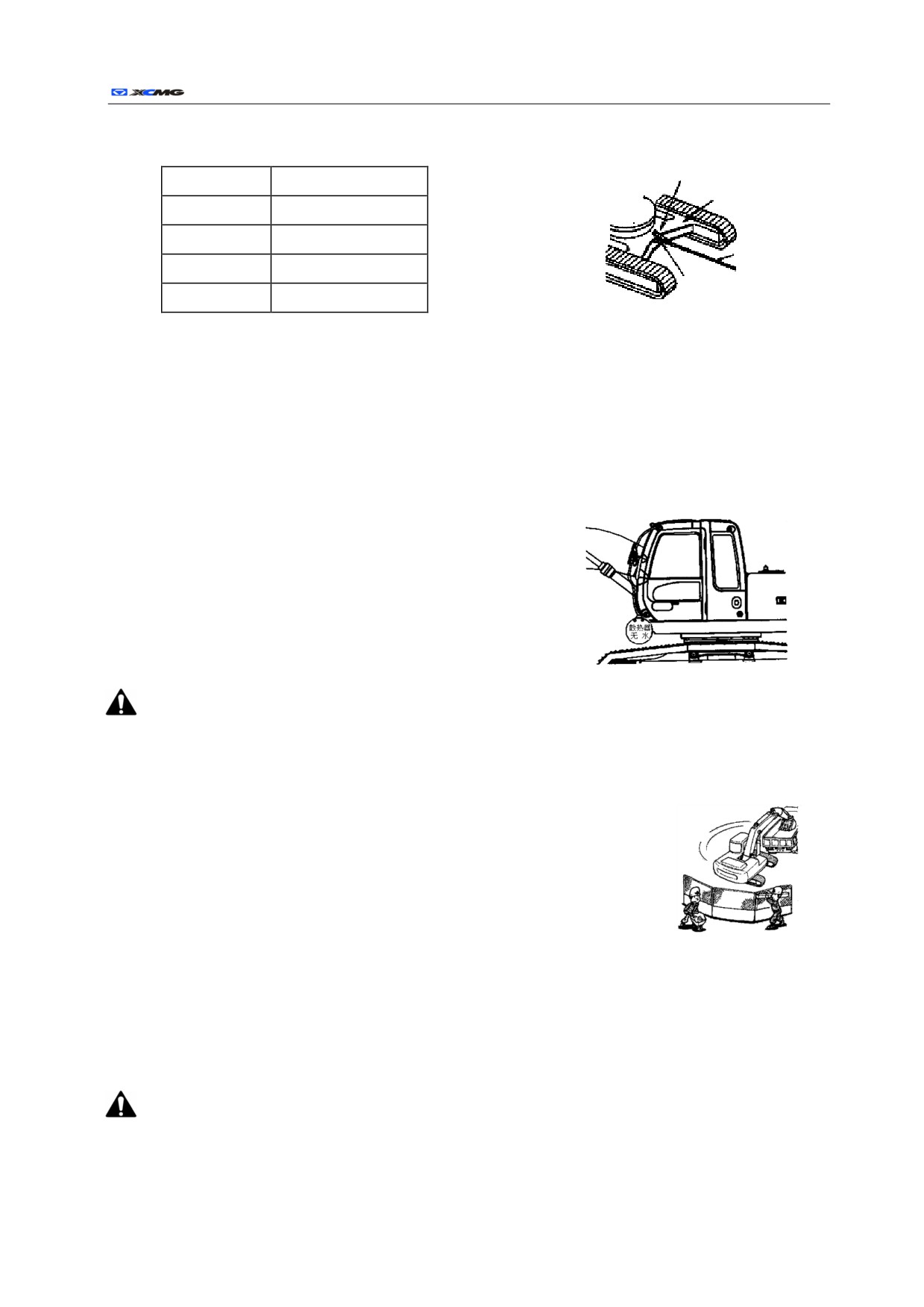
One hook hole is made on chassis bodyframe to tow the object whose weight is listed in the table
below.
Important: while using hook hole on chassis bodyframe, the following limitation and notices
must be identified, or the chassis bodyframe and (or) hook hole may be destroyed.
a)
The max. towing force is:A。
r
89
List 1-9 Parameter list
Hook hole
Machine type
A
Chassis bodyframe
XE210C
73600N(7.5T)
XE210C3Ⅶ
73600N(7.5T)
Steel cable
XE210C2
73600N(7.5T)
Hook
XE210C2Ⅶ
73600N(7.5T)
Fig.1-77
b)
Hook must be used.
c)
Make sure that steel cable is towed horizontally and in the same direction of crawler.
d)
Choose slow treading mode, drive the machine slowly when towing.
z
Pay attention when stopping the machine and staying overnight
a)
After finishing the duty of that day, drive the machine to the place where there is no falling stone,
ground collapse or flood, then park the machine on solid and level ground.
b)
Top up the fuel tank
c)
Clean the machine.
d)
In winter, if there is no anti-freeze fluid or cooling fluid
with long lifespan, make sure to drain off cooling water in
radiator and engine. After that, you must also hang up the
plate of “no water in radiator” in visible plate.
z
Notes for the work
Fig.1-78
Attention: check working site beforehand
1)
When working on site where some object may drop, you must install a roof protector for cab.
2)
If it is needed to work on soft land, the ground should be fully hardened in advance.
a)
When working on the machine, you must wear tight clothes and other
safety products like safety helmet, which are suitable for work.
b)
Let other person go out of the moving range of the operation and the
machine, clean all the obstruction. During the operation, you should pay
attention to the surrounding all the time, and don’t let the boarding run
into obstruction when working in small area surrounded by obstruction.
Fig.1-79
c)
While loading the material for the truck, you should lift the bucket
above the truck bucket from the rear of the truck, try not to rotate the bucket above the cab or anyone.
d)
When operating, fence should be installed at the side and rear of the bucket’s rotating radius to
prevent any unconcerned person enter into the working area.
z
Operate the machine safety
Attention:Prevent the machine from rolling over and influenced by ground collapse.
Pay attention to the followings:
a)
Ensure the work site is strong enough to support the machine hardly. When working in ditch or road
shoulder, operate the machine by making the crawler vertical to the wall and the treading motor at the

r
90
rear. In this way, even the wall collapses, the machine can withdraw easily.
b)
If it is necessary to work on cliff or under high bank, make sure to check working site at first and
confirm there is no possibility that cliff or bank will collapse, if there is, don’t work in this area.
c)
When working on soft land, the ground may collapse leading to the rolling over of the machine.
When you need to work on soft land, you must strengthen the ground at first with big steel board to
support the machine.
d)
When operating on uneven ground or slope, try to prevent the happening of turning over your
machine:
1)
Reduce the engine speed.
2)
Choose slow treading mode.
3)
Operate the machine slowly and pay attention to the movement of machine.
z
Guard against the falling of stones or gravels
When working in the place where there may be falling stones
Fig.1-80
or gravels, make sure FOPS(FALLING OBJECT PROTECTION
SYSTEM)cab is contained in the machine.
z
Move or operate the machine safely
When moving or operating the machine, the surrounding people may be
knocked down. So pay attention to:
a)
Pay special attention not to knock down the people around. Before
Fig.1-81
moving, turning or operating the machine, identify the position of those
people.
Always keep the treading annunciator and horn in working state (if there are). When the machine
begins to move, they can warn the surrounding people. When the machine is treading, rotating or
being operated, the signaler should be employed and coordinate the hand signs with others before
starting the machine.
z
Unified signals in multi-machine work
In the case of multi-machine work, the signal known by all the working staff
must be used. One signaler should be appointed to organize the operation to
ensure all the people follow the command of this signaler.
Fig.1-82
z
Prevent the reversing and injury suffered from rotation
When reversing or rotating the upper machine body, if someone is near the
machine, he will be knocked down or crushed, suffered from a severe casualty.
To guard against the reversing and rotating accident:
Fig.1-83
a)
Before reversing or rotating, confirm there is nobody around the machine.
b)
Keep the treading annunciator and horn in working state (if there are). Always
look out if there is other person entering into working area. Before moving the
machine, please warn others with horn or other signals.
c)
When reversing, if your view is blocked, please use a signaler, always keeping
Fig.1-84
r
91
him in your visual field and using the hand signs in accordance with local rules.
d)
Only when the signaler and operator understand the signals very well, can the machine be moved.
e)
Understand the meaning of all the banners, signals and signs used in the work and confirm who
should be responsible for issuing the signals.
f)
Keep the window, rearview mirror and lamps clean and perfect.
g)
Dust, heavy rain and fog will reduce the visibility, if the visibility is low, please decrease the speed
and use proper illumination.
h)
Read and understand all the operational procedure in this book.
z
Don’t place the bucket above anyone
It is forbidden to lift, move or rotate the bucket above anyone or truck cab.
Falling material from bucket or running into other bucket may lead to the
serious injury on people or damage on machine.
z
Guard against the undercut
To withdraw from the ditch side in case of collapsing groundwork,
Fig.1-85
always keep the treading motor at the rear and the lower machine body vertical to the ditch side to
place the machine.
When the groundwork begins to collapse and the machine can’t be
withdrawn, don’t get nervous. Instead, you should fix the machine by
lowering down the working equipments.
z
Avoid turning over the vehicle
Don’t try to jump out of tipping machine, or you will be suffered from
Fig.1-86
serious or fatal crush since the inclining speed of machine is faster than
yours. Buckle your safety belt when working.
a)
The danger of turning over always exists when operating on slope,
leading to a severe casualty accident.
b)
To prevent from turning over, be specially careful when working on
slope:
1)
In work area of leveling up.
Fig.1-87
2)
Lower the bucket down to the ground and keep it near to the machine.
3)
Decrease the operational speed to guard against turning over the vehicle
or skidding.
4)
When treading on slope, avoid changing the direction.
5)
If crossing the slope is a must, also you must not cross one whose
gradient is over 15º.
6)
When rotating the load, decrease the rotating speed according to the
Fig.1-88
situation.
c)
Look our when working on icy ground, since the going up of temperature will make the land soft and
unstable for treading on ground.
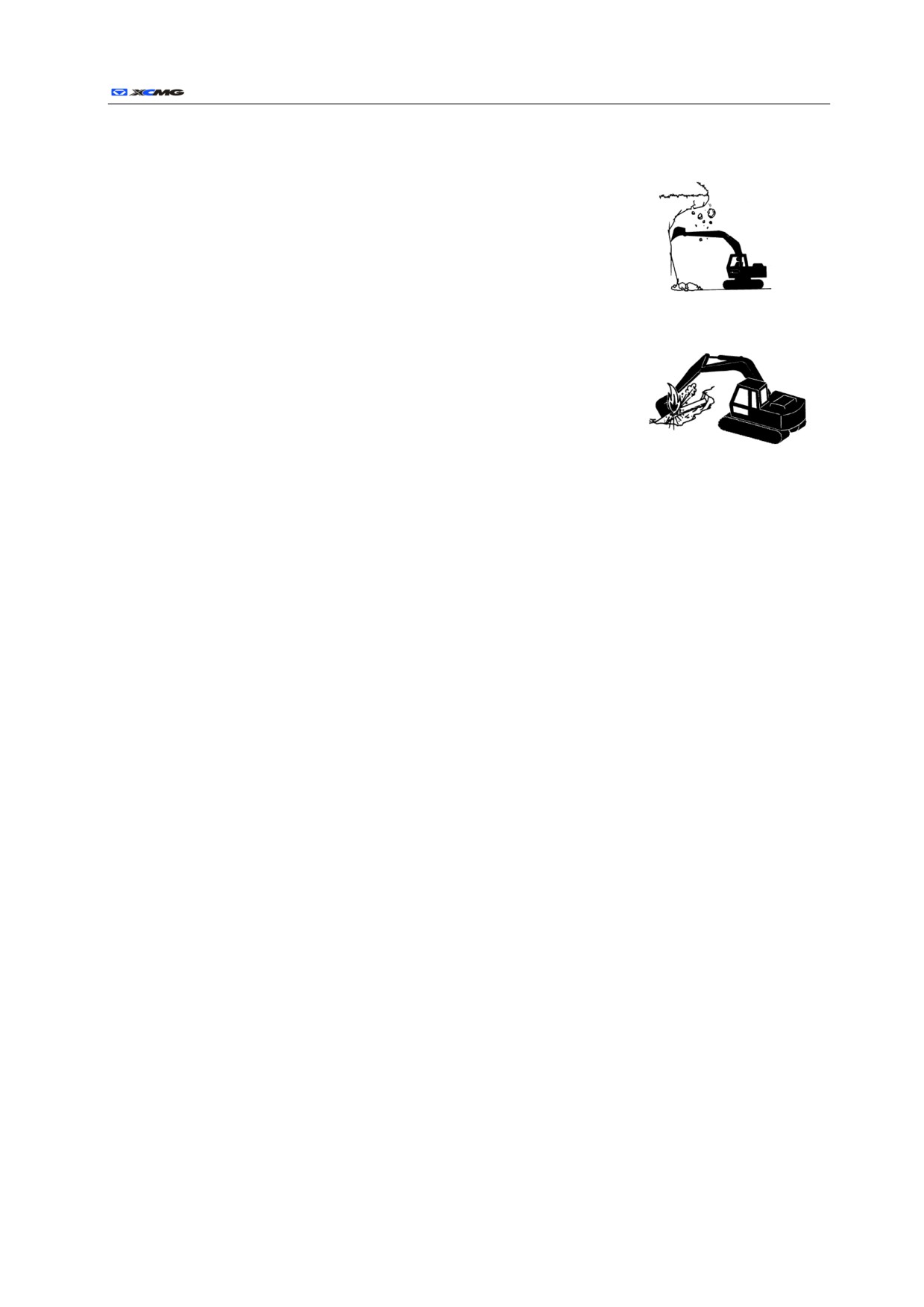
r
92
z
You mustn’t undercut a high bank
Undercutting a high bank may lead to the collapse of edge or landslide, causing a severe casualty.
z
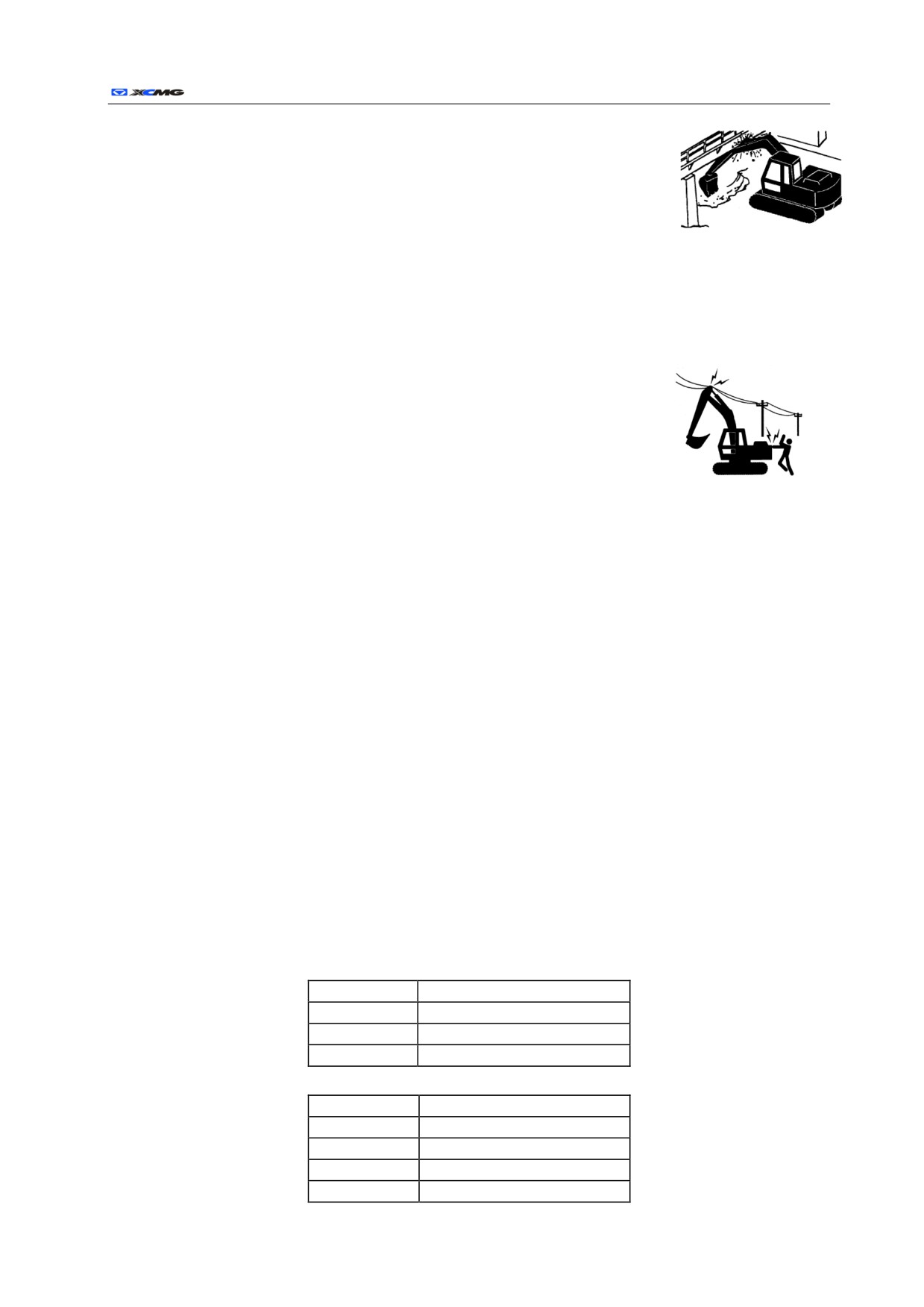
Dig with care
Accidentally cutting off underground electric cable or gas pipe may
lead to a explosion or fire, causing a severe casualty.
a)
Before the excavation, check the position of electric cables, gas pipes
and water pipes.
Fig.1-89
b)
Keep a legal min. distance with electric cables, gas pipes and water
pipes.
c)
If optical fiber cable is cut off due to the accident, Don’t look at the
end of cable which otherwise may lead to serious wound in your eyes.
d)
Please contact directly with local related department, ask them to
Fig.1-90
mark out the position of all the underground cables and pipes.
r
93
Operation under special conditions
z
Attention on operation
a)
If the front working equipments of machine or other part collide with high
objects such as overpass, both the machine and overpass will be damaged
even the person will be injured.
Fig.1-91
b)
Look out to prevent the moving arm or bucket lever from bumping with
high object.
z
Avoid the electric wires
a)
If there is no safe distance between the machine or working equipments
with electric wires, a casualty accident may be resulted from an electric
shock.
b)
When working near high-voltage wires, don’t move any part of machine
or load into a range, namely 3 meters away from electric wire plus
Fig.1-92
double length of insulator.
c)
Verify and follow all the local regulations in point.
d)
Wet ground will increase the electric shock range for the people, so the surrounding people should be
far away from working area.
z
Drive the machine prudently
Important: in cold weather, you must park your machine on hard ground to avoid the crawler
frozen with ground. Remove the oddments on crawlers and chassis bodyframe. If the crawler
has been frozen with ground, lift the crawler with moving arm and bucket lever and move the
machine with care to avoid destroying the driving wheel and crawlers.
a)
Try to choose even road surface, make all the efforts to operate the machine and change the direction
through straight line and slight change.
b)
When driving on uneven area, engine speed should be decreased to lower the possibility of damaging
the lower machine body.
Filling procedure of fuel, hydraulic oil, lubricant and anti-freeze fluid
z
Fuel system
a)
Recommended fuel brand
List 1-10 Fuel brand list
Time and area
Fuel products
Non-winter
0#( Above 4℃)
Winter
-10# (Above -5℃)
Frigid area
-35# (Above -29℃)
b)
Capacity of fuel tank
List 1-11 Capacity list
Type
Capacity of fuel tank
XE210C
380 L
XE210C3Ⅶ
380 L
XE210C2
380 L
XE210C2Ⅶ
380L

r
94
c)
Refilling method
1)
Park the machine on even ground.
2)
Lower the bucket on the ground.
3)
Run the engine for 5 min. at low-speed idling speed without load.
4)
Turn off the engine; withdraw the key from key switch.
Important: if the procedure of shutting the engine is not right, the turbocharger may be damaged.
5)
Pull the safe locking lever to LOCK.
Attention: deal with fuel with prudence. Before adding the fuel, engine must be shut off. No
smoking when the fuel tank is refilled or when fuel system is working.
6)
Check level meter of fuel or fuel meter on monitor, add new fuel if necessary.
Important: prevent any dirt, dust, water or other foreign things into fuel system.
7)
To prevent from condensation, fuel tank should be refilled after the completion of operation everyday.
Be careful not to splash the fuel on machine or ground. While refilling, regulated capacity should not
be exceeded.
8)
After the refill, replace the oil inlet cap on fuel tank to avoid losing or damage.
z
Hydraulic system
a)
Recommended hydraulic brand and name
List 1-12 brand and name list of hydraulic oil
Supplier
-20~15℃
-10~40℃
Special hydraulic oil used for
Special hydraulic oil used
for
Xugong
Xugong excavator (32#)
Xugong excavator (46#)
Shell petroleum
Tellus oil 32
Tellus oil 46
Mobil petroleum
DTE 24
DTE 25
Remark
Anti-abrasion hydraulic oil
b)
Capacity of hydraulic oil tank
List 1-13 Capacity list of hydraulic oil tank
Machine type
Capacity of oil tank
XE210C/ XE210C3Ⅶ
240 L
XE210C2/ XE210C2Ⅶ
240 L
z
Engine oil
a)
Recommended engine oil brand and name
List 1-14 Brand and name list of engine oil
Supplier
-20~30℃
20~40℃
Special hydraulic oil used for Xugong excavator
Xugong
SAE10W/30
SAE15W/40
Rimula Super
Shell petroleum
SAE10W/30
SAE15W/40
Mobil Delvac
Mobil petroleum
SAE10W/30
SAE15W/40
Remark
API CF grade

r
95
b)
Refilling quantity
XE series:XE210C/ XE210C3Ⅶ/ XE210C2/ XE210C2Ⅶ are 25 L
z
Driving equipment
a)
Gear oil brand and name recommended
List 1-15 Gear oil brand and name list
-20~40℃
Supplier
Travel reducer
Swing reducer
Special hydraulic oil used for
Special hydraulic oil used for
Xugong
Xugong excavator(90#)
Xugong excavator (140#)
Shell petroleum
Shell Spirax EP90
Shell Spirax EP140
Mobil petroleum
Mobilube GX90
Mobilube GX140
Remark
API GL-4 grade
b)
Refilling capacity
List 1-16 Capacity list
Parameter
Travel reducer
Swing reducer
Machine type
XE210C
6.8LX2
6.2L
XE210C3Ⅶ
6.8LX2
6.2L
XE210C2
6.8LX2
6.2L
XE210C
6.8LX2
6.2L
z
Cooling system
a)
Recommended cooling fluid:
List 1-17 Capacity list
Supplier
-20~30℃
-10~40℃
Special coolant used for Xugong
Special coolant used
for
Xugong
Xugong
excavator (30#)
excavator (45#)
Shell
OTA-30
OTA-45
b)
Capacity of cooling liquid
List 1-18 Capacity list
Parameter
Anti-freeze fluid
Antirust fluid
Machine type
XE210C
23 L
0.46 L
XE210C3Ⅶ
23 L
0.46 L
XE210C2
23 L
0.46 L
XE210C2Ⅶ
23L
0.46L
c)
Pay attention when preparing cooling fluid by the customer himself:
1)
Cooling water:Putting soft and pure water or bottled water in radiator.
2)
Antirust fluid:While changing cooling fluid, you should add antirust fluid whose capacity refers to
list1-18, into new cooling fluid. Antirust fluid in not needed when using anti-freeze fluid.
3)
Anti-freeze fluid:if the temperature is predicted to be below 0℃, the cooling system should be added
r
96
with the mixed fluid composing of anti-freeze fluid and soft water. The mixing rate of anti-freeze
fluid refers to List 1-19, normally between 30% and 50%. If the rate is less than 30%, the system
will be rusted; if the rate is over 50%, engine will be overheated.
d)
Mixing rate list of anti-freeze fluid
List 1-19 Parameter list
Mixing capacity
Temperature
Mixing rate
Anti-freeze fluid
Soft water
℃
%
L
L
-1
30
6.9
16.1
-4
30
6.9
16.1
-7
30
6.9
16.1
-l1
30
6.9
16.1
-15
35
8.1
14.9
-20
40
9.2
13.8
-25
45
10.4
12.6
-30
50
11.5
11.5
Attention:
1)
Anti-freeze fluid is poisonous. If taken in, it will result in a severe casualty accident. Once
drinking it by mistake, the patient should be channeled off to vomit and obtain an immediate
emergent treatment.
2)
While storing anti-freeze fluid, make sure to store it in a container with sealing cap and
remarkable mark. Always keep it away from the contact with children.
3)
If anti-freeze fluid is splashed into eyes carelessly, you should wash your eyes with water for
10-15 min. and then seek out an emergent treatment.
4)
When storing or abandoning anti-freeze fluid, you must abide by all the local regulations.
r
97
Safe operating procedure against fire
z
Treat the liquid safely
a)
Handle the fuel with care, since it is highly flammable. If fuel is ignited, it will explode and cause a
fire and person’s casualty.
1)
When smoking or being near the spark or burning object, don’t add
fuel to the machine.
2)
Before refilling, you must stop the engine.
3)
Refill the fuel outdoors.
4)
Static electricity can produce spark at the fuel inlet.
Fig.1-93
b)
When the weather is cold and dry or there is possible static electricity,
always keep fuel inlet contact with fuel supply pipe to guarantee a good earth.
a)
All the fuel, majority of lubricant and some cooling agents are flammable.
1)
Store the flammable liquid away from where there is fire danger.
2)
Don’t burn or pierce pressured container.
3)
Don’t save oil-contained rag, which can be ignited or burning automatically.
4)
Tighten the cover of fuel tank or other liquid tank, it is forbidden to start the equipment before
tightening.
z
Guard against a fire disaster
a)
Check leakage: the leakage of fuel, hydraulic oil and lubricant may lead
to a fire disaster.
1)
Check the loss or loose of pipe clamps, the distortion of hoses, mutual
friction between pipes and hoses, the damage on fuel cooler and the
loose of flange screw of fuel cooler to avoid the leakage.
Fig.1-94
2)
Tighten, repair or change any pipe clamp, pipe, hose, fuel cooler and
flange screw of fuel cooler which have been lost, flexible or damaged.
3)
Don’t bend or knock high-pressure pipe.
4)
Don’t install any bending or damaged pipes or hoses.
b)
Check short circuit: it may lead to a fire disaster.
1)
Clean and tighten all the electric connection.
2)
Before every shift or after 8-10 hours’ operation, check if the cables and electric wires have been
loose, distorted, hardened or broken.
3)
Before every shift or after 8-10 hours’ operation, checks if the terminal covers have been lost or
damaged.
4)
If the cables and electric wires have been loose or distorted, don’t operate the machine.
c)
Remove flammable objects: a fire can be causes by some flammable things such as splashed fuel,
hydraulic oil, anti-freeze fluid, washing fluid, garbage, lubricant, oddment, deposited cinder and etc.
check and clean the machine everyday, remove splashed or deposited flammable things timely to
avoid a fire.
d)
Check key switch: when catching a fire, the engine failing to stop will aggravate the fire, which is a
r
98
disadvantage to putting out the fire. So before operating the machine everyday, always check the
function of key switch:
1)
Start the engine and run it at low idling speed.
2)
Turn the key switch to OFF and confirm if the engine has stopped.
3)
If there is something abnormal, make sure to repair the machine before operating it.
e)
Check the emergency cutoff switch of engine: when catching a fire, if the pressured air in hydraulic
oil tank fails to be released, it will aggregate the fire and cause a trouble. So once every 250 hours,
always check the function of emergency cutoff switch of engine.
1)
Start the engine and run it at low idling speed.
2)
Press down emergency cutoff switch of engine.
3)
Confirm the engine has stopped and the pressured air in hydraulic oil tank has been released(you can
hear the sound of deflation).
4)
If there is something abnormal, make sure to repair the machine before operating it.
f)
Check insulation cover: a fire will be caused by the damage or loss of it, which if existing, should be
repaired or renewed before operating the machine.
z
Withdraw when catching a fire
a)
If catching a fire, leave from the machine according to the following
method:
1)
If time is permitted, turn the key switch to OFF and stop the engine.
Fig.1-95
2)
If time is permitted, use fire extinguisher.
3)
Leave from the machine。
b)
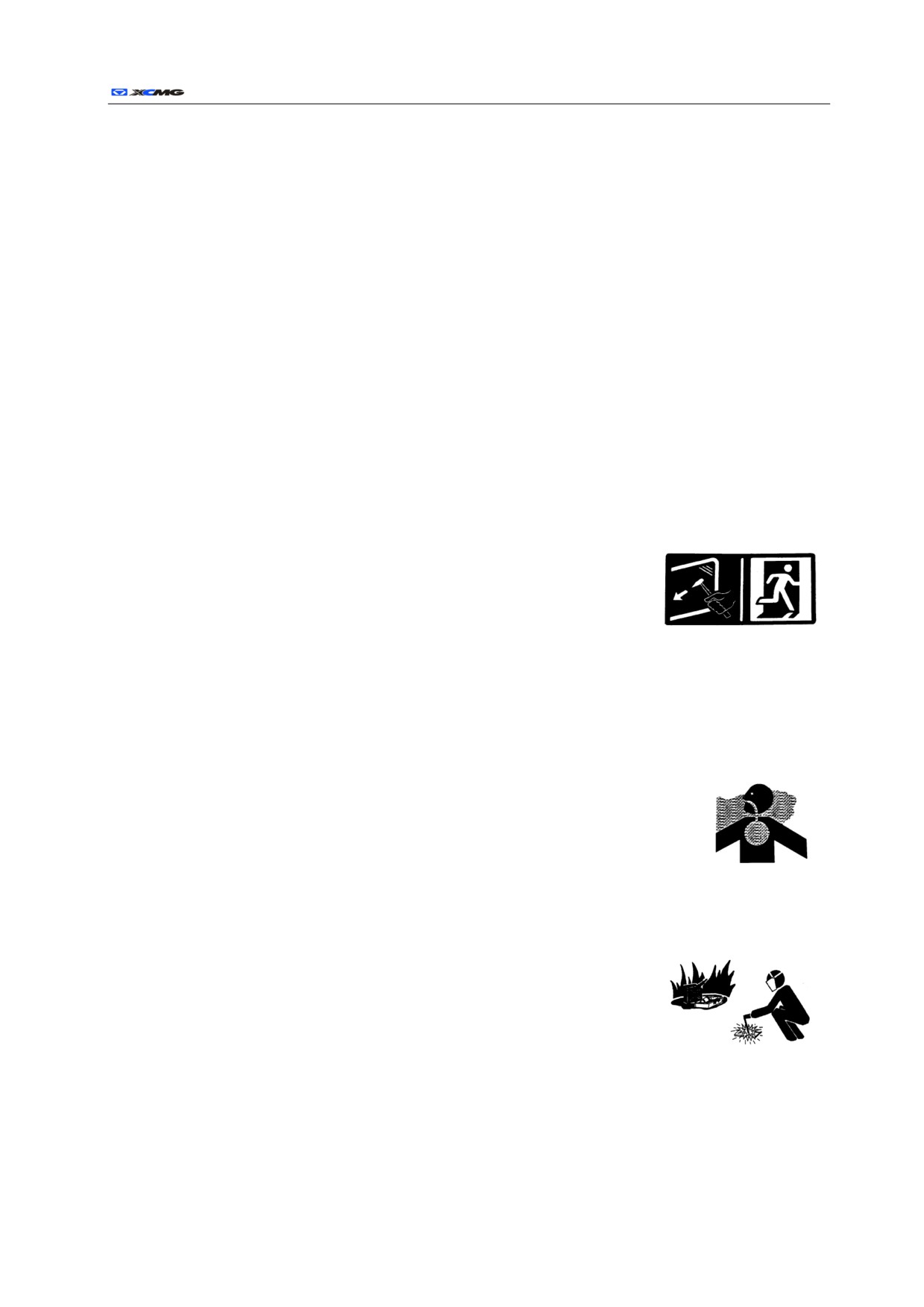
At the emergency, if the cab door and front window can’t be opened, smash front or rear window
glass with emergency hammer and then withdraw from the cab.
z
Beware of exhaustion
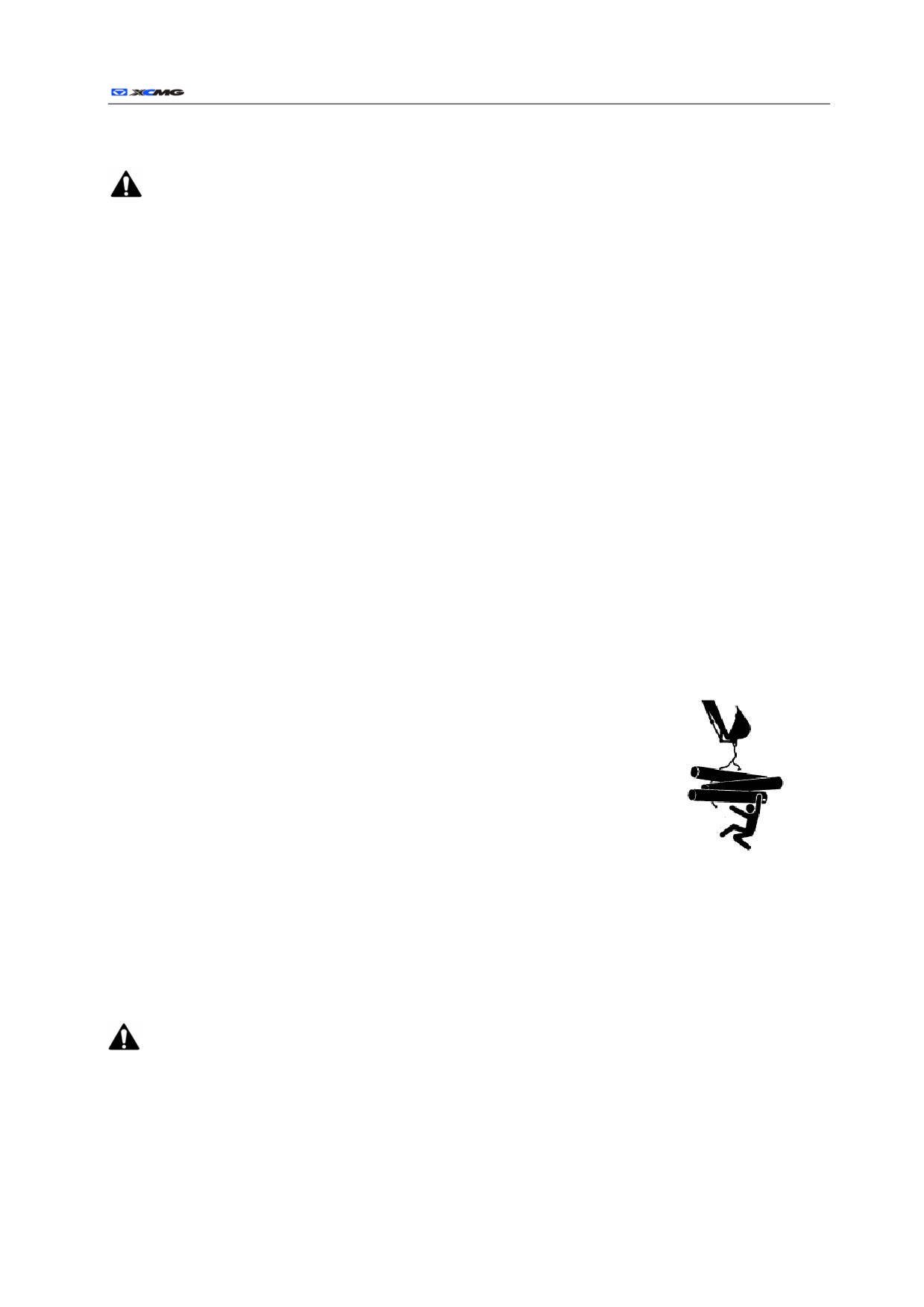
Beware of exhaustion and suffocation. The exhaustion may lead to disease or
death.
If you must work in the building, fully air ventilation should be guaranteed. The
smoke can be discharged by lengthened exhaust pipe or opening door or
Fig.1-96
window to introduce enough external air into working area.
z
Notices for welding and polishing
a)
Before welding, plug of controller should be cut off.
b)
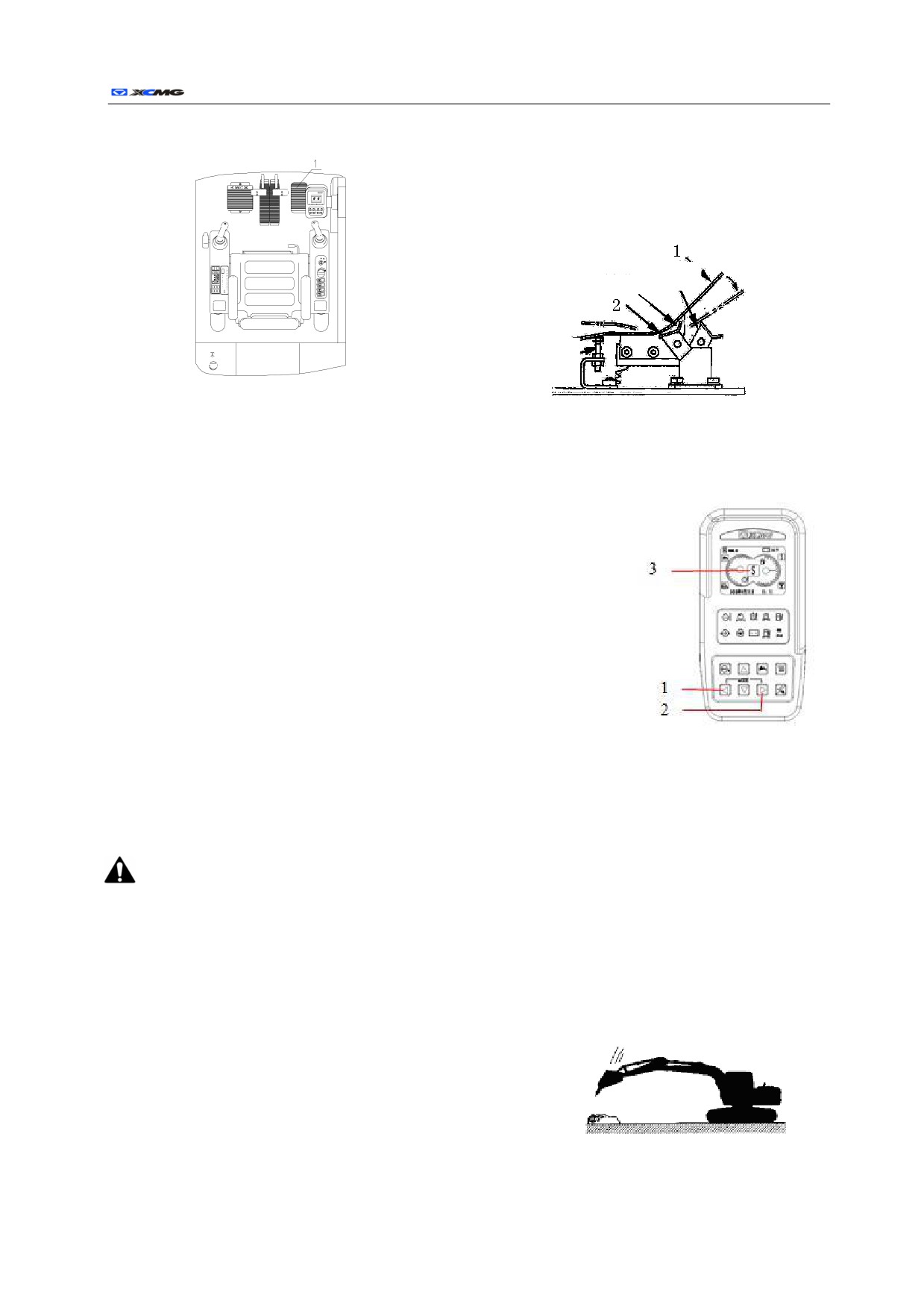
The welding will produce gas and flame. So :
1)
The welding must be carried out in fully ventilated and prepared place.
Before welding, place the flammable things into safe area.
Fig.1-97
2)
Rather than unqualified, only those qualified through examination can do
the welding.
c)
Polishing machine will give out sparks, so before the polish, put the flammable things into safe area.
d)
After the welding and polishing, check again if there is smoke around the welding area.

r
99
z
Avoid heating near the high-pressure hydraulic pipe
Flammable sprayer will be produced by heat near the high-pressure
hydraulic pipe, leading to a severe burning injury for you and the
surrounding people.
a)
Don’t weld or use welding torch near high-pressure hydraulic pipe or other
Fig.1-98
flammable material.
b)
When the heat is accumulated to certain degree, high-pressure hydraulic pipe will be cut off. When
doing the work like welding, the fireproofing cover must be installed to protect the hoses and other
material.
z
Avoid heating pipes with flammable fluid inside
a)
Don’t weld or gas-cutting any pipes or hoses with flammable fluid inside.
b)
Before welding or gas cutting any pipes, remove flammable fluid completely with non-flammable
solvent.
z
Remove the paint before welding or heating
Because heated by welding or using welding torch, the paint will produce poisonous gas, which will
cause a vomit if being taken in.
a)
Prevent the happening of latent poisonous gas and dust.
b)
Carry out removing-paint work outdoors or in drafty place, dispose the paint and solvent correctly.
c)
Remove the paint before the welding or heating.
1)
If the sand paper or grinding wheel is to get rid of paint, pay attention not to suck in dust by wearing
qualified respirator.
2)
If using the solvent or removing-paint agent, you should get rid of removing-paint agent with soap
and water before welding. Clean the solvent, removing-paint agent container or other flammable
object in working area. Before welding or heating, you should use at lease 15 min. to disperse the
volatile gas.
z
Avoid the explosion of battery
a)
The gas in battery will explode.
1)
Prevent spark or burned match from getting close to the top of battery.
2)
Don’t check the electricity of battery by placing one
Fig.1-99
metallic object cross the terminal.
3)
Don’t charge frozen battery, or there will be explosion. Warming up battery to 16℃.
4)
The loose of terminal may produce a spark, so all the connector should be tightened.
b)
Electrolyte of battery is poisonous, if the battery explodes, the electrolyte will enter into eyes, causing
the blindness.
r
Operating and Maintenance Manual 100
Other operating procedures
z
Lift or move objects
Attention:
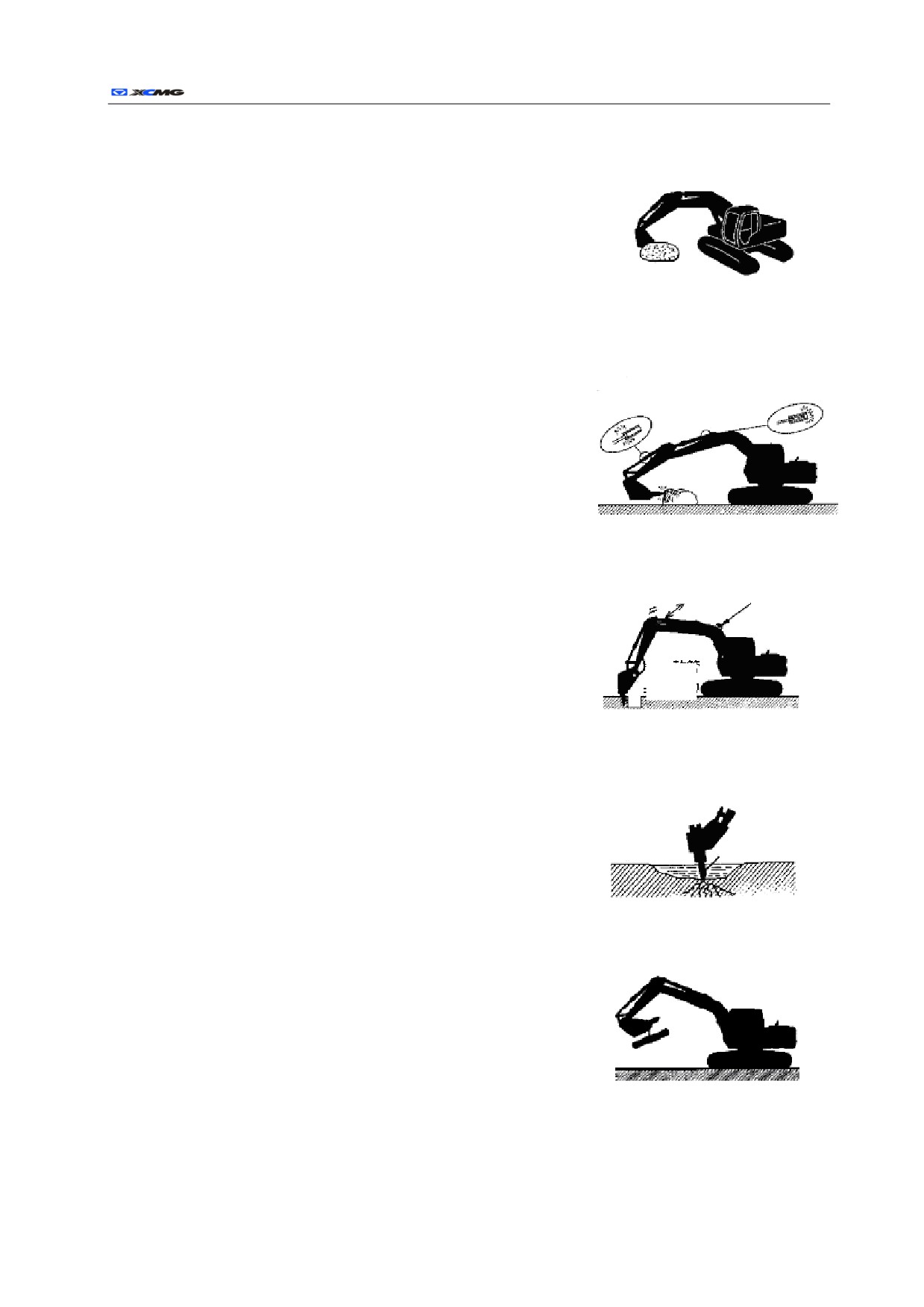
1)
When using the machine to lift or move objects, you must abide by all the local regulations.
Since the steel cable, strap or rope may be broken and lead to a severe casualty, so don’t use
damaged chain, broken steel cable or strap or rope to lift heavy thing. Move the object slowly
and carefully. Sudden movement of load even above the person’s head is not allowed. Don’t let
anyone get close to the load.
2)
Ensure all the people are away from the load lifted or tied with steel cable and placed on
ground, until the load has been supported by supporting block or placed on ground stably.
3)
Position the upper machine body perfectly and keep the treading motor at the rear. Don’t
connect sling/chain with bucket teeth, which may come off and result in the falling of lifted
object.
4)
Don’t let the sling entwine your hand and body.
5)
When wind speed is high, don’t use sling to lift or raise originally rated weight. When the
exterior area of the cargo is relatively big, watch out any kinds of gust.
a)
Bind the sling or chain tightly on the load supposed to be lifted. When binding the sling or chain,
make sure to wear gloves.
b)
Turn the bucket and withdraw the bucket lever, connect the sling or chain with bucket ring. Before
starting, hand signs must be coordinated with the signaler.
c)
Know very well the position of all the working staff in working site.
d)
Connect hand-pulling rope with the load and ensure the puller is far away
from the load.
e)
Before the lift, measure the load weight and lift up.
1)
Lift the load to the height of 50mm away from the ground or lift it only to
demanded height.
2)
Let the load go around nonstop to one side.
Fig.1-100
3)
Keep the load close to the ground and take it away from the machine.
f)
If there is any unstable phenomenon, lower the load immediate down to the ground.
z
The operation of hammer-style knapper
As the picture, if there is hammer-style knapper in the machine, operate it with operating pedal front
and right to the seat.
Attention: when not using the hammer-style knapper, you must lock operating pedal with pedal
lock.
r
Operating and Maintenance Manual 101
Releasing
Locking
Positioning
screw
Fig.1-101
Fig.1-102
1-operating pedal
1-operating pedal
2-pedal lock
Choose knapping hammer mode (mode B) through working mode switch,
the indicator of mode B will shine.
a)
Move the pedal lock and release the operating pedal.
b)
Step down the operating pedal and operate hammer-style knapper.
c)
Move your foot away from the operating pedal and stop
the hammer-style knapper.
d)
When the operating pedal is not used, always lock the pedal with
pedal lock.
Fig.1-103
1, 2-working mode switch
3-mode B indicator
z
Notices for operating hammer-style knapper
Attention:
1)
Since the hammer-style knapper is heavier than bucket, so the stability of machine may be
reduced.
2)
When using hammer-style knapper, the machine is easier to incline and the flying or bouncing
object may bounce into cab or other part of machine. Please abide by the following and other
necessary notices to avoid the happening of accident and
Wrong
damage on machine.
a)
Avoid using hammer-style knapper to bump into other
object. Since the knapper is heavier than the bucket, so it
will go down faster. Be careful, don’t use the knapper to
Fig.1-104
bump into other thing, or the knapper, front working
r
Operating and Maintenance Manual 102
equipment and machine’s upper structure may be shattered. Before operating the knapper, always
move (lower down) the knapper slowly and put it on broken
object.
Wrong
b)
Don’t use the knapper to rotate and move something, or the
moving arm, bucket lever and knapper will be damaged.
Fig.1-105
Wrong
c)
Prevent the damage on hydraulic cylinder or machine. When
operating the knapper, don’t retract or stretch the hydraulic
cylinder lever fully.
1
Fig.-106
d)
If there is abnormal jumpiness in hydraulic hose of knapper,
Abnormal jumpiness
Energy
of hose
please stop the operation at once. the pressure change inside
accumulator
the battery of knapper or damaged battery will lead to
abnormal hose jumpiness and even cause the damage on
Abnormal
jumpiness
knapper and (or) machine.
of hose
Fig.1-107
Wrong
e)
Don’t operate the knapper in water, which may make it rusted
even damage the seal and components in hydraulic system.
Hammer
lever
Fig.1-108
f)
Don’t use knapper to lift heavy things, which may make the
Wrong
machine rave about and (or) lead to the damage of knapper.
Fig.1-109
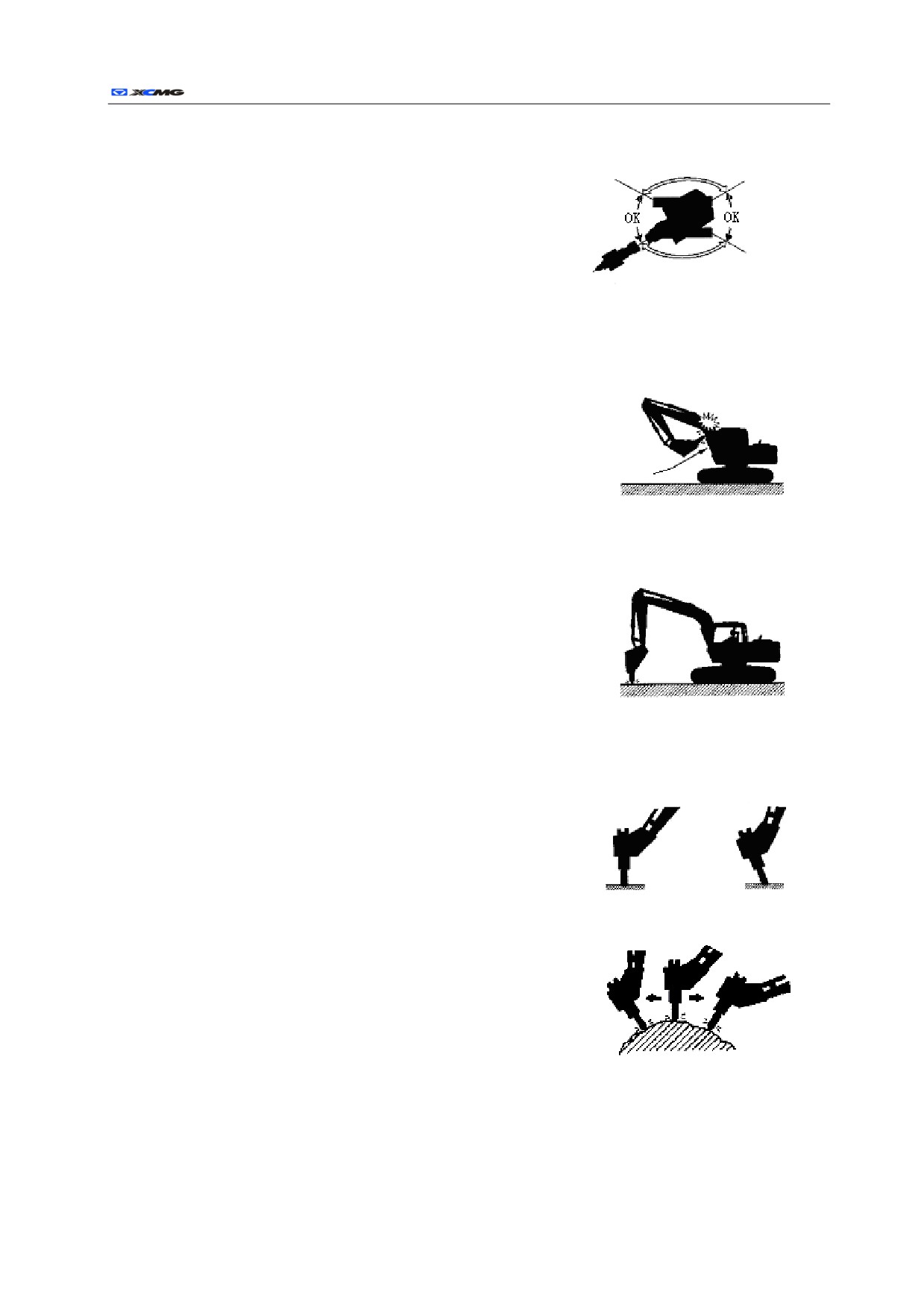
r
Operating and Maintenance Manual 103
Wrong
g)
Don’t rotate the upper machine structure to the side to
operate the knapper. This action will make the machine
unstable and even shorten the lifespan of lower machine
Correct
Correct
parts.
Wrong
Fig.1-110
h)
Operate the hydraulic excavator carefully and prevent the
Wrong
knapper from bumping into moving arm.
Attention! (Watch
out, don’t let
knapper bump into
moving arm)
Fig.1-111
i)
Don’t place the bucket lever on vertical position to operate the
Wrong
knapper, which may lead to the excessive vibration of
hydraulic cylinder of bucket lever and even the oil leakage.
Fig.1-112
j)
Press down the knapper and place the hammer head(axial
Correct
Wrong
center)vertically on object and push it in.
Fig.1-113
k)
Don’t operate the knapper continuously for over 1 min., which
may cause the excessive abrasion of hammer’s head. If the
object can’t be shattered in 1 min., place the hammer’s head to
other positions, every change of which should not exceed 1
min.
Fig.1-114

r
Operating and Maintenance Manual 104
l)
It is possible to damage the front working equipment by
relying on pressing down the knapper to prop up the lower
Pressing
Propping up
down
100mm-150
mm
machine body. Though it is permitted to prop up the front edge
of lower body within 150mm, but normally this method is not
Fig.1-115
necessary. You mustn’t prop up the front edge of lower body
for over 150mm only relying on pressing down the knapper.
r
Operating and Maintenance Manual 105
Lubrication, maintenance and repair
General principle
Warning:Only those trained and qualified can repair and maintain this machine.
Attention:Before any maintenance, read carefully the related content in this book.
Attention:If diesel engine is running indoors, ensure good ventilation condition.
Attention:For the details of diesel engine, see OPERATING MANUAL OF DIESEL ENGINE,
which is included in the documents along with the excavator.
● While carrying out maintenance or repair for this machine, the related record should be made and
saved.
● For the excavator, it is important to maintain and ensure its normal function. So the machine should
be kept clean so that any failure such as leakage, looseness of screw or connection will be spotted.
● Pay attention to environmental protection! Don’t let oil and other things harmful to environment
pollute our environment.
● The content of this chapter includes items related to regular check, maintenance and repair. The
operator of excavator should carry out according to the regulation.