XCMG XE210C Hydraulic Excavator. Operating & Maintenance Manual (2011) - page 4
r
64
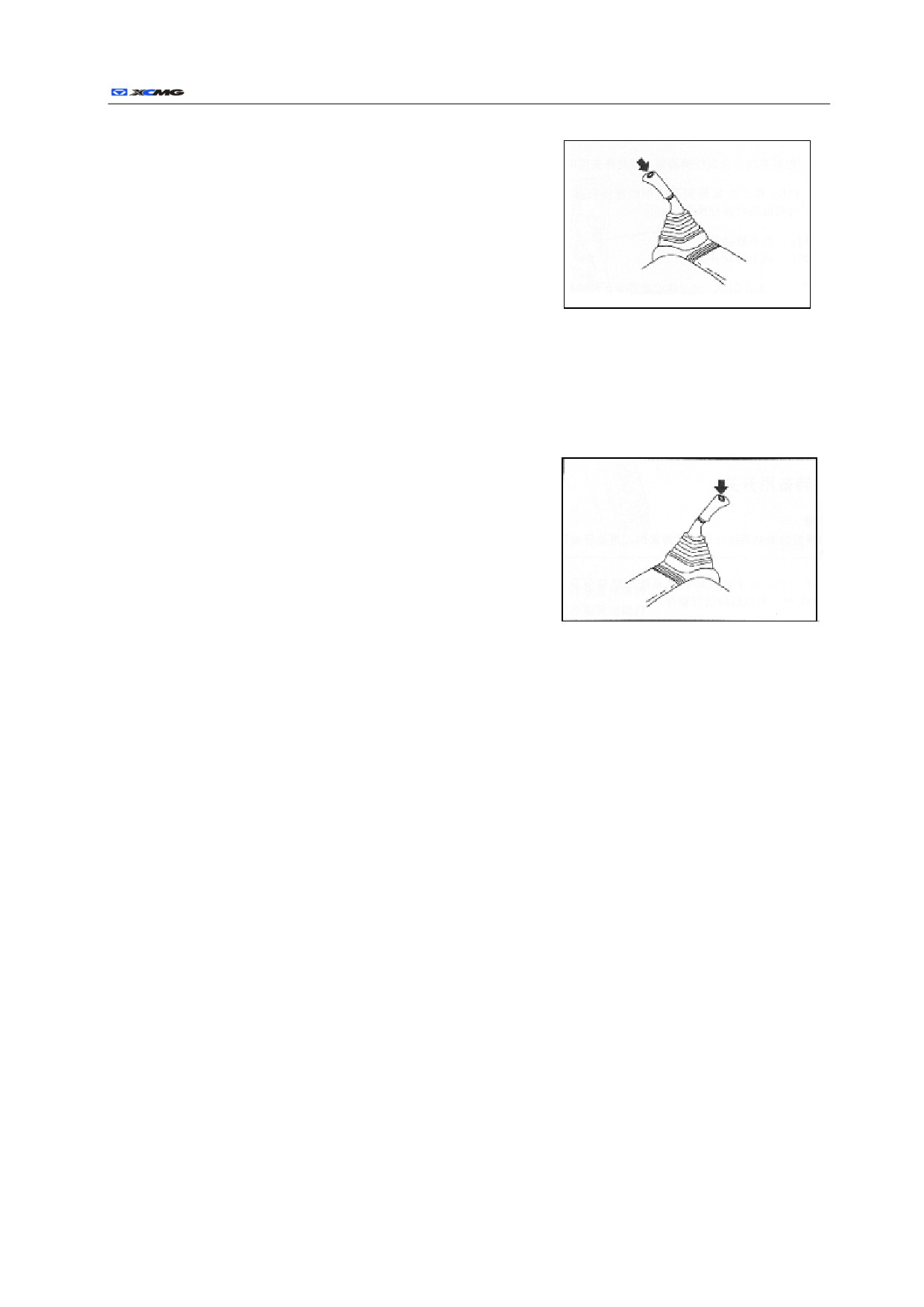
Switch for the horn
When pressing the button switch on top of the operating lever of
the
right working device, and the horn honks.
Pressure-up switch
The button switch on the operating lever of the left working device is used to start the
contact-mode strength function. As long as pressing the (click) switch, the hydraulic system
pressure can be increased, which plays a role of increasing the power output of the excavator
and the excavating force. But the maximum time to use the maximum power is 8 seconds to
prevent damaging the hydraulic system.
r
65
Operation
General principle
This machine can only be operated by those qualified, experienced operator with excavator operating
certificate, who is allowed to inspect and maintain this machine. Pay attention to:
z
Read carefully and command this book before the starting or the first operation of machine.
z
This book should be placed accessible for the convenience of timely replacement or supplement when
it is lost, damaged or unable to read.
z
Careful check should be done before starting this machine. Use and operate it strictly according to the
safety procedure.
z
Immediate high-speed running is avoided for the engine started at low temperature. The normal
working temperature for oil is 50℃~80℃, if it is below 25℃, warm-up running should be done so
that the oil temperature can be raised to the required one for the operation.
z
While the machine is transferred out of factory, there has been long-term rustproof and anti-freeze
fluid in the radiator, which should be drained out totally to protect the machine from rust if the
machine is stopped for a long time.
z
Winter-use lubricant and diesel fuel should be used in cold winter. The brand is according to this
book. For the cold-start of engine, please refer to operating manual of diesel engine and this book.
z
When a refill is needed for the loss of hydraulic oil, make sure to use the identified clean hydraulic oil.
Oil of different brand is forbidden.
z
Pay attention to the cleanliness of hydraulic oil at any time. If it is aging, bad or not clean enough, be
sure to replace it at once with the new oil. Normally a replacement happens after the running -in of
new machine.
z
The key parts of hydraulic system have been sealed by lead. During the warrant period, the seal can’t
be opened privately by the customer, or it won’t be guaranteed.
z
Before the delivery, the machine has been checked and adjusted strictly. But proper running-in must
be gone through will using the machine, so that all parts can run in very well and the life span of the
machine can be lengthen. The running-in period is 100 hours. For the first 50 hours, only L working
mode namely weak excavating mode is allowed, also the engine power is limited within 80% of full
load to run the machine. During this period, overdue idling is avoided, and all indicating meters
should be checked. The machine should be maintained everyday to avoid of the oil leakage. At the
first 50 hours or working in mud, pins should be lubricated once every 8 hours. After 50 hours, the
torque of tighten parts should be checked and the maintenance be made for the machine. After 50
hours, new lubricant should be added for the diesel engine.
r
66
Operating procedure
Operating environment
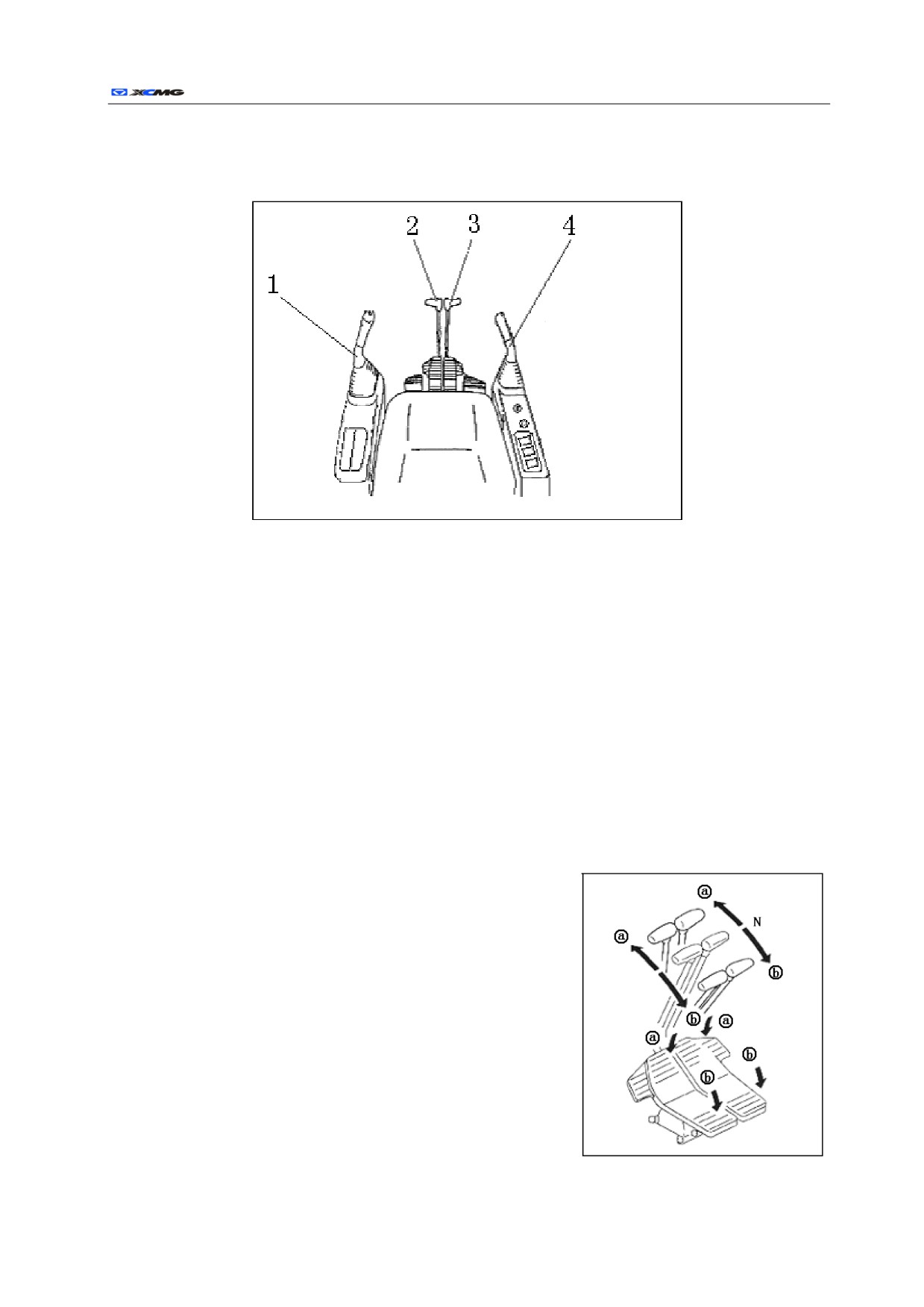
Operating lever
1. Left control handle
3. Right control handle for the crawler
2. Left control handle for the crawler
4. Right control handle
Traveling pedal
Warning!
z
Except the machine moves, do not put your feet on the pedal, if you put your feet on the pedal and
step by mistakes, the machine will move suddenly and cause serious accidents.
z
When the track frame is installed towards the rear part, the machine will move in the reverse direction
of moving forward and the heading direction of the reverse moving.
When using the operating lever, check the track frame is towards the rear part or the front part. (If the
chain wheel is in the rear part, then the track frame is towards the front part.)
z
When using the pedal for operating and moving, special attention should be paid.
The operating levers
(2 , 3) are used to exchange the moving
directions of the machine.
The operations for the pedal are described in (
).
(a)
Moving forward: push the operating lever forward (the pedal
will tilt forwards);
(b)
Reverse moving: pull the operating lever backwards (the
pedal will tilt backwards):
N (middle position): the machine stops
r
67
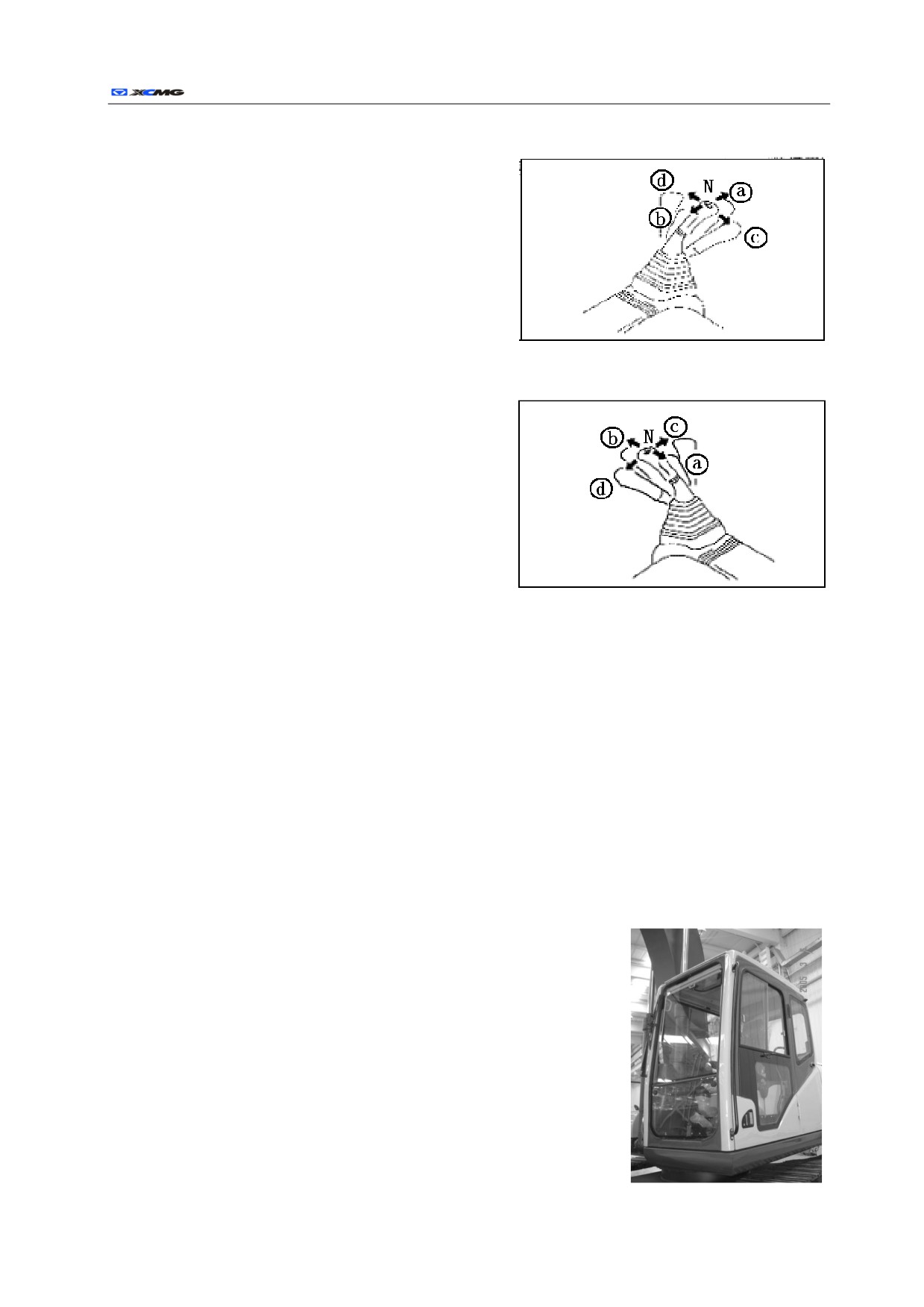
Operating lever for the working device
The operating lever (1) of the left working device is used to
operate the bucket rod and the rotation of the upper part of
the machine.
(a)
Bucket rod unloading
(b)
Bucket rod excavating
(c)
Right rotation
(d)
Left rotation
N (middle position): the upper part of the machine and the
bucket rod keep immovable.
The operating lever (4) of the right working device is used
to operate the movable arm and the scoop.
Movable arm operating/scoop operating
(a)
Movable arm lifting
(b)
Movable arm lowering down
(c)
Scoop unloading
(d)
Scoop excavating
N (middle position): the movable arm and the scoop keep
immovable.
Operation for the accumulator
Warning!
The accumulator is filled with high pressure nitrogen, wrong operation may cause explosion and result in
serious injury or damage. When operating the accumulator, the following steps must be followed:
·
Control the pressure in the pipeline not to be discharged thoroughly, and do not stand in the direction
of the oil spraying when dismantling the hydraulic devices, and loosen the bolts slowly.
·
Do not dismantle the accumulator.
·
Do not put the accumulator close to the open fire or expose in the fire.
·
Do not drill holes or weld on the accumulator.
·
Do not collide, roll or make the accumulator suffer from hit.
·
When disposing the accumulator, the gas must be emitted. Please contact Xugong Excavator or its
distributor
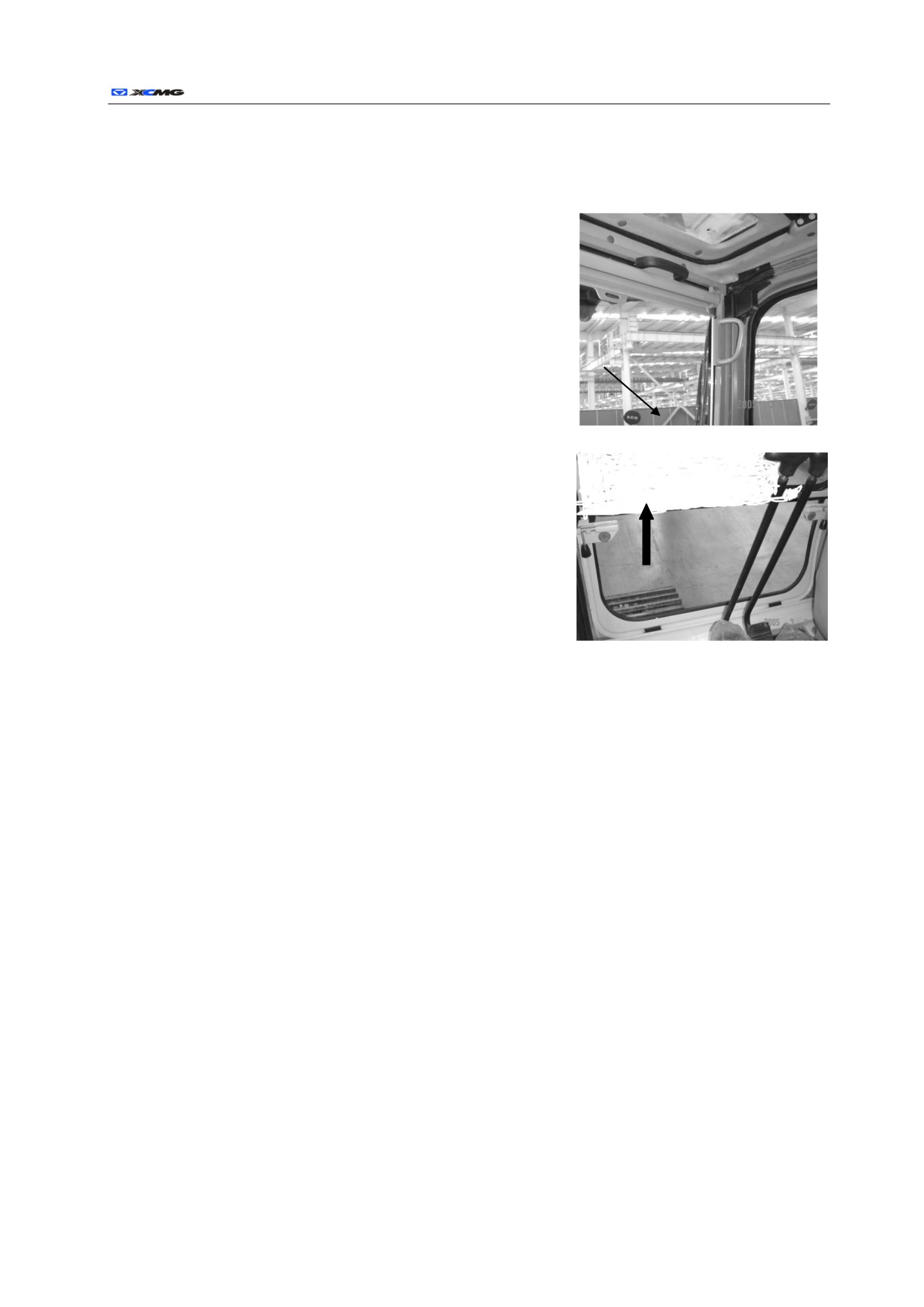
Windows for the driver’s cab
r
68
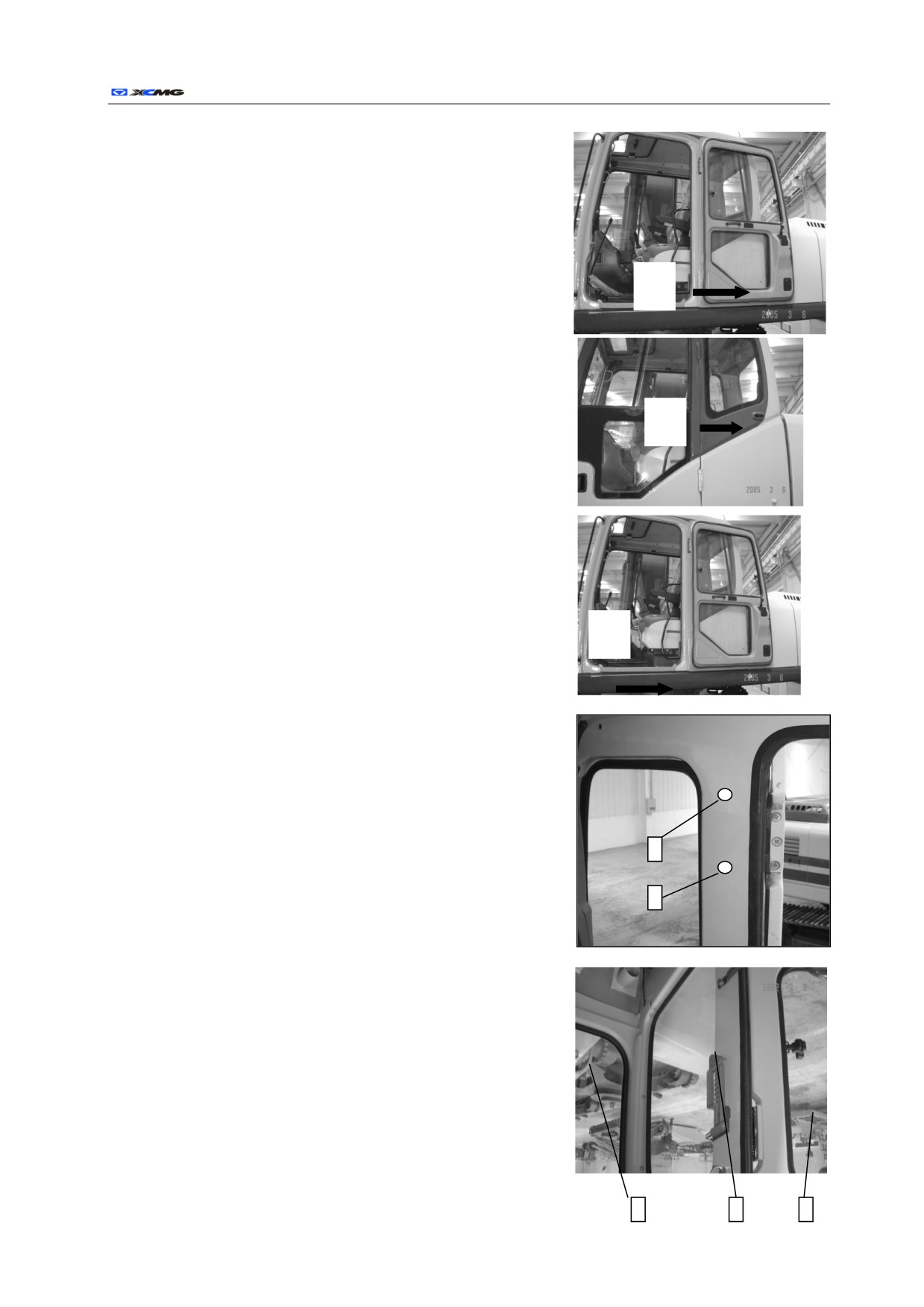
Open the windows
1.
Put the auxiliary devices on the ground, and then shut
down the engine.
2.
Hold two handles (A), heave outwards and pull
upwards, the front window can be opened.
3.
Put the window in the locking position after
opening them.
A
Close the windows
1.
Put the auxiliary devices on the ground, and then shut
down the engine.
2.
Hold two handles
(A), heave outwards and pull
downwards, the front window can be closed。
3.
Install the windows firmly and use the
key
to lock them.
r
69
Dismantle the front window
1.
For opening the front window, see the “open the windows”.
2.
Hold the upper part with two hands and pull upwards.
Store the windows dismantled in the inner side behind the driver’
cab, which is shown as (B) in the right graph.
B
Locking system for the driver’ cab
C
It is used to operate the door of the driver’ cab to be in open
state.
1.
The operator pushes the door of the driver’ cab out of the
driver’ cab.
D
2.
Ensure the door of the driver’ cab is fixed on the lock (C)
firmly.
Press the handle (D) in the driver’ cab of the operator, release
the door of the driver’ cab.
E
Fire extinguisher and emergency exit
Fire extinguisher (optional part)
E
The fire extinguisher is installed on the two bolts (E)
in the right and rear side of the driver’ cab.
Use the fire extinguisher when fire alarming.
Emergency exit
When emergency, use the emergency escape hammer (G).
There are two emergency exits---the door and the
rear window. Whether the rear window is fixed
mode or sliding mode, the emergency
escape hammer hung in the rear side
in the driver’ cab to crush the glass.
F——rear window
G——emergency escape hammer
H——door
F
G
H

r
70
The preparation and operation of starting
z
Follow the safety regulation
a)
Read carefully and abide by all the safety signs as well as all the
safety-related information in this book.
b)
If necessary, please install, maintain or replace safety signs.
c)
If safety signs or this book are lost or damaged, please order
the new ones from appointed dealer in the same way of purchasing
Fig.1-31
other parts (type and delivery number of the machine must be written
clearly).
d)
Learn how to operate the machine correctly and safely. Only those operators qualified after the
training are allowed to operate and maintain the machine.
e)
While carrying out the operation and maintenance, all the safety rules, warnings and requirements
must be strictly followed.
f)
Keep the machine under proper working condition. Any modification unapproved may spoil the
function or safety of the machine; even shorten its life span.
g)
Safety indications are the basic regulation for the safe of the machine. However, they won’t involve
you into any kind of danger that you may run into. If there is some question, please report to your
higher-up at first before operating or maintaining this machine.
h)
You can’t operate this machine in the case of bad health, weariness due to the medicine or unease in
the environment, which will reduce your response towards the contingency and lead to the accident.
i)
While working with other driver or traffic keeper on the spot, it is necessary to ensure the hand
language and working environment are familiar to all the personnel.
j)
Please keep an eye on all the factors affecting safety at any time.
z
Take precautions against the emergency
Guard against the happening of fire disaster or any accident.
a)
Install first-aid kit and fire extinguisher nearby.
b)
Read carefully and understand the information on the fire extinguisher,
user it correctly.
Fig.1-32
c)
To ensure the fire extinguisher can always be used in emergency,
regularly maintain it according to the recommended maintenance interval in operational manual of
fire extinguisher.
d)
Map out the emergency countermeasure guidance to cope with fire disaster or accident.
e)
Attach the phone numbers of doctors, ambulance, hospital and fire department near the phone.
z
Notice for the inside the cab
a)
While entering the cab, you should first remove the mud and oil on the sole, or you may slip when
stepping on the pedal and be trapped into an accident.
b)
After using the ashtray, at first you should check if the match and cigarette have been placed in order,
and then shut the cover of ashtray to avoid of a fire disaster.
c)
Don’t stick a couple on the window glass, which can serve as a lens and cause a fire disaster.

r
71
d)
Don’t put the lighter in the cab casually, which may explode if the temperature in the cab is very high.
e)
To ensure the safety, don’t wear earphone to tune in the radio or music to avoid of a severe accident.
f)
When operating, don’t extend you hand or head out of the window.
g)
When you need to stand on the seat, make sure the safe locking lever is locked. If not, with the
careless touch on the lever, the equipment will move suddenly and cause a accident.
h)
While leaving the machine, you should lower it to the ground, lock safe locking lever, stop the engine,
lock all the equipment with key and withdraw the key to keep it always with you.
z
Wear working clothes and individual protection outfit
a)
Wear tight clothes and safety products suitable for the work.
You may need the following safety products:
Hard safety helmet
Safety shoes
Safety glasses, goggles and mask
Thick gloves
Hearing protector
Glistening clothes
Fig.1-33
Rain wheel
Respirator or filtration mask
When working, you must wear working clothes and safety products without taking your chance.
b)
Fix the long hair, avoid of wearing large clothes, ornaments or other things, which will hook on to
control lever or other parts of the machine and cause the casualty.
c)
Don’t wear clothes full of oil stains, for it is flammable.
d)
Make sure to wear goggles, head helmet, safety shoes and gloves.
e)
While repairing the equipment, don’t use tool of weak strength, because it is easy to be broken or
slippery, leading to injury or incompetent installment.
f)
Don’t ignore those factors without immediate danger to your health, such as exhaust gas and noise
pollution, which, though invisible, may breed disability or permanent injury.
g)
Being in big noise for a long time may result in the injury or loss of your
hearing.
Wear proper hearing protector like earcap or earplug to avoid of harmful or
Fig.1-34
uncomfortable big noise.
z
Inside ventilation
Engine’s exhaustion will cause fatal casualty, making people lose consciousness, vigilance, judging
and controlling ability, even leading to a severe accident.
a)
Before starting the engine in closed area, please confirm good ventilation.
b)
Beware the opening door or window, where exhaust gas may enter or be blown
in by wind, leading to the danger.
Fig.1-35
z
Check the machine
a)
To avoid of the injury on people, check the machine before starting it everyday or in every shift.
r
72
Repeated inspection surrounding the machine should be done in earnest.
b)
While doing the repeated check, it is necessary to check all the items described latter in “checking the
engine before the start”.
z
Investigate the construction site beforehand
When working near the ditch or on the road shoulder, the machine
is possible to roll over,causing a severe casualty.
a)
Investigate the land form and floor condition of construction site beforehand,
such as ground, material heap and other place easy to collapse to prevent the
machine from turning over.
Fig.1-36
b)
Map out working schedule, use machine suitable to work or construction site.
c)
Reinforce the ground, ditch side or road shoulder according to the requirement, so that certain
distance is kept between the machine and ditch side or road shoulder.
d)
When working on slope or road shoulder, employ a signaler according to the demand.
e)
While working where some blocks or gravel may fall off, ensure that the FOPS (FALLING
OBJECTS PROTECTION SYSTEM) is equipped in the cab.
f)
When the groundwork turns soft, reinforcement on ground should be implemented before the work.
g)
While working on icy surface, you should be alert specially, for the going-up of environment
temperature will make the groundwork soft and slippery.
h)
When operating the machine beside some flammable things like dry grass, pay more attention to the
possibility of catching the fire.
z
Normal notice for the cab
a)
While entering the cab, the operator should first remove the mud and oil on the sole, or he may slip
when stepping on the pedal and be trapped into a accident.
b)
Don’t surround the seat with parts and tools, which should be placed according to the regulation.
c)
Try to avoid of placing transparent bottles in the cab and don’t hang any transparent ornaments
around the window glass, for they man focus the sunlight and result in a fire disaster.
d)
During the operation on machine, don’t tune in the radio or use earphone or mobile phone etc.
e)
Don’t put any flammable or explosive objects in the cab.
f)
After using the ashtray, always cover it to put out the match and cigarette or so. Don’t leave a lighter
inside the cab, because it may explode when the temperature in the cab goes up.

r
73
The preparation and operation of starting
z
Adjust the seat
Any seat position unsuitable to the operator or operation
will lead to the fatigue of the operator very soon even an
operational error.
a)
Every time when changing the operator, the seat should be
Fig.1-37
adjusted again.
When the operator leans against the back of seat, he should be able to push the pedal to the bottom
and operate the control lever correctly.
b)
If he can not, he can move the seat up and down, to and fro, and make a second adjustment.
z
Buckle the safety belt
In the case of turning over a machine, the operator may be injured or thrown
out of the cab, even crushed by the machine being turning over, trapped into
a severe casualty.
a)
Before the operation, the operator should check carefully
the belt, buckle and tightening parts. If there is any damage
Or wear and tear, he should replace the belt or its components.
Fig.1-38
b)
During the running of machine, the operator must always be sitting on t
ty
belt perfectly to minimize the possibility of injury from an accident.
c)
However the belt is safety, it is better to be renewed once every 3 years.
z
Operating only when the operator is on the seat
a)
Incorrect starting procedure of engine may cause a severe casualty.
b)
Start the engine only when the operator is on the seat.
c)
Make sure not to stand on crawler or ground to start the engine.
Fig.1-39
d)
Don’t starts the engine through short-circuit starting motor terminal.
e)
Before starting the engine, confirm all the control levers are in middle position.
z
Check the machine before starting the engine
a)
Electric control system: check if there is any worn or broken electrical wire or loosen connector.
b)
Don’t starts the engine through short-circuit starting motor terminal.
c)
Before starting the engine, confirm all the control levers are in middle position.
d)
Structural parts and crawler:Check moving arm, bucket and metal sheet etc; check if the crawler has
bending, damaged or lost parts.
e)
Tightening parts:Check if there is loose or lost part.
f)
Fuel system:Drain off water or deposit from fuel tank.
g)
Hydraulic system: check if there is leakage, hose distortion and friction mutually between pipe and
hose or between pipe and other parts.
h)
lubrication:Check the lubrication points mentioned in lubrication schedule.
i)
Protection mechanism:Check protection mechanism and mudguard.
r
74
j)
safety:Keep all the people away from the machine and remove the obstacle.
z
Check the cab before starting the engine
a)
Confirm the safe locking lever in LOCK position and all the control levers in middle position.
b)
Check the indication of indicator: if the key switches turned to START position, charge warning and
oil pressure for the engine will be indicated, meanwhile the machine will automatically check if
preheat and warm-up are needed. If there is the need, preheat indicator will flash, if a warm-up is
needed, warm-up indicator will be on.
Important: monitor will show the operational condition of the machine. If the indicator
has some malfunction during the work of machine, it will only have warning sound rather
than indication. So, if some malfunction is happened on the indication of indicator, an
immediate check and repair is needed. After the check, if indicating lamps for engine oil
pressure and alternator don’t flash and the warning doesn’t sound, it means the machine
is abnormal and needs an immediate repair.
c)
Adjust the seat. It is better for the operator to step the pedal to the bottom while leaning
Note:To avoid of damaging the surface of monitor, while cleaning the monitor or switch, it is
advisable that cloth is used rather than sharp objects like screwdriver, since they will spoil the screen of
monitor.
z
Start the engine
a)
Pull the safe locking lever to LOCK position.
Low-speed idling
b)
Turn the engine speed knob to low-speed idle position.
c)
Press the horn to remind the surrounding people.
d)
Turn the key switch to START position.
Fig.1-42
Important: prevent the damage on starting motor.
To avoid of the damage on starting motor, it is advisable that 10 seconds should not be
exceeded to operate the starting switch every time. If the engine still can’t be started, the
key switch should be turned to OFF position for a restart after another 30 seconds. After
the failure in starting the engine, if the key switch is turned for a restart before the
starting motor stops, the starting motor will be damaged.
e)
After starting the engine, key should be able to return to POWER position after the release.
z
Start and warm up the engine in cold weather
a)
Preheat must be carried out when starting the engine in cold weather.
1)
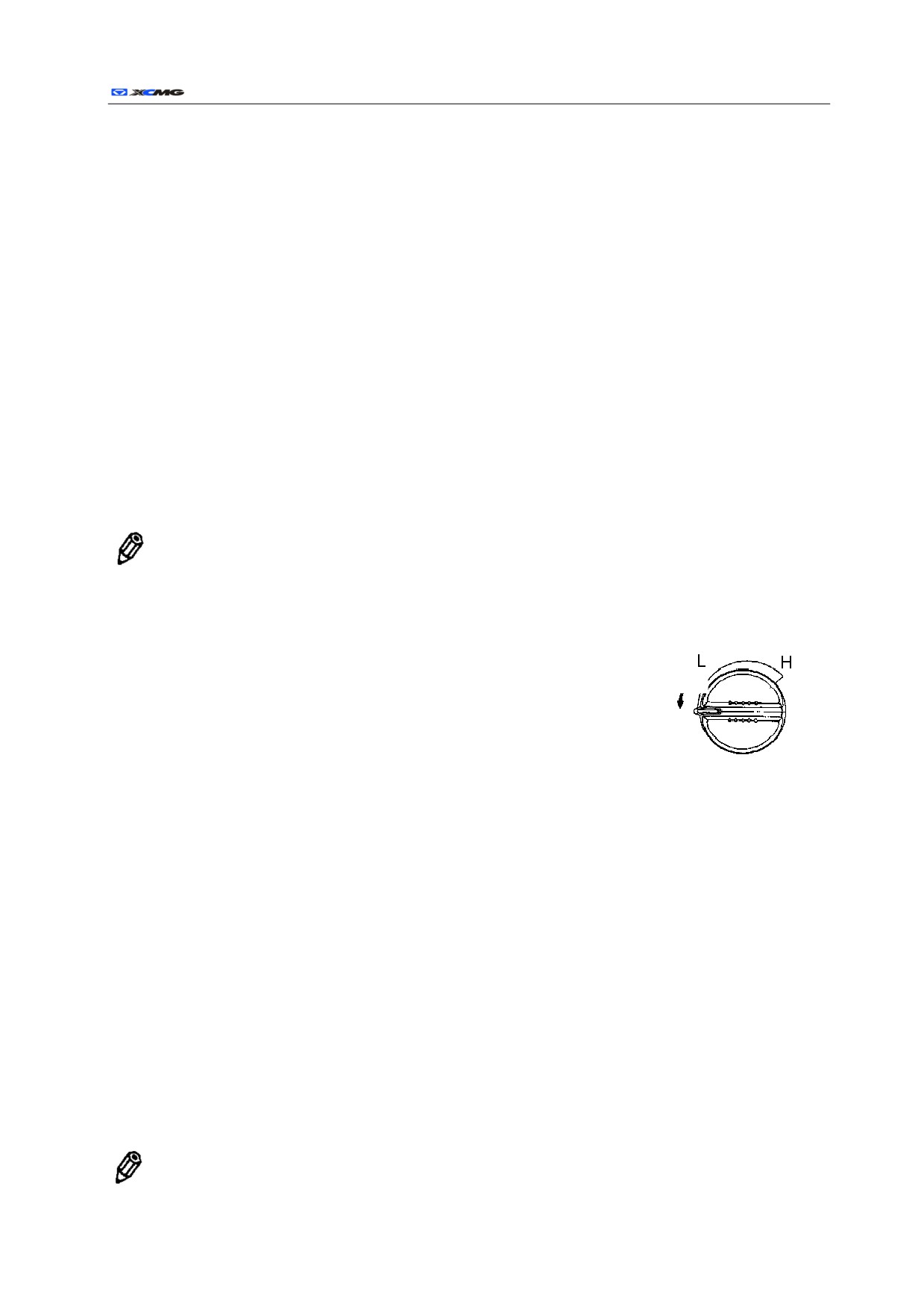
Turn the engine speed knob to the almost middle position between L (LOW) and H (HIGH).
2)
Turn the key switch to START position.
3)
The machine will automatically check if preheat is needed, if so, preheat indicator will be on for
about 8 seconds when the engine can not be started
Note:If preheat indicator does not show, it means preheat is not necessary.
r
75
4)
As the preheat indicator goes out, turn the key switch to START position again, and release it as soon
as the engine is started.
b)
Warm up the engine after the start.
Important: the best working temperature for hydraulic oil is 50℃~80℃. If the temperature is below
30℃, overwork of the machine will damage it and hydraulic parts seriously. Before the work, the
hydraulic oil should be heated up to 25℃. Before the completion of warm-up operation, it is forbidden
to operate the control lever or increase engine speed suddenly. Don’t let the engine run continuously
for over 20 min. at the idling or high speed.
1)
After the start of engine, the machine will automatically check if a warm-up is needed for the engine,
if so, warm-up indicator will be on.
Note:if warm-up indicator does not shine, it means the warm—up is not needed.
2)
At this moment, the bucket and bucket lever can be operated by turns in full stroke for 5 min. with
the interval of 30 seconds.
3)
When the hydraulic oil temperature reaches the required value, warm-up indicator will go out
showing the completion of warming up the engine.
4)
After heating the hydraulic oil, increase the engine speed and begin working.
Important: operate the machine at lower load and speed until the engine and hydraulic system have a
normal temperature.
z
Check after the start of engine
a)
Check or engine’s water temperature and oil pressure, as well as fuel level on all meters, indicators or
monitors, to see if they are normal.
b)
If the following indicators on the monitor continue to shine or the sound and exhaustion of engine are
not normal after the engine is started, the engine must be stopped immediately to remove the cause.
After starting the engine, the following should be confirmed:
1)
Indicator of alternator goes out.
2)
Oil pressure indicator of engine goes out.
3)
Sound and exhaustion of engine are normal.
c)
Check the level meter on hydraulic oil tank to see if oil level is within the regulated range.
d)
Check if fuel, oil or cooling fluid leak out.
Important: prevent the engine from possible damage.
r
76
Operation procedure of running
z
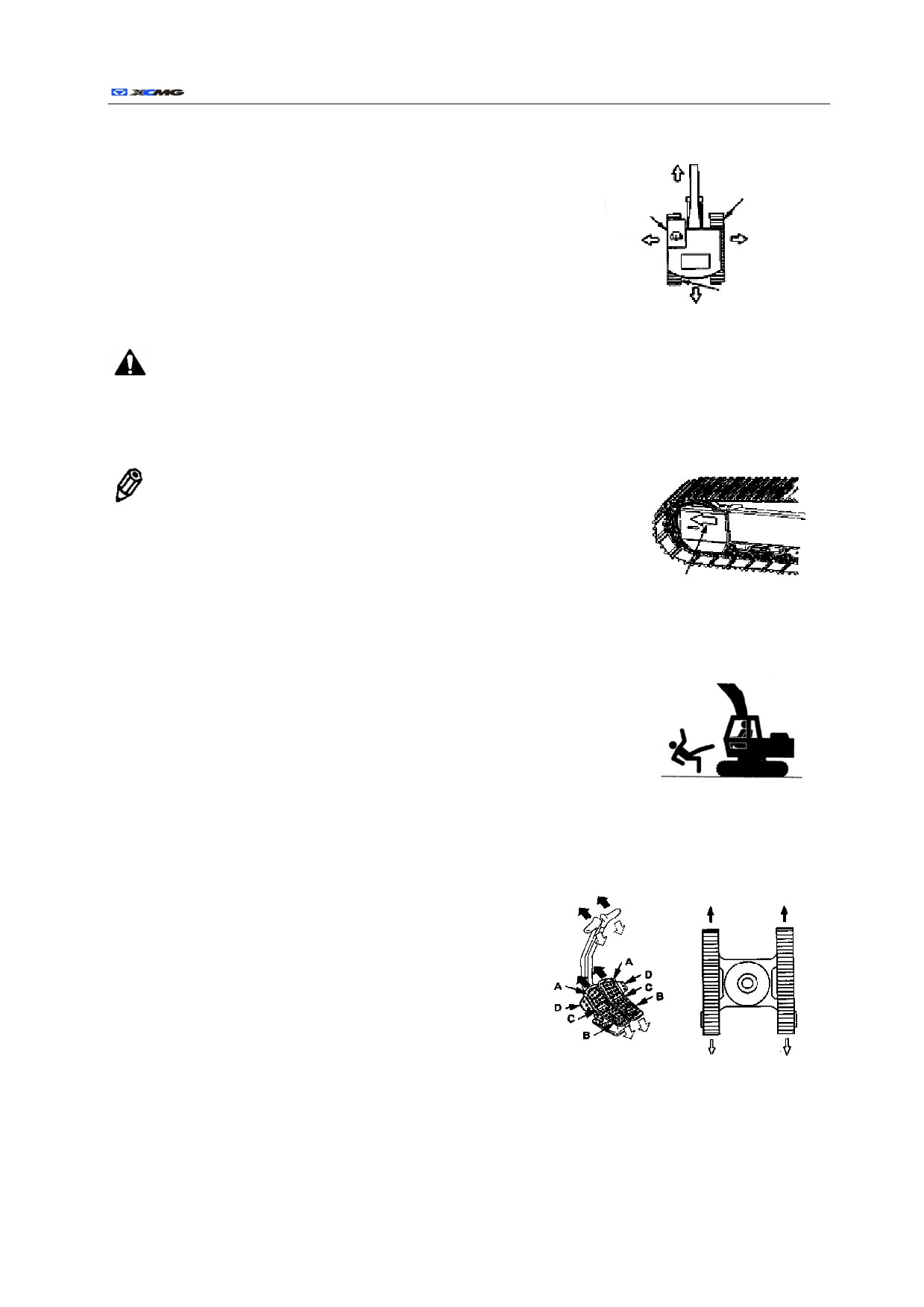
Confirm the treading direction of machine
Guidance wheel
Operational errors on treading pedal and control lever will lead to
Cab
a severe casualty.
Before driving this machine, confirm the relation between the
positions of machine’s low body and the operator.
Treading motor
If the treading motor is in the front of cab, the machine will move
backward when the treading pedal or control lever is pushed forward.
Caution: the standard treading position is: guiding wheel is in the front of the
machine, while treading motor and driving wheel at the rear. If the treading motor is in
the front, the treading pedal will function in reverse. Before treading, it is a must to
confirm the position of treading motor.
Note: at the side of chassis bodyframe, there is an arrow sign
indicating the front direction of machine.
Arrow
Fig.1-45
z
Prevent the machine from carrying the passengers.
a)
The passengers are easy to be wounded on the machine, for example, hit
by foreign object or cast away by the machine.
b)
Only the driver rather than other passenger is allowed to be on the
machine.
Fig.1-46
c)
Sometimes the passenger will block the view of driver, leading to the
operation of machine under unsafe condition.
z
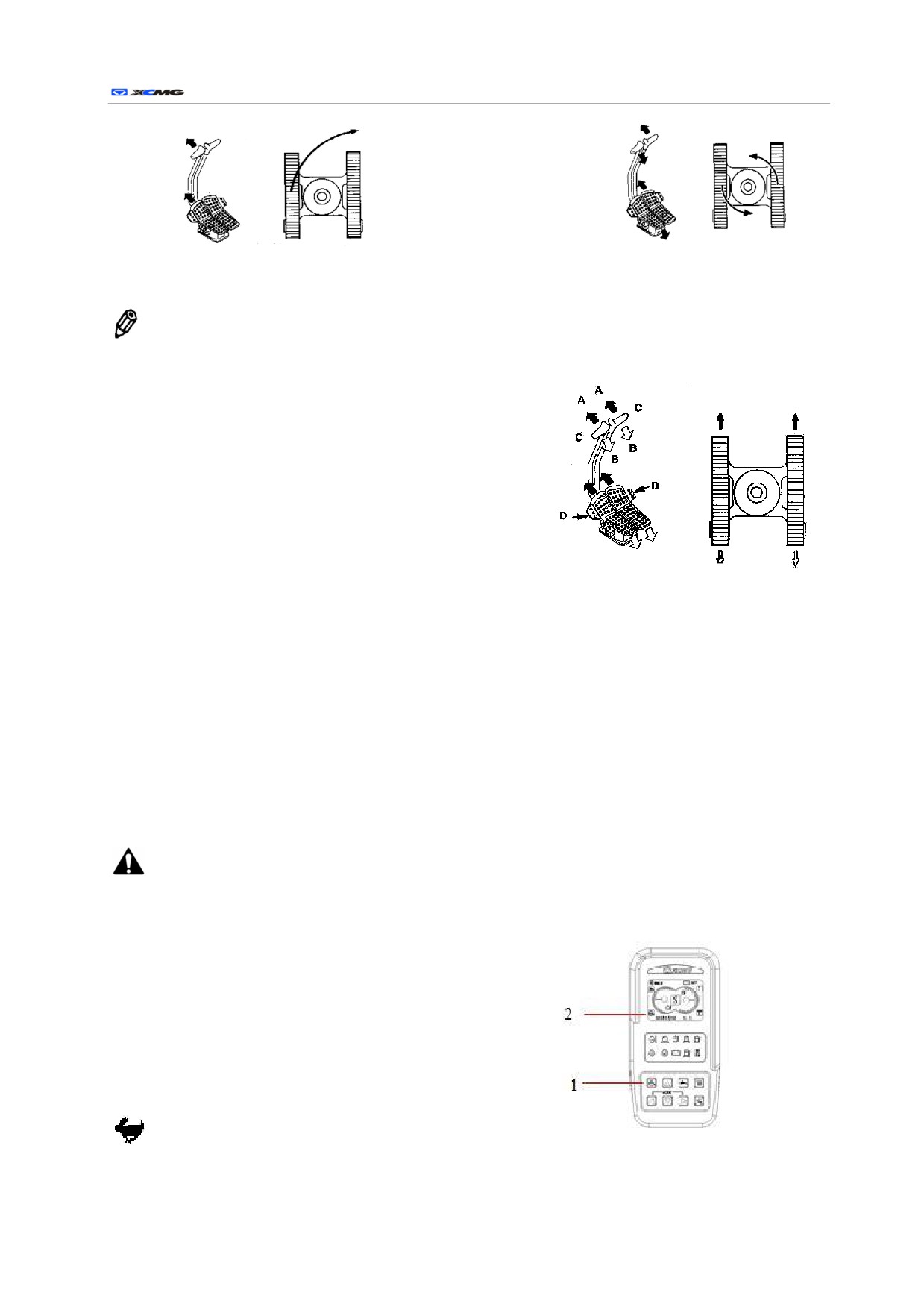
Use pedal to drive the machine
a)
travel forward:Step down the front of two pedals (A
in picture).
b)
travel backward:Step down the rear of two pedals (B
in picture).
c)
Middle position:When treading pedal is in middle
position(C in picture), the machine will be braked by
Forward and backward
treading brake.
Fig.1-47
d)
Turn right: step down the front of left pedal.
e)
Turn left: step down the front of right pedal.
f)
Rotate at the original position (self-rotation): step down the front of one pedal and the rear of another
one.
r
77
(Turn right)
(Rotate at original point)
Fig.1-48
Fig.1-49
Note: during a long journey, you can relax your feet by stepping on continuously the protruding
part of pedal (D in picture). To achieve the smooth operation, a damper has been installed on treading
guidance valve. When the weather is cold, operational force wi
increased. At this time, you can operate first
the treading control lever for several times
when the safe locking lever is at LOCK position.
z
Drive the machine through treading control lever
a)
Travel forward:push forward two treading
control levers (A in picture).
(Forward and backward)
b)
Travel backward: pull backward two treading control
levers (B in picture).
Fig.1-50
c)
Middle position:when treading control lever is in middle position(C in picture), the machine will be
braked by treading brake.
d)
Turn right: push forward the left treading control lever.
e)
Turn left: push forward the right treading control lever.
f)
Rotate at the original position (self-rotation): push forward one treading control lever while pull
another one.
z
Switch of treading mode
Caution: since rolling over of the vehicle will result in the casualty, so don’t change
the treading mode frequently, especially during the downgrade. Changing to a fast mode
will produce a very severe result. Remember to stop the machine before changing the
treading speed.
You can choose treading mode (fast/slow) through the
switch of treading mode on monitor, which will give you
the following two choices by turns with every press.
a)
Fast: indication is on.
b)
Slow: indicator is off.
sign (fast)
Fig.1-51
1-switch of treading mode
2-fast-speed indicator
r
78
z
Notes on travel
Note: when moving, rotating or operating the machine in narrow area, one signaler
is sure to be employed. Before starting the machine, hand signs should be coordinated.
a)
Before moving the machine, the operator should be clear how to operate the treading pedal/control
lever towards the desired direction. When treading motor is at the rear, the machine will move
forward in the direction of guidance wheel by stepping down the front of treading pedal or pushing
forward the treading control lever.
b)
Try to choose level ground and drive the machine in straight line, change the direction slowly and
slightly.
c)
Before the travel, check the strength of bridge and groundwork, reinforce them if necessary.
d)
To avoid of damage on road surface, it is advisable to use wooden board. When treading on pitch road
in summer, pay more attention to the drive.
e)
When crossing the rail, it is advisable to use wooden board to avoid of damage on road surface.
f)
Don’t let the machine contact with the edge of bridge.
g)
When crossing the river, the operator should measure the depth of river with bucket and cross the
river slowly. Don’t cross the river when the water exceeds the top edge of supporting-chain wheel.
h)
When treading on uneven ground, engine speed should be decreased and the slow treading mode
should be chosen to reduce the possibility of damage on the machine.
i)
Don’t travel across some obstruction, such as mud block, stone and metallic objects around the
machine. While running, other people are not allowed to stay around the machine.
j)
When running on slope, the machine may skid or turn over, causing some severe injury or even death.
k)
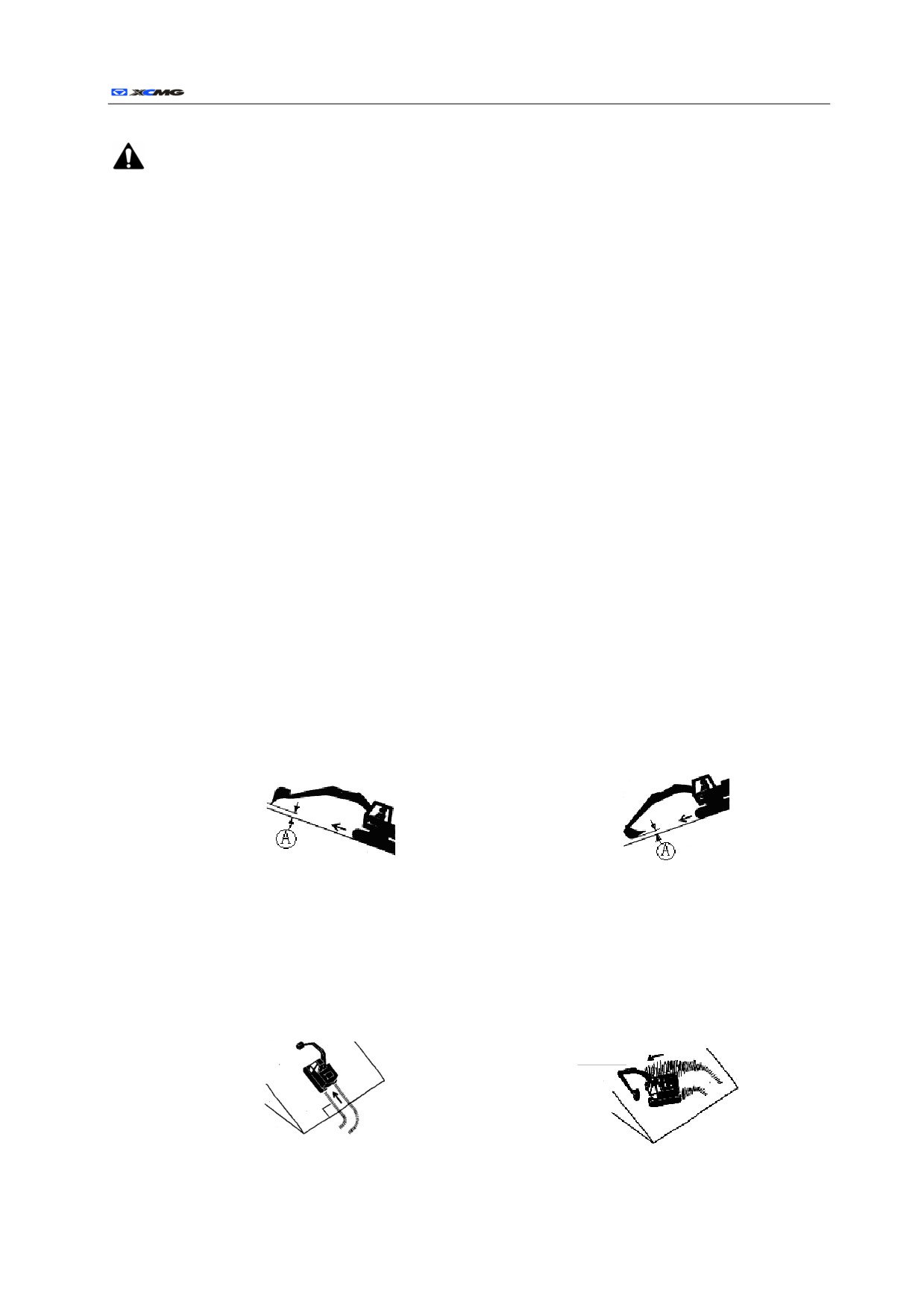
When upgrading or downgrading, bucket should be placed in the direction of treading with a distance
of 0.2-0.3 meters from the ground (see A in the picture below).
Fig.1-52
Fig.1-53
l)
If the machine begins to skid or becomes unstable, the bucket must be lowered immediately.
m) Crossing the slope sideling or changing the direction may lead to the danger of side-slipping or
turning over the machine, for the moment, it is better to travel safely through a detour after landing on
even ground
wrong
Fig.1-54
Fig.1-55
n)
Try to avoid of the operation, which may damage the crawler and lower machine parts.
r
79
o)
In frozen weather, before loading and unloading the machine, make sure to remove the deposited
snow and ice on crawler board to guard against the slip.
z
Operation on soft land
a)
Avoid running on very soft ground when there is no enough strength to support the machine.
b)
If the machine works on very soft ground or gets trapped, it is necessary to clean the chassis
bodyframe.
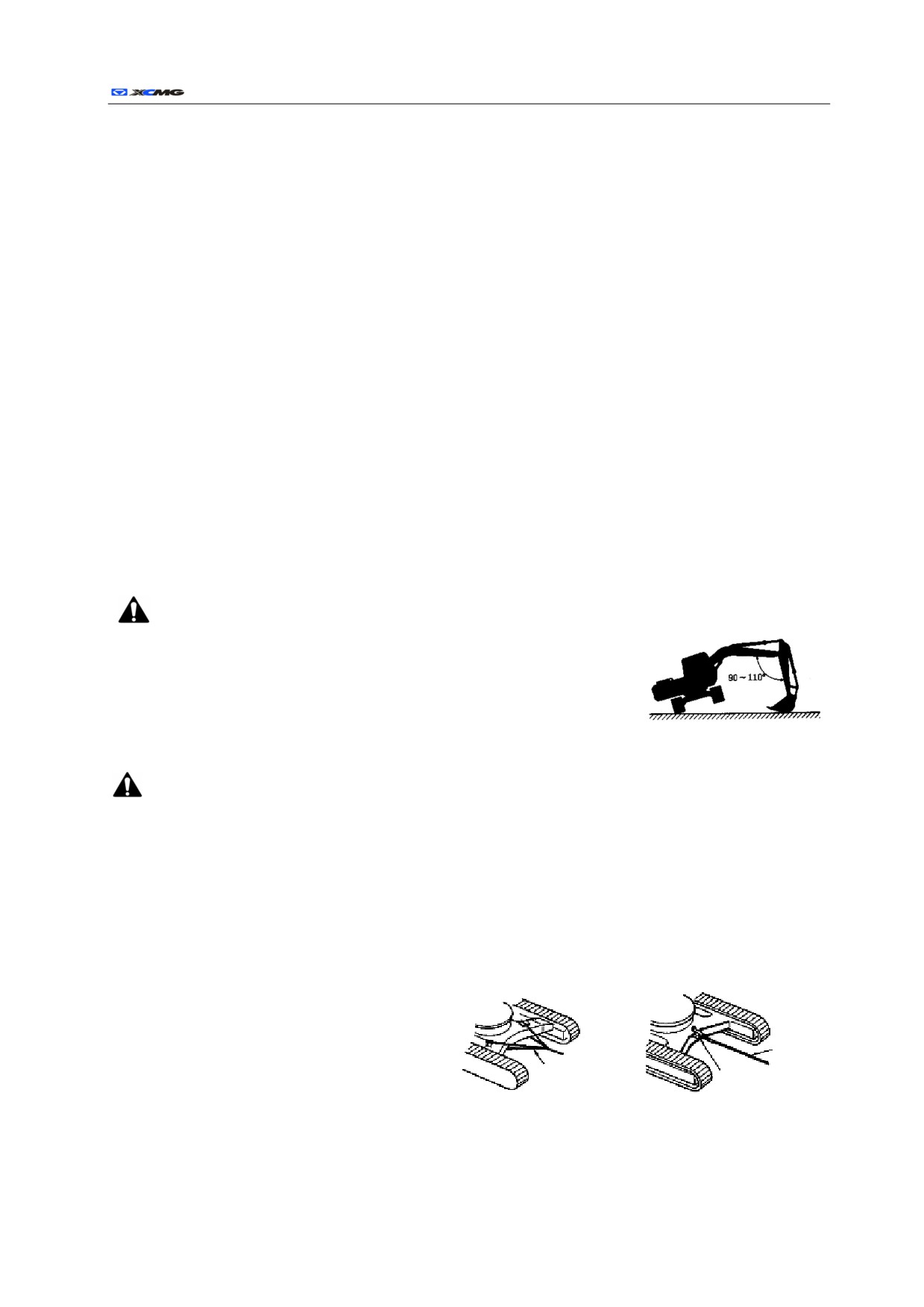
c)
One side of crawler should be lifted away from the ground by rotating the lower machine body by
90°and lowering down the bucket, the angle between the moving arm and bucket lever should be kept
90°~110°, and the arc part of bucket should be placed on ground.
d)
Remove the mud on crawler board by lifting the crawler with front and rear rotating arms.
e)
After landing the crawler, the treading speed should be lowered and the machine should be transferred
to solid ground with care.
f)
Operate the moving arm to coordinate with the bucket lever, tow the machine to solid ground.
g)
If the machine gets trapped but the engine remains working, towing the machine is possible but must
be done with towing rope equipped correctly(refer to the following part of “towing the machine in
short distance).
z
Lift single-side crawler with moving arm and bucket lever
Caution: the angle between the moving arm and bucket lever should be kept 90°~110°, and
the arc part of bucket should be placed on ground.
Crawler should be lifted away from the ground by rotating the lower machine
body by 90°and lowering down the bucket. The wedge should be placed
under the chassis bodyframe to support the machine.
Fig.1-56
z
Tow the machine is short distance
Caution: it is possible that steel cable, strap or rope will be broken and cause a
serious casualty, so damaged chain and worn steel cable, hook, strap or rope must not be
used to tow the machine. When dealing with steel cable, strap or rope, the gloves must be
worn all the time.
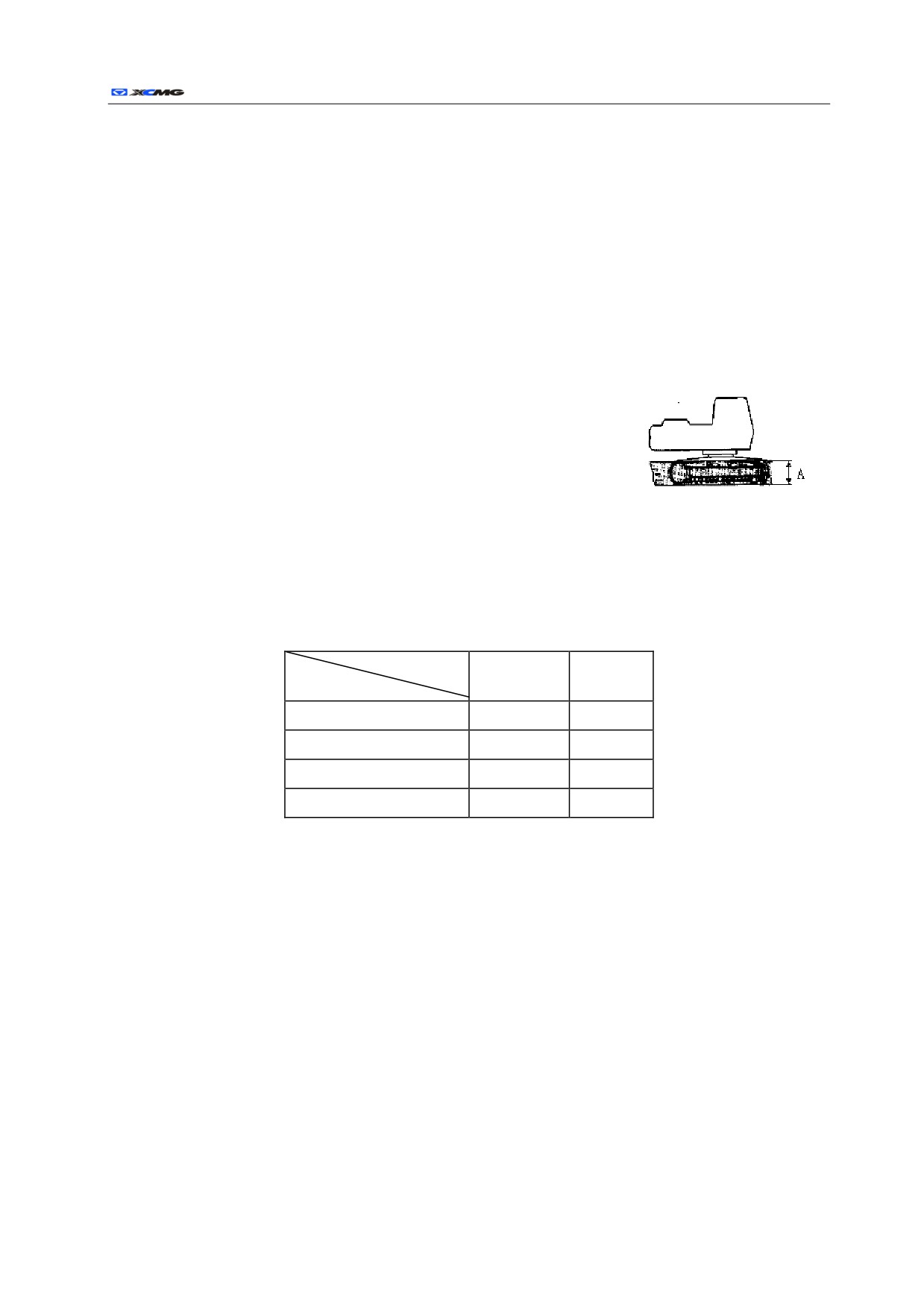
When the machine fails to run but the engine can be operated, please connect the towing steel cable and tow
your machine to solid ground by other machine according to the picture. You must fix the steel cable on
chassis bodyframe of two machines.
Correct
Wrong
Steel cable
Steel cable
Hook
Fig.1-57
To avoid the steel cable being worn out and broken, put some protection material between the chassis
bodyframe and steel cable.
Important: don’t tow the machine through hook hole on chassis bodyframe, this hole is
r
80
only for towing light-weight object.(refer to the introduction about how to use hook hole
correctly).
z
Operate in water or mud
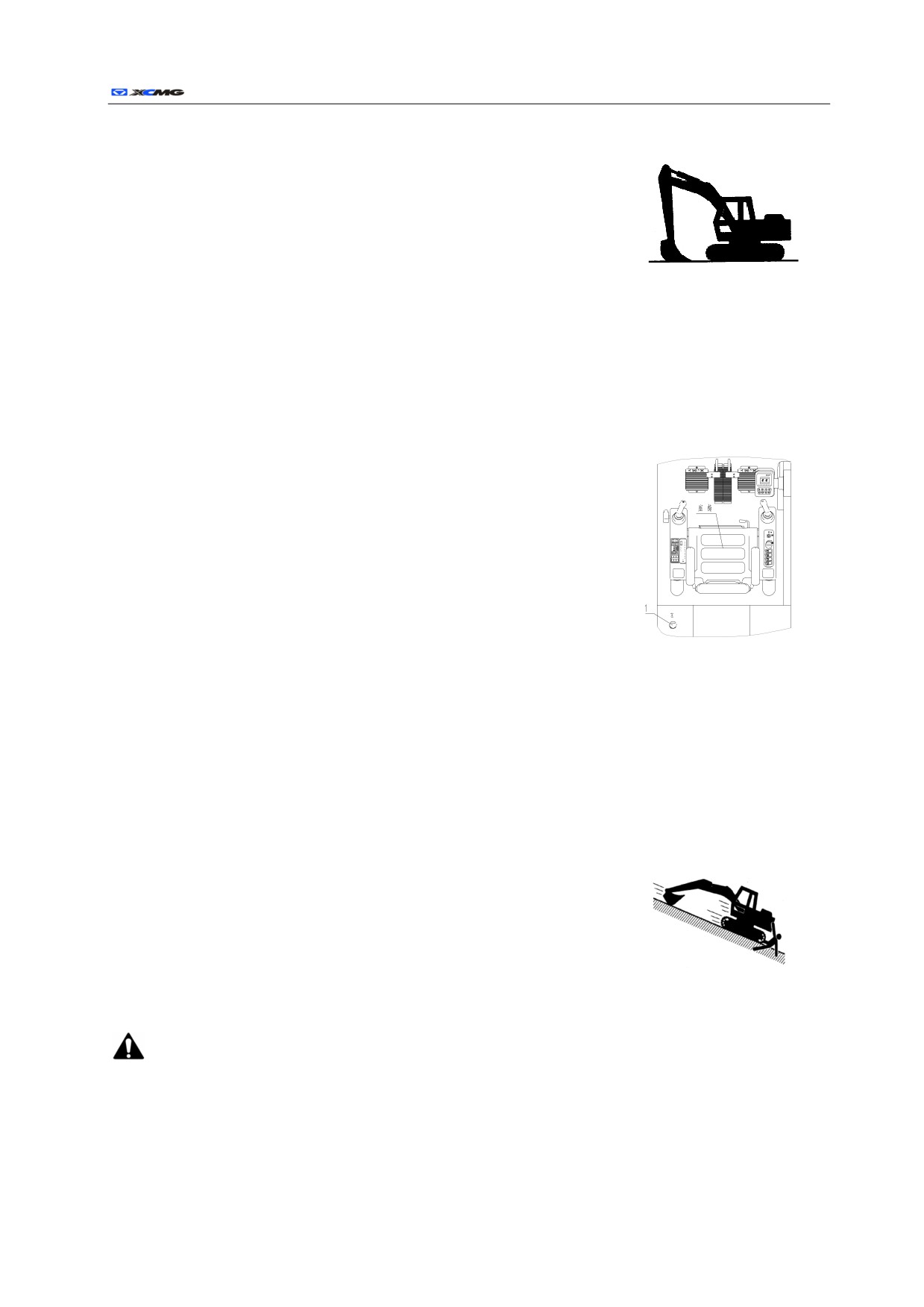
a)
Only when the groundwork of construction site is strong enough to prevent the going-down of
machine from exceeding the upper edge of supporting-chain wheel, is the machine allowed to be
operated in water whose surface is below the upper edge of supporting-chain wheel (An in picture
below).
b)
When operating under such condition, you should check the position of machine frequently, if
necessary, readjust it.
c)
Try to prevent water from submerging the rotary support, small rotary
gear and central connector.
d)
If the rotary support, small rotary gear and central connector are
submerged, you should dismantle the drain plug to remove mud and
water, cleaning rotary area, putting on the plug, lubricating the small
Fig.1-58
rotary gear and rotary support.
e)
The capacity of gear oil of rotary gearbox:B.
f)
Lubricate the rotary support (refer to the instruction of lubrication, maintenance and repair).
List 1-7 Parameter List
Parameter
A
B
Type
XE210C
770 mm
14 L
XE210C3Ⅶ
770 mm
14 L
XE210C2
770 mm
14 L
XE210C2Ⅶ
770 mm
14 L
r
81
Operation of cutoff
z
The procedure of stopping the engine
a)
Land the machine on even ground.
b)
Lower the bucket down the ground.
c)
Turn the engine speed knob to low-speed idling position
and run the engine for 5 min. to cool it.
Fig.1-59
Important: if the procedure of stopping the engine is
incorrect, turbocharger may be damaged.
d)
Turn the key switch to OFF position and stop the engine.
e)
Withdraw the key from key switch.
f)
Pull the safe locking lever to LOCK position.
Important: in bad weather, make sure to protect internal
electric parts in the cab. When parking the machine, always
shut the windows, roofhatch and the door.
g)
Shut the window and cab door.
h)
Lock all the maintenance hatches and compartments.
z
The procedure of engine’s emergency cutoff
(optional
attachment)
a)
Land the machine on even ground.
Fig.1-60
b)
Lower the bucket down to the ground.
1-Emergency cutoff button
c)
Press the emergency cutoff button and stop the engine.
Important: Normally being forbidden, this mode is used to
stop the engine only there is some big danger involving the person and equipment.
d)
Turn the key switch to OFF position and stop the engine.
e)
Withdraw the key from key switch.
f)
Pull the safe locking lever to LOCK position.
z
Prevent the machine from causing the injury
If you try to climb on or block the moving machine you may expect a
serious casualty. To prevent the machine from out of control, you should:
a)
Try to choose even ground when parking the machine.
Fig.1-61
b)
Don’t park the machine on slope.
z
Park the machine on slope
Caution: avoid parking the machine on slope, for it may roll over and lead to the person injury.
If you want to park the machine on slope, you should:
a)
Park it with proper distance away from other machine.
b)
Lower the bucket and (or) other working equipments down to the ground.
c)
Insert the bucket teeth into ground, position the machine perfectly and prevent it from rolling by
supporting the crawlers on both sides with stop blocks.
r
82
d)
Without load, run the engine 5 min. at low idling speed to cool the engine.
e)
Stop the engine and withdraw the key from switch.
f)
Pull the safe locking lever to LOCK position.
g)
Shut the windows and cab door.
h)
Lock all the maintenance hatches and compartments.
Fig.1-62
r
83
Getting on and off the machine
z
Use railing and ladder
Falling off is one of the major causes for person’s Injury. When getting on
or off the machine, make sure to keep three touching points (two feet and
one hand or two hands and one foot) with railing, pedal and crawler all the
time, facing the machine.
Fig.1-63
a)
Before getting on or off the machine, you should clean and dry the
oil, butter, mud or sand on railing, board or crawler immediately if they exist, then keep these parts
clean. If some part is damaged, you should repair it and tighten the loose screw.
b)
When getting on or off the machine, don’t grip the control lever.
c)
Don’t jump on or off the machine, especially those moving one, for these behaviors may make you
suffered from injury.
d)
While leaving the machine, pay attention to the slippery platform, ladder or railing.
r
84
Operating procedure
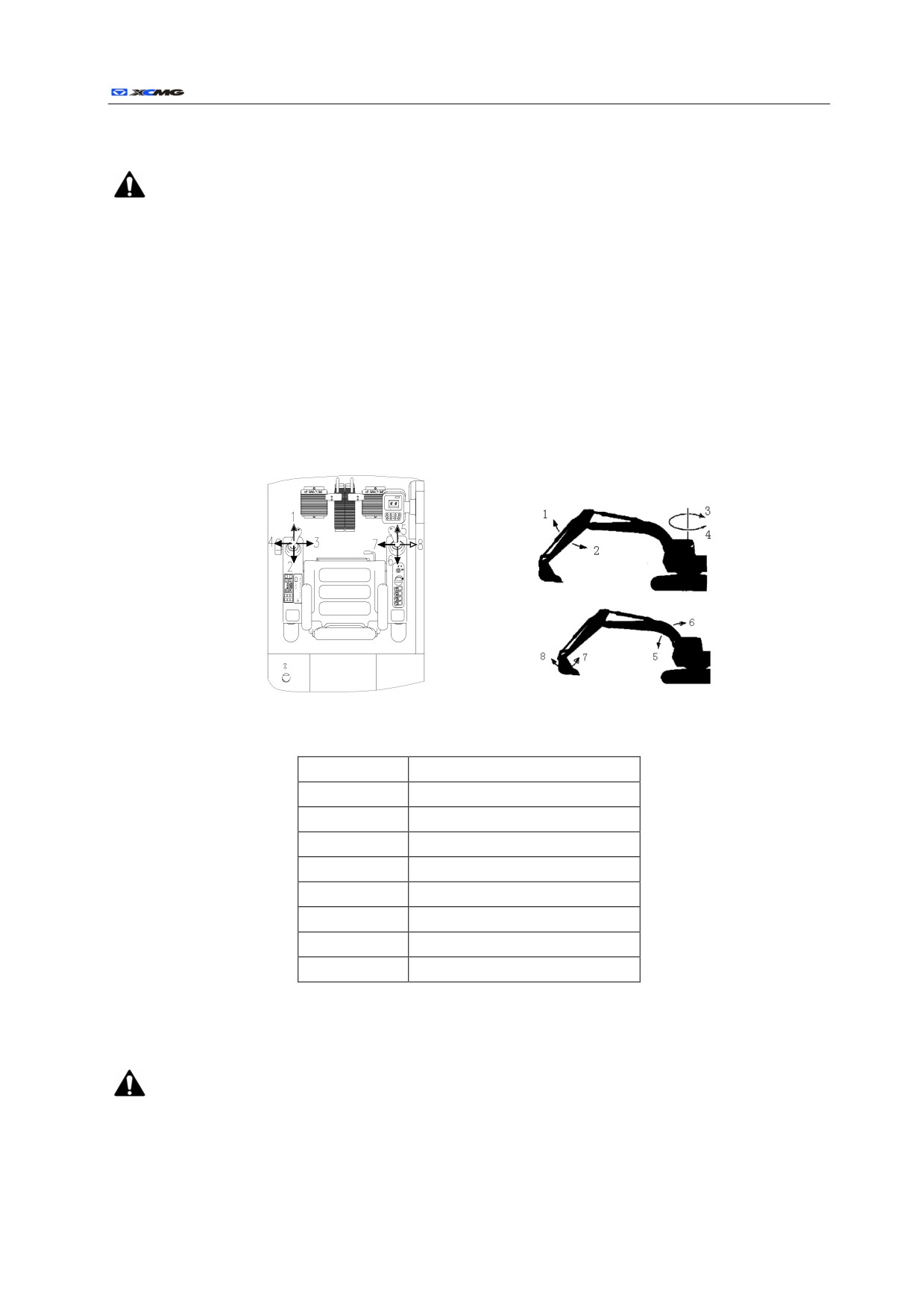
z
Control lever
Caution: Don’t extend any part of your body out of the right window frame of the cab. If
touching the right control lever due to careless collision or other reason, you may be injured by moving
arm. If some window is lost or broken, you should add or replace into a new one. Before the operation,
you should know very well the position and function of every control lever to prevent yourself from
injuring by accidental movement of the machine.
Important: don’t let hydraulic cylinder of moving arm contact with the crawler. When excavating near
one end of the crawler, you should place the treading motor at the rear to maximize the machine
stability and lifting ability.
On the machine, there is a scutcheon indicating the control mode of control lever and treading pedal. After
being released, the control lever will return to the middle position automatically followed by the stop of the
machine.
Fig.1-65
Fig.1-64
List 1-8 List of illustrated signs
Serial number
Function
1
Bucket lever protrudes
2
Bucket lever withdraws
3
Turn right
4
Turn left
5
Moving arm goes down
6
Moving arm goes up
7
Bucket excavates
8
Bucket unloads
z
Safe locking lever
When leaving or entering into the cab, the operator may touch the control lever accidentally, this can
be prevented by safe locking lever.
Caution:
1)
Always pull the safe locking lever to full LOCK position, or it won’t function.
2)
When leaving the machine, stop the engine and then pull the safe locking lever to full LOCK
position.