FM 3-05.70 Field Manual Survival (17 May 2002) - page 16
Oak (Continued)
Other Uses: Oak wood is excellent for building or burning. Small oaks can be
split and cut into long thin strips
(3 to
6 millimeters
[1/8 to
1/4 inch] thick and 1.2 centimeters [1/3 inch] wide) used to weave mats, baskets,
or frameworks for packs, sleds, furniture, etc. Oak bark soaked in water produces
a tanning solution used to preserve leather.
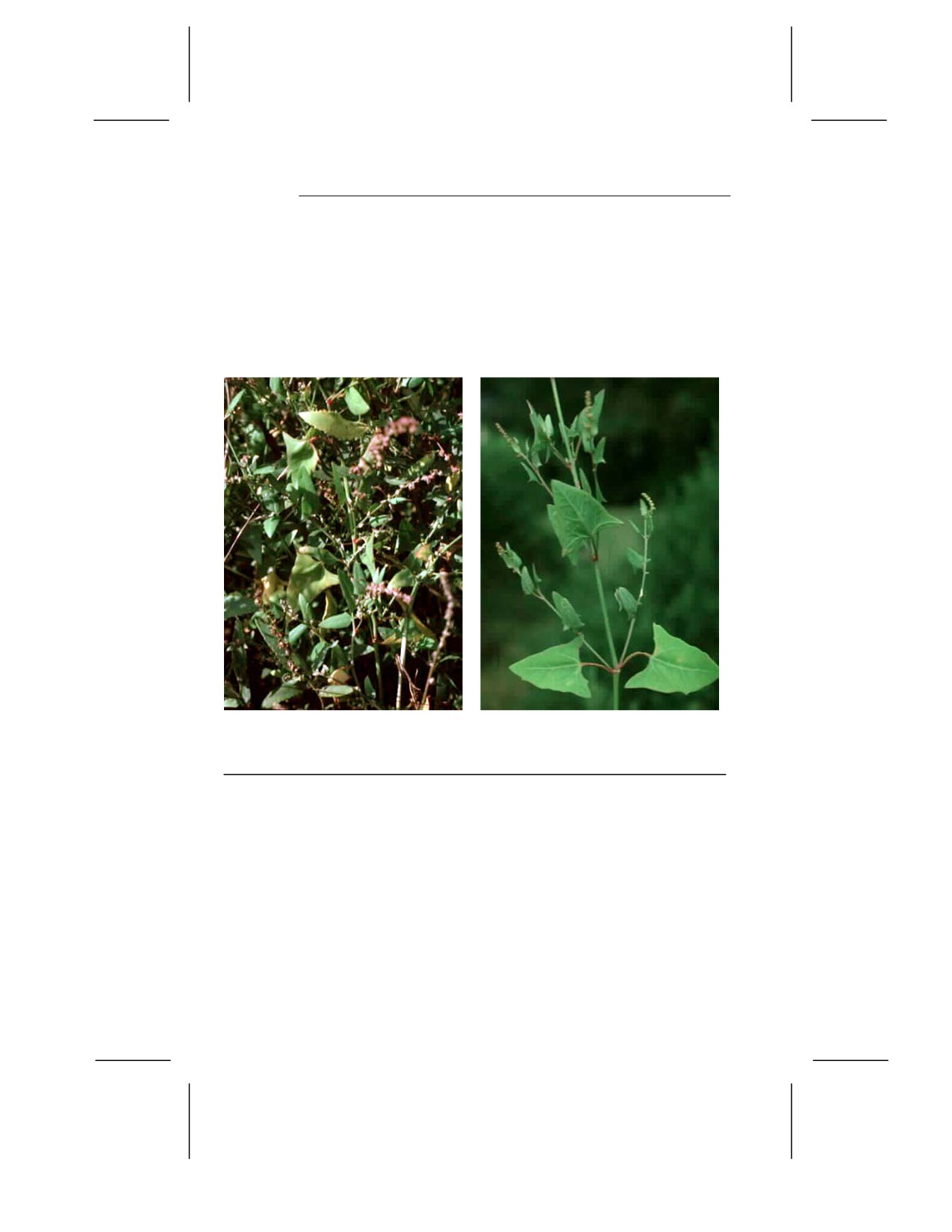
Orach
Atriplex species
Description: This plant is vinelike in growth and has arrowhead-shaped,
alternate leaves up to 5 centimeters (2 inches) long. Young leaves maybe silver-
colored. Its flowers and fruits are small and inconspicuous.
Habitat and Distribution: Orach species are entirety restricted to salty soils.
They are found along North America’s coasts and on the shores of alkaline lakes
inland. They are also found along seashores from the Mediterranean countries to
inland areas in North Africa and eastward to Turkey and central Siberia.
Edible Parts: The entire plant is edible raw or boiled.
B-60
Palmetto palm
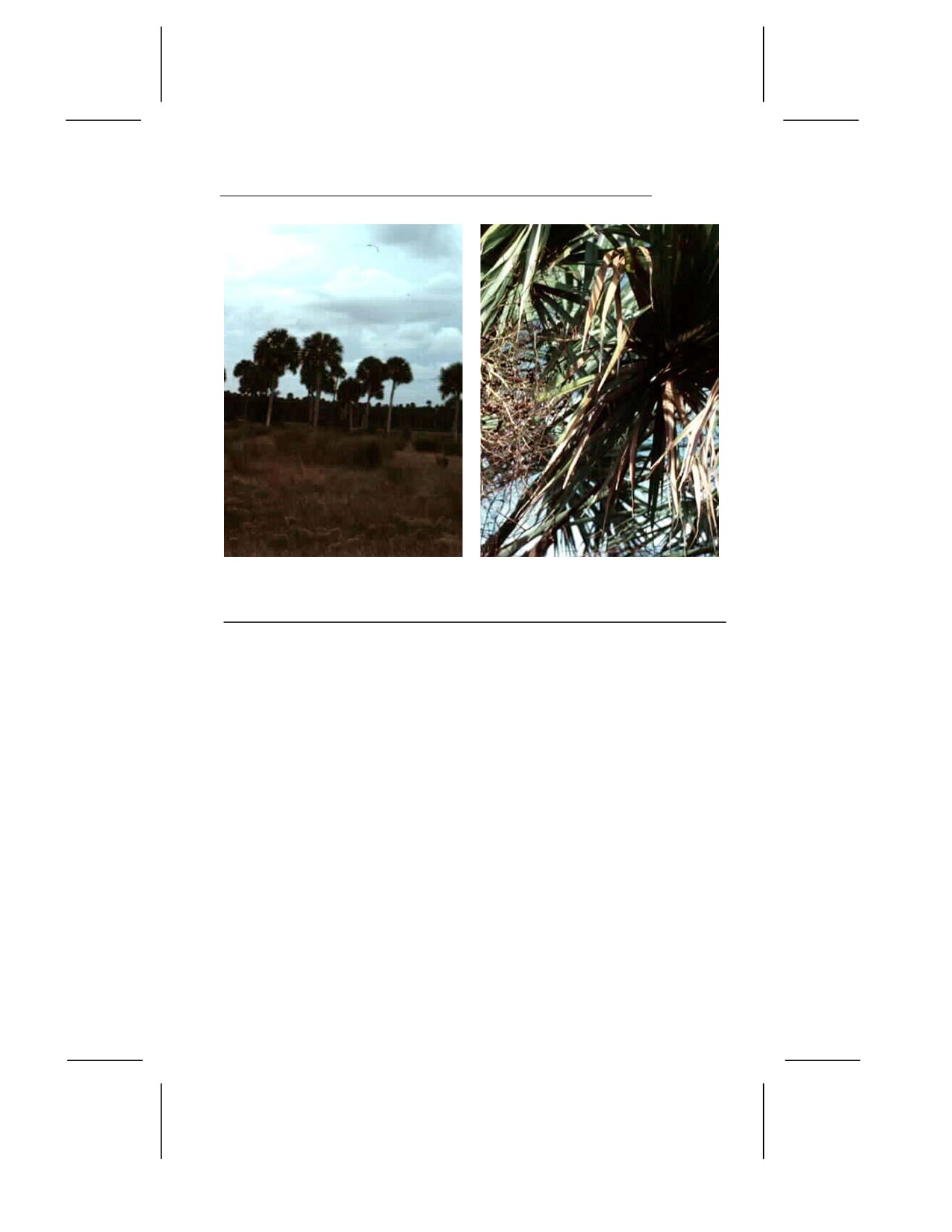
Sabal palmetto
Description: The palmetto palm is a tall, unbranched tree with persistent leaf
bases on most of the trunk. The leaves are large, simple, and palmately lobed.
Its fruits are dark blue or black with a hard seed.
Habitat and Distribution: The palmetto palm is found throughout the coastal
regions of the southeastern United States.
Edible Parts: The fruits are edible raw. The hard seeds may be ground into flour.
The heart of the palm is a nutritious food source at any time. Cut off the top of the
tree to obtain the palm heart.
B-61
Papaya or pawpaw
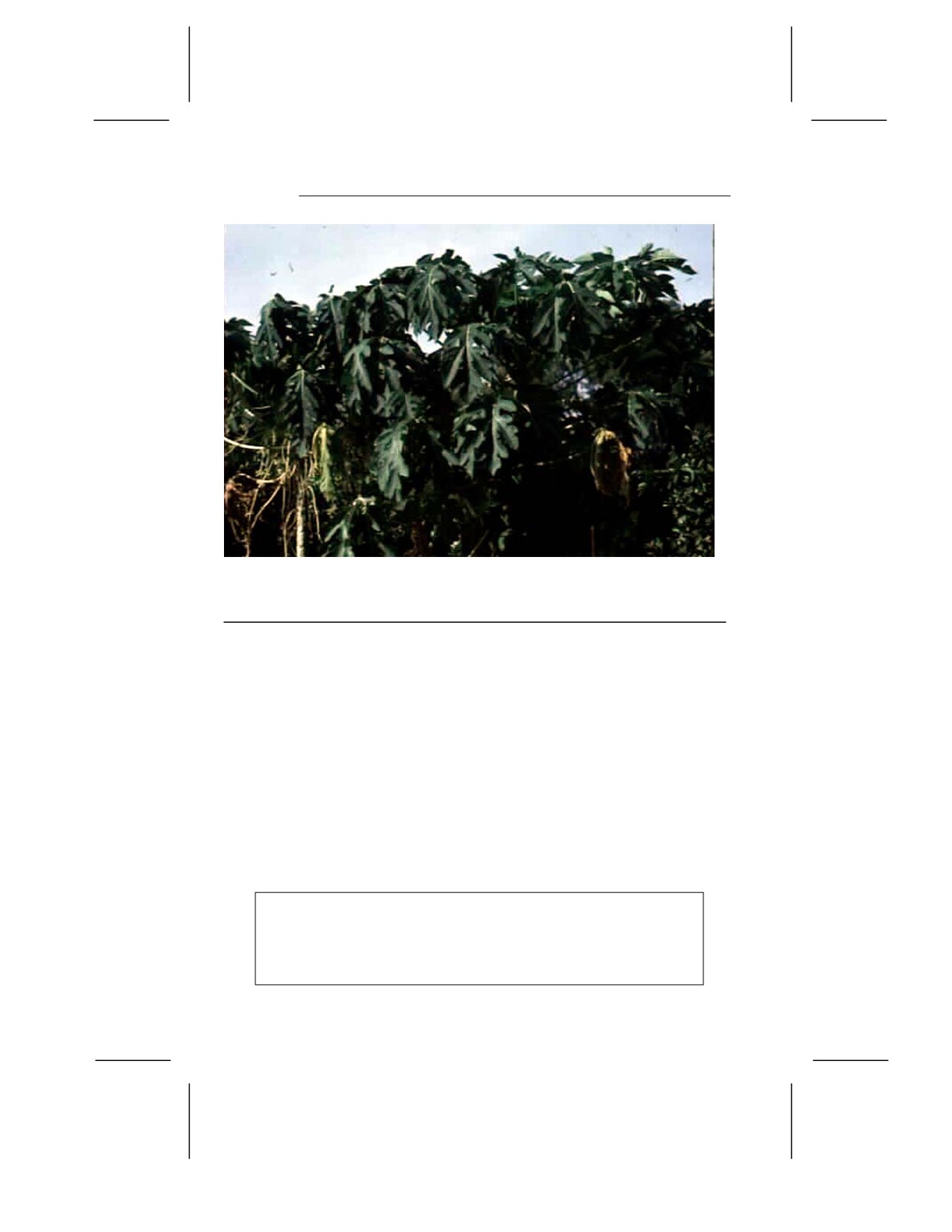
Carica papaya
Description: The papaya is a small tree 1.8 to 6 meters (6 to 20 feet) tall, with a
soft, hollow trunk. When cut, the entire plant exudes a milky juice. The trunk is
rough and the leaves are crowded at the trunk’s apex. The fruit grows directly
from the trunk, among and below the leaves. The fruit is green before ripening.
When ripe, it turns yellow or remains greenish with a squashlike appearance.
Habitat and Distribution: Papaya is found in rain forests and semievergreen
seasonal forests in tropical regions and in some temperate regions as well. Look
for it in moist areas near clearings and former habitations. It is also found in
open, sunny places in uninhabited jungle areas.
Edible Parts: The ripe fruit is high in vitamin C. Eat it raw or cook it like squash.
Place green fruit in the sun to make it ripen quickly. Cook the young papaya
leaves, flowers, and stems carefully, changing the water as for taro.
Other Uses: Use the milky juice of the unripe fruit to tenderize tough meat. Rub
the juice on the meat.
CAUTION
Be careful not to get the milky sap from the unripe fruit into your
eyes. It will cause intense pain and temporary—sometimes even
permanent—blindness.
B-62
Persimmon
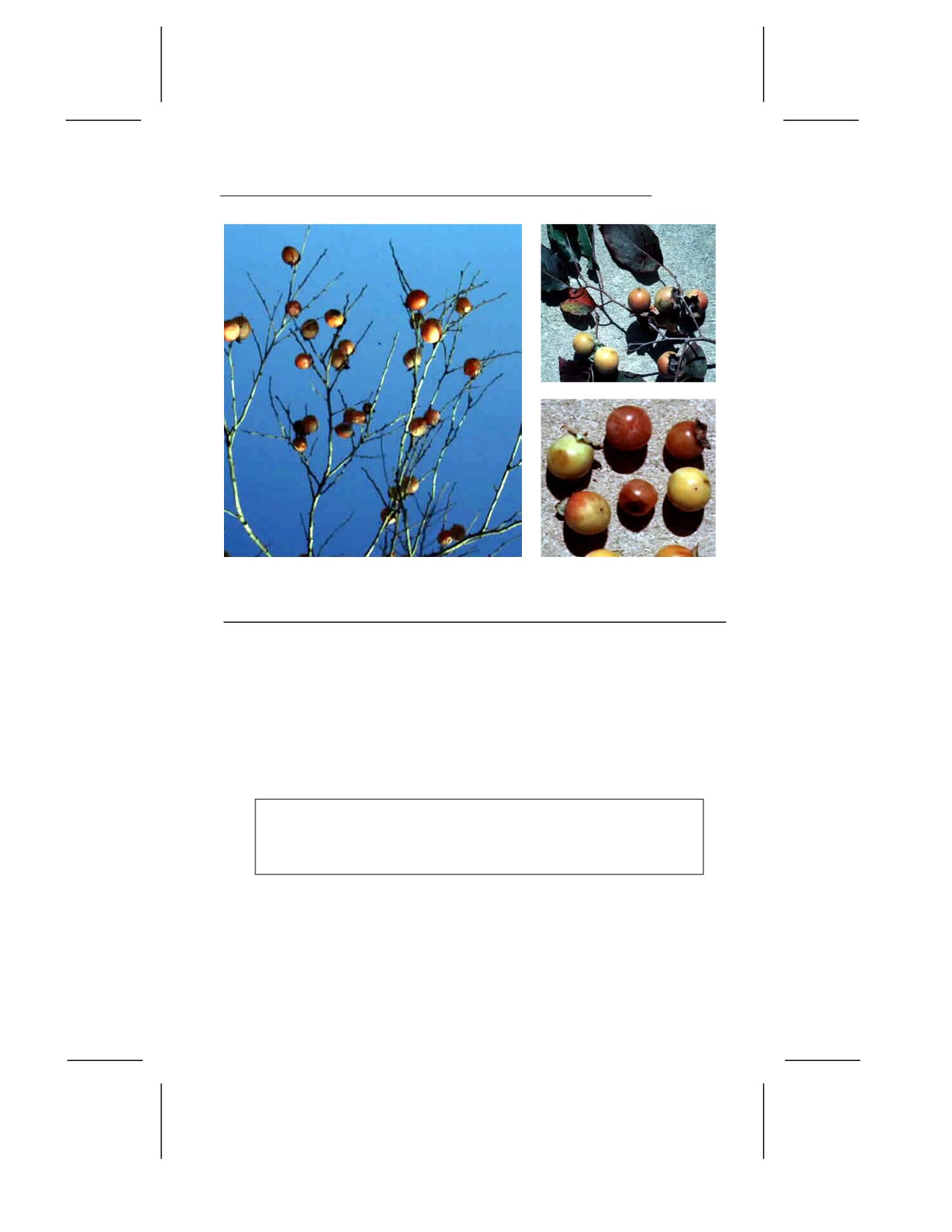
Diospyros virginiana and other species
Description: These trees have alternate, dark green, elliptic leaves with entire
margins. The flowers are inconspicuous. The fruits are orange, have a sticky
consistency, and have several seeds.
Habitat and Distribution: The persimmon is a common forest margin tree. It is
wide spread in Africa, eastern North America, and the Far East.
Edible Parts: The leaves are a good source of vitamin C. The fruits are edible
raw or baked. To make tea, dry the leaves and soak them in hot water. You can
eat the roasted seeds.
CAUTION
Some persons are unable to digest persimmon pulp. Unripe
persimmons are highly astringent and inedible.
B-63
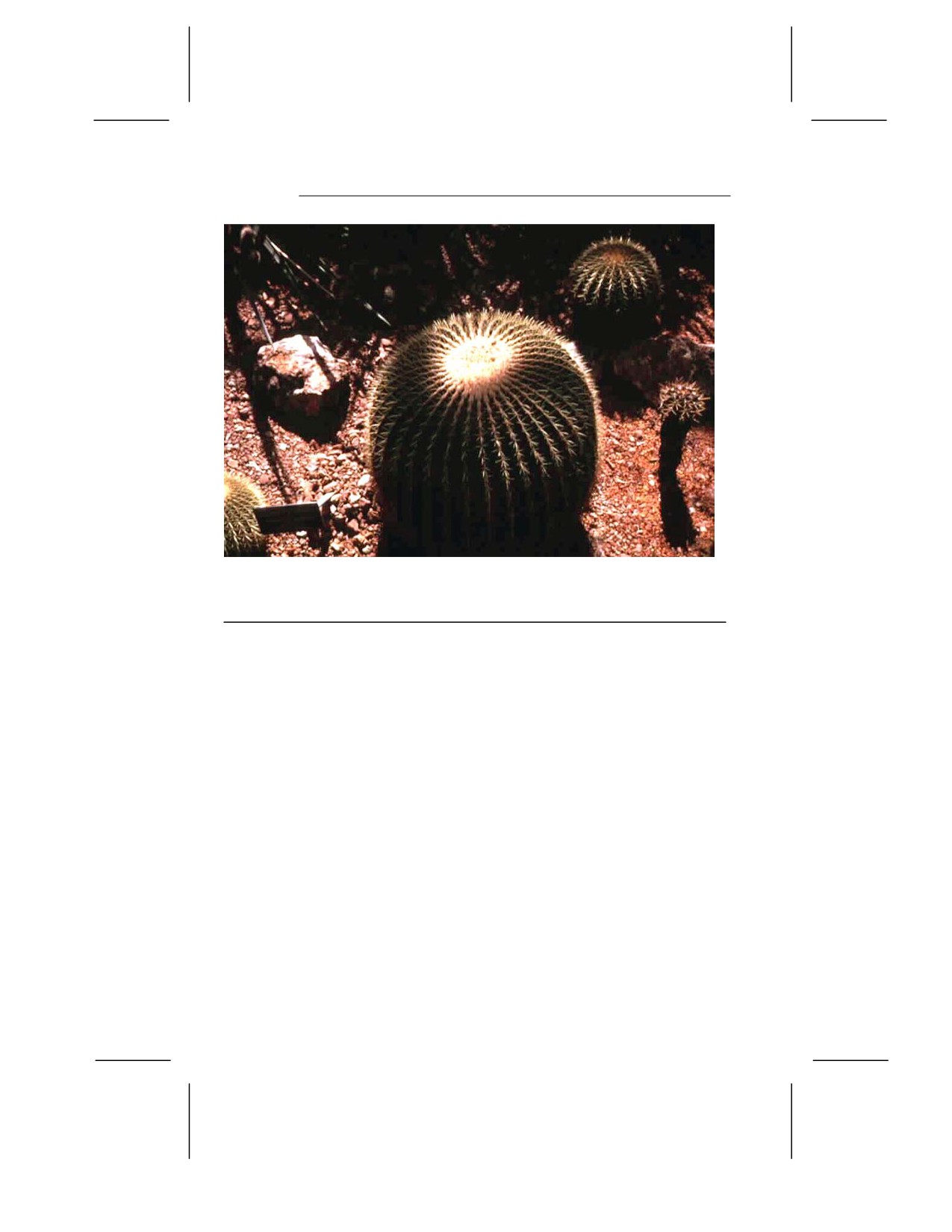
Pincushion cactus
Mammilaria species
Description: Members of this cactus group are round, short, barrel-shaped, and
without leaves. Sharp spines cover the entire plant.
Habitat and Distribution: These cacti are found throughout much of the desert
regions of the western United States and parts of Central America.
Edible Parts: They are a good source of water in the desert.
B-64
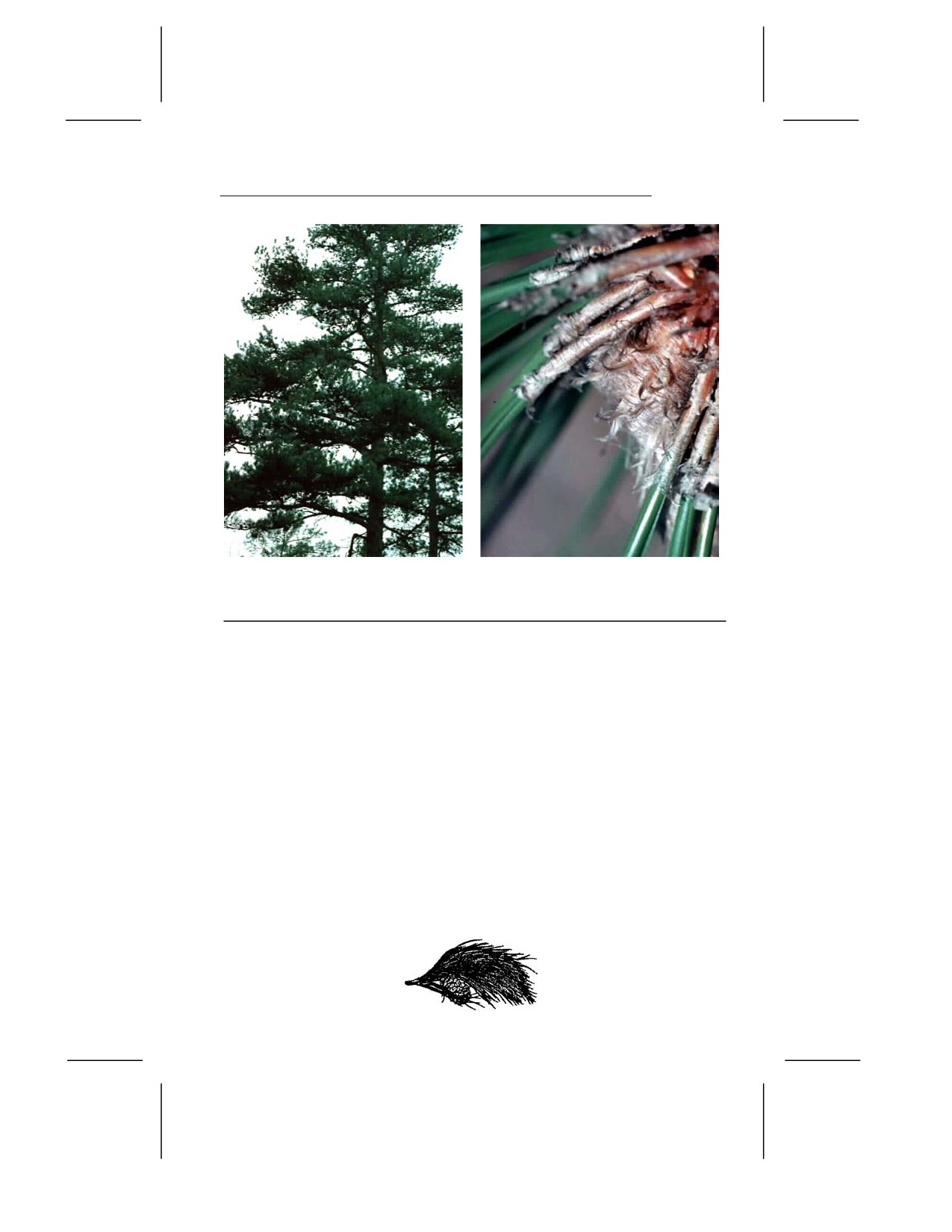
Pine
Pinus species
Description: Pine trees are easily recognized by their needlelike leaves grouped
in bundles. Each bundle may contain one to five needles, the number varying
among species. The tree’s odor and sticky sap provide a simple way to
distinguish pines from similar looking trees with needlelike leaves.
Habitat and Distribution: Pines prefer open, sunny areas. They are found
throughout North America, Central America, much of the Caribbean region, North
Africa, the Middle East, Europe, and some places in Asia.
Edible Parts: The seeds of all species are edible. You can collect the young
male cones, which grow only in the spring, as a survival food. Boil or bake the
young cones. The bark of young twigs is edible. Peel off the bark of thin twigs.
You can chew the juicy inner bark; it is rich in sugar and vitamins. Eat the seeds
raw or cooked. Green pine needle tea is high in vitamin C.
Other Uses: Use the resin to waterproof articles. Also, use it as glue. Collect the
resin from the tree. If there is not enough resin on the tree, cut a notch in the bark
so more sap will seep out. Put the resin in a container and heat it. The hot resin
is your glue. Use it as is or add a small amount of ash dust to strengthen it. Use it
immediately. You can use hardened pine resin as an emergency dental filling.
B-65
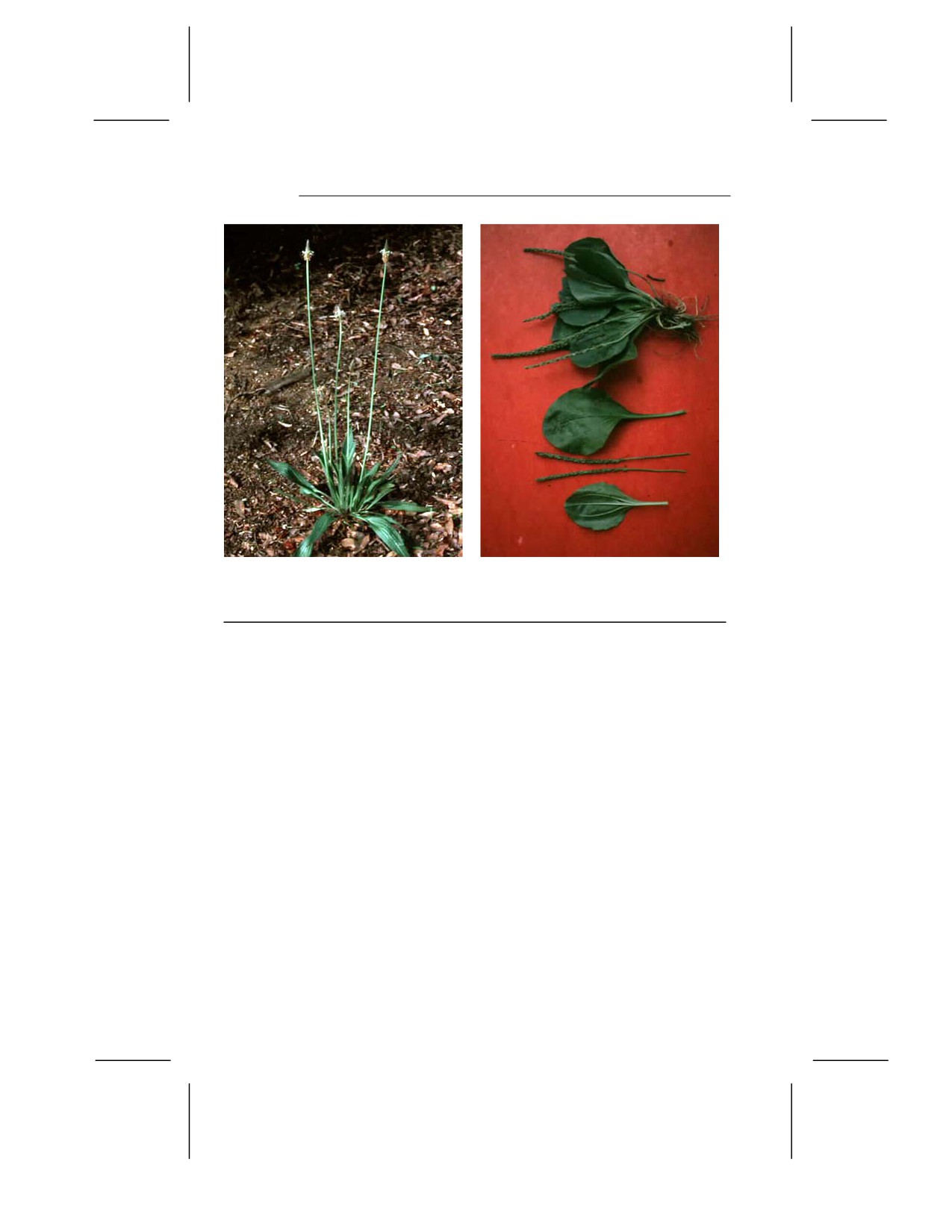
Plantain, broad and narrow leaf
Plantago species
Description: The broad leaf plantain has leaves over
2.5 centimeters
(1 inch) across that grow close to the ground. The flowers are on a spike that
rises from the middle of the cluster of leaves. The narrow leaf plantain has leaves
up to 12 centimeters (5 inches) long and 2.5 centimeters (1 inch) wide, covered
with hairs. The leaves form a rosette. The flowers are small and inconspicuous.
Habitat and Distribution: Look for these plants in lawns and along roads in the
north temperate zone. This plant is a common weed throughout much of
the world.
Edible Parts: The young tender leaves are edible raw. Older leaves should be
cooked. Seeds are edible raw or roasted.
Other Uses: To relieve pain from wounds and sores, wash and soak the entire
plant for a short time and apply it to the injured area. To treat diarrhea, drink tea
made from 28 grams (1 ounce) of the plant leaves boiled in 0.5 liter of water. The
seeds and seed husks act as laxatives.
B-66
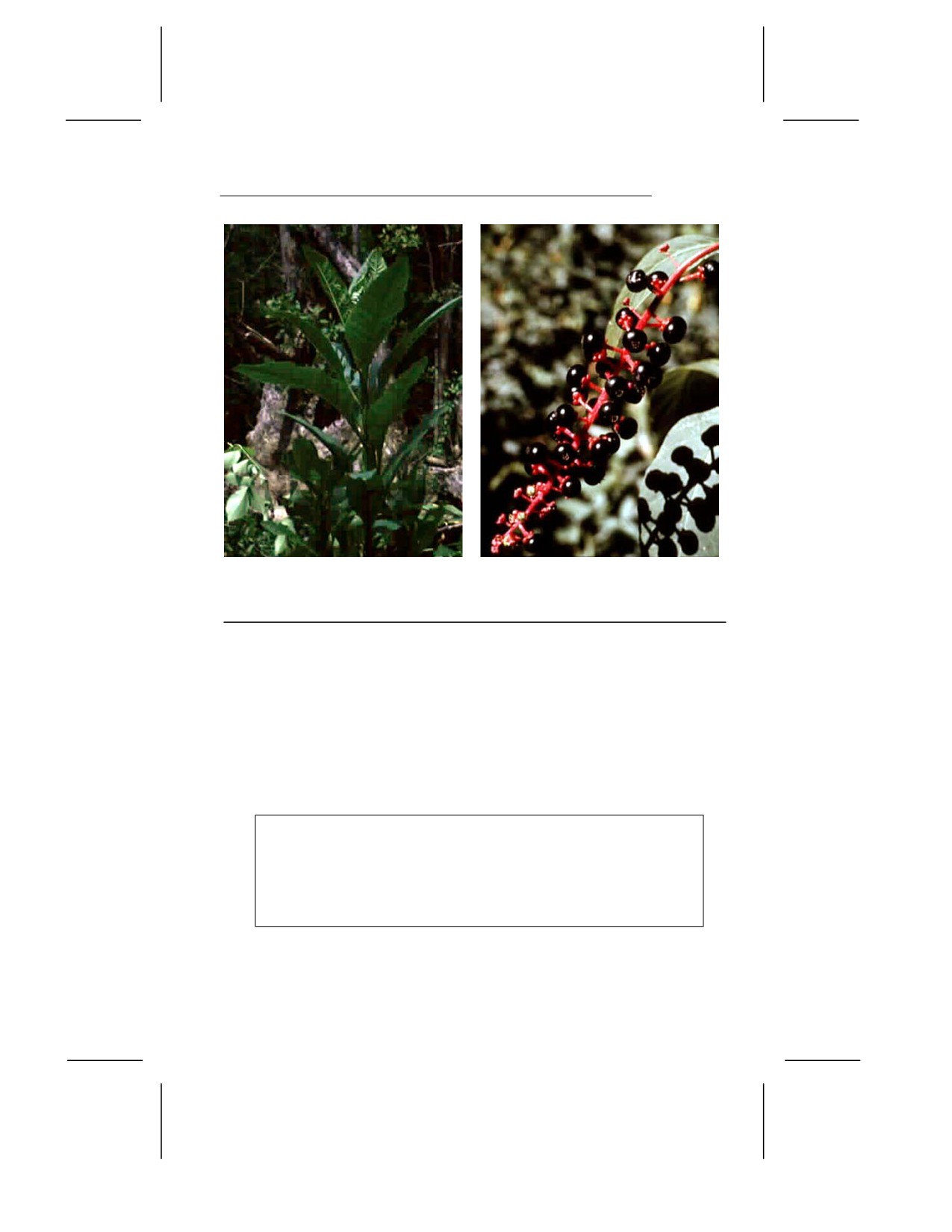
Pokeweed
Phytolacca americana
Description: This plant may grow as high as 3 meters (9 feet). Its leaves are
elliptic and up to 1 meter (3 feet) in length. It produces many large clusters of
purple fruits in late spring.
Habitat and Distribution: Look for this plant in open, sunny areas in forest
clearings, in fields, and along roadsides in eastern North America, Central
America, and the Caribbean.
Edible Parts: The young leaves and stems are edible cooked. Boil them twice,
discarding the water from the first boiling. The berries are considered poisonous,
even if cooked.
CAUTION
All parts of this plant are poisonous if eaten raw. Never eat the
underground portions of the plant as these contain the highest
concentrations of the poisons. Do not eat any plant over 25
centimeters (10 inches) tall or when red is showing in the plant.
Other Uses: Use the juice of fresh berries as a dye.
B-67
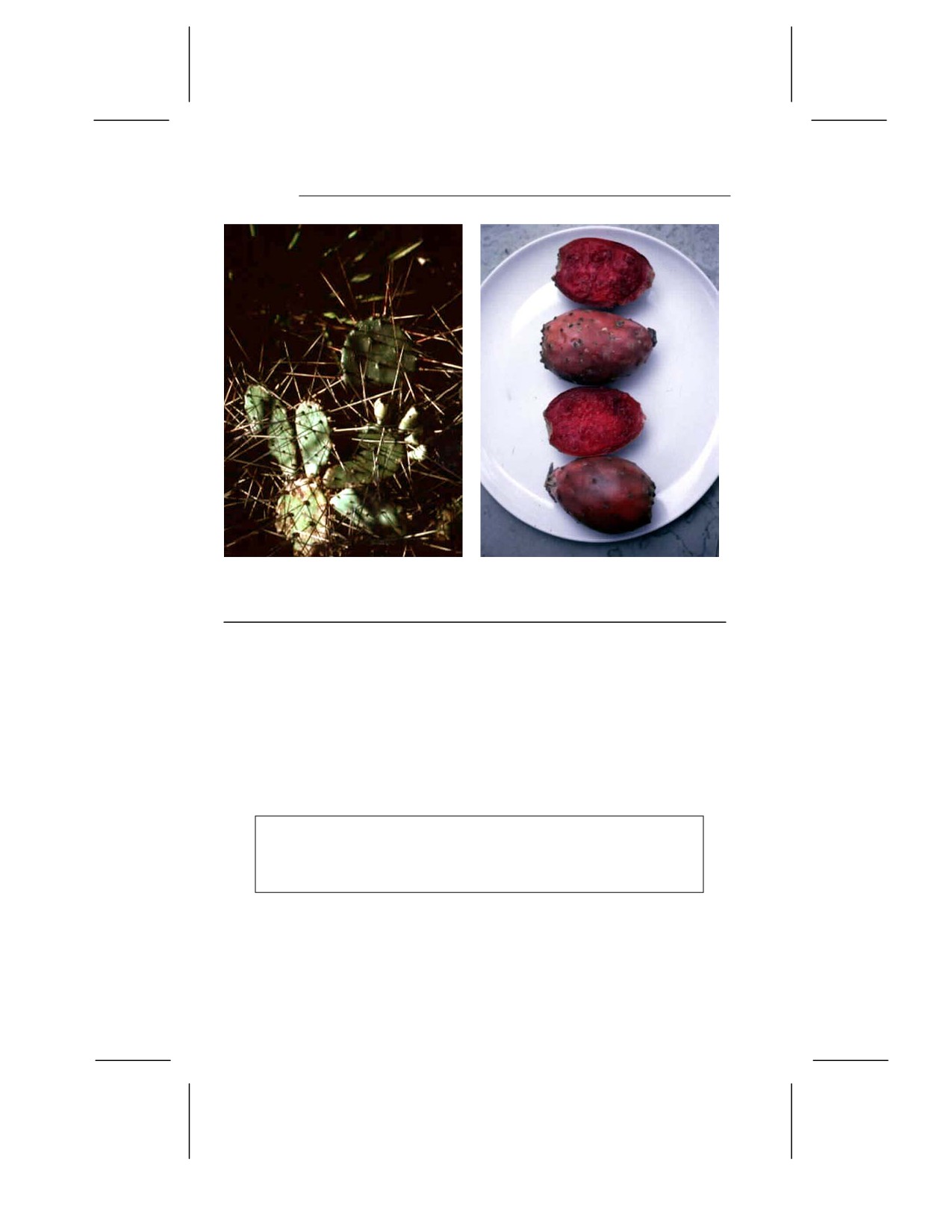
Prickly pear cactus
Opuntia species
Description: This cactus has flat, padlike stems that are green. Many round,
furry dots that contain sharp-pointed hairs cover these stems.
Habitat and Distribution: This cactus is found in arid and semiarid regions and
in dry, sandy areas of wetter regions throughout most of the United States and
Central and South America. Some species are planted in arid and semiarid
regions of other parts of the world.
Edible Parts: All parts of the plant are edible. Peel the fruits and eat them fresh
or crush them to prepare a refreshing drink. Avoid the tiny, pointed hairs. Roast
the seeds and grind them to a flour.
CAUTION
Avoid any plant that resembles the prickly pear cactus and has
milky sap.
Other Uses: The pad is a good source of water. Peel it carefully to remove all
sharp hairs before putting it in your mouth. You can also use the pads to promote
healing. Split them and apply the pulp to wounds.
B-68
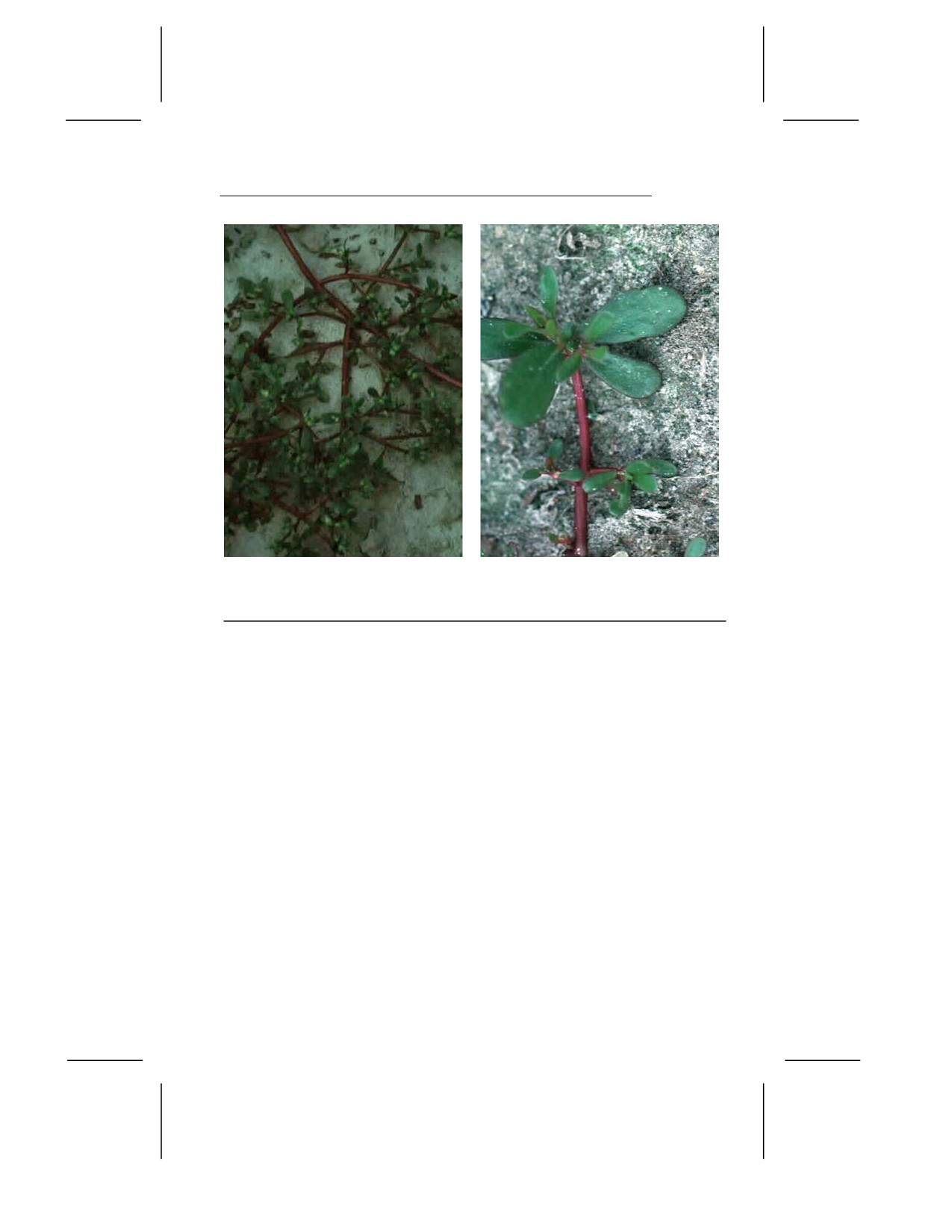
Purslane
Portulaca oleracea
Description: This plant grows close to the ground. It is seldom more than a few
centimeters tall. Its stems and leaves are fleshy and often tinged with red. It has
paddleshaped leaves, 2.5 centimeters (1 inch) or less long, clustered at the tips
of the stems. Its flowers are yellow or pink. Its seeds are tiny and black.
Habitat and Distribution: It grows in full sun in cultivated fields, field margins,
and other weedy areas throughout the world.
Edible Parts: All parts are edible. Wash and boil the plants for a tasty vegetable
or eat them raw. Use the seeds as a flour substitute or eat them raw.
B-69
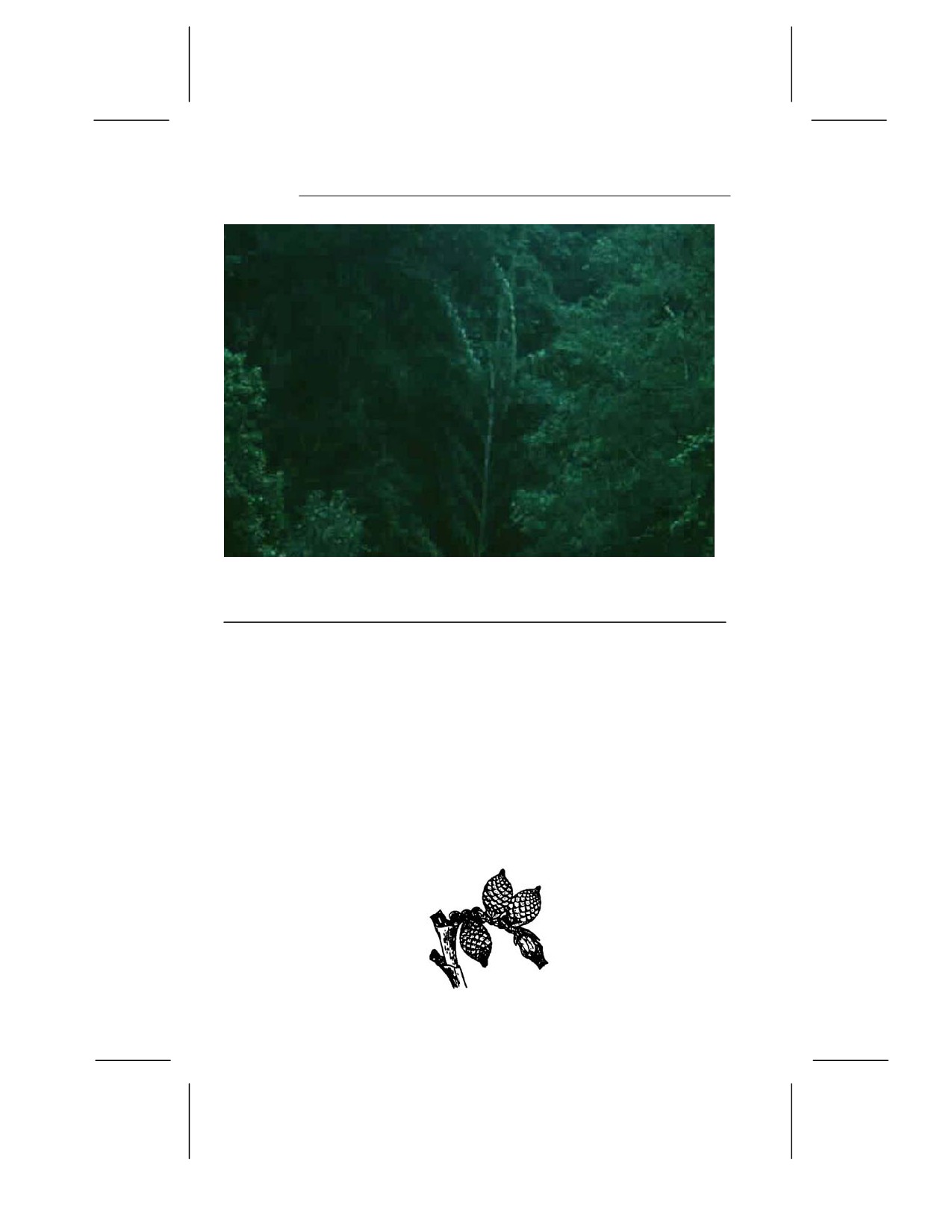
Rattan palm
Calamus species
Description: The rattan palm is a stout, robust climber. It has hooks on the
midrib of its leaves that it uses to remain attached to the trees on which it grows.
Sometimes, mature stems grow to 90 meters
(300 feet). It has alternate,
compound leaves and a whitish flower.
Habitat and Distribution: The rattan palm is found from tropical Africa through
Asia to the East Indies and Australia. It grows mainly in rain forests.
Edible Parts: Rattan palms hold a considerable amount of starch in their young
stem tips. You can eat them roasted or raw. In other kinds, a gelatinous pulp,
either sweet or sour, surrounds the seeds. You can suck out this pulp. The palm
heart is also edible raw or cooked.
Other Uses: You can obtain large amounts of potable water by cutting the ends
of the long stems (see Chapter 6). The stems can be used to make baskets and
fish traps.
B-70
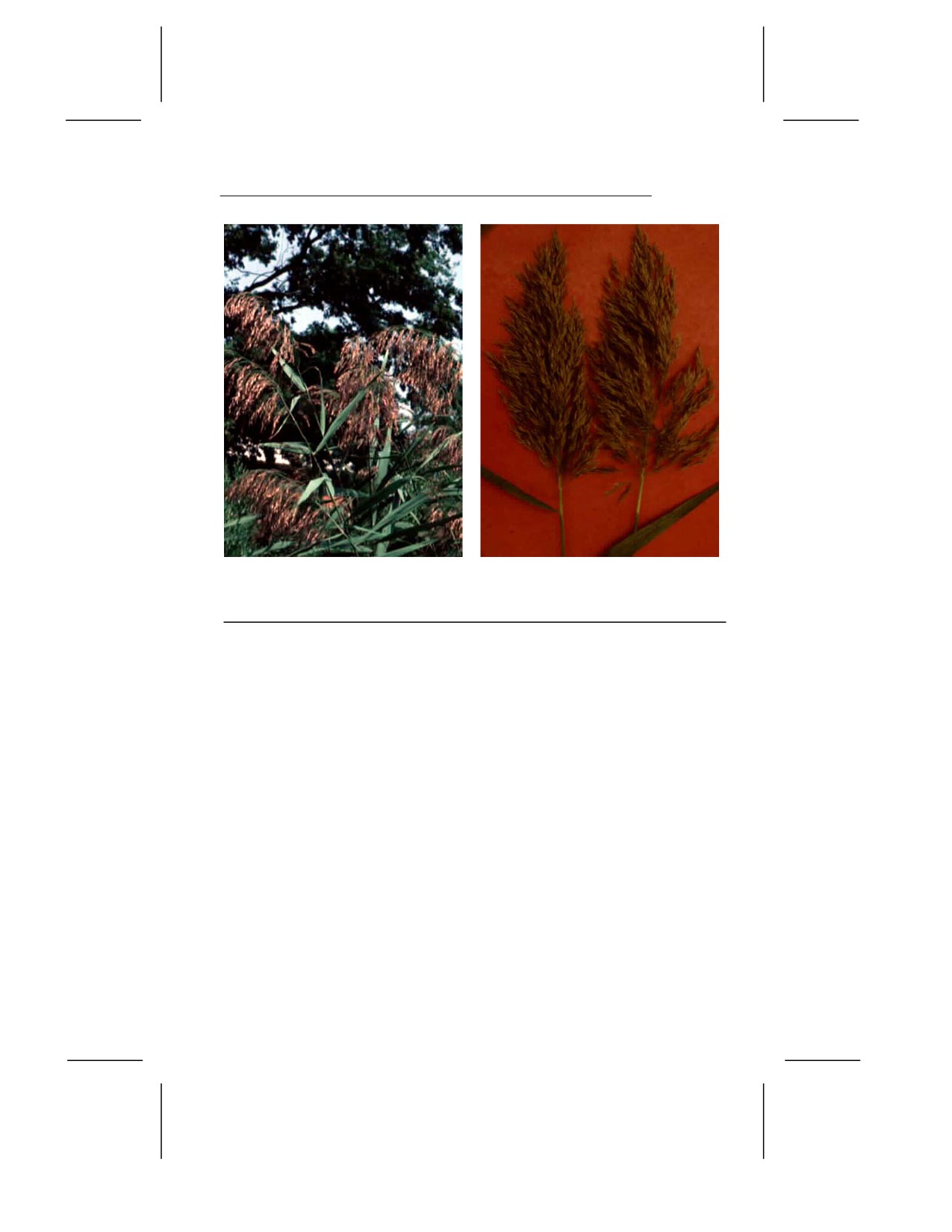
Reed
Phragmites australis
Description: This tall, coarse grass grows to 3.5 meters (12 feet) tall and has
gray-green leaves about 4 centimeters (1 1/2 inch) wide. It has large masses of
brown flower branches in early summer. These rarely produce grain and become
fluffy, gray masses late in the season.
Habitat and Distribution: Look for reed in any open, wet area, especially one
that has been disturbed through dredging. Reed is found throughout the
temperate regions of both the Northern and Southern Hemispheres.
Edible Parts: All parts of the plant are edible raw or cooked in any season.
Harvest the stems as they emerge from the soil and boil them. You can also
harvest them just before they produce flowers, then dry and beat them into flour.
You can also dig up and boil the underground stems, but they are often tough.
Seeds are edible raw or boiled, but they are rarely found.
B-71
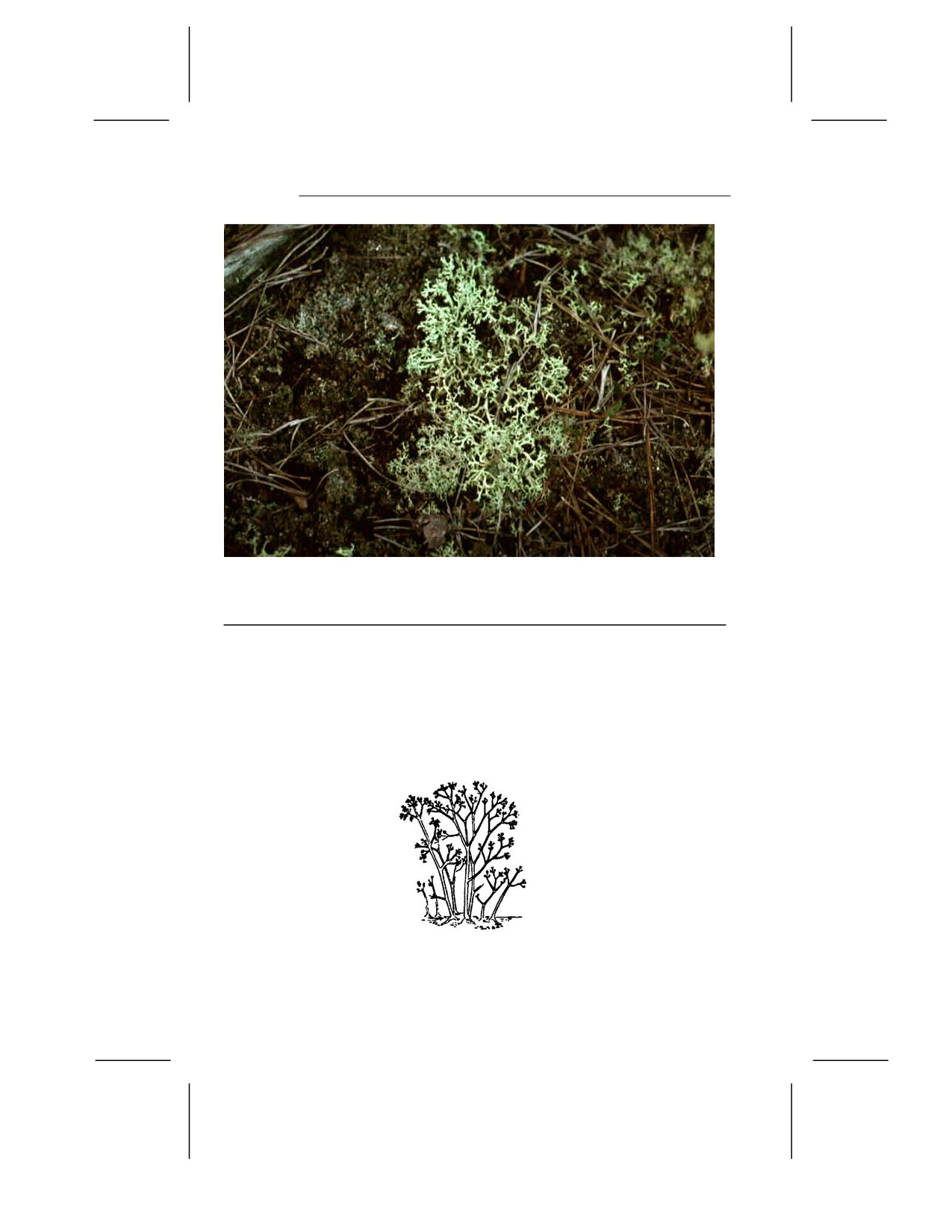
Reindeer moss
Cladonia rangiferina
Description: Reindeer moss is a low-growing plant only a few centimeters tall. It
does not flower but does produce bright red reproductive structures.
Habitat and Distribution: Look for this lichen in open, dry areas. It is very
common in much of North America.
Edible Parts: The entire plant is edible but has a crunchy, brittle texture. Soak
the plant in water with some wood ashes to remove the bitterness; then dry,
crush, and add it to milk or to other food.
B-72
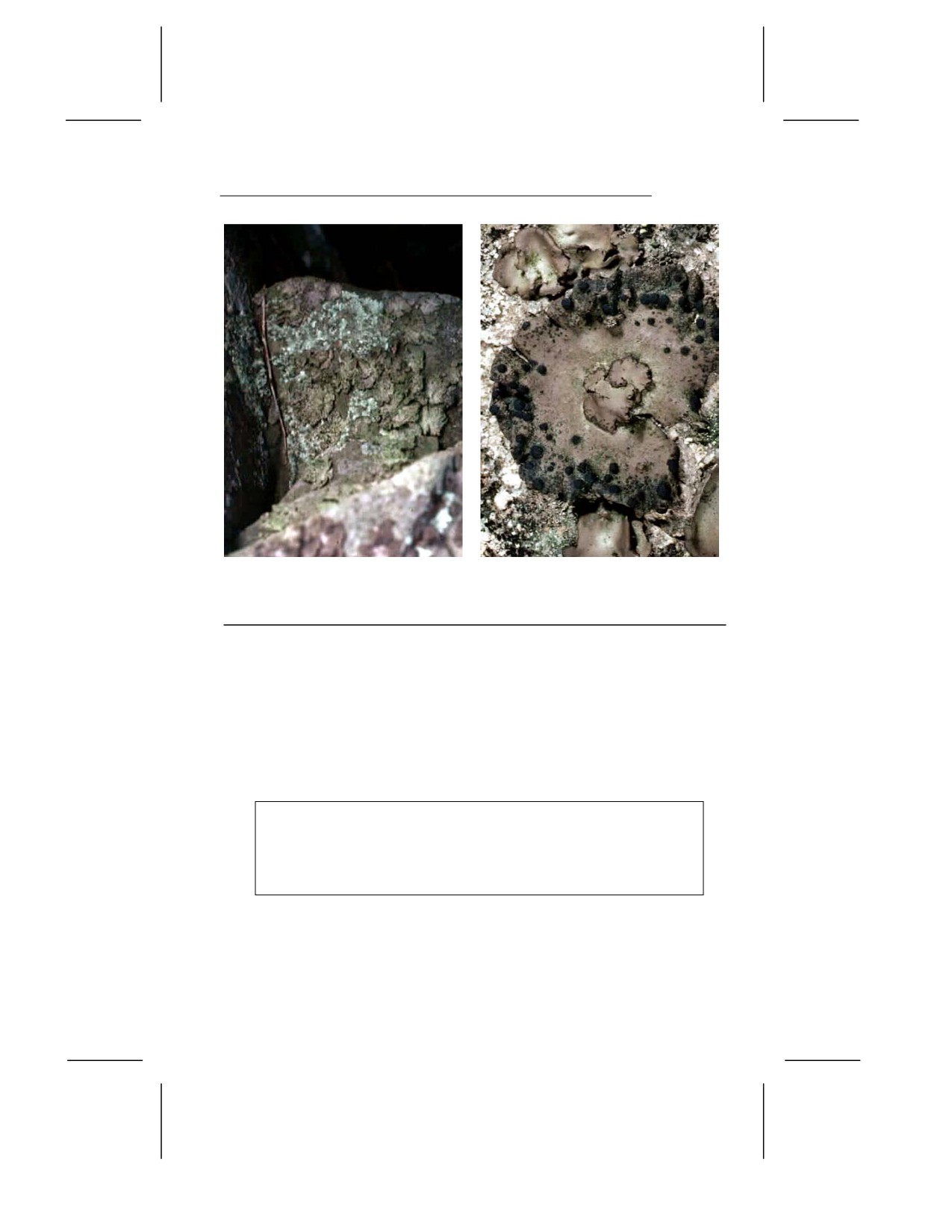
Rock tripe
Umbilicaria species
Description: This plant forms large patches with curling edges. The top of the
plant is usually black. The underside is lighter in color.
Habitat and Distribution: Look on rocks and boulders for this plant. It is
common throughout North America.
Edible Parts: The entire plant is edible. Scrape it off the rock and wash it to
remove grit. The plant may be dry and crunchy; soak it in water until it becomes
soft. Rock tripes may contain large quantities of bitter substances; soaking or
boiling the plant in several changes of water will remove the bitterness.
CAUTION
There are some reports of poisoning from rock tripe, so apply
the Universal Edibility Test.
B-73
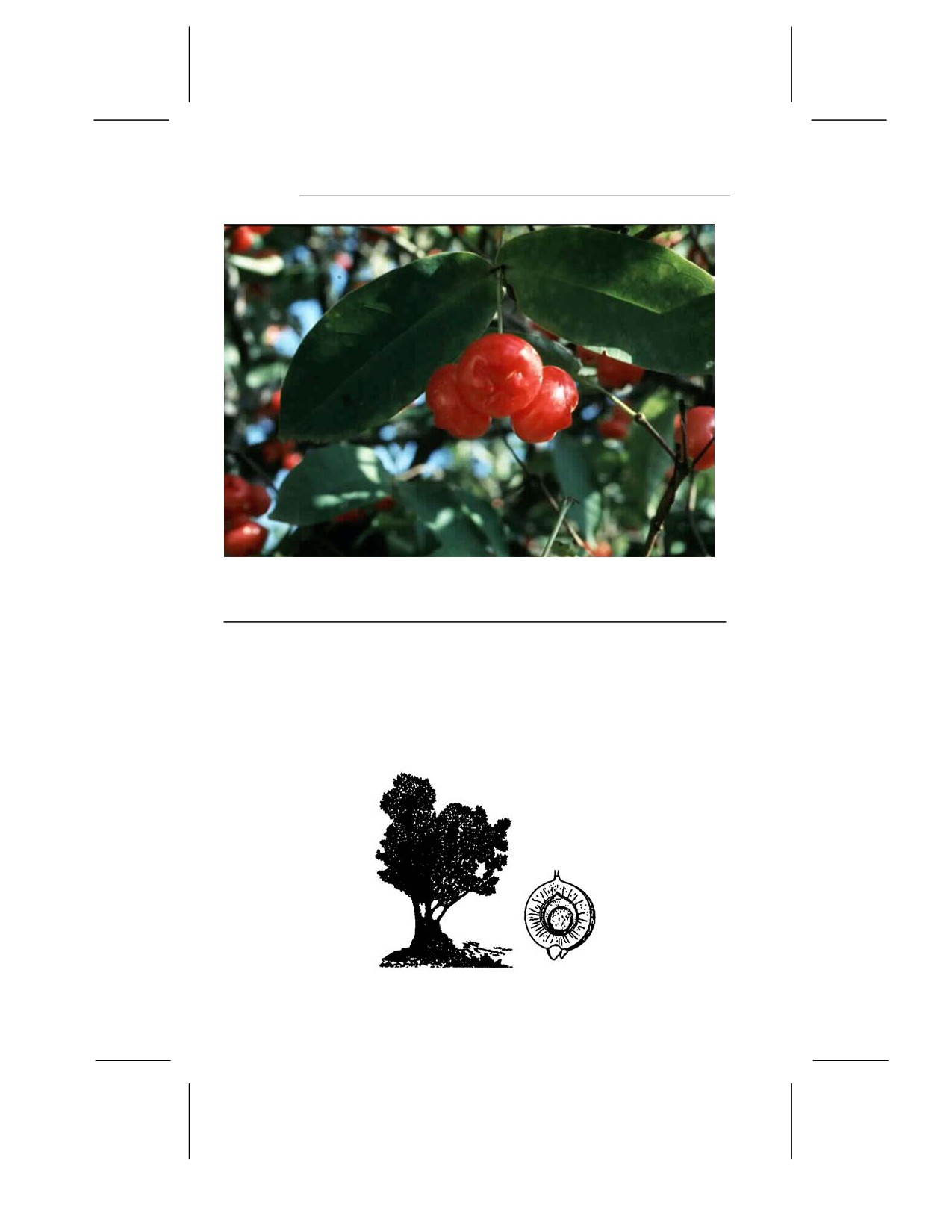
Rose apple
Eugenia jambos
Description: This tree grows 3 to 9 meters (9 to 27 feet) high. It has opposite,
simple, dark green, shiny leaves. When fresh, it has fluffy, yellowish-green
flowers and red to purple egg-shaped fruit.
Habitat and Distribution: This tree is widely planted in all of the tropics. It can
also be found in a semiwild state in thickets, waste places, and secondary
forests.
Edible Parts: The entire fruit is edible raw or cooked.
B-74
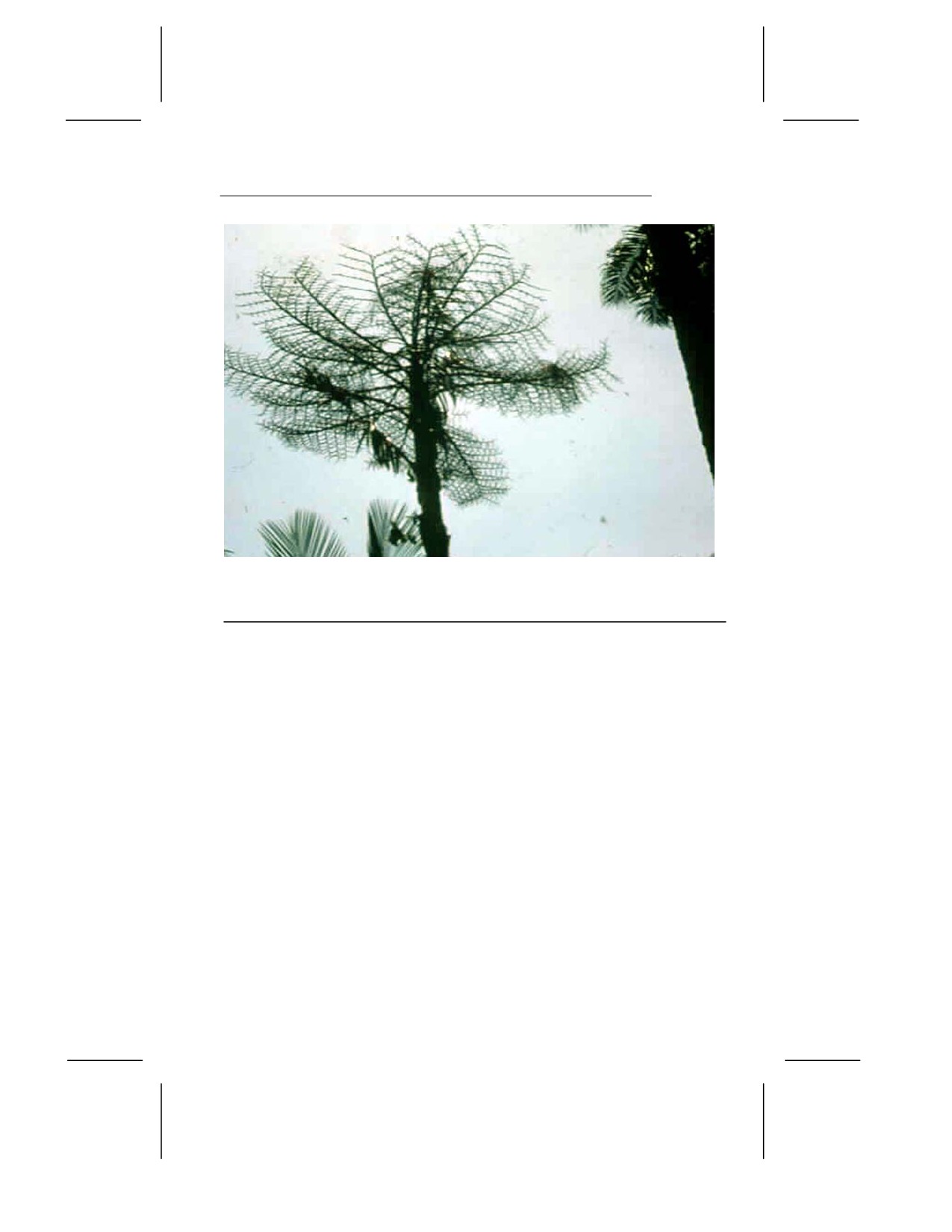
Sago palm
Metroxylon sagu
Description: These palms are low trees, rarely over 9 meters (27 feet) tall, with
a stout, spiny trunk. The outer rind is about 5 centimeters (2 inches) thick and
hard as bamboo. The rind encloses a spongy inner pith containing a high
proportion of starch. It has typical palmlike leaves clustered at the tip.
Habitat and Distribution: The sago palm is found in tropical rain forests. It
flourishes in damp lowlands in the Malay Peninsula, New Guinea, Indonesia, the
Philippines, and adjacent islands. It is found mainly in swamps and along
streams, lakes, and rivers.
Edible Parts: These palms, when available, are of great use to the survivor. One
trunk, cut just before it flowers, will yield enough sago to feed a person for 1 year.
Obtain sago starch from nonflowering palms. To extract the edible sage, cut
away the bark lengthwise from one half of the trunk and pound the soft, whitish
inner part (pith) as fine as possible. Knead the pith in water and strain it through
a coarse cloth into a container. The fine, white sago will settle in the container.
Once the sago settles, it is ready for use. Squeeze off the excess water and let it
dry. Cook it as pancakes or oatmeal. Two kilograms of sago is the nutritional
equivalent of 1.5 kilograms of rice. The upper part of the trunk’s core does not
yield sago, but you can roast it in lumps over a fire. You can also eat the young
sago nuts and the growing shoots or palm cabbage.
B-75
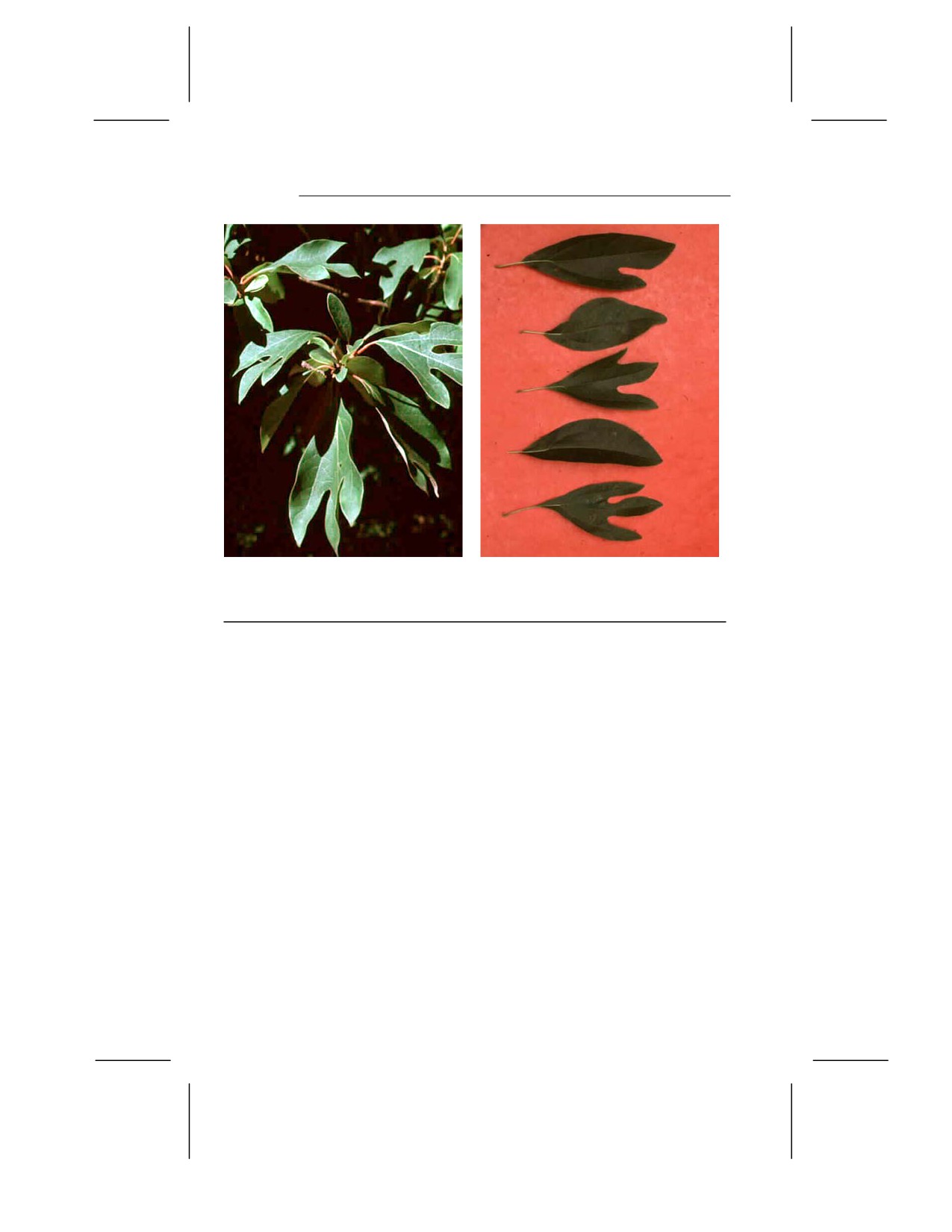
Sassafras
Sassafras albidum
Description: This shrub or small tree bears different leaves on the same plant.
Some leaves will have one lobe, some two lobes, and some no lobes. The
flowers, which appear in early spring, are small and yellow. The fruits are dark
blue. The plant parts have a characteristic root beer smell.
Habitat and Distribution: Sassafras grows at the margins of roads and forests,
usually in open, sunny areas. It is a common tree throughout eastern North
America.
Edible Parts: The young twigs and leaves are edible fresh or dried. You can add
dried young twigs and leaves to soups. Dig the underground portion, peel off the
bark, and let it dry. Then boil it in water to prepare sassafras tea.
Other Uses: Shred the tender twigs for use as a toothbrush.
B-76
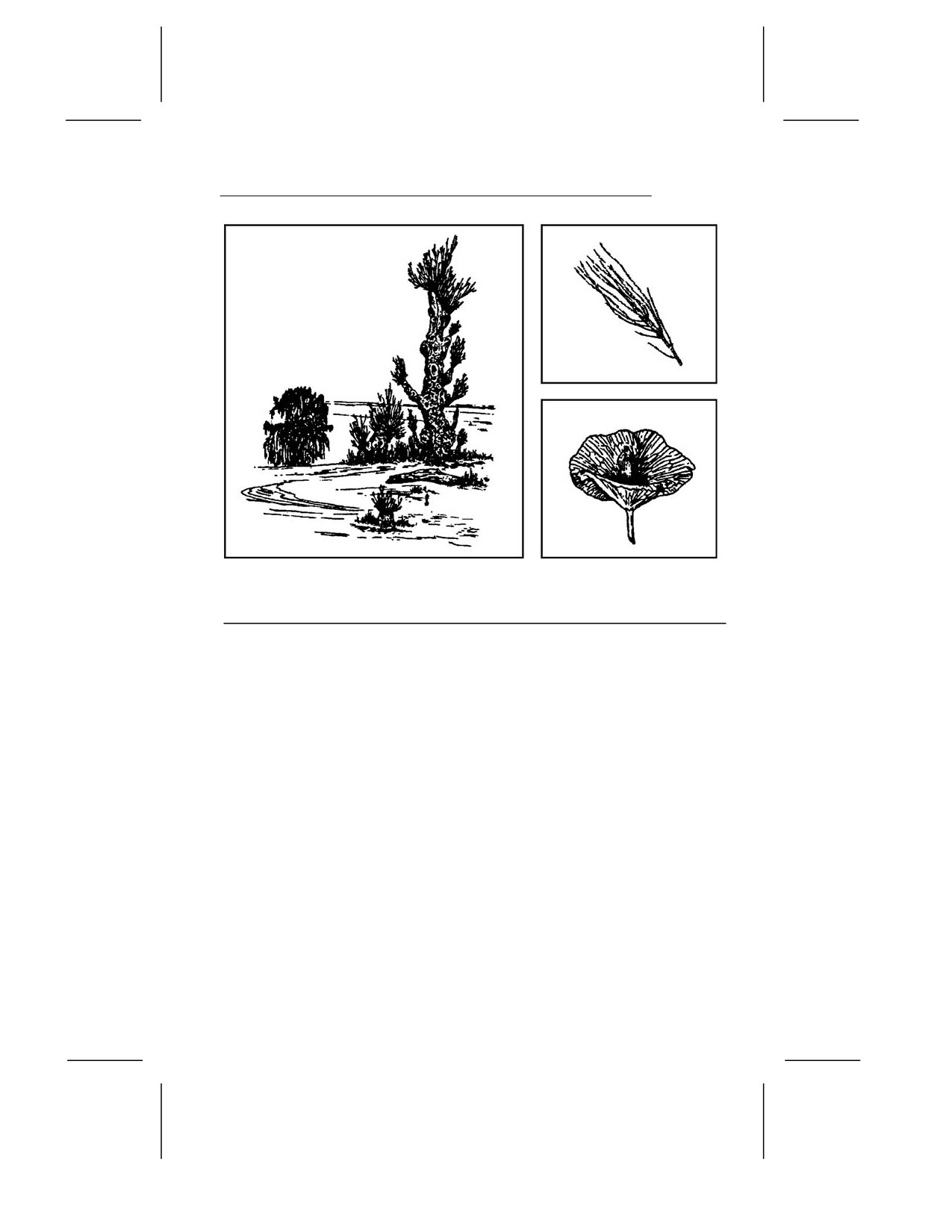
Saxaul
Haloxylon ammondendron
Description: The saxaul is found either as a small tree or as a large shrub with
heavy, coarse wood and spongy, water-soaked bark. The branches of the young
trees are vivid green and pendulous. The flowers are small and yellow.
Habitat and Distribution: The saxaul is found in desert and arid areas. It is
found on the arid salt deserts of Central Asia, particularly in the Turkestan region
and east of the Caspian Sea.
Edible Parts: The thick bark acts as a water storage organ. You can get drinking
water by pressing quantities of the bark. This plant is an important source of
water in the arid regions in which it grows.
B-77
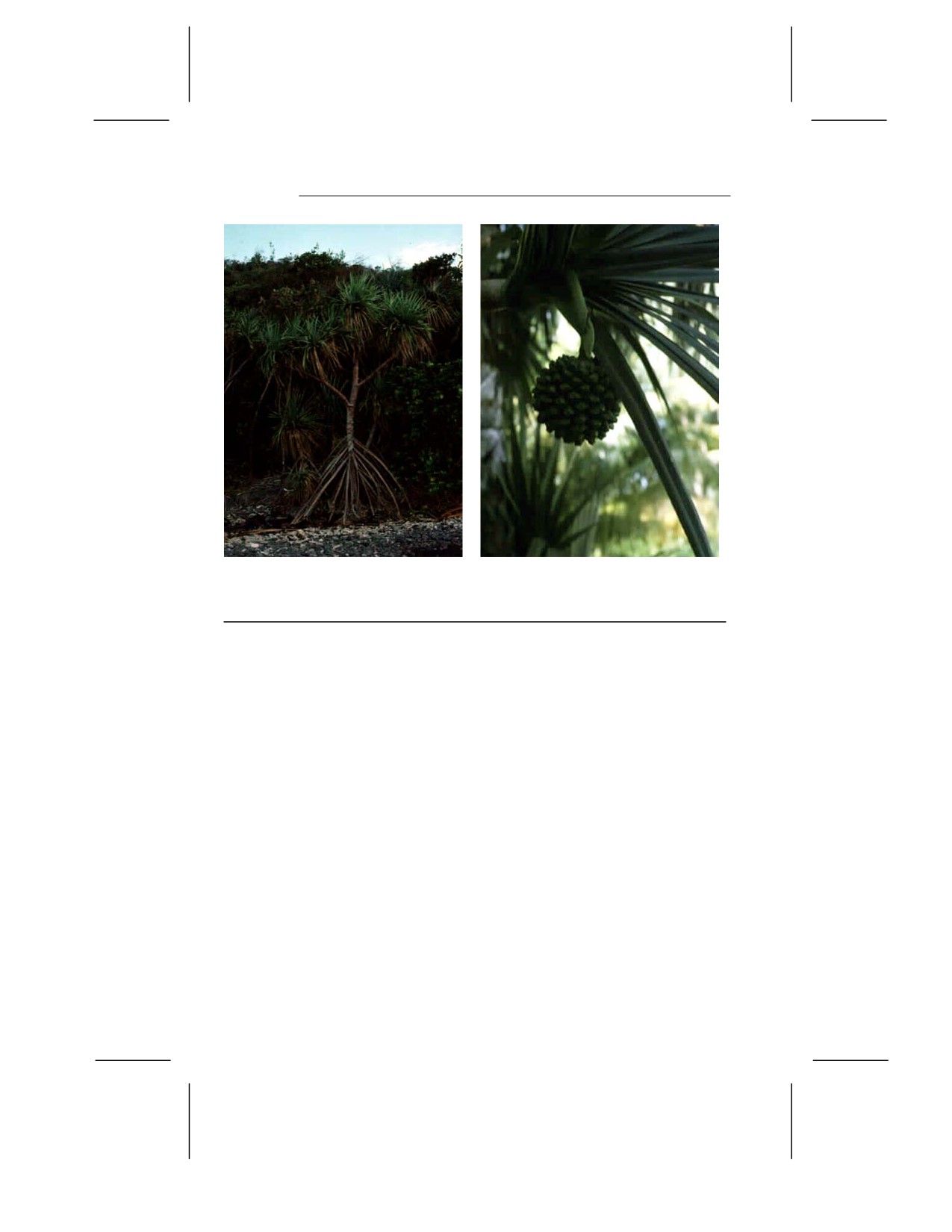
Screw pine
Pandanus species
Description: The screw pine is a strange plant on stilts, or prop roots, that
support the plant above ground so that it appears suspended in midair. These
plants are either shrubby or treelike, 3 to 9 meters (9 to 27 feet) tall, with stiff
leaves having sawlike edges. The fruits are large, roughened balls resembling
pineapples but without the tuft of leaves at the end.
Habitat and Distribution: The screw pine is a tropical plant that grows in rain
forests and semievergreen seasonal forests. It is found mainly along seashores,
although certain kinds occur inland for some distance, from Madagascar to
southern Asia and the islands of the southwestern Pacific. There are about
180 types.
Edible Parts: Knock the ripe fruit to the ground to separate the fruit segments
from the hard outer covering. Chew the inner fleshy part. Cook in an earth oven
fruit that is not fully ripe. Before cooking, wrap the whole fruit in banana leaves,
breadfruit leaves, or any other suitable thick, leathery leaves. After cooking for
about 2 hours, you can chew fruit segments like ripe fruit. Green fruit is inedible.
B-78
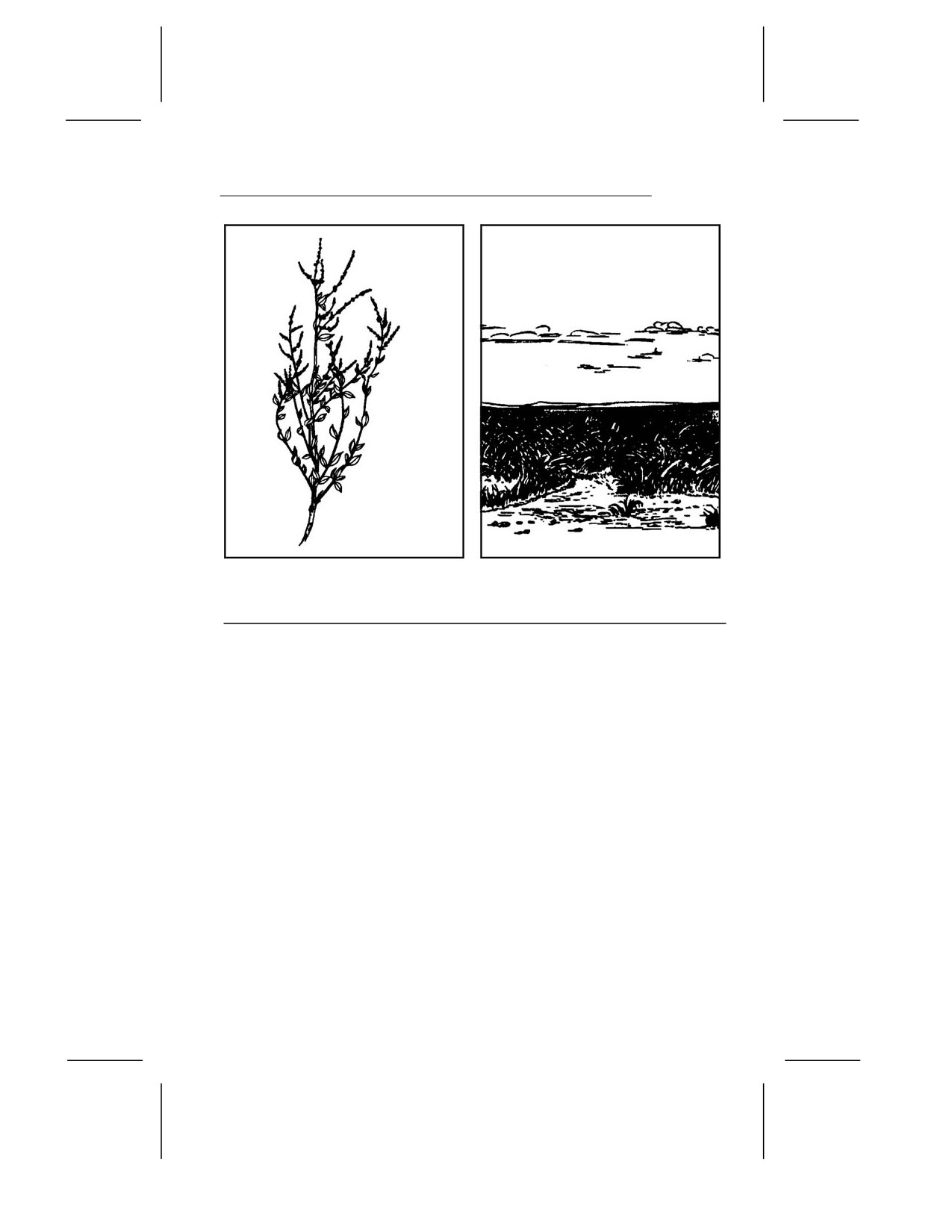
Sea orach
Atriplex halimus
Description: The sea orach is a sparingly branched herbaceous plant with small,
gray-colored leaves up to 2.5 centimeters (1 inch) long. Sea orach resembles
lamb’s quarter, a common weed in most gardens in the United States. It
produces its flowers in narrow, densely compacted spikes at the tips of its
branches.
Habitat and Distribution: The sea orach is found in highly alkaline and salty
areas along seashores from the Mediterranean countries to inland areas in North
Africa and eastward to Turkey and central Siberia. Generally, it can be found in
tropical scrub and thorn forests, steppes in temperate regions, and most desert
scrub and waste areas.
Edible Parts: Its leaves are edible. In the areas where it grows, it has the healthy
reputation of being one of the few native plants that can sustain man in times
of want.
B-79
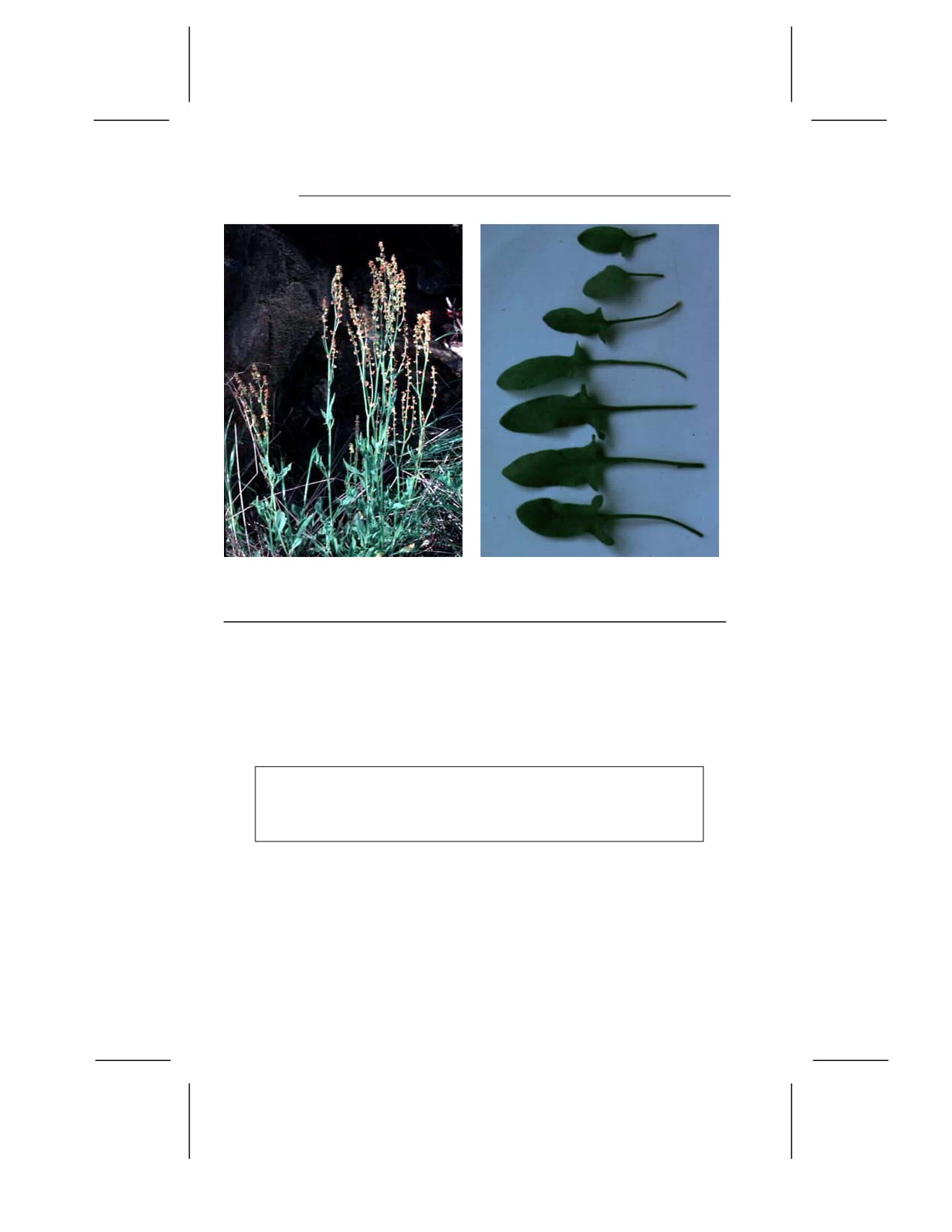
Sheep sorrel
Rumex acerosella
Description: These plants are seldom more than
30 centimeters
(12 inches) tall. They have alternate leaves, often with arrowlike bases, very
small flowers, and frequently reddish stems.
Habitat and Distribution: Look for these plants in old fields and other disturbed
areas in North America and Europe.
Edible Parts: The plants are edible raw or cooked.
CAUTION
These plants contain oxalic acid that can be damaging if too many
plants are eaten raw. Cooking seems to destroy the chemical.
B-80
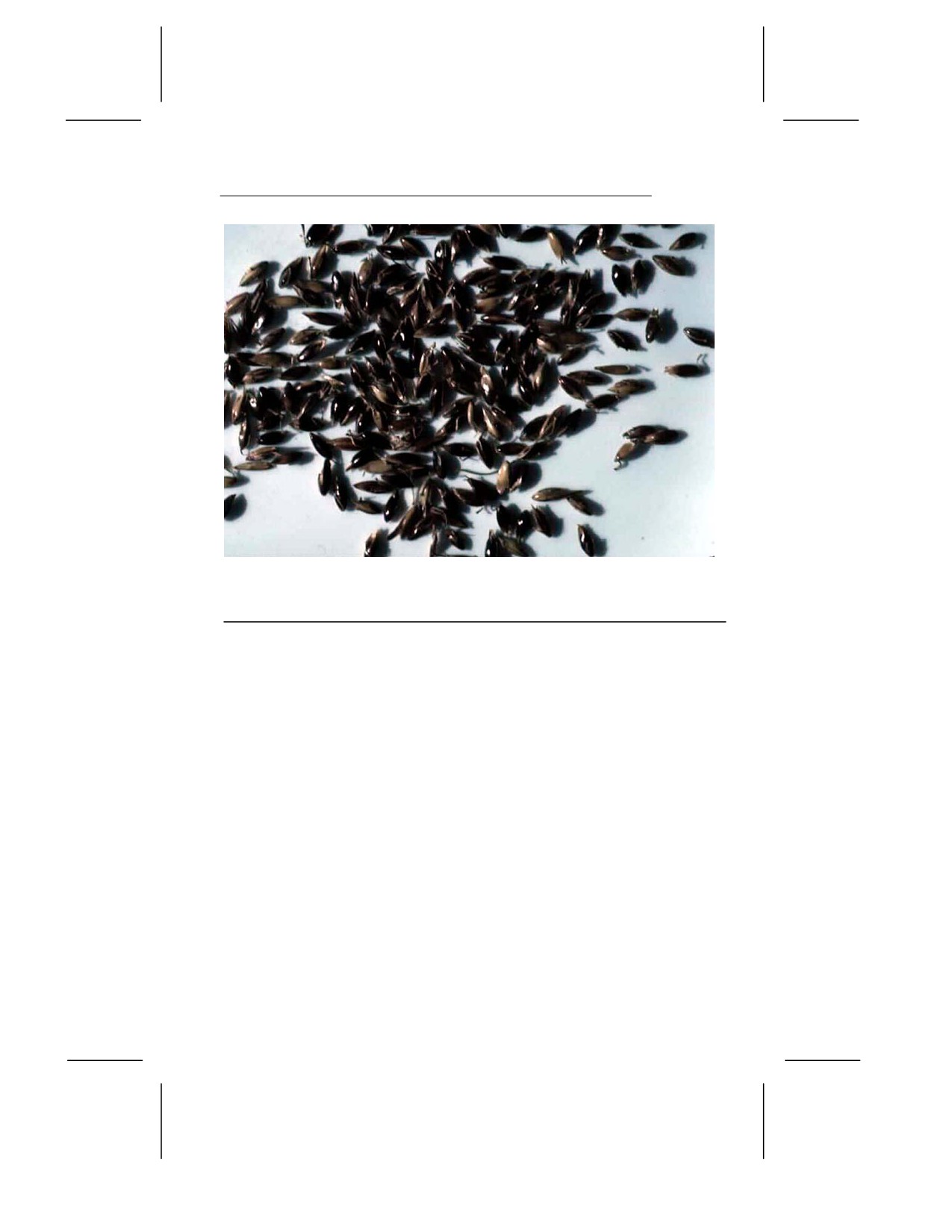
Sorghum
Sorghum species
Description: There are many different kinds of sorghum, all of which bear grains
in heads at the top of the plants. The grains are brown, white, red, or black.
Sorghum is the main food crop in many parts of the world.
Habitat and Distribution: Sorghum is found worldwide, usually in warmer
climates. All species are found in open, sunny areas.
Edible Parts: The grains are edible at any stage of development. When young,
the grains are milky and edible raw. Boil the older grains. Sorghum is a nutritious
food.
Other Uses: Use the stems of tall sorghum as building materials.
B-81
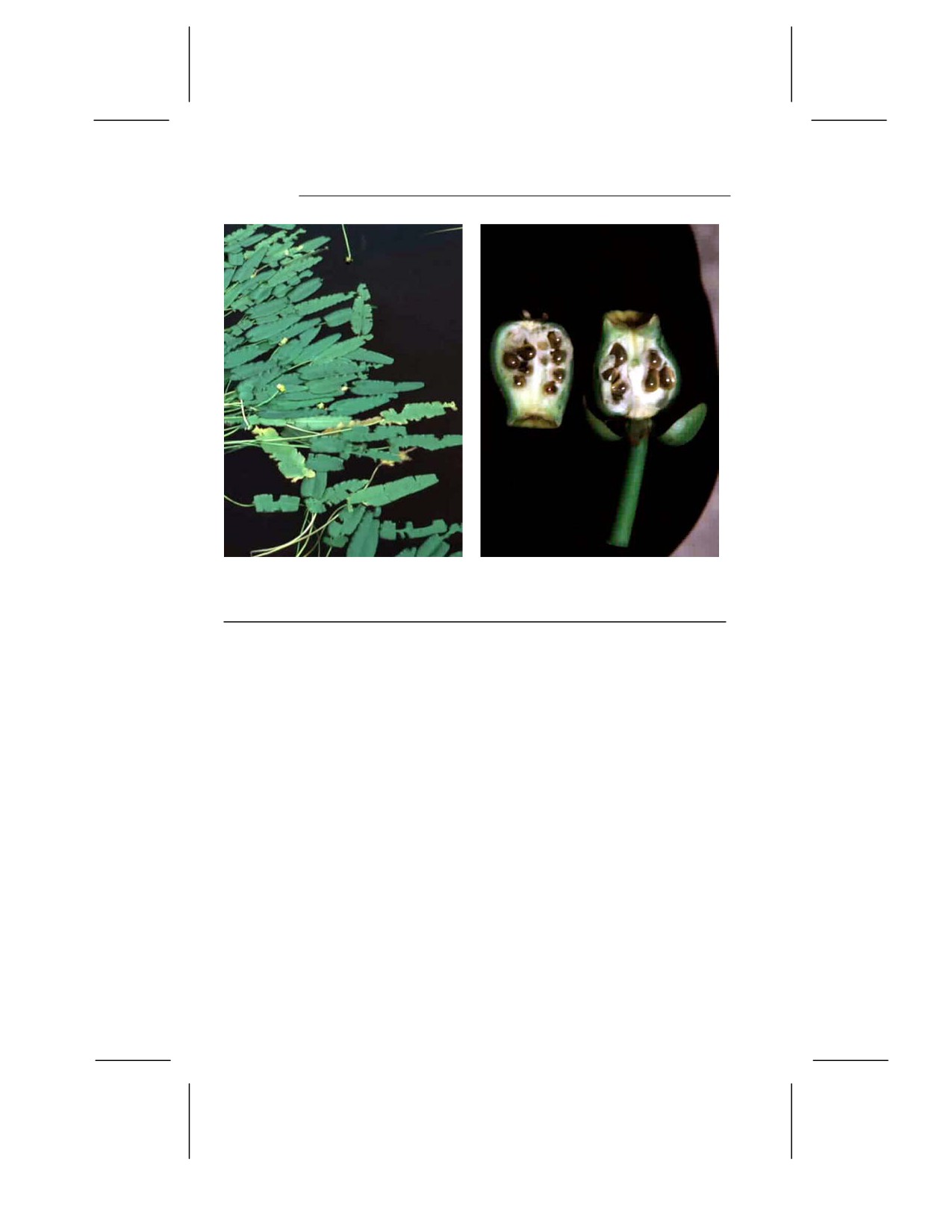
Spatterdock or yellow water lily
Nuphar species
Description: This plant has leaves up to 60 centimeters (24 inches) long with a
triangular notch at the base. The shape of the leaves is somewhat variable. The
plant’s yellow flowers are 2.5 centimeters (1 inch) across and develop into bottle-
shaped fruits. The fruits are green when ripe.
Habitat and Distribution: These plants grow throughout most of North America.
They are found in quiet, shallow
(never deeper than
1.8 meters
[6 feet])
freshwater.
Edible Parts: All parts of the plant are edible. The fruits contain several dark
brown seeds you can parch or roast and then grind into flour. The large rootstock
contains starch. Dig it out of the mud, peel off the outside, and boil the flesh.
Sometimes the rootstock contains large quantities of a very bitter compound.
Boiling the plant in several changes of water may remove the bitterness.
B-82
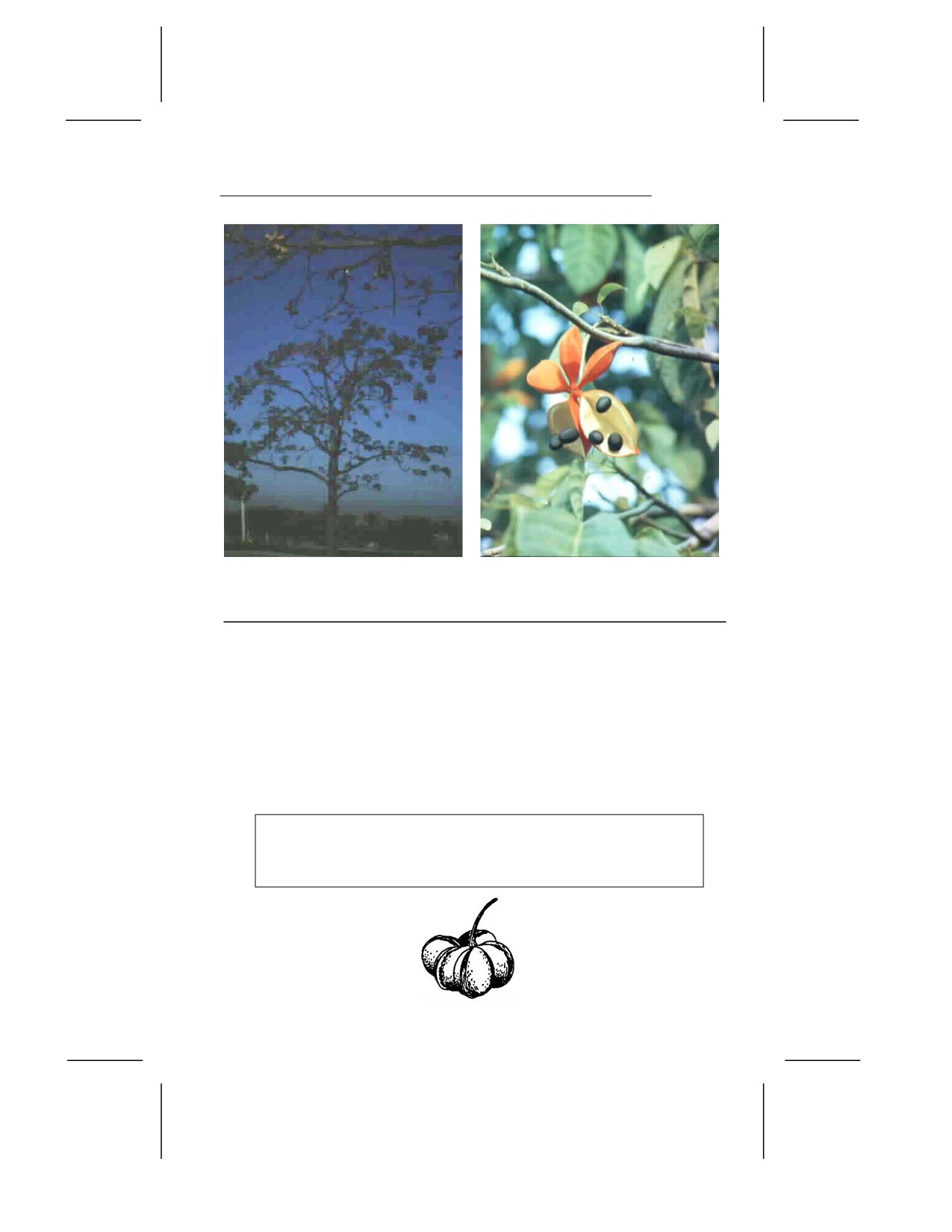
Sterculia
Sterculia foetida
Description: Sterculias are tall trees, rising in some instances to 30 meters
(90 feet). Their leaves are either undivided or palmately lobed. Their flowers are
red or purple. The fruit of all sterculias is similar in aspect, with a red, segmented
seedpod containing many edible black seeds.
Habitat and Distribution: There are over 100 species of sterculias distributed
through all warm or tropical climates. They are mainly forest trees.
Edible Parts: The large, red pods produce a number of edible seeds. The seeds
of all sterculias are edible and have a pleasant taste similar to cocoa. You can
eat them like nuts, either raw or roasted.
CAUTION
Avoid eating large quantities. The seeds may have a laxative
effect.
B-83
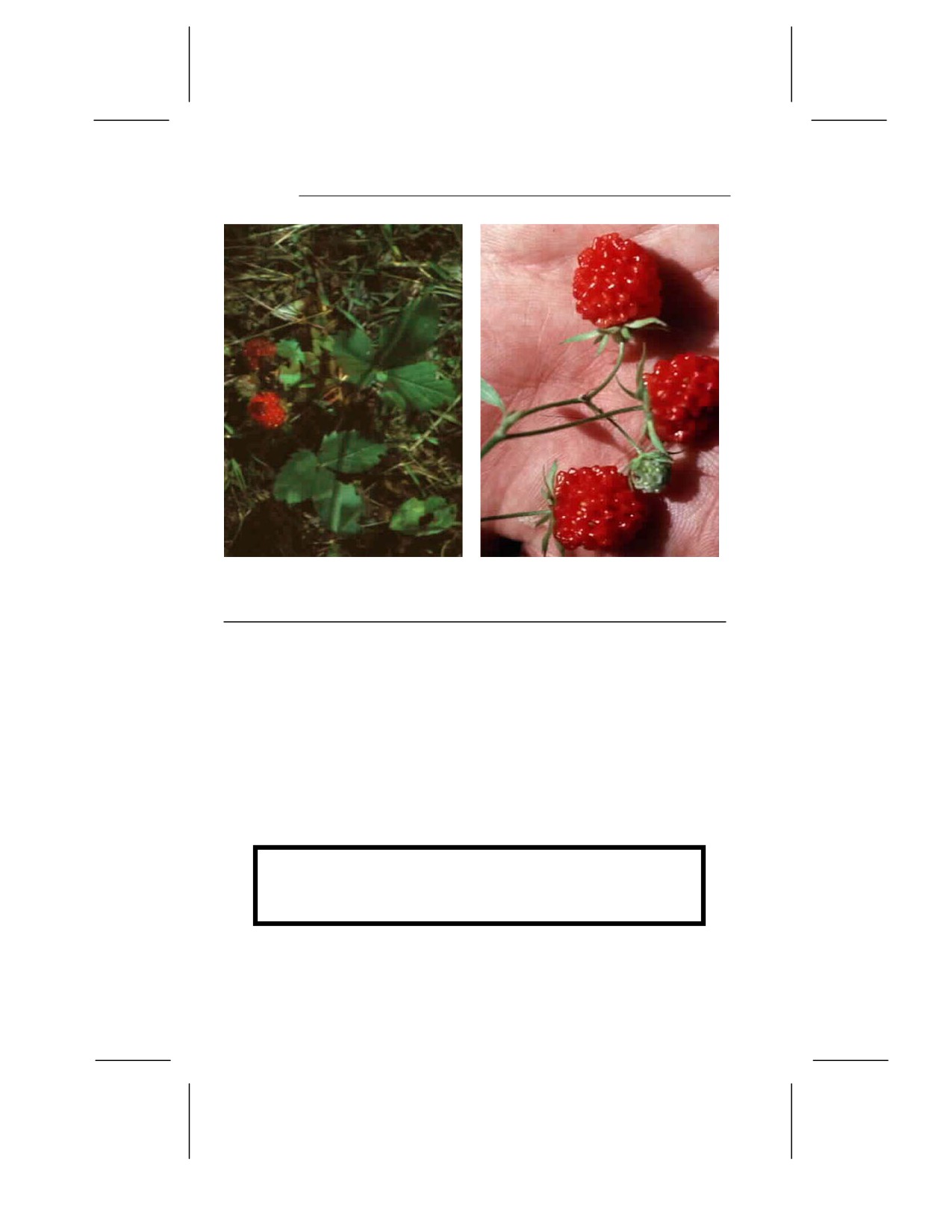
Strawberry
Fragaria species
Description: Strawberry is a small plant with a three-leaved growth pattern. It
has small, white flowers usually produced during the spring. Its fruit is red and
fleshy.
Habitat and Distribution: Strawberries are found in the north temperate zone
and also in the high mountains of the southern Western Hemisphere.
Strawberries prefer open, sunny areas. They are commonly planted.
Edible Parts: The fruit is edible fresh, cooked, or dried. Strawberries are a good
source of vitamin C. You can also eat the plant’s leaves or dry them to make a
tea. Care should be taken with strawberries and other farm foods that have
similar, pitted skins. In areas where human fertilizer is used, even bleach will not
be able to effectively remove all bacteria.
WARNING
Eat only white-flowering true strawberries. Other similar
plants without white flowers can be poisonous.
B-84
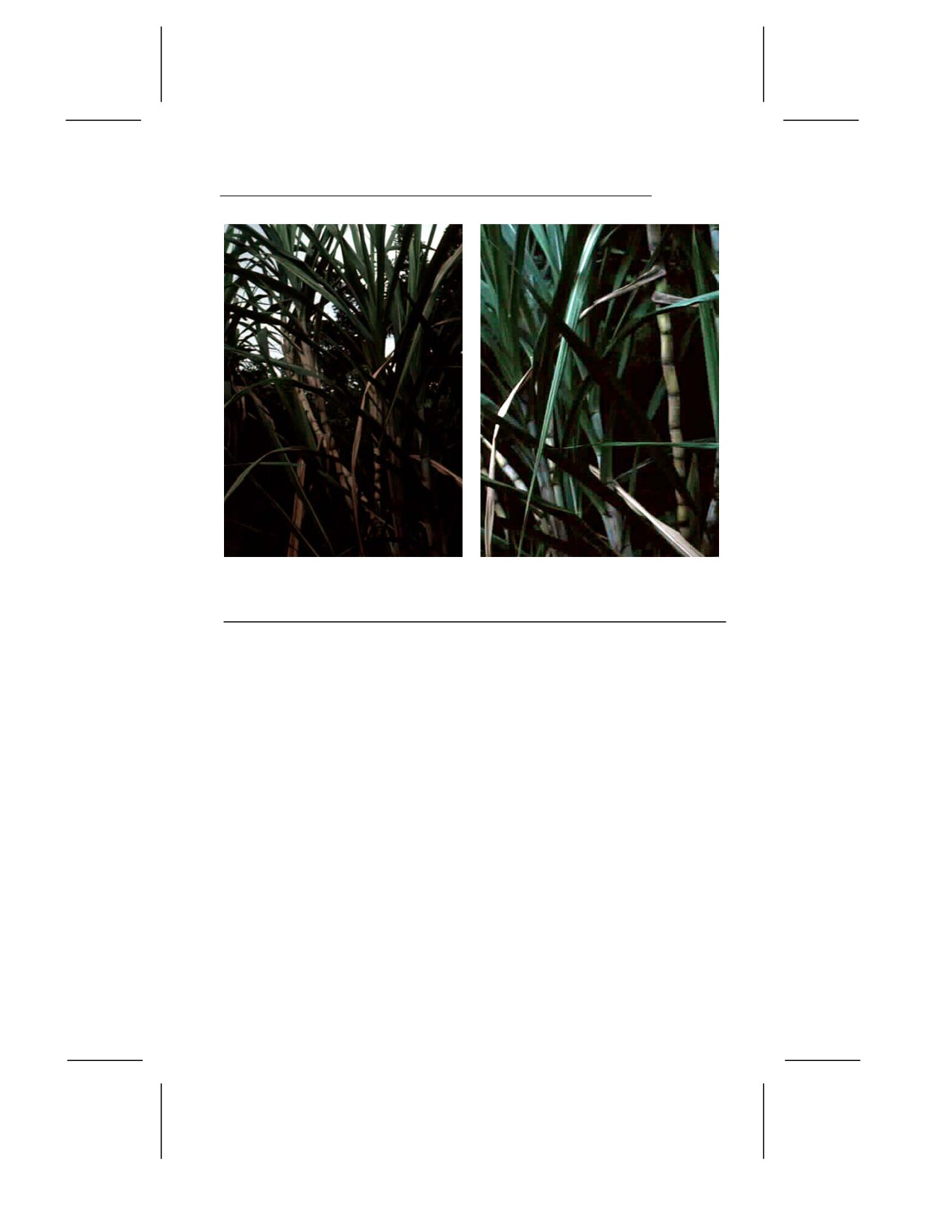
Sugarcane
Saccharum officinarum
Description: This plant grows up to 4.5 meters (15 feet) tall. It is a grass and has
grasslike leaves. Its green or reddish stems are swollen where the leaves grow.
Cultivated sugarcane seldom flowers.
Habitat and Distribution: Look for sugarcane in fields. It grows only in the
tropics (throughout the world). Because it is a crop, it is often found in large
numbers.
Edible Parts: The stem is an excellent source of sugar and is very nutritious.
Peel the outer portion off with your teeth and eat the sugarcane raw. You can
also squeeze juice out of the sugarcane.
B-85
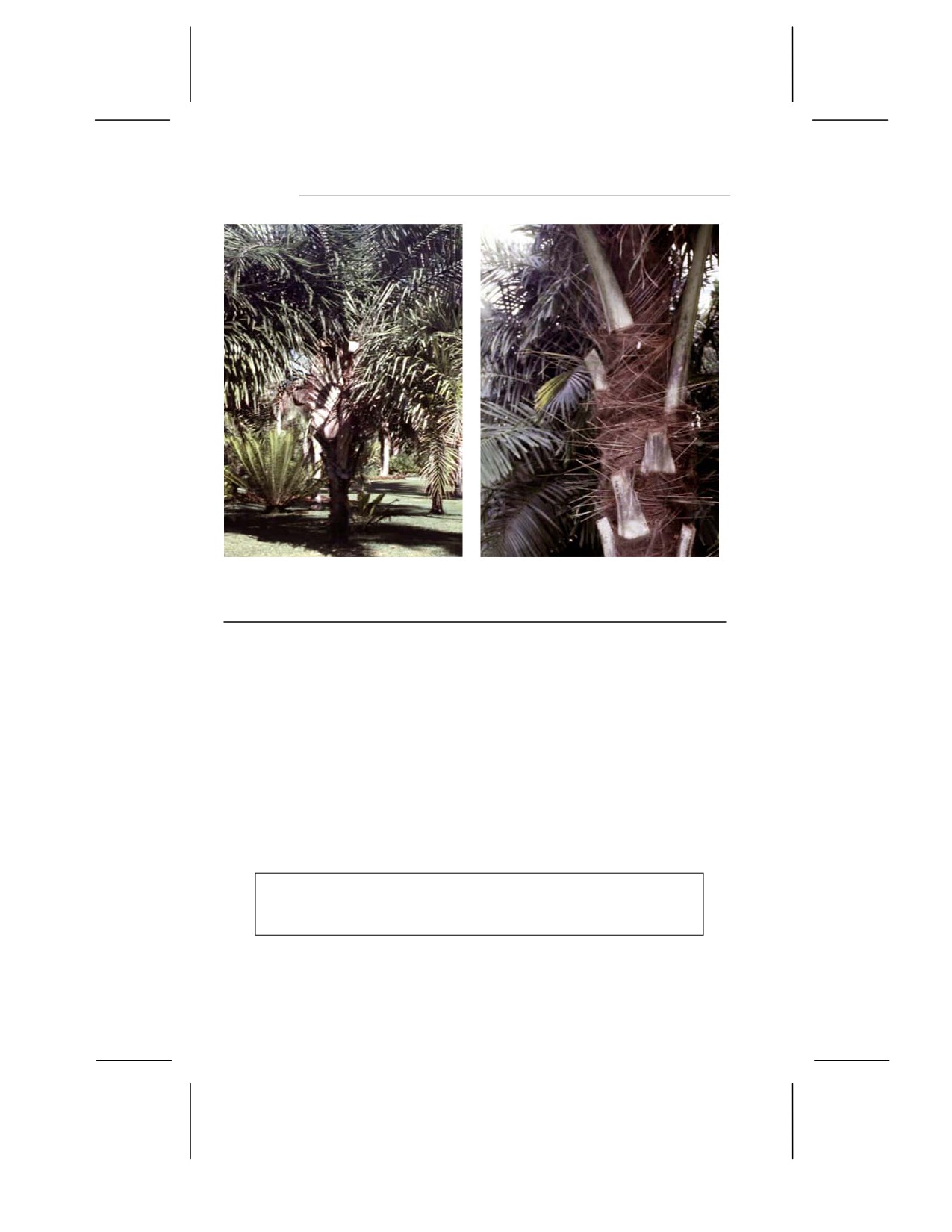
Sugar palm
Arenga pinnata
Description: This tree grows about 15 meters (45 feet) high and has huge
leaves up to 6 meters (18 feet) long. Needlelike structures stick out of the bases
of the leaves. Flowers grow below the leaves and form large conspicuous
dusters from which the fruits grow.
Habitat and Distribution: This palm is native to the East Indies but has been
planted in many parts of the tropics. It can be found at the margins of forests.
Edible Parts: The chief use of this palm is for sugar. However, its seeds and the
tip of its stems are a survival food. Bruise a young flower stalk with a stone or
similar object and collect the juice as it comes out. It is an excellent source of
sugar. Boil the seeds. Use the tip of the stems as a vegetable.
Other Uses: The shaggy material at the base of the leaves makes an excellent
rope, as it is strong and resists decay.
CAUTION
The flesh covering the seeds may cause dermatitis.
B-86
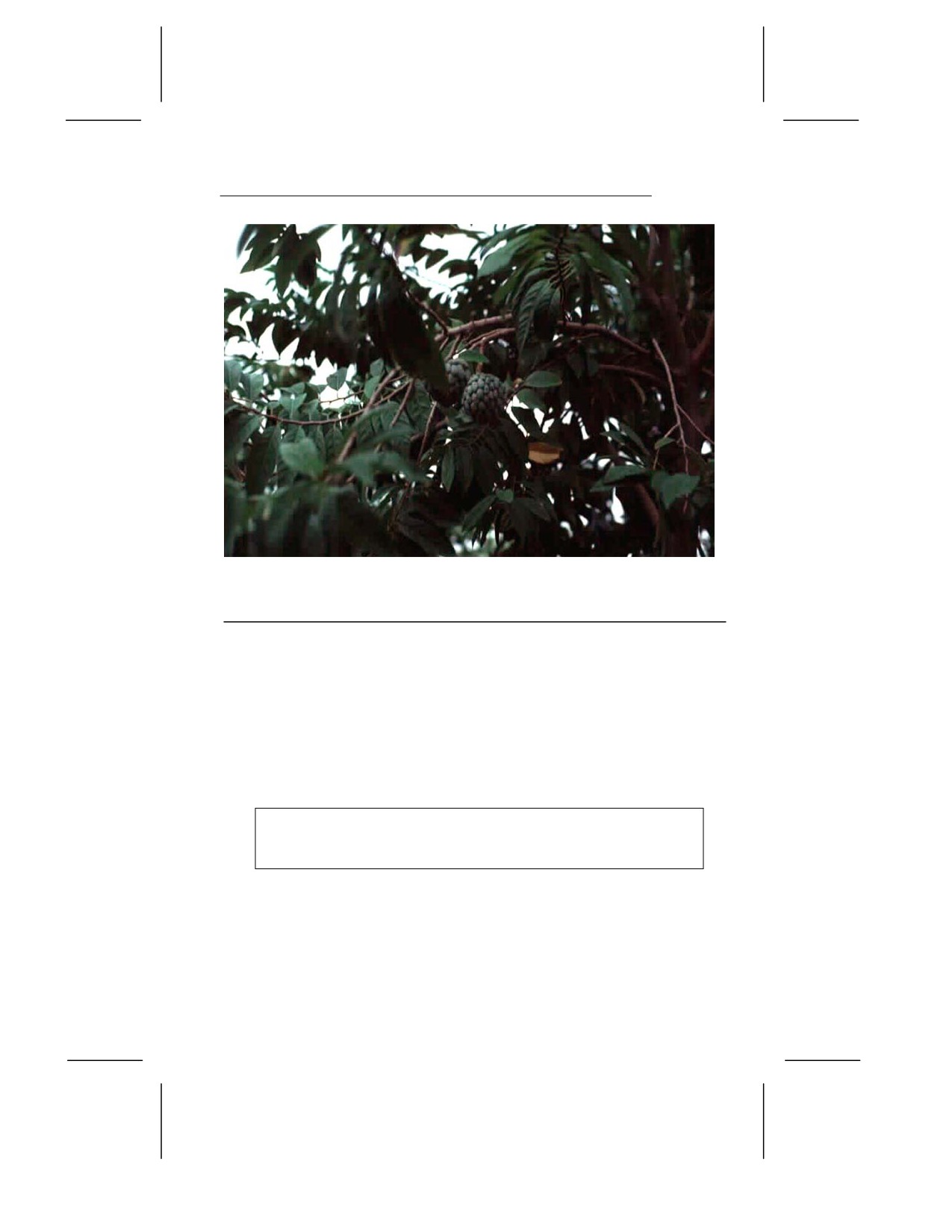
Sweetsop
Annona squamosa
Description: This tree is small, seldom more than 6 meters (18 feet) tall, and
multi-branched. It has alternate, simple, elongate, dark green leaves. Its fruit is
green when ripe, round, and covered with protruding bumps on its surface. The
fruit’s flesh is white and creamy.
Habitat and Distribution: Look for sweetsop at margins of fields, near villages,
and around homesites in tropical regions.
Edible Parts: The fruit flesh is edible raw.
Other Uses: You can use the finely ground seeds as an insecticide.
CAUTION
The ground seeds are extremely dangerous to the eyes.
B-87
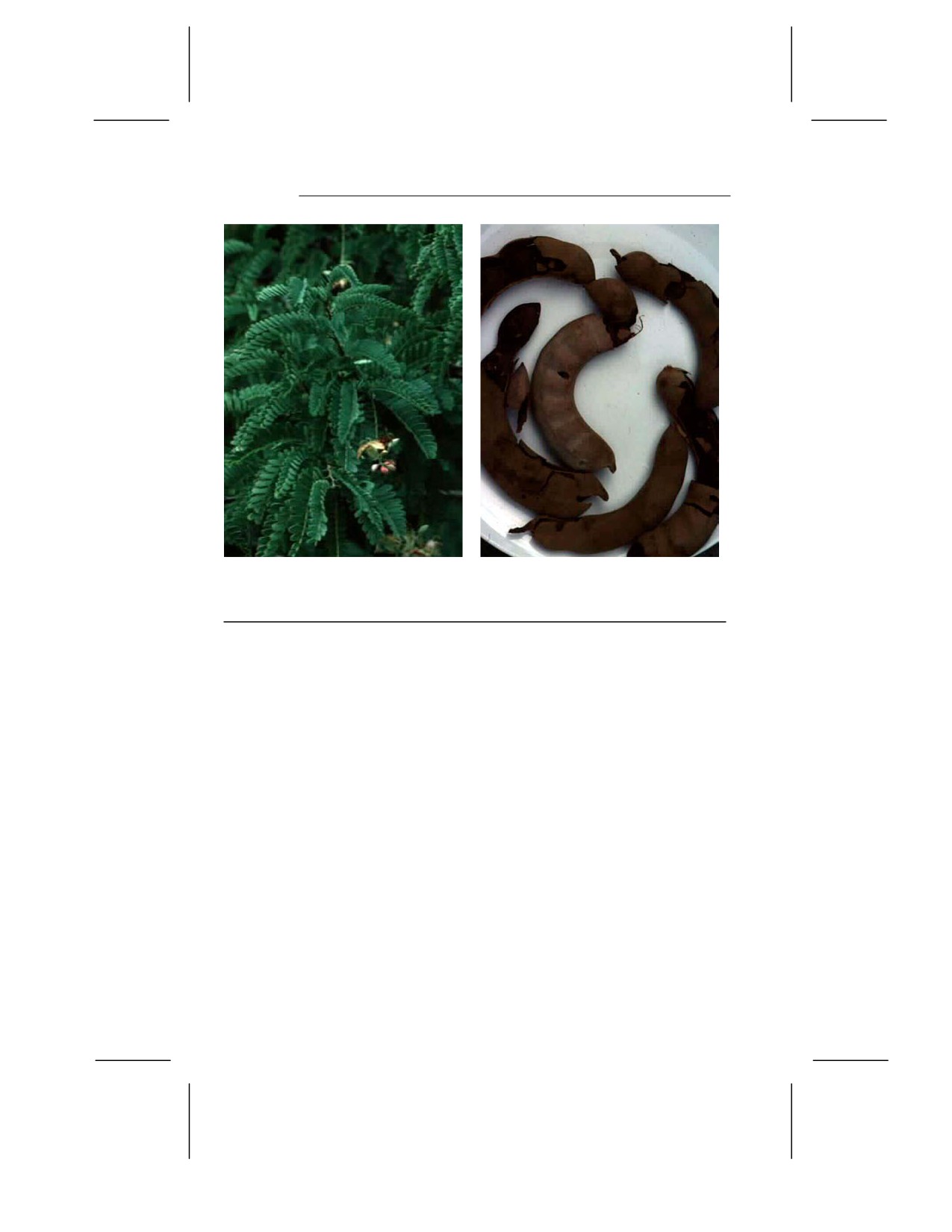
Tamarind
Tamarindus indica
Description: The tamarind is a large, densely branched tree. It grows up to 25
meters (75 feet) tall. Its has pinnate leaves (divided like a feather) with 10 to 15
pairs of leaflets.
Habitat and Distribution: The tamarind grows in the drier parts of Africa, Asia,
and the Philippines. Although it is thought to be a native of Africa, it has been
cultivated in India for so long that it looks like a native tree. It is also found in the
American tropics, the West Indies, Central America, and tropical South America.
Edible Parts: The pulp surrounding the seeds is rich in vitamin C and is an
important survival food. You can make a pleasantly acid drink by mixing the pulp
with water and sugar or honey and letting the mixture mature for several days.
Suck the pulp to relieve thirst. Cook the young, unripe fruits or seedpods with
meat. Use the young leaves in soup. You must cook the seeds. Roast them
above a fire or in ashes. Another way is to remove the seed coat and soak the
seeds in salted water and grated coconut for 24 hours, then cook them. You can
peel the tamarind bark and chew it.
B-88
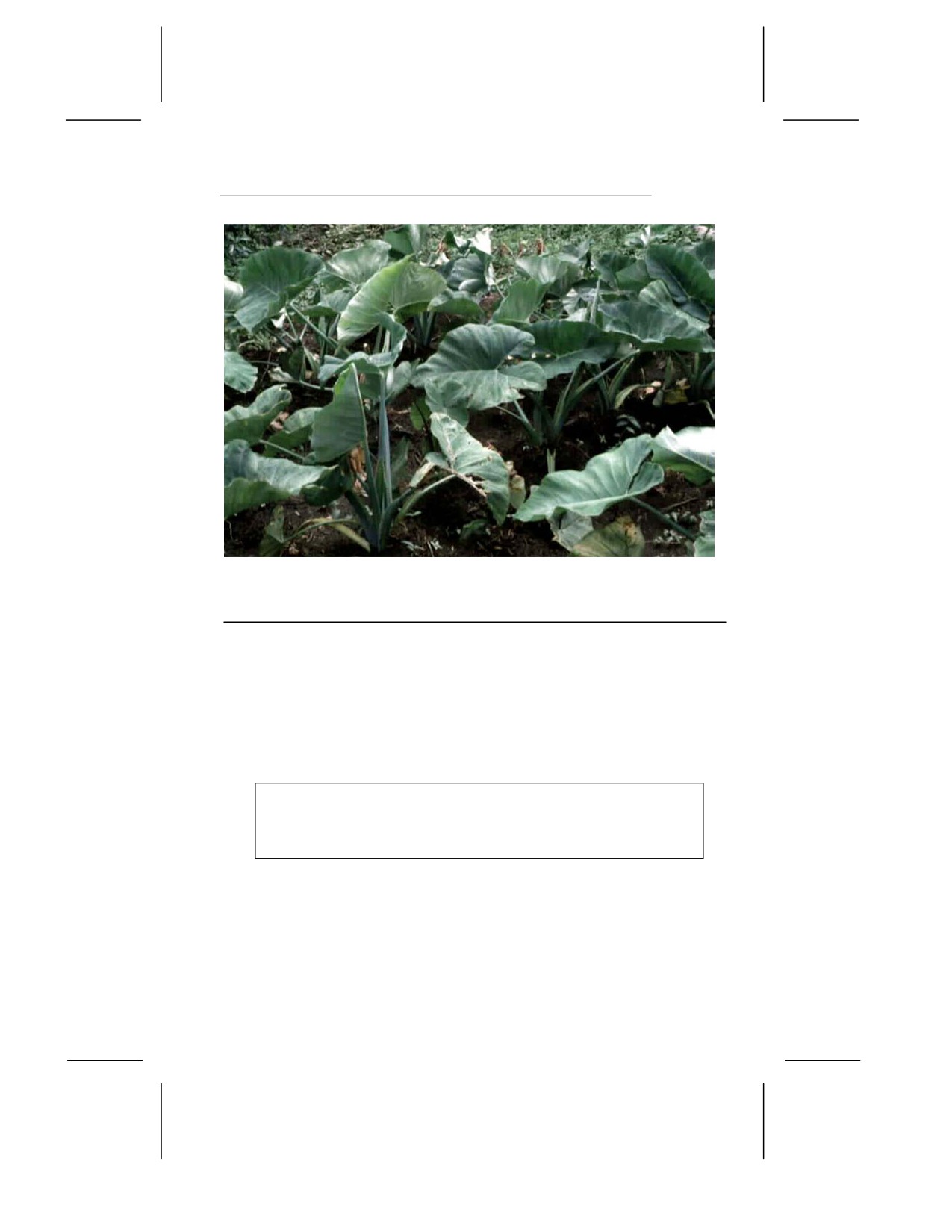
Taro, cocoyam, elephant ears, eddo, dasheen
Colocasia and Alocasia species
Description: All plants in these groups have large leaves, sometimes up to 1.8
meters (6 feet) tall, that grow from a very short stem. The rootstock is thick,
fleshy, and filled with starch.
Habitat and Distribution: These plants grow in the humid tropics. Look for them
in fields and near homesites and villages.
Edible Parts: All parts of the plant are edible when boiled or roasted. When
boiling, change the water once to get rid of any poison.
CAUTION
If eaten raw, these plants will cause a serious inflammation of
the mouth and throat.
B-89