FM 3-05.70 Field Manual Survival (17 May 2002) - page 13
TYPES OF NUCLEAR BURSTS
23-8. There are three types of nuclear bursts: subsurface burst,
airburst, and surface burst. The type of burst directly affects your
chances of survival. A subsurface burst occurs completely
underground or underwater. Its effects remain beneath the
surface or in the immediate area where the surface collapses into
a crater over the burst’s location. Subsurface bursts cause you
little or no radioactive hazard unless you enter the immediate
area of the crater.
23-9. An airburst occurs in the air above its intended target. The
airburst provides the maximum radiation effect on the target and
is, therefore, most dangerous to you in terms of immediate
nuclear effects.
23-10. A surface burst occurs on the ground or water surface.
Large amounts of fallout result, with serious long-term effects for
you. This type of burst is your greatest nuclear hazard.
NUCLEAR INJURIES
23-11. Most injuries in the nuclear environment result from the
initial nuclear effects of the detonation. These injuries are classed
as blast, thermal, or radiation injuries. Further radiation injuries
may occur if you do not take proper precautions against fallout.
Individuals in the area near a nuclear explosion will probably
suffer a combination of all three types of injuries.
Blast Injuries
23-12. Blast injuries produced by nuclear weapons are similar to
those caused by conventional high-explosive weapons. Blast
overpressure can collapse lungs and rupture internal organs.
Projectile wounds occur as the explosion’s force hurls debris at
you. Large pieces of debris striking you will cause fractured limbs
or massive internal injuries. Blast overpressure may throw you
long distances, and you will suffer severe injury upon impact with
the ground or other objects. Substantial cover and distance from
the explosion are the best protection against blast injury. Cover
blast injury wounds as soon as possible to prevent the entry of
radioactive dust particles.
23-3
Thermal Injuries
23-13. The heat and light the nuclear fireball emits cause thermal
injuries. First-, second-, or third-degree burns may result. Flash
blindness also occurs. This blindness may be permanent or
temporary depending on the degree of exposure of the eyes.
Substantial cover and distance from the explosion can prevent
thermal injuries. Clothing will provide significant protection
against thermal injuries. Cover as much exposed skin as possible
before a nuclear explosion. First aid for thermal injuries is the
same as first aid for burns. Cover open burns (second- or third-
degree) to prevent the entry of radioactive particles. Wash all
burns before covering.
Radiation Injuries
23-14. Neutrons, gamma radiation, alpha radiation, and beta
radiation cause radiation injuries. Neutrons are high-speed,
extremely penetrating particles that actually smash cells within
your body. Gamma radiation is similar to X rays and is also
highly penetrating radiation. During the initial fireball stage of a
nuclear detonation, initial gamma radiation and neutrons are the
most serious threat. Beta and alpha radiation are radioactive
particles normally associated with radioactive dust from fallout.
They are short-range particles. You can easily protect yourself
against them if you take precautions. See “Bodily Reactions to
Radiation,” below, for the symptoms of radiation injuries.
RESIDUAL RADIATION
23-15. Residual radiation is all radiation emitted after 1 minute
from the instant of the nuclear explosion. Residual radiation
consists of induced radiation and fallout.
Induced Radiation
23-16. This term describes a relatively small, intensely
radioactive area directly underneath the nuclear weapon’s
fireball. The irradiated earth in this area will remain highly
radioactive for an extremely long time. You should not travel into
an area of induced radiation.
23-4
Fallout
23-17. Fallout consists of radioactive soil and water particles, as
well as weapon fragments. During a surface detonation, or if an
airburst’s nuclear fireball touches the ground, large amounts of
soil and water are vaporized along with the bomb’s fragments,
and forced upward to altitudes of 25,000 meters (82,000 feet) or
more. When these vaporized contents cool, they can form more
than 200 different radioactive products. The vaporized bomb
contents condense into tiny radioactive particles that the wind
carries until they fall back to earth as radioactive dust. Fallout
particles emit alpha, beta, and gamma radiation. Alpha and beta
radiation are relatively easy to counteract, and residual gamma
radiation is much less intense than the gamma radiation emitted
during the first minute after the explosion. Fallout is your most
significant radiation hazard, provided you have not received a
lethal radiation dose from the initial radiation.
BODILY REACTIONS TO RADIATION
23-18. The effects of radiation on the human body can be broadly
classed as either chronic or acute. Chronic effects are those that
occur some years after exposure to radiation. Examples are
cancer and genetic defects. Chronic effects are of minor concern
insofar as they affect your immediate survival in a radioactive
environment. On the other hand, acute effects are of primary
importance to your survival. Some acute effects occur within
hours after exposure to radiation. These effects result from the
radiation’s direct physical damage to tissue. Radiation sickness
and beta burns are examples of acute effects. Radiation sickness
symptoms include nausea, diarrhea, vomiting, fatigue, weakness,
and loss of hair. Penetrating beta rays cause radiation burns; the
wounds are similar to fire burns.
Recovery Capability
23-19. The extent of body damage depends mainly on the part of
the body exposed to radiation and how long it was exposed, as
well as its ability to recover. The brain and kidneys have little
recovery capability. Other parts (skin and bone marrow) have a
great ability to recover from damage. Usually, a dose of 600
centigrays (cGy) to the entire body will result in almost certain
death. If only your hands received this same dose, your overall
23-5
health would not suffer much, although your hands would suffer
severe damage.
External and Internal Hazards
23-20. An external or internal hazard can cause body damage.
Highly penetrating gamma radiation or the less penetrating beta
radiation that causes burns can cause external damage. The
entry of alpha or beta radiation-emitting particles into the body
can cause internal damage. The external hazard produces overall
irradiation and beta burns. The internal hazard results in
irradiation of critical organs such as the gastrointestinal tract,
thyroid gland, and bone. A very small amount of radioactive
material can cause extreme damage to these and other internal
organs. The internal hazard can enter the body either through
consumption of contaminated water or food or by absorption
through cuts or abrasions. Material that enters the body through
breathing presents only a minor hazard. You can greatly reduce
the internal radiation hazard by using good personal hygiene and
carefully decontaminating your food and water.
Symptoms
23-21. The symptoms of radiation injuries include nausea,
diarrhea, and vomiting. The severity of these symptoms is due to
the extreme sensitivity of the gastrointestinal tract to radiation.
The severity of the symptoms and the speed of onset after
exposure are good indicators of the degree of radiation damage.
The gastrointestinal damage can come from either the external or
the internal radiation hazard.
COUNTERMEASURES AGAINST
PENETRATING EXTERNAL RADIATION
23-22. Knowledge of the radiation hazards discussed earlier is
extremely important in surviving in a fallout area. It is also
critical to know how to protect yourself from the most dangerous
form of residual radiation—penetrating external radiation.
23-23. The means you can use to protect yourself from
penetrating external radiation are time, distance, and shielding.
You can reduce the level of radiation and help increase your
chance of survival by controlling the duration of exposure. You
can also get as far away from the radiation source as possible.
23-6
Finally, you can place some radiation-absorbing or shielding
material between you and the radiation.
Time
23-24. Time is important, in two ways, when you are in a survival
situation. First, radiation dosages are cumulative. The longer you
are exposed to a radioactive source, the greater the dose you will
receive. Obviously, spend as little time in a radioactive area as
possible. Second, radioactivity decreases or decays over time. This
concept is known as radioactive half-life. Thus, a radioactive
element decays or loses half of its radioactivity within a certain
time. The rule of thumb for radioactivity decay is that it decreases
in intensity by a factor of ten for every sevenfold increase in time
following the peak radiation level. For example, if a nuclear
fallout area had a maximum radiation rate of 200 cGy per hour
when fallout is complete, this rate would fall to 20 cGy per hour
after 7 hours; it would fall still further to 2 cGy per hour after 49
hours. Even an untrained observer can see that the greatest
hazard from fallout occurs immediately after detonation, and that
the hazard decreases quickly over a relatively short time. You
should try to avoid fallout areas until the radioactivity decays to
safe levels. If you can avoid fallout areas long enough for most of
the radioactivity to decay, you enhance your chance of survival.
Distance
23-25. Distance provides very effective protection against
penetrating gamma radiation because radiation intensity
decreases by the square of the distance from the source. For
example, if exposed to
1,000 cGy of radiation standing
30
centimeters (12 inches) from the source, at 60 centimeters (24
inches), you would only receive 250 cGy. Thus, when you double
the distance, radiation decreases to (0.5)2 or 0.25 the amount.
While this formula is valid for concentrated sources of radiation
in small areas, it becomes more complicated for large areas of
radiation such as fallout areas.
Shielding
23-26. Shielding is the most important method of protection from
penetrating radiation. Of the three countermeasures against
penetrating radiation, shielding provides the greatest protection
23-7
and is the easiest to use under survival conditions. Therefore, it is
the most desirable method. If shielding is not possible, use the
other two methods to the maximum extent practical.
23-27. Shielding actually works by absorbing or weakening the
penetrating radiation, thereby reducing the amount of radiation
reaching your body. The denser the material, the better the
shielding effect. Lead, iron, concrete, and water are good
examples of shielding materials.
Special Medical Aspects
23-28. The presence of fallout material in your area requires
slight changes in first aid procedures. You must cover all wounds
to prevent contamination and the entry of radioactive particles.
You must first wash burns of beta radiation, then treat them as
ordinary burns. Take extra measures to prevent infection. Your
body will be extremely sensitive to infections due to changes in
your blood chemistry. Pay close attention to the prevention of
colds or respiratory infections. Rigorously practice personal
hygiene to prevent infections. Cover your eyes with improvised
goggles to prevent the entry of particles.
SHELTER
23-29. As stated earlier, the shielding material’s effectiveness
depends on its thickness and density. An ample thickness of
shielding material will reduce the level of radiation to negligible
amounts.
23-30. The primary reason for finding and building a shelter is to
get protection against the high-intensity radiation levels of early
gamma fallout as fast as possible. Five minutes to locate the
shelter is a good guide. Speed in finding shelter is absolutely
essential. Without shelter, the dosage received in the first few
hours will exceed that received during the rest of a week in a
contaminated area. The dosage received in this first week will
exceed the dosage accumulated during the rest of a lifetime spent
in the same contaminated area.
23-8
Shielding Materials
23-31. The thickness required to weaken gamma radiation from
fallout is far less than that needed to shield against initial
gamma radiation. Fallout radiation has less energy than a
nuclear detonation’s initial radiation. For fallout radiation, a
relatively small amount of shielding material can provide
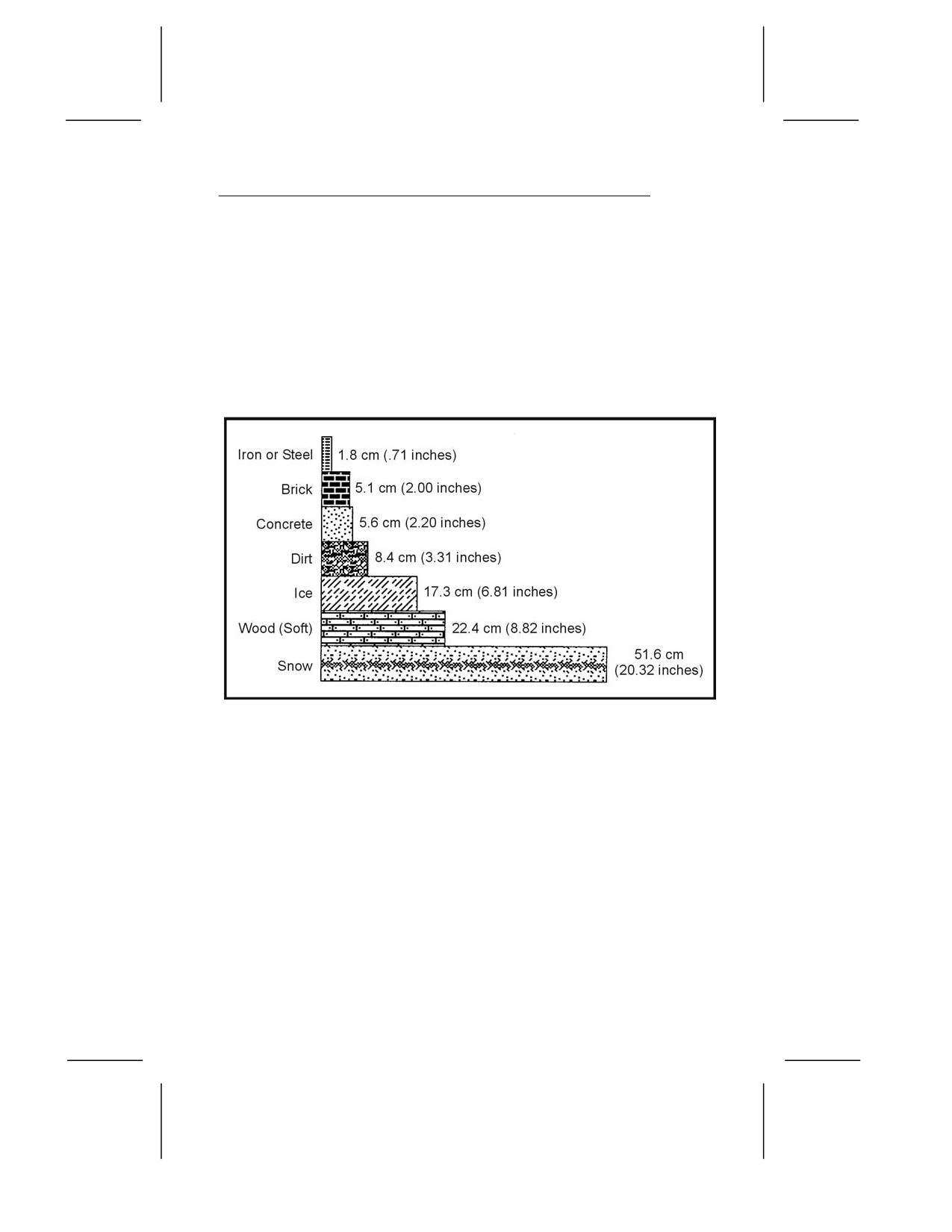
adequate protection. Figure 23-1 shows the thickness of various
materials needed to reduce residual gamma radiation
transmission by 50 percent.
Figure 23-1. Materials to Reduce Gamma Radiation
23-32. The principle of half-value layer thickness is useful in
understanding the absorption of gamma radiation by various
materials. According to this principle, if 5 centimeters (2 inches)
of brick reduce the gamma radiation level by one-half, adding
another 5 centimeters (2 inches) of brick
(another half-value
layer) will reduce the intensity by another half, namely, to one-
fourth the original amount. Fifteen centimeters (6 inches) will
reduce gamma radiation fallout levels to one-eighth its original
amount, 20 centimeters (8 inches) to one-sixteenth, and so on.
Thus, a shelter protected by 1 meter (3 feet) of dirt would reduce
a radiation intensity of 1,000 cGy per hour on the outside to about
0.5 cGy per hour inside the shelter.
23-9
Natural Shelters
23-33. Terrain that provides natural shielding and easy shelter
construction is the ideal location for an emergency shelter. Good
examples are ditches, ravines, rocky outcropping, hills, and
riverbanks. In level areas without natural protection, dig a
fighting position or slit trench.
Trenches
23-34. When digging a trench, work from inside the trench as
soon as it is large enough to cover part of your body thereby not
exposing all your body to radiation. In open country, try to dig the
trench from a prone position, stacking the dirt carefully and
evenly around the trench. On level ground, pile the dirt around
your body for additional shielding. Depending upon soil
conditions, shelter construction time will vary from a few minutes
to a few hours. If you dig as quickly as possible, you will reduce
the dosage you receive.
Other Shelters
23-35. While an underground shelter covered by 1 meter (3 feet)
or more of earth provides the best protection against fallout
radiation, the following unoccupied structures (in order listed)
offer the next best protection:
• Caves and tunnels covered by more than 1 meter (3 feet) of
earth.
• Storm or storage cellars.
• Culverts.
• Basements or cellars of abandoned buildings.
• Abandoned buildings made of stone or mud.
Roofs
23-36. It is not mandatory that you build a roof on your shelter.
Build one only if the materials are readily available with only a
brief exposure to outside contamination. If building a roof would
require extended exposure to penetrating radiation, it would be
wiser to leave the shelter roofless. A roof’s sole function is to
reduce radiation from the fallout source to your body. Unless you
use a thick roof, a roof provides very little shielding.
23-10
23-37. You can construct a simple roof from a poncho anchored
down with dirt, rocks, or other refuse from your shelter. You can
remove large particles of dirt and debris from the top of the
poncho by beating it off from the inside at frequent intervals. This
cover will not offer shielding from the radioactive particles
deposited on the surface, but it will increase the distance from the
fallout source and keep the shelter area from further
contamination.
Shelter Site Selection and Preparation
23-38. To reduce your exposure time and thereby reduce the
dosage received, remember the following factors when selecting
and setting up a shelter:
•
Where possible, seek a crude, existing shelter that you can
improve. If none is available, dig a trench.
•
Dig the shelter deep enough to get good protection, then
enlarge it as required for comfort.
•
Cover the top of the fighting position or trench with any
readily available material and a thick layer of earth, if you
can do so without leaving the shelter. While a roof and
camouflage are both desirable, it is probably safer to do
without them than to expose yourself to radiation outside
your fighting position.
•
While building your shelter, keep all parts of your body
covered with clothing to protect it against beta burns.
•
Clean the shelter site of any surface deposit using a branch
or other object that you can discard. Do this cleaning to
remove contaminated materials from the area you will
occupy. The cleaned area should extend at least 1.5 meters
(5 feet) beyond your shelter’s area.
•
Decontaminate any materials you bring into the shelter.
These materials include grass or foliage that you use as
insulation or bedding, and your outer clothing (especially
footgear). If the weather permits and you have heavily
contaminated outer clothing, you may want to remove it
and bury it under a foot of earth at the end of your shelter.
You may retrieve it later (after the radioactivity decays)
when leaving the shelter. If the clothing is dry, you may
23-11
decontaminate it by beating or shaking it outside the
shelter’s entrance to remove the radioactive dust. You may
use any body of water, even though contaminated, to rid
materials of excess fallout particles. Simply dip the
material into the water and shake it to get rid of the excess
water. Do not wring it out, this action will trap the
particles.
•
If possible and without leaving the shelter, wash your body
thoroughly with soap and water, even if the water on hand
may be contaminated. This washing will remove most of
the harmful radioactive particles that are likely to cause
beta burns or other damage. If water is not available, wipe
your face and any other exposed skin surface to remove
contaminated dust and dirt. You may wipe your face with a
clean piece of cloth or a handful of uncontaminated dirt.
You get this uncontaminated dirt by scraping off the top
few inches of soil and using the “clean” dirt.
•
Upon completing the shelter, lie down, keep warm, and
sleep and rest as much as possible while in the shelter.
•
When not resting, keep busy by planning future actions,
studying your maps, or making the shelter more
comfortable and effective.
•
Don’t panic if you experience nausea and symptoms of
radiation sickness. Your main danger from radiation
sickness is infection. There is no first aid for this sickness.
Resting, drinking fluids, taking any medicine that
prevents vomiting, maintaining your food intake, and
preventing additional exposure will help avoid infection
and aid recovery. Even small doses of radiation can cause
these symptoms, which may disappear in a short time.
Exposure Timetable
23-39. The following timetable provides you with the information
needed to avoid receiving a serious dosage and still let you cope
with survival problems:
• Complete isolation from 4 to 6 days following delivery of
the last weapon.
23-12
• A very brief exposure to get water on the third day is
permissible, but exposure should not exceed 30 minutes.
• One exposure of not more than 30 minutes on the seventh
day.
• One exposure of not more than 1 hour on the eighth day.
• Exposure of 2 to 4 hours from the ninth day through the
twelfth day.
• Normal operation, followed by rest in a protected shelter,
from the thirteenth day on.
• In all instances, make your exposures as brief as possible.
Consider only mandatory requirements as valid reasons for
exposure. Decontaminate at every stop.
23-40. The times given above are conservative. If forced to move
after the first or second day, you may do so. Make sure that the
exposure is no longer than absolutely necessary.
WATER PROCUREMENT
23-41. In a fallout-contaminated area, available water sources
may be contaminated. If you wait at least
48 hours before
drinking any water to allow radioactive decay to take place and
select the safest possible water source, you will greatly reduce the
danger of ingesting harmful amounts of radioactivity.
23-42. Although many factors (wind direction, rainfall, sediment)
will influence your choice in selecting water sources, consider the
following guidelines.
Safest Water Sources
23-43. Water from springs, wells, or other underground sources
that undergo natural filtration will be your safest sources. Any
water found in the pipes or containers of abandoned houses or
stores will also be free from radioactive particles. This water will
be safe to drink, although you will have to take precautions
against bacteria in the water.
23-44. Snow taken from 15 centimeters (6 inches) or more below
the surface during the fallout is also a safe source of water.
23-13
Streams and Rivers
23-45. Water from streams and rivers will be relatively free from
fallout within several days after the last nuclear explosion because
of dilution. If possible, filter such water before drinking to get rid of
radioactive particles. The best filtration method is to dig sediment
holes or seepage basins along the side of a water source. The water
will seep laterally into the hole through the intervening soil that
acts as a filtering agent and removes the contaminated fallout
particles that settled on the original body of water. This method
can remove up to 99 percent of the radioactivity in water. You must
cover the hole in some way to prevent further contamination.
See Figure 6-9, page 6-13, for an example of a water filter.
Standing Water
23-46. Water from lakes, pools, ponds, and other standing sources
is likely to be heavily contaminated; though most of the heavier,
long-lived radioactive isotopes will settle to the bottom. Use the
settling technique to purify this water. First, fill a bucket or other
deep container three-fourths full with contaminated water. Then
take dirt from a depth of 10 centimeters (4 inches) or more below
the ground surface and stir it into the water. Use about 2.5
centimeters (1 inch) of dirt for every 10 centimeters (4 inches) of
water. Stir the water until you see most dirt particles suspended
in the water. Let the mixture settle for at least 6 hours. The
settling dirt particles will carry most of the suspended fallout
particles to the bottom and cover them. You can then dip out the
clear water. Purify this water using a filtration device.
Additional Precautions
23-47. As an additional precaution against disease, treat all water
with water purification tablets from your survival kit or boil it.
FOOD PROCUREMENT
23-48. Obtaining edible food in a radiation-contaminated area is a
serious but not insurmountable problem. You need to follow a few
special procedures in selecting and preparing rations and local
foods for use. Since secure packaging protects your combat
rations, they will be perfectly safe for use. Supplement your
rations with any food you can find on trips outside your shelter.
23-14
Abandoned buildings may have stores of processed foods. They
are safe for use after decontaminating them. Canned and
packaged foods should have containers or wrappers removed or
washed free of fallout particles. These processed foods also
include food stored in any closed container and food stored in
protected areas (such as cellars). All such foods must be washed
before eating or handling them.
23-49. If little or no processed food is available in your area, you
may have to supplement your diet with local food sources.
Animals and plants are local food sources.
Animals—A Food Source
23-50. Assume that all animals, regardless of their habitat or
living conditions, were exposed to radiation. The effects of
radiation on animals are similar to those on humans. Thus, most
of the wild animals living in a fallout area are likely to become
sick or die from radiation during the first month after the nuclear
explosion. Although animals may not be free from harmful
radioactive materials, you can and must use them in survival
conditions as a food source if other foods are not available. With
careful preparation and by following several important principles,
animals can be safe food sources.
23-51. First, do not eat an animal that appears to be sick. It may
have developed a bacterial infection because of radiation
poisoning. Contaminated meat, even if thoroughly cooked, could
cause severe illness or death if eaten.
23-52. Carefully skin all animals to prevent any radioactive
particles on the skin or fur from entering the body. Do not eat
meat close to the bones and joints as an animal’s skeleton
contains over
90 percent of the radioactivity. However, the
remaining animal muscle tissue will be safe to eat. Before cooking
it, cut the meat away from the bone, leaving at least a
3-
millimeter (1/8-inch) thickness of meat on the bone. Discard all
internal organs (heart, liver, and kidneys) since they tend to
concentrate beta and gamma radioactivity.
23-53. Cook all meat until it is very well done. To be sure the
meat is well done, cut it into less than 13-millimeter-thick (4 1/2-
inch-thick) pieces before cooking. Such cuts will also reduce
cooking time and save fuel.
23-15
23-54. The extent of contamination in fish and aquatic animals
will be much greater than that of land animals. This is also true
for water plants, especially in coastal areas. Use aquatic food
sources only in conditions of extreme emergency.
23-55. All eggs, even if laid during the period of fallout, will be
safe to eat. Completely avoid milk from any animals in a fallout
area because animals absorb large amounts of radioactivity from
the plants they eat.
Plants—A Food Source
23-56. Plant contamination occurs by the accumulation of fallout
on their outer surfaces or by absorption of radioactive elements
through their roots. Your first choice of plant food should be
vegetables such as potatoes, turnips, carrots, and other plants
whose edible portion grows underground. These are the safest to
eat once you scrub them and remove their skins.
23-57. Second, in order of preference, are those plants with edible
parts that you can decontaminate by washing and peeling their
outer surfaces. Examples are bananas, apples, tomatoes, prickly
pears, and other such fruits and vegetables.
23-58. Any smooth-skinned vegetable, fruit, or plant that you
cannot easily peel or effectively decontaminate by washing will be
your third choice of emergency food.
23-59. The effectiveness of decontamination by scrubbing is
inversely proportional to the roughness of the fruit’s surface.
Smooth-surfaced fruits will lose 90 percent of their contamination
after washing, but rough-surfaced plants will lose only about 50
percent.
23-60. Eat rough-surfaced plants (such as lettuce) only as a last
resort because you cannot effectively decontaminate them by
peeling or washing. Other difficult foods to decontaminate by
washing with water include dried fruits (figs, prunes, peaches,
apricots, pears) and soybeans.
23-61. In general, you can use any plant food that is ready for
harvest if you can effectively decontaminate it. However, growing
plants can absorb some radioactive materials through their leaves
as well as from the soil, especially if rains have occurred during or
23-16
after the fallout period. Avoid using these plants for food except in
an emergency.
BIOLOGICAL ENVIRONMENTS
23-62. The use of biological agents is real. Prepare yourself for
survival by being proficient in the tasks identified in your
soldier’s manuals of common tasks (SMCTs). Know what to do to
protect yourself against these agents.
BIOLOGICAL AGENTS AND EFFECTS
23-63. Biological agents are microorganisms that can cause
disease among personnel, animals, or plants. They can also cause
the deterioration of material. These agents fall into two broad
categories—pathogens
(usually called germs) and toxins.
Pathogens are living microorganisms that cause lethal or
incapacitating diseases. Bacteria, rickettsiae, fungi, and viruses
are included in the pathogens. Toxins are poisons that plants,
animals, or microorganisms produce naturally. Possible biological
warfare toxins include a variety of neurotoxic
(affecting the
central nervous system) and cytotoxic
(causing cell death)
compounds.
Germs
23-64. Germs are living organisms. Some nations have used them
in the past as weapons. Only a few germs can start an infection,
especially if inhaled into the lungs. Because germs are so small
and weigh so little, the wind can spread them over great
distances; they can also enter unfiltered or nonairtight places.
Buildings and bunkers can trap them, causing a higher
concentration. Germs do not affect the body immediately. They
must multiply inside the body and overcome the body’s defenses—
a process called the incubation period. Incubation periods vary
from several hours to several months, depending on the germ.
Most germs must live within another living organism (host), such
as your body, to survive and grow. Weather conditions such as
wind, rain, cold, and sunlight rapidly kill germs.
23-65. Some germs can form protective shells, or spores, to allow
survival outside the host. Spore-producing agents are a long-term
hazard you must neutralize by decontaminating infected areas or
personnel. Fortunately, most live agents are not spore producing.
23-17
These agents must find a host within roughly a day of their
delivery or they die. Germs have three basic routes of entry into
your body—through the respiratory tract, through a break in the
skin, and through the digestive tract. Symptoms of infection vary
according to the disease.
Toxins
23-66. Toxins are substances that plants, animals, or germs
produce naturally. These toxins are what actually harm man, not
bacteria. An example is botulin, which produces botulism. Modern
science has allowed large-scale production of these toxins without
the use of the germ that produces the toxin. Toxins may produce
effects similar to those of chemical agents. However, toxic victims
may not respond to first aid measures used against chemical
agents. Toxins enter the body in the same manner as germs.
However, some toxins, unlike germs, can penetrate unbroken
skin. Symptoms appear almost immediately, since there is no
incubation period. Many toxins are extremely lethal, even in very
small doses. Symptoms may include any of the following:
• Dizziness.
• Mental confusion.
• Blurred or double vision.
• Numbness or tingling of skin.
• Paralysis.
• Convulsions.
• Rashes or blisters.
• Coughing.
• Fever.
• Aching muscles.
• Tiredness.
• Nausea, vomiting, or diarrhea.
• Bleeding from body openings.
• Blood in urine, stool, or saliva.
• Shock.
• Death.
23-18
DETECTION OF BIOLOGICAL AGENTS
23-67. Biological agents are, by nature, difficult to detect. You
cannot detect them by any of the five physical senses. Often, the
first sign of a biological agent will be symptoms of the victims
exposed to the agent. Your best chance of detecting biological
agents before they can affect you is to recognize their means of
delivery. The three main means of delivery are—
• Bursting-type munitions. These may be bombs or
projectiles whose burst causes very little damage. The
burst will produce a small cloud of liquid or powder in the
immediate impact area. This cloud will disperse
eventually; the rate of dispersion depends on terrain and
weather conditions.
• Spray tanks or generators. Aircraft, vehicle spray tanks, or
ground-level aerosol generators produce an aerosol cloud of
biological agents.
• Vectors. Insects such as mosquitoes, fleas, lice, and ticks
deliver pathogens. Large infestations of these insects may
indicate the use of biological agents.
23-68. Sign of a possible biological attack are the presence of
unusual substances on the ground or vegetation, or sick-looking
plants, crops, or animals.
INFLUENCE OF WEATHER AND TERRAIN
23-69. Your knowledge of how weather and terrain affect the
agents can help you avoid contamination by biological agents.
Major weather factors that affect biological agents are sunlight,
wind, and precipitation. Aerosol sprays will tend to concentrate in
low areas of terrain, similar to early morning mist.
23-70. Sunlight contains visible and ultraviolet solar radiation
that rapidly kills most germs used as biological agents. However,
natural or man-made cover may protect some agents from
sunlight. Other man-made mutant strains of germs may be
resistant to sunlight.
23-71. High wind speeds increase the dispersion of biological
agents, dilute their concentration, and dehydrate them. The
further downwind the agent travels, the less effective it becomes
due to dilution and death of the pathogens. However, the
23-19
downwind hazard area of the biological agent is significant and
you cannot ignore it.
23-72. Precipitation in the form of moderate to heavy rain tends
to wash biological agents out of the air, reducing downwind
hazard areas. However, the agents may still be very effective
where they were deposited on the ground.
PROTECTION AGAINST BIOLOGICAL AGENTS
23-73. While you must maintain a healthy respect for biological
agents, there is no reason for you to panic. You can reduce your
susceptibility to biological agents by maintaining current
immunizations, avoiding contaminated areas, and controlling
rodents and pests. You must also use proper first aid measures in
the treatment of wounds, and only safe or properly
decontaminated sources of food and water. You must ensure that
you get enough sleep to prevent a run-down condition. You must
always use proper field sanitation procedures.
23-74. Assuming you do not have a protective mask, always try to
keep your face covered with some type of cloth to protect yourself
against biological agent aerosols. Dust may contain biological
agents; wear some type of mask when dust is in the air.
23-75. Your uniform and gloves will protect you against bites
from vectors
(mosquitoes and ticks) that carry diseases.
Completely button your clothing and tuck your trousers tightly
into your boots. Wear a chemical protective overgarment, if
available, as it provides better protection than normal clothing.
Covering your skin will also reduce the chance of the agent
entering your body through cuts or scratches. Always practice
high standards of personal hygiene and sanitation to help prevent
the spread of vectors.
23-76. Bathe with soap and water whenever possible. Use
germicidal soap, if available. Wash your hair and body
thoroughly. Clean under your fingernails. Clean teeth, gums,
tongue, and the roof of your mouth frequently. Wash your
clothing in hot, soapy water if you can. If you cannot wash your
clothing, lay it out in an area of bright sunlight and allow the
light to kill the microorganisms. After a toxin attack,
decontaminate yourself as if for a chemical attack using the
M258A2 kit (if available) or by washing with soap and water.
23-20
SHELTER
23-77. You can build expedient shelters under biological
contamination conditions using the same techniques described in
Chapter 5. However, you must make slight changes to reduce the
chance of biological contamination. Do not build your shelter in
depressions in the ground. Aerosol sprays tend to concentrate in
these depressions. Avoid building your shelter in areas of
vegetation, as vegetation provides shade and some degree of
protection to biological agents. Avoid using vegetation in
constructing your shelter. Place your shelter’s entrance at a 90-
degree angle to the prevailing winds. Such placement will limit
the entry of airborne agents and prevent air stagnation in your
shelter. Always keep your shelter clean.
WATER PROCUREMENT
23-78. Water procurement under biological conditions is difficult
but not impossible. Whenever possible, try to use water that has
been in a sealed container. You can assume that the water inside
the sealed container is not contaminated. Wash the water
container thoroughly with soap and water or boil it for at least 10
minutes before breaking the seal.
23-79. If water in sealed containers is not available, your next
choice, only under emergency conditions, is water from
springs. Again, boil the water for at least 10 minutes before
drinking. Keep the water covered while boiling to prevent
contamination by airborne pathogens. Your last choice, only in
an extreme emergency, is to use standing water. Vectors and
germs can survive easily in stagnant water. Boil this water as
long as practicable to kill all organisms. Filter this water through
a cloth to remove the dead vectors. Use water purification tablets
in all cases.
FOOD PROCUREMENT
23-80. Food procurement, like water procurement, is not
impossible, but you must take special precautions. Your combat
rations are sealed, and you can assume they are not
contaminated. You can also assume that sealed containers or
packages of processed food are safe. To ensure safety,
decontaminate all food containers by washing with soap and
water or by boiling the container in water for 10 minutes.
23-21
23-81. You should consider supplementing your rations with local
plants or animals only in extreme emergencies. No matter what
you do to prepare the food, there is no guarantee that cooking will
kill all the biological agents. Use local food only in life-or-death
situations. Remember, you can survive for a long time without
food, especially if the food you eat may kill you!
23-82. If you must use local food, select only healthy-looking
plants and animals. Do not select known carriers of vectors such
as rats or other vermin. Select and prepare plants as you would in
radioactive areas. Prepare animals as you do plants. Always use
gloves and protective clothing when handling animals or plants.
Cook all plant and animal food by boiling only. Boil all food for at
least 10 minutes to kill all pathogens. Do not try to fry, bake, or
roast local food. There is no guarantee that all infected portions
have reached the required temperature to kill all pathogens. Do
not eat raw food.
CHEMICAL ENVIRONMENTS
23-83. Chemical agent warfare is real. It can create extreme
problems in a survival situation, but you can overcome the
problems with the proper equipment, knowledge, and training. In
a survival situation, your first line of defense against chemical
agents is your proficiency in individual NBC training, to include
donning and wearing the protective mask and overgarment,
personal decontamination, recognition of chemical agent
symptoms, and individual first aid for chemical agent
contamination. The SMCTs cover these subjects. If you are not
proficient in these skills, you will have little chance of surviving a
chemical environment.
23-84. The subject matter covered below is not a substitute for
any of the individual tasks in which you must be proficient. The
SMCTs address the various chemical agents, their effects, and
first aid for these agents. The following information is provided
under the assumption that you are proficient in the use of
chemical protective equipment and know the symptoms of various
chemical agents.
23-22
DETECTION OF CHEMICAL AGENTS
23-85. The best method for detecting chemical agents is the use of
a chemical agent detector. If you have one, use it. However, in a
survival situation, you will most likely have to rely solely on the
use of all of your physical senses. You must be alert and able to
detect any clues indicating the use of chemical warfare. General
indicators of the presence of chemical agents are tears, difficult
breathing, choking, itching, coughing, and dizziness. With agents
that are very hard to detect, you must watch for symptoms in
other personnel. Your surroundings will provide valuable clues to
the presence of chemical agents; for example, dead animals, sick
people, or people and animals displaying abnormal behavior.
23-86. Your sense of smell may alert you to some chemical agents,
but most will be odorless. The odor of newly cut grass or hay may
indicate the presence of choking agents. A smell of almonds may
indicate blood agents.
23-87. Sight will help you detect chemical agents. Most chemical
agents in the solid or liquid state have some color. In the vapor
state, you can see some chemical agents as a mist or thin fog
immediately after the bomb or shell bursts. By observing for
symptoms in others and by observing delivery means, you may be
able to have some warning of chemical agents. Mustard gas in the
liquid state will appear as oily patches on leaves or on buildings.
23-88. The sound of enemy munitions will give some clue to the
presence of chemical weapons. Muffled shell or bomb detonations
are a good indicator.
23-89. Irritation in the nose or eyes or on the skin is an urgent
warning to protect your body from chemical agents. Additionally,
a strange taste in food, water, or cigarettes may serve as a
warning that they have been contaminated.
PROTECTION AGAINST CHEMICAL AGENTS
23-90. In a survival situation, always perform the following steps,
in the order listed, to protect yourself from a chemical attack:
• Use protective equipment.
• Give quick and correct self-aid when contaminated.
• Avoid areas where chemical agents exist.
23-23
• Decontaminate your equipment and body as soon as
possible.
23-91. Your protective mask and overgarment are the key to your
survival. Without these, you stand very little chance of survival.
You must take care of these items and protect them from damage.
You must practice and know correct self-aid procedures before
exposure to chemical agents. The detection of chemical agents
and the avoidance of contaminated areas are extremely important
to your survival. Use whatever detection kits may be available to
help in detection. Since you are in a survival situation, avoid
contaminated areas at all costs. You can expect no help should
you become contaminated. If you do become contaminated,
decontaminate yourself as soon as possible using proper
procedures.
SHELTER
23-92. If you find yourself in a contaminated area, try to move out
of the area as fast as possible. Travel crosswind or upwind to
reduce the time spent in the downwind hazard area. If you cannot
leave the area immediately and have to build a shelter, use
normal shelter construction techniques, with a few changes. Build
the shelter in a clearing, away from all vegetation. Remove all
topsoil in the area of the shelter to decontaminate the area. Keep
the shelter’s entrance closed and oriented at a 90-degree angle to
the prevailing wind. Do not build a fire using contaminated wood;
the smoke will be toxic. Use extreme caution when entering your
shelter so that you will not bring contamination inside.
WATER PROCUREMENT
23-93. As with biological and nuclear environments, getting water
in a chemical environment is difficult. Obviously, water in sealed
containers is your best and safest source. You must protect this
water as much as possible. Be sure to decontaminate the
containers before opening.
23-94. If you cannot get water in sealed containers, try to get it
from a closed source such as underground water pipes. You may
use rainwater or snow if there is no evidence of contamination.
Use water from slow-moving streams, if necessary, but always
check first for signs of contamination, and always filter the water
as described under nuclear conditions. Signs of water source
23-24
contamination are foreign odors such as garlic, mustard,
geranium, or bitter almonds; oily spots on the surface of the water
or nearby; and the presence of dead fish or animals. If these signs
are present, do not use the water. Always boil or purify the water
to prevent bacteriological infection.
FOOD PROCUREMENT
23-95. It is extremely difficult to eat while in a contaminated
area. You will have to break the seal on your protective mask to
eat. If you eat, find an area in which you can safely unmask. The
safest source of food is your sealed combat rations. Food in sealed
cans or bottles will also be safe. Decontaminate all sealed food
containers before opening, otherwise you will contaminate the
food.
23-96. If you must supplement your combat rations with local
plants or animals, do not use plants from contaminated areas or
animals that appear to be sick. When handling plants or animals,
always use protective gloves and clothing.
23-25
Appendix A
Survival Kits
The Army has several basic survival kits,
primarily for issue to aviators. There are kits for
cold climates, hot climates, and overwater. There
is also an individual survival kit with a general
packet and medical packet. The cold, hot, and
overwater kits are in canvas carrying bags.
These kits are normally stowed in the
helicopter’s cargo and passenger area.
An aviator’s survival vest (SRU-21P), worn by
helicopter crews, also contains survival items.
U.S. Army aviators flying fixed-wing aircraft
equipped with ejection seats use the SRFU-31/P
survival vest. The individual survival kits are
stowed in the seat pan. Like all other kits, the
rigid seat survival kit (RSSK) you use depends
on the environment.
Items contained in the kits may be ordered
separately through supply channels. All survival
kits and vests are Common Table of Allowances
50-900 items and can be ordered by authorized
units. Figures A-1 through A-6, pages A-2
through A-8, describe the various survival kits
and their contents.
A-1
•
Food packets.
•
Snare wire.
•
Smoke, illumination signals.
•
Waterproof matchbox.
•
Saw/knife blade.
•
Wood matches.
•
First aid kit.
•
MC-1 magnetic compass.
•
Pocket knife.
•
Saw/knife/shovel handle.
•
Frying pan.
•
Illuminating candles.
•
Compressed trioxane fuel.
•
Signaling mirror.
•
Survival fishing kit.
•
Plastic spoon.
•
Survival manual (AFM 64-5).
•
Poncho.
•
Insect headnet.
•
Ejector snap.
•
Attaching strap.
•
Kit, outer case.
•
Kit, inner case.
•
Shovel.
•
Water bag.
•
Kit, packing list.
•
Sleeping bag.
Figure A-1. Cold Climate Kit
A-2
•
Canned drinking water.
•
Waterproof matchbox.
•
Plastic whistle.
•
Smoke, illumination signals.
•
Pocket knife.
•
Signaling mirror.
•
Plastic water bag.
•
First aid kit.
•
Sunburn-prevention cream.
•
Plastic spoon.
•
Food packets.
•
Compression trioxane fuel.
•
Fishing tackle kit.
•
MC-1 magnetic compass.
•
Snare wire.
•
Frying pan.
•
Wood matches.
•
Insect headnet.
•
Reversible sun hat.
•
Tool kit.
•
Kit, packing list.
•
Tarpaulin.
•
Survival manual (AFM 64-5).
•
Kit, inner case.
•
Kit, outer case.
•
Attaching strap.
•
Ejector snap.
Figure A-2. Hot Climate Kit
A-3
•
Kit, packing list.
•
Raft boat paddle.
•
Survival manual (AFM 64-5).
•
Insect headnet.
•
Reversible sun hat.
•
Water storage bag.
•
MC-1 magnetic compass.
•
Boat bailer.
•
Sponge.
•
Sunburn-prevention cream.
•
Wood matches.
•
First aid kit.
•
Plastic spoon.
•
Pocket knife.
•
Food packets.
•
Fluorescent sea marker.
•
Frying pan.
•
Seawater desalter kit.
•
Compressed trioxane fuel.
•
Smoke, illumination signals.
•
Signaling mirror.
•
Fishing tackle kit.
•
Waterproof matchbox.
•
Raft repair kit.
Figure A-3. Overwater Kit
A-4
NSN
Description
QTY/UI
1680-00-205-0474
SURVIVAL KIT, INDIVIDUAL
SURVIVAL VEST (OV-1), large, SC
1680-97-CL-A07
1680-00-187-5716
SURVIVAL KIT, INDIVIDUAL
SURVIVAL VEST (OV-1), small, SC
1680-97-CL-A07
Consisting of the following
components:
7340-00-098-4327
KNIFE, HUNTING: 5-inch lg blade,
leather handle, w/sheath
1 ea
5110-00-850-8655
KNIFE, POCKET: one 3-1/16-inch lg
cutting blade, and one 1-25/32-inch
lg hook blade, w/safety lock and
clevis
1 ea
4220-00-850-8655
LIFE PRESERVER, UNDERARM:
gas or orally inflated, w/gas cyl, adult
size, 10-inch h, orange color,
shoulder and chest-type harness
w/quick-release buckle and clip
1 ea
6230-00-938-1778
LIGHT, MARKER, DISTRESS:
plastic body, rd, 1-inch w, accom 1
flashtube; one 5.4 v dry battery
required
1 ea
6350-00-105-1252
MIRROR, EMERGENCY
SIGNALING: glass, circular clear
window in center or mirror for
sighting, 3-inch lg, 2-inch w, 1/8-inch
thk, w/o case, w/lanyard
1 ea
1370-00-490-7362
SIGNAL KIT, PERSONNEL
DISTRESS: w/7 rocket cartridges
and launcher
1 ea
Figure A-4. Individual Survival Kit With General and
Medical Packets
A-5
NSN
Description
QTY/UI
6546-00-478-6504
SURVIVAL KIT, INDIVIDUAL
consisting of:
4240-00-152-1578
GENERAL PACKET, INDIVIDUAL
SURVIVAL KIT: w/mandatory pack
bag; 1 pkg ea of coffee and fruit-
flavored candy; 3 pkg chewing gum;
1 water storage container; 2 flash
guards, w/infrared and blue filters; 1
mosquito headnet and pr mittens; 1
instruction card; 1 emergency
signaling mirror; 1 fire starter and
tinder; 5 safety pins; 1 small straight-
type surgical razor; 1 rescue/
signal/medical instruction panel; 1
tweezer, and 1 wrist compass, strap
and lanyard
1 ea
6545-00-231-9421
MEDICAL PACKET, INDIVIDUAL
SURVIVAL KIT: w/carrying bag; 1
tube insect repellent and sunscreen
ointment; 1 medical instruction card;
1 waterproof receptacle, 1 bar soap
and the following items:
1 ea
6510-00-926-8881
ADHESIVE TAPE, SURGICAL: white
rubber coating, 1/2-inch w, 360-inch
lg., porous woven
1 ea
6505-00-118-1948
ASPIRIN TABLETS, USP: 0.324 gm,
individually sealed in roll strip
container
10 ea
6510-00-913-7909
BANDAGE, ADHESIVE: flesh,
plastic coated, 3/4-inch w, 3-inch lg
1 ea
BANDAGE, GAUZE, ELASTIC:
6510-00-913-7906
white, sterile, 2-inch w, 180-inch lg
1 ea
Figure A-4. Individual Survival Kit With General and
Medical Packets (Continued)
A-6
NSN
Description
QTY/UI
6505-00-118-1914
DIPHENOXYLATE
HYDROCHLORIDE AND
ATROPINE SULFATE TABLETS,
USP: 0.025 mg atropine sulfate and
2.500 mg diphenoxylate
hydrochloride active ingredients,
individually sealed, roll strip
container
10 ea
6505-00-183-9419
SULFACETAMIDE SODIUM
OPHTHALMIC OINTMENT, USP:
10 percent
3.5 gm
6850-00-985-7166
WATER PURIFICATION TABLET,
IODINE: 8 mg
50 ea
VEST, SURVIVAL: nylon duck
8415-00-201-9098
large size
1 ea
8415-00-201-9097
small size
1 ea
8465-00-254-8803
WHISTLE, BALL: plastic, olive drab
1 ea
w/lanyard
Figure A-4. Individual Survival Kit With General and
Medical Packets (Continued)
A-7