Physics For Scientists And Engineers 6E - part 320
Problems
1277
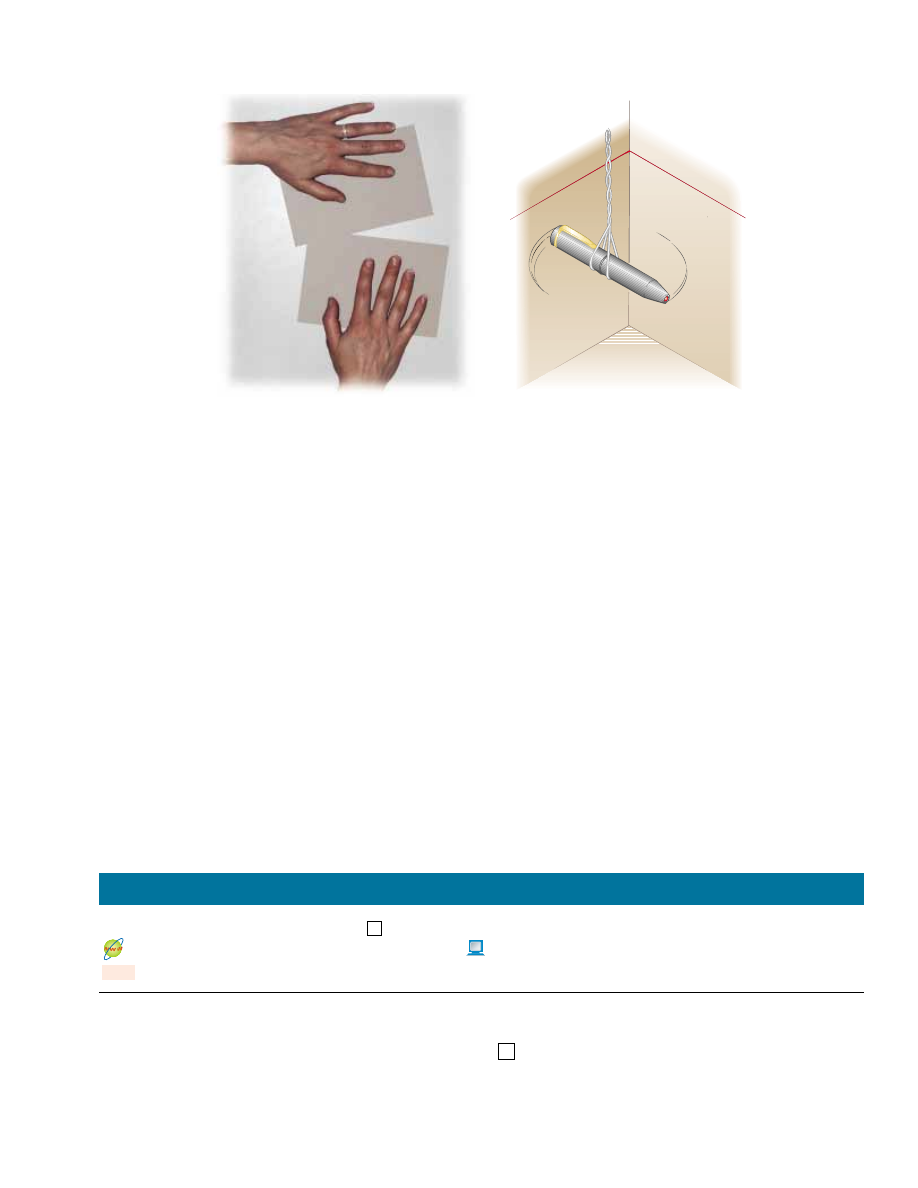
18. Two cards have straight edges. Suppose that the top edge
of one card crosses the bottom edge of another card at a
small angle, as in Figure Q39.18a. A person slides the cards
together at a moderately high speed. In what direction
does the intersection point of the edges move? Show that
it can move at a speed greater than the speed of light.
A small flashlight is suspended in a horizontal plane
and set into rapid rotation. Show that the spot of light it
produces on a distant screen can move across the screen at
a speed greater than the speed of light. (If you use a laser
pointer, as in Figure Q39.18b, make sure the direct laser
light cannot enter a person’s eyes.) Argue that these exper-
iments do not invalidate the principle that no material, no
energy, and no information can move faster than light
moves in a vacuum.
19. Describe how the results of Example 39.7 would change if,
instead of fast space vehicles, two ordinary cars were
approaching each other at highway speeds.
20. Two objects are identical except that one is hotter than the
other. Compare how they respond to identical forces.
21. With regard to reference frames, how does general relativ-
ity differ from special relativity?
22. Two identical clocks are in the same house, one upstairs in
a bedroom, and the other downstairs in the kitchen.
Which clock runs more slowly? Explain.
23. A thought experiment. Imagine ants living on a merry-
go-round turning at relativistic speed, which is their two-
dimensional world. From measurements on small circles
they are thoroughly familiar with the number 2. When
they measure the circumference of their world, and
divide it by the diameter, they expect to calculate the
number 2 ! 3.141 59. . . . We see the merry-go-round
turning at relativistic speed. From our point of view, the
ants’ measuring rods on the circumference are experi-
encing length contraction in the tangential direction;
hence the ants will need some extra rods to fill that
entire distance. The rods measuring the diameter,
however, do not contract, because their motion is
perpendicular to their lengths. As a result, the computed
ratio does not agree with the number 2. If you were an
ant, you would say that the rest of the universe is
spinning in circles, and your disk is stationary. What
possible explanation can you then give for the discrep-
ancy, in light of the general theory of relativity?
(b)
(a)
Figure Q39.18
Section 39.1 The Principle of Galilean Relativity
1. A 2 000-kg car moving at 20.0 m/s collides and locks
together with a 1 500-kg car at rest at a stop sign. Show that
momentum is conserved in a reference frame moving at
10.0 m/s in the direction of the moving car.
2. A ball is thrown at 20.0 m/s inside a boxcar moving along
the tracks at 40.0 m/s. What is the speed of the ball
relative to the ground if the ball is thrown (a) forward
(b) backward (c) out the side door?
In a laboratory frame of reference, an observer notes
that Newton’s second law is valid. Show that it is also
valid for an observer moving at a constant speed, small
compared with the speed of light, relative to the labora-
tory frame.
3.
1,
2
,
3
= straightforward, intermediate, challenging
= full solution available in the Student Solutions Manual and Study Guide
= coached solution with hints available at http://www.pse6.com
= computer useful in solving problem
= paired numerical and symbolic problems
P R O B L E M S