Physics For Scientists And Engineers 6E - part 319
 

  Index      Production     Physics For Scientists And Engineers 6E


Search            


Content   ..  317  318  319  320   ..


Physics For Scientists And Engineers 6E - part 319


39.10 The General Theory of Relativity

Up to this point, we have sidestepped a curious puzzle. Mass has two seemingly differ-
ent  properties:  a  gravitational  attraction  for  other  masses  and  an  inertial  property  that
represents  a  resistance  to  acceleration.  To  designate  these  two  attributes,  we  use  the
subscripts and and write

Gravitational property

F

g

!

m

g

g

Inertial property

m

i

a

The value for the gravitational constant was chosen to make the magnitudes of m

g

and m

i

numerically equal. Regardless of how is chosen, however, the strict propor-

tionality of m

g

and m

i

has been established experimentally to an extremely high degree:

a  few  parts  in  10

12

.  Thus,  it  appears  that  gravitational  mass  and  inertial  mass  may

indeed be exactly proportional.

But  why?  They  seem  to  involve  two  entirely  different  concepts:  a  force  of  mutual

gravitational  attraction  between  two  masses,  and  the  resistance  of  a  single  mass  to
being  accelerated.  This  question,  which  puzzled  Newton  and  many  other  physicists
over the years, was answered by Einstein in 1916 when he published his theory of gravi-
tation, known as the general theory of relativity. Because it is a mathematically complex
theory, we offer merely a hint of its elegance and insight.

In Einstein’s view, the dual behavior of mass was evidence for a very intimate and

basic  connection  between  the  two  behaviors.  He  pointed  out  that  no  mechanical
experiment (such as dropping an object) could distinguish between the two situations
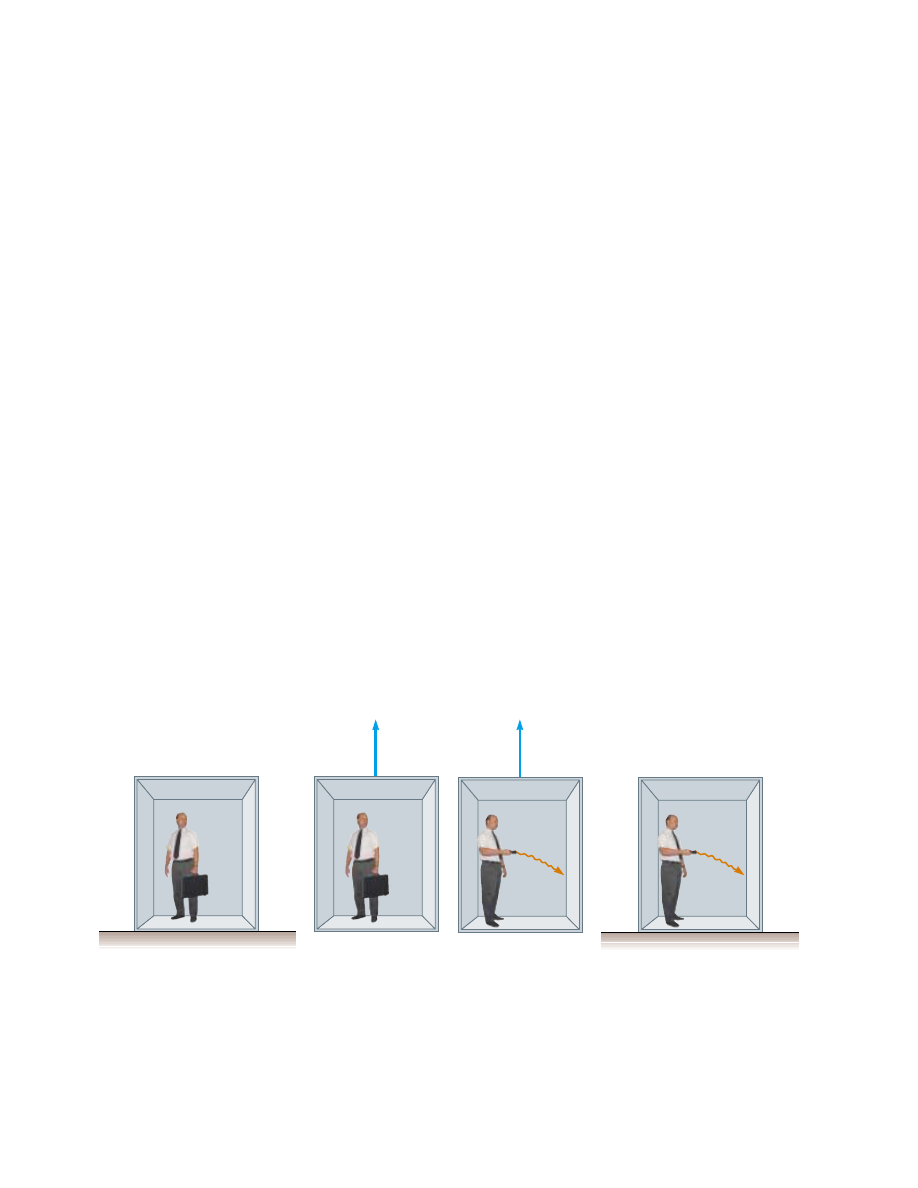
illustrated in Figures 39.19a and 39.19b. In Figure 39.19a, a person is standing in an
elevator on the surface of a planet, and feels pressed into the floor, due to the gravita-
tional force. In Figure 39.19b, the person is in an elevator in empty space accelerating
upward with g. The person feels pressed into the floor with the same force as in
Figure 39.19a. In each case, an object released by the observer undergoes a downward
acceleration of magnitude relative to the floor. In Figure 39.19a, the person is in an
inertial frame in a gravitational field. In Figure 39.19b, the person is in a noninertial
frame accelerating in gravity-free space. Einstein’s claim is that these two situations are
completely equivalent.

)

S E C T I O N   3 9 . 10 •  The General Theory of Relativity

1273

(b)

F

(a)

(c)

(d)

F

Figure 39.19 (a) The observer is at rest in a uniform gravitational field 

g, directed

downward. (b) The observer is in a region where gravity is negligible, but the frame

is accelerated by an external force 

F that produces an acceleration g directed

upward. According to Einstein, the frames of reference in parts (a) and (b) are

equivalent in every way. No local experiment can distinguish any difference between

the two frames. (c) In the accelerating frame, a ray of light would appear to bend

downward due to the acceleration of the elevator. (d) If parts (a) and (b) are truly

equivalent, as Einstein proposed, then part (c) suggests that a ray of light would

bend downward in a gravitational field.

Einstein carried this idea further and proposed that no experiment, mechanical or

otherwise,  could  distinguish  between  the  two  cases.  This  extension  to  include  all
phenomena  (not  just  mechanical  ones)  has  interesting  consequences.  For  example,
suppose  that  a  light  pulse  is  sent  horizontally  across  an  elevator  that  is  accelerating
upward in empty space, as in Figure 39.19c. From the point of view of an observer in
an  inertial  frame  outside  of  the  elevator,  the  light  travels  in  a  straight  line  while  the
floor  of  the  elevator  accelerates  upward.  According  to  the  observer  on  the  elevator,
however, the trajectory of the light pulse bends downward as the floor of the elevator
(and  the  observer)  accelerates  upward.  Therefore,  based  on  the  equality  of  parts
(a) and (b) of the figure for all phenomena, Einstein proposed that 

a beam of light

should also be bent downward by a gravitational field, as in Figure 39.19d. Experi-
ments  have  verified  the  effect,  although  the  bending  is  small.  A  laser  aimed  at  the
horizon falls less than 1 cm after traveling 6 000 km. (No such bending is predicted in
Newton’s theory of gravitation.)

The two postulates of Einstein’s 

general theory of relativity are

• All the laws of nature have the same form for observers in any frame of reference,

whether accelerated or not.

• In  the  vicinity  of  any  point,  a  gravitational  field  is  equivalent  to  an  accelerated

frame of reference in the absence of gravitational effects. (This is the 

principle of

equivalence.)

One  interesting  effect  predicted  by  the  general  theory  is  that  time  is  altered  by

gravity. A clock in the presence of gravity runs slower than one located where gravity
is negligible.  Consequently,  the  frequencies  of  radiation  emitted  by  atoms  in  the
presence  of  a  strong  gravitational  field  are  red-shifted to  lower  frequencies  when
compared with the same emissions in the presence of a weak field. This gravitational
red shift has been detected in spectral lines emitted by atoms in massive stars. It has
also been verified on the Earth by comparing the frequencies of gamma rays emitted
from nuclei separated vertically by about 20 m.

The second postulate suggests that a gravitational field may be “transformed away”

at  any  point  if  we  choose  an  appropriate  accelerated  frame  of  reference—a  freely
falling  one.  Einstein  developed  an  ingenious  method  of  describing  the  acceleration
necessary  to  make  the  gravitational  field  “disappear.”  He  specified  a  concept,  the
curvature of space–time, that describes the gravitational effect at every point. In fact, the
curvature of space–time completely replaces Newton’s gravitational theory. According
to  Einstein,  there  is  no  such  thing  as  a  gravitational  force.  Rather,  the  presence  of  a
mass  causes  a  curvature  of  space–time  in  the  vicinity  of  the  mass,  and  this  curvature
dictates the space–time path that all freely moving objects must follow. In 1979, John
Wheeler summarized Einstein’s general theory of relativity in a single sentence: “Space
tells matter how to move and matter tells space how to curve.”

As an example of the effects of curved space–time, imagine two travelers moving on

parallel paths a few meters apart on the surface of the Earth and maintaining an exact
northward  heading  along  two  longitude  lines.  As  they  observe  each  other  near  the
equator,  they  will  claim  that  their  paths  are  exactly  parallel.  As  they  approach  the
North  Pole,  however,  they  notice  that  they  are  moving  closer  together,  and  they  will
actually meet at the North Pole. Thus, they will claim that they moved along parallel
paths, but moved toward each other, as if there were an attractive force between them. They
will  make  this  conclusion  based  on  their  everyday  experience  of  moving  on  flat
surfaces. From our mental representation, however, we realize that they are walking on
a  curved  surface,  and  it  is  the  geometry  of  the  curved  surface  that  causes  them  to
converge,  rather  than  an  attractive  force.  In  a  similar  way,  general  relativity  replaces
the notion of forces with the movement of objects through curved space–time.

One prediction of the general theory of relativity is that a light ray passing near the

Sun  should  be  deflected  in  the  curved  space–time  created  by  the  Sun’s  mass.  This
prediction was confirmed when astronomers detected the bending of starlight near the

1274

C H A P T E R   3 9 •  Relativity

Postulates of the general theory

of relativity

Einstein’s cross. The four bright

spots are images of the same galaxy

that have been bent around a

massive object located between the

galaxy and the Earth. The massive

object acts like a lens, causing the

rays of light that were diverging

from the distant galaxy to converge

on the Earth. (If the intervening

massive object had a uniform mass

distribution, we would see a bright

ring instead of four spots.)

Courtesy of NASA

Sun  during  a  total  solar  eclipse  that  occurred  shortly  after  World  War  I  (Fig.  39.20).
When this discovery was announced, Einstein became an international celebrity.

If  the  concentration  of  mass  becomes  very  great,  as  is  believed  to  occur  when  a

large star exhausts its nuclear fuel and collapses to a very small volume, a 

black hole

may  form.  Here,  the  curvature  of  space–time  is  so  extreme  that,  within  a  certain
distance  from  the  center  of  the  black  hole,  all  matter  and  light  become  trapped,  as
discussed in Section 13.7.

Summary

1275

1.75"

Sun

Light from star

(actual direction)

Apparent

direction to star

Deflected path of light

from star

Earth

Figure 39.20 Deflection of starlight passing near the Sun. Because of this effect, the

Sun or some other remote object can act as a gravitational lens. In his general theory of

relativity, Einstein calculated that starlight just grazing the Sun’s surface should be

deflected by an angle of 1.75 s of arc.

The two basic postulates of the special theory of relativity are

• The laws of physics must be the same in all inertial reference frames.
• The speed of light in vacuum has the same value, ! 3.00 $ 10

8

m/s, in all inertial

frames, regardless of the velocity of the observer or the velocity of the source emit-
ting the light.

Three consequences of the special theory of relativity are

• Events that are measured to be simultaneous for one observer are not necessarily

measured  to  be  simultaneous  for  another  observer  who  is  in  motion  relative  to
the first.

• Clocks  in  motion  relative  to  an  observer  are  measured  to  run  slower  by  a  factor

* !

(1 # v

2

/c

2

)

#

1/2

. This phenomenon is known as 

time dilation.

• The length of objects in motion are measured to be contracted in the direction of

motion  by  a  factor  1/* ! (1 # v

2

/c

2

)

1/2

This  phenomenon  is  known  as 

length

contraction.

To satisfy the postulates of special relativity, the Galilean transformation equations

must be replaced by the 

Lorentz transformation equations:

x" ! *(vt)

y" ! y

z" ! z

(39.11)

where * ! (1 # v

2

/c

2

)

#

1/2

and the S" frame moves in the direction relative to the S

frame.

The relativistic form of the 

velocity transformation equation is

(39.16)

where  u

x

is  the  speed  of  an  object  as  measured  in  the  S  frame  and  u"

x

is  its  speed

measured in the S" frame.

u


"

x

!

u

x

#

v

1 #

u

x


v

c


2

t


" !

*


"

#

v

c


2

 x

#

Take a practice test for

this chapter by clicking on
the Practice Test link at
http://www.pse6.com.

S U M M A R Y

1276

C H A P T E R   3 9 •  Relativity

1. What two speed measurements do two observers in relative

motion always agree on?

2. A  spacecraft  with  the  shape  of  a  sphere  moves  past  an

observer on Earth with a speed 0.5c. What shape does the
observer measure for the spacecraft as it moves past?

3. The  speed  of  light  in  water  is  230 Mm/s.  Suppose  an

electron is moving through water at 250 Mm/s. Does this
violate the principle of relativity?

4. Two identical clocks are synchronized. One is then put in

orbit  directed  eastward  around  the  Earth  while  the  other
remains on the Earth. Which clock runs slower? When the
moving  clock  returns  to  the  Earth,  are  the  two  still
synchronized?
Explain why it is necessary, when defining the length of a
rod, to specify that the positions of the ends of the rod are
to be measured simultaneously.

6. A train is approaching you at very high speed as you stand

next to the tracks. Just as an observer on the train passes
you, you both begin to play the same Beethoven symphony
on  portable  compact  disc  players.  (a)  According  to  you,
whose CD player finishes the symphony first? (b) What If?
According  to  the  observer  on  the  train,  whose  CD  player
finishes  the  symphony  first?  (c)  Whose  CD  player  really
finishes the symphony first?
List  some  ways  our  day-to-day  lives  would  change  if  the
speed of light were only 50 m/s.

8. Does saying that a moving clock runs slower than a station-

ary  one  imply  that  something  is  physically  unusual  about
the moving clock?

7.

5.

9. How is acceleration indicated on a space–time graph?

10. A particle is moving at a speed less than c/2. If the speed

of the particle is doubled, what happens to its momentum?
Give a physical argument that shows that it is impossible to
accelerate an object of mass to the speed of light, even
with a continuous force acting on it.

12. The upper limit of the speed of an electron is the speed of

light  c.  Does  that  mean  that  the  momentum  of  the
electron has an upper limit?

13. Because mass is a measure of energy, can we conclude that

the mass of a compressed spring is greater than the mass
of the same spring when it is not compressed?

14. It is said that Einstein, in his teenage years, asked the ques-

tion,  “What  would  I  see  in  a  mirror  if  I  carried  it  in  my
hands  and  ran  at  the  speed  of  light?”  How  would  you
answer this question?

15. Some  distant  astronomical  objects,  called  quasars,  are

receding  from  us  at  half  the  speed  of  light  (or  greater).
What  is  the  speed  of  the  light  we  receive  from  these
quasars?

16. Photons  of  light  have  zero  mass.  How  is  it  possible  that

they have momentum?

17. “Newtonian mechanics correctly describes objects moving

at  ordinary  speeds  and  relativistic  mechanics  correctly
describes objects moving very fast.” “Relativistic mechanics
must make a smooth transition as it reduces to Newtonian
mechanics in a case where the speed of an object becomes
small compared to the speed of light.” Argue for or against
each of these two statements.

11.

Q U E S T I O N S

The relativistic expression for the 

linear momentum of a particle moving with a

velocity 

u is

(39.19)

The relativistic expression for the 

kinetic energy of a particle is

(39.23)

The constant term mc

2

in Equation 39.23 is called the 

rest energy E

R

of the particle:

E

R

!

mc

2

(39.24)

The total energy of a particle is given by 

(39.26)

The relativistic linear momentum of a particle is related to its total energy through

the equation

E

2

!

p

2

c

2

&

(mc

2

)

2

(39.27)

!

mc


2

1 #

u

2

c


2

!

*

mc


2

!

mc


2

1 #

u

2

c


2

#

mc


2

!

(* # 1)mc


2

p ' 

m


u

1 #

u

2

c


2

!

*

m


u


Content   ..  317  318  319  320   ..