Physics For Scientists And Engineers 6E - part 316
 

  Index      Production     Physics For Scientists And Engineers 6E


Search            


Content   ..  314  315  316  317   ..


Physics For Scientists And Engineers 6E - part 316


S E C T I O N   3 9 . 4 •  Consequences of the Special Theory of Relativity

1261

An  astronaut  takes  a  trip  to  Sirius,  which  is  located  a
distance  of  8  lightyears  from  the  Earth.  The  astronaut
measures the time of the one-way journey to be 6 yr. If the
spaceship moves at a constant speed of 0.8c, how can the 8-ly
distance  be  reconciled  with  the  6-yr  trip  time  measured  by
the astronaut?

Solution The distance of 8 ly represents the proper length
from  the  Earth  to  Sirius  measured  by  an  observer  seeing
both  objects  nearly  at  rest.  The  astronaut  sees  Sirius
approaching  her  at  0.8but  also  sees  the  distance

contracted to

Thus, the travel time measured on her clock is

Note  that  we  have  used  the  value  for  the  speed  of  light  as
! 1 ly/yr.

'

!

d
v

!

5 ly

0.8c

!

6 yr

8 ly

*

!

(8 ly) 

1 #

v

2

c


2

!

(8 ly) 

1 #

(0.8c)

2

c


2

!

5 ly

Example 39.5 A Voyage to Sirius

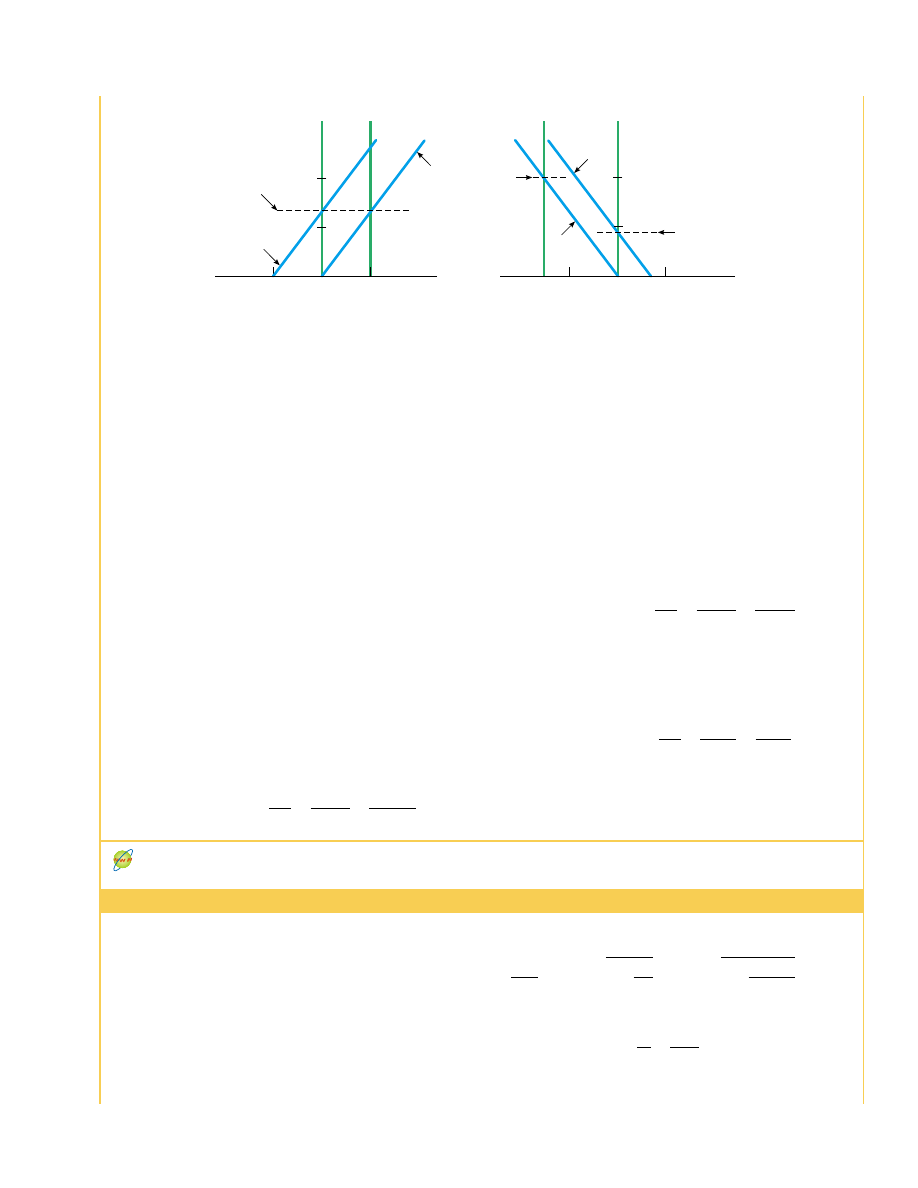
for each end of the moving pole. These world-lines are 9.9 m
apart horizontally, which is the contracted length seen by the
ground observer. As seen in Figure 39.13a, at one instant, the
pole is entirely within the barn.

Figure  39.13b  shows  the  space–time  graph  according  to

the runner. Here, the world-lines for the pole are separated by
15 m and are vertical because the pole is at rest in the runner’s
frame of reference. The barn is hurtling toward the runner, so
the  world-lines  for  the  front  and  rear  doors  of  the  barn  are
tilted  in  the  opposite  direction  compared  to  Figure  39.13a.
The  world-lines  for  the  barn  are  separated  by  6.6 m,  the
contracted length as seen by the runner. Notice that the front
of the pole leaves the rear door of the barn long before the
back  of  the  pole  enters  the  barn.  Thus,  the  opening  of  the
rear door occurs before the closing of the front door.

From  the  ground  observer’s  point  of  view,  the  time  at

which the trailing end of the pole enters the barn is found
from

'

# 0 ! !

'

x

v

!

9.9 m

0.75c

!

13.2 m

c

Thus,  the  pole  should  be  completely  inside  the  barn  at  a
time  corresponding  to  ct ! 13.2 m.  This  is  consistent  with
the  point  on  the  ct axis  in  Figure  39.13a  where  the  pole  is
inside the barn.

From the runner’s point of view, the time at which the

leading end of the pole leaves the barn is found from

leading  to  ct ! 8.8 m.  This  is  consistent  with  the  point  on
the ct axis in Figure 39.13b where the back door of the barn
arrives  at  the  leading  end  of  the  pole.  Finally,  the  time  at
which the trailing end of the pole enters the front door of
the barn is found from

This gives ct ! 20 m, which agrees with the instant shown in
Figure 39.13b.

'

# 0 ! !

'

x

v

!

15 m
0.75c

!

20 m

c

'

# 0 ! !

'

x

v

!

6.6 m

0.75c

!

8.8 m

c

10

20

ct (m)

Front

door

Back

door

Pole is

entirely

in barn

Leading

end of

pole

Trailing

end of

pole

–10

0

10

x (m)

(a)

Front door

arrives at

trailing end

of pole

Trailing

end of

pole

Leading

end of

pole

Back

door

Front

door

10

20

10

–10

0

Back door

arrives at

leading end

of pole

x (m)

(b)

ct (m)

Figure 39.13 (Example 39.4) Space–time graphs for the pole-in-the-barn paradox.

(a) From the ground observer’s point of view, the world-lines for the front and back

doors of the barn are vertical lines. The world-lines for the ends of the pole are

tilted and are 9.9 m apart horizontally. The front door of the barn is at ! 0, and

the leading end of the pole enters the front door at ! 0. The entire pole is inside

the barn at the time indicated by the dashed line. (b) From the runner’s point of

view, the world-lines for the ends of the pole are vertical. The barn is moving in the

negative direction, so the world-lines for the front and back doors are tilted to the

left. The leading end of the pole exits the back door before the trailing end arrives

at the front door.

Investigate the pole-in-the-barn paradox at the Interactive Worked Example link at http://www.pse6.com.

The Relativistic Doppler Effect

Another  important  consequence  of  time  dilation  is  the  shift  in  frequency
found for light  emitted  by  atoms  in  motion  as  opposed  to  light  emitted  by  atoms
at rest. This phenomenon, known as the Doppler effect, was introduced in Chapter
17  as  it  pertains  to  sound  waves.  In  the  case  of  sound,  the  motion  of  the  source
with respect  to  the  medium  of  propagation  can  be  distinguished  from  the  motion
of the observer  with  respect  to  the  medium.  Light  waves  must  be  analyzed
differently,  however,  because  they  require  no  medium  of  propagation,  and  no
method  exists  for  distinguishing  the  motion  of  a  light  source  from  the  motion  of
the observer.

If a light source and an observer approach each other with a relative speed v, the

frequency f

obs

measured by the observer is

(39.10)

where f

source

is the frequency of the source measured in its rest frame. Note that this

relativistic  Doppler  shift  equation,  unlike  the  Doppler  shift  equation  for  sound,
depends only on the relative speed of the source and observer and holds for relative
speeds as great as c. As you might expect, the equation predicts that f

obs

,

f

source

when

the source and observer approach each other. We obtain the expression for the case in
which the source and observer recede from each other by substituting negative values
for in Equation 39.10.

The  most  spectacular  and  dramatic  use  of  the  relativistic  Doppler  effect  is  the

measurement  of  shifts  in  the  frequency  of  light  emitted  by  a  moving  astronomical
object  such  as  a  galaxy.  Light  emitted  by  atoms  and  normally  found  in  the  extreme
violet region of the spectrum is shifted toward the red end of the spectrum for atoms
in  other  galaxies—indicating  that  these  galaxies  are  receding from  us.  The  American
astronomer Edwin Hubble (1889–1953) performed extensive measurements of this red
shift  
to  confirm  that  most  galaxies  are  moving  away  from  us,  indicating  that  the
Universe is expanding.

39.5 The Lorentz Transformation Equations

Suppose  an  event  that  occurs  at  some  point  is  reported  by  two  observers,  one
at rest  in  a  frame  S  and  another  in  a  frame  S" that  is  moving  to  the  right  with
speed as  in Figure  39.14.  The  observer  in  S  reports  the  event  with  space–time
coordinates  (x,  y,  z,  t),  while  the  observer  in  S" reports  the  same  event  using  the
coordinates  (x",  y",  z",  t").  If  two  events  occur  at  and  ,  Equation  39.1
predicts that  '! 'x",  that  is,  the  distance  between  the  two  points  in  space

f


obs

!

1 & v/c

1 # v/c

 f


source

1262

C H A P T E R   3 9 •  Relativity

What  If?

What if this trip is observed with a very powerful

telescope  by  a  technician  in  Mission  Control  on  Earth?  At
what  time  will  this  technician see  that  the  astronaut  has
arrived at Sirius?

Answer The time interval that the technician will measure
for the astronaut to arrive is

In order for the technician to see the arrival, the light from
the scene of the arrival must travel back to Earth and enter

'

!

d
v

!

8 ly

0.8c

!

10 yr

the telescope. This will require a time interval of

Thus,  the  technician  sees  the  arrival  after  10 yr & 8 yr !
18 yr.  Notice  that  if  the  astronaut  immediately  turns
around  and  comes  back  home,  she  arrives,  according  to
the technician, 20 years after leaving, only 2 years after he
saw her  arrive!  In  addition,  she  would  have  aged  by  only
12 years.

'

!

d
v

!

8 ly

c

!

8 yr

y

y

v

S

S

O

x

x

P (event)

O

Q (event)

vt

x

x

x

Figure 39.14 Events occur at

points and and are observed by

an observer at rest in the S frame

and another in the S" frame, which

is moving to the right with a speed v.

at which  the  events  occur  does  not  depend  on  motion  of  the  observer.  Because
this is  contradictory  to  the  notion  of  length  contraction,  the  Galilean  trans-
formation  is  not  valid  when  v  approaches  the  speed  of  light.  In  this  section,  we
state the  correct  transformation  equations  that  apply  for  all  speeds  in  the  range
0 - c.

The equations that are valid for all speeds and enable us to transform coordinates

from S to S" are the 

Lorentz transformation equations:

x" ! *(vt)

y" ! y

z" ! z

(39.11)

These  transformation  equations  were  developed  by  Hendrik  A.  Lorentz  (1853–1928)
in 1890 in connection with electromagnetism. However, it was Einstein who recognized
their  physical  significance  and  took  the  bold  step  of  interpreting  them  within  the
framework of the special theory of relativity.

Note  the  difference  between  the  Galilean  and  Lorentz  time  equations.  In

the Galilean case, t", but in the Lorentz case the value for t" assigned to an event by
an observer O" in the S" frame in Figure 39.14 depends both on the time and on the
coordinate as measured by an observer in the S frame. This is consistent with the
notion  that  an  event  is  characterized  by  four  space–time  coordinates  (x,  y,  z,  t).  In
other  words,  in  relativity,  space  and  time  are  not separate concepts  but  rather  are
closely interwoven with each other.

If we wish to transform coordinates in the S" frame to coordinates in the S frame,

we simply replace by # and interchange the primed and unprimed coordinates in
Equations 39.11:

! *(x" & vt")

y"

z"

(39.12)

When  (( c,  the  Lorentz  transformation  equations  should  reduce  to  the
Galilean equations.  To  verify  this,  note  that  as  v  approaches  zero,  v/(( 1;  thus,
* :

1,  and  Equations  39.11  reduce  to  the  Galilean  space–time  transformation

equations:

x" ! vt

y" ! y

z" ! z

t" ! t

In  many  situations,  we  would  like  to  know  the  difference  in  coordinates  between

two events or the time interval between two events as seen by observers and O". We
can accomplish this by writing the Lorentz equations in a form suitable for describing
pairs  of  events.  From  Equations  39.11  and  39.12,  we  can  express  the  differences
between the four variables xx", t, and t" in the form

(39.13)

(39.14)

where 'x" ! x"

2

#

x"

1

and 't" ! "

2

#

"

1

are the differences measured by observer O"

and 'x

2

#

x

1

and 't

2

#

t

1

are the differences measured by observer O. (We

have not included the expressions for relating the and coordinates because they are
unaffected by motion along the direction.

5

)

'

t


!

*


"

'

t


" &

v

c


2

 'x


"

#

'

x


!

*


('x


" &

v 't


"

)

'

t


" !

*


"

'

#

v

c


2

 'x

#

'

x


" !

*


('v 't


)

t


!

*


"

t


" &

v

c


2


x


"

#

t


" !

*


"

#

v

c


2


x

#

S E C T I O N   3 9 . 5 •  The Lorentz Transformation Equations

1263

Lorentz transformation for

S!

5

Although relative motion of the two frames along the axis does not change the and coordi-

nates of an object, it does change the and velocity components of an object moving in either frame,
as noted in Section 39.6.

Inverse Lorentz transformation

for S" : S

&

S : S"

&

S" : S

39.6 The Lorentz Velocity Transformation

Equations

Suppose two observers in relative motion with respect to each other are both observing
the  motion  of  an  object.  Previously,  we  defined  an  event  as  occurring  at  an  instant  of
time. Now, we wish to interpret the “event” as the motion of the object. We know that the
Galilean velocity transformation (Eq. 39.2) is valid for low speeds. How do the observers’
measurements of the velocity of the object relate to each other if the speed of the object
is  close  to  that  of  light?  Once  again  S" is  our  frame  moving  at  a  speed  relative  to  S.
Suppose that an object has a velocity component u"

x

measured in the S" frame, where

(39.15)

Using Equation 39.11, we have

dx" ! *(dx v dt)

Substituting these values into Equation 39.15 gives

But dx/dt is just the velocity component u

x

of the object measured by an observer in S,

and so this expression becomes

(39.16)

If  the  object  has  velocity  components  along  the  and  axes,  the  components  as

measured by an observer in S" are

(39.17)

u


"

y

!

u

y

*


"

1 #

u

x


v

c


2

#


and


u


"

z

!

u

z

*


"

1 #

u

x


v

c


2

#

u


"

x

!

u

x

#

v

1 #

u

x


v

c


2

u


"

x

!

dx


"

dt


"

!

dx v dt

dt #

v

c


2

 dx

!

dx

dt

#

v

1 #

v

c


2


dx

dt

dt


" !

*


"

dt #

v

c


2

 dx

#

u"

x

!

dx


"

dt


"

1264

C H A P T E R   3 9 •  Relativity

Lorentz velocity transformation

for S S"

Use  the  Lorentz  transformation  equations  in  difference
form to show that

(A)

simultaneity is not an absolute concept and that

(B)

a moving clock is measured to run more slowly than a

clock that is at rest with respect to an observer.

Solution (A)  Suppose  that  two  events  are  simultaneous
and  separated  in  space  such  that  't" ! 0  and  'x" ! 0
according  to  an  observer  O" who  is  moving  with  speed  v
relative  to  O.  From  the  expression  for  'given  in
Equation  39.14,  we  see  that  in  this  case  the  time  interval
'

measured by observer is '! *'x"/c

2

. That is, the

time interval for the same two events as measured by is
nonzero, and so the events do not appear to be simultane-
ous to O.

(B) Suppose that observer O" carries a clock that he uses

to measure a time interval 't". He finds that two events occur
at  the  same  place  in  his  reference  frame  ('x" ! 0)  but  at
different  times  ('t" ! 0).  Observer  O" is  moving  with  speed 
relative  to  O,  who  measures  the  time  interval  between  the
events to be 't. In this situation, the expression for 'given 
in  Equation  39.14  becomes  '! * 't".  This  is  the  equation
for time dilation found earlier (Eq. 39.7), where 't" ! 't

p

is

the  proper  time  measured  by  the  clock  carried  by  observer 
O". Thus, measures the moving clock to run slow.

Example 39.6 Simultaneity and Time Dilation Revisited


Content   ..  314  315  316  317   ..