Physics For Scientists And Engineers 6E - part 293
 

  Index      Production     Physics For Scientists And Engineers 6E


Search            


Content   ..  291  292  293  294   ..


Physics For Scientists And Engineers 6E - part 293


Problems

1169

8. At an intersection of hospital hallways, a convex mirror is

mounted  high  on  a  wall  to  help  people  avoid  collisions.
The  mirror  has  a  radius  of  curvature  of  0.550 m.  Locate
and  describe  the  image  of  a  patient  10.0 m  from  the
mirror. Determine the magnification.

A  spherical  convex  mirror  has  a  radius  of  curvature

with  a  magnitude  of  40.0 cm.  Determine  the  position  of
the  virtual  image  and  the  magnification  for  object
distances  of  (a)  30.0 cm  and  (b)  60.0 cm.  (c)  Are  the
images upright or inverted?

10. A large church has a niche in one wall. On the floor plan

it appears as a semicircular indentation of radius 2.50 m. A
worshiper  stands  on  the  center  line  of  the  niche,  2.00 m
out from its deepest point, and whispers a prayer. Where is
the sound concentrated after reflection from the back wall
of the niche?
A  concave  mirror  has  a  radius  of  curvature  of  60.0 cm.
Calculate the image position and magnification of an object
placed in front of the mirror at distances of (a) 90.0 cm and
(b)  20.0 cm.  (c)  Draw  ray  diagrams  to  obtain  the  image
characteristics in each case.

12.

A concave mirror has a focal length of 40.0 cm. Determine
the object position for which the resulting image is upright
and four times the size of the object.

13.

A certain Christmas tree ornament is a silver sphere having
a  diameter  of  8.50 cm.  Determine  an  object  location  for
which  the  size  of  the  reflected  image  is  three-fourths  the
size of the object. Use a principal-ray diagram to arrive at a
description of the image.

14.

(a)  A  concave  mirror  forms  an  inverted  image  four  times
larger than the object. Find the focal length of the mirror,
assuming the distance between object and image is 0.600 m.
(b)  A  convex  mirror  forms  a  virtual  image  half  the  size
of the  object.  Assuming  the  distance  between  image  and
object is 20.0 cm, determine the radius of curvature of the
mirror.

15. To fit a contact lens to a patient’s eye, a keratometer can be

used to measure the curvature of the front surface of the
eye,  the  cornea.  This  instrument  places  an  illuminated
object  of  known  size  at  a  known  distance  from  the
cornea.  The  cornea  reflects  some  light  from  the  object,
forming  an  image  of  the  object.  The  magnification  M  of
the image is measured by using a small viewing telescope
that  allows  comparison  of  the  image  formed  by  the
cornea with a second calibrated image projected into the
field  of  view  by  a  prism  arrangement.  Determine  the  ra-
dius  of  curvature  of  the  cornea  for  the  case  " 30.0 cm
and " 0.013 0. 

16.

An  object  10.0 cm  tall  is  placed  at  the  zero  mark  of  a
meter stick. A spherical mirror located at some point on
the  meter  stick  creates  an  image  of  the  object  that  is
upright,  4.00 cm  tall,  and  located  at  the  42.0-cm  mark
of the meter stick. (a) Is the mirror convex or concave?
(b)  Where  is  the  mirror?  (c)  What  is  the  mirror’s  focal
length? 
A spherical mirror is to be used to form, on a screen located
5.00 m from the object, an image five times the size of the
object. (a) Describe the type of mirror required. (b) Where
should the mirror be positioned relative to the object?

17.

11.

9.

18.

A  dedicated  sports  car  enthusiast  polishes  the  inside  and
outside surfaces of a hubcap that is a section of a sphere.
When she looks into one side of the hubcap, she sees an
image of her face 30.0 cm in back of the hubcap. She then
flips the hubcap over and sees another image of her face
10.0 cm  in  back  of  the  hubcap.  (a)  How  far  is  her  face
from  the  hubcap?  (b)  What  is  the  radius  of  curvature  of
the hubcap?

19.

You  unconsciously  estimate  the  distance  to  an  object
from the  angle  it  subtends  in  your  field  of  view.  This
angle # in  radians  is  related  to  the  linear  height  of  the
object  and  to  the  distance  d  by  # " h/d.  Assume  that
you are  driving  a  car  and  another  car,  1.50 m  high,  is
24.0 m  behind  you.  (a)  Suppose  your  car  has  a  flat
passenger-side  rearview  mirror,  1.55 m  from  your  eyes.
How  far  from  your  eyes  is  the  image  of  the  car  following
you?  (b)  What  angle  does  the  image  subtend  in  your
field of  view?  (c)  What  If?  Suppose  instead  that  your  car
has  a  convex  rearview  mirror  with  a  radius  of  curvature
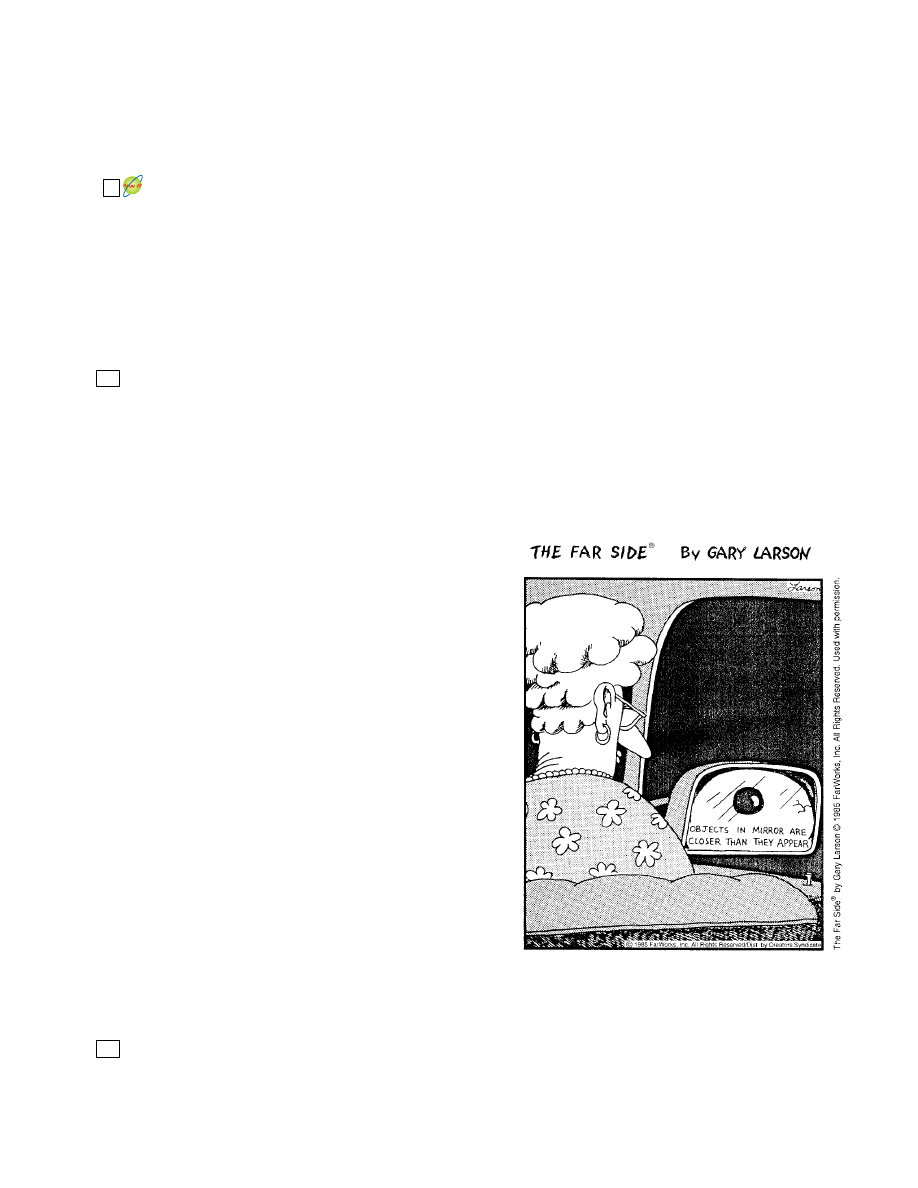
of magnitude  2.00 m  (Fig.  P36.19).  How  far  from  your
eyes is  the  image  of  the  car  behind  you?  (d)  What  angle
does  the  image  subtend  at  your  eyes?  (e)  Based  on  its
angular  size,  how  far  away  does  the  following  car  appear
to be?

Figure P36.19

20.

Review Problem. A ball is dropped at " 0 from rest 3.00 m
directly  above  the  vertex  of  a  concave  mirror  that  has  a
radius of curvature of 1.00 m and lies in a horizontal plane.
(a)  Describe  the  motion  of  the  ball’s  image  in  the  mirror.
(b) At what time do the ball and its image coincide?

1170

C H A P T E R   3 6 •  Image Formation

Section 36.3 Images Formed by Refraction

A cubical block of ice 50.0 cm on a side is placed on a level
floor over a speck of dust. Find the location of the image
of the speck as viewed from above. The index of refraction
of ice is 1.309.

22.

A  flint  glass  plate  (" 1.66)  rests  on  the  bottom  of  an
aquarium tank. The plate is 8.00 cm thick (vertical dimen-
sion)  and  is  covered  with  a  layer  of  water  (" 1.33)
12.0 cm  deep.  Calculate  the  apparent  thickness  of  the
plate as viewed from straight above the water. 
A  glass  sphere  (" 1.50)  with  a  radius  of  15.0 cm  has  a
tiny  air  bubble  5.00 cm  above  its  center.  The  sphere  is
viewed  looking  down  along  the  extended  radius  contain-
ing the bubble. What is the apparent depth of the bubble
below the surface of the sphere?

24.

A simple model of the human eye ignores its lens entirely.
Most  of  what  the  eye  does  to  light  happens  at  the  outer
surface of the transparent cornea. Assume that this surface
has a radius of curvature of 6.00 mm, and assume that the
eyeball  contains  just  one  fluid  with  a  refractive  index  of
1.40. Prove that a very distant object will be imaged on the
retina, 21.0 mm behind the cornea. Describe the image.

25. One  end  of  a  long  glass  rod  (" 1.50)  is  formed  into  a

convex  surface  with  a  radius  of  curvature  of  6.00 cm.  An
object is located in air along the axis of the rod. Find the
image  positions  corresponding  to  object  distances  of
(a) 20.0 cm, (b) 10.0 cm, and (c) 3.00 cm from the end of
the rod.

26.

A transparent sphere of unknown composition is observed
to form an image of the Sun on the surface of the sphere
opposite  the  Sun.  What  is  the  refractive  index  of  the
sphere material?

27.

A goldfish is swimming at 2.00 cm/s toward the front wall
of a rectangular aquarium. What is the apparent speed of
the fish measured by an observer looking in from outside
the front wall of the tank? The index of refraction of water
is 1.33.

Section 36.4 Thin Lenses
28. 
A  contact  lens  is  made  of  plastic  with  an  index  of  refrac-

tion of 1.50. The lens has an outer radius of curvature of
&

2.00 cm and an inner radius of curvature of & 2.50 cm.

What is the focal length of the lens?

The left face of a biconvex lens has a radius of curva-

ture of magnitude 12.0 cm, and the right face has a radius
of  curvature  of  magnitude  18.0 cm.  The  index  of  refrac-
tion  of  the  glass  is  1.44.  (a)  Calculate  the  focal  length  of
the lens. (b) What If? Calculate the focal length the lens
has after is turned around to interchange the radii of cur-
vature of the two faces.

30. A converging lens has a focal length of 20.0 cm. Locate the

image for object distances of (a) 40.0 cm, (b) 20.0 cm, and
(c) 10.0 cm. For each case, state whether the image is real
or virtual and upright or inverted. Find the magnification
in each case.

31. A  thin  lens  has  a  focal  length  of  25.0 cm.  Locate  and

describe the image when the object is placed (a) 26.0 cm
and (b) 24.0 cm in front of the lens. 

29.

23.

21.

32. An  object  located  32.0 cm  in  front  of  a  lens  forms  an

image  on  a  screen  8.00 cm  behind  the  lens.  (a)  Find  the
focal length of the lens. (b) Determine the magnification.
(c) Is the lens converging or diverging?

The  nickel’s  image  in  Figure  P36.33  has  twice  the

diameter of the nickel and is 2.84 cm from the lens. Deter-
mine the focal length of the lens.

33.

Figure P36.33

34. A  person  looks  at  a  gem  with  a  jeweler’s  loupe—a

converging  lens  that  has  a  focal  length  of  12.5 cm.  The
loupe  forms  a  virtual  image  30.0 cm  from  the  lens.
(a) Determine  the  magnification.  Is  the  image  upright
or  inverted?  (b)  Construct  a  ray  diagram  for  this
arrangement.

35.

Suppose an object has thickness dp so that it extends from
object distance to dp. Prove that the thickness dq of
its image is given by ($ q

2

/p

2

)dp, so that the longitudinal

magnification  dq/dp " $ M

2

,  where  is  the  lateral

magnification.

36. The projection lens in a certain slide projector is a single

thin lens. A slide 24.0 mm high is to be projected so that
its  image  fills  a  screen  1.80 m  high.  The  slide-to-screen
distance  is  3.00 m.  (a)  Determine  the  focal  length  of  the
projection lens. (b) How far from the slide should the lens
of the projector be placed in order to form the image on
the screen?
An object is located 20.0 cm to the left of a diverging lens
having  a  focal  length  " $ 32.0 cm.  Determine  (a)  the
location  and  (b)  the  magnification  of  the  image. 
(c) Construct a ray diagram for this arrangement.

38.

An antelope is at a distance of 20.0 m from a converging
lens  of  focal  length  30.0 cm.  The  lens  forms  an  image  of
the  animal.  If  the  antelope  runs  away  from  the  lens  at  a
speed  of  5.00 m/s,  how  fast  does  the  image  move?  Does
the image move toward or away from the lens?

39. In some types of optical spectroscopy, such as photolumi-

nescence and Raman spectroscopy, a laser beam exits from
a  pupil  and  is  focused  on  a  sample  to  stimulate  electro-
magnetic  radiation  from  the  sample.  The  focusing  lens
usually  has  an  antireflective  coating  preventing  any  light
loss.  Assume  a  100-mW  laser  is  located  4.80 m  from  the
lens, which has a focal length of 7.00 cm. (a) How far from
the lens should the sample be located so that an image of
the laser exit pupil is formed on the surface of the sample?
(b) If the diameter of the laser exit pupil is 5.00 mm, what

37.

Problems

1171

is the diameter of the light spot on the sample? (c) What is
the light intensity at the spot?

40.

Figure  P36.40  shows  a  thin  glass  (" 1.50)  converging
lens for which the radii of curvature are R

1

"

15.0 cm and

R

2

" $

12.0 cm. To the left of the lens is a cube having a

face area of 100 cm

2

. The base of the cube is on the axis of

the  lens,  and  the  right  face  is  20.0 cm  to  the  left  of  the
lens. (a) Determine the focal length of the lens. (b) Draw
the image of the square face formed by the lens. What type
of geometric figure is this? (c) Determine the area of the
image.

45.

Two  rays  traveling  parallel  to  the  principal  axis  strike  a
large  plano-convex  lens  having  a  refractive  index  of  1.60
(Fig. P36.45). If the convex face is spherical, a ray near the
edge  does  not  pass  through  the  focal  point  (spherical
aberration  occurs).  Assume  this  face  has  a  radius  of
curvature  of  20.0 cm  and  the  two  rays  are  at  distances
h

1

"

0.500 cm  and  h

2

"

12.0 cm  from  the  principal  axis.

Find the difference -in the positions where each crosses
the principal axis.

20.0 cm

F

F

Figure P36.40

C

R

x

Figure P36.45

41.

An  object  is  at  a  distance  d  to  the  left  of  a  flat  screen.  A
converging  lens  with  focal  length  d/4  is  placed
between  object  and  screen.  (a)  Show  that  two  lens  posi-
tions  exist  that  form  an  image  on  the  screen,  and  deter-
mine how far these positions are from the object. (b) How
do the two images differ from each other?

42. Figure 36.36 diagrams a cross section of a camera. It has a

single  lens  of  focal  length  65.0 mm,  which  is  to  form  an
image on the film at the back of the camera. Suppose the
position of the lens has been adjusted to focus the image
of a distant object. How far and in what direction must the
lens be moved to form a sharp image of an object that is
2.00 m away?

43.

The  South  American  capybara  is  the  largest  rodent  on
Earth; its body can be 1.20 m long. The smallest rodent is
the  pygmy  mouse  found  in  Texas,  with  an  average  body
length of 3.60 cm. Assume that a pygmy mouse is observed
by looking through a lens placed 20.0 cm from the mouse.
The  whole  image  of  the  mouse  is  the  size  of  a  capybara.
Then  the  lens  is  moved  a  certain  distance  along  its  axis,
and  the  image  of  the  mouse  is  the  same  size  as  before!
How far was the lens moved?

Section 36.5 Lens Aberrations

44.

The magnitudes of the radii of curvature are 32.5 cm and
42.5 cm for the two faces of a biconcave lens. The glass has
index  of  refraction  1.53  for  violet  light  and  1.51  for  red
light. For a very distant object, locate and describe (a) the
image formed by violet light, and (b) the image formed by
red light.

Section 36.6 The Camera
46. 
A camera is being used with a correct exposure at f/4 and

a  shutter  speed  of  (1/16) s.  In  order  to  photograph  a
rapidly  moving  subject,  the  shutter  speed  is  changed  to
(1/128) s.  Find  the  new  -number  setting  needed  to
maintain satisfactory exposure.

Section 36.7 The Eye

A  nearsighted  person  cannot  see  objects  clearly  beyond
25.0 cm  (her  far  point).  If  she  has  no  astigmatism  and
contact lenses are prescribed for her, what power and type
of lens are required to correct her vision?

48.

The accommodation limits for Nearsighted Nick’s eyes are
18.0 cm  and  80.0 cm.  When  he  wears  his  glasses,  he  can
see faraway objects clearly. At what minimum distance is he
able to see objects clearly?

49. A person sees clearly when he wears eyeglasses that have a

power  of  $ 4.00  diopters  and  sit  2.00 cm  in  front  of  his
eyes. If the person wants to switch to contact lenses, which
are placed directly on the eyes, what lens power should be
prescribed?

Section 36.8 The Simple Magnifier
Section 36.9 The Compound Microscope
Section 36.10 The Telescope
50. 
A  lens  that  has  a  focal  length  of  5.00 cm  is  used  as  a

magnifying  glass.  (a)  To  obtain  maximum  magnification,
where  should  the  object  be  placed?  (b)  What  is  the
magnification?

47.

1172

C H A P T E R   3 6 •  Image Formation

51. The  distance  between  eyepiece  and  objective  lens  in  a

certain compound microscope is 23.0 cm. The focal length
of  the  eyepiece  is  2.50 cm,  and  that  of  the  objective
is 0.400 cm.  What  is  the  overall  magnification  of  the
microscope?

52. The  desired  overall  magnification  of  a  compound  micro-

scope is 140/. The objective alone produces a lateral mag-
nification  of  12.0/.  Determine  the  required  focal  length
of the eyepiece.
The  Yerkes  refracting  telescope  has  a  1.00-m  diameter
objective lens of focal length 20.0 m. Assume it is used with
an  eyepiece  of  focal  length  2.50 cm.  (a)  Determine  the
magnification of the planet Mars as seen through this tele-
scope.  (b)  Are  the  Martian  polar  caps  right  side  up  or
upside down?

54.

Astronomers  often  take  photographs  with  the  objective
lens  or  mirror  of  a  telescope  alone,  without  an  eyepiece.
(a) Show that the image size h! for this telescope is given
by h! " f h/(p) where is the object size, is the objec-
tive focal length, and is the object distance. (b) What If?
Simplify  the  expression  in  part  (a)  for  the  case  in  which
the  object  distance  is  much  greater  than  objective  focal
length.  (c)  The  “wingspan”  of  the  International  Space
Station is 108.6 m, the overall width of its solar panel con-
figuration. Find the width of the image formed by a tele-
scope objective of focal length 4.00 m when the station is
orbiting at an altitude of 407 km.

55.

Galileo devised a simple terrestrial telescope that produces
an upright image. It consists of a converging objective lens
and a diverging eyepiece at opposite ends of the telescope
tube.  For  distant  objects,  the  tube  length  is  equal  to  the
objective  focal  length  minus  the  absolute  value  of  the
eyepiece  focal  length.  (a)  Does  the  user  of  the  telescope
see  a  real  or  virtual  image?  (b)  Where  is  the  final  image?
(c) If a telescope is to be constructed with a tube of length
10.0 cm  and  a  magnification  of  3.00,  what  are  the  focal
lengths of the objective and eyepiece?

56.

A  certain  telescope  has  an  objective  mirror  with  an  aper-
ture diameter of 200 mm and a focal length of 2 000 mm.
It captures the image of a nebula on photographic film at
its  prime  focus  with  an  exposure  time  of  1.50 min.  To
produce the same light energy per unit area on the film,
what  is  the  required  exposure  time  to  photograph  the
same  nebula  with  a  smaller  telescope,  which  has  an
objective with a diameter of 60.0 mm and a focal length of
900 mm?

Additional Problems

57. The  distance  between  an  object  and  its  upright  image  is

20.0 cm.  If  the  magnification  is  0.500,  what  is  the  focal
length of the lens that is being used to form the image?

58.

The distance between an object and its upright image is d.
If  the  magnification  is  M,  what  is  the  focal  length  of  the
lens that is being used to form the image?

59.

Your  friend  needs  glasses  with  diverging  lenses  of  focal
length $ 65.0 cm for both eyes. You tell him he looks good

53.

when he doesn’t squint, but he is worried about how thick
the lenses will be. Assuming the radius of curvature of the
first surface is R

1

"

50.0 cm and the high-index plastic has

a refractive index of 1.66, (a) find the required radius of
curvature  of  the  second  surface.  (b)  Assume  the  lens  is
ground  from  a  disk  4.00 cm  in  diameter  and  0.100 cm
thick at the center. Find the thickness of the plastic at the
edge of the lens, measured parallel to the axis. Suggestion:
Draw a large cross-sectional diagram.

60.

A  cylindrical  rod  of  glass  with  index  of  refraction  1.50  is
immersed  in  water  with  index  1.33.  The  diameter  of  the
rod is 9.00 cm. The outer part of each end of the rod has
been ground away to form each end into a hemisphere of
radius  4.50 cm.  The  central  portion  of  the  rod  with
straight sides is 75.0 cm long. An object is situated in the
water, on the axis of the rod, at a distance of 100 cm from
the vertex of the nearer hemisphere. (a) Find the location
of  the  final  image  formed  by  refraction  at  both  surfaces.
(b) Is the final image real or virtual? Upright or inverted?
Enlarged or diminished?

61.

zoom lens system is a combination of lenses that produces
a  variable  magnification  while  maintaining  fixed  object
and  image  positions.  The  magnification  is  varied  by
moving one or more lenses along the axis. While multiple
lenses  are  used  in  practice  to  obtain  high-quality  images,
the effect of zooming in on an object can be demonstrated
with  a  simple  two-lens  system.  An  object,  two  converging
lenses,  and  a  screen  are  mounted  on  an  optical  bench.
The  first  lens,  which  is  to  the  right  of  the  object,  has  a
focal  length  of  5.00 cm,  and  the  second  lens,  which  is  to
the  right  of  the  first  lens,  has  a  focal  length  of  10.0 cm.
The screen is to the right of the second lens. Initially, an
object is situated at a distance of 7.50 cm to the left of the
first lens, and the image formed on the screen has a mag-
nification  of  & 1.00.  (a)  Find  the  distance  between  the
object  and  the  screen.  (b)  Both  lenses  are  now  moved
along their common axis, while the object and the screen
maintain  fixed  positions,  until  the  image  formed  on  the
screen  has  a  magnification  of  & 3.00.  Find  the  displace-
ment of each lens from its initial position in (a). Can the
lenses be displaced in more than one way?

62.

The  object  in  Figure  P36.62  is  midway  between  the  lens
and  the  mirror.  The  mirror’s  radius  of  curvature  is
20.0 cm, and the lens has a focal length of $ 16.7 cm. Con-
sidering  only  the  light  that  leaves  the  object  and  travels
first  toward  the  mirror,  locate  the  final  image  formed  by
this  system.  Is  this  image  real  or  virtual?  Is  it  upright  or
inverted? What is the overall magnification?

Lens

Object

Mirror

25.0 cm

Figure P36.62


Content   ..  291  292  293  294   ..