Physics For Scientists And Engineers 6E - part 268
 

  Index      Production     Physics For Scientists And Engineers 6E


Search            


Content   ..  266  267  268  269   ..


Physics For Scientists And Engineers 6E - part 268


Additionally, Hertz showed in a series of experiments that the radiation generated

by  his  spark-gap  device  exhibited  the  wave  properties  of  interference,  diffraction,
reflection, refraction, and polarization, all of which are properties exhibited by light,
as we shall see in Part 5 of the text. Thus, it became evident that the radio-frequency
waves Hertz was generating had properties similar to those of light waves and differed
only  in  frequency  and  wavelength.  Perhaps  his  most  convincing  experiment  was  the
measurement of the speed of this radiation. Waves of known frequency were reflected
from  a  metal  sheet  and  created  a  standing-wave  interference  pattern  whose  nodal
points  could  be  detected.  The  measured  distance  between  the  nodal  points  enabled
determination  of  the  wavelength  *.  Using  the  relationship 

" *(Eq.  16.12),  Hertz

found that was close to 3 $ 10

8

m/s, the known speed of visible light.

34.2 Plane Electromagnetic Waves

The properties of electromagnetic waves can be deduced from Maxwell’s equations. One
approach to deriving these properties is to solve the second-order differential equation
obtained from Maxwell’s third and fourth equations. A rigorous mathematical treatment
of that sort is beyond the scope of this text. To circumvent this problem, we assume that
the vectors for the electric field and magnetic field in an electromagnetic wave have a
specific space–time behavior that is simple but consistent with Maxwell’s equations.

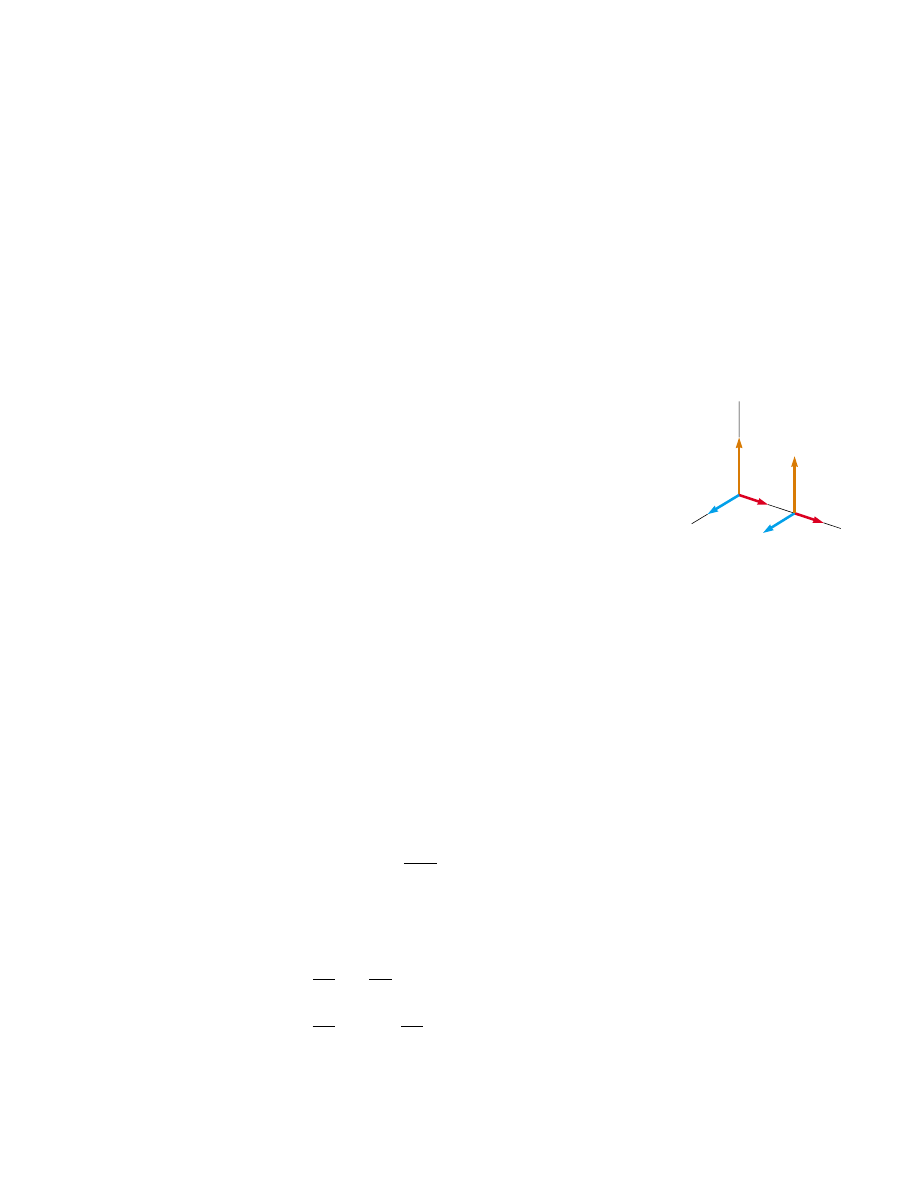
To understand the prediction of electromagnetic waves more fully, let us focus our

attention  on  an  electromagnetic  wave  that  travels  in  the  direction  (the  direction  of
propagation
).  In  this  wave,  the  electric  field 

E is in the direction, and the magnetic

field 

B is in the direction, as shown in Figure 34.2. Waves such as this one, in which

the electric and magnetic fields are restricted to being parallel to a pair of perpendicu-
lar axes, are said to be 

linearly polarized waves. Furthermore, we assume that at any

point in space, the magnitudes and of the fields depend upon and only, and not
upon the or coordinate.

Let us also imagine that the source of the electromagnetic waves is such that a wave

radiated from any position in the yz plane (not just from the origin as might be sug-
gested by Figure 34.2) propagates in the direction, and all such waves are emitted in
phase. If we define a 

ray as the line along which the wave travels, then all rays for these

waves  are  parallel.  This  entire  collection  of  waves  is  often  called  a 

plane  wave. A

surface connecting points of equal phase on all waves, which we call a 

wave front, as

introduced in Chapter 17, is a geometric plane. In comparison, a point source of radia-
tion  sends  waves  out  radially  in  all  directions.  A  surface  connecting  points  of  equal
phase for this situation is a sphere, so this is called a 

spherical wave.

We can relate and to each other with Equations 34.3 and 34.4. In empty space,

where " 0 and " 0, Equation 34.3 remains unchanged and Equation 34.4 becomes

(34.5)

Using Equations 34.3 and 34.5 and the plane-wave assumption, we obtain the following
differential equations relating and B. (We shall derive these equations formally later
in this section.)

(34.6)

(34.7)

Note  that  the  derivatives  here  are  partial  derivatives.  For  example,  when  we  evaluate
+

E/+x,  we  assume  that  is  constant.  Likewise,  when  we  evaluate  +B/+t,  is  held

constant. Taking the derivative of Equation 34.6 with respect to and combining the

+

B

+

x

" )

&

0


#

0


+

E

+

t

+

E

+

x

" )

+

B

+

t

!


B!d


s " #

0


&

0


d


(

E

dt

S E C T I O N   3 4 . 2 •  Plane Electromagnetic Waves

1069

y

E

E

c

B

z

c

x

B

Figure 34.2 An electromagnetic

wave traveling at velocity 

c in the

positive direction. The electric

field is along the direction, and

the magnetic field is along the di-

rection. These fields depend only

on and t.

PITFALL PREVENTION 

34.1 What Is “a” Wave?

A  sticky  point  in  these  types  of
discussions is what we mean by a
single wave.  We  could  define  one
wave as that which is emitted by a
single  charged  particle.  In
practice, however, the word wave
represents  both  the  emission
from a single point (“wave radiated
from  any  position  in  the  yz
plane”)  and  the  collection  of
waves  from  all  points on  the
source  (“plane  wave”).  You
should be able to use this term in
both  ways  and  to  understand  its
meaning from the context.

result with Equation 34.7, we obtain

(34.8)

In the same manner, taking the derivative of Equation 34.7 with respect to and com-
bining it with Equation 34.6, we obtain

(34.9)

Equations  34.8  and  34.9  both  have  the  form  of  the  general  wave  equation

1

with  the

wave speed replaced by c, where

(34.10)

Taking  &

0

"

4, $ 10

)

7

T ! m/A  and  #

0

"

8.854 19 $ 10

)

12

C

2

/N ! m

2

in  Equation

34.10, we find that " 2.997 92 $ 10

8

m/s. Because this speed is precisely the same as

the speed of light in empty space, we are led to believe (correctly) that light is an elec-
tromagnetic wave.

The simplest solution to Equations 34.8 and 34.9 is a sinusoidal wave, for which the

field magnitudes and vary with and according to the expressions

(34.11)

(34.12)

where E

max

and B

max

are the maximum values of the fields. The angular wave number

is " 2,/*, where * is the wavelength. The angular frequency is % " 2,f, where is
the wave frequency. The ratio %/equals the speed of an electromagnetic wave, :

where  we  have  used  Equation  16.12,  " *f,  which  relates  the  speed,  frequency,
and  wavelength  of  any  continuous  wave.  Thus,  for  electromagnetic  waves,  the
wavelength and frequency of these waves are related by

(34.13)

Figure  34.3a  is  a  pictorial  representation,  at  one  instant,  of  a  sinusoidal,  linearly

polarized plane wave moving in the positive direction. Figure 34.3b shows how the
electric and magnetic field vectors at a fixed location vary with time.

Taking  partial  derivatives  of  Equations  34.11  (with  respect  to  x)  and  34.12  (with

respect to t), we find that

+

B

+

t

"

%

B


max

 sin(kx ) %t)

+

E

+

x

" )

k


E


max

 sin(kx ) %t)

* "

c

f

"

3.00 $ 10

8

 m/s

f

%

k

"

2,f

2,/*

"

*

c

B


max

 cos(kx ) %t)

E


max

 cos(kx ) %t)

"

1

&

0

#

0

+

2

B

+

x


2

"

&

0

#

0


+

2

B

+

t

2

+

2

E

+

x


2

"

&

0

#

0


+

2

E

+

t

2

+

2

E

+

x


2

" )

+

+

x


"

+

B

+

t

#

" )

+

+

t


"

+

B

+

x

#

" )

+

+

t


"

)

&

0

#

0


+

E

+

t

#

1070

C H A P T E R   3 4 •  Electromagnetic Waves

Speed of electromagnetic

waves

1

The general wave equation is of the form (+

2

y/+x

2

) " (1/v

2

)(+

2

y/+t

2

) where is the speed of the

wave and is the wave function. The general wave equation was introduced as Equation 16.27, and it
would be useful for you to review Section 16.6.

Sinusoidal electric and

magnetic fields

Substituting these results into Equation 34.6, we find that at any instant

Using these results together with Equations 34.11 and 34.12, we see that

(34.14)

That  is, 

at  every  instant  the  ratio  of  the  magnitude  of  the  electric  field  to  the

magnitude of the magnetic field in an electromagnetic wave equals the speed of
light.

Finally,  note  that  electromagnetic  waves  obey  the  superposition  principle  (which

we discussed in Section 18.1 with respect to mechanical waves) because the differential
equations involving and are linear equations. For example, we can add two waves
with the same frequency and polarization simply by adding the magnitudes of the two
electric fields algebraically.

Let us summarize the properties of electromagnetic waves as we have described them:

• The  solutions  of  Maxwell’s  third  and  fourth  equations  are  wave-like,  with  both  E

and satisfying a wave equation.

• Electromagnetic waves travel through empty space at the speed of light 
• The components of the electric and magnetic fields of plane electromagnetic waves

are perpendicular to each other and perpendicular to the direction of wave propa-
gation. We can summarize the latter property by saying that electromagnetic waves
are transverse waves.

" 1/

#

0


&

0

.

E


max

B


max

"

E
B

"

c

E


max

B


max

"

%

k

"

c

k


E


max

"

%

B


max

S E C T I O N   3 4 . 2 •  Plane Electromagnetic Waves

1071

PITFALL PREVENTION 

34.2 E Stronger Than B?

Because the value of is so large,
some  students  incorrectly  inter-
pret  Equation  34.14  as  meaning
that  the  electric  field  is  much
stronger than the magnetic field.
Electric  and  magnetic  fields  are
measured in different units, how-
ever,  so  they  cannot  be  directly
compared.  In  Section  34.3,  we
find  that  the  electric  and  mag-
netic  fields  contribute  equally  to
the energy of the wave.

(b)

y

z

y

z

y

z

B

E

y

z

y

z

y

z

y

z

y

z

y

z

y

z

y

z

y

z

E

B

c

y

x

z

(a)

Active Figure 34.3 Representation of a sinusoidal, linearly polarized plane

electromagnetic wave moving in the positive direction with velocity 

c. (a) The wave at

some instant. Note the sinusoidal variations of and with x. (b) A time sequence

(starting at the upper left) illustrating the electric and magnetic field vectors at a fixed

point in the yz plane, as seen by an observer looking in the negative direction. The

variations of and with are sinusoidal.

At the Active Figures link

at http://www.pse6.com, you

can observe the wave in part

(a) and the variation of the

fields in part (b). In addition,

you can take a “snapshot” of

the wave at an instant of time

and investigate the electric and

magnetic fields at that instant.

Properties of electromagnetic

waves

• The  magnitudes  of 

E and  B in  empty  space  are  related  by  the  expression

E/B c.

• Electromagnetic waves obey the principle of superposition.

1072

C H A P T E R   3 4 •  Electromagnetic Waves

Quick  Quiz  34.1

What  is  the  phase  difference  between  the  sinusoidal

oscillations  of  the  electric  and  magnetic  fields  in  Figure  34.3?  (a)  180° (b)  90° (c)  0
(d) impossible to determine.

Example 34.1 An Electromagnetic Wave

(B)

At some point and at some instant, the electric field has

its maximum value of 750 N/C and is along the axis. Cal-
culate the magnitude and direction of the magnetic field at
this position and time.

Solution From Equation 34.14 we see that

Because 

E and  B must  be  perpendicular  to  each

other and  perpendicular  to  the  direction  of  wave  propa-
gation  (in  this  case),  we  conclude  that 

B is  in  the  z

direction.

(C)

Write  expressions  for  the  space–time  variation  of  the

components  of  the  electric  and  magnetic  fields  for  this
wave.

Solution We can apply Equations 34.11 and 34.12 directly:

where

"

2,

*

"

2,

7.50 m

"

0.838 rad/m

% "

2," 2,(4.00 $ 10

7

 s

)

1

) " 2.51 $ 10

8

 rad/s

B


max

 cos(kx ) %t) " (2.50 $ 10

)

6

 T) cos(kx ) %t)

E


max

 cos(kx ) %t) " (750 N/C) cos(kx ) %t)

2.50 $ 10

)

6

 T

B


max

"

E


max

c

"

750 N/C

3.00 $ 10

8

 m/s

"

A  sinusoidal  electromagnetic  wave  of  frequency  40.0 MHz
travels in free space in the direction, as in Figure 34.4.

(A)

Determine the wavelength and period of the wave.

Solution Using  Equation  34.13  for  light  waves  and  given
that " 40.0 MHz " 4.00 $ 10

7

s

)

1

, we have

The period of the wave is the inverse of the frequency:

2.50 $ 10

)

8

 s

- "

1

f

"

1

4.00 $ 10

7

 s

)

1

"

7.50 m

* "

c

f

"

3.00 $ 10

8

 m/s

4.00 $ 10

7

 s

)

1

"

B

c

x

y

E = 750j N/C

z

ˆ

Figure 34.4 (Example 34.1) At some instant, a plane electro-

magnetic wave moving in the direction has a maximum

electric field of 750 N/C in the positive direction. The

corresponding magnetic field at that point has a magnitude E/c

and is in the direction.

Explore electromagnetic waves of different frequencies at the Interactive Worked Example link at http://www.pse6.com.

Interactive

Derivation of Equations 34.6 and 34.7

To derive Equation 34.6, we start with Faraday’s law, Equation 34.3:

Let us again assume that the electromagnetic wave is traveling in the direction, with
the electric field 

E in the positive direction and the magnetic field B in the positive z

direction.

!


E!d


s " )

d


(

B

dt


Content   ..  266  267  268  269   ..