Physics For Scientists And Engineers 6E - part 113
 

  Index      Production     Physics For Scientists And Engineers 6E


Search            


Content   ..  111  112  113  114   ..


Physics For Scientists And Engineers 6E - part 113


Problems

449

h

d

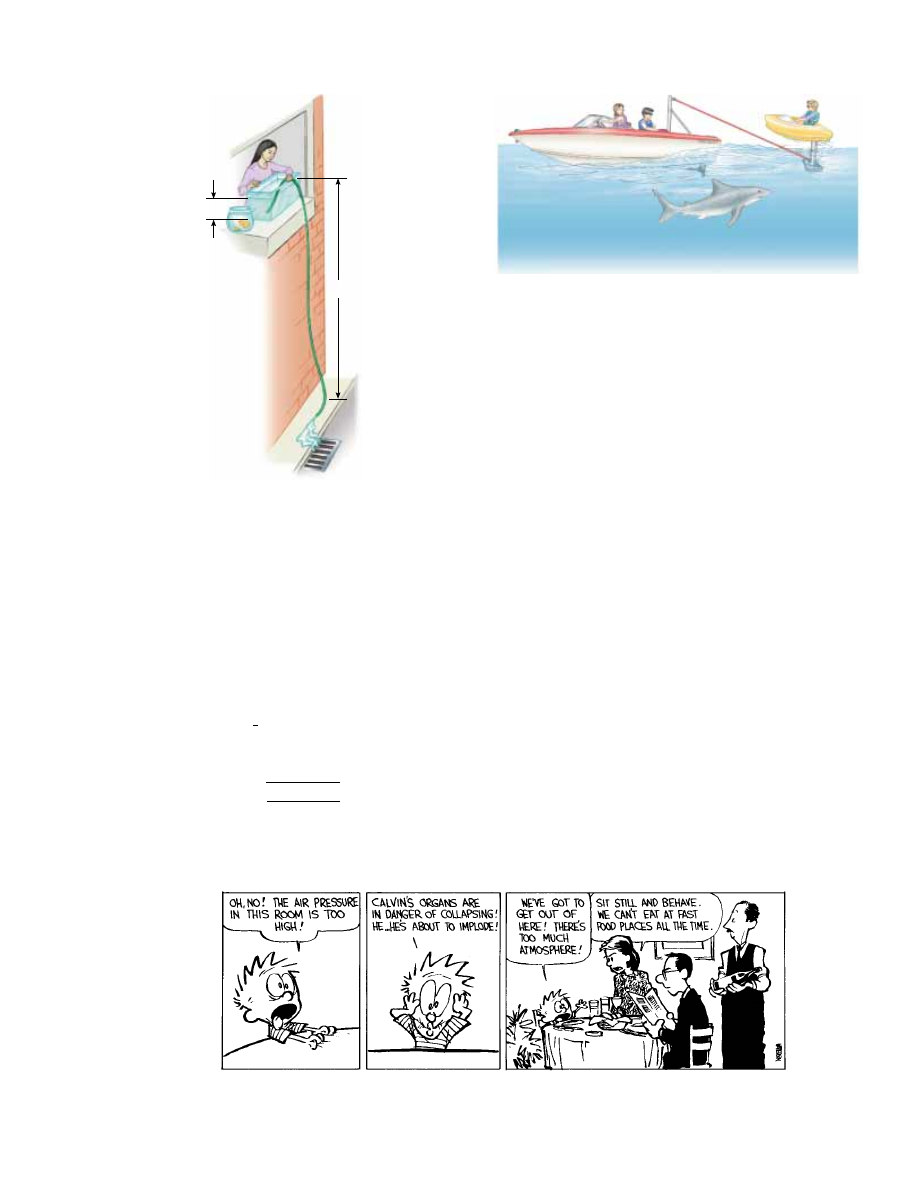
Figure P14.74

Figure P14.75

75.

The hull of an experimental boat is to be lifted above the
water  by  a  hydrofoil  mounted  below  its  keel,  as  shown  in
Figure  P14.75.  The  hydrofoil  has  a  shape  like  that  of  an
airplane wing. Its area projected onto a horizontal surface
is A. When the boat is towed at sufficiently high speed, wa-
ter of density $ moves in streamline flow so that its average
speed at the top of the hydrofoil is times larger than its
speed  v

b

below  the  hydrofoil.  (a)  Neglecting  the  buoyant

force, show that the upward lift force exerted by the water
on the hydrofoil has a magnitude given by

(b)  The  boat  has  mass  M.  Show  that  the  liftoff  speed  is
given by

(c)  Assume  that  an  800-kg  boat  is  to  lift  off  at  9.50 m/s.
Evaluate the area required for the hydrofoil if its design
yields ! 1.05.

v

%

2Mg

(n

2

&

1)A$

F


%

1

2

(n

2

&

1)$v

b

2

A

Answer to Quick Quizzes

14.1 (a).  Because  the  basketball  player’s  weight  is  distributed

over  the  larger  surface  area  of  the  shoe,  the  pressure
(F/A)  that  he  applies  is  relatively  small.  The  woman’s
lesser  weight  is  distributed  over  the  very  small  cross-
sectional area of the spiked heel, so the pressure is high. 

14.2 (a). Because both fluids have the same depth, the one with

the smaller density (alcohol) will exert the smaller pressure.

14.3 (c). All barometers will have the same pressure at the bot-

tom of the column of fluid—atmospheric pressure. Thus,
the  barometer  with  the  highest  column  will  be  the  one
with the fluid of lowest density.

14.4 (d). Because there is no atmosphere on the Moon, there

is no atmospheric pressure to provide a force to push the
water up the straw.

14.5 (b).  For  a  totally  submerged  object,  the  buoyant  force

does not depend on the depth in an incompressible fluid.

14.6 (c).  The  ice  cube  displaces  a  volume  of  water  that  has  a

weight  equal  to  that  of  the  ice  cube.  When  the  ice  cube
melts, it becomes a parcel of water with the same weight
and exactly the volume that was displaced by the ice cube
before.

14.7 (b) or (c). In all three cases, the weight of the treasure chest

causes a downward force on the raft that makes it sink into
the  water.  In  (b)  and  (c),  however,  the  treasure  chest  also
displaces  water,  which  provides  a  buoyant  force  in  the  up-
ward direction, reducing the effect of the chest’s weight.

14.8 (b).  The  liquid  moves  at  the  highest  speed  in  the  straw

with the smaller cross sectional area.

14.9 (a). The high-speed air between the balloons results in low

pressure in this region. The higher pressure on the outer
surfaces of the balloons pushes them toward each other.

Calvin and Hobbes © 1992 Watterson. Reprinted with permission of Universal Press

Syndicate. All rights reserved.

P A R T

2

!

Drops of water fall from a leaf into a pond. The disturbance caused by the falling water

causes the water surface to oscillate. These oscillations are associated with waves moving
away from the point at which the water fell. In Part 2 of the text, we will explore the principles
related to oscillations and waves. (Don Bonsey/Getty Images)

451

e begin this new part of the text by studying a special type of motion called
periodic motion.  This  is  a  repeating motion  of  an  object  in  which  the  object
continues to return to a given position after a fixed time interval. Familiar ob-

jects that exhibit periodic motion include a pendulum and a beach ball floating on the
waves at a beach. The back and forth movements of such an object are called oscil-
lations. We will focus our attention on a special case of periodic motion called sim-
ple  harmonic  motion. We  shall  find  that  all  periodic  motions  can  be  modeled  as
combinations of simple harmonic motions. Thus, simple harmonic motion forms a ba-
sic building block for more complicated periodic motion.

Simple harmonic motion also forms the basis for our understanding of mechani-

cal  waves.  Sound  waves,  seismic  waves,  waves  on  stretched  strings,  and  water
waves  are  all  produced  by  some  source  of  oscillation.  As  a  sound  wave  travels
through the air, elements of the air oscillate back and forth; as a water wave travels
across a pond, elements of the water oscillate up and down and backward and for-
ward. In general, as waves travel through any medium, the elements of the medium
move in repetitive cycles. Therefore, the motion of the elements of the medium bears
a strong resemblance to the periodic motion of an oscillating pendulum or an object
attached to a spring.

To explain many other phenomena in nature, we must understand the concepts of

oscillations and waves. For instance, although skyscrapers and bridges appear to be
rigid, they actually oscillate, a fact that the architects and engineers who design and
build them must take into account. To understand how radio and television work, we
must understand the origin and nature of electromagnetic waves and how they prop-
agate  through  space.  Finally,  much  of  what  scientists  have  learned  about  atomic
structure has come from information carried by waves. Therefore, we must first study
oscillations and waves if we are to understand the concepts and theories of atomic
physics. 

W

Oscillations and

Mechanical Waves

Chapter 15

Oscillatory Motion

C H A P T E R   O U T L I N E

15.1 Motion of an Object Attached

to a Spring

15.2 Mathematical Representation

of Simple Harmonic Motion

15.3 Energy of the Simple

Harmonic Oscillator

15.4 Comparing Simple Harmonic

Motion with Uniform Circular
Motion 

15.5 The Pendulum

15.6 Damped Oscillations

15.7 Forced Oscillations

452

In the Bay of Fundy, Nova Scotia, the tides undergo oscillations with very large

amplitudes, such that boats often end up sitting on dry ground for part of the day. In this
chapter, we will investigate the physics of oscillatory motion. (www.comstock.com)


Content   ..  111  112  113  114   ..