Physics For Scientists And Engineers 6E - part 111
 

  Index      Production     Physics For Scientists And Engineers 6E


Search            


Content   ..  109  110  111  112   ..


Physics For Scientists And Engineers 6E - part 111


Problems

441

excavation. This foundation wall is 0.183 m away from the
front of the cellar hole. During a rainstorm, drainage from
the  street  fills  up  the  space  in  front  of  the  concrete  wall,
but not the cellar behind the wall. The water does not soak
into  the  clay  soil.  Find  the  force  the  water  causes  on  the
foundation wall. For comparison, the weight of the water is
given  by  2.40 m " 9.60 m " 0.183 m " 1 000 kg/m

3

"

9.80 m/s

2

!

41.3 kN.

12. A  swimming  pool  has  dimensions  30.0 m " 10.0 m  and  a

flat bottom. When the pool is filled to a depth of 2.00 m
with fresh water, what is the force caused by the water on
the bottom? On each end? On each side?

13.

A sealed spherical shell of diameter is rigidly attached to
a cart, which is moving horizontally with an acceleration a
as in Figure P14.13. The sphere is nearly filled with a fluid
having density $ and also contains one small bubble of air
at atmospheric pressure. Determine the pressure at the
center of the sphere.

Section 14.3 Pressure Measurements

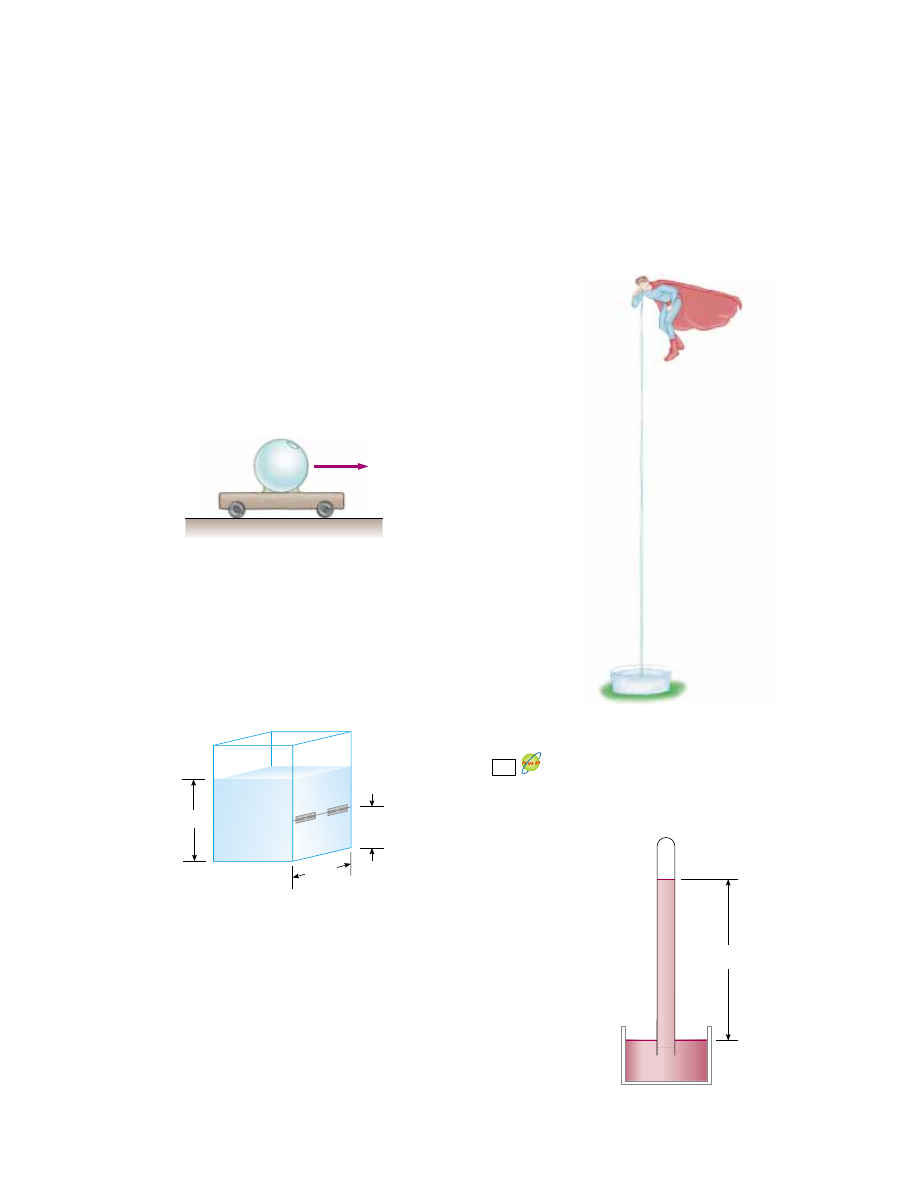
16. Figure P14.16 shows Superman attempting to drink water

through  a  very  long  straw.  With  his  great  strength  he
achieves maximum possible suction. The walls of the tubu-
lar  straw  do  not  collapse.  (a)  Find  the  maximum  height
through  which  he  can  lift  the  water.  (b)  What  If?  Still
thirsty, the Man of Steel repeats his attempt on the Moon,
which has no atmosphere. Find the difference between the
water levels inside and outside the straw.

a

Figure P14.13

Figure P14.16

Figure P14.14

2.00 m

2.00 m

1.00 m

h

P

0

Figure P14.17

14.

The tank in Figure P14.14 is filled with water 2.00 m deep.
At  the  bottom  of  one  side  wall  is  a  rectangular  hatch
1.00 m high and 2.00 m wide, which is hinged at the top of
the hatch. (a) Determine the force the water exerts on the
hatch. (b) Find the torque exerted by the water about the
hinges.

15.

Review  problem.  The  Abbott  of  Aberbrothock  paid  to
have a bell moored to the Inchcape Rock to warn seamen
of the hazard. Assume the bell was 3.00 m in diameter, cast
from brass with a bulk modulus of 14.0 " 10

10

N/m

2

. The

pirate  Ralph  the  Rover  cut  loose  the  warning  bell  and
threw it into the ocean. By how much did the diameter of
the  bell  decrease  as  it  sank  to  a  depth  of  10.0  km?  Years
later, Ralph drowned when his ship collided with the rock.
Note :  The  brass  is  compressed  uniformly,  so  you  may
model the bell as a sphere of diameter 3.00 m.

Blaise Pascal duplicated Torricelli’s barometer using

a red Bordeaux wine, of density 984 kg/m

3

, as the working

liquid  (Fig.  P14.17).  What  was  the  height  of  the  wine

17.

442

C H A P T E R   1 4 •  Fluid Mechanics

column  for  normal  atmospheric  pressure?  Would  you  ex-
pect  the  vacuum  above  the  column  to  be  as  good  as  for
mercury?

18.

Mercury  is  poured  into  a  U-tube  as  in  Figure  P14.18a.
The  left  arm  of  the  tube  has  cross-sectional  area  A

1

of

10.0 cm

2

,  and  the  right  arm  has  a  cross-sectional  area

A

2

of  5.00 cm

2

.  One  hundred  grams  of  water  are  then

poured  into  the  right  arm  as  in  Figure  P14.18b.  (a)  De-
termine the length of the water column in the right arm
of  the  U-tube.  (b)  Given  that  the  density  of  mercury  is
13.6 g/cm

3

, what distance does the mercury rise in the

left arm?

pressure of 100 to 200 mm of H

2

O above the prevailing at-

mospheric  pressure.  In  medical  work  pressures  are  often
measured in units of millimeters of H

2

O because body flu-

ids,  including  the  cerebrospinal  fluid,  typically  have  the
same  density  as  water.  The  pressure  of  the  cerebrospinal
fluid  can  be  measured  by  means  of  a  spinal  tap,  as  illus-
trated in Figure P14.21. A hollow tube is inserted into the
spinal  column,  and  the  height  to  which  the  fluid  rises  is
observed. If the fluid rises to a height of 160 mm, we write
its gauge pressure as 160 mm H

2

O. (a) Express this pres-

sure in pascals, in atmospheres, and in millimeters of mer-
cury. (b) Sometimes it is necessary to determine if an acci-
dent victim has suffered a crushed vertebra that is blocking
flow  of  the  cerebrospinal  fluid  in  the  spinal  column.  In
other  cases  a  physician  may  suspect  a  tumor  or  other
growth  is  blocking  the  spinal  column  and  inhibiting  flow
of cerebrospinal fluid. Such conditions can be investigated
by  means  of  the  Queckensted  test.  In  this  procedure,  the
veins  in  the  patient’s  neck  are  compressed,  to  make  the
blood pressure rise in the brain. The increase in pressure
in  the  blood  vessels  is  transmitted  to  the  cerebrospinal
fluid. What should be the normal effect on the height of
the fluid in the spinal tap? (c) Suppose that compressing
the veins had no effect on the fluid level. What might ac-
count for this?

A

1

(a)

A

2

Mercury

A

1

A

2

h

Water

(b)

Figure P14.18

19. Normal  atmospheric  pressure  is  1.013 " 10

5

Pa.  The  ap-

proach of a storm causes the height of a mercury barome-
ter  to  drop  by  20.0 mm  from  the  normal  height.  What  is
the  atmospheric  pressure?  (The  density  of  mercury  is
13.59 g/cm

3

.)

20.

A  U-tube  of  uniform  cross-sectional  area,  open  to  the  at-
mosphere,  is  partially  filled  with  mercury.  Water  is  then
poured into both arms. If the equilibrium configuration of
the tube is as shown in Figure P14.20, with h

2

!

1.00 cm,

determine the value of h

1

.

h

2

h

1

Water

Mercury

Figure P14.20

21. The  human  brain  and  spinal  cord  are  immersed  in  the

cerebrospinal  fluid.  The  fluid  is  normally  continuous  be-
tween  the  cranial  and  spinal  cavities.  It  normally  exerts  a

Figure P14.21

Section 14.4 Buoyant Forces and Archimedes’s

Principle

22. (a) A light balloon is filled with 400 m

3

of helium. At 0°C,

the balloon can lift a payload of what mass? (b) What If?
In  Table  14.1,  observe  that  the  density  of  hydrogen  is
nearly  half  the  density  of  helium.  What  load  can  the  bal-
loon lift if filled with hydrogen?
A  Ping-Pong  ball  has  a  diameter  of  3.80 cm  and  average
density of 0.084 0 g/cm

3

. What force is required to hold it

completely submerged under water?

24. A  Styrofoam  slab  has  thickness  and  density  $

s

.  When  a

swimmer of mass is resting on it, the slab floats in fresh
water  with  its  top  at  the  same  level  as  the  water  surface.
Find the area of the slab.

25. A  piece  of  aluminum  with  mass  1.00 kg  and  density 

2 700 kg/m

3

is  suspended  from  a  string  and  then  com-

pletely immersed in a container of water (Figure P14.25).
Calculate the tension in the string (a) before and (b) after
the metal is immersed.

23.

Problems

443

26.

The weight of a rectangular block of low-density material is
15.0 N. With a thin string, the center of the horizontal bot-
tom  face  of  the  block  is  tied  to  the  bottom  of  a  beaker
partly filled with water. When 25.0% of the block’s volume
is  submerged,  the  tension  in  the  string  is  10.0 N.
(a) Sketch a free-body diagram for the block, showing all
forces  acting  on  it.  (b)  Find  the  buoyant  force  on  the
block. (c) Oil of density 800 kg/m

3

is now steadily added

to  the  beaker,  forming  a  layer  above  the  water  and  sur-
rounding  the  block.  The  oil  exerts  forces  on  each  of  the
four side walls of the block that the oil touches. What are
the  directions  of  these  forces?  (d)  What  happens  to  the
string tension as the oil is added? Explain how the oil has
this  effect  on  the  string  tension.  (e)  The  string  breaks
when its tension reaches 60.0 N. At this moment, 25.0% of
the block’s volume is still below the water line; what addi-
tional fraction of the block’s volume is below the top sur-
face of the oil? (f) After the string breaks, the block comes
to  a  new  equilibrium  position  in  the  beaker.  It  is  now  in
contact only with the oil. What fraction of the block’s vol-
ume is submerged? 

27. A 10.0-kg block of metal measuring 12.0 cm " 10.0 cm "

10.0 cm is suspended from a scale and immersed in water
as  in  Figure  P14.25b.  The  12.0-cm  dimension  is  vertical,
and  the  top  of  the  block  is  5.00 cm  below  the  surface  of
the water. (a) What are the forces acting on the top and on
the bottom of the block? (Take P

0

!

1.013 0 " 10

5

N/m

2

.)

(b) What is the reading of the spring scale? (c) Show that
the buoyant force equals the difference between the forces
at the top and bottom of the block.

28.

To an order of magnitude, how many helium-filled toy bal-
loons would be required to lift you? Because helium is an
irreplaceable resource, develop a theoretical answer rather
than  an  experimental  answer.  In  your  solution  state  what
physical  quantities  you  take  as  data  and  the  values  you
measure or estimate for them.

A cube of wood having an edge dimension of 20.0 cm

and a density of 650 kg/m

3

floats on water. (a) What is the

distance from the horizontal top surface of the cube to the
water level? (b) How much lead weight has to be placed on
top of the cube so that its top is just level with the water?

29.

30.

A  spherical  aluminum  ball  of  mass  1.26 kg  contains  an
empty spherical cavity that is concentric with the ball. The
ball  just  barely  floats  in  water.  Calculate  (a)  the  outer  ra-
dius of the ball and (b) the radius of the cavity.

31.

Determination of the density of a fluid has many important
applications. A car battery contains sulfuric acid, for which
density  is  a  measure  of  concentration.  For  the  battery  to
function properly, the density must be inside a range speci-
fied by the manufacturer. Similarly, the effectiveness of an-
tifreeze in your car’s engine coolant depends on the density
of  the  mixture  (usually  ethylene  glycol  and  water).  When
you donate blood to a blood bank, its screening includes de-
termination of the density of the blood, since higher density
correlates  with  higher  hemoglobin  content.  A  hydrometer is
an  instrument  used  to  determine  liquid  density.  A  simple
one  is  sketched  in  Figure  P14.31.  The  bulb  of  a  syringe  is
squeezed and released to let the atmosphere lift a sample of
the liquid of interest into a tube containing a calibrated rod
of known density. The rod, of length and average density
$

0

,  floats  partially  immersed  in  the  liquid  of  density  $.  A

length of the rod protrudes above the surface of the liq-
uid. Show that the density of the liquid is given by

$ !

$

0

L

h

(a)

T

2

B

(b)

Mg

T

1

Mg

Scale

Figure P14.25 Problems 25 and 27

L

96

98

102
104

100

96

98

100
102

104

h

Figure P14.31 Problems 31 and 32

32.

Refer to Problem 31 and Figure P14.31. A hydrometer is
to  be  constructed  with  a  cylindrical  floating  rod.  Nine
fiduciary  marks  are  to  be  placed  along  the  rod  to  indi-
cate  densities  of  0.98  g/cm

3

,  1.00  g/cm

3

,  1.02  g/cm

3

,

1.04 g/cm

3

, . . . 1.14 g/cm

3

. The row of marks is to start

0.200 cm from the top end of the rod and end 1.80 cm
from the top end. (a) What is the required length of the
rod?  (b)  What  must  be  its  average  density?  (c)  Should
the marks be equally spaced? Explain your answer.

How many cubic meters of helium are required to lift a bal-
loon  with  a  400-kg  payload  to  a  height  of  8 000 m?  (Take
$

He

!

0.180 kg/m

3

.)  Assume  that  the  balloon  maintains  a

33.

444

C H A P T E R   1 4 •  Fluid Mechanics

constant volume and that the density of air decreases with
the altitude according to the expression $

air

!

$

0

e

&

z/8 000

,

where is in meters and $

0

!

1.25 kg/m

3

is the density of

air at sea level.

34. A  frog  in  a  hemispherical  pod  (Fig.  P14.34)  just  floats

without sinking into a sea of blue-green ooze with density
1.35 g/cm

3

. If the pod has radius 6.00 cm and negligible

mass, what is the mass of the frog?

with a nozzle of diameter 2.20 cm. A rubber stopper is in-
serted into the nozzle. The water level in the tank is kept
7.50 m  above  the  nozzle.  (a)  Calculate  the  friction  force
exerted  by  the  nozzle  on  the  stopper.  (b)  The  stopper
is removed.  What  mass  of  water  flows  from  the  nozzle  in
2.00  h?  (c)  Calculate  the  gauge  pressure  of  the  flowing
water in the hose just behind the nozzle.
Water  flows  through  a  fire  hose  of  diameter  6.35 cm  at  a
rate of 0.0120 m

3

/s. The fire hose ends in a nozzle of in-

ner  diameter  2.20 cm.  What  is  the  speed  with  which  the
water exits the nozzle?

42.

Water falls over a dam of height with a mass flow rate of
R, in units of kg/s. (a) Show that the power available from
the water is

where is the free-fall acceleration. (b) Each hydroelectric
unit at the Grand Coulee Dam takes in water at a rate of
8.50 " 10

5

kg/s from a height of 87.0 m. The power devel-

oped  by  the  falling  water  is  converted  to  electric  power
with  an  efficiency  of  85.0%.  How  much  electric  power  is
produced by each hydroelectric unit?

43.

Figure P14.43 shows a stream of water in steady flow from
a kitchen faucet. At the faucet the diameter of the stream
is 0.960 cm. The stream fills a 125-cm

3

container in 16.3 s.

Find the diameter of the stream 13.0 cm below the open-
ing of the faucet.

! !

Rgh

41.

Figure P14.34

A plastic sphere floats in water with 50.0 percent of its vol-
ume  submerged.  This  same  sphere  floats  in  glycerin  with
40.0 percent of its volume submerged. Determine the den-
sities of the glycerin and the sphere.

36. A bathysphere used for deep-sea exploration has a radius

of 1.50 m and a mass of 1.20 " 10

4

kg. To dive, this subma-

rine takes on mass in the form of seawater. Determine the
amount of mass the submarine must take on if it is to de-
scend  at  a  constant  speed  of  1.20 m/s,  when  the  resistive
force on it is 1 100 N in the upward direction. The density
of seawater is 1.03 " 10

3

kg/m

3

.

37. The  United  States  possesses  the  eight  largest  warships  in

the  world—aircraft  carriers  of  the  Nimitz  class—and  is
building  two  more.  Suppose  one  of  the  ships  bobs  up  to
float 11.0 cm higher in the water when 50 fighters take off
from it in 25 min, at a location where the free-fall accelera-
tion  is  9.78 m/s

2

.  Bristling  with  bombs  and  missiles,  the

planes  have  average  mass  29  000 kg.  Find  the  horizontal
area  enclosed  by  the  waterline  of  the  $4-billion  ship.  By
comparison,  its  flight  deck  has  area  18 000 m

2

.  Below

decks are passageways hundreds of meters long, so narrow
that two large men cannot pass each other. 

Section 14.5 Fluid Dynamics
Section 14.6 Bernoulli’s Equation

38.

A horizontal pipe 10.0 cm in diameter has a smooth reduc-
tion to a pipe 5.00 cm in diameter. If the pressure of the
water in the larger pipe is 8.00 " 10

4

Pa and the pressure

in  the  smaller  pipe  is  6.00 " 10

4

Pa,  at  what  rate  does

water flow through the pipes?
A large storage tank, open at the top and filled with water,
develops  a  small  hole  in  its  side  at  a  point  16.0 m  below
the water level. If the rate of flow from the leak is equal to
2.50 " 10

&

3

m

3

/min,  determine  (a)  the  speed  at  which

the water leaves the hole and (b) the diameter of the hole.

40.

A village maintains a large tank with an open top, contain-
ing water for emergencies. The water can drain from the
tank through a hose of diameter 6.60 cm. The hose ends

39.

35.

Figure P14.43

44.

A legendary Dutch boy saved Holland by plugging a hole in
a  dike  with  his  finger,  which  is  1.20 cm  in  diameter.  If  the
hole was 2.00 m below the surface of the North Sea (density
1 030 kg/m

3

), (a) what was the force on his finger? (b) If he

pulled his finger out of the hole, how long would it take the
released water to fill 1 acre of land to a depth of 1 ft, assum-
ing the hole remained constant in size? (A typical U.S. family
of four uses 1 acre-foot of water, 1 234 m

3

, in 1 year.)

45.

Through  a  pipe  15.0 cm  in  diameter,  water  is  pumped
from the Colorado River up to Grand Canyon Village, lo-
cated on the rim of the canyon. The river is at an elevation
of  564 m,  and  the  village  is  at  an  elevation  of  2 096 m.

George Semple


Content   ..  109  110  111  112   ..