Physics For Scientists And Engineers 6E - part 108
 

  Index      Production     Physics For Scientists And Engineers 6E


Search            


Content   ..  106  107  108  109   ..


Physics For Scientists And Engineers 6E - part 108


S E C T I O N   1 4 . 4 •  Buoyant Forces and Archimedes’s Principle

429

B

F

g

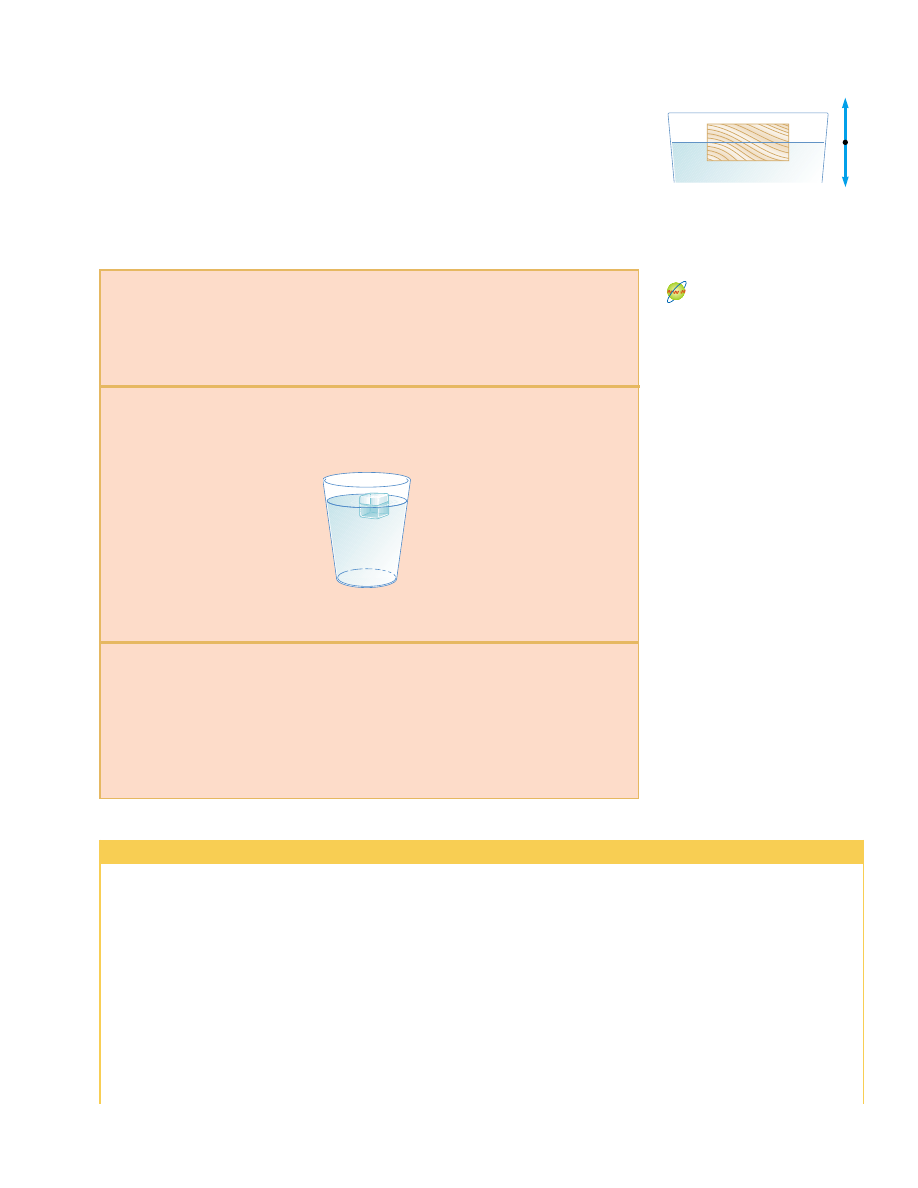
Active Figure 14.10 An object

floating on the surface of a fluid

experiences two forces, the gravita-

tional force 

F

g

and the buoyant

force 

B. Because the object floats

in equilibrium, F

g

At the Active Figures link

at http://www.pse6.com, you

can change the densities of the

object and the fluid.

Quick  Quiz  14.5

An apple is held completely submerged just below the sur-

face of a container of water. The apple is then moved to a deeper point in the water. Com-
pared to the force needed to hold the apple just below the surface, the force needed to
hold it at a deeper point is (a) larger (b) the same (c) smaller (d) impossible to deter-
mine.

Quick  Quiz  14.6

A  glass  of  water  contains  a  single  floating  ice  cube  (Fig.

14.11). When the ice melts, does the water level (a) go up (b) go down (c) remain the
same?

Figure 14.11 (Quick Quiz 14.6) An ice cube floats on the surface of water. What hap-

pens to the water level as the ice cube melts?

Quick  Quiz  14.7

You  are  shipwrecked  and  floating  in  the  middle  of  the

ocean on a raft. Your cargo on the raft includes a treasure chest full of gold that you
found before your ship sank, and the raft is just barely afloat. To keep you floating as
high as possible in the water, should you (a) leave the treasure chest on top of the raft
(b) secure the treasure chest to the underside of the raft (c) hang the treasure chest in
the  water  with  a  rope  attached  to  the  raft?  (Assume  that  throwing  the  treasure  chest
overboard is not an option you wish to consider!)

Example 14.5 Eureka!

suspended in air, the scale reads the true weight T

1

!

F

g

(ne-

glecting  the  buoyancy  of  air).  When  it  is  immersed  in  water,
the buoyant force 

B reduces the scale reading to an apparent

weight  of  T

2

!

F

g

&

B.  Because  the  crown  is  in  equilibrium,

the net force on it is zero. When the crown is in water,

so that

Because  this  buoyant  force  is  equal  in  magnitude  to  the
weight  of  the  displaced  water,  we  have  $

w

gV

w

!

1.00 N,

where V

w

is the volume of the displaced water and $

w

is its

F

g

&

T

2

!

7.84 N & 6.84 N ! 1.00 N

$


T

2

&

F

g

!

0

Archimedes  supposedly  was  asked  to  determine  whether  a
crown made for the king consisted of pure gold. Legend has
it that he solved this problem by weighing the crown first in
air and then in water, as shown in Figure 14.12. Suppose the
scale  read  7.84 N  in  air  and  6.84 N  in  water.  What  should
Archimedes have told the king?

Solution Figure  14.12  helps  us  to  conceptualize  the  prob-
lem. Because of our understanding of the buoyant force, we
realize that the scale reading will be smaller in Figure 14.12b
than in Figure 14.12a. The scale reading is a measure of one
of the forces on the crown, and we recognize that the crown is
stationary. Thus, we can categorize this as a force equilibrium
problem. To analyze the problem, note that when the crown is

This equation tells us that 

the fraction of the volume of a floating object that is be-

low the fluid surface is equal to the ratio of the density of the object to that of
the fluid.

Under normal conditions, the weight of a fish is slightly greater than the buoyant

force due to water. It follows that the fish would sink if it did not have some mechanism
for adjusting the buoyant force. The fish accomplishes this by internally regulating the
size of its air-filled swim bladder to increase its volume and the magnitude of the buoy-
ant force acting on it. In this manner, fish are able to swim to various depths.

430

C H A P T E R   1 4 •  Fluid Mechanics

Example 14.6 A Titanic Surprise

ward buoyant force equals the weight of the displaced water:
! $

w

V

w

g, where V

w

, the volume of the displaced water, is

equal  to  the  volume  of  the  ice  beneath  the  water  (the
shaded region in Fig. 14.13b) and $

w

is the density of seawa-

ter,  $

w

!

1  030 kg/m

3

.  Because  $

i

V

i

! $

w

V

w

g,  the  fraction

of ice beneath the water’s surface is

or 

89.0%

0.890

!

V

w

V

i

!

$

i

$

w

!

917 kg/m

3

1 030 kg/m

3

!

An iceberg floating in seawater, as shown in Figure 14.13a, is
extremely  dangerous  because  most  of  the  ice  is  below  the
surface. This hidden ice can damage a ship that is still a con-
siderable distance from the visible ice. What fraction of the
iceberg lies below the water level?

Solution This problem corresponds to Case 2. The weight
of the iceberg is F

g

!

$

i

V

i

g, where $

i

!

917 kg/m

3

and V

i

is

the volume of the whole iceberg. The magnitude of the up-

(a)

(b)

Figure 14.13 (Example 14.6) (a) Much of the volume of this iceberg is beneath the

water.  (b) A ship can be damaged even when it is not near the visible ice.

Geraldine 

Prentice/Getty

T

1

T

2

(b)

(a)

F

g

B

F

g

Figure 14.12 (Example 14.5) (a) When the crown is sus-

pended in air, the scale reads its true weight because T

1

!

F

g

(the buoyancy of air is negligible). (b) When the crown is im-

mersed in water, the buoyant force 

B changes the scale reading

to a lower value T

2

!

F

g

&

B.

Finally, the density of the crown is

To  finalize  the  problem,  from  Table  14.1  we  see  that  the
density  of  gold  is  19.3 " 10

3

kg/m

3

.  Thus,  Archimedes

should  have  told  the  king  that  he  had  been  cheated.
Either  the  crown  was  hollow,  or  it  was  not  made  of  pure
gold.

What If?

Suppose the crown has the same weight but were

indeed pure gold and not hollow. What would the scale read-
ing be when the crown is immersed in water?

Answer We first find the volume of the solid gold crown:

Now, the buoyant force on the crown will be

and the tension in the string hanging from the scale is

T

2

!

F

g

&

! 7.84 N & 0.406 N ! 7.43 N

 ! 0.406 N

 ! (1.00 " 10

3

 kg/m

3

)(9.80 m/s

2

)(4.15 " 10

&

5

 m

3

)

! $

w


gV

w

!

$

w


gV

c

 ! 4.15 " 10

&

5

 m

3

V

c

!

m

c

$

c

!

m

c

g

$

c

g

!

7.84 N

(19.3 " 10

3

 kg/m

3

)(9.80 m/s

2

)

 ! 7.84 " 10

3

 kg/m

3

$

c

!

m

c

V

c

!

m

c

g

V

c

g

!

7.84 N

(1.02 " 10

&

4

 m

3

)(9.80 m/s

2

)

density. Also, the volume of the crown V

c

is equal to the vol-

ume of the displaced water because the crown is completely
submerged. Therefore,

 ! 1.02 " 10

&

4

 m

3

V

c

!

V

w

!

1.00 N

$

w

g

!

1.00 N

(1 000 kg/m

3

)(9.80 m/s

2

)

14.5 Fluid Dynamics

Thus far, our study of fluids has been restricted to fluids at rest. We now turn our atten-
tion to fluids in motion. When fluid is in motion, its flow can be characterized as being
one of two main types. The flow is said to be 

steady, or laminar, if each particle of the

fluid follows a smooth path, such that the paths of different particles never cross each
other,  as  shown  in  Figure  14.14.  In  steady  flow,  the  velocity  of  fluid  particles  passing
any point remains constant in time.

Above  a  certain  critical  speed,  fluid  flow  becomes 

turbulent; turbulent  flow

is  irregular  flow  characterized  by  small  whirlpool-like  regions,  as  shown  in
Figure 14.15.

The term 

viscosity is commonly used in the description of fluid flow to character-

ize the degree of internal friction in the fluid. This internal friction, or viscous force, is
associated with the resistance that two adjacent layers of fluid have to moving relative
to each other. Viscosity causes part of the kinetic energy of a fluid to be converted to
internal energy. This mechanism is similar to the one by which an object sliding on a
rough horizontal surface loses kinetic energy.

Because  the  motion  of  real  fluids  is  very  complex  and  not  fully  understood,  we

make some simplifying assumptions in our approach. In our model of 

ideal fluid flow,

we make the following four assumptions:

1.

The fluid is nonviscous. In a nonviscous fluid, internal friction is neglected. An
object moving through the fluid experiences no viscous force.

2.

The flow is steady. In steady (laminar) flow, the velocity of the fluid at each point
remains constant.

3.

The fluid is incompressible. The density of an incompressible fluid is constant.

4.

The flow is irrotational. In irrotational flow, the fluid has no angular momentum
about any point. If a small paddle wheel placed anywhere in the fluid does not ro-
tate about the wheel’s center of mass, then the flow is irrotational.

The path taken by a fluid particle under steady flow is called a 

streamline. The ve-

locity of the particle is always tangent to the streamline, as shown in Figure 14.16. A set
of streamlines like the ones shown in Figure 14.16 form a tube of flow. Note that fluid

S E C T I O N   1 4 . 5 •  Fluid Dynamics

431

Figure 14.14 Laminar flow around an automobile in a test wind tunnel.

Andy Sacks/Getty

Figure 14.15 Hot gases from a cig-

arette made visible by smoke parti-

cles. The smoke first moves in lami-

nar flow at the bottom and then in

turbulent flow above. 

W

erner W

olff/Black Star

v

P

Figure 14.16 A particle in laminar

flow follows a streamline, and at

each point along its path the parti-

cle’s velocity is tangent to the

streamline.

particles cannot flow into or out of the sides of this tube; if they could, then the stream-
lines would cross each other.

Consider an ideal fluid flowing through a pipe of nonuniform size, as illustrated in

Figure 14.17. The particles in the fluid move along streamlines in steady flow. In a time
interval 't, the fluid at the bottom end of the pipe moves a distance 'x

1

!

v

1

'

t. If A

1

is

the  cross-sectional  area  in  this  region,  then  the  mass  of  fluid  contained  in  the  left
shaded region in Figure 14.17 is m

1

!

$

A

1

'

x

1

!

$

A

1

v

1

'

t, where $ is the (unchanging)

density of the ideal fluid. Similarly, the fluid that moves through the upper end of the
pipe in the time interval 'has a mass m

2

!

$

A

2

v

2

'

t. However, because the fluid is in-

compressible and because the flow is steady, the mass that crosses A

1

in a time interval

'

must equal the mass that crosses A

2

in the same time interval. That is, m

1

!

m

2

, or

$

A

1

v

1

!

$

A

2

v

2

; this means that

(14.7)

This expression is called the 

equation of continuity for fluids. It states that

A

1

v

1

!

A

2

v

2

!

constant

432

C H A P T E R   1 4 •  Fluid Mechanics

Figure 14.18 The speed of water spraying

from the end of a garden hose increases as

the size of the opening is decreased with the

thumb.

George Semple

Quick Quiz 14.8

You tape two different soda straws together end-to-end to

make a longer straw with no leaks. The two straws have radii of 3 mm and 5 mm. You
drink a soda through your combination straw. In which straw is the speed of the liquid
the  highest?  (a)  whichever  one  is  nearest  your  mouth  (b)  the  one  of  radius  3 mm
(c) the one of radius 5 mm (d) Neither—the speed is the same in both straws.

v

1

x

1

x

2

Point 2

Point 1

A

1

A

2

v

2

Figure 14.17 A fluid moving with

steady flow through a pipe of vary-

ing cross-sectional area. The vol-

ume of fluid flowing through area

A

1

in a time interval 'must equal

the volume flowing through area

A

2

in the same time interval. 

Therefore, A

1

v

1

!

A

2

v

2

.

the product of the area and the fluid speed at all points along a pipe is constant for
an incompressible fluid.

Equation 14.7 tells us that the speed is high where the tube is constricted (small A) and
low where the tube is wide (large A). The product Av, which has the dimensions of vol-
ume per unit time, is called either the volume flux or the flow rate. The condition Av !
constant is equivalent to the statement that the volume of fluid that enters one end of
a tube in a given time interval equals the volume leaving the other end of the tube in
the same time interval if no leaks are present.

You demonstrate the equation of continuity each time you water your garden with

your thumb over the end of a garden hose as in Figure 14.18. By partially blocking the
opening with your thumb, you reduce the cross-sectional area through which the water
passes. As a result, the speed of the water increases as it exits the hose, and it can be
sprayed over a long distance.


Content   ..  106  107  108  109   ..