Electrical Engineering Dictionary - part 10
 

  Index      Production     Electrical Engineering Dictionary


Search            


Content   ..  8  9  10  11   ..


Electrical Engineering Dictionary - part 10


a motor, prime mover, or by the shaft of the
synchronous machine.

ALU

See

arithmetic and logic unit

.

AM

See

amplitude modulation

.

AM to PM conversion

phase variations

of an output signal, due to passing through an
active device, where the phase of the output
signal varies in response with the amplitude
of the input signal.

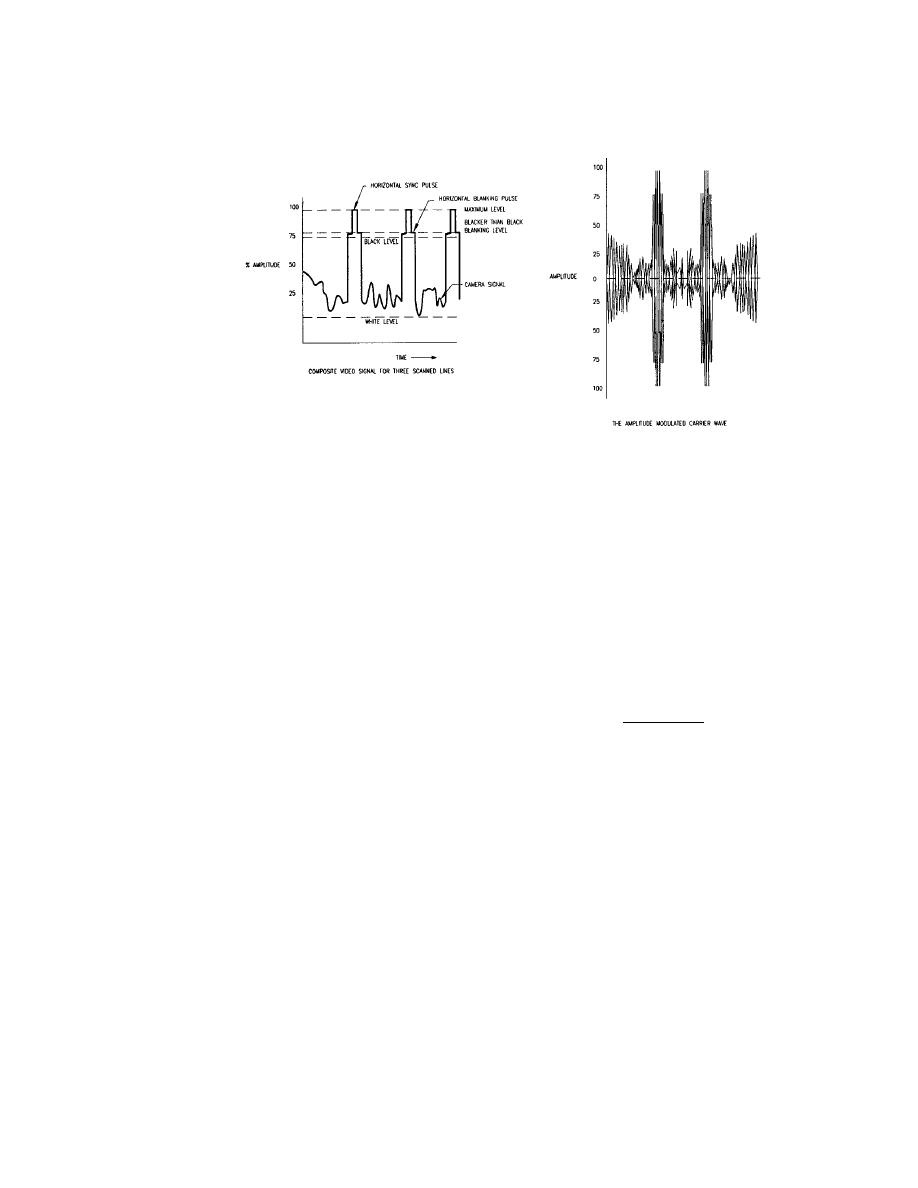
AM video

the amplitude modulated video

carrier wave is produced by an amplitude
modulated video transmitter where the am-
plitude of the wave form varies in step with
the video signal similar to that shown in the
figure.

amateur radio

The practice and study of

electronic communications as an avocation;
most often referring to those persons possess-
ing a license earned by examination (in the
U.S., the Federal Communications Commis-
sion grants such licenses).

ambient field

the background magnetic

field level existing in the environment, with-
out contribution from specific magnetic field
sources.

ambient temperature

the temperature

of the air or liquid surrounding any electrical
part or device. Usually refers to the effect
of such temperature in aiding or retarding re-
moval of heat by radiation and convection
from the part or device in question.

ambiguity

in artificial intelligence, the

presence of more than one meaning or possi-
bility.

Amdahl’s law

states that the speedup

factor of a multiprocessor system is given by

S(n) =

n

1

(n − 1)f

where there are

processors and is the frac-

tion of computational that must be performed
sequentially (by one processor alone). The
remaining part of the computation is assumed
to be divided into

equal parts each executed

by a separate processor but simultaneously.
The speedup factor tends to 1

/f as → ∞,

which demonstrates that under the assump-
tions given, the maximum speedup is con-
strained by the serial fraction.

American National Standards Institute
(ANSI)

The U.S. organization that rec-

ommends standards for metrology, drawing
symbology and numerous other facets for
products and industries.

c

2000 by CRC Press LLC

American standard code for information
interchange (ASCII)

a binary code com-

prised of seven digits, originally used to
transmit telegraph signal information.

ammeter

an instrument for measuring

electric current in amperes.

ammonia maser

first maser, invented by

Charles H. Townes. Such a maser operates
at microwave frequencies.

ammonium dihydrogen phosphate (ADP)

a strong linear electro-optic material. Its

chemical formula is

NH

4

H

2

P O

4

See also

potassium dihydrogen phosphate (KDP)

.

amorphous alloy

a ferromagnetic mate-

rial with very low coercive force (i.e., a nar-
row hysteresis loop). The material is formed
as a very thin ribbon, by freezing the molting
alloy before it can crystallize, thus providing
a random molecular orientation.

amortisseur winding

See

damper

winding

.

ampacity

the maximum current which

can be safely carried by a conductor under
specified conditions.

ampere interrupting rating

the inter-

rupting rating of a device expressed in amps
(often rms symmetrical amps).

See also

MVA interrupting rating

.

Ampere’s Law

a fundamental rela-

tionship in electromagnetic theory.

In a

fairly general form it is expressed by one of
Maxwell’s equations,

∇ × H(r, t) =

D(r, t)

∂t

J(r, t)

where

is the time, is the coordinate vector,

and the other vectors are defined as D

(r, t)

electric displacement; H

(r, t), magnetic field

strength; J

(r, t), electric current density.

Ampere, Andre Marie

(1775–1836)

Born: Lyon, France

Ampere is best known for his pioneering

work in the field of Electrodynamics. During
his emotionally troubled life, he held several
professorships: at Bourg, Lyon, and at the
Ecole Polytechnic in Paris. While Ampere
worked in several sciences, the work of the
Danish physicist Hans Christian Oerstad on
the electric deflection of a compass needle, as
demonstrated to him by Dominique Arago,
caused Ampere’s great interest in electro-
magnetism. His seminal work, Notes on the
Theory of Electrodynamic Phenomena De-
duced Solely from Experiment, 
established
the mathematical formulations for electro-
magnetics including what is now known as
Ampere’s Law. It can be said that Ampere
founded the field of electromagnetics. He is
honored for this by the naming of the unit of
electric current as the ampere.

amperometric sensor

an electrochem-

ical sensor that determines the amount of
a substance by means of an oxidation–
reduction reaction involving that substance.
Electrons are transferred as a part of the re-
action, so that the electrical current through
the sensor is related to the amount of the sub-
stance seen by the sensor.

amplidyne

a special generator that acts

like a DC power amplifier by using com-
pensation coils and a short circuit across its
brushes to precisely and fastly control high
powers with low level control signals.

amplified spontaneous emission

sponta-

neous emission that has been enhanced in am-
plitude and perhaps modified in spectrum by
propagation through an amplifying medium,
usually the medium in which it was first gen-
erated.

amplifier

a circuit element that has a

linear input-output signal relationship, with
gain in voltage, current, and/or power. See
also

balanced amplifier

,

feedback amplifier

,

feedforward amplifier

,

laser amplifier

,

maser

amplifier

,

optical amplifier

,

single-ended

amplifier

.

c

2000 by CRC Press LLC

ASCII Code Chart

Hex

Char

Hex

Char

Hex

Char

Hex

Char

00

nul

20

sp

40

@

60

01

soh

21

!

41

A

61

a

02

stx

22

"

42

B

62

a

03

etx

23

#

43

C

63

c

04

eot

24

$

44

D

64

d

05

enq

25

%

45

E

65

e

06

ack

26

&

46

F

66

f

07

bel

27

47

G

67

g

08

bs

28

(

48

H

68

h

09

ht

29

)

49

I

69

i

0A

lf

2A

*

4A

J

6A

j

0B

vt

2B

4B

K

6B

k

0C

ff

2C

,

4C

L

6C

l

0D

cr

2D

-

4D

M

6D

m

0E

so

2E

.

4E

N

6E

n

0F

si

2F

/

4F

O

6F

o

10

dle

30

0

50

P

70

p

11

dc1

31

1

51

Q

71

q

12

dc2

32

2

52

R

72

r

13

dc3

33

3

53

S

73

s

14

dc4

34

4

54

T

74

t

15

nak

35

5

55

U

75

u

16

syn

36

6

56

V

76

v

17

etb

37

7

57

W

77

w

18

can

38

8

58

X

78

x

19

em

39

9

59

Y

79

y

1A

sub

3A

:

5A

Z

7A

z

1B

esc

3B

;

5B

[

7B

{

1C

fs

3C

<

5C

\

7C

|

1D

gs

3D

=

5D

]

7D

}

1E

rs

3E

>

5E

ˆ

7E

˜

1F

us

3F

?

5F

_

7F

c

2000 by CRC Press LLC

amplitron

a classic crossed-field am-

plifier in which output current is obtained
primarily by secondary emission from the
negative electrode that serves as a cathode
throughout all or most of the interaction
space.

amplitude

descriptor of the strength of a

wave disturbance such as an electromagnetic
or acoustic wave.

amplitude equations

a form of the

Schr¨odinger equation that describes the evo-
lution of a quantum mechanical system in
terms of only the coefficients of the preferred
basis states. These coefficients are known
as quantum mechanical amplitudes and con-
tain both magnitude and phase information.
Amplitude equations are often used to gain
physical insight into interactions of quantum
systems with electromagnetic fields. See also

Schr¨odinger wave equation (SWE)

.

amplitude linearity

qualitative measure

of the extent to which the output ampli-
tude of a device is a faithful reproduction of
its input, with no new frequency harmonics
added. A perfectly linear device would out-
put a scaled version of its input, where the
shape of the input waveform has been un-
altered (i.e., there is no distortion of the in-
put waveform). Viewed in the frequency do-
main, the output signal would contain only
those spectral components found in the in-
put signal, and each frequency line would be
scaled by the same amount (i.e., by the gain
of the device).

amplitude modulation (AM)

the process

of modulating a signal

x(t) by a carrier wave

c(t) for transmission:

y(t) c(t)x(t),

where

y(t) is the signal to be transmitted.

c(t) is either a complex exponential of the
form

c(t) e

j (ω

c

t+θ

c

)

or a sinusoidal signal of the form

c(t) = cos

c

θ

c

).

ω

c

is referred to as the carrier frequency. AM

has the effect of shifting the frequency spec-
trum of

x(t) by ω

c

. The signal is recovered by

shifting the spectrum of

x(t) back to its orig-

inal form. See also

frequency modulation

.

amplitude response

the magnitude of the

steady-state response of a fixed, linear system
to a unit-amplitude input sinusoid.

amplitude spectrum

the magnitude of

the Fourier transform

|F (ω)|−∞ < ω <

∞ of a signal f (t). For example, the ampli-
tude spectrum of a rectangular pulse of unit
width is given in the following figure: See
also

Fourier transform

.

Amplitude spectrum.

amplitude stabilization circuit

a circuit

used to obtain a precise oscillation amplitude
of oscillators. These circuits are used in in-
strumentation when it is required to increase
the purity of output signal and reduce the fre-
quency depression (especially in Meachem-
bridge oscillator with crystal) of the main har-
monic by higher harmonics (van der Pol ef-
fect). Three types of circuits are used:

1. An element of large inertia (tungsten

lamp, thermistor) is included in the circuit at
a point where it can change the magnitude of
feedback, but not affect the frequency.

c

2000 by CRC Press LLC


Content   ..  8  9  10  11   ..