Volvo V60 Twin Engine (2020 year). Manual in english - page 3
 

  Index      Manuals     Volvo V60 Twin Engine (2020 year). Manual in english


Search            copyright infringement  


Content      ..     1      2      3      4      ..


Volvo V60 Twin Engine (2020 year). Manual in english - page 3


||

SAFETY

* Option/accessory.

64

switch to activate/deactivate the passenger
airbag

*

.

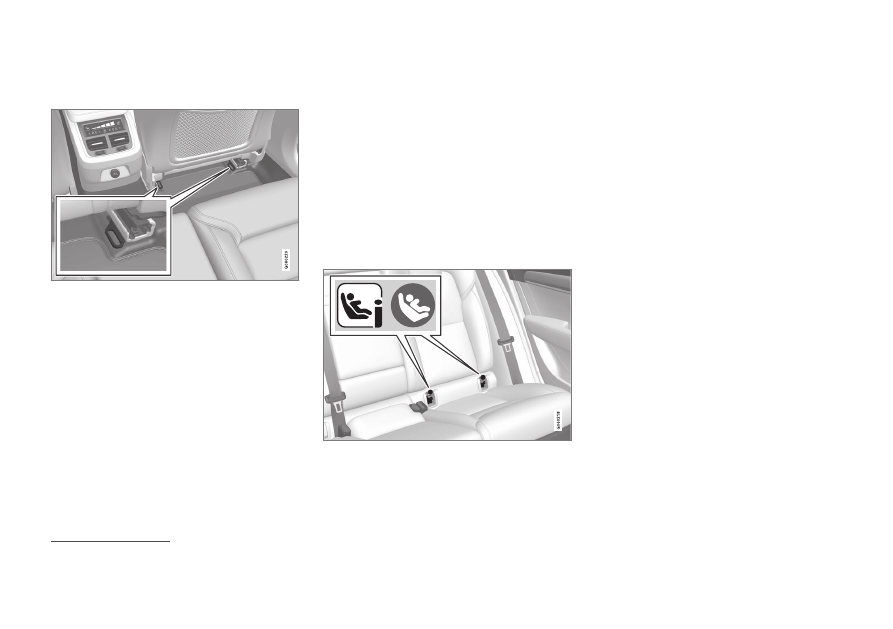
Mounting point locations in the rear seat.

The mounting points in the rear seat are
located on the rear section of the front seat's
floor rails.

Related information

Child seats (p. 62)

Upper mounting points for child seats
(p. 62)

i-Size/ISOFIX mounting points for child
seats (p. 64)

Overview table for location of child seats
(p. 68)

Table for location of child seats using the
car's seatbelts (p. 69)

i-Size/ISOFIX mounting points for

child seats

The car is equipped with i-Size/ISOFIX
mounting points for child seats in the rear
seat.

i-Size/ISOFIX

2

 is a fixture system for car child

seats that is based on an international stand-
ard.

Always follow the manufacturer's installation
instructions when connecting a child seat to
the i-Size/ISOFIX mounting points.

The location of the mounting points

Mounting point locations are indicated by symbols

2

on the upholstery of the backrest.

The mounting points for i-Size/ISOFIX are
located behind covers in the lower section of
the rear seat's backrest, in the outer seats.

Lift the covers in order to access the mounting
points.

Related information

Child seats (p. 62)

Upper mounting points for child seats
(p. 62)

Lower mounting points for child seats
(p. 63)

Overview table for location of child seats
(p. 68)

Table for location of i-Size child seats
(p. 71)

Table for location of ISOFIX child seats
(p. 72)

2

Names and symbols change depending on market.

-------------------------------------------------------------------------------------------------------------------------------------------------------------

SAFETY

65

Child seat positioning

It is important to position the child seat in the
right place in the car. The choice of location
depends, amongst other things, on the type
of child seat and whether the passenger air-
bag is activated.

Rear-facing child seat and airbag are not compatible.

Always fit rear-facing child seats in the rear
seat if the passenger airbag is activated. If a
child is sitting on the front passenger seat
then he/she could suffer serious injury if the
airbag deploys.

If the passenger airbag is deactivated then
rear-facing child seats can be fitted on the
front passenger seat.

NOTE

Regulations regarding the placement of
children in cars vary from country to coun-
try. Check what does apply.

WARNING

Never allow anybody to stand or sit in front

of the front passenger seat.
Never use a rear-facing child seat on the

front passenger seat if the airbag is acti-

vated.
Front-facing passengers (children and

adults) must never sit on the front passen-

ger seat if the passenger airbag is deacti-

vated.
Failure to follow the advice given above

can endanger life or lead to serious per-

sonal injury.

Label for passenger airbag

Label on the passenger side's sun visor.

The warning label for the passenger airbag is
positioned as shown above.

Related information

Child seats (p. 62)

Child seat mounting (p. 66)

Overview table for location of child seats
(p. 68)

Table for location of child seats using the
car's seatbelts (p. 69)

Table for location of i-Size child seats
(p. 71)

Table for location of ISOFIX child seats
(p. 72)

-------------------------------------------------------------------------------------------------------------------------------------------------------------

SAFETY

66

Child seat mounting

It is important to remember a number of
things when a child seat is mounted and
used, which depend on where the child seat
is positioned.

WARNING

Booster cushions/child seats with steel

braces or some other design that could

rest on the seatbelt buckle's opening but-

ton must not be used, as they could cause

the seatbelt buckle to open accidentally.
Do not secure the straps for the child seat

into the seat's horizontal adjustment bar or

in springs, rails or beams under the seat.

Sharp edges may damage the straps.
Do not allow the upper section of the child

seat to rest against the windscreen.

NOTE

When using child safety equipment, it is
important to read the installation instruc-
tions included.

In the event of questions when fitting child
safety equipment, contact the manufac-
turer for clearer instructions.

NOTE

Never leave a child seat loose in the car.
Always secure it according to the instruc-
tions for the child seat, even when it is not
in use.

NOTE

Long-term installation and use of child
seats may cause wear and tear on the car's
fittings. Volvo recommends using the kick
guard accessory to protect the car's fit-
tings.

Installation in the front seat

When fitting rear-facing child seats, check
that the passenger airbag is deactivated.

When fitting front-facing child seats,
check that the passenger airbag is acti-
vated.

Only use child seats that are recom-
mended by Volvo, are universally approved
or are semi-universal, and where the car is
included on the manufacturer's vehicle list.

ISOFIX child seats can only be fitted when
the car is equipped with the ISOFIX con-
sole

3

 accessory.

If the child seat is equipped with lower
straps, Volvo recommends that the lower
mounting points are used with these

3

.

If the child seat is equipped with support
legs, always fit the support leg/support
legs directly to the floor. Never fit a sup-
port leg to a footrest or other object.

Installation in the rear seat

Only use child seats that are recom-
mended by Volvo, are universally
approved

4

 or are semi-universal, and

where the car is included on the manufac-
turer's vehicle list.

A child seat with support legs must not be
fitted in the centre seat.

The outer seats are equipped with the
ISOFIX fixture system and are approved
for i-Size

5

.

The outer seats are equipped with upper
mounting points. Volvo recommends that
child seat's upper straps should be pulled
through the hole in the head restraint
before being tensioned at the mounting
point. If this is not possible, follow the rec-
ommendations from the child seat manu-
facturer.

3

The accessory range varies depending on market.

4

Does not apply to the centre seat.

5

Varies depending on market.

-------------------------------------------------------------------------------------------------------------------------------------------------------------

SAFETY

67

If the child seat is equipped with lower
straps, never adjust the position of the
seat in front after the straps have been fit-
ted in the lower mounting points. Always
remember to remove the lower straps
when the child seat is not installed.

If the child seat is equipped with support
legs, always fit the support leg/support
legs directly to the floor. Never fit a sup-
port leg to a footrest or other object.

With the installation of an infant seat in the rear seat,

Volvo recommends a distance of at least 50 mm

(2 inches) from the front part of the infant seat to the

rearmost part of the seat in front.

Related information

Child seat positioning (p. 65)

Overview table for location of child seats
(p. 68)

Table for location of child seats using the
car's seatbelts (p. 69)

Table for location of i-Size child seats
(p. 71)

Table for location of ISOFIX child seats
(p. 72)

-------------------------------------------------------------------------------------------------------------------------------------------------------------

SAFETY

68

Overview table for location of child

seats

The table gives an overview of the types of
child seats suitable for the car's seats.

Seat positions in left-hand drive cars.

Seat positions in right-hand drive cars.

i-Size child seats

Universally approved child seats secured using the car's seatbelt

Other child seat categories

A

Seat position

B

3, 5

2

C

, 3, 5

2

C

, 3, 4, 5

A

For more information, contact the child seat manufacturer.

B

According to the numbering above.

C

Activated airbag for front-facing child seats. Deactivated airbag for rear-facing child seats.

Related information

Child seat positioning (p. 65)

Child seat mounting (p. 66)

Table for location of child seats using the
car's seatbelts (p. 69)

Table for location of i-Size child seats
(p. 71)

Table for location of ISOFIX child seats
(p. 72)

-------------------------------------------------------------------------------------------------------------------------------------------------------------

SAFETY

}}

69

Table for location of child seats

using the car's seatbelts

The table gives a recommendation for which
child seats suit which locations, and for what
size of child.

NOTE

Always read the owner's manual section
on installing a child seat before installing
one in the car.

Weight

Front seat (with deactivated airbag, only
rear-facing child seats)

A

Front seat (with activated airbag, only
front-facing child seats)

A

Outer rear seat Centre rear seat

Group 0

max 10 kg

U

B, C

X

U

C

L

C

Group 0+

max 13 kg

U

B, C

X

U

C

L

C

Group 1

9-18 kg

L

D

UF

B, E

U

E

, L

D

L

E

Group 2

15-25 kg

L

D

UF

B, F

U

F

, L

D

L

F

-------------------------------------------------------------------------------------------------------------------------------------------------------------

||

SAFETY

70

Weight

Front seat (with deactivated airbag, only
rear-facing child seats)

A

Front seat (with activated airbag, only
front-facing child seats)

A

Outer rear seat Centre rear seat

Group 3

22-36 kg

X

UF

B, F

U

F

L

F

U: Suitable for universal category restraints approved for use in this mass group.

UF: Suitable for front-facing universally approved child seats.

L: Suitable for particular child restraints. These restraints may be of the specific vehicle, restricted or semi-universal categories.

X: The seat is not suitable for children in this mass group.

A

The seat cushion extension must always be retracted for the installation of child seats.

B

Adjust the backrest to a more upright position.

C

Volvo recommends: Volvo infant seat (type approval E1 04301146).

D

Volvo recommends: Volvo rear-facing seat (type approval E5 04212).

E

Volvo recommends rear-facing child seat for children in this mass group.

F

Volvo recommends: Booster cushion with and without back (type approval E5 04216); Volvo booster seat (type approval E1 04301312).

WARNING

Never use a rear-facing child seat on the

front passenger seat if the passenger air-

bag is activated.

Related information

Child seat positioning (p. 65)

Child seat mounting (p. 66)

Overview table for location of child seats
(p. 68)

Table for location of i-Size child seats
(p. 71)

Table for location of ISOFIX child seats
(p. 72)

Seatbelts (p. 48)

-------------------------------------------------------------------------------------------------------------------------------------------------------------

SAFETY

71

Table for location of i-Size child

seats

The table gives a recommendation for which
i-Size child seats suit which locations, and for
what size of child.

The child seat must be approved in accord-
ance with UN Reg R129.

NOTE

Always read the owner's manual section
on installing a child seat before installing
one in the car.

Type of child seat

Front seat (with deactivated airbag,

only rear-facing child seats)

Front seat (with activated airbag, only

front-facing child seats)

Outer rear seat Centre rear seat

i-Size child seats

X

X

i-U

A, B

X

i-U: Suitable for i-Size "universal" child seat, front-facing and rear-facing.

X: Not suitable for universally approved child seats.

A

Volvo recommends that children travel in a rear-facing child seat until as late an age as possible, at least until 3-4 years of age.

B

Volvo recommends: BeSafe iZi Kid X2 i-Size (type approval E4-129R-000002).

Related information

Child seat positioning (p. 65)

Child seat mounting (p. 66)

Overview table for location of child seats
(p. 68)

Table for location of child seats using the
car's seatbelts (p. 69)

Table for location of ISOFIX child seats
(p. 72)

i-Size/ISOFIX mounting points for child
seats (p. 64)

-------------------------------------------------------------------------------------------------------------------------------------------------------------

SAFETY

72

Table for location of ISOFIX child

seats

The table gives a recommendation for which
ISOFIX child seats suit which locations, and
for what size of child.

The child seat must be approved in accord-
ance with UN Reg R44 and the car model
must be included in the manufacturer's vehicle
list.

NOTE

Always read the owner's manual section
on installing a child seat before installing
one in the car.

Weight

Size class

A

Type of child seat

Front seat (with deacti-
vated airbag, only rear-

facing child seats)

B, C

Front seat (with acti-

vated airbag, only

front-facing child

seats)

B, C

Outer rear seat Centre rear seat

Group 0

max 10 kg

E

Rear-facing infant seat

IL

B, D

, X

E

X

IL

D

X

Group 0+

max 13 kg

E

Rear-facing infant seat

IL

B, D, F

, X

E

X

IL

D

X

C

Rear-facing child seat

D

Rear-facing child seat

-------------------------------------------------------------------------------------------------------------------------------------------------------------

SAFETY

}}

73

Weight

Size class

A

Type of child seat

Front seat (with deacti-
vated airbag, only rear-

facing child seats)

B, C

Front seat (with acti-

vated airbag, only

front-facing child

seats)

B, C

Outer rear seat Centre rear seat

Group 1

9-18 kg

A

Front-facing child seat

X

IL

B, F, G

, X

E

IL

G

, IUF

G

X

B

Front-facing child seat

B1

Front-facing child seat

C

Rear-facing child seat

IL

B, F

, X

E

X

IL

X

D

Rear-facing child seat

IL: Suitable for particular ISOFIX child restraint systems. These child restraint systems are those of the specific vehicle, restricted or semi-universal
categories.

IUF: Suitable for ISOFIX forward child restraint systems of universal category approved for use in the mass group.

X: Not suitable for ISOFIX child restraint systems.

A

For child seats with the ISOFIX fixture system there is a size classification to help users choose the right type of child seat. The size class can be read on the child seat's label.

B

Works for the installation of ISOFIX child seats that are semi-universally approved (IL) if the car is equipped with the ISOFIX console accessory (the accessory range varies depending on market).

There are no upper mounting points for child seats here.

C

The seat cushion extension must always be retracted for the installation of child seats.

D

Volvo recommends: Volvo infant seat secured using the ISOFIX fixture system (type approval E1 04301146).

E

Applicable if the car is not fitted with an ISOFIX bracket.

F

Adjust the backrest so that the head restraint does not interfere with the child seat.

G

Volvo recommends rear-facing child seat for children in this mass group.

WARNING

Never use a rear-facing child seat on the

front passenger seat if the passenger air-

bag is activated.

NOTE

If an i-Size/ISOFIX child seat has no size
classification, the car model must be
included on the vehicle list for the child
seat.

NOTE

Volvo recommends contacting an author-
ised Volvo dealer for information about
which i-Size/ISOFIX child seats Volvo rec-
ommends.

-------------------------------------------------------------------------------------------------------------------------------------------------------------

-------------------------------------------------------------------------------------------------------------------------------------------------------------

DISPLAYS AND VOICE CONTROL

* Option/accessory.

76

Instruments and controls in left-

hand drive car

The overviews show where the displays and
controls near the driver are located.

Steering wheel and instrument panel

Position lamps, daytime running lights,
dipped beam, main beam, direction indi-
cators, rear fog lamp, resetting the trip
meter
Steering wheel paddles for manual gear
changing in an automatic gearbox

*

Head-up display

*

Driver display

Wipers and washing, rain sensor

*

Right-hand steering wheel keypad

Steering wheel adjustment

Horn

Left-hand steering wheel keypad

Bonnet opening

Display lighting, tailgate unlocking/open-
ing

*

/closing

*

, halogen headlamp levelling

Roof console

Front reading lamps and interior lighting

Panorama roof

*

Display in roof console, 

ON CALL

 button

*

Manual dimming of interior rearview mir-
ror

Centre and tunnel console

Centre display

Hazard warning flashers, defrosting,
media
Gear selector

Start knob

Drive mode control

Parking brake

Automatic braking when stationary

-------------------------------------------------------------------------------------------------------------------------------------------------------------

DISPLAYS AND VOICE CONTROL

}}

* Option/accessory.

77

Driver's door

Memories for power front seat

*

, door mir-

ror and head-up display

*

 settings

Central locking

Power windows, door mirrors, electric
child safety lock

*

Adjusting front seat

Related information

Manual front seat (p. 182)

Adjusting the power

*

 front seat (p. 183)

Adjusting the steering wheel (p. 196)

Lighting control (p. 148)

Starting the car (p. 438)

Driver display (p. 79)

Overview of centre display (p. 105)

Gearbox (p. 452)

Instruments and controls in right-

hand drive car

The overviews show where the displays and
controls near the driver are located.

Steering wheel and instrument panel

Position lamps, daytime running lights,
dipped beam, main beam, direction indi-
cators, rear fog lamp, resetting the trip
meter
Steering wheel paddles for manual gear
changing in an automatic gearbox

*

Head-up display

*

Driver display

Wipers and washing, rain sensor

*

Right-hand steering wheel keypad

Display lighting, tailgate unlocking/open-
ing

*

/closing

*

, halogen headlamp levelling

Bonnet opening

Horn

Steering wheel adjustment

Left-hand steering wheel keypad

Roof console

Front reading lamps and interior lighting

Panorama roof

*

Display in roof console, 

ON CALL

 button

*

Manual dimming of interior rearview mir-
ror

-------------------------------------------------------------------------------------------------------------------------------------------------------------

||

DISPLAYS AND VOICE CONTROL

* Option/accessory.

78

Centre and tunnel console

Centre display

Hazard warning flashers, defrosting,
media
Gear selector

Start knob

Drive mode control

Parking brake

Automatic braking when stationary

Driver's door

Memories for power front seat

*

, door mir-

ror and head-up display

*

 settings

Central locking

Power windows, door mirrors, electric
child safety lock

*

Adjusting front seat

Related information

Manual front seat (p. 182)

Adjusting the power

*

 front seat (p. 183)

Adjusting the steering wheel (p. 196)

Lighting control (p. 148)

Starting the car (p. 438)

Driver display (p. 79)

Overview of centre display (p. 105)

Gearbox (p. 452)

-------------------------------------------------------------------------------------------------------------------------------------------------------------

DISPLAYS AND VOICE CONTROL

}}

* Option/accessory.

79

Driver display

The driver display shows information about
the car and driving.

The driver display contains gauges, indicators
and indicator and warning symbols. The con-
tent of the driver display depends on the car's
equipment, settings and which functions are
active at that time.

The driver display is activated as soon as a
door is opened, i.e. in ignition position 

0

. The

driver display extinguishes after a while if it is
not used. To reactivate it, proceed with one of
the following:

Depress the brake pedal.

Activate ignition position 

I

.

Open one of the doors.

WARNING

If the driver display should extinguish, not

illuminate on activation/start or be fully or

partially illegible, the car must not be used.

You should visit a workshop immediately.

Volvo recommends an authorised Volvo

workshop.

WARNING

In the event of a fault in the driver display

the information on e.g. brakes, airbags or

other safety systems may not be shown. In

which case, the driver cannot check the

status of the car's systems or receive cur-

rent warnings and information.

The figure is schematic - parts may vary depending

on car model.

Location in the driver display:

On the left

In the middle

On the right

Speedometer

Indicator and warning symbols

Tachometer/Hybrid gauge

A

Trip meter

Outside temperature gauge

Gear shift indicator

Odometer

B

Clock

Drive mode

Cruise control and speed limiter information

Messages, in some cases with graphics

Fuel gauge

Road Sign Information

*

Door and seatbelt information

Hybrid battery gauge

Charging status

Distance to empty tank

Media player

Distance to empty battery

-------------------------------------------------------------------------------------------------------------------------------------------------------------

||

DISPLAYS AND VOICE CONTROL

* Option/accessory.

80

On the left

In the middle

On the right

Navigation map

*

Instantaneous fuel consumption

Phone

App menu (activated via steering wheel keypad)

Voice recognition

A

Depends on drive mode selected.

B

Accumulated mileage.

Dynamic symbol

The dynamic symbol in its
basic form.

The centre of the driver display contains a
dynamic symbol that changes appearance for
different types of message. An amber or red
marker around the symbol indicates the
degree of severity of a control or warning mes-
sage.

Examples of indicator symbol.

With an animation, the basic shape can be
turned into a graphic showing where a prob-
lem is situated, or in order to clarify informa-
tion.

Related information

Driver display settings (p. 81)

Warning symbols in the driver display
(p. 92)

Indicator symbols in the driver display
(p. 89)

Trip computer (p. 84)

Messages in the driver display (p. 101)

Handling the application menu in the
driver display (p. 100)

Drive modes (p. 459)

-------------------------------------------------------------------------------------------------------------------------------------------------------------


Content      ..     1      2      3      4      ..