Volkswagen Touareg (2015 year). Instruction - part 23
 

  Index      Volkswagen     Volkswagen Touareg - instruction 2015 year in english


Search            copyright infringement  


Content   ..  21  22  23  24   ..


Volkswagen Touareg (2015 year). Instruction - part 23


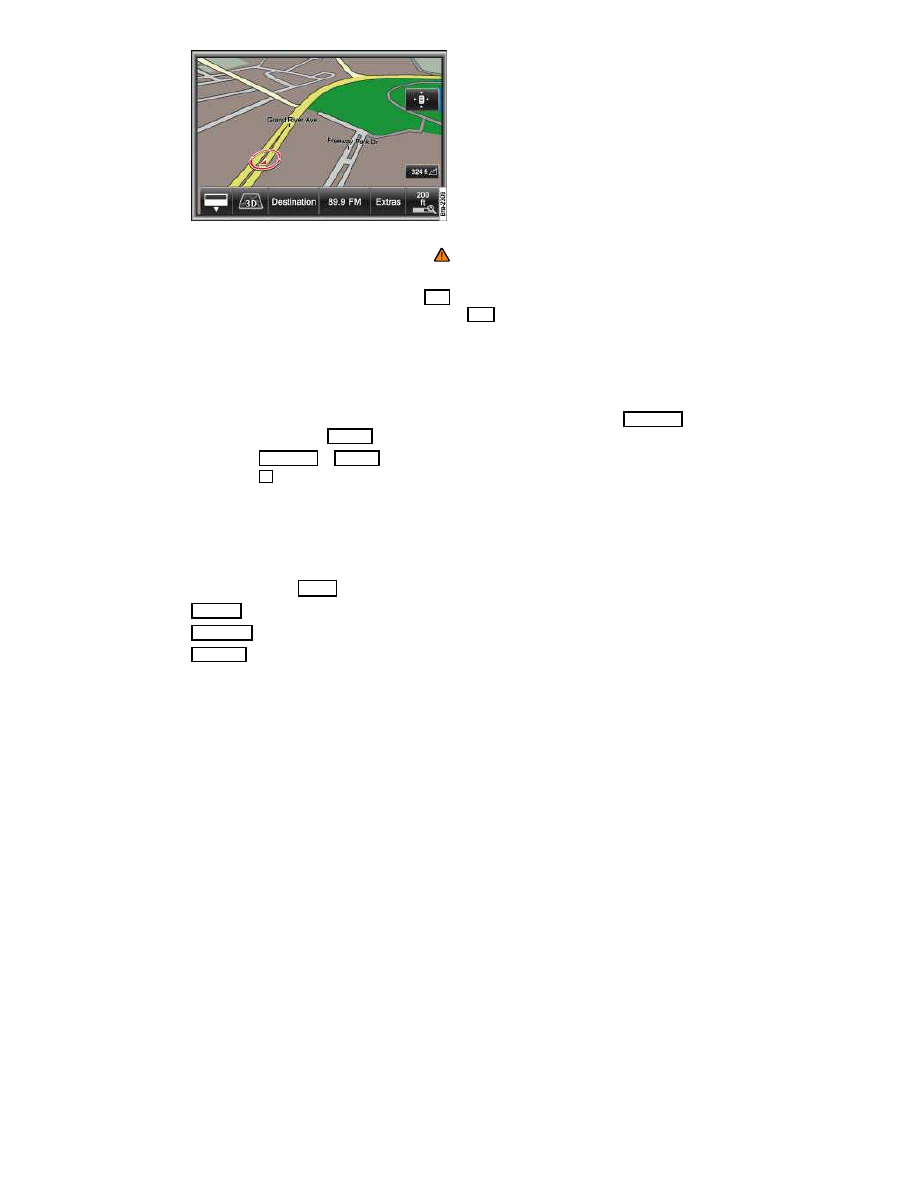
Fig. 224 3D map display moved with vehicle position. 

 Please first read and heed the WARNINGS 

 and note the introductory information  

The system automatically switches over to the map display when route guidance is started. 

To switch manually to the map view, press the 

NAV

 Infotainment button repeatedly until the map view 

is displayed or, in the Navigation main menu, press the  MAP  function key 

⇒ 

fig. 216

The map display is shown with the most recently selected display type  

Further screens can be displayed using the split screen  

The red vehicle position indicator   shows vehicle position and direction of travel. If the symbol   
turns gray and the map view “freezes”, it is currently not possible to determine the vehicle's position, 
such as in a multi-story parking garage. 

During route guidance, the route to be taken is shown as a blue line and instead of the  Destination  

function key 

⇒ 

fig. 224

, the 

...  ...  function key is displayed 

⇒ 

fig. 223

  Press the  Destination  or 

...  ...  function key to switch to the Navigation main menu. 

  Press the 

 function key to show or hide the function keys in the bottom line of the screen. 

Controlling audio source 

The currently selected audio source is displayed in the fourth function key 

⇒ 

fig. 224

  Press the function key briefly to open a pop-up window for controlling the current audio source. 

Some external media sources cannot be controlled. 

Available options:  Extras  function key 

Day/night : Changes between day and night design of map view. 

Split screen : Shows or hides the split screen  

Display off : Switches the display off. To switch on again, press any Infotainment button or touch 

screen. 


Browsing and centering map 


Fig. 225 3D map view (map section moved). 

 Please first read and heed the WARNINGS 

 and note the introductory information 

  In order to move the displayed map section, place your finger on the screen and, without lifting it 

off, drag it over the screen. 

This function is used for “browsing the map” and, for example, looking for special or favorite destina-
tions in the vicinity of the vehicle position  , which can be selected if necessary  

Showing vehicle position   on map 

The 

 function key is displayed at the top right on the map if the screen section has been moved 

⇒ 

fig. 225

The map view no longer follows the vehicle position, instead it stays in the selected position. 

  Press the 

 function key to display the vehicle position   on the map again. 

While the map section is moved manually (display:  

), autozoom remains disabled  

Changing the scale and view 

 Please first read and heed the WARNINGS 

 and note the introductory information  

  Turn the setting knob 

⇒ 

fig. 131


(3)

 to change the map scale. 

Additional function keys can be shown to change the map section and the map scale. 

  Press the function key at the bottom right showing the currently selected map scale in order to 

show additional function keys. 

The function keys are hidden after five seconds of inactivity. 

  Press the  +  or  -  function key or move the slider 

 in the scale to change the map scale. 

  Press the   function key to “zoom” the map display briefly into the map overview. After a few 

seconds, it returns automatically to the last selected scale. 

Display of start and end points on the map 

  Press the 

 function key to display the start and end points in an overview map. 

  Press the active 

 function key again to display the map in the original display type. 

If autozoom is also enabled, the screen switches to a 2D crossroads view when you come to a junc-
tion. 


Autozoom 

If Autozoom is active, the map scale is adjusted automatically, depending on the route (small scale for 
driving on the highway and a large scale for driving in town). 

  Press the 

 function key to switch autozoom on or off. 

When autozoom is reactivated, the screen automatically switches to the view of the current vehicle 
position  . 

Furthermore,   is displayed in the function key for showing the selected map scale 

⇒ 

fig. 226

While the map section is moved manually 

⇒ 

fig. 225

, autozoom remains disabled  

  Press the 

 function key to display the vehicle position   on the map again. 

Changing display type and displaying destination area 


Fig. 226 3D route guidance with autozoom. 


Fig. 227 2D route guidance in the map overview (section moved manually). 

 Please first read and heed the WARNINGS 

 and note the introductory information  

The symbol shown in the second function key 

 or 

 shows the currently selected display type. 

  Press the function key and press the map display type to select it 

⇒ 

fig. 226

 2D: 2 dimensional, from above (conventional). 

 3D: 3 dimensional, from the front at an angle (as would be seen approaching from an airplane). 

: Destination view; shows the currently set destination   in the 2D map view. 


2D: Setting orientation of map 

  Press the 

 function key at the top right to change the map alignment for the 2D map display 

(facing north or direction of travel) 

⇒ 

fig. 227

When autozoom is activated, the screen will be automatically oriented to the direction of travel at a 
junction. 

The 3D map view is always shown in the direction of travel. 

Split screen in the map view 


Fig. 228 Maneuver list in the map display during route guidance. 

 Please first read and heed the WARNINGS 

 and note the introductory information  

Further information can be displayed in the split screen. Information to support route guidance can be 
displayed while you are using the navigation system. 

  In the map view, press the  Extras  function key and check the check box in the 

 Extra wind.  

function key by pressing it. 

  Press the   ...  function key at the top in the split screen to show further display options 

⇒ 

fig. 228

  Select the desired display by pressing a function key. 

Maneuver list : Maneuver list during route guidance  

Compass : Compass view with current direction of travel and the current road being used. 

GPS viewer : Current vehicle position in coordinates, altitude and GPS status (satellite reception). 

Off-road info : Shows steering angle. 

Symbols and additional displays on the map 

 Please first read and heed the WARNINGS 

 and note the introductory information 

Special and favorite destinations can be displayed as symbols on the map. 

Reported traffic problems are also displayed by a symbol on the map  

The display of symbols in the map can be activated or deactivated in the Selection of map 

icons menu  


Favorite destinations on the map 

A favorite category can be specified for stored destinations. Favorite destinations can be displayed on 
the map with the orange favorite icon assigned to them (private   or business  ). 

The list of favorite destinations is called up from the Destination entry menu. 

Points of interest on the map 

Points of interest can be selected as a navigation destination. 

Points of interest are divided into point of interest categories. These point of interest categories are 
assigned to blue point of interest icons (such as   hotel and   petrol station). A list of available point 
of interest categories can be called up from the Map settings menu. Map icons can be selected 
there for display. 

Display detailed information on points of interest 

  Press the symbol on the map briefly to display a window with further information. 

Due to the map scale, there may be several entries behind one symbol on the map, in which case a 
list appears for selecting an entry. 

  Select the required entry by pressing. 

Function keys for further operation are displayed in the information window that appears. 

  Selecting points of interest and favorite destinations from the map  
  TMC traffic reports on the map  

3D models on the map 

An abstract 3D city model can be displayed in the 

 3D display type for some cities (such as Berlin). 

In addition, special historical buildings and sights of interest are displayed as photo-realistic 3D mod-
els. 

To display these, autozoom needs to be switched off in some cases and you have to zoom further into 
the map  

The display of 3D city models and 3D sights of interest is enabled and disabled in the map settings  

  If no symbols or 3D models can be displayed due to the scale, turn the setting knob clockwise 

⇒ 

fig. 131


(3)

 in order to zoom in on the map. 

Map settings: selecting map symbols 

 Please first read and heed the WARNINGS 

 and note the introductory information  

  Press the 

SETUP

 Infotainment button 

⇒ 

fig. 131

  Press the  Navigation  function key. 

  In the  Navigation settings  menu, press the  Map icons  function key. 

  In the Selection of map icons menu, check the check boxes in the function keys for display 

on the map  . 


Function key: effect on map  

All: Selects all available icons for display. Not recommended for cities.  


Function key: effect on map  

 Traffic information: TMC traffic reports are displayed as icons  

 3D landmarks: Photo-realistic 3D models of special historical buildings 

and landmarks are displayed

17

.  

 3D city model: Buildings in cities are displayed as abstract 3D models

17

.  

   Important destinations (business): Shows favorite destinations from 

the “business” category that were selected upon saving with    

   Important destinations (private): Shows favorite destinations from the 

“private” category that were selected upon saving with    

     ...: Activated point of interest categories are displayed.  


17

  Only available for some cities. 


Introduction 

Before using 


Before using the cellular telephone (mobile phone) control for the 
first time, carry out the following steps. This will enable you to use 
the mobile phone control safely and make full use of the functions it 
provides:  

   Follow the basic safety instructions 

.  

   Familiarize yourself with the controls.  


Read the instruction manual of the mobile phone or 
audio player you wish to pair with the unit.  


Safety information 

  WARNING 

Driving on today's roads demands the full attention of the driver at all times. Driver distrac-
tion causes accidents, collisions and serious personal injury! 

  Never let yourself be distracted when setting, adjusting, or using the Infotainment System, 

when using your mobile phone, or when operating the mobile phone controls. 

  Always drive attentively and responsibly. Use the Infotainment system, your mobile 

phone, and the mobile phone controls only if road, traffic, and weather conditions permit and 
you will not be distracted from your driving. 

  If you cannot use the Infotainment System, your mobile phone, or the mobile phone con-

trols safely while driving, wait until later or find a safe spot where you can pull off the road 
and park the vehicle. 

  Always set sound volume levels so that you can clearly hear horns, sirens, and other 

warning sounds outside the vehicle. 

  Setting the sound volume too high may damage your hearing. This applies even if you are 

exposed to high volumes for short periods only. 

  Your call may be cut off or you may be unable to make calls if you are in an area with no 

mobile phone network coverage, an area where the network is very weak or, in some cases, 
in a tunnel, garage or underpass. This also means that no emergency calls can be made. 

  In some countries, an emergency call is supported only if the mobile phone is connected 

to the telephone control containing an “unlocked” SIM card with sufficient credit or if a valid 
SIM card is in the SIM card reader. 


  WARNING 

The volume may suddenly get louder change when you switch media source or connect a 
new audio source. 

  Always lower the volume before switching media source or connecting a new audio 

source. 


  WARNING 

A mobile phone on the seat, instrument panel or in other places can be thrown around the 
inside of the vehicle during a sudden braking maneuver, a crash or other accident and injure 
vehicle occupants. 

  Never attach a mobile phone to, or place it on, a door, the windshield, or above or near the 

areas marked “AIRBAG” on the steering wheel, the instrument panel, and the seat backrests, 
or between these areas and the vehicle occupants. The mobile phone could cause serious 
injury in an accident, especially when the airbags inflate. 


  WARNING 

Always switch off the mobile phone when refueling and in areas with a risk of explosion. The 
electromagnetic radiation can cause sparks that can ignite fuel vapors and cause a fire. 

  The mobile phone can automatically log itself into the mobile phone network again when 

the Bluetooth® connection to the telephone control is interrupted. 


  WARNING 

If a mobile phone not connected to an external aerial is used in the vehicle, electromagnetic 
radiation in the interior could exceed limit values. This also applies if the outside antenna is 
not installed properly. 

  Heart specialists advise that mobile phones can adversely affect the way pacemakers 

work. Always keep the mobile phone and its integrated antenna at least 8 inches (20 cm) 
away from a pacemaker. 

  Never carry a mobile phone that is switched on in the breast pocket directly over a pace-

maker. 

  If you suspect there may be interference with a pacemaker or other medical device, switch 

the mobile phone off immediately. 


  NOTICE 

  Your mobile phone and the telephone control must always be switched off in areas where 

special regulations apply and when the use of mobile phones is forbidden. Radiation from a 
switched-on mobile phone can interfere with sensitive technical and medical devices, poten-
tially causing malfunctions or damage to the devices.
 

  High speeds, poor weather and road conditions as well as the network quality may impair 

telephone calls in the vehicle and lead to loss of connection. 


General information 

When pairing a mobile phone with the telephone control using the hands-free profile (HFP) observe 
the information for use of a mobile phone in the vehicle without connection to the external aerial  

Only use compatible Bluetooth® devices. Information on compatible Bluetooth products is available 
from your Volkswagen dealer or on the Internet. 

Follow the operational instructions of the mobile phone and the accessory manufacturer. 

You may experience poor reception or may be cut off in areas where the signal is weak. 

Most electrical devices are shielded against RF (high-frequency) signals. In rare cases, however, 
electronic devices may not be shielded against high-frequency signals emitted by the telephone con-
trol. Interference may occur. 

  Some countries may have restrictions regarding the use of Bluetooth devices. Information can be 

obtained from the local authorities. 

  When connecting the telephone control with a device using Bluetooth, read the device's operat-

ing manual for detailed safety information. Use only Bluetooth-compatible devices. 


Description 

 Introduction 

In this section you’ll find information about: 

Bluetooth


Components of the telephone control


“Bluetooth audio” wireless communication interface


Adjusting the volume


Information and breakdown call


Some functions and settings are only possible when the vehicle is stationary and are not supported by 
all mobile phones. 

Description

18


The telephone control is, together with a compatible mobile phone, which is paired via Bluetooth rSAP, 
or with an inserted SIM card, a fully-fledged GSM car telephone system. 

The telephone control described in this manual is approved for use in the following networks: 
GSM 850, GSM 900, GSM 1800 and GSM 1900. 

You can connect up to 4 mobile phones to the Infotainment System using the telephone control and 3 
Bluetooth profiles (rSAP, HFP and A2DP for audio playback)  

  Using a mobile phone in the vehicle may cause noise from the vehicle speakers. 

  Some networks might not support all language-dependent characters and services. 

Bluetooth 

 Please first read and heed the WARNINGS 

 and note the introductory information  

Bluetooth® 

Bluetooth technology is used to connect a mobile phone to the vehicle telephone control. A pairing 
process needs to be carried out once only to use the telephone control with a Bluetooth mobile phone. 

Some Bluetooth mobile phones are detected and connected automatically when the ignition is 
switched on, provided a connection had been made previously. For this to happen, the mobile phone 
itself and the Bluetooth feature in the telephone must be switched on and all active Bluetooth connec-
tions to other units must be disconnected. 

The Bluetooth wireless connection is free of charge. 

Bluetooth

®

 is a registered trademark of Bluetooth

®

 SIG, Inc. 

Bluetooth profiles 

When a mobile phone is connected to the telephone control, data is exchanged via one of 3 Bluetooth 
profiles. 


18

  country specific 


  Bluetooth remote SIM Access Profiles (rSAP)

19

: The mobile phone must support rSAP. The 

telephone control does not use its own SIM card, but rather “borrows” the SIM data of the mobile 
phone via a Bluetooth connection. The mobile phone logs itself out of the GSM network and logs into 
the telephone control using the data from the “borrowed” SIM card. The telephone is then controlled 
exclusively via the controls in the vehicle. The mobile phone goes into standby mode. This Bluetooth 
profile allows all telephone control functions and the exterior aerial to be used to the full. 

  Bluetooth Hands-Free Profile (HFP): If a mobile phone is connected via HFP to the telephone 

control, you can make calls wireless via the hands-free system. Many other telephone control func-
tions are not available. The vehicle's exterior aerial can thus not be used. 

  Advanced Audio Distribution Profile (A2DP): Bluetooth profile for transferring audio signals  

  Volkswagen recommends pairing a mobile phone with the telephone control via Bluetooth-rSAP 

in order to use all telephone control functions. 

Components of the telephone control 


Fig. 229 3 button module in the roof: Controls for the telephone control. 

 Please first read and heed the WARNINGS 

 and note the introductory information  


Button   Effect  


Starting or ending voice operation  

i  

Press and hold for more than 2 seconds: Information on the 
Volkswagen brand and on selected value-added services relating 
to traffic and travel  


Hold down for more than 2 seconds: Assistance from the 
Volkswagen dealership network in the event of a breakdown  


19

  country specific 


Button   Effect  


Make the telephone control briefly visible to Bluetooth devices  


Mute the microphone in the vehicle during a telephone call or 
cancel muting.  


Components of telephone control

20


  Cellular telephone (mobile phone) with Bluetooth® Remote SIM-Access-Profiles (rSAP) or sepa-

rate SIM card

21


  Infotainment System with touchscreen  
  Multi-function steering wheel  
  Instrument cluster display shows telephone functions  

  3 button module in the roof 

⇒ 

fig. 229

  NOTICE 

To operate the telephone control, a light press of the button or light pressure on the feature 
keys on the screen is sufficient.
 

“Bluetooth audio” wireless communication interface 

 Please first read and heed the WARNINGS 

 and note the introductory information  

Music stored on the mobile phone can be played back on the Infotainment System via the “Bluetooth 
audio
” wireless communication interface. 

Observe the notes on media mode and on operation during Bluetooth audio transmission. 

In order to use “Bluetooth audio”, the mobile phone needs to support at least the Bluetooth profile 
“Advanced Audio Distribution Profile” (A2DP). A2DP is used for wireless transferring of stereo audio 
signals in high quality. If you wish to display track information on the instrument cluster and to control 
the audio playback via the Infotainment System the mobile phone must support the Bluetooth profile 
“Audio Video Remote Control Profile” (AVRCP).

22


Making telephone calls during music playback via “Bluetooth audio” 

All telephone functions are available during music playback via “Bluetooth audio”. During a telephone 
call or when other functions are carried out via Bluetooth, e.g. device search, the music playback is 
stopped. 

Pairing a Bluetooth-enabled audio device 

If you want to pair a Bluetooth-enabled audio device, for example an MP3 player, with the telephone 
control in addition to your mobile phone, please observe the following: 

  Pair the Bluetooth-enabled audio device with the telephone control. 


20

  country specific 

21

  Available as an accessory Not provided with the vehicle. 

22

  Depending on the mobile phone. 


  To reconnect, deactivate the Bluetooth audio (A2DP) function in the Bluetooth settings 

menu. 

  Connect a mobile phone. 
  Activate Bluetooth audio (A2DP). 
  Connect audio device via A2DP. 
  If necessary, change settings for A2DP on the mobile phone.

22


  The volume can be changed directly on the mobile phone with several mobile phone models. 

Volkswagen recommends setting the volume to maximum on the mobile phone and adjusting the 
volume on the Infotainment System during operation. 

  On a connected Bluetooth audio source, all warning and service tones, such as touch tones on a 

mobile phone, should be switched off to avoid interference and malfunctions. 

  If the device is connected to the telephone control via A2DP, no other devices can be paired. The 

Bluetooth visibility of the telephone control deactivated for the duration of the active A2DP connection. 
This is not a fault in the telephone control. In order to pair further devices, deactivate the Bluetooth 
audio (A2DP) feature in  Telephone settings  and  Bluetooth settings  and activate it again after com-
pleting the pairing. 

Adjusting the volume 

 Please first read and heed the WARNINGS 

 and note the introductory information  

During a telephone call, the volume can be adjusted with the volume control of the Infotainment Sys-
tem, or with the buttons on the multi-function steering wheel. Settings on the mobile phone are not 
necessary. 

On some mobile phones, the volume of the telephone control can be adjusted using the corresponding 
buttons on the phone. 

Adjusting the volume of the ring tone

23


  Press the 

SETUP

 Infotainment button. 

  Press the  Sound  function key and adjust the volume with the  Volume  and  Ring tone volume  

function keys. 

  Save the volume settings with the  OK  function key. 

Infotainment System 

If the Infotainment System is switched off and the ignition is switched on, it will automatically be 
switched on for outgoing or incoming calls via the telephone control. The Infotainment System is 
switched off at the end of the call. 

The radio broadcast or other music source is muted during an incoming or outgoing call so that the call 
is not disturbed by unnecessary background noise. 

You can adjust the volume of an active call with the Infotainment System volume control. 

Navigation system 

If route guidance is in use, you can switch navigation information off and on while you are making a 
telephone call via the Navigation settings menu  


23

  With a connection via HFP, depending on mobile phone. 


  The volume of the telephone control can only be adjusted if a mobile phone is paired or a SIM 

card is inserted in the SIM card reader

24

Information and breakdown call 

 Please first read and heed the WARNINGS 

 and note the introductory information  

In certain countries, you can use the  i  and  

  buttons on the 3 button module to call the breakdown 

and service center of the Volkswagen Service Call Center. The system automatically connects you 
with the service center of your home country. A telephone connection can only be set up if a switched-
on mobile phone is paired with the telephone control via Bluetooth  

Volkswagen makes every effort to make these services available to you at the most reasonable price 
possible. Please inquire with a Volkswagen dealer regarding country-specific rates. 

Info call 

The Info call  i   button offers information regarding Volkswagen and selected premium-rate services 
concerning traffic and traveling. 

Press the  i   button for at least 2 seconds in order to establish the connection. 

Service call 

Roadside assistance via the 

  button offers immediate assistance in the event of a breakdown. 

The Volkswagen dealership network with mobile service vehicles is at your disposal. 

Press the 

  button for at least 2 seconds in order to establish the connection. 

  A mobile network must be available for the Info and Service call. The services might not be 

available in some countries. 


24

  country specific 


First steps 

 Introduction 

In this section you’ll find information about: 

Pairing a mobile phone via Bluetooth-HFP


Automatic connection to a paired mobile phone


Some functions and settings are only possible when the vehicle is stationary and are not supported by 
all mobile phones. 

Before the telephone control can be used with a mobile phone, a one-time pairing process with the 
mobile phone must be carried out to “connect” the units to each other. A user profile is created auto-
matically in the telephone control which is clearly linked to the mobile phone and its SIM card. If a user 
profile already exists, replace or delete it. 

A mobile phone can be paired with the telephone control using Bluetooth HFP or Bluetooth-rSAP

25


Once the pairing process has been carried out, the telephone control will connect automatically with 
the “known” device via the Bluetooth connection when the ignition is switched on.  If necessary, further 
settings can be made on the device for the Bluetooth connection. 

All directory entries imported into the directory or created there are automatically assigned to the user 
profile. 

Checklist 

Before using (pairing) for the first time 

  Switch on the mobile phone with Bluetooth. 

  Activate Bluetooth on the mobile phone. 

  Switch on Bluetooth visibility on the mobile phone. 

  Activate rSAP on the mobile phone

2526

  Close any Bluetooth connections on the mobile phone that are still active, i.e. that switch on auto-

matically. 

  Deactivate the keypad lock and screensaver on the mobile phone. 


Checklist 

To use the telephone 

  Activate Bluetooth on the mobile phone. 

  Connect the mobile phone with the telephone control. 


25

  country specific 

26

  Applies if rSAP is supported by the mobile phone. 


  WARNING 

Driving on today's roads demands the full attention of the driver at all times. Driver distrac-
tion causes accidents, collisions and serious personal injury! 

  Never pair the mobile phone or configure user profiles while driving. Do this only when 

the vehicle is parked in a safe place. 

  Never let yourself be distracted when setting, adjusting, or using the Infotainment System, 

when using your mobile phone, or when operating the mobile phone controls. 

  Always drive attentively and responsibly. Use the Infotainment system, your mobile 

phone, and the mobile phone controls only if road, traffic, and weather conditions permit and 
you will not be distracted from your driving. 

  If you cannot use the Infotainment System, your mobile phone, or the mobile phone con-

trols safely while driving, wait until later or find a safe spot where you can pull off the road 
and park the vehicle. 

  Always set sound volume levels so that you can clearly hear horns, sirens, and other 

warning sounds outside the vehicle. 

  For device search, select a location with the likelihood of only a few unknown Bluetooth devices, 

for example in the garage. The search range for Bluetooth is approximately 10 meters. 

Pairing a mobile phone via Bluetooth-HFP 

 Please first read and heed the WARNINGS 

 note the introductory information and heed 

the WARNINGS 


Each mobile phone must be paired with the telephone control via Bluetooth once. 

Linking takes several minutes. The first pairing can only be carried out when the ignition is switched on 
and the vehicle is stationary. 

Read the operating manual for the mobile phone and prepare the mobile phone for pairing  

Keep the mobile phone close to hand as you will need to operate it during the first pairing procedure 
between the telephone control and the mobile phone. 


Pairing procedure if no mobile phone has been paired with the telephone control yet 

Step 1: Making the Bluetooth connection visible 

  Activate the Bluetooth feature on the mobile phone. 
  Switch the mobile phone to “device visible to all” The mobile phone will now be visible for a few 

minutes.

27

 Repeat steps 1 and 2 as required if the time allowed expires without successful pairing. 

Step 2: Bluetooth device search 

  Switch on the ignition. 

  Access the PHONE main menu with the 

PHONE

 Infotainment button. 

  Press the  Search for telephones  function key. 

  Confirm the query about whether Bluetooth has been activated on the mobile phone with  Next . 

Step 3: Pairing mobile phone 

There is a time limit for entering the password! Read through the whole of step 3 before carrying out 
all of the individual actions.


27

  Depending on the mobile phone. 


Content   ..  21  22  23  24   ..