Toyota 4Runner (2024 year). Manual in english - page 6
 

  Index      Toyota     Toyota 4Runner (2024 year). Manual in english


Search            copyright infringement  


Content      ..     4      5      6      7     ..


Toyota 4Runner (2024 year). Manual in english - page 6


161

3-5. Opening, closing the windows and moon roof

3

Op
eration

 o

f each

 compo

nen

t

4RUNNER (U)

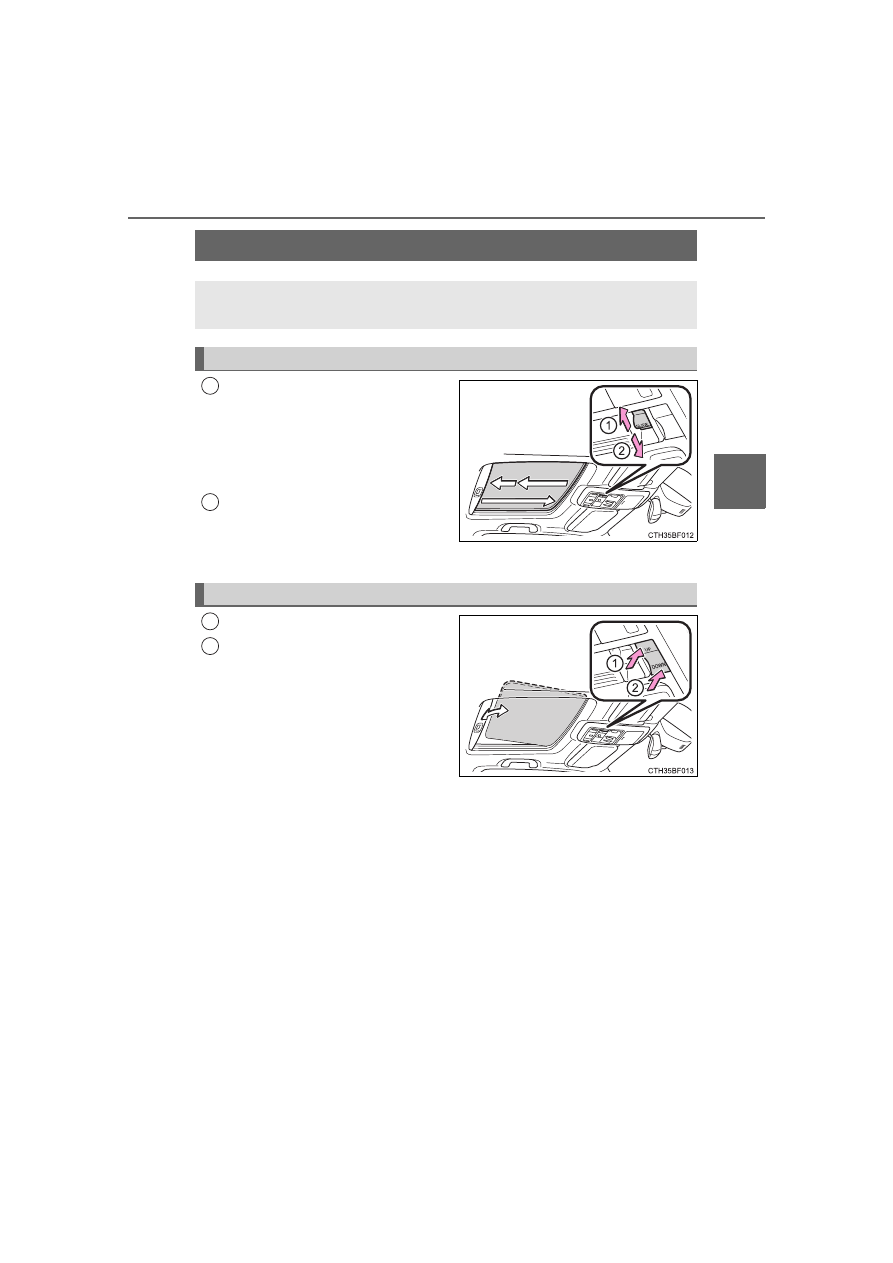
Opens the moon roof

*

The moon roof stops slightly before
the fully open position to reduce
wind noise. 

Press the switch again to fully open
the moon roof.

Closes the moon roof

*

*

: Lightly press either way of the

moon roof switch to stop the moon
roof partway.

Tilts the moon roof up

*

Tilts the moon roof down

*

*

: Lightly press either way of the

moon roof switch to stop the moon
roof partway.

Moon roof

: If equipped

Use the overhead switches to open and close the moon roof and
tilt it up and down.

Opening and closing

1

2

Tilting up and down

1

2

162

3-5. Opening, closing the windows and moon roof

4RUNNER (U)

The moon roof can be operated when

The engine switch is in IGNITION ON mode.

Operating the moon roof after turning the engine off

The moon roof can be operated for approximately 45 seconds after the
engine switch is turned to ACCESSORY mode or turned off. It cannot, how-
ever, be operated once either front door is opened.

Jam protection function

If an object is detected between the moon roof and the frame while the moon
roof is closing or tilting down, travel is stopped and the moon roof opens
slightly.

To reduce moon roof wind noise

When the moon roof is opened automatically, it will stop slightly before the
fully open position. Driving with the moon roof in this position can help reduce
wind noise.

Sunshade

The sunshade can be opened and closed manually. However, the sunshade
will open automatically when the moon roof is opened. 

163

3-5. Opening, closing the windows and moon roof

3

Op
eration

 o

f each

 compo

nen

t

4RUNNER (U)

When the moon roof does not close normally

Perform the following procedure:

If the moon roof closes but then re-opens slightly

Stop the vehicle.

Press and hold the “SLIDE (open/close)” switch in the close position.

*

1

The moon roof will close, reopen and pause for approximately 10 sec-
onds.

*

2

 Then it will close again, tilt up and pause for approximately 1 sec-

ond. Finally, it will tilt down, open and close.

Check to make sure that the moon roof is completely closed and then
release the switch.

If the moon roof tilts down but then tilts back up

Stop the vehicle.

Press and hold the “UP” switch

*

1

 until the moon roof moves into the tilt

up position and stops.

Release the “UP” switch once and then press and hold the “UP” switch
again.

*

1

The moon roof will pause for approximately 10 seconds in the tilt up posi-
tion.

*

2

 Then it will adjust slightly and pause for approximately 1 second.

Finally, it will tilt down, open and close.

Check to make sure that the moon roof is completely closed and then
release the switch.

*

1

: If the switch is released at the incorrect time, the procedure will have to

be performed again from the beginning.

*

2

: If the switch is released after the above mentioned 10 second pause,

automatic operation will be disabled. In that case, press and hold the
“UP” or “DOWN” switch, and the moon roof will tilt up and pause for
approximately 1 second. Then it will tilt down, open and close. Check to
make sure that the moon roof is completely closed and then release the
switch.

If the moon roof does not fully close even after performing the above proce-
dure correctly, have the vehicle inspected by your Toyota dealer.

Moon roof open reminder function

An alarm will sound when the driver’s door is opened with the moon roof not
fully closed and the engine switch off.

Door lock linked moon roof operation

The moon roof can be opened and closed using the key or mechanical key.

*

(

P. 106, 512)

The moon roof can be opened using the wireless remote control.

*


(

P. 106)

*

: These settings must be customized at your Toyota dealer.

1

2

3

1

2

3

4

164

3-5. Opening, closing the windows and moon roof

4RUNNER (U)

Customization that can be configured at Toyota dealer

Settings (e.g. key linked operation) can be changed. 

(Customizable features 

P. 549)

WARNING

Observe the following precautions.

Failure to do so may cause death or serious injury.

Opening the moon roof

Do not allow any passengers to put their hands or heads outside the vehi-

cle while it is moving.

Do not sit on top of the moon roof.

Closing the moon roof

The driver is responsible for moon roof opening and closing operations. 

In order to prevent accidental operation, especially by a child, do not let a

child operate the moon roof. It is possible for children and other passen-

gers to have body parts caught in the moon roof.

Check to make sure that all passengers do not have any part of their body

in a position where it could be caught when the moon roof is being oper-

ated. 

When using the key or mechanical key and operating the moon roof, oper-

ate the moon roof after checking to make sure that there is no possibility of

any passenger having any of their body parts caught in the moon roof.

Also, do not let a child operate moon roof by the key or mechanical key. It

is possible for children and other passengers to get caught in the moon

roof.

When exiting the vehicle, turn the engine switch off, carry the key and exit

the vehicle along with the child. There may be accidental operation, due to

mischief, etc., that may possibly lead to an accident.

Jam protection function

Never use any part of your body to intentionally activate the jam protection

function.

The jam protection function may not work if something gets caught just

before the moon roof fully closes.

165

Driving

4

4RUNNER (U)

4-1. Before driving

Driving the vehicle............. 166

Cargo and luggage ........... 176

Vehicle load limits ............. 181

Trailer towing..................... 182

Dinghy towing ................... 198

4-2. Driving procedures

Engine (ignition) switch ..... 199

Automatic transmission ..... 205

Turn signal lever................ 210

Parking brake .................... 211

4-3.  Operating the lights 

and wipers

Headlight switch ................ 212

AHB (Automatic High 

Beam) ............................. 217

Fog light switch ................. 221

Windshield wipers and 

washer ............................ 223

Rear window wiper and 

washer ............................ 226

4-4. Refueling

Opening the fuel tank 

cap .................................. 229

4-5.  Using the driving 

support systems

Toyota Safety Sense P ..... 232

PCS (Pre-Collision 

System)........................... 239

LDA (Lane Departure 

Alert) ............................... 249

Dynamic radar cruise 

control ............................. 257

BSM (Blind Spot 

Monitor)........................... 270

Intuitive parking assist....... 277

RCTA (Rear Cross 

Traffic Alert) .................... 286

Four-wheel drive system 

(part-time 4WD 
models) ........................... 294

Four-wheel drive system 

(full-time 4WD 
models) ........................... 298

Active traction control 

system ............................ 302

AUTO LSD system 

(2WD models) ................. 304

Rear differential lock 

system ............................ 306

Downhill assist control 

system ............................ 309

Crawl Control .................... 312

Multi-terrain Select ............ 315

Driving assist systems ...... 322

4-6. Driving tips

Winter driving tips ............. 331

Off-road precautions ......... 335

166

4RUNNER (U)

4-1. Before driving

P. 199

With the brake pedal depressed, shift the shift lever to D. (

P. 205)

Release the parking brake. (

P. 211)

Gradually release the brake pedal and gently depress the accelera-
tor pedal to accelerate the vehicle.

With the shift lever in D, depress the brake pedal until the vehicle
comes to a stop.

If necessary, set the parking brake.

If the vehicle is to be stopped for an extended period of time, shift the shift
lever to P or N. (

P. 205)

With the shift lever in D, depress the brake pedal.

Set the parking brake (

P. 211), and shift the shift lever to P (

P.

205).

Press the engine switch to stop the engine.

Lock the door, making sure that you have the key on your person.

If parking on a hill, block the wheels as needed.

Driving the vehicle

The following procedures should be observed to ensure safe
driving: 

Starting the engine

Driving

Stopping

Parking the vehicle

1

2

3

1

2

1

2

3

4

167

4-1. Before driving

4

Drivin

g

4RUNNER (U)

Make sure that the parking brake is set and shift the shift lever to D.

Gently depress the accelerator pedal.

Release the parking brake.

Driving in the rain

Drive carefully when it is raining, because visibility will be reduced, the win-
dows may become fogged-up, and the road will be slippery.

Drive carefully when it starts to rain, because the road surface will be espe-
cially slippery.

Refrain from driving at high speeds in the rain, as there may be a layer of
water between the tires and the road surface, preventing the steering and
brakes from operating properly.

Engine speed while driving

In the following conditions, the engine speed may become high while driving.
This is due to automatic up-shifting control or down-shifting implementation to
meet driving conditions. It does not indicate sudden acceleration.

The vehicle is judged to be driving uphill or downhill

When the accelerator pedal is released

Restraining the engine output (Brake Override System)

When the accelerator and brake pedals are depressed at the same time, the
engine output may be restrained.

A warning message is displayed on the multi-information display while the
system is operating.

Restraining sudden start (Drive-Start Control)

When the following unusual operation is performed, the engine output may
be restrained.

• When the shift lever is shifted from R to D, D to R, N to R, P to D, or P to

R (D includes S) with the accelerator pedal depressed, a warning mes-
sage appears on the multi-information display.

• When the accelerator pedal is depressed too much while the vehicle is in

reverse.

While Drive-Start Control is being activated, your vehicle may have trouble
escaping from the mud or fresh snow. In such case, perform the following
actions to cancel Drive-Start Control so that the vehicle may become able to
escape from the mud or fresh snow.

• Deactivate TRAC (

P. 324, 325)

• 2WD models: When the AUTO LSD system is turned on. (

P. 304)

• Part-time 4WD models: The four-wheel drive control switch is in “L4”

position. (

P. 294)

• Full-time 4WD models: The four-wheel drive control switch is in “L4L”

position. (

P. 298)

Starting off on a steep uphill

1

2

3

168

4-1. Before driving

4RUNNER (U)

Breaking in your new Toyota

To extend the life of the vehicle, observing the following precautions is recom-

mended:

For the first 200 miles (300 km):

Avoid sudden stops.

For the first 500 miles (800 km):

Do not tow a trailer.

For the first 1000 miles (1600 km):
• Do not drive at extremely high speeds.

• Avoid sudden acceleration.

• Do not drive continuously in low gears.

• Do not drive at a constant speed for extended periods.

Drum-in-disc type parking brake system

Your vehicle has a drum-in-disc type parking brake system. This type of brake

system needs bedding-down of the brake shoes periodically or whenever the

parking brake shoes and/or drum are replaced. Have your Toyota dealer per-

form the bedding down operation.

Operating your vehicle in a foreign country

Comply with the relevant vehicle registration laws and confirm the availability

of the correct fuel. (

P. 534)

When turning off the engine

The emission system operating sounds may continue for a short time after

the engine is turned off. This is not a malfunction, and helps to ensure optimal

performance of the emission system.

WARNING

Observe the following precautions. 

Failure to do so may result in death or serious injury.

When starting the vehicle

Always keep your foot on the brake pedal while stopped with the engine

running. This prevents the vehicle from creeping.

169

4-1. Before driving

4

D

riv

ing

4RUNNER (U)

WARNING

Observe the following precautions. 

Failure to do so may result in death or serious injury.

When driving the vehicle

Do not drive if you are unfamiliar with the location of the brake and accel-

erator pedals to avoid depressing the wrong pedal. 
• Accidentally depressing the accelerator pedal instead of the brake

pedal will result in sudden acceleration that may lead to an accident.

• When backing up, you may twist your body around, leading to a diffi-

culty in operating the pedals. Make sure to operate the pedals properly.

• Make sure to keep a correct driving posture even when moving the

vehicle only slightly. This allows you to depress the brake and accelera-

tor pedals properly.

• Depress the brake pedal using your right foot. Depressing the brake

pedal using your left foot may delay response in an emergency, result-

ing in an accident.

Do not drive the vehicle over or stop the vehicle near flammable materials.

The exhaust system and exhaust gases can be extremely hot. These hot

parts may cause a fire if there is any flammable material nearby.

When driving the vehicle

During normal driving, do not turn off the engine. Turning the engine off

while driving will not cause loss of steering or braking control, but the

power assist to these systems will be lost. This will make it more difficult to

steer and brake, so you should pull over and stop the vehicle as soon as it

is safe to do so. 

However, in the event of an emergency, such as if it becomes impossible

to stop the vehicle in the normal way: 

P. 467

Use engine braking (downshift) to maintain a safe speed when driving

down a steep hill. 

Using the brakes continuously may cause the brakes to overheat and lose

effectiveness. (

P. 205)

Do not adjust the positions of the steering wheel, the seat, or the inside or

outside rear view mirrors while driving.

Doing so may result in a loss of vehicle control.

Always check that all passengers’ arms, heads or other parts of their body

are not outside the vehicle.

Do not drive in excess of the speed limit. Even if the legal speed limit per-

mits it, do not drive over 85 mph (140 km/h) unless your vehicle has high-

speed capability tires. Driving over 85 mph (140 km/h) may result in tire

failure, loss of control and possible injury. Be sure to consult a tire dealer

to determine whether the tires on your vehicle are high-speed capability

tires or not before driving at such speeds.

170

4-1. Before driving

4RUNNER (U)

WARNING

Observe the following precautions. 

Failure to do so may result in death or serious injury.

When driving on slippery road surfaces

Sudden braking, acceleration and steering may cause tire slippage and

reduce your ability to control the vehicle, resulting in an accident.

Sudden acceleration, engine braking due to shifting, or changes in engine

speed could cause the vehicle to skid, resulting in an accident.

After driving through a puddle, lightly depress the brake pedal to make

sure that the brakes are functioning properly. Wet brake pads may prevent

the brakes from functioning properly. If the brakes on only one side are wet

and not functioning properly, steering control may be affected, resulting in

an accident.

When shifting the shift lever

Do not let the vehicle roll backward while the shift lever is in a driving posi-

tion, or roll forward while the shift lever is in R.

Doing so may cause the engine to stall or lead to poor brake and steering

performance, resulting in an accident or damage to the vehicle.

Do not shift the shift lever to P while the vehicle is moving. 

Doing so can damage the transmission and may result in a loss of vehicle

control.

Do not shift the shift lever to R while the vehicle is moving forward. 

Doing so can damage the transmission and may result in a loss of vehicle

control.

Do not shift the shift lever to a driving position while the vehicle is moving

backward. 

Doing so can damage the transmission and may result in a loss of vehicle

control.

Moving the shift lever to N while the vehicle is moving will disengage the

engine from the transmission. Engine braking is not available when N is

selected.

Be careful not to shift the shift lever with the accelerator pedal depressed.

Shifting the shift lever to a gear other than P or N may lead to unexpected

rapid acceleration of the vehicle that may cause an accident and result in

death or serious injury.

171

4-1. Before driving

4

D

riv

ing

4RUNNER (U)

WARNING

Observe the following precautions. 

Failure to do so may result in death or serious injury.

If you hear a squealing or scraping noise (brake pad wear limit indica-

tors)

Have the brake pads checked and replaced by your Toyota dealer as soon

as possible. 

Rotor damage may result if the pads are not replaced when needed.
It is dangerous to drive the vehicle when the wear limits of the brake pads

and/or those of the brake discs are exceeded.

When the vehicle is stopped

Do not race the engine.

If the vehicle is in any gear other than P or N, the vehicle may accelerate

suddenly and unexpectedly, causing an accident.

In order to prevent accidents due to the vehicle rolling away, always keep

depressing the brake pedal while the engine is running, and apply the

parking brake as necessary.

If the vehicle is stopped on an incline, in order to prevent accidents caused

by the vehicle rolling forward or backward, always depress the brake pedal

and securely apply the parking brake as needed.

Avoid revving or racing the engine. 

Running the engine at high speed while the vehicle is stopped may cause

the exhaust system to overheat, which could result in a fire if combustible

material is nearby.

172

4-1. Before driving

4RUNNER (U)

WARNING

Observe the following precautions. 

Failure to do so may result in death or serious injury.

When the vehicle is parked

Do not leave glasses, cigarette lighters, spray cans, or soft drink cans in

the vehicle when it is in the sun.

Doing so may result in the following:
• Gas may leak from a cigarette lighter or spray can, and may lead to a

fire.

• The temperature inside the vehicle may cause the plastic lenses and

plastic material of glasses to deform or crack.

• Soft drink cans may fracture, causing the contents to spray over the

interior of the vehicle, and may also cause a short circuit in the vehicle’s

electrical components.

Do not leave cigarette lighters in the vehicle. If a cigarette lighter is in a

place such as the glove box or on the floor, it may be lit accidentally when

luggage is loaded or the seat is adjusted, causing a fire.

Do not attach adhesive discs to the windshield or windows. Do not place

containers such as air fresheners on the instrument panel or dashboard.

Adhesive discs or containers may act as lenses, causing a fire in the vehi-

cle.

Do not leave a door or window open if the curved glass is coated with a

metallized film such as a silver-colored one. Reflected sunlight may cause

the glass to act as a lens, causing a fire.

Always apply the parking brake, shift the shift lever to P, stop the engine

and lock the vehicle.

Do not leave the vehicle unattended while the engine is running.

If the vehicle is parked with the shift lever in P but the parking brake is not

set, the vehicle may start to move, possibly leading to an accident.

Do not touch the exhaust pipes while the engine is running or immediately

after turning the engine off.

Doing so may cause burns.

173

4-1. Before driving

4

D

riv

ing

4RUNNER (U)

WARNING

Observe the following precautions. 

Failure to do so may result in death or serious injury.

When taking a nap in the vehicle

Always turn the engine off. Otherwise, if you accidentally move the shift

lever or depress the accelerator pedal, this could cause an accident or fire

due to engine overheating. Additionally, if the vehicle is parked in a poorly

ventilated area, exhaust gases may collect and enter the vehicle, leading to

death or a serious health hazard.

When braking

When the brakes are wet, drive more cautiously.

Braking distance increases when the brakes are wet, and this may cause

one side of the vehicle to brake differently than the other side. Also, the

parking brake may not securely hold the vehicle.

If the brake booster device does not operate, do not follow other vehicles

closely and avoid hills or sharp turns that require braking. 

In this case, braking is still possible, but the brake pedal should be

depressed more firmly than usual. Also, the braking distance will increase.

Do not pump the brake pedal if the engine stalls. 

Each push on the brake pedal uses up the reserve for the power-assisted

brakes.

The brake system consists of 2 individual hydraulic systems; if one of the

systems fails, the other will still operate. In this case, the brake pedal

should be depressed more firmly than usual and the braking distance will

increase.

If this happens, do not continue to drive the vehicle. Have your brakes

fixed immediately. 

174

4-1. Before driving

4RUNNER (U)

NOTICE

When driving the vehicle

Do not depress the accelerator and brake pedals at the same time during

driving, as this may restrain the engine output.

Do not use the accelerator pedal or depress the accelerator and brake

pedals at the same time to hold the vehicle on a hill.

When parking the vehicle

Always set the parking brake, and shift the shift lever to P. Failure to do so

may cause the vehicle to move or the vehicle may accelerate suddenly if

the accelerator pedal is accidentally depressed.

Avoiding damage to vehicle parts

Do not turn the steering wheel fully in either direction and hold it there for

an extended period of time. 

Doing so may damage the power steering pump.

When driving over bumps in the road, drive as slowly as possible to avoid

damaging the wheels, underside of the vehicle, etc. 

If you get a flat tire while driving 

A flat or damaged tire may cause the following situations. Hold the steering

wheel firmly and gradually depress the brake pedal to slow down the vehi-

cle.

It may be difficult to control your vehicle.

The vehicle will make abnormal sounds or vibrations.

The vehicle will behave abnormally.

Information on what to do in case of a flat tire (

P. 493)

175

4-1. Before driving

4

D

riv

ing

4RUNNER (U)

NOTICE

When encountering flooded roads

Do not drive on a road that has flooded after heavy rain etc. Doing so may

cause the following serious damage to the vehicle:

Engine stalling

Short in electrical components

Engine damage caused by water immersion

In the event that you drive on a flooded road and the vehicle is flooded, be

sure to have your Toyota dealer check the following:

Brake function

Changes in quantity and quality of oil and fluid used for the engine, trans-

mission, transfer (4WD models), differentials, etc.

Lubricant condition for the propeller shaft, bearings and suspension joints

(where possible), and the function of all joints, bearings, etc.

176

4-1. Before driving

4RUNNER (U)

Cargo and luggage

Take notice of the following information about storage precau-
tions, cargo capacity and load:

Stow cargo and luggage in the luggage compartment whenever
possible.

Be sure all items are secured in place. 

To maintain vehicle balance while driving, position luggage evenly
within the luggage compartment.

For better fuel economy, do not carry unnecessary weight.

177

4-1. Before driving

4

Drivin

g

4RUNNER (U)

Cargo capacity depends on the total weight of the occupants.

(Cargo capacity) = (Total load capacity) — (Total weight of occupants)

Steps for Determining Correct Load Limit —

(1) Locate the statement “The combined weight of occupants and

cargo should never exceed XXX kg or XXX lbs.” on your vehicle’s
placard. 

(2) Determine the combined weight of the driver and passengers that

will be riding in your vehicle. 

(3) Subtract the combined weight of the driver and passengers from

XXX kg or XXX lbs.

(4) The resulting figure equals the available amount of cargo and lug-

gage load capacity. 

For example, if the “XXX” amount equals 1400 lbs. and there will be
five 150 lb passengers in your vehicle, the amount of available
cargo and luggage load capacity is 650 lbs. (1400 

 750 (5



150) =

650 lbs.) 

(5) Determine the combined weight of luggage and cargo being loaded

on the vehicle. That weight may not safely exceed the available
cargo and luggage load capacity calculated in Step 4. 

(6) If your vehicle will be towing a trailer, load from your trailer will be

transferred to your vehicle. Consult this manual to determine how
this reduces the available cargo and luggage load capacity of your
vehicle.

(

P. 524)

Capacity and distribution

178

4-1. Before driving

4RUNNER (U)

Cargo capacity

Total load capacity (vehicle
capacity weight) (

P. 524)

When 2 people with the combined weight of A lb. (kg) are riding in
your vehicle, which has a total load capacity (vehicle capacity weight)
of B lb. (kg), the available amount of cargo and luggage load capacity
will be C lb. (kg) as follows: 

B

*

2

 lb. (kg) - A

*

1

 lb. (kg) = C

*

3

 lb. (kg)

*

1

: A =Weight of people 

*

2

: B =Total load capacity 

*

3

: C =Available cargo and luggage load

In this condition, if 3 more passengers with the combined weight of D
lb. (kg) get on, the available cargo and luggage load will be reduced E
lb. (kg) as follows:

C lb. (kg) - D

*

4

 lb. (kg) = E

*

5

 lb. (kg)

*

4

: D =Additional weight of people 

*

5

: E =Available cargo and luggage load

As shown in the example above, if the number of occupants
increases, the cargo and luggage load will be reduced by an amount
that equals the increased weight due to the additional occupants. In
other words, if an increase in the number of occupants causes an
excess of the total load capacity (combined weight of occupants plus
cargo and luggage load), you must reduce the cargo and luggage on
your vehicle. 

Calculation formula for your vehicle

1

2

179

4-1. Before driving

4

D

riv

ing

4RUNNER (U)

When using the roof rails (if equipped)

To use the roof rails as a roof luggage

carrier, you must fit the roof rails with

two or more genuine Toyota cross rails

or their equivalent.

When there is no luggage on the roof

luggage carrier Toyota recommends

that the front and rear cross rails be

secured in the positions indicated in

the illustration. This may reduce wind

noise while driving.

WARNING

Things that must not be carried in the luggage compartment

The following things may cause a fire if loaded in the luggage compart-

ment:

Receptacles containing gasoline

Aerosol cans

Storage precautions

Observe the following precautions.

Failure to do so may prevent the pedals from being depressed properly,

may block the driver’s vision, or may result in items hitting the driver or

passengers, possibly causing an accident.

Stow cargo and luggage in the luggage compartment whenever possi-

ble.

Do not stack cargo and luggage in the luggage compartment higher

than the seatbacks. 

Do not place cargo or luggage in or on the following locations.
• At the feet of the driver

• On the front passenger or rear seats (when stacking items)

• On the instrument panel

• On the dashboard

Secure all items in the occupant compartment.

When you fold down the rear seats, long items should not be placed

directly behind the front seats.

Never allow anyone to ride in the luggage compartment. It is not

designed for passengers. They should ride in their seats with their seat

belts properly fastened. Otherwise, they are much more likely to suffer

death or serious bodily injury, in the event of sudden braking, sudden

swerving or an accident.

Roof rails

Cross rails

180

4-1. Before driving

4RUNNER (U)

WARNING

Capacity and distribution

Do not exceed the maximum axle weight rating or the total vehicle

weight rating.

Even if the total load of occupant’s weight and the cargo load is less

than the total load capacity, do not apply the load unevenly. Improper

loading may cause deterioration of steering or braking control which

may cause death or serious injury.

When loading cargo on the roof luggage carrier

Observe the following precautions:

Place the cargo so that its weight is distributed evenly between the

front and rear axles.

If loading long or wide cargo, never exceed the vehicle overall length

or width. (

P. 524

)

Before driving, make sure the cargo is securely fastened on the roof

luggage carrier.

Loading cargo on the roof luggage carrier will make the center of grav-

ity of the vehicle higher. Avoid high speeds, sudden starts, sharp turns,

sudden braking or abrupt maneuvers, otherwise it may result in loss of

control or vehicle rollover due to failure to operate this vehicle correctly

and result in death or serious injury.

If driving for a long distance, on rough roads, or at high speeds, stop

the vehicle now and then during the trip to make sure the cross rails

are fixed securely and that the cargo remains in its place.

Do not exceed 120 lb. (54 kg) cargo weight on the roof luggage carrier.

NOTICE

When loading cargo on the roof luggage carrier

Be careful not to scratch the surface of the moon roof (if equipped).

181

4-1. Before driving

4

D

riv

ing

4RUNNER (U)

Total load capacity (vehicle capacity weight): 

P. 524 

Total load capacity means the combined weight of occupants, cargo

and luggage. 

Seating capacity: 

P. 524

Seating capacity means the maximum number of occupants whose

estimated average weight is 150 lb. (68 kg) per person. 

TWR (Trailer Weight Rating): 

P. 187, 524

TWR means the maximum gross trailer weight (trailer weight plus

its cargo weight) that you vehicle is able to tow.

Cargo capacity

Cargo capacity may increase or decrease depending on the weight

and the number of occupants. 

Total load capacity and seating capacity

These details are also described on the tire and loading information label.

(

P. 440)

Vehicle load limits

Vehicle load limits include total load capacity, seating capacity,

TWR (Trailer Weight Rating) and cargo capacity. 

WARNING

Overloading the vehicle

Do not overload the vehicle.

It may not only cause damage to the tires, but also degrade steering

and braking ability, resulting in an accident. 

182

4-1. Before driving

4RUNNER (U)

Trailer towing

Your vehicle is designed primarily as a passenger-and-load-car-
rying vehicle. Towing a trailer can have an adverse impact on
handling, performance, braking, durability, and fuel consump-
tion. For your safety and the safety of others, you must not over-
load your vehicle or trailer. You must also ensure that you are
using appropriate towing equipment, that the towing equipment
has been installed correctly and used properly, and that you
employ the requisite driving habits.

Vehicle-trailer stability and braking performance are affected by
trailer stability, brake performance and setting, trailer brakes,
the hitch and hitch systems (if equipped).

To tow a trailer safely, use extreme care and drive the vehicle in
accordance with your trailer’s characteristics and operating
conditions.

Toyota warranties do not apply to damage or malfunction
caused by towing a trailer for commercial purposes.

Contact your Toyota dealer for further information about addi-
tional requirements such as a towing kit, etc.

183

4-1. Before driving

4

Drivin

g

4RUNNER (U)

GCWR (Gross Combination Weight Rating)

The maximum allowable gross
combination weight. The gross
combination weight is the sum
of the total vehicle weight
(including the occupants, cargo
and any optional equipment
installed on the vehicle) and the
weight of the trailer being towed
(including the cargo in the
trailer).

GVWR (Gross Vehicle Weight Rating)

The maximum allowable gross
vehicle weight. The gross vehi-
cle weight is the total weight of
the vehicle. When towing a
trailer, it is the sum of the vehi-
cle weight (including the occu-
pants, cargo and any optional
equipment installed on the vehi-
cle) and the tongue weight.

Towing related terms

184

4-1. Before driving

4RUNNER (U)

GAWR (Gross Axle Weight Rating)

The maximum allowable gross
axle weight. The gross axle
weight is the load placed on
each axle (front and rear).

TWR (Trailer Weight Rating)

The maximum allowable gross
trailer weight. The gross trailer
weight is the sum of the trailer
weight and the weight of the
cargo in the trailer.

TWR is calculated assuming
base vehicle with one driver,
one front passenger, towing
package (if available), hitch and
hitch systems (if required).

Additional optional equipment, passengers and cargo in the vehicle will
reduce the trailer weight rating so as not to exceed GCWR, GVWR and
GAWR.
If the gross trailer weight exceeds 3000 lb. (1360 kg), it is recommended
to use a trailer with 2 or more axles.

Front GAWR

Rear GAWR

(With brakes)

185

4-1. Before driving

4

Drivin

g

4RUNNER (U)

Unbraked TWR (Unbraked Trailer Weight Rating)

The trailer weight rating for tow-
ing a trailer without a trailer ser-
vice brake system.

Tongue Weight

The load placed on the trailer
hitch ball. (

P. 187)

(Without brakes)

186

4-1. Before driving

4RUNNER (U)

The gross trailer weight must never exceed the TWR described in
the table. (

P. 187)

The gross combination weight must never exceed the GCWR
described in the table. (

P. 187)

The gross vehicle weight must
never exceed the GVWR indi-
cated on the Certification Label.

The gross axle weight on each
axle must never exceed the
GAWR indicated on the Certifi-
cation Label.

If the gross trailer weight is over the unbraked TWR, trailer service
brakes are required.

If the gross trailer weight is over 2000 lb. (907 kg), a sway control
device with sufficient capacity is required.

Weight limits

187

4-1. Before driving

4

Drivin

g

4RUNNER (U)

Confirm that the gross trailer weight, gross combination weight, gross
vehicle weight, gross axle weight and tongue weight are all within the
limits.

GCWR

*

 and TWR

*

Unbraked TWR

*

1655 lb. (750 kg)

*

: These models meet the tow-vehicle trailering requirement of SAE Interna-

tional per SAE J2807.

A recommended tongue weight varies in accordance with the types
of trailers or towing as described below.

To ensure the recommended values shown below, the trailer must
be loaded by referring to the following instructions.

• Tongue Weight

The gross trailer weight should be distributed so that the tongue
weight is 9% to 11%. (Tongue weight /Gross trailer weight x 100
= 9% to 11%)

Gross trailer weight

Tongue weight

The gross trailer weight, gross axle weight and tongue weight
can be measured with platform scales found at a highway weigh-
ing station, building supply company, trucking company, junk
yard, etc.

GCWR, TWR and Unbraked TWR

Driving system

Trailer Weight 

Rating

GCWR

2WD

5000 lb. 

(2270 kg)

11100 lb. (5035 kg)

4WD

11300 lb. (5125 kg)

Trailer Tongue Weight

1

2

188

4-1. Before driving

4RUNNER (U)

Trailer hitch assemblies have different weight capacities. Toyota rec-
ommends the use of Toyota hitch/bracket for your vehicle. For details,
contact your Toyota dealer.

If you wish to install a trailer hitch, contact your Toyota dealer.

Use only a hitch that conforms to the gross trailer weight require-
ment of your vehicle.

Follow the directions supplied by the hitch manufacturer.

Lubricate the hitch ball with a light coating of grease.

Remove the hitch ball whenever you are not towing a trailer.
Remove the trailer hitch if you do not need it. After removing the
hitch, seal any mounting hole in the vehicle body to prevent entry of
any substances into the vehicle.

Hitch

189

4-1. Before driving

4

Drivin

g

4RUNNER (U)

Use the correct trailer ball for your application.

Trailer ball load rating

Matches or exceeds the gross
trailer weight rating of the trailer.

Ball diameter

Matches the size of the trailer cou-
pler. Most couplers are stamped
with the required trailer ball size.

Shank length

Protrudes beyond the bottom of the lock washer and nut by at least 2
threads.

Shank diameter

Matches the ball mount hole diameter size.

Selecting trailer ball

1

2

Trailer class

Typical trailer ball size

IV

2 5/16 in.

II and III

2 in.

I

1 7/8 in.

3

4

190

4-1. Before driving

4RUNNER (U)

Weight carrying ball position:
50.1 in. (1272 mm)

Hitch receiver pin hole position:
43.7 in. (1109 mm)

Use the wire harness stored in the
rear end under body.

Please consult your dealer when installing trailer lights, as incorrect
installation may cause damage to the vehicle’s lights. Please take
care to comply with your state’s laws when installing trailer lights.

Service connector for towing brake controller

Positions for towing hitch receiver and hitch ball

1

2

Connecting trailer lights

Your vehicle is equipped with a service
connector for the trailer brake controller
as shown.

191

4-1. Before driving

4

Drivin

g

4RUNNER (U)

Your vehicle will handle differently when towing a trailer. Help to avoid
an accident, death or serious injury, keep the following in mind when
towing:

Speed limits for towing a trailer vary by state or province. Do not
exceed the posted towing speed limit.

Toyota recommends that the vehicle-trailer speed limit is 65 mph
(104 km/h) on a flat, straight, dry road. Do not exceed this limit, the
posted towing speed limit or the speed limit for your trailer as set
forth in your trailer owner’s manual, whichever is lowest. Instability
of the towing vehicle-trailer combination (trailer sway) increases as
speed increases. Exceeding speed limits may cause loss of control.

Before starting out, check the trailer lights, tires and the vehicle-
trailer connections. Recheck after driving a short distance.

Practice turning, stopping and reversing with the trailer attached in
an area away from traffic until you become accustomed to the feel
of the vehicle-trailer combination.

Reversing with a trailer attached is difficult and requires practice.
Grip the bottom of the steering wheel and move your hand to the
left to move the trailer to the left. Move your hand to the right to
move the trailer to right. (This is generally opposite to reversing
without a trailer attached.) Avoid sharp or prolonged turning. Have
someone guide you when reversing to reduce the risk of an acci-
dent.

As stopping distance is increased when towing a trailer, vehicle-to
vehicle distance should be increased. For each 10 mph (16 km/h)
of speed, allow at least one vehicle and trailer length.

Avoid sudden braking as you may skid, resulting in the trailer jack-
knifing and a loss of vehicle control. This is especially true on wet or
slippery surfaces.

Trailer towing tips

192

4-1. Before driving

4RUNNER (U)

Avoid jerky starts or sudden acceleration.

Avoid jerky steering and sharp turns, and slow down before making
turn.

Note that when making a turn, the trailer wheels will be closer than
the vehicle wheels to the inside of the turn. Compensate by making
a wider than normal turning radius.

Slow down before making a turn, in cross winds, on wet or slippery
surfaces, etc.
Increasing vehicle speed can destabilize the trailer.

Take care when passing other vehicles. Passing requires consider-
able distance. After passing a vehicle, do not forget the length of
your trailer, and be sure you have plenty of room before changing
lanes.

To maintain engine braking efficiency and charging system perfor-
mance when using engine braking, do not put the transmission in
D.

Instability happens more frequently when descending steep or long
downhill grades. Before descending, slow down and downshift. Do
not make sudden downshifts while descending steep or long down-
hill grades.

Avoid holding the brake pedal down too long or applying the brakes
too frequently. This could cause the brakes to overheat and result in
reduced braking efficiency.

Due to the added load of the trailer, your vehicle’s engine may over-
heat on hot days (at temperatures over 85°F [30°C]) when driving
up a long or steep grade. If the engine coolant temperature gauge
indicates overheating, immediately turn off the air conditioning (if in
use), pull your vehicle off the road and stop in a safe spot. 
(

P. 519)


Content      ..     4      5      6      7     ..