Toyota Prius Plug-in Hybrid (2023 year). Manual in english - page 7
 

  Index      Toyota     Toyota Prius Plug-in Hybrid (2023 year). Manual in english


Search            copyright infringement  


Content      ..     5      6      7      8     ..


Toyota Prius Plug-in Hybrid (2023 year). Manual in english - page 7


112

2-2. Charging

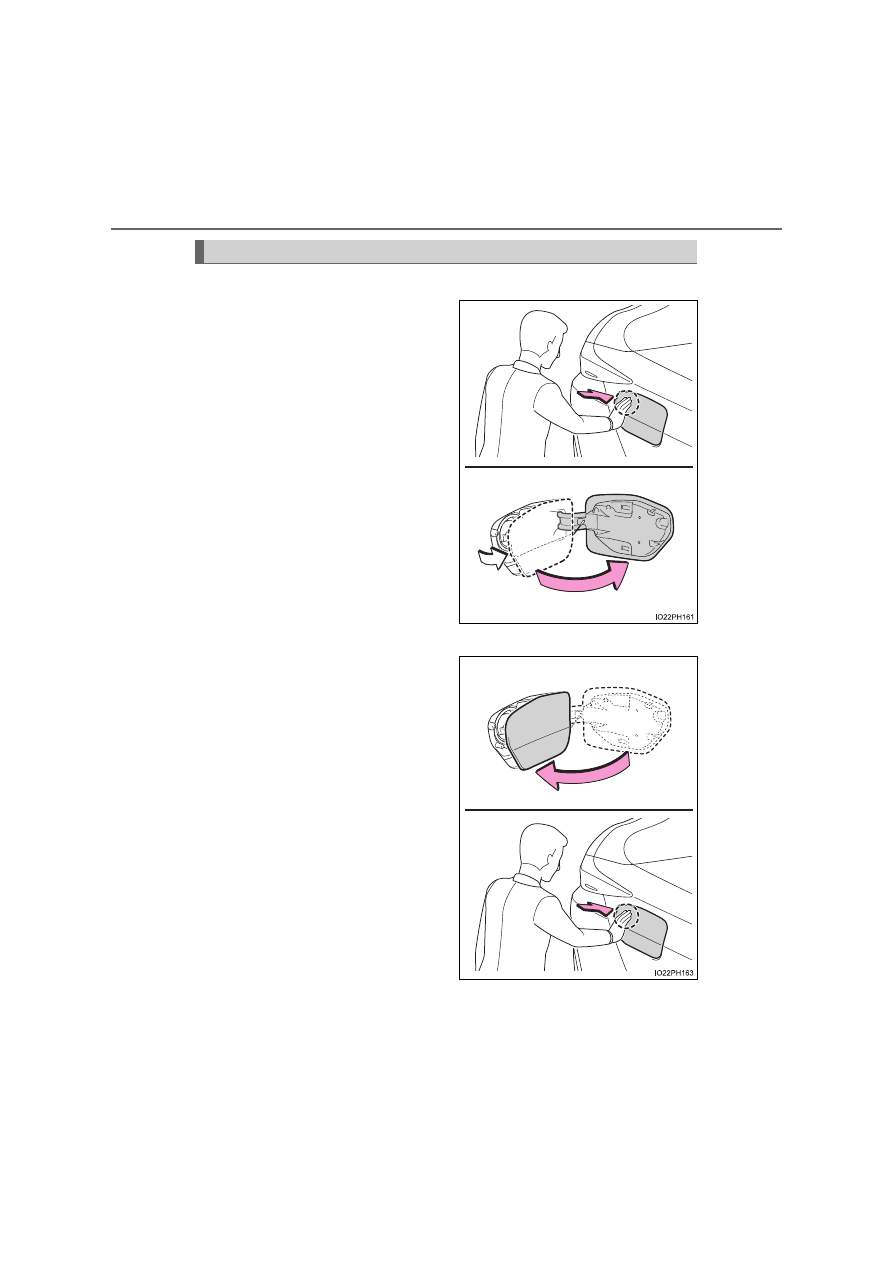
Opening the charging port lid

Press the rear edge of the
charging port lid (the position
shown in the illustration) with
the doors unlocked.

Push and take your hand away
to slightly open the charging port
lid. Then open the lid fully by
hand.
While the doors are locked, only
the charging port lid can be
unlocked by carrying an elec-
tronic key and pressing the
charging port lid. (

P. 131)

Closing the charging port lid

Close the charging port lid and
press the rear edge of the
charging port lid (the position
shown in the illustration).

When the doors are locked with
the smart entry & start system,
wireless remote control or door
lock switch, the charging port lid
is also locked. (

P. 273, 275)

If the charging port lid is closed
with the doors locked, the
charging port lid locks.

Opening and closing the charging port lid

113

2-2. Charging

2

P

lu

g

-in

 hy
br

id

 s

ys

tem

When the charging cable is con-
nected to the charging inlet, the
user is informed of the charging
status of the hybrid battery (trac-
tion battery) by the statuses of 3
indicators (turned off, illuminated
or flashing).

During charging

Hybrid battery (traction battery) status indicator

Charging status of the 

hybrid battery 

(traction battery)

Hybrid battery (traction battery) status indicator

About less than half

Flashes

Not illuminated Not illuminated

About more than half

Illuminated

Flashes

Not illuminated

Full

Illuminated

Illuminated

Flashes

1

2

3

114

2-2. Charging

Except during charging

The hybrid battery (traction battery) status indicators illuminate

*

1

while the charging port lid is open and any of the followings are per-
formed.

When an electronic key is carried near the effective range

*

2


(

P. 284)

When the doors are unlocked

*

1

: The indicators illuminate for a maximum of approximately 15 seconds.

*

2

: Excluding the effective range of the charging port lid.

When the hybrid battery (traction battery) is fully charged

When the charging cable is connected, all 3 hybrid battery (traction battery)
status indicators illuminate to inform the user that the hybrid battery (traction
battery) is fully charged.

*

*

: If the push lifter (

P. 161) is pushed in, the hybrid battery (traction battery)

status indicators may flash.

Charging status of the 

hybrid battery 

(traction battery)

Hybrid battery (traction battery) status indicator

About less than half

Illuminated

Not illuminated Not illuminated

About more than half

Illuminated

Illuminated

Not illuminated

Full

Illuminated

Illuminated

Illuminated

1

2

3

115

2-2. Charging

2

P

lu

g

-in

 hy
br

id

 s

ys

tem

The illumination/flashing pattern
changes to inform the user of the
charging status in the following
ways.

*

1

: If equipped

*

2

: Turns off after flashing for a certain period of time.

Charging indicator

When a system malfunction occurs while charging or using the Remote Air
Conditioning System, the charging indicator rapidly flashes for a certain
period of time, and then turns off.
If this occurs, the next time the hybrid system is started, a message is dis-
played on the multi-information display. When a message is displayed, follow
the instructions displayed on the screen.

Charging indicator

Illumination/flashing 

pattern

Vehicle condition

Illuminated

• Charging is in progress
• Charging is possible
• “Traction Battery Heater” (

P. 144) is operating

• “Traction Battery Cooler” (

P. 145) is operating

*

1

Flashing 
(normally)

*

2

When charge schedule is registered (

P. 166) and

charging cable is connected to vehicle

Rapidly flashing

*

2

When charging cannot be carried out due to mal-
function in a power source or the vehicle etc. 
(

P. 184)

Not illuminated

• Charging connector is not inserted into charging

inlet

• When the charging schedule (

P. 166) is on

standby

• When charging is completed

116

2-2. Charging

Charging cable

Mode 2 charging cable

The function, correct operating, etc. of the charging cable are
written.

The names of each part of the charging cable

Charging connector
Identification label
Plug
Plug-cord
CCID (Charging Circuit Inter-
rupting Device)

Power indicator (

P. 120)

Charging indicator (

P. 120)

Error warning indicator 
(

P. 120)

1
2
3
4
5

6
7
8

117

2-2. Charging

2

P

lu

g

-in

 hy
br

id

 s

ys

tem

Mode 3 charging cable (if equipped)

Charging connector (vehicle
side)
Identification label (on the
charging connector)
Charging plug (charger side)
Identification label (on the
charging plug)

Charging cable types

The following charging modes are categorized according to the availability of
a charging control device, which detects malfunctions such as electrical leak-
ages, and its location (whether it is attached to the charger or charging
cable). The type of charging cable that can be used differs according to the
charging mode.

1

2

3
4

Charging mode

Outline

Mode 1

A charging method which does not use charging
control to detect electrical leakages between an
external power source and the vehicle.
Does not apply to this vehicle.

Mode 2

A charging method which connects the vehicle to an
external power source through a charging cable
equipped with a CCID (Charging Circuit Interrupting
Device).
Applies to charging through most household sock-
ets.

Mode 3

A charging method which charges from a charger
(such as at a public charging station) equipped with
charging control to detect electrical leakages. Con-
trol to detect electrical leakages is implemented on
the charger side. Therefore, a CCID (Charging Cir-
cuit Interrupting Device) is not equipped to the
charging cable.
Not all chargers are equipped with charging cables.
If there is no charging cable available, use the Mode
3 charging cable equipped to this vehicle. (if
equipped)

118

2-2. Charging

Identification label

Identification labels are attached to the vehicle, charging cable and charger to
inform the user of which device they should use.
The meaning of the each identification label is as follows:

Identifi-

cation 

label

Supply 

type

Standard

Configura-

tion

Type of 

accessory

Voltage 

range

AC

EN 62196-2

TYPE 2

• Charging

port lid

• Charging

connector

 480V RMS

AC

EN 62196-2

TYPE 2

• Charging

plug

• Charger

 480V RMS

DC

EN 62196-3

FF

• Charging

port lid

• Charging

connector

50V to 500V

DC

EN 62196-3

AA

• Charging

port lid

• Charging

connector

50V to 500V

119

2-2. Charging

2

P

lu

g

-in

 hy
br

id

 s

ys

tem

This product must be grounded. In case of malfunction or break down,
grounding provides a path of least resistance for electric current to
reduce the risk of electric shock. This product is equipped with a
grounding conductor and a grounding plug. The grounding plug must
be plugged into an appropriate socket that is properly installed and
grounded in accordance with all local codes and ordinances.

The CCID (Charging Circuit Interrupting Device) has the following
safety features.

Electrical leakage detection function

If an electrical leakage is detected during charging, the power
source will be automatically interrupted, thus preventing fires or
electrical shocks caused by electrical leakage.

If the power source is interrupted, the error warning indicator flashes.
If the power source is interrupted: 

P. 120

Automatic check function

This is an automatic system check that is run before charging
begins to check for problems in the operation of the electrical leak-
age detection function.

If a malfunction is found in the electrical leakage detection function as a
result of the check, the error warning indicator flashes to inform the
user. (

P. 120)

Temperature detection function

A temperature detection function is equipped to the plug. While
charging, if heat is generated due to looseness on the socket side
etc., this function suppresses heat by controlling the charging cur-
rent.

Grounding (Mode 2 charging cable)

WARNING

Grounding precautions

Improper connection of the grounding conductor increases the risk of elec-
tric shock. Check with a qualified electrician or serviceman if you are in
doubt as to whether the product is properly grounded.

Do not modify the grounding plug provided with the product. If it does not
fit the socket, have a proper socket installed by a qualified electrician.

Safety functions (Mode 2 charging cable)

120

2-2. Charging

Conditions for supplying current to the vehicle

The CCID (Charging Circuit Interrupting Device) is designed to pre-
vent electrical current from being supplied to the charging connec-
tor when it is not connected to the vehicle, even if the plug is
inserted into the socket.

Indicator operation

3 indicators are used to indicate the following conditions.

Power indicator

Illuminates when electricity is
flowing to the CCID (Charging
Circuit Interrupting Device).

Charging indicator

Illuminates when charging is in
progress.

Error warning indicator

Flashes when there is an electri-
cal leakage or when a malfunc-
tion occurs in the CCID
(Charging Circuit Interrupting
Device).

When a malfunction occurs during charging

The indicators on the CCID (Charging Circuit Interrupting Device)
use a combination of different statuses (not illuminated, illuminated
or flashing) to inform the user of internal malfunctions.

When the error warning indicator is illuminated or flashing, temporarily
remove the plug from the socket and then reconnect it to check if the
error indicator turns off.
If the error warning indicator turns off, charging is now possible.
If it does not turn off, perform the correction procedure in the following
chart.

CCID (Charging Circuit Interrupting Device) indicators (Mode 2
charging cable)

1

2

3

121

2-2. Charging

2

P

lu

g

-in

 hy
br

id

 s

ys

tem

Status

Power 

indicator

Error 

warning 

indicator

Cause/Correction procedure

Charging 

system error

Not 

illuminated

Not 

illuminated 

or 

illuminated

An electrical leakage is
detected and charging is can-
celed, or there is a malfunction
in the charging cable.

Consult any authorized
Toyota retailer or Toyota
authorized repairer, or any
reliable repairer

Illuminated

Flashes

Plug 

temperature 

detection 

malfunction

Flashes

Flashes

There is a malfunction in the
plug temperature detection
part.

Consult any authorized
Toyota retailer or Toyota
authorized repairer, or any
reliable repairer

Plug 

temperature 

increase 

detection

Flashes

Not 

illuminated

An increase in the temperature
of the plug is detected due to an
improper connection between
the socket and plug.

Check that the plug is
securely connected to the
socket.

Charging 

cable life 

span notice

Illuminated

Flashes

The number of charges using
the charging cable is nearing
the end of its usable life span.

Consult any authorized
Toyota retailer or Toyota
authorized repairer, or any
reliable repairer

Charging 

cable life 

span

Illuminated

Illuminated

The number of charges using
the charging cable has
exceeded its usable number of
charges.

Consult any authorized
Toyota retailer or Toyota
authorized repairer, or any
reliable repairer

122

2-2. Charging

The plug-cord can be replaced using the following procedure.

Prepare the charging cable
(

P. 116) and the replacement

plug-cord.

Pull out the release key.

Make sure that the pulled out
release key is not lost.

Remove the plug-cord connec-
tor cap.

Insert the release key into the
release slot of the CCID
(Charging Circuit Interrupting
Device).

Insert the release key in the direc-
tion shown in the illustration.

Replacing the plug-cord (Mode 2 charging cable) (if equipped)

1

2

3

4

123

2-2. Charging

2

P

lu

g

-in

 hy
br

id

 s

ys

tem

With the release key fully
inserted into the release slot of
the CCID (Charging Circuit
Interrupting Device), turn the
plug-cord connector nut of the
plug-cord to remove the cord.

After the plug-cord is removed,
remove the release key.

Do not leave the vehicle alone with the plug-cord removed. If the plug-cord
is not installed, water or other foreign matter may enter the CCID
(Charging Circuit Interrupting Device), resulting in a malfunction.

Align the protrusion of the CCID
(Charging Circuit Interrupting
Device), with the groove of the
plug-cord, insert the plug-cord
into the CCID (Charging Circuit
Interrupting Device), and then
turn the plug-cord connector
nut of the plug-cord to install it.

Make sure that there are no foreign
objects attached to the connection
before installing the plug-cord.
Remove any foreign objects if they
are attached. Otherwise, water or
other foreign matter may enter the
CCID (Charging Circuit Interrupting
Device), resulting in a malfunction.
Turn the plug-cord connector nut of the plug-cord in the opposite direction
of removal until a click sound is heard and the plug-cord is secured.

Install the plug-cord connector cap and release key to the plug-cord
that has been removed.

Securely install the release key to the protection cap to prevent it from
being lost. Also, make sure that the release key does not fall out of the pro-
tection cap accidently.
Store the plug-cord in a safe, clean and dry place.

5

6

7

124

2-2. Charging

WARNING

When using the charging cable and CCID (Charging Circuit Interrupt-
ing Device) 

Observe the following precautions.
Failure to do so may cause an unexpected accident, resulting in death or
serious injury.

Do not attempt to disassemble or repair the charging cable, charging con-
nector, plug or CCID (Charging Circuit Interrupting Device).
If a problem arises with the charging cable or the CCID (Charging Circuit
Interrupting Device), stop charging immediately and contact any autho-
rized Toyota retailer or Toyota authorized repairer, or any reliable repairer.

Do not subject the charging cable, charging connector, plug or CCID
(Charging Circuit Interrupting Device) to strong force or impact.

Do not apply excessive force to the charging cable by forcefully folding,
twisting, pulling or dragging the charging cable.

Do not damage the charging cable with sharp objects.

Do not fold the charging connector or plug or insert foreign objects into
them.

Do not put the charging connector and plug into water.

Do not bring the charging cable to a high-temperature item such as a heat-
ing device.

Do not apply a load to the charging cable and plug-cord (such as wrapping
the charging cable around the CCID (Charging Circuit Interrupting Device)
and the charging connector).

Do not use or leave the charging cable in situations where a load is applied
to the socket and the plug (such as when the CCID (Charging Circuit Inter-
rupting Device) is hanging in the air without contacting the ground).

Mode 3 charging cable: Do not use outside the rated voltage (less than 277
V) or rated current (less than 20 A).

125

2-2. Charging

2

P

lu

g

-in

 hy
br

id

 s

ys

tem

WARNING

When replacing the plug-cord (if equipped)

Check the following points regularly. 
Failure to do so may cause an unexpected accident, resulting in death or
serious injury.

Do not replace the plug-cord with wet hands.
Also, do not replace in a place that is rainy or wet.

Do not replace the plug-cord when the plug and/or charging connector are
connected.

Check whether there are any local EV-charging regulations in place, and
adhere to them.

Do not leave the CCID (Charging Circuit Interrupting Device) with the plug-
cord removed.

Make sure that there are no foreign objects attached to the connection
when installing the plug-cord to the CCID (Charging Circuit Interrupting
Device).

When replacing the plug-cord, firmly turn the nut of the plug-cord until a
click sound can be heard.

Do not replace the plug cord in Norway.

NOTICE

When use the charging cable and related parts

P. 164

Precautions for low temperatures

In low temperatures, the charging cable and plug-cord may become hard.
Therefore, make sure to not apply excessive force when they are hard. If
excessive force is applied to the hardened charging cable and plug-cord,
they may be damaged.

Precautions for the plug-cord (if equipped)

Do not use the plug-cord for any use other than charging this vehicle. Doing
so may cause the plug-cord to be damaged.

126

2-2. Charging

For safety, inspect the charging cable on a routine basis.

Rating

Voltage (Un): 220 V - 240 V ~

Frequency: 50 Hz / 60 Hz 1

Φ

Current: 10 A

Residual operating current (I

Δ

n): 6 mA

Ambient temperature: -30 °C to 55 °C

IP67

Inspecting and maintaining the charging cable

WARNING

Routine inspection

Check the following points regularly.
Failure to do so may cause an unexpected accident, resulting in death or
serious injury.

The charging cable, plug, charging connector, CCID (Charging Circuit
Interrupting Device) etc. have not been damaged

The socket has not been damaged

The plug can be securely inserted into the socket

The plug does not get extremely hot during use

The tip of the plug has not been deformed

The plug is not dirtied by dust etc.

Remove the plug from the socket before inspecting it. If any abnormalities
are found in the charging cable as a result of the inspection, immediately
stop use and consult any authorized Toyota retailer or Toyota authorized
repairer, or any reliable repairer.

Maintaining the charging cable

When the charging cable is dirty, first remove the dirt with a hard, wringed
cloth, and then wipe the cable with a dry cloth. 
However, never wash it with water. If the charging cable is washed with
water, fire or electric shock may occur during charging, possibly resulting in
death or serious injury.

When not using the charging cable for a long time

Remove the plug from the socket. Dust could accumulate on the plug or in
the socket, possibly causing overheating which could lead to a fire.
Also, keep the cable in a place free from moisture.

Appendix (Mode 2 charging cable)

127

2-2. Charging

2

P

lu

g

-in

 hy
br

id

 s

ys

tem

Warning symbols

This device is for use with electric vehicles. (This
device does not require ventilation)

Do not attempt to disassemble or repair the
charging cable, charging connector, plug or CCID
(Charging Circuit Interrupting Device).

There may be a risk of electrical shock when using
this device improperly.

If the plug, charging connector or CCID (Charging
Circuit Interrupting Device) is abnormally hot during
use, unplug it immediately.

Connecting the charging cable to an extension cord
is strictly prohibited.

Do not connect the device to a socket that is loose,
worn, or broken. Ensure the plug fits the socket
tightly.

When the plug is used with a rain-tight socket for
outdoor use, protect the plug and socket from rain
and snow by using a rain-tight cover.

Do not immerse the plug or cord in water or other
liquid. Do not expose the plug to rain and snow.


Content      ..     5      6      7      8     ..