Toyota Prius (2023 year). Manual in english - page 39
 

  Index      Toyota     Toyota Prius (2023 year). Manual in english


Search            copyright infringement  


Content      ..     37      38      39      40     ..


Toyota Prius (2023 year). Manual in english - page 39


645

7-2. Steps to take in an emergency

7

W

hen
 trou

bl

e ari

se

s

If your vehicle overheats

If the high coolant temperature warning light comes on or
flashes

Stop the vehicle in a safe place and turn off the air conditioning
system, and then stop the hybrid system.
If you see steam: 
Carefully lift the hood after the steam subsides.
If you do not see steam:
Carefully lift the hood.
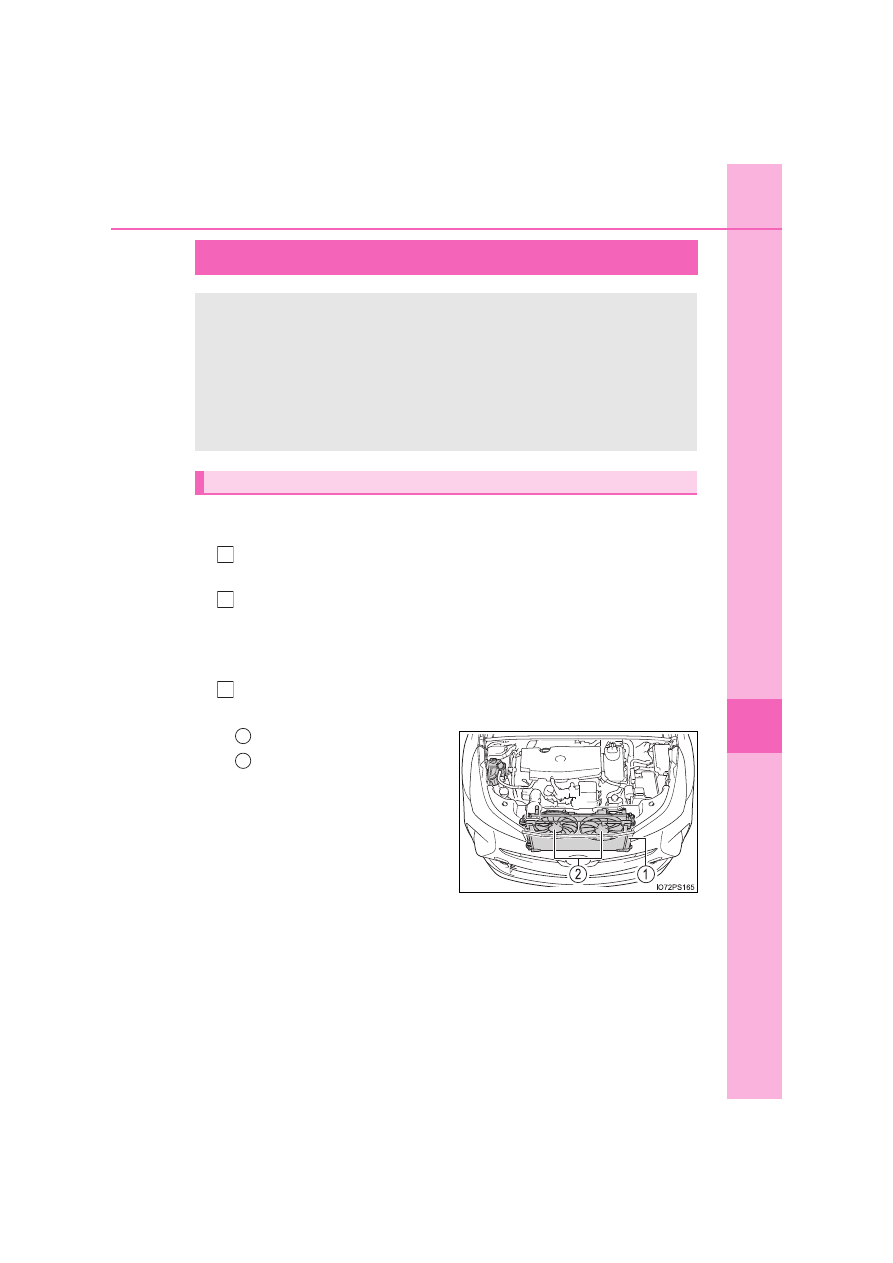
After the hybrid system has cooled down sufficiently, inspect the
hoses and radiator core (radiator) for any leaks.

Radiator
Cooling fans

If a large amount of coolant
leaks, immediately contact
any authorized Toyota retailer
or Toyota authorized repairer,
or any reliable repairer.

The following may indicate that your vehicle is overheating.

The high coolant temperature warning light (

P. 583) comes on

or flashes, or a loss of hybrid system power is experienced. (For
example, the vehicle speed does not increase.)

“Hybrid System Overheated” is shown on the multi-information
display.

Steam comes out from under the hood.

Correction procedures

1

2

3

1
2

646

7-2. Steps to take in an emergency

The coolant level is satisfactory if it is between the “MAX” and
“MIN” lines on the reservoir.

Reservoir
“MAX” line
“MIN” line

Add coolant if necessary.

Water can be used in an emergency if coolant is unavailable.

4

1
2
3

5

647

7-2. Steps to take in an emergency

7

W

hen
 trou

bl

e ari

se

s

Start the hybrid system and turn the air conditioning system on to
check that the radiator cooling fans operate and to check for
coolant leaks from the radiator or hoses.

The fans operate when the air conditioning system is turned on immedi-
ately after a cold start. Confirm that the fans are operating by checking
the fan sound and air flow. If it is difficult to check these, turn the air con-
ditioning system on and off repeatedly. (The fans may not operate in
freezing temperatures.)

If the fans are not operating:
Stop the hybrid system immediately and contact any authorized
Toyota retailer or Toyota authorized repairer, or any reliable
repairer.
If the fans are operating:
Have the vehicle inspected at the nearest any authorized Toyota
retailer or Toyota authorized repairer, or any reliable repairer.

If “Hybrid System Overheated” is shown on the multi-informa-
tion display

Stop the vehicle in a safe place.
Stop the hybrid system and carefully lift the hood.
After the hybrid system has cooled down, inspect the hoses and
radiator core (radiator) for any leaks.

Radiator
Cooling fans

If a large amount of coolant
leaks, immediately contact
any authorized Toyota retailer
or Toyota authorized repairer,
or any reliable repairer.

6

7

1

2

3

1
2

648

7-2. Steps to take in an emergency

The coolant level is satisfactory if it is between the “FULL” and
“LOW” lines on the reservoir.

Reservoir
“FULL” line
“LOW” line

Add coolant if necessary.

Water can be used in an emer-
gency if coolant is unavailable.
If water was added in an emer-
gency, have the vehicle
inspected at any authorized
Toyota retailer or Toyota autho-
rized repairer, or any reliable
repairer as soon as possible.

After stopping the hybrid system and waiting for 5 minutes or
more, start the hybrid system again and check if “Hybrid System
Overheated” is shown on the multi-information display.
If the message does not disappear: 
Stop the hybrid system and contact any authorized Toyota
retailer or Toyota authorized repairer, or any reliable repairer.
If the message is not displayed: 
The hybrid system temperature has dropped and the vehicle may
be driven normally.

However, if the message appears again frequently, contact any autho-
rized Toyota retailer or Toyota authorized repairer, or any reliable
repairer.

4

1
2
3

5

6

649

7-2. Steps to take in an emergency

7

W

hen
 trou

bl

e ari

se

s

WARNING

To prevent an accident or injury when inspecting under the hood of
your vehicle

Observe the following precautions.
Failure to do so may result in serious injury such as burns.

If steam is seen coming from under the hood, do not open the hood until
the steam has subsided. The engine compartment may be very hot.

After the hybrid system has been turned off, check that the “Accessory”,
“Ignition ON” or mileage display (

P. 118, 120) on the main display and

the “READY” indicator are off. 
When the hybrid system is operating, the gasoline engine may automati-
cally start, or the cooling fans may suddenly operate even if the gasoline
engine stops. Do not touch or approach rotating parts such as the fan,
which may lead to fingers or clothing (especially a tie, a scarf or a muffler)
getting caught, resulting in serious injury.

Do not loosen the coolant reservoir caps while the hybrid system and radi-
ator are hot.
High temperature steam or coolant could spray out.

NOTICE

When adding engine/power control unit coolant

Add coolant slowly after the hybrid system has cooled down sufficiently.
Adding cool coolant to a hot hybrid system too quickly can cause damage to
the hybrid system.

To prevent damage to the cooling system

Observe the following precautions:

Avoid contaminating the coolant with foreign matter (such as sand or dust
etc.).

Do not use any coolant additive.

650

7-2. Steps to take in an emergency

If the vehicle becomes stuck

Set the parking brake and shift the shift position to P. Stop the
hybrid system.
Remove the mud, snow or sand from around the front wheels.
Place wood, stones or some other material under the front wheels
to help provide traction.
Restart the hybrid system.
Shift the shift position to D or R and release the parking brake.
Then, while exercising caution, depress the accelerator pedal.

When it is difficult to free the vehicle

Carry out the following procedures if the tires spin or the vehicle
becomes stuck in mud, dirt or snow:

Press 

 to turn off TRC. (

P. 443)

1

2

3

4

5

651

7-2. Steps to take in an emergency

7

W

hen
 trou

bl

e ari

se

s

WARNING

When attempting to free a stuck vehicle

If you choose to push the vehicle back and forth to free it, make sure the
surrounding area is clear to avoid striking other vehicles, objects or people.
The vehicle may also lunge forward or lunge back suddenly as it becomes
free. Use extreme caution.

When changing the shift position

Be careful not to change the shift position with the accelerator pedal
depressed. 
This may lead to unexpected rapid acceleration of the vehicle that may
cause an accident resulting in death or serious injury.

NOTICE

To avoid damage to the hybrid transmission and other components

Avoid spinning the front wheels and depressing the accelerator pedal
more than necessary.

If the vehicle remains stuck even after these procedures are performed,
the vehicle may require towing to be freed.

653

8

Vehicle specifications

8-1. Specifications

Maintenance data 

(fuel, oil level, etc.)...........654

Fuel information .................668

8-2. Customization

Customizable features .......670

8-3. Initialization

Items to initialize ................679

654

8-1. Specifications

Maintenance data (fuel, oil level, etc.)

*

1

: Unladen vehicle

*

2

: Vehicles with 195/65R15 tires

*

3

: Vehicles with 215/45R17 tires

*

4

: Vehicles that can tow a trailer. (

P. 233)

Dimensions and weights

Overall length

4575 mm (180.1 in.)

Overall width

1760 mm (69.3 in.)

Overall height

*

1

2WD
models

Without raised
vehicle height

1470 mm (57.9 in.)

With raised vehi-
cle height

1490 mm (58.7 in.)

AWD models

1475 mm (58.1 in.)

Wheelbase

2700 mm (106.3 in.)

Tread

*

1

Front

1530 mm (60.2 in.)

*

2

1510 mm (59.4 in.)

*

3

Rear

Without raised
vehicle height

1540 mm (60.6 in.)

*

2

1520 mm (59.8 in.)

*

3

With raised vehi-
cle height

1530 mm (60.2 in.)

*

2

1510 mm (59.4 in.)

*

3

Gross vehicle
mass

2WD models

1790 kg (3946 lb.)

AWD models

1845 kg (4068 lb.)

Maximum per-
missible axle
capacity

Front

1020 kg (2249 lb.)

Rear

975 kg (2150 lb.)

Drawbar load

*

4

60kg (132 lb.)

Towing capac-
ity

*

4

Without brake

725 kg (1598 lb.)

With brake

655

8-1. Specifications

8

V

eh

icl

e s
pe

cif

ic

at

io

ns

Vehicle identification number

The vehicle identification number (VIN) is the legal identifier for
your vehicle. This is the primary identification number for your

Toyota. It is used in registering the ownership of your vehicle.

This number is on the top left of
the instrument panel.

This number is also stamped
under the right-hand front seat.

This number is also on the
manufacturer’s label.

Vehicle identification

656

8-1. Specifications

Engine number

The engine number is stamped
on the engine block as shown.

Engine

Model

2ZR-FXE

Type

4-cylinder in line, 4-cycle, gasoline

Bore and stroke

80.5 

 88.3 mm (3.17 

 3.48 in.)

Displacement

1798 cm

3

 (109.7 cu.in.)

Valve clearance

Automatic adjustment

657

8-1. Specifications

8

V

eh

icl

e s
pe

cif

ic

at

io

ns

Fuel

Fuel type

When you find these types of fuel label at
the gas station, use only the fuel with one of
the following labels.


EU area:
Unleaded gasoline conforming to European
standard EN228 only

Except EU area:
Unleaded gasoline only

Research Octane Number

EU area:
95 or higher

Except EU area:
95 or higher

Russia only:
91 or higher

Fuel tank capacity 
(Reference)

43 L (11.4 gal., 9.5 lmp.gal.)

Electric motor (traction motor)

Front

Rear (AWD models)

Type

Permanent magnet
synchronous motor

Permanent induc-
tion motor

Maximum output

53 kW

5.3 kW

Maximum torque

163 N•m (16.6 kgf•m, 
120.2 ft•lbf)

55 N•m (5.6 kgf•m, 
40.6 ft•lbf)

Hybrid battery (traction battery)

Type

Nickel-Metal hydride battery

Voltage

7.2 V/module

Capacity

6.5 Ah (3HR)

Quantity

28 modules

Nominal voltage

201.6 V

658

8-1. Specifications

Oil capacity (Drain and refill [Reference

*

])

*

: The engine oil capacity is a reference quantity to be used when changing

the engine oil. Park the vehicle on level ground. After warming up the
engine and turning off the hybrid system, wait more than 5 minutes, and
check the oil level on the dipstick.

Engine oil selection

“Toyota Genuine Motor Oil” is used in your Toyota vehicle. Toyota
recommends the use of approved “Toyota Genuine Motor Oil”.
Another motor oil of matching quality can also be used.
Oil grade:
0W-16:
API grade SN “Resource-Conserving”, SN PLUS “Resource-Con-
serving” or SP “Resource-Conserving”; or ILSAC GF-6B multigrade
engine oil
0W-20 and 5W-30:
API grade SM “Energy-Conserving”, SN “Resource-Conserving”,
SN PLUS “Resource-Conserving” or SP “Resource-Conserving”; or
ILSAC GF-6A multigrade engine oil

Recommended viscosity (SAE):

SAE 0W-16 is filled into your
Toyota vehicle at manufactur-
ing, and the best choice for
good fuel economy and good
starting in cold weather.
If SAE 0W-16 oil is not avail-
able, SAE 0W-20 oil may be
used. However, it should be
replaced with SAE 0W-16 at the
next oil change.

Lubrication system (except for Georgia, New Caledonia and Rus-
sia)

With filter

4.2 L (4.4 qt., 3.7 Imp.qt.)

Without filter

3.9 L (4.1 qt., 3.4 Imp.qt.)

Temperature range anticipated 
before next oil change

Preferred

659

8-1. Specifications

8

V

eh

icl

e s
pe

cif

ic

at

io

ns

Oil viscosity (0W-16 is explained here as an example):

• The 0W in 0W-16 indicates the characteristic of the oil which

allows cold startability. Oils with a lower value before the W allow
for easier starting of the engine in cold weather.

• The 16 in 0W-16 indicates the viscosity characteristic of the oil

when the oil is at high temperature. An oil with a higher viscosity
(one with a higher value) may be better suited if the vehicle is
operated at high speeds, or under extreme load conditions.

How to read oil container labels:
Either or both API registered marks are added to some oil contain-
ers to help you select the oil you should use.

API Service Symbol

Top portion: “API SERVICE SP”
means the oil quality designa-
tion by American Petroleum Ins-
titute (API).
Center portion: “SAE 0W-16”
means the SAE viscosity grade.
Lower portion: “Resource-
Conserving” means that the oil
has fuel-saving and environ-
mental protection capabilities.

ILSAC Certification Mark

The International Lubricant Specification Advisory Committee (ILSAC)
Certification Mark is displayed on the front of the container.

1

2

660

8-1. Specifications

Oil capacity (Drain and refill [Reference

*

])

*

: The engine oil capacity is a reference quantity to be used when changing

the engine oil. Park the vehicle on level ground. After warming up the
engine and turning off the hybrid system, wait more than 5 minutes, and
check the oil level on the dipstick.

Engine oil selection

“Toyota Genuine Motor Oil” is used in your Toyota vehicle. Use
Toyota approved “Toyota Genuine Motor Oil” or equivalent to satisfy
the following grade and viscosity.
Oil grade:
0W-20, 5W-20, 5W-30 and 10W-30:
API grade SL “Energy-Conserving”, SM “Energy-Conserving”, SN
“Resource-Conserving”, SN PLUS “Resource-Conserving” or SP
“Resource-Conserving”; or ILSAC GF-6A multigrade engine oil

Recommended viscosity (SAE):

SAE 0W-20 is filled into your
Toyota vehicle at manufactur-
ing, and the best choice for
good fuel economy and good
starting in cold weather.
If you use SAE 10W-30 or a
higher viscosity engine oil in
extremely low temperatures,
the engine may become difficult
to start, so SAE 0W-20, 5W-20
or 5W-30 engine oil is recom-
mended.

Lubrication system (for Georgia, New Caledonia and Russia)

With filter

4.2 L (4.4 qt., 3.7 Imp.qt.)

Without filter

3.9 L (4.1 qt., 3.4 Imp.qt.)

Temperature range anticipated 

before next oil change

Preferred

661

8-1. Specifications

8

V

eh

icl

e s
pe

cif

ic

at

io

ns

Oil viscosity (0W-20 is explained here as an example):

• The 0W in 0W-20 indicates the characteristic of the oil which

allows cold startability. Oils with a lower value before the W allow
for easier starting of the engine in cold weather.

• The 20 in 0W-20 indicates the viscosity characteristic of the oil

when the oil is at high temperature. An oil with a higher viscosity
(one with a higher value) may be better suited if the vehicle is
operated at high speeds, or under extreme load conditions.

How to read oil container labels:
Either or both API registered marks are added to some oil contain-
ers to help you select the oil you should use.

API Service Symbol

Top portion: “API SERVICE SP”
means the oil quality designa-
tion by American Petroleum Ins-
titute (API).
Center portion: “SAE 0W-20”
means the SAE viscosity grade.
Lower portion: “Resource-Con-
serving” means that the oil has
fuel-saving and environmental
protection capabilities.

ILSAC Certification Mark

The International Lubricant Specification Advisory Committee (ILSAC)
Certification Mark is displayed on the front of the container.

1

2


Content      ..     37      38      39      40     ..