Toyota Sienna Hybrid (2023 year). Manual in english - page 20
 

  Index      Toyota     Toyota Sienna Hybrid (2023 year). Manual in english


Search            copyright infringement  


Content      ..     18      19      20      21     ..


Toyota Sienna Hybrid (2023 year). Manual in english - page 20


320

4-5. Using the driving support systems

*

: If equipped

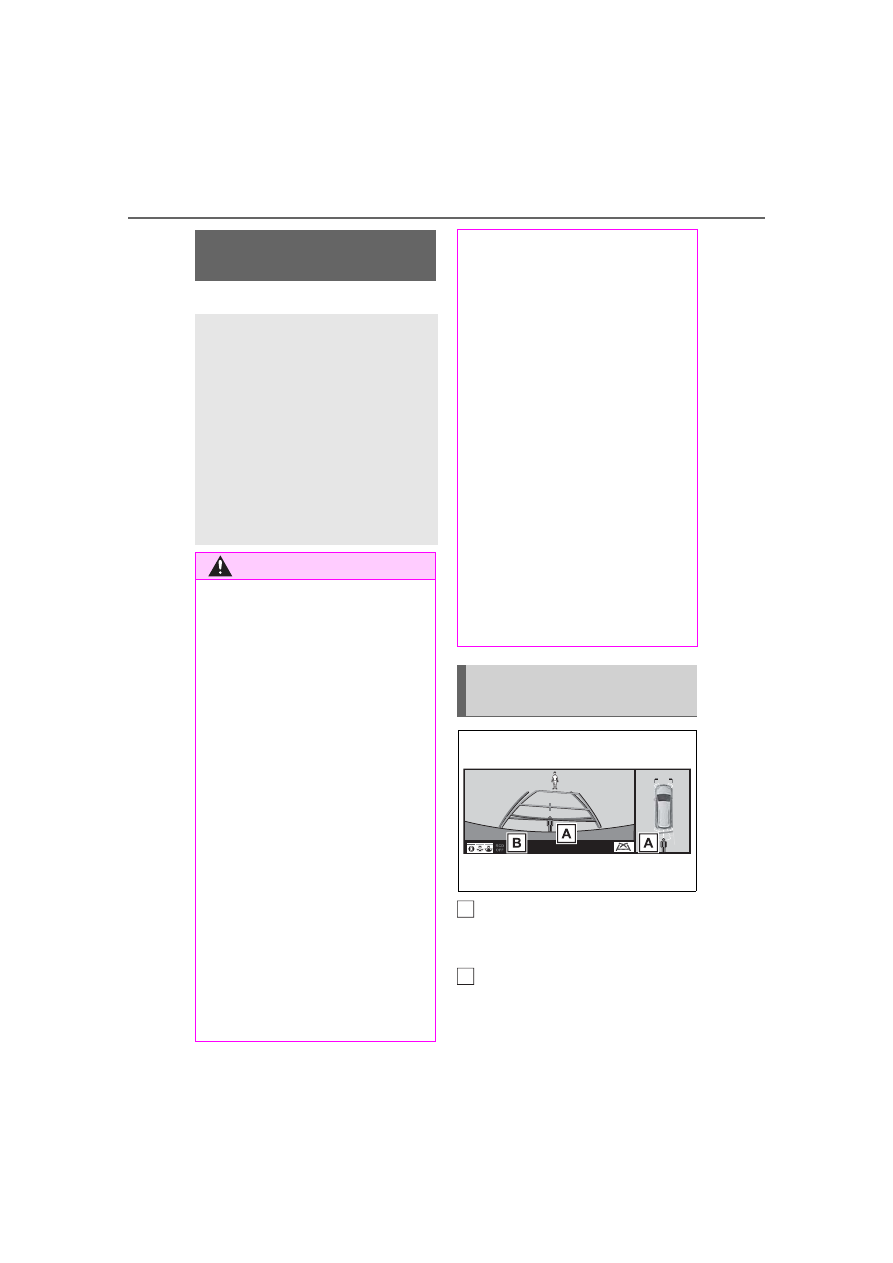
Pedestrian detection icon

Displayed automatically when a 
pedestrian is detected.

RCD OFF icon

When the RCD function is disabled, 
the RCD OFF icon illuminates. 
(Each time the power switch is 

RCD (Rear Camera 

Detection) function

*

When the vehicle is back-
ing up, the rear camera 
detection function can 
detect pedestrians in the 
detection area behind the 
vehicle. If a pedestrian is 
detected, a buzzer will 
sound and an icon will be 
displayed on the audio sys-
tem screen to inform the 
driver of the pedestrian.

WARNING

Cautions regarding the use of 

the system

The recognition and control capa-

bilities for this system are limited. 

The driver should always drive 

safely by always being responsi-

ble without over relying on the 

system and have a understanding 

of the surrounding situations.

To ensure the system can 

operate properly

Observe the following, otherwise 

there is the danger that could lead 

to an accident.

Always clean the camera with-

out damaging it.

Do not install market electronic 

parts (such as Illuminated 

license plate, fog lamps, etc.) in 

the camera vicinity.

Do not subject the camera vicin-

ity to strong impacts. If the vicin-

ity is subjected to a strong 

impact, have the vehicle 

inspected by your Toyota 

dealer.

Do not disassemble, remodel or 

paint the camera.

Do not attach accessories or 

stickers to the camera.

Do not install market protection 

parts (bumper trim, etc.) to the 

rear bumper.

Maintain suitable tire air pres-

sure.

Make sure the back door is 

completely closed.

RCD function is turned off

In the following situations the sys-

tem turns off. The RCD function 

may not operate properly and 

thus there is the danger that an 

accident may occur.

The contents mentioned above 

are not observed.

Suspensions other than Toyota 

genuine parts are installed.

Display (audio system 
screen)

A

B

321

4-5. Using the driving support systems

4

Dr

iv

ing

turned off then changed to ON, the 
RCD function will be enabled auto-
matically.)

Use the meter control switches 
to enable/disable the RCD func-
tion. (

P.112)

4.2-inch display

1

Press 

 or 

 of the meter 

control switches and select 

.

2

Press 

 or 

 of the meter 

control switches to select 
“RCD” and then press “OK”.

7-inch display

1

Press 

 or 

 of the meter 

control switches and select 

.

2

Press 

 or 

 of the meter 

control switches to select 
“RCD” and then press “OK”.

3

ON and OFF will be switched 
when “OK” is pressed.

When the RCD function is disabled, 

the RCD OFF indicator (

P.94) 

illuminates on the multi-information 

display.

If the rear camera detection 
function detects a pedestrian in 
the detection area, the buzzer 
and pedestrian detection will 

operate as follows:

If a pedestrian is detected in 
area 
Buzzer: Sounds repeatedly
Pedestrian detection icon: 
Blinks 3 times and then stays 
on

If a pedestrian is detected in 
area 
Buzzer (When the vehicle is 
stationary): Sounds 3 times
Buzzer (When the vehicle is 
backing up, when a pedes-
trian approaches the rear of 
the vehicle): Sounds repeat-
edly
Pedestrian detection icon: 
Blinks 3 times and then stays 
on

If the system determines that 
your vehicle may collide with 
a pedestrian in area 
Buzzer: Sounds repeatedly
Pedestrian detection icon: 
Blinks 3 times and then stays 

Turning the RCD function 
on/off

When a pedestrian is 
detected

A

B

C

A

A

B

B

C

C

322

4-5. Using the driving support systems

on

The rear camera detection func-

tion is operational when

The power switch is in ON.

RCD function is on.

The shift lever is in R.

Setting the buzzer volume

The buzzer volume can be adjusted 

on the multi-information display. 

(

P.112)

Muting the buzzer sound

The buzzer can be temporarily 

muted by pressing “OK” of the meter 

control switches while a suggestion 

that says mute is available is shown 

on the multi-information display.

If “Rear Camera Detection 

Unavailable Remove the Dirt of 

Rear Camera” is displayed on 

the multi-information display

A rear camera lens may be dirty or 

covered with snow or ice. In such 

cases, if it is removed from the rear 

camera lens, the system should 

return to normal. (It may be neces-

sary to drive the vehicle for some 

time before the system returns to 

normal. Even after the camera 

cleaning washer operated, driving 

the vehicle may also be necessary.)

If “Rear Camera Detection 

Unavailable See Owner’s Man-

ual” is displayed on the multi-

information display

If this message is displayed after 

the 12-volt battery has been dis-

connected and reconnected, fully 

turn the steering wheel to the left 

and then the right on level ground.

If this message is displayed only 

when the shift lever is in R, the 

rear camera lens may be dirty. 

Clean the rear camera lens.

Situations in which the system 

may not operate properly

Some pedestrians, such as the 

following, may not be detected by 

the rear camera detection func-

tion, preventing the function from 

operating properly:

• Pedestrians who are bending for-

ward or squatting

• Pedestrians who are lying down

• Pedestrians who are running

• Pedestrians who suddenly enter 

the detection area

• People riding a bicycle, skate-

board, or other light vehicle

• Pedestrians wearing oversized 

clothing such as a rain coat, long 

skirt, etc., making their silhouette 

obscure

• Pedestrians whose body is par-

tially hidden by an object, such as 

a cart or umbrella

• Pedestrians which are obscured 

by darkness, such as at night

In some situations, such as the 

following, pedestrians may not be 

detected by the rear camera 

detection function, preventing the 

function from operating properly:

• When backing up in inclement 

weather (rain, snow, fog, etc.)

• When the rear camera is 

obscured (dirt, snow, ice, etc. are 

attached) or scratched

• When a very bright light, such as 

the sun, or the headlights of 

another vehicle, shines directly 

into the rear camera

• When backing up in a place where 

the surrounding brightness 

changes suddenly, such as at the 

entrance or exit of a garage or 

underground parking lot

• When backing up in a dim envi-

ronment such as during dusk or in 

an underground parking lot

• When the dedicated camera 

cleaning washer is operating

• When the camera position and 

direction are deviated

• When a towing hook is attached

• When water droplets are flowing 

on the camera lens

• When the vehicle height is 

extremely changed (nose up, 

nose down)

• When tire chains or an emergency 

323

4-5. Using the driving support systems

4

Dr

iv

ing

tire puncture repair kit are used

Situations in which the system 

may operate unexpectedly

Even though there are no pedes-

trians in the detection area, some 

objects, such as the following, 

may be detected, possibly caus-

ing the rear camera detection 

function to operate.

• Three dimensional objects, such 

as a pole, traffic cone, fence, or 

parked vehicle

• Moving objects, such as a car or 

motorcycle

• Objects moving toward your vehi-

cle when backing up, such as 

flags or puddles (or airborne mat-

ter, such as smoke, steam, rain, or 

snow)

• Cobblestone or gravel roads, tram 

rails, road repairs, white lines, 

pedestrian crossings or fallen 

leaves on the road

• Metal covers (gratings), such as 

those used for drainage ditches

• Objects reflected in a puddle or on 

a wet road surface

• Shadows on the road

In some situations, such as the 

following, the rear camera detec-

tion function may operate even 

though there are no pedestrians in 

the detection area.

• When backing up toward the road-

side or a bump on the road

• When backing up toward an 

incline/decline

• If the rear of the vehicle is raised 

or lowered due to the carried load

• If a bumper protector, such as an 

additional trim strip, is installed to 

the rear bumper

• If the orientation of the rear cam-

era has been changed due to a 

collision or other impact, or 

removal and installation

• When water is flowing over the 

rear camera lens

• When the rear camera is 

obscured (dirt, snow, ice, etc. are 

attached) or scratched

• If there is a flashing light in the 

detection area, such as the emer-

gency flashers of another vehicle

• When tire chains or an emergency 

tire puncture repair kit are used.

Situations in which the rear cam-

era detection function may be diffi-

cult to notice

• The buzzer may be difficult to hear 

if the surrounding area is noisy, 

the volume of the audio system 

volume is high, the air condition-

ing system is being used, etc.

• If the temperature in the cabin is 

extremely high or low, the audio 

system screen may not operate 

correctly.

324

4-5. Using the driving support systems

*

: If equipped

Parking Support Brake 
function (static objects)

P.329

Parking Support Brake 
function (rear-crossing 
vehicles)

P.332

PKSB (Parking Sup-

port Brake)

*

The Parking Support Brake 
system consists of the fol-
lowing functions that oper-
ate when driving at a low 
speed or backing up, such 
as when parking. When the 
system determines that the 
possibility of a collision 
with a detected object is 
high, a warning operates to 
urge the driver to take eva-
sive action. If the system 
determines that the possi-
bility of a collision with a 
detected object is extremely 
high, the brakes are auto-
matically applied to help 
avoid the collision or help 
reduce the impact of the 
collision.

PKSB (Parking Support 
Brake) system

WARNING

Cautions regarding the use of 

the system

Do not overly rely on the system, 

as doing so may lead to an acci-

dent.
Always drive while checking the 

safety of the surroundings of the 

vehicle.

Depending on the vehicle and 

road conditions, weather, etc., the 

system may not operate.

The detection capabilities of sen-

sors and radars are limited. 

Always drive while checking the 

safety of the surroundings of the 

vehicle.

The driver is solely responsible 

for safe driving. Always drive 

carefully, taking care to observe 

your surroundings. The Parking 

Support Brake system is 

designed to provide support to 

lessen the severity of collisions. 

However, it may not operate in 

some situations.

The Parking Support Brake sys-

tem is not designed to stop the 

vehicle completely. Addition-

ally, even if the system has 

stopped the vehicle, it is neces-

sary to depress the brake pedal 

immediately as brake control 

will be canceled after approxi-

mately 2 seconds.

It is extremely dangerous to 

check the system operations by 

intentionally driving the vehicle 

into the direction of a wall, etc. 

Never attempt such actions.

When to disable the Parking 

Support Brake

In the following situations, disable 

the Parking Support Brake as the 

system may operate even though 

there is no possibility of a colli-

sion.

325

4-5. Using the driving support systems

4

Dr

iv

ing

The Parking Support Brake can 
be enabled/disabled on the 


screen of the multi-information 
display. All of the Parking Sup-
port Brake functions (static 
objects and rear-crossing vehi-
cles) are enabled/disabled 
simultaneously. (

P.112)

When the Parking Support Brake is 
disabled, the PKSB OFF indicator 
(

P.94) illuminates on the multi-

information display.

To re-enable the system, select 


on the multi-information display, 
select 

 and turn it on.

If the system is disabled, it will 
remain off even if the power switch 
is turned to ON after the power 
switch has been turned off.

WARNING

When inspecting the vehicle 

using a chassis roller, chassis 

dynamo or free roller.

When loading the vehicle onto a 

boat, truck or other transport 

vessel.

If the suspension has been 

modified or tires of a size other 

than specified are installed.

If the front of the vehicle is 

raised or lowered due to the 

carried load.

When equipment that may 

obstruct a sensor is installed, 

such as a towing eyelet, bumper 

protector (an additional trim 

strip, etc.), bicycle carrier, or 

snow plow.

When using automatic car 

washing devices.

If the vehicle cannot be driven in 

a stable manner, such as when 

the vehicle has been in an acci-

dent or is malfunctioning.

When the vehicle is driven in a 

sporty manner or off-road.

When the tires are not properly 

inflated.

When the tires are very worn.

When tire chains, a compact 

spare tire or an emergency tire 

puncture repair kit are used.

When your vehicle is towing a 

trailer or during emergency tow-

ing.

NOTICE

If “Parking Support Brake 

Unavailable” is displayed on 

the multi-information display 

and the PKSB OFF indicator 

illuminates

If this message is displayed 

immediately after the power 

switch is changed to ON, operate 

the vehicle carefully, paying atten-

tion to your surroundings. It may 

be necessary to drive the vehicle 

for a certain amount of time 

before the system returns to nor-

mal. (If the system does not return 

to normal after driving for a while, 

clean the sensors and their sur-

rounding area on the bumpers.)

Enabling/Disabling the 
Parking Support Brake

326

4-5. Using the driving support systems

If the hybrid system output 
restriction control or brake con-
trol operates, a buzzer will 
sound and a message will be 
displayed on the multi-informa-
tion display or audio system 
screen to alert the driver.
On vehicles with head-up dis-
play, the head-up display will 
display the same message as 
the multi-information display.

Depending on the situation, hybrid 
system output restriction control will 
operate to either limit acceleration 
or restrict output as much as possi-
ble.

Hybrid system output restric-
tion control is operating 
(acceleration restriction)

Acceleration greater than a certain 
amount is restricted by the system.
Audio system screen: No warning 
displayed
Multi-information display: “Object 
Detected Acceleration Reduced”
PKSB OFF indicator: Not illumi-
nated
Buzzer: Does not sound

Hybrid system output restric-
tion control is operating (out-
put restricted as much as 
possible)

The system has determined that 
stronger-than-normal brake opera-

tion is necessary.
Audio system screen: “BRAKE!”
Multi-information display: “BRAKE!”
PKSB OFF indicator: Not illumi-
nated
Buzzer: Short beep

Brake control is operating

The system determined that emer-
gency braking is necessary.
Audio system screen: “BRAKE!”
Multi-information display: “BRAKE!”
PKSB OFF indicator: Not illumi-
nated
Buzzer: Short beep

Vehicle stopped by system 
operation

The vehicle has been stopped by 
brake control operation.
Audio system screen: “Press Brake 
Pedal”
Multi-information display: “Switch to 
Brake” (If the accelerator pedal is 
not depressed, “Brake” will be dis-
played.)
PKSB OFF indicator: Illuminated
Buzzer: Short beep

If the Parking Support Brake 
determines that a collision with a 
detected object is possible, the 
hybrid system output will be 
restricted to restrain any 
increase in the vehicle speed. 
(Hybrid system output restriction 
control: See figure 2.)
Additionally, if the accelerator 

Display and buzzer for 
hybrid system output 
restriction control and 
brake control

System overview

327

4-5. Using the driving support systems

4

Dr

iv

ing

pedal continues to be 
depressed, the brakes will be 
applied automatically to reduce 
the vehicle speed. (Brake con-
trol: See figure 3.)

Figure 1: When the PKSB 
(Parking Support Brake) is not 
operating

Hybrid system output

Braking force

Time

Figure 2: When hybrid system 
output restriction control oper-
ates

Hybrid system output

Braking force

Time

Hybrid system output restric-
tion control begins operating 

(System determines that pos-
sibility of collision with 
detected object is high)

Figure 3: When hybrid system 
output restriction control and 
brake control operates

Hybrid system output

Braking force

Time

Hybrid system output restric-
tion control begins operating 
(System determines that pos-
sibility of collision with 
detected object is high)

Brake control begins operat-
ing (System determines that 
possibility of collision with 
detected object is extremely 
high)

If the Parking Support Brake 

has operated

If the vehicle is stopped due to oper-

ation of the Parking Support Brake, 

the Parking Support Brake will be 

disabled and the PKSB OFF indica-

tor will illuminate. If the Parking Sup-

port Brake operates unnecessarily, 

brake control can be canceled by 

depressing the brake pedal or wait-

ing for approximately 2 seconds for 

it to automatically be canceled. 

A

B

C

A

B

C

D

A

B

C

D

E

328

4-5. Using the driving support systems

Then, the vehicle can be operated 

by depressing the accelerator pedal.

Re-enabling the Parking Sup-

port Brake

To re-enable the Parking Support 

Brake when it is disabled due to 

operation of the Parking Support 

Brake, either enable the system 

again (

P.325), or turn the power 

switch off and then back to ON. 

Additionally, if the object becomes 

no longer in the traveling direction of 

the vehicle or if the traveling direc-

tion of the vehicle changes (such as 

changing from moving forward to 

backing up, or from backing up to 

moving forward), the system will be 

re-enabled automatically.

If “Parking Support Brake 

Unavailable Remove the Dirt of 

Rear Camera” is displayed on 

the multi-information display 

and the PKSB OFF indicator 

illuminates

A sensor may be covered with ice, 

snow, dirt, etc. In this case, 

remove the ice, snow, dirt, etc., 

from the sensor to return the sys-

tem to normal. If this message is 

shown even after removing dirt 

from the sensor, or shown when 

the sensor was not dirty to begin 

with, have the vehicle inspected at 

your Toyota dealer.

A sensor may be frozen. Once the 

ice melts, the system will return to 

normal.

Water may be continuously flow-

ing over the sensor surface, such 

as in a heavy rain. When the sys-

tem determines that it is normal, 

the system will return to normal.

329

4-5. Using the driving support systems

4

Dr

iv

ing

*

: If equipped

This function will operate in situations such as the following if an 
object is detected in the traveling direction of the vehicle.

When traveling at a low speed and the brake pedal is not 
depressed, or is depressed late

Parking Support Brake function (static objects)

*

If the sensors detect a static object, such as a wall, in the trav-
eling direction of the vehicle and the system determines that 
a collision may occur due to the vehicle suddenly moving for-
ward due to an accidental accelerator pedal operation, the 
vehicle moving the unintended direction due to the wrong 
shift position being selected, or while parking or traveling at 
low speeds, the system will operate to lessen the impact with 
the detected static object and reduce the resulting damage.

Examples of function operation

330

4-5. Using the driving support systems

When the accelerator pedal is depressed excessively

When the vehicle moves in the unintended direction due to 
the wrong shift position being selected

P.312

Types of sensors

WARNING

To ensure the system can 

operate properly

P.314

If the Parking Support Brake 

function (static objects) oper-

ates unnecessarily, such as 

at a railroad crossing

P.327

Notes when washing the vehi-

cle

P.314

331

4-5. Using the driving support systems

4

Dr

iv

ing

The Parking Support Brake 

function (static object) will 

operate when

The function will operate when the 

PKSB OFF indicator is not illumi-

nated (

P.93, 94) and all of the fol-

lowing conditions are met:

Hybrid system output restriction 

control

• The Parking Support Brake is 

enabled.

• The vehicle speed is approxi-

mately 9 mph (15 km/h) or less.

• There is a static object in the trav-

eling direction of the vehicle and 

approximately 6 to 13 ft. (2 to 4 m) 

away.

• The Parking Support Brake deter-

mines that a stronger-than-nor-

mal brake operation is necessary 

to avoid a collision.

Brake control

• Hybrid system output restriction 

control is operating

• The Parking Support Brake deter-

mines that an immediate brake 

operation is necessary to avoid a 

collision.

The Parking Support Brake 

function (static objects) will 

stop operating when

The function will stop operating if 

any of the following conditions are 

met:

Hybrid system output restriction 

control

• The Parking Support Brake is dis-

abled.

• The system determines that the 

collision has become avoidable 

with normal brake operation.

• The static object is no longer 

approximately 6 to 13 ft. (2 to 4 m) 

away from the vehicle or in the 

traveling direction of the vehicle.

Brake control

• The Parking Support Brake is dis-

abled.

• Approximately 2 seconds have 

elapsed since the vehicle was 

stopped by brake control.

• The brake pedal is depressed 

after the vehicle is stopped by 

brake control.

• The static object is no longer 

approximately 6 to 13 ft. (2 to 4 m) 

away from the vehicle or in the 

traveling direction of the vehicle.

Detection range of the Parking 

Support Brake function (static 

objects)

The detection range of the Parking 

Support Brake function (static 

objects) differs from the detection 

range of the intuitive parking assist. 

(

P.317) Therefore, even if the 

intuitive parking assist detects an 

object and provides a warning, the 

Parking Support Brake function 

(static objects) may not start operat-

ing.

Situations in which the Parking 

Support Brake function (static 

objects) may not operate

When the shift lever is in N

Situations in which the system 

may not operate properly

P.315

Situations in which the system 

may operate even if there is no 

possibility of a collision

P.316

332

4-5. Using the driving support systems

*

: If equipped

This function will operate in situations such as the following if a vehi-
cle is detected in the traveling direction of the vehicle.

When reversing, a vehicle is approaching and the brake pedal 
is not depressed, or is depressed late

P.304

The Parking Support Brake 

function (rear-crossing vehi-

cles) will operate when

The function will operate when the 

PKSB OFF indicator is not illumi-

nated (

P.93, 94) and all of the fol-

lowing conditions are met:

Hybrid system output restriction 

control

• The Parking Support Brake is 

enabled.

• The vehicle speed is approxi-

Parking Support Brake function (rear-crossing 

vehicles)

*

If a rear radar sensor detects a vehicle approaching from the 
right or left at the rear of the vehicle and the system deter-
mines that the possibility of a collision is high, this function 
will perform brake control to reduce the likelihood of an 
impact with the approaching vehicle.

Examples of function operation

Types of sensors

WARNING

To ensure the system can 

operate properly

P.304

333

4-5. Using the driving support systems

4

Dr

iv

ing

mately 9 mph (15 km/h) or less.

• Vehicles are approaching from the 

right or left at the rear of the vehi-

cle at a traveling speed of approx-

imately 5 mph (8 km/h) or more.

• The shift lever is in R.

• The Parking Support Brake deter-

mines that a stronger than normal 

brake operation is necessary to 

avoid a collision with an approach-

ing vehicle.

Brake control

• Hybrid system output restriction 

control is operating

• The Parking Support Brake deter-

mines that an emergency brake 

operation is necessary to avoid a 

collision with an approaching vehi-

cle.

The Parking Support Brake 

function (rear-crossing vehi-

cles) will stop operating when

The function will stop operating if 

any of the following conditions are 

met:

Hybrid system output restriction 

control

• The Parking Support Brake is dis-

abled.

• The collision becomes avoidable 

with normal brake operation.

• A vehicle is no longer approaching 

from the right or left at the rear of 

the vehicle.

Brake control

• The Parking Support Brake is dis-

abled.

• Approximately 2 seconds have 

elapsed since the vehicle was 

stopped by brake control.

• The brake pedal is depressed 

after the vehicle is stopped by 

brake control.

• A vehicle is no longer approaching 

from the right or left at the rear of 

the vehicle.

Detection area of the Parking 

Support Brake function (rear-

crossing vehicles)

The detection area of the Parking 

Support Brake function (rear-cross-

ing vehicles) differs from the detec-

tion area of the RCTA function 

(

P.308). Therefore, even if the 

RCTA function detects a vehicle 

and provides an alert, the Parking 

Support Brake function (rear-cross-

ing vehicles) may not start operat-

ing.

Situations in which the system 

may not operate properly

P.309

Situations in which the system 

may operate even if there is no 

possibility of a collision

P.310

334

4-5. Using the driving support systems

Multi-information display (7-
inch display)

Multi-information display 
(4.2-inch display)

Driving mode select switch

Operate the driving mode select 
switch forward or backward to 
select the desired driving mode on 
the multi-information display.

1

Normal mode

Provides an optimal balance of fuel 
economy, quietness, and dynamic 
performance. Suitable for normal 

driving.

2

Sport mode

Controls the hybrid system to pro-
vide quick, powerful acceleration.
This mode also changes the steer-
ing feel, making it suitable for when 
agile driving response is desired, 
such as when driving on roads with 
many curves.
When Sport mode is selected, 
Sport mode indicator comes on.

3

Eco drive mode

Helps the driver accelerate in an 
eco-friendly manner and improve 
fuel economy through moderate 
throttle characteristics and by con-
trolling the operation of the air con-
ditioning system (heating/cooling).
When Eco drive mode is selected, 
Eco drive mode indicator comes 
on.

When changing to a driving 

mode other than normal mode

The background color of the multi-

information display changes 

according to the selected driving 

mode.

When the speedometer is set to 

analog display, the speedometer 

display color also changes. (For 

vehicles with the 7-inch multi-

information display only)

Air conditioning system opera-

tion in Eco drive mode

In Eco drive mode, heating/cooling 

operations and the fan speed is con-

trolled to improve fuel efficiency. 

Perform the following procedures to 

increase the air conditioning perfor-

mance.

Turn eco air conditioning mode off 

(

P.350)

Adjust the fan speed (

P.349)

Cancel Eco drive mode

Driving mode select 

switch

The driving modes can be 
selected to suit the driving 
and usage conditions.

Selecting a driving mode

A

B

C

335

4-5. Using the driving support systems

4

Dr

iv

ing

Canceling a driving mode

Sport mode is automatically can-

celed and the driving mode 

returns to normal mode when the 

power switch is turned off.

Normal mode and Eco drive mode 

are not canceled until another 

driving mode is selected. (Even if 

the power switch is turned off, nor-

mal mode and Eco drive mode will 

not be automatically canceled).

ECB (Electronically Con-
trolled Brake System)

The electronically controlled 
system generates braking force 
corresponding to the brake 
operation

ABS (Anti-lock Brake Sys-
tem)

Helps to prevent wheel lock 
when the brakes are applied 
suddenly, or if the brakes are 
applied while driving on a slip-
pery road surface

Brake assist

Generates an increased level of 
braking force after the brake 
pedal is depressed when the 
system detects a panic stop sit-
uation

Driving assist systems

To keep driving safety and 
performance, the following 
systems operate automati-
cally in response to various 
driving situations. Be 
aware, however, that these 
systems are supplementary 
and should not be relied 
upon too heavily when oper-
ating the vehicle.

Summary of the driving 
assist systems


Content      ..     18      19      20      21     ..