Toyota RAV4 Prime (2023 year). Manual in english - page 5
 

  Index      Toyota     Toyota RAV4 Prime (2023 year). Manual in english


Search            copyright infringement  


Content      ..     3      4      5      6     ..


Toyota RAV4 Prime (2023 year). Manual in english - page 5


80

2-1. Plug-in hybrid system

When the accelerator pedal is 
depressed heavily, drive force 
from both the gasoline engine 
and the electric motor (trac-
tion motor) is used to acceler-
ate.

*

: When the hybrid battery (traction 

battery) requires charging or the 
engine is warming up, etc., the 
gasoline engine will not automati-
cally stop. (

P.81)

When braking (regenera-
tive braking)

The electric motor (traction 
motor) charges the hybrid bat-
tery (traction battery).
The EV driving range can be 
extended by actively using this 
regenerative braking to store 
electricity in the hybrid battery 
(traction battery).
Moreover, as fuel consumption 
is also reduced when in HV 
mode, the regenerative braking 
system can be used effectively.

Regenerative braking

In the following situations, kinetic 

energy is converted to electric 

energy and deceleration force can 

be obtained in conjunction with the 

recharging of the hybrid battery 

(traction battery).

The accelerator pedal is released 

while driving with the shift lever in 

D or S.

The brake pedal is depressed 

while driving with the shift lever in 

D or S.

EV driving range

The EV driving range is displayed 

on the multi-information display. 

(

P.173, 178)

The EV driving range changes in 

accordance with the charge status 

of the hybrid battery (traction bat-

tery), the speed of the vehicle, etc.

Even if there is enough charge 

remaining in the hybrid battery 

(traction battery), EV driving may 

be canceled and both gasoline 

engine and electric motor are 

used depending on the situation. 

(

P.80)

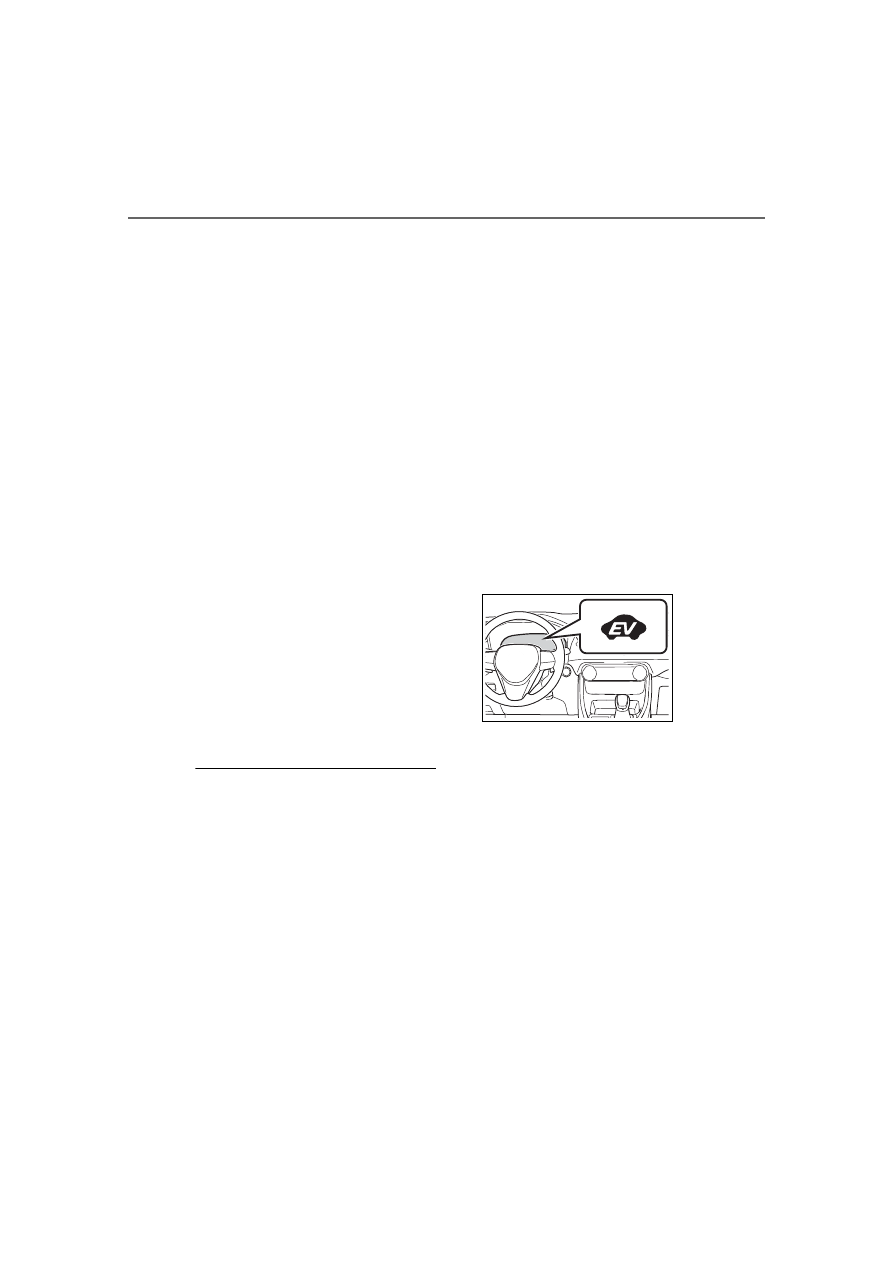
EV indicator

The EV indicator comes on when 

the vehicle is driven using only the 

electric motor (traction motor) or the 

gasoline engine is stopped.
The on/off operation of the EV indi-
cator can be changed. (

P.191, 

203)

After EV mode has switched to 

HV mode due to low hybrid bat-

tery (traction battery) charge

If the hybrid battery (traction battery) 

is regenerated by driving continu-

ously down a long slope, the EV 

driving range etc. will be displayed 

on the multi-information display and 

EV mode will be automatically 

switched to.
If EV mode is not switched to even 

though EV driving range is being 

displayed, EV mode can be 

switched to by pressing the EV/HV 

mode selection switch.

Gasoline engine operation in 

EV mode or AUTO EV/HV mode

Even if there is a sufficient amount 

of electricity remaining in the hybrid 

81

2-1. Plug-in hybrid system

2

Plug-in 

hybri

sy

st

em

battery (traction battery) and EV 

driving range (

P.186, 199) is 

being displayed on the multi-infor-

mation display, EV driving (driving 

using only the electric motor) may 

be canceled and both gasoline 

engine and electric motor are used 

depending on the situation (EV driv-

ing will be returned to automatically 

after EV driving becomes possible 

again).
EV driving may be canceled auto-

matically in the following circum-
stances

*1

:

When vehicle speed is more than 

approximately 84 mph (135 km/h).

When power is needed temporar-

ily, for example when the acceler-

ator pedal is depressed firmly or 
when accelerating suddenly.

*2

When the temperature of the 

hybrid system is high. 

The vehicle has been left in the 

sun, driven on a hill, driven at high 

speeds, etc.

When the temperature of the 

hybrid system is low.

When the heater is switched on 

when the outside temperature is 

below about 14°F (-10°C).

When the windshield defogger 

switch is pressed. (

P.424)

When the system determines that 

the gasoline engine needs to be 

started.

*1

:The gasoline engine may also 

operate in circumstances other 
than those listed above, depend-
ing on conditions.

*2

:When driving in AUTO EV/HV 

mode. Even in EV mode, the gas-
oline engine may start, depend-
ing on the condition of the hybrid 
battery (traction battery).

If “Engine Started to Protect 

System EV driving unavailable” 

is displayed on the multi-infor-

mation display

EV driving may be canceled in order 

to protect the hybrid system, etc.
In this case, perform driving with the 

gasoline engine until EV driving will 

be returned to automatically.

Conditions in which the gaso-

line engine may not stop

The gasoline engine starts and 

stops automatically. However, it 

may not stop automatically in the 
following conditions

*

:

During gasoline engine warm-up

During hybrid battery (traction bat-

tery) charging

When the temperature of the 

hybrid battery (traction battery) is 

high or low

When the windshield defogger 

switch is pressed. (

P.424)

*

: Depending on the circumstances, 

the gasoline engine may also not 
stop automatically in situations 
other than those above.

Sounds and vibrations specific 

to a Plug-in Hybrid Electric 

Vehicle

There may be no engine sound or 

vibration even though the vehicle is 

able to move with the “READY” indi-

cator is illuminated. For safety, 

apply the parking brake and make 

sure to shift the shift lever to P when 

parked.
The following sounds or vibrations 

may occur when the hybrid system 

is operating and are not a malfunc-

tion.

Motor sounds may be heard from 

the engine compartment.

Sounds may be heard from the 

hybrid battery (traction battery) 

when the hybrid system starts or 

stops.

82

2-1. Plug-in hybrid system

Relay operating sounds such as a 

snap or soft clank will be emitted 

from the hybrid battery (traction 

battery), under the rear seats or 

under the floor, when the hybrid 

system is started or stopped.

Sounds from the hybrid system 

may be heard when the back door 

is open.

Sounds may be heard from the 

transmission when the gasoline 

engine starts or stops, when driv-

ing at low speeds, or during idling.

Engine sounds may be heard 

when accelerating sharply.

Sounds may be heard due to 

regenerative braking when the 

brake pedal is depressed or as 

the accelerator pedal is released.

Vibration may be felt when the 

gasoline engine starts or stops.

Cooling fan sounds may be heard 

from the air intake vent under the 

rear seat. (

P.89)

Sounds may be heard from near 

the hybrid battery (traction battery) 

in accordance with the operation 

of the air conditioning system or 

battery cooler. (

P.114)

Maintenance, repair, recycling, 

and disposal

Contact your Toyota dealer regard-

ing maintenance, repair, recycling 

and disposal. Do not dispose of the 

vehicle yourself.

In order to make EV mode or 
AUTO EV/HV mode available, 
charge the hybrid battery (trac-
tion battery) from an external 
power source before using the 
vehicle.

Even if charging the hybrid battery 
(traction battery) has not been com-

pleted, the vehicle can be driven. 
However, if there is not enough 
charge remaining, it is possible that 
the vehicle cannot be driven in EV 
mode or AUTO EV/HV mode or the 
EV driving range will become 
shorter.

Refilling fuel

Plug-in Hybrid Electric Vehicles can 

be driven using electricity charged 

from an external power source. 

However, as the gasoline engine is 

used depending on the situation 

(

P.80) even if in EV mode or 

AUTO EV/HV mode, and the gaso-

line engine is provided on board as 

a power source for driving in HV 

mode, it is needed to refueling the 

vehicle.
Check the fuel amount and refill 

immediately when the fuel level 

becomes low. (

P.332)

If the vehicle is not used for a 

long time

The 12-volt battery may dis-

charge. In this event, charge the 

12-volt battery. (

P.569) 

In order to prevent the hybrid bat-

tery (traction battery) from becom-

ing extremely low in charge, 

charge the hybrid battery (traction 

battery) from external power 

source or start the hybrid system 

Charging (

P.97)

83

2-1. Plug-in hybrid system

2

Plug-in 

hybri

sy

st

em

at least once every 2 or 3 months, 

and turn the power switch off after 

the gasoline engine has stopped 

automatically. (If the gasoline 

engine does not start up even 

after approximately 10 seconds 

have passed since the “READY” 

indicator came on, the power 

switch can be turned to off without 

any further action.) 

When the 12-volt battery is dis-

charged, refer to P.569, “If the 12-

volt battery is discharged” and 

perform the correction procedure.

When the vehicle is left with the 

AC charging cable connected, the 

electricity consumption amount of 

the 12-volt battery increases due 

to controls, such as the system 

checking, operating. When the AC 

charging cable is not needed, 

remove it from the vehicle.

When driving with the gasoline 
engine stopped, a sound, which 
changes in accordance with the 
driving speed, will be played in 
order to warn people nearby of 
the vehicle’s approach. The 
sound will stop when the vehicle 
speed exceeds approximately 
22 mph (35 km/h).

Acoustic Vehicle Alerting Sys-

tem

In the following cases, the Acoustic 

Vehicle Alerting System may be dif-

ficult for surrounding people to hear.

In very noisy areas

In the wind or the rain

Also, as the Acoustic Vehicle Alert-

ing System is installed on the front 

of the vehicle, it may be more diffi-

cult to hear from the rear of the vehi-

cle compared to the front.

When “Acoustic Vehicle Alert-

ing System Malfunction Visit 

your Dealer” is displayed on the 

multi-information display

The Acoustic Vehicle Alerting Sys-

tem may be malfunctioning. Have 

the vehicle inspected by your 

Toyota dealer immediately.

*

: This function can only be used in 

the mainland U.S.A. It cannot be 
used in other states and territo-
ries, including Alaska and Hawaii.

This system operates based on 
the driving situation and traffic 
information to enhance fuel 
economy.
For details about Predictive effi-
cient drive, refer to “MULTIME-
DIA OWNER’S MANUAL”.

Predictive deceleration sup-
port

When the vehicle approaches 
to predictive deceleration sup-
port points registered in the 
navigation system, the refer-
ence operation range (

) of 

the ECO Accelerator Guid-
ance (

P.187) on the multi-

information display will be 
turned off to encourage the 
driver to reduce excessive 
acceleration.

With 7-in display:

Acoustic Vehicle Alerting 
System

Predictive efficient drive 
(if equipped)

*

A

84

2-1. Plug-in hybrid system

With 12.3-in display:

The engine braking force will 
be increased according to the 
driving conditions to more effi-
ciently charge the hybrid bat-
tery (traction battery) after the 
accelerator pedal is released.

85

2-1. Plug-in hybrid system

2

Plug-in 

hybri

sy

st

em

The illustration is an example for explanation and may differ from the actual 
item.

Caution label

High voltage cables (orange)

Power control unit

DC/DC converter

Rear electric motor (traction motor)

AC charging inlet

Service plug

Onboard traction battery charger

Hybrid battery (traction battery)

Plug-in hybrid system precautions

Take care when handling the hybrid system, as it contains a 
high voltage system (about 650V at maximum) as well as 
parts that become extremely hot when the hybrid system is 
operating. Obey the caution labels attached to the vehicle.

System components

A

B

C

D

E

F

G

H

I

86

2-1. Plug-in hybrid system

Front electric motor (traction motor)

Air conditioning compressor

Junction box

Running out of fuel

When the vehicle has run out of fuel 

and the hybrid system cannot be 

started, refuel the vehicle with at 

least enough gasoline to make the 

low fuel level warning light (

P.547) 

go off. If there is only a small 

amount of fuel, the hybrid system 

may not be able to start. (The stan-

dard amount of fuel is about 2.3 gal. 

[8.8 L, 1.9 Imp.gal.], when the vehi-

cle is on a level surface. This value 

may vary when the vehicle is on a 

slope. Add extra fuel when the vehi-

cle is inclined.)

Electromagnetic waves

High voltage parts and cables on 

the Plug-in Hybrid Electric Vehi-

cles incorporate electromagnetic 

shielding, and therefore emit 

approximately the same amount 

of electromagnetic waves as con-

ventional gasoline powered vehi-

cles or home electronic 

appliances.

Your vehicle may cause sound 

interference in some third party-

produced radio parts.

Effect of magnetic forces

If objects that generate strong mag-

netic forces, such as large speak-

ers, are placed inside the luggage 

compartment or installed nearby, 

the generated magnetic forces may 

negatively affect the hybrid system.

Hybrid battery (traction battery) 

(lithium-ion battery)

The hybrid battery (traction battery) 

has a limited service life.
The hybrid battery (traction battery) 

capacity (the ability to hold a 

charge) reduces with time and use 

in the same way as other recharge-

able batteries. The extent at which 

capacity reduces changes drasti-

cally depending on the environment 

(ambient temperature, etc.) and 

usage conditions, such as how the 

vehicle is driven and how the hybrid 

battery (traction battery) is charged. 

This is a natural characteristic of 

lithium-ion batteries, and is not a 

malfunction. Also, even though the 

EV driving range becomes shorter 

when the hybrid battery (traction 

battery) capacity reduces, vehicle 

performance does not significantly 

become worse.
In order to reduce the possibility of 

the capacity reducing, follow the 

directions listed on P.119, “Capacity 

reduction of the hybrid battery (trac-

tion battery)”.

Starting the hybrid system in an 

extremely cold environment

When the hybrid battery (traction 

battery) is extremely cold (below 

approximately -22°F [-30°C]) under 

the influence of the outside tem-

perature, it may not be possible to 

start the hybrid system. In this case, 

try to start the hybrid system again 

after the temperature of the hybrid 

battery increases due to the outside 

temperature increase etc.

J

K

L

WARNING

High voltage precautions

The vehicle has high voltage DC 

and AC systems as well as a 12-

volt system. DC and AC high volt-

age is very dangerous and can 

cause severe burns and electric 

shock that may result in death or 

serious injury.

87

2-1. Plug-in hybrid system

2

Plug-in 

hybri

sy

st

em

WARNING

Never touch, disassemble, 

remove or replace the high volt-

age parts, cables or their con-

nectors.

The hybrid system will become 

hot after starting as the system 

uses high voltage. Be careful of 

both the high voltage and the 

high temperature, and always 

obey the caution labels 

attached to the vehicle.

Never try to open the service 

plug access hole located in the 

luggage compartment. The ser-

vice plug is used only when the 

vehicle is serviced and is sub-

ject to high voltage.

Road accident cautions

Observe the following precautions 

to reduce the risk of death or seri-

ous injury:

Pull your vehicle off the road, 

apply the parking brake, shift 

the shift lever to P, and turn the 

hybrid system off.

Do not touch the high voltage 

parts, cables and connectors.

If electric wires are exposed 

inside or outside your vehicle, 

an electric shock may occur. 

Never touch exposed electric 

wires.

Do not touch the battery if liquid 

is leaking from or adhering to it. 

If electrolyte (carbonic-based 

organic electrolyte) from the 

hybrid battery (traction battery) 

comes into contact with the 

eyes or skin, it could cause 

blindness or skin wounds. In the 

unlikely event that it comes into 

contact with the eyes or skin, 

wash it off immediately with a 

large amount of water, and seek 

immediate medical attention.

If electrolyte is leaking from the 

hybrid battery (traction battery), 

do not approach the vehicle. 

Even in the unlikely event that 

the hybrid battery (traction bat-

tery) is damaged, the internal 

construction of the battery will 

prevent a large amount of elec-

trolyte from leaking out. How-

ever, any electrolyte that does 

leak out will give off a vapor. 

This vapor is an irritant to skin 

and eyes and could cause acute 

poisoning if inhaled.

Do not bring burning or high-

temperature items close to the 

electrolyte. The electrolyte may 

ignite and cause a fire.

If a fire occurs in the Plug-in 

Hybrid Electric Vehicle, leave 

the vehicle as soon as possible. 

Never use a fire extinguisher 

that is not meant for electric 

fires. Using even a small 

amount of water may be dan-

gerous.

If your vehicle needs to be 

towed, do so with front wheels 

raised. If the wheels connected 

to the electric motor (traction 

motor) are on the ground when 

towing, the motor may continue 

to generate electricity. This may 

cause a fire. (

P.538)

88

2-1. Plug-in hybrid system

WARNING

Carefully inspect the ground 

under the vehicle. If you find 

that liquid has leaked onto the 

ground, the fuel system may 

have been damaged. Leave the 

vehicle as soon as possible.

Hybrid battery (traction bat-

tery)

Your vehicle contains a sealed 

lithium-ion battery.

Never resell, hand over or mod-

ify the hybrid battery. To prevent 

accidents, hybrid batteries that 

have been removed from a dis-

posed vehicle are collected 

through Toyota dealer. Do not 

dispose of the battery yourself. 

Unless the battery is properly 

collected, the following may 

occur, resulting in death or seri-

ous injury:

• The hybrid battery may be ille-

gally disposed of or dumped, 

and it is hazardous to the envi-

ronment or someone may touch 

a high voltage part, resulting in 

an electric shock.

• The hybrid battery is intended to 

be used exclusively with your 

Hybrid Electric Vehicle. If the 

hybrid battery is used outside of 

your vehicle or modified in any 

way, accidents such as electric 

shock, heat generation, smoke 

generation, an explosion and 

electrolyte leakage may occur. 

When reselling or handing over 

your vehicle, the possibility of 

an accident is extremely high 

because the person receiving 

the vehicle may not be aware of 

these dangers.

If your vehicle is disposed of 

without the hybrid battery hav-

ing been removed, there is a 

danger of serious electric shock 

if high voltage parts, cables and 

their connectors are touched. In 

the event that your vehicle must 

be disposed of, the hybrid bat-

tery must be disposed of by 

your Toyota dealer or a qualified 

service shop. If the hybrid bat-

tery is not disposed of properly, 

it may cause electric shock that 

can result in death or serious 

injury.

Caution while driving

If the vehicle under floor area 

receives strong shock or impact 

while driving, stop the vehicle in a 

safe area and check around the 

bottom of the vehicle. If there is 

damage to the hybrid battery 

(traction battery) or liquid leakage, 

it may lead to a vehicle fire, etc. 

Do not touch the vehicle and 

immediately contact your Toyota 

dealer.

Modifications

Do not modify the vehicle to make 

the height lower.
It is easier for the hybrid battery 

(traction battery) in the under floor 

area to come in contact with the 

ground when the vehicle is low-

ered. If the hybrid battery (traction 

battery) is damaged, a vehicle fire 

may occur which could lead to 

death or serious injury.

89

2-1. Plug-in hybrid system

2

Plug-in 

hybri

sy

st

em

There is an air intake vent under 
the rear seat for cooling the 
DC/DC converter.
Blocking the air intake vent may 
prevent the plug-in hybrid sys-
tem from operating properly.

When a certain level of impact is 

NOTICE

Notice about fuel

For Plug-in Hybrid Electric Vehi-

cles, fuel may remain in the tank 

for a long time and undergo 

changes in quality depending 

on the how the vehicle is used. 

Refuel at least 5.3 gal. (20 L, 

4.4 Imp.gal.) of fuel every 12 

months (refuel a total of at least 

5.3 gal. [20 L, 4.4 Imp.gal.] over 

a 12-month period), as this may 

affect components of the fuel 

system or the gasoline engine.

If the vehicle has not been refu-

eled for a certain amount of time 

and it is possible that the quality 

of the fuel remaining in the tank 

has changed, “No New Fuel has 

been Added Recently Please 

refuel” is displayed on the multi-

information display when the 

power switch is turned to ON. If 

the message is displayed, refuel 

the vehicle immediately.

DC/DC converter air 
intake vent

NOTICE

DC/DC converter air intake 

vent

Make sure not to block the air 

intake vent with anything, such 

as a seat cover, plastic cover, or 

luggage. Blocking the air intake 

vent may prevent the plug-in 

hybrid system from operating 

properly.

When dust etc. has accumu-

lated in the air intake vent, clean 

it with a vacuum cleaner to pre-

vent the vent from clogging.

Do not wet or allow foreign sub-

stances to enter the air vent as 

this may cause a short circuit 

and damage the DC/DC con-

verter.

Do not carry large amounts of 

water such as water cooler bot-

tles in the vehicle. If water spills 

onto the DC/DC converter, the 

converter may be damaged. 

Have the vehicle inspected by 

your Toyota dealer.

A filter is installed to the air 

intake vent. When the filter 

remains noticeably dirty even 

after cleaning the air intake 

vent, filter cleaning or replace-

ment is recommended. When 

cleaning the filter, refer to 

P.515.

If “Maintenance required for 

DCDC converter cooling parts 

See Owner’s Manual” is shown 

on the multi-information dis-

play, the air intake vent and fil-

ter may be clogged. Refer to 

P.515 for information on how to 

clean the air intake vent.

Emergency shut off sys-
tem

90

2-1. Plug-in hybrid system

detected by the impact sensor, 
the emergency shut off system 
blocks off the high voltage cur-
rent and stops the fuel pump to 
minimize the risk of electrocu-
tion and fuel leakage. 
If the emergency shut off system 
activates, your vehicle will not 
restart. To restart the hybrid sys-
tem, contact your Toyota dealer.

A message is automatically dis-
played when a malfunction 
occurs in the hybrid system or 
an improper operation is 
attempted.
If a warning message is shown 
on the multi-information display, 
read the message and follow the 
instructions.

If a warning light comes on, a 

warning message is displayed 

or the 12-volt battery is discon-

nected

The hybrid system may not start. In 

that case, try to start the system 

again. If the “READY” indicator does 

not come on, contact your Toyota 

dealer.

Primarily using EV mode and 
AUTO EV/HV mode when driv-
ing in cities and using HV mode 
when driving on highways (or 
freeways) can help conserve 
fuel and electricity. (

P.76)

When using Eco drive mode, the 
torque corresponding to the 
accelerator pedal depression 
amount can be generated more 
smoothly than it is in normal 
conditions. In addition, the oper-
ation of the air conditioning sys-
tem (heating/cooling) will be 
minimized, improving fuel and 
electricity economy. (

P.404)

Eco-friendly driving is possible 
by keeping the Hybrid System 
Indicator within Eco area. 
(

P.175, 181)

Hybrid warning message

Plug-in Hybrid Elec-

tric Vehicle driving 

tips

For economical and ecolog-
ical driving, pay attention to 
the following points:

Using EV mode, AUTO 
EV/HV mode and HV 
mode effectively

Using Eco drive mode

Use of Hybrid System 
Indicator

91

2-1. Plug-in hybrid system

2

Plug-in 

hybri

sy

st

em

Shift the shift lever to D when 
stopped at a traffic light, or driv-
ing in heavy traffic etc. Shift the 
shift lever to P when parking. 
When using the N, there is no 
positive effect on fuel consump-
tion. In the N, the gasoline 
engine operates but electricity 
cannot be generated. Also, 
when using the air conditioning 
system, etc., the hybrid battery 
(traction battery) power is con-
sumed.

Drive your vehicle smoothly. 
Avoid abrupt acceleration and 
deceleration. Gradual accel-
eration and deceleration will 
make more effective use of 
the electric motor (traction 
motor) without having to use 
gasoline engine power.

Avoid repeated acceleration. 
Repeated acceleration con-
sumes hybrid battery (trac-
tion battery) power, resulting 
in poor fuel consumption. Bat-
tery power can be restored by 
driving with the accelerator 
pedal slightly released.

Make sure to operate the brakes 
gently and a timely manner. A 

greater amount of electrical 
energy can be regenerated 
when slowing down.

Repeated acceleration and 
deceleration, as well as long 
waits at traffic lights, will lead to 
high fuel and electricity con-
sumption. Check traffic reports 
before leaving and avoid delays 
as much as possible. When driv-
ing in a traffic jam, gently 
release the brake pedal to allow 
the vehicle to move forward 
slightly while avoiding overuse 
of the accelerator pedal. Doing 
so can help control excessive 
electricity and fuel consumption.

Control and maintain the vehi-
cle at a constant speed. 
Before stopping at a toll booth 
or similar, allow plenty of time 
to release the accelerator and 
gently apply the brakes. A 
greater amount of electrical 
energy can be regenerated 
when slowing down.

Electricity consumption will 
increase significantly when 
driving at high speeds in EV 
mode or AUTO EV/HV mode. 
If there will be a long distance 
to the next external charging 
point after leaving a freeway, 
it is recommended to drive in 

Shift lever operation

Accelerator pedal/brake 
pedal operation

When braking

Delays

Highway driving

92

2-1. Plug-in hybrid system

HV mode while on the free-
way and change to EV mode 
or AUTO EV/HV mode after 
leaving the freeway. (

P.76)

Turn the “A/C” switch off 
when it is not needed. Doing 
so can help reduce excessive 
electricity and fuel consump-
tion.

In summer: When the ambient tem-
perature is high, use the recircu-
lated air mode. Doing so will help to 
reduce the burden on the air condi-
tioning system and reduce electric-
ity and fuel consumption as well.
In winter: Avoid excessive and 
unnecessary use of the heater. 
Usage of the heated steering wheel 
(if equipped) and seat heaters are 
effective. (

P.433)

Using the Remote Air Condi-
tioning System (

P.431) 

while the AC charging cable is 
connected to the vehicle can 
reduce electricity consump-
tion immediately after starting 
off by operating air condition-
ing mainly using electricity 
from an external power 
source.

When setting the charging 
schedule, setting the charging 
mode to “Departure” or 
“Departure time” and “Climate 
Prep” or “Climate preparation” 
to on can reduce electricity 
consumption immediately 

after starting off by operating 
air conditioning before 
charging is completed. 
(

P.128)

Make sure to check the tire infla-
tion pressure frequently. If there 
is improper tire inflation pres-
sure in the tires, the EV driving 
range will become shorter, and 
fuel consumption when in HV 
mode will increase.
Also, as snow tires can cause 
large amounts of friction, their 
use on dry roads can lead to 
increased fuel and electricity 
consumption.

Carrying heavy luggage will lead 
to poor fuel economy. Avoid car-
rying unnecessary luggage. 
Installing a large roof rack will 
also cause poor fuel economy.

Since the gasoline engine starts 
up and cuts out automatically, 
warming up is not necessary.

Air conditioning

Checking tire inflation 
pressure

Luggage

Warming up before driv-
ing

93

2-1. Plug-in hybrid system

2

Plug-in 

hybri

sy

st

em

The value displayed on the SOC 
(State of Charge) gauge 
(

P.173, 178) is estimated from 

the following information.

The amount of hybrid battery 
(traction battery) charge cur-
rently remaining

The electricity consumption 
(the estimated distance that 
EV driving is possible per unit 
of electrical energy) based on 
the recorded value

Past air conditioning system 
electricity consumption 
amount

The electricity consumption var-
ies depending on how the vehi-
cle is driven. The vehicle 

automatically records the elec-
tricity consumption when being 
charged and uses the electricity 
consumption for estimating the 
EV driving range. Therefore, the 
EV driving range displayed 
when the hybrid battery (traction 
battery) is fully charged may dif-
fer from the previous EV driving 
range depending on how the 
vehicle was driven.
The EV driving range may 
change significantly with each 
charging until the electricity con-
sumption based on the recorded 
value is stable (for approxi-
mately the first month or two). 
However, this does not indicate 
a malfunction.
When the air conditioning sys-
tem is turned on, the EV driving 
range (with using the air condi-
tioning system) is estimated 
based on the past air condition-
ing electricity consumption 
amount considering that the 
electricity consumption may 
become higher.

The distance that EV driving is 
possible varies significantly 
depending on how the vehicle is 
driven, road conditions, the 
weather, the outside tempera-
ture, usage conditions of electri-
cal components and the number 

EV driving range

The EV driving range dis-
played on the multi-informa-
tion display shows the 
reference distance that EV 
driving (driving using only 
the electric motor) is possi-
ble, and the actual distance 
that can be driven may dif-
fer from that displayed.

Even if the EV driving range is 
displayed, EV driving may be 
canceled and both gasoline 
engine and electric motor are 
used depending on the situa-
tion. (

P.80)

Displayed value

Tips for extending the EV 
driving range

94

2-1. Plug-in hybrid system

of occupants.
The distance that EV driving is 
possible can be extended if the 
following is performed:

When starting off, depress 
the accelerator pedal 
smoothly to accelerate

As a guide, accelerate up to 
approximately 12mph (20 km/h) 
in the first 5 seconds.
Electrical and fuel efficiency can 
be improved just by using the 
ECO Accelerator Guidance dis-
played on the multi-information 
display and taking care to start 
off gently. (

P.187)

When the driving mode is set to 
Eco drive mode, depressing the 
accelerator pedal generates 
smooth torque that makes it easier 
to operate the accelerator gently.
At the same time, the air condition-
ing control is switched to eco air 
conditioning mode (

P.423) to 

reduce the strength of the air condi-
tioning operation.

Maintain sufficient vehicle-
to-vehicle distance and do 
not accelerate or decelerate 
unnecessarily

Try to maintain a fixed speed 
while driving. Driving at a short 
vehicle-to-vehicle distance will 
result in repeating wasteful 
acceleration and deceleration, 
which will worsen the electrical 
and fuel efficiency.

Release the accelerator 
pedal early before stopping 
the vehicle, such as at a 
traffic light

The regenerative brake will 
operate to convert the kinetic 
energy of the vehicle into electri-
cal energy, which will charge the 
hybrid battery (traction battery).
The regeneration status can be 
checked from the Hybrid Sys-
tem Indicator. (

P.175)

When the brake pedal is 
depressed lightly during decel-
eration, the regeneration 
amount increases, enabling 
more electrical energy to be 
recovered.

If the brake pedal is depressed too 
strongly, the recovered amount 
indicator will reach the maximum 
level and the upper limit of the 
recoverable energy will be 
exceeded. Therefore, be sure to 
operate the brake pedal early.

Use the air conditioning 
system appropriately, and 
also utilize the heated steer-
ing wheel (if equipped) and 
seat heaters

In EV mode, the vehicle is 
cooled and heated by electrical 
energy. (Except in extremely 
cold temperatures of approxi-
mately 14°F (-10°C) or less.)
Preventing excessive cooling or 
heating of the vehicle will reduce 
power consumption and 
improve electrical efficiency.

95

2-1. Plug-in hybrid system

2

Plug-in 

hybri

sy

st

em

When eco air conditioning mode 
is used, the air conditioning con-
trol is switched automatically to 
a lower setting. (

P.423)

The heated steering wheel (if 
equipped) and seat heaters are 
efficient heating device that 
directly warm the body using 
less electric power.

When used together with the air 
conditioning system, a low tem-
perature setting can be used to 
improve electrical and fuel effi-
ciency.

Check the tire pressure

If the tire pressure is lower than 
the specified value, it will 
worsen the electrical and fuel 
efficiency.

A pressure level 7 psi (50 kPa, 0.5 
kgf/cm

2

 or bar) lower than the spec-

ified value will cause a worsening of 
several percentage points.

When driving on highways, 
use the EV/HV mode selec-
tion switch to drive in HV 
mode

The power consumption will 
increase significantly if the vehi-
cle is driven in EV mode on 
highways.

Do not load unnecessary 
objects in the vehicle

Driving with objects weighing 
220 lb. (100 kg) in the vehicle 
will worsen the electrical and 
fuel efficiency by approximately 
3%.

Air resistance also greatly 
affects electrical and fuel effi-
ciency. Remove any exterior 
accessories such as a roof lug-
gage carrier when they are not 
being used.
The running resistance of snow 
tires is high and they will worsen 
electrical and fuel efficiency. 
Replace them with standard 
tires as soon as they are no lon-
ger needed.

Know your vehicle’s electri-
cal and fuel efficiency

If you know your vehicle’s daily 
electrical and fuel efficiency, you 
will understand the benefits of 
Eco drive.
Use the Power Consump-
tion/Fuel Economy, ECO Accel-
erator Guidance/“Eco Score” 
and other data displayed on the 
multi-information display.

The following indicate that 
charging has been carried out 
properly.

The charging indicator of the 
charging port turns off

“Charging Complete” is dis-
played on the multi-informa-
tion display when a door is 
opened with the power switch 
off (

P.117)

Regardless of the type of power 

Display when charging is 
completed


Content      ..     3      4      5      6     ..