Toyota Raize (2023 year). Manual in english - page 2
 

  Index      Toyota     Toyota Raize (2023 year). Manual in english


Search            copyright infringement  


Content      ..      1      2      3      ..


Toyota Raize (2023 year). Manual in english - page 2


29

1-1. For safe use

For safety and s

ecurity

1

WARNING

Observe the following precautions.
Failure to do so may cause the driver’s floor mat to slip, possibly interfering with

the pedals while driving. An unexpectedly high speed may result or it may

become difficult to stop the vehicle. This could lead to an accident, resulting in

death or serious injury.

When installing the driver’s floor mat

Do not use floor mats designed for other models or different model year
vehicles, even if they are Toyota Genuine floor mats.

Only use floor mats designed for the driver’s seat.

Always install the floor mat securely using the retaining hooks (clips) pro-
vided.

Do not use two or more floor mats on top of each other.

Do not place the floor mat bottom-side up or upside-down.

Before driving

Check that the floor mat is securely fixed in the correct place with all the pro-
vided retaining hooks (clips). Be especially careful to perform this check after

cleaning the floor.

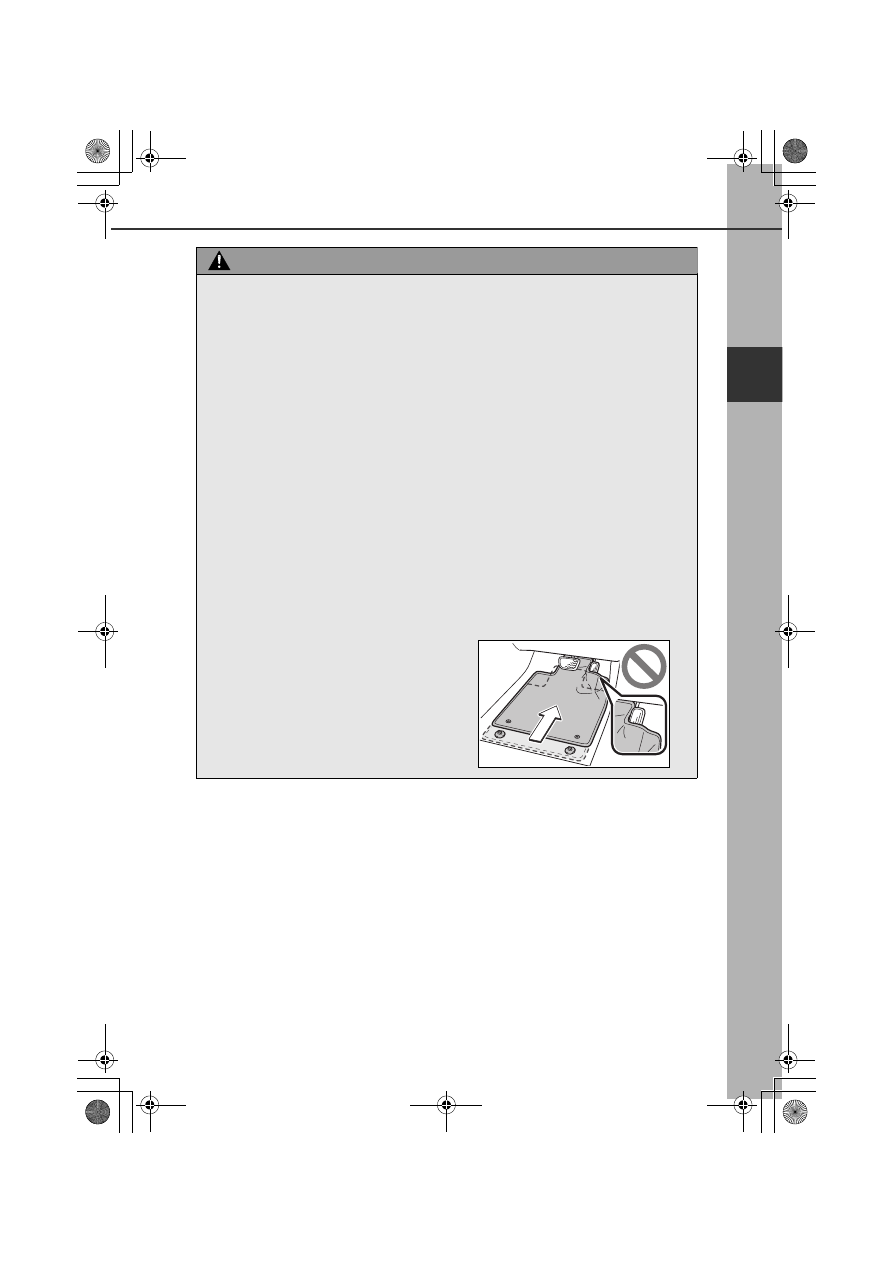
With the engine stopped and the
shift lever in P (continuously varia-

ble transmission) or N (manual

transmission), fully depress each

pedal to the floor to make sure it

does not interfere with the floor

mat.

KBTA110103
30

1-1. For safe use

For safe driving

For safe driving, adjust the seat and mirror to an appropriate posi-

tion before driving.

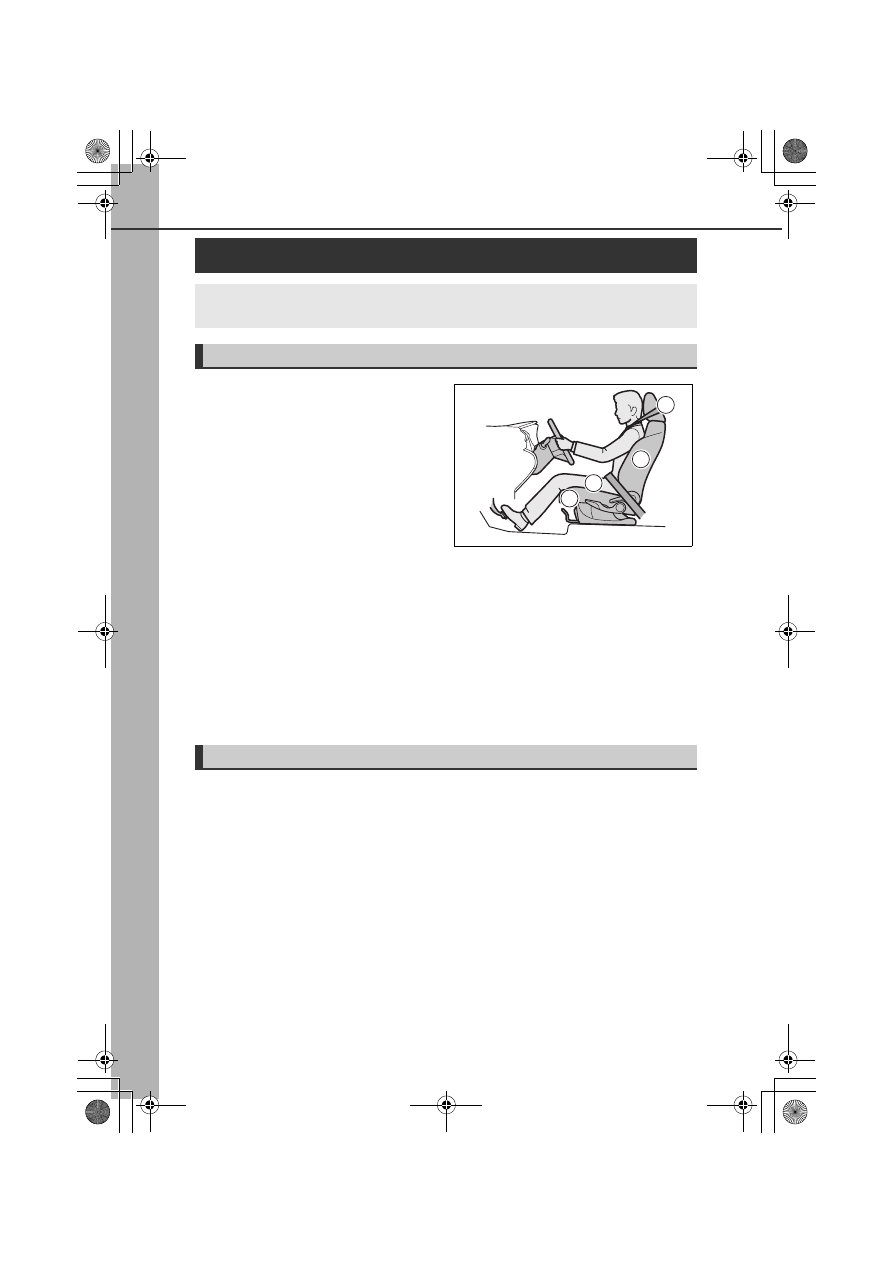
Correct driving posture

a

Sit up straight and adjust the

angle of the seatback so that

your body does not lifted from

the seatback when driving

(

P. 148)

b

Adjust the seat position so that

you can depress the pedals fully

and so that your arms bend

slightly at the elbow when grip-

ping the steering wheel

(

P. 148)

c

Lock the head restraint in place

with the center of the head

restraint closest to the top of

your ears (

P. 152)

d

Wearing the seat belt correctly

(

P. 32)

Wearing the seat belt properly

Make sure that all occupants are wearing their seat belts properly before

driving the vehicle. (

P. 32)

When a child who cannot properly wear the seat belt is in the vehicle, use

a proper child restraint system. (

P. 49)

2

1

4

3

KBRO110201E

31

1-1. For safe use

For safety and s

ecurity

1

Adjusting the mirrors

Make sure that you can see the rear of the vehicle clearly, by adjusting the

inside and outside rear view mirrors properly. (

P. 156, 157)

WARNING

Observe the following precautions.
Failure to do so may result in death or serious injury.

Do not adjust the position of the driver’s seat while driving. Doing so could
cause the driver to mishandle the vehicle.

Do not place a cushion between the driver or passenger and the seatback.
A cushion may prevent correct posture from being achieved, and reduce the

effectiveness of the seat belt and head restraint in the event of collision.

Do not place anything under the front seats.
Objects placed under the front seats may become jammed in the seat tracks

and stop the seat from locking in place. This may lead to an unforeseen acci-

dent or damage to the adjustment mechanism.

Wear footwear that ensures that you can reliably operate the pedals. Failure to
operate the pedals reliably may lead to an unforeseen accident.

Always observe the legal speed limit when driving on public roads.

Always pay attention to the surrounding conditions, such as other vehicles and
pedestrians, and try to drive safely.

Never drink and drive. If you drink alcohol, your alertness and judgement will
be impaired, and it may cause an accident. Also, refrain from driving if you

have taken any medicine that can cause drowsiness.

Do not use a mobile phone or adjust equipment while driving. Your attention
to the surrounding conditions will be impaired, which is very dangerous. Using

a non-hands-free car phone or mobile phone while driving is prohibited by law.

When driving over long distances, take regular breaks before you start to feel
tired.
Also, if you feel tired or sleepy while driving, do not force yourself to continue

driving and take a break immediately.

32

1-1. For safe use

Seat belts

Make sure that all occupants are wearing their seat belts properly

before driving the vehicle.

Correct use of the seat belts

Extend the shoulder belt so that it

comes fully over the shoulder

But does not come into contact with the

neck or slide off the shoulder.

Position the lap belt as low as pos-

sible over the hips

Adjust the position of the seat-

back. Sit up straight and well back

in the seat

Do not twist the seat belt

Fastening and releasing the seat belt

a

To fasten the seat belt, push the

plate into the buckle until you

hear a click sound

b

To release the seat belt, press

the lock release button

The belt retracts automatically, so

check it for twists and snags, and

slowly put it back in place with your

hand on the plate.

KBRO110301E

1

2

KBRO110302E

Release button

33

1-1. For safe use

For safety and s

ecurity

1

Seat belt pretensioner & force limiter (front seats)

Pretensioner

The pretensioners help the seat

belts to quickly restrain the occu-

pants by retracting the seat belts

when the vehicle is subjected to a

severe frontal collision.

The pretensioners do not activate in the

event of a minor frontal impact, a rear

impact or a vehicle rollover.

Force limiters

When a strong frontal impact is applied, and the load applied to the seat

belt exceeds a certain level, this mechanism prevents the load from being

applied further, and reduces the impact on the occupants’ chests.

The pretensioners do not activate in the event of a minor frontal impact, a rear

impact or a vehicle rollover.

How to release the seat belt lock

The belt will lock in the case of a sudden stop or impact. It may also lock if you

suddenly lean forward, or pull the seat belt too quickly. If the seat belt is locked

and you cannot extend it, pull it strongly once, loosen it, and then move it

slowly to extend.

Seat belt pretensioner & force limiter (front seats)

The seat belt pretensioners & force limiters only work once. Even if they

receive continuous impacts from a pile-up, they will not operate in subsequent

collisions once they have activated.

After using the rear center seat belt

Place the buckle back in its storage

space.

KBRO110303E

KBRO110306

34

1-1. For safe use

Seat belt regulations

If seat belt regulations exist in the country where you reside, please contact

your Toyota dealer for seat belt replacement or installation.

WARNING

Observe the following precautions to reduce the risk of injury in the event of sud-

den braking, sudden swerving or an accident.
Failure to do so may cause death or serious injury.

Wearing a seat belt

Ensure that all passengers wear a seat belt.

Always wear a seat belt properly.

Do not load items that block the
seat belt path

Do not drive with the seat belt too close to the steering wheel or meter

Do not slacken the seat belt with clothespins or clips

Each seat belt should be used by one person only. Do not use a seat belt for
more than one person at once, including children.

Toyota recommends that children be seated in the rear seats and always use
a seat belt and/or an appropriate child restraint system.

To achieve a proper seating position, do not recline the seat more than nec-
essary. The seat belt is most effective when the occupants are sitting up

straight and well back in the seats.

Do not wear the shoulder belt under your arm.

Always wear your seat belt low and snug across your hips.

Child seat belt usage

The seat belts of your vehicle were principally designed for persons of adult

size.

Use a child restraint system appropriate for the child, until the child becomes
large enough to properly wear the vehicle’s seat belt. (

P. 49)

When the child becomes large enough to properly wear the vehicle’s seat
belt, follow the instructions regarding seat belt usage. (

P. 32)

KBRO110304

35

1-1. For safe use

WARNING

For safety and s

ecurity

1

Pregnant women

Obtain medical advice and wear the

seat belt in the proper way. (

P. 32)

Women who are pregnant should

position the lap belt as low as possi-

ble over the hips in the same manner

as other occupants, extending the

shoulder belt completely over the

shoulder and avoiding belt contact

with the rounding of the abdominal

area.

If the seat belt is not worn properly,

not only the pregnant woman, but

also the fetus could suffer death or

serious injury as a result of sudden

braking or a collision.

People suffering illness

Obtain medical advice and wear the seat belt in the proper way.

When children are in the vehicle

P. 62

If the seat belt becomes dirty

Use a neutral detergent. If organic solvents such as benzene are used, the per-

formance of the seat belt will be reduced and it will lose its effectiveness. Simi-

larly, do not remove the color from, or dye the seat belt.

Seat belt pretensioner & force limiter

If the pretensioner has activated, the SRS warning light will flash. In that case,

the seat belt cannot be used again and must be replaced at your Toyota

dealer.

KBRO110305E

36

1-1. For safe use

WARNING

Seat belt damage and wear

Do not damage the seat belts by allowing the belt, plate, or buckle to be
jammed in the door.

Inspect the seat belt system periodically. Check for cuts, fraying, and loose
parts. Do not use a damaged seat belt until it is replaced. Damaged seat

belts cannot protect an occupant from death or serious injury.

Do not put any foreign matter inside the buckle or retractor.

Ensure that the belt and plate are locked and the belt is not twisted.
If the seat belt does not function correctly, immediately contact your Toyota

dealer.

Replace the seat assembly, including the belts, if your vehicle has been
involved in a serious accident, even if there is no obvious damage.

Do not attempt to install, remove, or modify seat belts. They may not work
effectively at the time of a collision.

Do not attempt to install, remove, modify, disassemble or dispose of the seat
belts. Have any necessary repairs carried out by your Toyota dealer.
Inappropriate handling may lead to incorrect operation.

37

1-1. For safe use

: If equipped

For safety and s

ecurity

1

SRS airbags

The SRS airbags inflate when the vehicle is subjected to a severe

impacts that may cause significant injury to the occupants. They

work together with the seat belts to help reduce the risk of death or

serious injury.

SRS front airbags

a

SRS driver airbag/front passenger airbag

(Can help reduce the impact on the heads and chests of the driver and

front passenger)

SRS side and curtain shield airbags

b

SRS side airbag

(Helps reduce impact to the chest of the front passenger)

c

SRS curtain shield airbag

(Helps reduce impact to the front and rear seat passengers, mainly to

their heads)

1

1

2

2

3

KBRO110401E

38

1-1. For safe use

: If equipped

SRS airbag system components

a

Seat belt pretensioners and force

limiters

b

Side airbags

c

Curtain shield airbags

d

Driver airbag

e

SRS warning light

f

Front passenger airbag

g

Front impact sensors

h

Side impact sensors

i

Airbag sensor assembly

The main SRS airbag system components are shown above. The SRS air-

bag system is controlled by the airbag sensor assembly. As the airbags

deploy, a chemical reaction in the inflators quickly fills the airbags with

non-toxic gas to help restrain the motion of the occupants.

1

1

2

3

2

3

4

5

6

7

8

8 9

KBRO110402E

39

1-1. For safe use

For safety and s

ecurity

1

WARNING

SRS airbag precautions

Observe the following precautions regarding the SRS airbags.
Failure to do so may cause death or serious injury.

The driver and all passengers in the vehicle must wear their seat belts prop-
erly.
The SRS airbags are supplemental devices to be used with the seat belts.

The SRS driver airbag deploys with considerable force, and can cause death
or serious injury especially if the driver is very close to the airbag.
Since the risk zone for the driver’s airbag is the first 50 - 75 mm (2 - 3 in.) of

inflation, placing yourself 250 mm (10 in.) from your driver airbag provides

you with a clear margin of safety. This distance is measured from the center

of the steering wheel to your breastbone. If you sit less than 250 mm (10 in.)

away now, you can change your driving position in several ways:

Move your seat to the rear as far as you can while still reaching the pedals

comfortably.

Slightly recline the back of the seat. Although vehicle designs vary, many

drivers can achieve the 250 mm (10 in.) distance, even with the driver seat

all the way forward, simply by reclining the back of the seat somewhat. If

reclining the back of your seat makes it hard to see the road, raise yourself

by using a firm, non-slippery cushion, or raise the seat if your vehicle has

that feature.

If your steering wheel is adjustable, tilt it downward. This points the airbag

toward your chest instead of your head and neck.

The seat should be adjusted as recommended above, while still maintaining

control of the foot pedals, steering wheel, and your view of the instrument

panel controls.

The SRS front passenger airbag also deploys with considerable force, and
can cause death or serious injury especially if the front passenger is very

close to the airbag. The front passenger seat should be as far from the air-

bag as possible with the seatback adjusted, so the front passenger sits

upright.

A deploying airbag can cause even the death or serious injury of an infant or
child who is improperly seated and/or restrained. An infant or child who is

too small to use a seat belt should be properly secured using a child

restraint system. Toyota strongly recommends that all infants and children

be placed in the rear seats of the vehicle and properly restrained. The rear

seats are safer for infants and children than the front passenger seat.

(

P. 49)

40

1-1. For safe use

WARNING

Do not sit on the edge of the seat
or lean against the dashboard.

Do not allow a child to stand in
front of the SRS front passenger

airbag unit or sit on the knees of a

front passenger.

Do not allow the front seat occu-
pants to hold items on their knees.

Vehicles with SRS side and curtain
shield airbags: Do not lean against

the door, the roof side rail or the

front, side and rear pillars

Vehicles with SRS side and curtain
shield airbags: Do not allow anyone

to kneel on the passenger seat

toward the door or put their head

or hands outside the vehicle

Do not attach anything to or lean
anything against areas such as the

dashboard or steering wheel pad.
These items can become projectiles

when the SRS driver and front pas-

senger airbags deploy.

KBRO110403E

KBRO110404E

KBRO110405E

KBRO110406E

KBRO110407E

41

1-1. For safe use

WARNING

For safety and s

ecurity

1

Vehicles with SRS side and curtain
shield airbags: Do not attach any-

thing to areas such as a door, wind-

shield glass, side door glass, front

or rear pillar, roof side rail and

assist grip

Vehicles with SRS side and curtain shield airbags: Do not use seat accesso-
ries which cover the parts where the SRS side airbags inflate as they may

interfere with inflation of the SRS airbags. Such accessories may prevent the

side airbags from activating correctly, disable the system or cause the side

airbags to inflate accidentally, resulting in death or serious injury

Do not strike or apply significant levels of force to the area of the SRS airbag
components.
Doing so can cause the SRS airbags to malfunction.

Do not touch any of the component parts immediately after the SRS airbags
have deployed (inflated) as they may be hot.

If breathing becomes difficult after the SRS airbags have deployed, open a
door or window to allow fresh air in, or leave the vehicle if it is safe to do so.

Wash off any residue as soon as possible to prevent skin irritation.

Vehicles without SRS side and curtain shield airbags: If the areas where the
SRS airbags are stored, such as the steering wheel pad, are damaged or

cracked, have them replaced by your Toyota dealer.

Vehicles with SRS side and curtain shield airbags: If the areas where the SRS
airbags are stored, such as the steering wheel pad and front and rear pillar

garnishes, are damaged or cracked, have them replaced by your Toyota

dealer.

If the SRS airbags deploy (inflate)

High-temperature gas will inflate the SRS airbags at an extremely high
speed, possibly leading to injuries, including scrapes, burns, and contusions.

KBRO110408E

42

1-1. For safe use

WARNING

Modification and disposal of SRS airbag system components

Do not dispose of your vehicle or perform any of the following modifications

without consulting your Toyota dealer.
The SRS airbags may malfunction or deploy (inflate) accidentally, causing death

or serious injury.

Installation, removal, disassembly and repair of the SRS airbags

Vehicles without SRS side and curtain shield airbags: Repairs, modifications,
removal or replacement of the steering wheel, instrument panel, dashboard

Vehicles with SRS side and curtain shield airbags: Repairs, modifications,
removal or replacement of the steering wheel, instrument panel, dashboard,

seats or seat upholstery, front, side and rear pillars or roof side rails

Repairs or modifications of the front fender, front bumper or side of the
occupant compartment

Installation of a grille guard (bull bars, kangaroo bar, etc.), snow plows or
winches

Modifications to the vehicle’s suspension system

Installation of electronic devices such as mobile two-way radios (RF trans-
mitter) and CD players

Modification to your vehicle for a person with a physical disability

If the SRS airbags deploy (inflate)

A loud noise and white gas will be emitted.

Vehicles without SRS curtain shield airbag: In addition to the front seat, parts
of the airbag module (steering wheel hub, airbag cover and inflator) may

become hot for several minutes. The airbag itself may also be hot.

Vehicles with SRS side and curtain shield airbags: Parts of the airbag module
(steering wheel hub, airbag cover and inflator), as well as parts of the front

seat, front pillar, center pillar, rear pillar, and roof side rails, may also become

hot for several minutes. The airbag itself may also be hot.

The windshield may be damaged.

43

1-1. For safe use

: If equipped

For safety and s

ecurity

1

Vehicles with eCall: If any of the following situations occur, the system is
designed to send an emergency call* to the eCall control center, notifying

them of the vehicle’s location (without needing to push the “SOS” button)

and an agent will attempt to speak with the occupants to ascertain the level

of emergency and assistance required. If the occupants are unable to com-

municate, the agent automatically treats the call as an emergency and helps

to dispatch the necessary emergency services. (

P. 68)

An SRS airbag is deployed.

A seat belt pretensioner is activated.

The vehicle is involved in a severe rear-end collision.

The vehicle is involved in a rollover accident.

*

In some cases, the call cannot be made. (

P. 70)

Types of collisions that may deploy SRS airbags (SRS front airbags)

The SRS front airbags will deploy in the event of an impact that exceeds the
set threshold level (the level of force corresponding to a frontal collision at

the speed of approx. 20 to 30 km/h (12 to 18 mph) against a fixed wall that

will not move or deform).
However, this threshold velocity of the airbag deployment will be considera-

bly higher in the following situations:

When the vehicle collides with a concrete wall or guardrail at an angle of

about 30° or more to the front

If the vehicle strikes an object, such as a parked vehicle or sign pole, which

can move or deform on impact

If the vehicle is involved in an underride collision, such as a collision in

which the front of the vehicle “underrides”, or goes under, is pinned under

a truck

Depending on the type of collision, it is possible that only the seat belt pre-
tensioners will activate.

Types of collisions that may deploy SRS airbags (SRS side and curtain 
shield airbags)

The SRS side and curtain shield airbags will deploy in the event of an impact
that exceeds the set threshold level (the level of force corresponding to a

perpendicular collision of an approximately 1.5-ton vehicle traveling at

approximately 50 km/h (31 mph) into the cabin of the vehicle).

The right and left SRS side and curtain shield airbags will also deploy in a
frontal collision if the force of the collision is particularly strong.

44

1-1. For safe use

Conditions under which it may deploy, other than a collision

The SRS front airbags and SRS side and curtain shield airbags

 may also

deploy if a serious impact occurs to the underside of your vehicle, as in the fol-

lowing cases.

Hitting a curb, edge of pavement or
hard surface

Falling into or jumping over a deep
hole

Landing hard after jumping or fall-
ing from a road

Types of collisions that may not deploy the SRS airbags

Even if a collision occurs, the SRS airbags do not inflate if the engine switch is

“OFF” or “ACC”.

Types of collisions that may not deploy the SRS airbags (SRS front airbags)

The SRS front airbags do not generally inflate if the vehicle is involved in a side

or rear collision, if it rolls over, or if it is involved in a low-speed frontal collision.

But, whenever such an impact causes sufficient forward deceleration of the

vehicle, deployment of the SRS front airbags may occur.

Collision from the side

Collision from the rear

Vehicle rollover

KBRO110408

KBRO110409


Content      ..      1      2      3      ..