Toyota Mirai (2023 year). Manual in english - page 30
 

  Index      Toyota     Toyota Mirai (2023 year). Manual in english


Search            copyright infringement  


Content      ..     28      29      30      31     ..


Toyota Mirai (2023 year). Manual in english - page 30


486

8-2. Steps to take in an emergency

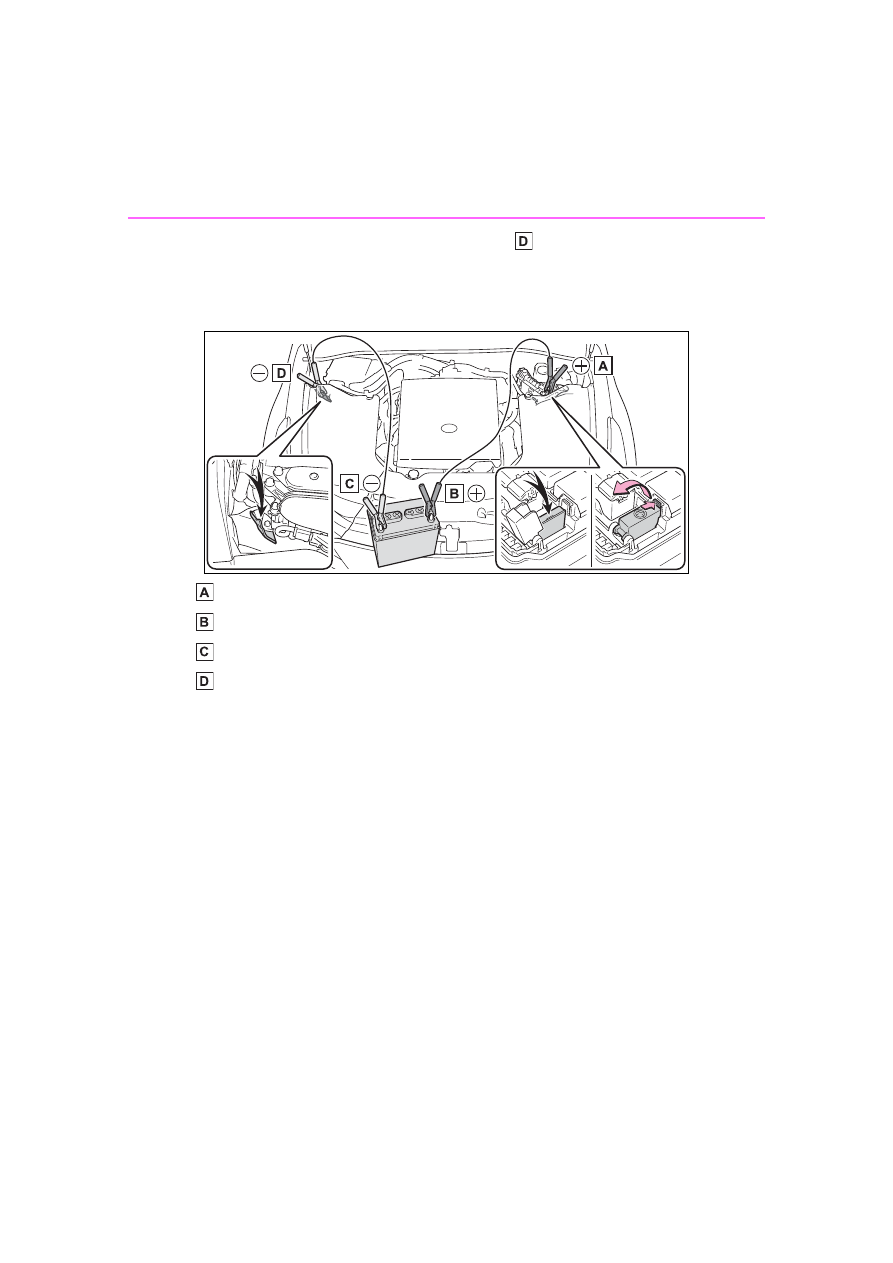
When connecting to an unpainted metallic point 

, make the connection 

after checking the surrounding area. Also, do not make any connections 
where parts nearby may interfere.
Use jumper cables that can reach the specified terminals and connecting 

point.

Exclusive jump starting terminal (your vehicle)

Positive (+) battery terminal (second vehicle)

Negative (-) battery terminal (second vehicle)

Metallic point shown in the illustration

5

Start the engine of the sec-
ond vehicle. Increase the 
engine speed slightly and 
maintain at that level for 
approximately 5 minutes to 
recharge the 12-volt battery 
of your vehicle.

6

Open and close any of the 
doors of your vehicle with the 
power switch off.

7

Maintain the engine speed of 
the second vehicle and start 
the fuel cell system of your 
vehicle by turning the power 
switch to ON.

8

Make sure the “READY” indi-
cator comes on. If the indica-
tor does not come on, contact 
your Toyota dealer.

9

Once the fuel cell system has 
started, remove the jumper 
cables in the exact reverse 
order from which they were 
connected.

10

Close the exclusive jump 

starting terminal cover and 
install the fuse box cover.

Once the fuel cell system starts, 
have the vehicle inspected at 
your Toyota dealer as soon as 
possible.

487

8-2. Steps to take in an emergency

8

Whe

n tr

ouble

 a

rises

Starting the fuel cell system 

when the 12-volt battery is dis-

charged

The fuel cell system cannot be 

started by push-starting.

To prevent 12-volt battery dis-

charge

Turn off the headlights and the 

audio system while the fuel cell 

system is off.

Turn off any unnecessary electri-

cal components when the vehicle 

is running at a low speed for an 

extended period, such as in heavy 

traffic.

When the 12-volt battery is 

removed or discharged

Information stored in the ECU is 

cleared. When the 12-volt battery 

is depleted, have the vehicle 

inspected at your Toyota dealer.

Some systems may require initial-

ization. (

P.526)

If the 12-volt battery discharges, it 

may not be possible to shift the 

shift position to other positions.

In this case, the vehicle cannot be 
towed without lifting both rear 
wheels because the rear wheels will 
be locked.

When removing the 12-volt bat-

tery terminals

When the 12-volt battery terminals 

are removed, the information stored 

in the ECU is cleared. Before 

removing the 12-volt battery termi-

nals, contact your Toyota dealer.

Charging the 12-volt battery

The electricity stored in the 12-volt 

battery will discharge gradually even 

when the vehicle is not in use, due 

to natural discharge and the drain-

ing effects of certain electrical appli-

ances. If the vehicle is left for a long 

time, the 12-volt battery may dis-

charge, and the fuel cell system 

may be unable to start. (The 12-volt 

battery recharges automatically 

while the fuel cell system is operat-

ing.)

When recharging or replacing 

the 12-volt battery

In some cases, it may not be pos-

sible to unlock the doors using the 

smart key system when the 12-

volt battery is discharged. Use the 

wireless remote control or the 

mechanical key to lock or unlock 

the doors.

The fuel cell system may not start 

on the first attempt after the 12- 

volt battery has recharged but will 

start normally after the second 

attempt. This is not a malfunction.

The power switch mode is memo-

rized by the vehicle. When the 12-

volt battery is reconnected, the 

system will return to the mode it 

was in before the 12-volt battery 

was discharged. Before discon-

necting the 12-volt battery, turn 

the power switch off.

If you are unsure what mode the 

power switch was in before the 

12-volt battery discharged, be 

especially careful when recon-

necting the 12-volt battery.

When the 12-volt battery is recon-

nected, start the fuel cell system, 

depress the brake pedal, and con-

firm that it is possible to shift into 

each shift position.

If the battery is removed or the ter-

minals disconnected without oper-

ating the water release function 

during cold weather, the vehicle 

may not start due to the fuel cell 

system being frozen. To prevent 

this, operate the water release 

function before removing the bat-

tery or disconnecting the termi-

nals. (

P.196)

488

8-2. Steps to take in an emergency

When replacing the 12-volt bat-

tery

Use a Central Degassing type 12-

volt battery (European Regula-

tions).

Use a 12-volt battery with the 

same case size as the previous 

12-volt battery and an equivalent 

20 hour rate capacity (20HR) or 

greater.

• If the sizes differ, the 12-volt bat-

tery cannot be properly secured.

• If the 20 hour rate capacity is low, 

even if the time period where the 

vehicle is not used is a short time, 

the 12-volt battery may discharge 

and the fuel cell system may not 

be able to start.

Use a 12-volt battery with a han-

dle. If a 12-volt battery without a 

handle is used, removal is more 

difficult.

After replacing, firmly attach the 

following items to the exhaust hole 

of the 12-volt battery.

• Use the exhaust hose that was 

attached to the 12-volt battery 

before replacing and confirm that 

it is firmly connected to the hole 

section of the vehicle.

• Use the exhaust hole plug 

included with the 12-volt battery 

replaced or the one installed on 

the 12-volt battery prior to the 

replacement. (Depending on the 

12-volt battery to be replaced, the 

exhaust hole may be plugged.)

Exhaust hole plug

Exhaust hole

Exhaust hose

For details, consult your Toyota 
dealer.

WARNING

When removing the 12-volt 

battery terminals

Always remove the negative (-) 

terminal first. If the positive (+) ter-

minal contacts any metal in the 

surrounding area when the posi-

tive (+) terminal is removed, a 

spark may occur, leading to a fire 

in addition to electrical shocks 

and death or serious injury.

Avoiding 12-volt battery fires 

or explosions

Observe the following precautions 

to prevent accidentally igniting the 

flammable gas that may be emit-

ted from the 12-volt battery:

Make sure each jumper cable is 

connected to the correct termi-

nal and that it is not unintention-

ally in contact with any other 

than the intended terminal.

Do not allow the other end of 

the jumper cable connected to 

the “+” terminal to come into 

contact with any other parts or 

metal surfaces in the area, such 

as brackets or unpainted metal.

Do not allow the + and - clamps 

of the jumper cables to come 

into contact with each other.

Do not smoke, use matches, 

cigarette lighters or allow open 

flame near the 12-volt battery.

12-volt battery precautions

The 12-volt battery contains poi-

sonous and corrosive acidic elec-

trolyte, while related parts contain 

lead and lead compounds. 

Observe the following precautions 

when handling the 12-volt battery:

489

8-2. Steps to take in an emergency

8

Whe

n tr

ouble

 a

rises

WARNING

When working with the 12-volt 

battery, always wear safety 

glasses and take care not to 

allow any battery fluids (acid) to 

come into contact with skin, 

clothing or the vehicle body.

Do not lean over the 12-volt bat-

tery.

In the event that battery fluid 

comes into contact with the skin 

or eyes, immediately wash the 

affected area with water and 

seek medical attention. Place a 

wet sponge or cloth over the 

affected area until medical 

attention can be received.

Always wash your hands after 

handling the 12-volt battery sup-

port, terminals, and other bat-

tery-related parts.

Do not allow children near the 

12-volt battery.

After recharging the 12-volt 

battery

Have the 12-volt battery 

inspected at your Toyota dealer 

as soon as possible.

If the 12-volt battery is deteriorat-

ing, continued use may cause the 

12-volt battery to emit a malodor-

ous gas, which may be detrimen-

tal to the health of passengers.

When replacing the 12-volt 

battery

When the vent plug and indica-

tor are close to the hold down 

clamp, the battery fluid (sulfuric 

acid) may leak.

For information regarding 12-

volt battery replacement, con-

tact your Toyota dealer.

After replacing, securely attach 

the exhaust hose and exhaust 

hole plug to the exhaust hole of 

the replaced 12-volt battery. If 

not properly installed, gases 

(hydrogen) may leak into the 

vehicle interior, and there is the 

possible danger of the gas ignit-

ing and exploding.

NOTICE

When handling jumper cables

When connecting the jumper 

cables, ensure that they do not 

become entangled in the cooling 

fan.

When connecting jumper 

cables

Make sure to connect jumper 

cables to the specified terminals 

and connecting point. Failure to 

do so may adversely affect the 

electronic devices or damage to 

them.

To prevent damaging the 

vehicle

The exclusive jump starting termi-

nal is to be used when charging 

the 12-volt battery from another 

vehicle in an emergency. It cannot 

be used to jump start another 

vehicle.

490

8-2. Steps to take in an emergency

Label

Fuel cell stack coolant reservoir

Inverter coolant reservoir

If your vehicle overheats

The following may indicate that your vehicle is overheating.

The high coolant temperature warning light (

P.455) comes on 

or flashes, or a loss of fuel cell system power is experienced. 
(For example, the vehicle speed does not increase.)

The fuel cell system overheat warning light (

P.455) comes on

Steam comes out from under the hood.

Parts name for cooling components

491

8-2. Steps to take in an emergency

8

Whe

n tr

ouble

 a

rises

If the high coolant tempera-
ture warning light comes on or 
flashes

1

Stop the vehicle in a safe 
place and turn off the air con-
ditioning system, and then 
stop the fuel cell system.

2

If you see steam:
Carefully lift the hood after 
the steam subsides.
If you do not see steam:
Carefully lift the hood.

3

After the fuel cell system has 
cooled down sufficiently, 
inspect the hoses and radia-

tor core (radiator) for any 
leaks.

Electric cooling fan

Fuel cell stack coolant radia-
tor

If a large amount of coolant leaks, 
immediately contact your Toyota 
dealer.

4

The fuel cell stack coolant 
level is satisfactory if it is 
between the “MAX” and 
“MIN” lines on the reservoir.

Fuel cell stack coolant reser-
voir

“MAX” line

“MIN” line

If the amount of fuel cell stack 
coolant is low:
Immediately contact your Toyota 
dealer.

NOTICE

Fuel cell stack coolant

The fuel cell stack coolant is 

exclusive for fuel cell stack usage. 

Damage may occur when water 

or any other type of coolant is 

used, so never use any other 

fluid. If the fuel cell stack coolant 

is low, immediately contact your 

Toyota dealer.

Correction procedures

492

8-2. Steps to take in an emergency

If the amount of fuel cell stack 
coolant is not low:
Have the vehicle inspected at 
the nearest Toyota dealer.
Even if the fuel cell stack cool-
ant is low, do not refill it.

If the fuel cell system over-
heat warning light comes on

1

Stop the vehicle in a safe 
place and turn off the air con-
ditioning system, and then 
stop the fuel cell system.

2

If you see steam or coolant 
leaks:
Carefully lift the hood after 
the steam subsides.
If you do not see steam or 
coolant leaks:
Carefully lift the hood.

3

After the fuel cell system has 
cooled down, inspect the 

hoses and radiator core (radi-
ator) for any leaks.

Electric cooling fan

Inverter coolant radiator

If a large amount of coolant leaks, 
immediately contact your Toyota 
dealer.

4

The inverter coolant level is 
satisfactory if it is between 
the “MAX” and “MIN” lines on 
the reservoir.

Inverter coolant reservoir

“MAX” line

“MIN” line

5

Add inverter coolant if neces-
sary.

Water can be used in an emer-

gency if inverter coolant is unavail-

493

8-2. Steps to take in an emergency

8

Whe

n tr

ouble

 a

rises

able.

6

Start the fuel cell system and 
turn the air conditioning sys-
tem on to check that the radi-
ator cooling fan operate and 
to check for coolant leaks 
from the radiator or hoses.

The fan operate when the air condi-

tioning system is turned on immedi-

ately after a cold start. Confirm that 

the fan is operating by checking the 

fan sound and air flow. If it is diffi-

cult to check these, turn the air con-

ditioning system on and off 

repeatedly.
(The fan may not operate in freez-

ing temperatures.)

7

If the fan is not operating:
Stop the fuel cell system 
immediately and contact your 
Toyota dealer.
If the fan is operating:
Have the vehicle inspected at 
the nearest Toyota dealer.

WARNING

When inspecting under the 

hood of your vehicle

Observe the following precau-

tions.

Failure to do so may result in seri-

ous injury such as burns.

If steam is seen coming from 

under the hood, do not open the 

hood until the steam has sub-

sided. The fuel cell unit com-

partment may be very hot.

Even if fuel cell system has 

stopped, the cooling fan may 

begin to move suddenly.

Do not touch or approach the 

rotating parts of the fan. Doing 

so may lead to fingers, clothes 

or tools getting caught, resulting 

in injury.

Do not loosen the coolant reser-

voir caps or radiator cap, while 

the fuel cell system and radiator 

are hot.

High temperature steam or 

coolant could spray out.

NOTICE

When inverter coolant

Add coolant slowly after the fuel 

cell system has cooled down suffi-

ciently. Adding inverter cool cool-

ant to a hot fuel cell system too 

quickly can cause damage to the 

fuel cell system.

To prevent damage to the 

cooling system

Observe the following precau-

tions:

Avoid contaminating the coolant 

with foreign matter (such as 

sand or dust etc.).

Do not use any coolant additive 

with inverter coolant.

For replacement of the fuel cell 

stack coolant, contact your Toy-

ota dealer.

Do not use water or any other 

coolant when refilling the fuel 

cell stack coolant. Also, do not 

use any additive agents for the 

coolant.

494

8-2. Steps to take in an emergency

1

Set the parking brake and 
stop the fuel cell system.

2

Remove the mud, snow or 
sand from around the rear 
wheels.

3

Place wood, stones or some 
other material under the rear 
wheels to help provide trac-
tion.

4

Restart the fuel cell system.

5

Shift the shift position to D or 
R and release the parking 
brake. Then, while exercising 
caution, depress the acceler-
ator pedal.

When it is difficult to free the 

vehicle

Press the 

 switch to turn off 

TRAC.

“Traction Control Turned Off”

If the vehicle becomes 

stuck

Carry out the following pro-
cedures if the tires spin or 
the vehicle becomes stuck 
in mud, dirt or snow:

Recovering procedure

WARNING

When attempting to free a 

stuck vehicle

If you choose to push the vehicle 

back and forth to free it, make 

sure the surrounding area is clear 

to avoid striking other vehicles, 

objects or people. The vehicle 

may also lunge forward or lunge 

back suddenly as it becomes free. 

Use extreme caution.

When shifting the shift posi-

tion

Be careful not to shift the shift 

position with the accelerator pedal 

depressed.

This may lead to unexpected 

rapid acceleration of the vehicle 

that may cause an accident 

resulting in death or serious injury.

NOTICE

To avoid damaging the trans-

mission and other compo-

nents

Avoid spinning the rear wheels 

and depressing the accelerator 

pedal more than necessary.

If the vehicle remains stuck 

even after these procedures are 

performed, the vehicle may 

require towing to be freed.

495

9

9

Vehicle

 specifications

Vehicle specifications

9-1. Specifications

Maintenance data (fuel, fluid 

level, etc.)..................

496

Tire information ...........

502

9-2. Customization

Customizable features

512

9-3. Initialization

Items to initialize .........

526

496

9-1. Specifications

9-1.Specifications

*1

:Unladen vehicles

*2

:Vehicles without electronic sunshade

*3

:Vehicles with electronic sunshade

Vehicle identification num-
ber

The vehicle identification num-
ber (VIN) is the legal identifier 
for your vehicle. This is the pri-
mary identification number for 
your Toyota. It is used in regis-
tering the ownership of your 
vehicle.
This number is stamped on the 
top left of the instrument panel.

This number is also stamped 
under the right-hand front seat.

Maintenance data (fuel, fluid level, etc.)

Dimensions and weight

Overall length

195.9 in. (4975 mm)

Overall width

74.2 in. (1885 mm)

Overall height

*1

57.9 in. (1470 mm)

*2

58.3 in. (1480 mm)

*3

Wheelbase

115.0 in. (2920 mm)

Tread

*1

Front

63.4 in. (1610 mm)

Rear

63.2 in. (1605 mm)

Vehicle capacity weight
(Occupants + luggage)

835 lb. (380 kg)

Seating capacity

Seating capacity

5 (Front 2, Rear 3)

Vehicle identification

497

9-1. Specifications

9

Vehicle

 specifications

This number is also on the Certi-

fication Label.

*1

:H2 quality standard:

EN 17124 (European standard for EU27 countries)
ISO 14687 Grade D (European standard)
SAE J2719 (US standard)

*2

:This is the maximum possible fill amount. The actual fuel amount 

achieved at hydrogen stations may be different due to station capacity or 
station settings.

*3

:For models of JPD20L-CEDSSA

*5

 and JPD20L-CEDHSA

*5

*4

:For models of JPD20L-CEDBSA

*5

*5

:The model code is indicated on the manufacturer’s plate or label. 

(

P.496)

Fuel

Fuel type

Compressed hydrogen gas

*1

Nominal working pressure

10150 psi (70 MPa, 714 kgf/cm

2

, 700 

bar)

Hydrogen tanks’ fuel capacity (Refer-
ence)

37.5 gal. (142.2 L, 31.2 Imp.gal.) 
(Approximately 12.6 lb. [5.7 
kg.]

*2

)

*3

30.8 gal. (116.9 L, 25.7 Imp.gal.) 
(Approximately 10.4 lb. [4.7 
kg.]

*2

)

*4

498

9-1. Specifications

Electric motor (traction motor)

Type

Permanent magnet synchronous 
motor

Maximum output

134 kW

Maximum torque

221.3 ft•lbf (300 N•m, 30.6 kgf•m)

Traction battery

Type

Lithium-ion battery

Voltage

3.7 V/cell

Capacity

4.0 Ah

Quantity

84 cells

Nominal voltage

310.8 V

Cooling system

Capacity

*

Fuel cell 
stack

17.3 qt. (16.4 L, 14.4 Imp. qt.)

Inverter

4.2 qt. (4.0 L, 3.5 Imp. qt.)

499

9-1. Specifications

9

Vehicle

 specifications

*

: The fluid capacity is a reference quantity.

If replacement is necessary, contact your Toyota dealer.

Coolant 
type

Fuel cell 
stack

“Toyota Genuine FC Stack Coolant”

In order to safely cool the fuel cell stack, which 
is at high voltages, the fuel cell stack coolant is 
an exclusive high insulation product.

Never use water or other kinds of coolants as 
they will cause damage.

Coolant changes are unnecessary.

Do not reuse coolant that has been removed 
from the radiator.

Coolant is colorless.

Consult your Toyota dealer about replenishing 
or changing the fuel cell stack coolant.

Inverter

Use either of the following:

“Toyota Super Long Life Coolant”

Similar high-quality ethylene glycol-based non-
silicate, non-amine, non-nitrite, and non-borate 
coolant with long-life hybrid organic acid tech-
nology

Do not use plain water alone.

NOTICE

Fuel cell stack coolant

The fuel cell stack coolant is exclusive for fuel cell stack usage. Damage 

may occur when water or any other type of coolant is used, so never use 

any other fluid.

If the fuel cell stack coolant is low, immediately contact your Toyota dealer.

500

9-1. Specifications

*

: The fluid capacity is a reference quantity.

If replacement is necessary, contact your Toyota dealer.

*1

:Minimum pedal clearance when depressed with a force of 112 lbf (500 N, 

51 kgf) while the fuel cell system is operating.
When performing the brake pedal inspection, also be sure to check that 

Electrical system (12-volt battery)

Open voltage at 68°F (20°C):

12.0 V or higher
(Turn the power switch off and turn on the 
high beam headlights for 30 seconds.)

Charging rates
Quick charge
Slow charge

15 A max.
5 A max.

Transmission

Fluid capacity

*

5.9 qt. (5.6 L, 4.9 Imp. qt.)

Fluid type

Toyota Genuine ATF WS

NOTICE

Transmission fluid type

Using transmission fluid other than the above type may cause abnormal 

noise or vibration, or damage the transmission of your vehicle.

Brakes

Pedal clearance

*1

4.0 in. (102 mm) Min.

Pedal free play

0.04 

 0.24 in. (1 

 6 mm)

Brake pad wear limit

0.04 in. (1 mm)

Parking brake lining wear limit 0.04 in. (1 mm)

Parking brake indicator

*2

When pulling the parking brake switch for 
1 to 2 seconds: comes on
When pushing the parking brake switch for 
1 to 2 seconds: turns off

Fluid type

FMVSS No.116 DOT 3 or SAE J1703
FMVSS No.116 DOT 4 or SAE J1704

501

9-1. Specifications

9

Vehicle

 specifications

the brake system warning light is not illuminated when the fuel cell sys-
tem is operating. (If the brake system warning light is illuminated, refer to 
P.454.)

*2

:Make sure to confirm that the brake warning light (yellow) does not illumi-

nate. (If the brake warning light illuminates, refer to P.454.)

19-inch tires

20-inch tires

Steering

Free play

Less than 1.2 in. (30 mm)

Tires and wheels

Tire size

235/55R19 101V

Tire inflation pressure
(Recommended cold tire 
inflation pressure)

Front: 33 psi (230 kPa, 2.3 kgf/cm

2

 or bar)

Rear: 33 psi (230 kPa, 2.3 kgf/cm

2

 or bar)

Wheel size

19 

 8J

Wheel nut torque

103 ft•lbf (140 N•m, 14.3 kgf•m)

Tire size

245/45ZR20 103Y

Tire inflation pressure
(Recommended cold tire 
inflation pressure)

Front: 33 psi (230 kPa, 2.3 kgf/cm

2

 or bar)

Rear: 33 psi (230 kPa, 2.3 kgf/cm

2

 or bar)

Wheel size

20 

 8 1/2J

Wheel nut torque

103 ft•lbf (140 N•m, 14.3 kgf•m)


Content      ..     28      29      30      31     ..