Toyota Corolla Hybrid (2023 year). Manual in english - page 8
 

  Index      Toyota     Toyota Corolla Hybrid (2023 year). Manual in english


Search            copyright infringement  


Content      ..     6      7      8      9     ..


Toyota Corolla Hybrid (2023 year). Manual in english - page 8


128

3-2. Opening, closing and locking the doors

other doors.
Press and hold to open the win-
dows

*1

and moon roof.

*1, 2

*1

:This setting must be customized 

at your Toyota dealer.

*2

:If equipped

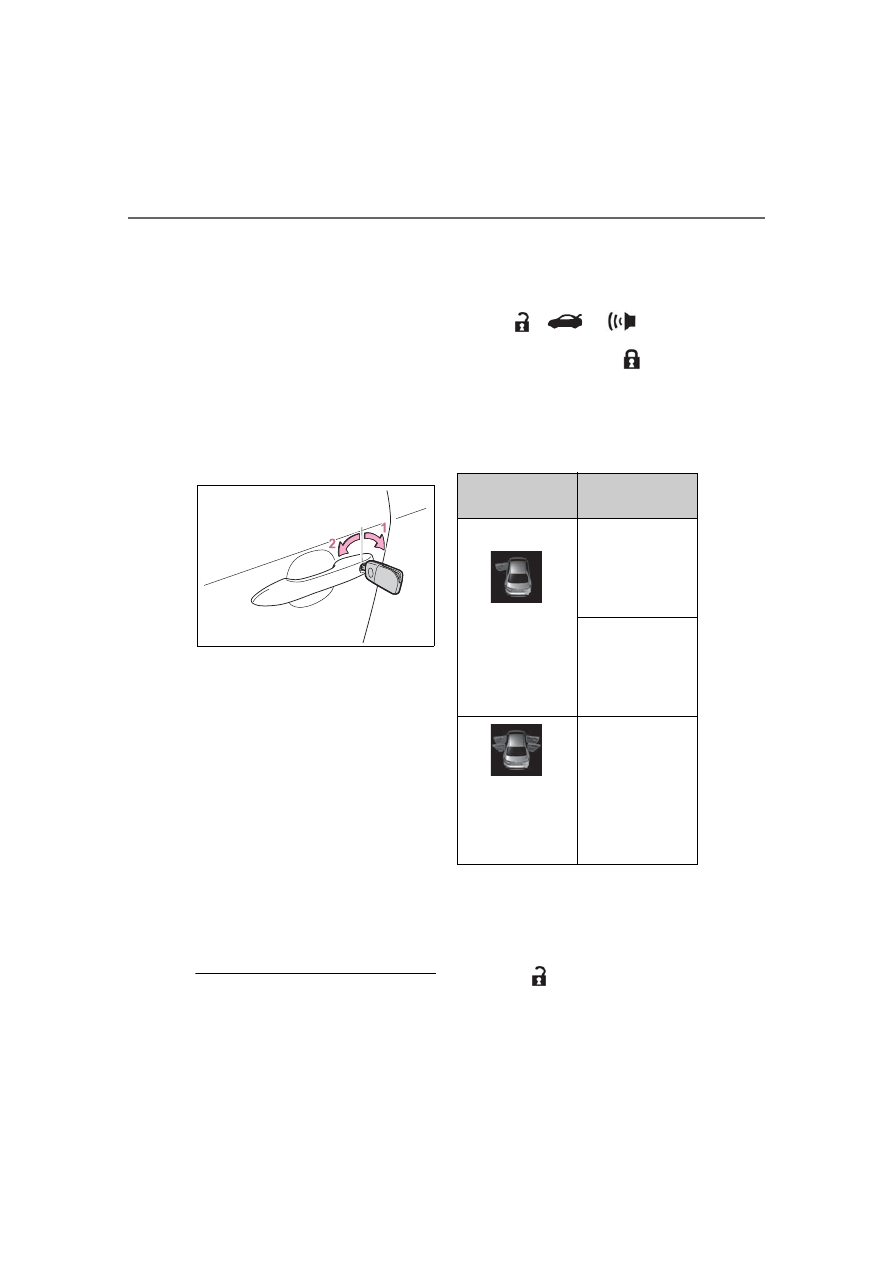
Key

Turning the key operates the 
doors as follows:

Vehicles without a smart key 
system

1

Unlocks all the doors

Turning the key unlocks the driver’s 
door. Turning the key again unlocks 
the other doors.

Turn and hold to open the windows

*

2

Locks all the doors

Turn and hold to open the windows

*

*

: This setting must be customized 

at your Toyota dealer.

Vehicles with a smart key sys-
tem

The doors can also be locked 
and unlocked with the mechani-
cal key. (

P.408)

Switching the door unlock func-

tion (vehicles with a smart key 

system)

It is possible to set which doors the 

entry function unlocks using the 

wireless remote control.

1

Turn the power switch off.

2

When the indicator light on the 

key surface is not on, press and 
hold 

 , 

 or 

 for 

approximately 5 seconds while 
pressing and holding 

.

The setting changes each time an 

operation is performed, as shown 

below. (When changing the setting 

continuously, release the buttons, 

wait for at least 5 seconds, and 

repeat step 

2

.)

To prevent unintended triggering of 

the alarm, unlock the doors using 

the wireless remote control and 

open and close a door once after 

the settings have been changed. (If 

a door is not opened within 60 sec-
onds after 

 is pressed, the doors 

will be locked again and the alarm 

will automatically be set.)

In case that the alarm is triggered, 

Multi-informa-

tion display/Beep

Unlocking func-

tion

Exterior: Beeps 3 

times

Interior: Pings 

once

Holding the 
driver’s door 
handle unlocks 
only the driver’s 
door.

Holding the front 
passenger’s 
door handle 
unlocks all the 
doors.

Exterior: Beeps 

twice

Interior: Pings 

once

Holding either 
front door handle 
unlocks all the 
doors.

129

3-2. Opening, closing and locking the doors

3

Before driv

ing

immediately stop the alarm. (

P.88)

Operation signals

Vehicles without a smart key sys-

tem

A buzzer sounds and the emer-

gency flashers flash to indicate that 

the doors have been 

locked/unlocked using the wireless 

remote control. (Locked: Once; 

Unlocked: Twice)

Vehicles with a smart key system

A buzzer sounds and the emer-

gency flashers flash to indicate that 

the doors have been 

locked/unlocked using the entry 

function or wireless remote control. 

(Locked: Once; Unlocked: Twice)
A buzzer sounds to indicate that the 
windows and moon roof

*

are operat-

ing.

*

: If equipped

Security feature

Vehicles without a smart key sys-

tem

If a door is not opened within 

approximately 60 seconds after the 

vehicle is unlocked using the wire-

less remote control, the security fea-

ture automatically locks the vehicle 

again.

Vehicles with a smart key system

If a door is not opened within 

approximately 60 seconds after the 

vehicle is unlocked using the entry 

function or wireless remote control, 

the security feature automatically 

locks the vehicle again.

When the door cannot be 

locked by the lock sensor on 

the surface of the front door 

handle (vehicles with a smart 

key system)

If the doors cannot be locked by 

touching the lock sensor with a fin-

ger, touch the lock sensor with the 

palm of your hand.
If you are wearing gloves, remove 

them.

Door lock buzzer (vehicles with 

a smart key system)

If an attempt to lock the doors using 

the entry function or wireless remote 

control is made when a door is not 

fully closed, a buzzer will sound 

continuously for 5 seconds. Fully 

close the door to stop the buzzer, 

and lock the doors again.

Alarm

Locking the doors will set the alarm 

system. (

P.88)

Conditions affecting the opera-

tion of the smart key system (if 

equipped) or wireless remote 

control

Vehicles without a smart key sys-

tem

P.125

Vehicles with a smart key system

P.137

If the smart key system (if 

equipped) or the wireless 

remote control does not oper-

ate properly

Vehicles without a smart key sys-

tem

Replace the key battery with a new 

one if it is depleted. (

P.350)

Vehicles with a smart key system

Use the mechanical key to lock and 

unlock the doors. (

P.408)

Replace the key battery with a new 

one if it is depleted. (

P.350)

130

3-2. Opening, closing and locking the doors

If the 12-volt battery is dis-

charged (vehicles with a smart 

key system)

The doors cannot be locked and 

unlocked using the smart key sys-

tem or wireless remote control. Lock 

or unlock the doors using the 

mechanical key. (

P.408)

Rear seat reminder function

In order to remind you not to forget 

luggage, etc. in the rear seat, when 

the power switch is turned off after 

any of the following conditions are 

met, a buzzer will sound and a mes-

sage will be displayed on the 

multi-information display for approx-

imately 6 seconds.

The hybrid system is started 

within approximately 10 minutes 

after opening and closing a rear 

door.

A rear door has been opened and 

closed after the hybrid system 

was started.

However, if a rear door is opened 

and then closed within approxi-

mately 2 seconds, the rear seat 

reminder function may not operate.
The rear seat reminder function 

determines that luggage, etc. has 

been placed in a rear seat based on 

opening and closing of a rear door. 

Therefore, depending on the situa-

tion, the rear seat reminder function 

may not operate and you may still 

forget luggage, etc. in the rear seat, 

or it may operate unnecessarily.

Customization

Some functions can be customized. 

(

P.442)

WARNING

To prevent an accident

Observe the following precautions 

while driving the vehicle.

Failure to do so may result in a 

door opening and an occupant 

being thrown out of the vehicle, 

resulting in death or serious injury.

Ensure that all doors are prop-

erly closed and locked.

Do not pull the inside door han-

dle while driving.

Be especially careful of the front 

doors, as the doors may be 

opened even if the inside lock 

buttons are in the locked posi-

tion.

Set the rear door child-protector 

locks when children are seated 

in the rear seats.

When opening or closing a 

door

Check the surroundings of the 

vehicle such as whether the vehi-

cle is on an incline, whether there 

is enough space for a door to 

open and whether a strong wind 

is blowing. When opening or clos-

ing the door, hold the door handle 

tightly to prepare for any unpre-

dictable movement.

When using the wireless 

remote control or the key and 

operating the power win-

dows or moon roof (if 

equipped)

Operate the power windows or 

moon roof after checking to make 

sure that there is no possibility of 

any passenger having any of their 

body parts caught in the windows 

or moon roof. Also, do not allow 

children to operate the wireless 

remote control or the key. It is 

possible for children and other 

passengers to get caught in the 

power windows or moon roof.

131

3-2. Opening, closing and locking the doors

3

Before driv

ing

Door lock switches (to 
lock/unlock)

1

Locks all the doors

2

Unlocks all the doors

For driver’s side

For passenger’s side

1

Locks all the doors

2

Unlocks all the doors

Inside lock buttons

1

Locks the door

2

Unlocks the door

The front doors can be opened by 
pulling the inside handle even if the 
lock buttons are in the lock position.

Locking the front doors from 

the outside without a key

1

Move the inside lock button to 

the lock position.

2

Close the door.

Vehicles without a smart key sys-

tem

The door cannot be locked if the key 

is in the power switch.

Vehicles with a smart key system

The door cannot be locked if the 

power switch is in ACC or ON, or 

the electronic key is left inside the 

vehicle.
The key may not be detected cor-

rectly and the door may be locked.

Open door warning buzzer

If a door or the trunk is not fully 

closed, a buzzer will sound when 

the vehicle speed reaches 3 mph (5 

km/h).
The open door(s) or trunk is indi-

cated on the multi-information dis-

play.

Unlocking and locking the 
doors from the inside

132

3-2. Opening, closing and locking the doors

The door cannot be opened 
from inside the vehicle when 
lock is set.

1

Unlock

2

Lock

These locks can be set to prevent 
children from opening the rear 
doors. Push down on each rear 
door switch to lock both rear doors.

The following functions can be 
set or canceled:

For instructions on customizing, 
refer to P.442.

Rear door child-protector 
lock

Automatic door locking 
and unlocking systems

Function

Operation

Speed linked 
door locking 
function

All doors are auto-
matically locked 
when vehicle 
speed is approxi-
mately 12 mph (20 
km/h) or higher.

Shift position 
linked door 
locking func-
tion

All doors are auto-
matically locked 
when shifting the 
shift lever out of P.

Shift position 
linked door 
unlocking 
function

All doors are auto-
matically unlocked 
when shifting the 
shift lever to P.

Driver’s door 
linked door 
unlocking 
function

All doors are auto-
matically unlocked 
when driver’s door 
is opened.

Function

Operation

133

3-2. Opening, closing and locking the doors

3

Before driv

ing

Trunk

The trunk can be opened 
using the trunk opener, 
entry function or wireless 
remote control.

WARNING

Observe the following precau-

tions.

Failure to do so may result in 

death or serious injury.

Before driving

Make sure that the trunk lid is 

fully closed. If the trunk lid is not 

fully closed, it may open unex-

pectedly while driving and hit 

near-by objects or luggage in 

the trunk may be thrown out, 

causing an accident.

Do not allow children to play in 

the trunk.

If a child is accidentally locked 

in the trunk, they could suffer 

from heat exhaustion, suffoca-

tion or other injuries.

Do not allow a child to open or 

close the trunk lid.

Doing so may cause the trunk 

lid to open unexpectedly, or 

cause the child’s hands, head, 

or neck to be caught by the 

closing trunk lid.

Important points while driving

Never let anyone sit in the trunk. 

In the event of sudden braking or 

a collision, they are susceptible to 

death or serious injury.

Using the trunk

Observe the following precau-

tions.

Failure to do so may cause parts 

of the body to be caught, resulting 

in serious injury.

Remove any heavy loads, such 

as snow and ice, from the trunk 

lid before opening it. Failure to 

do so may cause the trunk lid to 

suddenly shut again after it is 

opened.

When opening or closing the 

trunk lid, thoroughly check to 

make sure the surrounding area 

is safe.

If anyone is in the vicinity, make 

sure they are safe and let them 

know that the trunk is about to 

open or close.

Use caution when opening or 

closing the trunk lid in windy 

weather as it may move 

abruptly in strong wind.

The trunk lid may suddenly shut 

if it is not opened fully. It is more 

difficult to open or close the 

trunk lid on an incline than on a 

level surface, so beware of the 

trunk lid unexpectedly opening 

or closing by itself. Make sure 

that the trunk lid is fully open 

and secure before using the 

trunk.

When closing the trunk lid, take 

extra care to prevent your fin-

gers etc. from being caught.

134

3-2. Opening, closing and locking the doors

Trunk opener

Pull the lever upward to release 
the trunk lid.

Trunk release button (vehi-
cles with a smart key sys-
tem)

While carrying the electronic 
key, press the button on the 
trunk lid.
When all the doors are unlocked 
using one of the following meth-
ods, the trunk can be opened 
without the electronic key:

Entry function

Wireless remote control

Door lock switches

Automatic door unlocking sys-

tem

Mechanical key

Wireless remote control

Vehicles without a smart key 
system

Press and hold the switch.

A buzzer sounds.

Vehicles with a smart key sys-
tem

Press and hold the switch.

A buzzer sounds.

WARNING

When closing the trunk lid, 

make sure to press it lightly on 

its outer surface.

Do not attach any accessories 

other than genuine Toyota parts 

to the trunk lid. Such additional 

weight on the trunk lid may 

cause the lid to suddenly shut 

again after it is opened.

Opening the trunk

135

3-2. Opening, closing and locking the doors

3

Before driv

ing

Trunk light

The trunk light turns on when the 

trunk is opened.

If the trunk light is left on when the 

power switch is turned off, the light 

will go off automatically after 20 

minutes.

Function to prevent the trunk 

being locked with the electronic 

key inside (vehicles with a 

smart key system)

When all doors are locked, closing 

the trunk lid with the electronic key 

left inside the trunk will sound an 

alarm.

In this case, the trunk lid can be 

opened pressing the trunk release 

button on the trunk lid.

If the spare electronic key is put in 

the trunk with all the doors locked, 

the key confinement prevention 

function is activated so the trunk 

can be opened. In order to pre-

vent theft, take all electronic keys 

with you when leaving the vehicle.

If the electronic key is put in the 

trunk with all the doors locked, the 

key may not be detected depend-

ing on the location of the key and 

the surrounding radio wave condi-

tions. In this case, the key con-

finement prevention function 

cannot be activated, causing the 

doors to lock when the trunk is 

closed. Make sure to check where 

the key is before closing the trunk.

The key confinement prevention 

function cannot be activated if any 

one of the doors is unlocked. In 

this case, open the trunk using the 

trunk opener.

Internal trunk release lever

The trunk lid can be opened by pull-

ing up the glow-in-the-dark lever 

located on the inside of the trunk lid.
The lever will continue to glow for 

some time after the trunk lid is 

closed.

If the smart key system (if 

equipped)  or the wireless 

remote control does not oper-

ate properly

Replace the key battery with a new 

one if it is depleted. (

P.350)

Open door warning buzzer

P.131

Customization

Some functions can be customized. 

(

P.442)

136

3-2. Opening, closing and locking the doors

*

: If equipped

Antenna location

Antennas outside the cabin
Antennas inside the cabin
Antenna inside the trunk
Antenna outside the trunk

Effective range (areas within 

which the electronic key is 

detected)

When locking or unlocking the 
doors

The system can be operated when 
the electronic key is within about 2.3 
ft. (0.7 m) of either of the front out-
side door handles. (Only the doors 
detecting the key can be operated.)

When starting the hybrid system 
or changing power switch 
modes

The system can be operated when 
the electronic key is inside the vehi-
cle.

When opening the trunk

The system can be operated when 
the electronic key is within about 2.3 
ft. (0.7 m) of the trunk release but-
ton.

Alarms and warning messages

A combination of exterior and inte-

rior buzzers as well as warning mes-

sages shown on the 

multi-information display are used to 

prevent theft of the vehicle and acci-

dents resulting from erroneous 

operation. Take appropriate mea-

sures based on the displayed mes-

sage. (

P.382)

When only an alarm sounds, cir-

cumstances and correction proce-

dures are as follows.

Exterior buzzer sounds once for 5 

seconds

Smart key system

*

The following operations 
can be performed simply by 
carrying the electronic key 
on your person, for example 
in your pocket. The driver 
should always carry the 
electronic key.

Locks and unlocks the 
doors (

P.127)

Opens the trunk (

P.134)

Starts the hybrid system 
(

P.172)

137

3-2. Opening, closing and locking the doors

3

Before driv

ing

Interior buzzer sounds continu-

ously

Battery-saving function

The battery-saving function will be 

activated in order to prevent the 

electronic key battery and the 

12-volt battery from being dis-

charged while the vehicle is not 

operated for a long time.

In the following situations, the 

smart key system may take some 

time to unlock the doors.

• The electronic key has been left 

within approximately 11 ft. (3.5 m) 

of the outside of the vehicle for 2 

minutes or longer.

• The smart key system has not 

been used for 5 days or longer.

If the smart key system has not 

been used for 14 days or longer, 

the doors cannot be unlocked 

from any door except the driver’s 

door. In this case, hold the driver’s 

door handle, or use the wireless 

remote control or mechanical key 

to unlock the doors.

Electronic key battery-saving 

function

When battery-saving mode is set, 

battery depletion is minimized by 

stopping the electronic key from 

receiving radio waves.

Press 

 twice while pressing and 

holding 

. Confirm that the elec-

tronic key indicator flashes 4 times.
While the battery-saving mode is 

set, the smart key system cannot be 

used. To cancel the function, press 

any of the electronic key buttons.

Electronic keys that will not be 

used for long periods of time can 

be set to the battery-saving mode 

in advance.

Conditions affecting operation

The smart key system uses weak 

radio waves. In the following situa-

tions, the communication between 

the electronic key and the vehicle 

may be affected, preventing the 

smart key system, wireless remote 

control and immobilizer system from 

operating properly.

When the electronic key battery is 

depleted

Situation

Correction 

procedure

An attempt was 
made to lock the 
vehicle while a door 
was open.

Close all of 
the doors 
and lock the 
doors again.

The trunk was closed 
while the electronic 
key was still inside 
the trunk and all the 
doors were locked.

Retrieve the 
electronic 
key from the 
trunk and 
close the 
trunk lid.

Situation

Correction 

procedure

The power switch 
was turned to ACC 
while the driver’s 
door was open (or 
the driver’s door was 
opened while the 
power switch was in 
ACC).

Turn the 
power 
switch off 
and close 
the driver’s 
door.

The power switch 
was turned to off 
while the driver’s 
door was open.

Close the 
driver’s door

138

3-2. Opening, closing and locking the doors

Near a TV tower, electric power 

plant, gas station, radio station, 

large display, airport or other facil-

ity that generates strong radio 

waves or electrical noise

When carrying a portable radio, 

cellular phone, cordless phone or 

other wireless communication 

device

When the electronic key is in con-

tact with, or is covered by the fol-

lowing metallic objects

• Cards to which aluminum foil is 

attached

• Cigarette boxes that have alumi-

num foil inside

• Metallic wallets or bags

• Coins

• Hand warmers made of metal

• Media such as CDs and DVDs

When other wireless keys (that 

emit radio waves) are being used 

nearby

When carrying the electronic key 

together with the following devices 

that emit radio waves

• Another vehicle’s electronic key or 

a wireless key that emits radio 

waves

• Personal computers or personal 

digital assistants (PDAs)

• Digital audio players

• Portable game systems

If window tint with a metallic con-

tent or metallic objects are 

attached to the rear window

When the electronic key is placed 

near a battery charger or elec-

tronic devices

When the vehicle is parked in a 

pay parking spot where radio 

waves are emitted

If the doors cannot be 

locked/unlocked using the smart key 

system, lock/unlock the doors by 

performing any of the following:

Bring the electronic key close to 

either front door handle and oper-

ate the entry function.

Operate the wireless remote con-

trol.

If the doors cannot be 

locked/unlocked using the above 

methods, use the mechanical key. 

(

P.408)

If the hybrid system cannot be 

started using the smart key system, 

refer to P.409.

Note for the entry function

Even when the electronic key is 

within the effective range (detec-

tion areas), the system may not 

operate properly in the following 

cases:

• The electronic key is too close to 

the window or outside door han-

dle, near the ground, or in a high 

place when the doors are locked 

or unlocked.

• The electronic key is near the 

ground or in a high place, or too 

close to the center of the rear 

bumper when the trunk is opened.

• The electronic key is on the instru-

ment panel, rear package tray or 

floor, or in the door pockets or 

glove box when the hybrid system 

is started or power switch modes 

are changed.

Do not leave the electronic key on 

top of the instrument panel or near 

the door pockets when exiting the 

vehicle. Depending on the radio 

wave reception conditions, it may 

be detected by the antenna out-

side the cabin and the door will 

become lockable from the outside, 

possibly trapping the electronic 

key inside the vehicle.

As long as the electronic key is 

within the effective range, the 

doors may be locked or unlocked 

by anyone. However, only the 

doors detecting the electronic key 

can be used to unlock the vehicle.

Even if the electronic key is not 

inside the vehicle, it may be possi-

ble to start the hybrid system if the 

electronic key is near the window.

The doors may unlock or lock if a 

large amount of water splashes on 

139

3-2. Opening, closing and locking the doors

3

Before driv

ing

the door handle, such as in the 

rain or in a car wash when the 

electronic key is within the effec-

tive range. (The doors will auto-

matically be locked after 

approximately 60 seconds if the 

doors are not opened and closed.)

If the wireless remote control is 

used to lock the doors when the 

electronic key is near the vehicle, 

there is a possibility that the door 

may not be unlocked by the entry 

function. (Use the wireless remote 

control to unlock the doors.)

If the doors have been locked 

from outside of the vehicle and are 

then not unlocked using the wire-

less remote control or smart key 

system, the hybrid system cannot 

be started using the smart key 

system. (However, if the doors 

have been locked from inside the 

vehicle, the hybrid system can be 

started using the smart key sys-

tem.)

If it is necessary to start the hybrid 

system, it can be started using the 

procedure in “If the electronic key 

dose not operate properly” 

(

P.409).

Touching the door lock or unlock 

sensor while wearing gloves may 

prevent lock or unlock operation.

When the lock operation is per-

formed using the lock sensor, rec-

ognition signals will be shown up 

to two consecutive times. After 

this, no recognition signals will be 

given.

If the door handle becomes wet 

while the electronic key is within 

the effective range, the door may 

lock and unlock repeatedly. In that 

case, follow the following correc-

tion procedures to wash the vehi-

cle:

• Place the electronic key in a loca-

tion 6 ft. (2 m) or more away from 

the vehicle. (Take care to ensure 

that the key is not stolen.)

• Set the electronic key to bat-

tery-saving mode to disable the 

smart key system. (

P.137)

If the electronic key is inside the 

vehicle and a door handle 

becomes wet during a car wash, a 

message may be shown on the 

multi-information display and a 

buzzer will sound outside the vehi-

cle. To turn off the alarm, lock all 

the doors.

The lock sensor may not work 

properly if it comes into contact 

with ice, snow, mud, etc. Clean 

the lock sensor and attempt to 

operate it again.

A sudden handle operation or a 

handle operation immediately 

after entering the effective range 

may prevent the doors from being 

unlocked. Touch the door unlock 

sensor and check that the doors 

are unlocked before pulling the 

door handle again.

If there is another electronic key in 

the detection area, it may take 

slightly longer to unlock the doors 

after the door handle is gripped.

When the vehicle is not driven 

for extended periods

To prevent theft of the vehicle, do 

not leave the electronic key within 

6 ft. (2 m) of the vehicle.

The smart key system can be 

deactivated in advance. (

P.442)

Setting the electronic key to bat-

tery-saving mode helps to reduce 

key battery depletion. (

P.137)

To operate the system properly

Make sure to carry the electronic 

key when operating the system. 

Do not get the electronic key too 

close to the vehicle when operat-

ing the system from the outside of 

the vehicle.

Depending on the position and hold-

ing condition of the electronic key, 

the key may not be detected cor-

rectly and the system may not oper-

140

3-2. Opening, closing and locking the doors

ate properly. (The alarm may go off 

accidentally, or the door lock pre-

vention function may not operate.)

Do not leave the electronic key 

inside the trunk.

The key confinement prevention 

function may not operate, depend-

ing on the location of the key (the 

inside edge of the trunk), condi-

tions (inside a metal bag, close to 

metallic objects) and the radio 

waves in the surrounding area. 

(

P.135)

If the smart key system does 

not operate properly

Locking and unlocking the doors: 

P.408

Starting the hybrid system: 

P.409

Customization

Some functions can be customized. 

(

P.442)

If the smart key system has 

been deactivated in a custom-

ized setting

Locking and unlocking the doors: 

Use the wireless remote control or 

mechanical key. (

P.127, 408)

Starting the hybrid system and 

changing power switch modes: 

P.409

Stopping the hybrid system: 

P.174

WARNING

Caution regarding interfer-

ence with electronic devices

People with implantable car-

diac pacemakers, cardiac 

resynchronization ther-

apy-pacemakers or implantable 

cardioverter defibrillators should 

keep away from the smart key 

system antennas. (

P.136)

The radio waves may affect the 

operation of such devices. If 

necessary, the entry function 

can be disabled. Ask your Toy-

ota dealer for details, such as 

the frequency of radio waves 

and timing of the emitted radio 

waves. Then, consult your doc-

tor to see if you should disable 

the entry function.

Users of any electrical medical 

device other than implantable 

cardiac pacemakers, cardiac 

resynchronization ther-

apy-pacemakers or implantable 

cardioverter defibrillators should 

consult the manufacturer of the 

device for information about its 

operation under the influence of 

radio waves.

Radio waves could have unex-

pected effects on the operation 

of such medical devices.

Ask your Toyota dealer for details 

on disabling the entry function.

141

3-3. Adjusting the seats

3

Before driv

ing

3-3.Adjusting the seats

Manual seat

Seat position adjustment 
lever
Seatback angle adjustment 
lever
Vertical height adjustment 
lever (driver’s side only)

Power seat (driver’s side 
only)

Seat position adjustment 
switch
Seatback angle adjustment 
switch
Seat cushion (front) angle 
adjustment switch
Vertical height adjustment 
switch
Lumbar support adjustment 
switch

*

*

: If equipped

Front seats

Adjustment procedure

WARNING

When adjusting the seat posi-

tion

Take care when adjusting the 

seat position to ensure that 

other passengers are not 

injured by the moving seat.

Do not put your hands under the 

seat or near the moving parts to 

avoid injury.

Fingers or hands may become 

jammed in the seat mechanism.

Make sure to leave enough 

space around the feet so they 

do not get stuck.

Seat adjustment

Be careful that the seat does 

not hit passengers or luggage.

142

3-3. Adjusting the seats

1

Move the front seats forward. 
(

P.141)

2

Stow the rear armrest. 
(

P.299)

3

Fold the seatback down while 
pushing the seatback lock 
release button.

Each seatback may be folded sep-

arately.

WARNING

To reduce the risk of sliding 

under the lap belt during a colli-

sion, do not recline the seat 

more than necessary.

If the seat is too reclined, the lap 

belt may slide past the hips and 

apply restraint forces directly to 

the abdomen, or your neck may 

contact the shoulder belt, 

increasing the risk of death or 

serious injury in the event of an 

accident.

Adjustments should not be 

made while driving as the seat 

may unexpectedly move and 

cause the driver to lose control 

of the vehicle.

Manual seat only: After adjust-

ing the seat, make sure that the 

seat is locked in position.

NOTICE

When adjusting a front seat

When adjusting a front seat, make 

sure that the head restraint does 

not contact the headliner. Other-

wise, the head restraint and head-

liner may be damaged.

Rear seats

The seatbacks of the rear 
seats can be folded down.

Folding down the rear 
seatbacks

WARNING

Observe the following precau-

tions. Failure to do so may result 

in death or serious injury.

When folding the rear seat-

backs down

Do not fold the seatbacks down 

while driving.

Stop the vehicle on level 

ground, set the parking brake 

and shift the shift lever to P.

143

3-3. Adjusting the seats

3

Before driv

ing

WARNING

Do not allow anyone to sit on a 

folded seatback or in the trunk 

while driving.

Do not allow children to enter 

the trunk.

Be careful not to get your hand 

caught when folding the rear 

seatbacks.

Adjust the position of the front 

seats before folding down the 

rear seatbacks so that the front 

seats do not interfere with the 

rear seatbacks when folding 

down the rear seatbacks.

After returning the rear seat-

back to the upright position

Make sure that the seatback is 

securely locked in position by 

lightly pushing it back and forth.

If the seatback is not securely 

locked, the red marking will be 

visible on the seatback lock 

release button. Make sure that the 

red marking is not visible.

Check that the seat belts are 

not twisted or caught in the 

seatback.

If the seat belt gets caught 

between the seatback’s securing 

hook and latch, it may damage 

the seat belt.

NOTICE

When the right seatback is 

folded down

Make sure the luggage loaded in 

the enlarged trunk will not dam-

age the webbing of the rear cen-

ter seat belt.


Content      ..     6      7      8      9     ..