Toyota Corolla Hatchback (2023 year). Manual in english - page 11
 

  Index      Toyota     Toyota Corolla Hatchback (2023 year). Manual in english


Search            copyright infringement  


Content      ..     9      10      11      12     ..


Toyota Corolla Hatchback (2023 year). Manual in english - page 11


176

4-5. Using the driving support systems

• If a vehicle ahead is a child sized 

bicycle, is carrying a large load, is 

carrying an extra passenger, or 

has an unusual shape (bicycles 

equipped with a child seat, tan-

dem bicycles, etc.)

• If a pedestrian or bicycle is shorter 

than approximately 3.2 ft. (1 m) or 

taller than approximately 6.5 ft. (2 

m).

• When the silhouette of a pedes-

trian or bicycle is unclear (such as 

when they are wearing a raincoat, 

long skirt, etc.)

• When a pedestrian or bicycle is 

bending forward or squatting

• When a pedestrian or bicycle is 

moving at high speed

• When a pedestrian is pushing a 

stroller, wheelchair, bicycle or 

other vehicle

• When a detectable object blends 

in with the surrounding area, such 

as when it is dim (at dawn or dusk) 

or dark (at night or in a tunnel)

• When the vehicle has not been 

driven for a certain amount of time 

after the engine was started

• While turning left/right or a few 

seconds after turning left/right

• While driving around a curve and 

a few seconds after driving around 

a curve

• When turning left/right and an 

oncoming vehicle is driving in a 

lane 3 or more lanes from the 

vehicle

• When turning left/right and the 

direction of the vehicle differs 

greatly from the direction traffic 

flows in the oncoming lane

• When turning left/right and 

approaching a pedestrian which 

was traveling in the same direc-

tion as the vehicle and continues 

straight

In addition to the preceding, in 

certain situations, such as the fol-

lowing, the emergency steering 

assist may not operate properly:

• When a detectable object is too 

close to the vehicle

• When there is insufficient space to 

perform evasive steering maneu-

vers or an obstruction exists in the 

evasion direction

• When there is an oncoming vehi-

cle

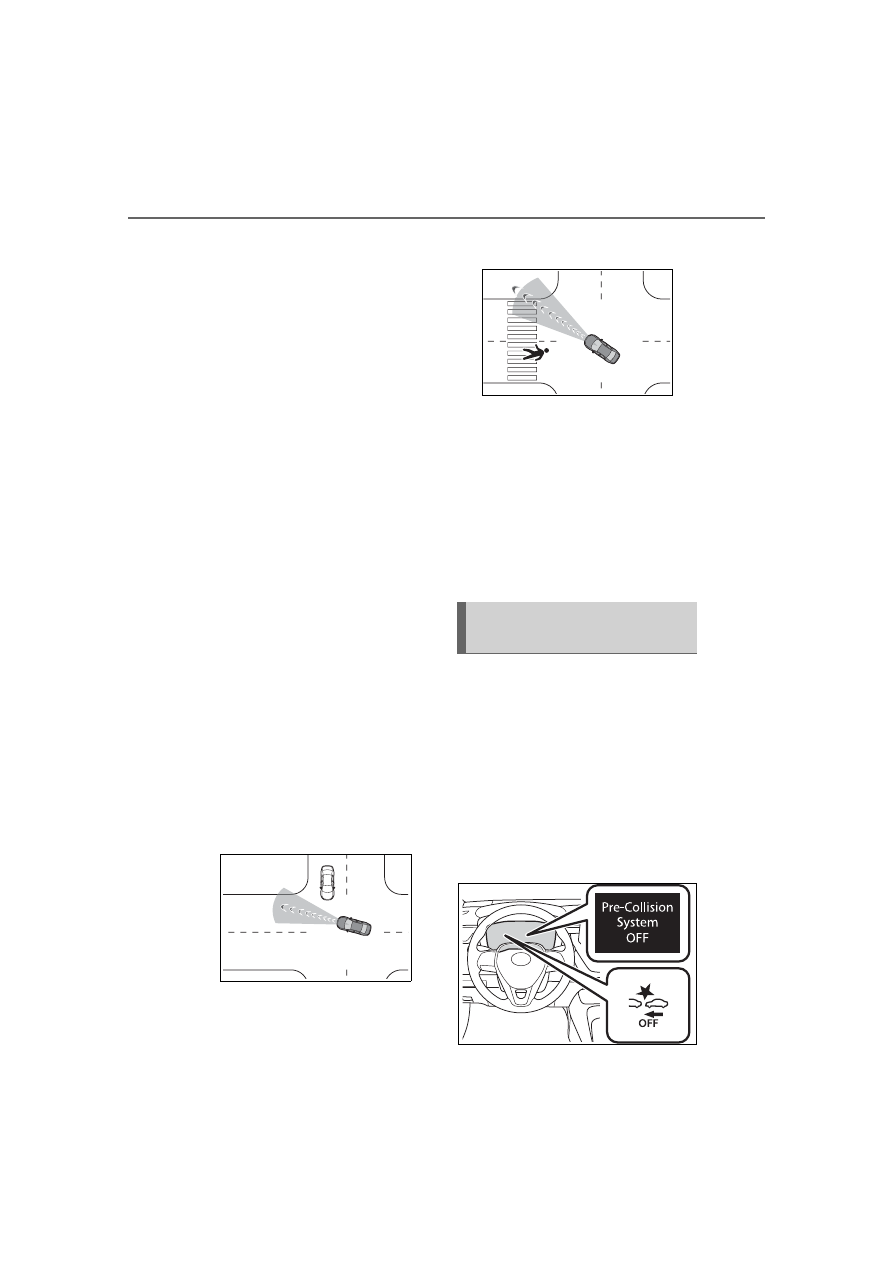
The pre-collision system can 
be enabled/disabled through 
a customize setting. (

P.391)

The system is enabled each time 
the engine switch is turned to ON.

When the system is disabled, 
the PCS warning light will illu-
minate and a message will be 
displayed on the multi-infor-
mation display.

Changing the pre-colli-
sion setting

177

4-5. Using the driving support systems

4

Dr

iv

ing

The pre-collision setting can 
be changed on the customize 
settings. (

P.391)

When the pre-collision warn-
ing timing is changed, the 
emergency steering assist 
(excluding the active steering 
function) timing will also be 
changed.
When "Later" is selected, the 
emergency steering assist 
(excluding the active steering 
function) will not operate in 
most cases.

When the dynamic radar 
cruise control is operating, the 
pre-collision warning will 
operate at the “Earlier” timing, 
regardless of the user setting.

When driving on a road with 
clear lane lines with the 
dynamic radar cruise control 
operating, lane lines and pre-
ceding and surrounding vehi-
cles are detected using the 
front camera and radar sen-
sor, and the steering wheel is 
operated to maintain the vehi-
cle’s lane position.

Use this function only on highways 
and expressways.
If the dynamic radar cruise control 
is not operating, the function will not 
operate.
In situations where the lane lines 
are difficult to see or are not visible, 
such as when in a traffic jam, sup-
port will be provided using the path 
of preceding and surrounding vehi-
cles.
If the system determines that the 
steering wheel has not been oper-
ated for a certain amount of time or 
the steering wheel is not being 
firmly gripped, the driver will be 
alerted via a display and this func-
tion will be temporarily canceled.
If the steering wheel is firmly 
gripped, the function will begin 
operating again.

LTA (Lane Tracing 

Assist)

LTA functions

178

4-5. Using the driving support systems

When the function is operat-
ing, if the vehicle is likely to 
depart from its lane, the driver 
will be alerted via a display 
and buzzer.

When the buzzer sounds, check 
the area around the vehicle and 
carefully operate the steering wheel 
to move the vehicle back to the 
center of the lane.

Operating conditions of func-

tion

This function is operable when all of 

WARNING

Before using the LTA system

Do not overly rely on the LTA 

system. The LTA system is not a 

system which provides auto-

mated assistance in driving and 

it is not a system which reduces 

the amount of attention neces-

sary for safe driving. The driver 

is solely responsible for paying 

attention to their surroundings 

and operating the steering 

wheel as necessary to ensure 

safety. Also, the driver is 

responsible for taking adequate 

breaks when fatigued, such as 

when driving for a long time.

Failure to perform appropriate 

driving operations and pay care-

ful attention may lead to an 

accident.

When not using the LTA system, 

turn it off using the LTA switch.

179

4-5. Using the driving support systems

4

Dr

iv

ing

the following conditions are met:

The LTA system detects lane lines 

or the path of preceding or sur-

rounding vehicles (except when 

the preceding vehicle is small, 

such as a motorcycle).

The dynamic radar cruise control 

is operating.

The lane width is approximately 

10 to 13 ft. (3 to 4 m).

The turn signal lever is not being 

operated.

The vehicle is not being driven 

around a sharp curve.

The vehicle is not accelerating or 

decelerating more than a certain 

amount.

The steering wheel is not being 

turned with a large force.

The hands off steering wheel 

warning (

P.179) is not operat-

ing.

The vehicle is being driven in the 

center of a lane.

Temporary cancelation of func-

tions

When the operating conditions are 

no longer met, a function may be 

temporarily canceled. However, 

when the operation conditions are 

met again, operation of the func-

tion will automatically be restored. 

(

P.178)

If the operating conditions of a 

function are no longer met while 

the function is operating, a buzzer 

may sound to indicate that the 

function has been temporarily 

canceled.

The steering assist operation of 

the function can be overridden by 

the steering wheel operation of 

the driver.

Lane departure warning func-

tion when the LTA is operating

Even if the LDA warning method is 

changed to vibration of the steer-

ing wheel, if the vehicle deviates 

from the lane while the LTA is 

operating, the warning buzzer will 

sound to alert the driver.

If steering wheel operation equiv-

alent to that necessary for a lane 

change is detected, the system 

will determine the vehicle is not 

deviating from the lane and the 

warning will not operate.

Hands off steering wheel warn-

ing operation

In the following situations, a mes-

sage urging the driver to grip the 

steering wheel and the icon shown 

in the illustration will be displayed on 

the multi-information display to warn 

the driver. If the system detects that 

the steering wheel is held, the warn-

ing will be canceled. When using the 

system, make sure to grip the steer-

ing wheel firmly, regardless of 

whether the warning is operating or 

not.

When the system determines the 

driver is not holding the steering 

wheel while the function is operat-

ing

If no operations are detected for a 

certain amount of time, a buzzer will 

sound, the warning will operate, and 

the function will be temporarily can-

celed. This warning may also oper-

ate if the driver only operates 

steering wheel a small amount con-

tinuously.
Depending on the condition of the 

vehicle, handle control condition 

and road surface, the warning func-

tion may not operate.

180

4-5. Using the driving support systems

The LTA will change between 
enabled/disabled each time the 
LTA switch is pressed.

When the LTA is enabled, the LTA 
indicator will illuminate.

Enabling/disabling the 
system

WARNING

Situations in which the func-

tions may not operate prop-

erly

In the following situations, the 

functions may not operate prop-

erly and the vehicle may depart 

from its lane. Do not overly rely on 

these functions. The driver is 

solely responsible for paying 

attention to their surroundings 

and operating the steering wheel 

as necessary to ensure safety.

When a preceding or surround-

ing vehicle changes lanes (Your 

vehicle may follow the preced-

ing or surrounding vehicle and 

also change lanes)

When a preceding or surround-

ing vehicle is swaying (Your 

vehicle may sway accordingly 

and depart from the lane)

When a preceding or surround-

ing vehicle departs from a lane 

(Your vehicle may follow the 

preceding or surrounding vehi-

cle and also depart from the 

lane)

When a preceding or surround-

ing vehicle is being driven 

extremely close to the left/right 

lane line (Your vehicle may fol-

low the preceding or surround-

ing vehicle accordingly and 

depart from the lane)

When there are moving objects 

or structures in the surrounding 

area (Depending on the position 

of the moving object or structure 

relative to your vehicle, your 

vehicle may sway)

When the vehicle is struck by a 

crosswind or the turbulence of 

other nearby vehicles

Situations in which the sensors 

may not operate properly: 

P.165

Situations in which the lane may 

not be detected: 

P.166

When it is necessary to disable 

the system: 

P.161

181

4-5. Using the driving support systems

4

Dr

iv

ing

The operating state of the LTA system is indicated.

Operation display of steering wheel operation support

Indicator

Lane dis-

play

Steering 

icon

Situation

White

Gray

Gray

LTA is on standby

Green

Green

Green

LTA is operating

Orange

Flashing

Orange

Flashing

Green

The vehicle is departing the lane 
toward the side which the lane dis-
play is flashing

182

4-5. Using the driving support systems

The LDA system warns the 
driver if the vehicle may deviate 
from the current lane or course

*

and also can slightly operate the 
steering wheel to help avoid 
deviation from the lane or 
course

*

.

The front camera is used to 
detect lane lines or a course

*

.

*

: Boundary between the asphalt 

and grass, soil, etc., or structures, 
such as a curb, guardrail, etc.

Lane departure alert func-
tion

When the system determines 
that the vehicle might depart 
from its lane or course

*

, a warn-

ing is displayed on a display, 
and either a warning buzzer will 
sound or the steering wheel will 
vibrate to alert the driver.

Check the area around your vehicle 
and carefully operate the steering 
wheel to move the vehicle back to 
the center of the lane or course

*

.

Vehicles with BSM: If the system 
determines that the vehicle may 
collide with a vehicle in an adjacent 
lane, the lane departure alert will 
operate even if the turn signals are 
operating.

*

: Boundary between the asphalt 

and grass, soil, etc., or structures, 

such as a curb, guardrail, etc.

Lane departure prevention 
function

If the system determines that 
the vehicle is likely to depart 
from its lane or course

*

, it pro-

vides assistance through steer-
ing wheel operations to help 
avoid deviation from the lane or 
course.

If the system determines that the 
steering wheel has not been oper-
ated for a certain amount of time or 
the steering wheel is not being 
firmly gripped, a warning message 
may be displayed and a warning 
buzzer may sound to alert the 
driver.
Vehicles with BSM: If the system 
determines that the vehicle may 
collide with a vehicle in an adjacent 
lane, the lane departure prevention 
function will operate even if the turn 
signals are operating.

LDA (Lane Departure 

Alert)

Basic functions

183

4-5. Using the driving support systems

4

Dr

iv

ing

*

: Boundary between the asphalt 

and grass, soil, etc., or structures, 
such as a curb, guardrail, etc.

Break suggestion function

If the vehicle is swaying, a mes-
sage will be displayed and a 
warning buzzer will sound to 
urge the driver to take a break.

Operating conditions of each 

function

Lane departure alert/prevention 

function

WARNING

Before using the LDA system

Do not overly rely on the LDA 

system. The LDA system is not 

a system which provides auto-

mated assistance in driving and 

it is not a system which reduces 

the amount of attention neces-

sary for safe driving. The driver 

is solely responsible for paying 

attention to their surroundings 

and operating the steering 

wheel as necessary to ensure 

safety. Also, the driver is 

responsible for taking adequate 

breaks when fatigued, such as 

when driving for a long time.

Failure to perform appropriate 

driving operations and pay care-

ful attention may lead to an 

accident.

184

4-5. Using the driving support systems

This function is operable when all of 

the following conditions are met:

• The vehicle speed is approxi-

mately 30 mph (50 km/h) or more.

Operation may be possible when 
the vehicle speed is approximately 
25 mph (40 km/h) or more if vehi-
cles, motorcycles, bicycles, or 
pedestrians are detected near the 
lane.
• The system recognizes a lane or 

course

*

. (When recognized on 

only one side, the system will 

operate only for the recognized 

side.)

• The lane width is approximately 

9.8 ft. (3 m) or more.

• The turn signal lever is not being 

operated. (Vehicles with BSM: 

Except when a vehicle is detected 

in the direction that the turn signal 

lever is operated.)

• The vehicle is not being driven 

around a sharp curve.

• The vehicle is not accelerating or 

decelerating more than a certain 

amount.

• The steering wheel is not being 

turned sufficiently to perform a 

lane change.

*

: Boundary between the asphalt 

and grass, soil, etc., or structures, 
such as a curb, guardrail, etc.

Break suggestion function

This function is operable when all of 

the following conditions are met:

• The vehicle speed is approxi-

mately 32 mph (50 km/h) or more.

• The lane width is approximately 

9.8 ft. (3 m) or more.

Temporary cancellation of func-

tions

When the operating conditions are 

no longer met, a function may be 

temporarily canceled. However, 

when the operation conditions are 

met again, operation of the function 

will automatically be restored. 

(

P.183)

Operation of the lane departure 

alert function/lane departure 

prevention function

Depending on the vehicle speed, 

road conditions, lane departure 

angle, etc., operation of the lane 

departure prevention function may 

not be felt or the function may not 

operate.

Depending on the conditions, the 

warning buzzer may operate even 

if vibration is selected through a 

customize setting.

If a course

*

 is not clear or straight, 

the lane departure alert function or 

lane departure prevention function 

may not operate.

The lane departure alert function 

or lane departure prevention func-

tion may not operate if the system 

judges that the vehicle is inten-

tionally being steered to avoid a 

pedestrian or parked vehicle.

Vehicles with BSM: It may not be 

possible for the system to judge if 

there is danger of a collision with a 

vehicle in an adjacent lane.

The steering assist operation of 

the lane departure prevention 

function can be overridden by the 

steering wheel operation of the 

driver.

*

: Boundary between the asphalt 

and grass, soil, etc., or structures, 
such as a curb, guardrail, etc.

Hands off steering wheel warn-

ing operation

In the following situations, a mes-

sage urging the driver to operate the 

steering wheel and an icon will be 

displayed and a buzzer will sound to 

warn the driver. When using the sys-

tem, make sure to grip the steering 

wheel firmly, regardless of whether 

the warning is operating or not.

185

4-5. Using the driving support systems

4

Dr

iv

ing

When the system determines that 

the driver is not securely holding 

the steering wheel, or the steering 

wheel is not being operated when 

the steering assist operation of the 

lane departure prevention function 

is operating

The length of time that the warning 

buzzer operates will become longer 

as the frequency of the steering 

assist operating increases. Even if 

the system judges that the steering 

wheel has been operated, the warn-

ing buzzer will sound for a certain 

amount of time.

Break suggestion function

If the vehicle is swaying, a message 

will be displayed and a warning 

buzzer will sound to urge the driver 

to take a break.

Depending on the condition of the 

vehicle and road surface, the break 

suggestion function may not oper-

ate.

The LDA system can be 

enabled/disabled through a 
customize setting. (

P.386)

The settings of the LDA can 
be changed on the customize 
settings. (

P.386)

The operating state of the lane departure alert function and steering 
assist operation of the lane departure prevention function are indi-

Changing LDA settings

WARNING

Situations in which the sys-

tem may not operate properly

In the following situations, the 

system may not operate properly 

and the vehicle may depart from 

its lane. Do not overly rely on 

these functions. The driver is 

solely responsible for paying 

attention to their surroundings 

and operating the steering wheel 

as necessary to ensure safety.

When the boundary between 

the asphalt and grass, soil, etc., 

or structures, such as a curb, 

guardrail, etc. is not clear or 

straight

When the vehicle is struck by a 

crosswind or the turbulence of 

other nearby vehicles

Situations in which the lane may 

not be detected: 

P.166

Situations in which the sensors 

may not operate properly: 

P.165

Situations in which some or all 

of the functions of the system 

cannot operate: 

P.166

When it is necessary to disable 

the system: 

P.161

Displays and system operation

186

4-5. Using the driving support systems

cated.

Indicator

Lane dis-

play

Steering 

icon

Situation

Not illumi-

nated

Not illumi-

nated

Not illumi-

nated

System disabled

White

Gray

Not illumi-

nated

Lane lines are not detected by the 
system

White

White

Not illumi-

nated

Lane lines are detected by the sys-
tem

Orange

Flashing

Orange

Flashing

Not illumi-

nated

Lane departure alert function is 
operating for the side which the lane 
display is flashing

Green

Green

Green

Lane departure prevention function 
is operating for the side which the 
lane display is illuminated

Orange

Flashing

Orange

Flashing

Green

Lane departure alert function/lane 
departure prevention function is 
operating for the side which the lane 
display is flashing

187

4-5. Using the driving support systems

4

Dr

iv

ing

PDA (Proactive driv-

ing assist)

When a detectable object 
(

P.188) is detected, the 

proactive driving assist 
operates the brakes and 
steering wheel to help pre-
vent the vehicle from 
approaching too close to 
the object.

WARNING

For safe use

Driving safely is solely the respon-

sibility of the driver.

The proactive driving assist is 

designed to provide some 

assistance for regular braking 

and steering operations, as well 

as helping to prevent the vehicle 

from approaching too close to a 

detectable object. However, the 

scope of this assistance is lim-

ited.

The driver should perform brake 

and steering operations as neces-

sary. Read the following items 

carefully. Do not overly rely on the 

proactive driving assist and 

always drive carefully.(

P.189)

The proactive driving assist is 

not a system which reduces the 

amount of attention necessary 

for safe driving. Even if the sys-

tem is operating correctly, the 

surrounding conditions as rec-

ognized by the driver and 

detected by the system may dif-

fer. It is necessary for the driver 

to pay attention, assess risks, 

and ensure safety. Over-reli-

ance on this system to drive the 

vehicle safely may lead to an 

accident resulting in death or 

serious injury.

Proactive driving assist is not a 

system which allows for inatten-

tive driving and is not a system 

which assists in poor visibility 

conditions. The driver is solely 

responsible for paying attention 

to their surroundings and driving 

safely.

When turning proactive driv-

ing assist off

Situations in which the sensors 

may not operate properly 

:

P.165

When it is necessary to disable 

the system :

P.161

188

4-5. Using the driving support systems

According to the driving conditions, the operation and detectable 
objects of the proactive driving assist will change as follows.

System operating conditions and detectable objects

Function

Conditions

Operation

Detectable 
objects

Obstacle 
Anticipation 
Assist

A detectable 
object is detected 
crossing the road

Assistance with 
some brake opera-
tions is provided in 
order to reduce the 
possibility of a colli-
sion.

Pedestrians

Bicyclists

A detectable 
object is detected 
on the side of the 
road

Assistance with 
some brake and 
steering wheel oper-
ations are provided 
according to the sur-
rounding conditions 
to help prevent the 
vehicle from 
approaching too 
close to a detected 
object.

Pedestrians

Bicyclists

Parked vehi-
cles

Assistance with 
steering wheel oper-
ations is provided 
within a range that 
the vehicle will not 
deviate from its cur-
rent lane.

Deceleration 
Assist

A preceding or 
adjacent vehicle 
is detected as cut-
ting in front of the 
vehicle

The vehicle is gently 
decelerated so that 
the vehicle-to-vehi-
cle distance is 
excessively short.

Preceding vehi-
cles

Motorcycles

A curve is 
detected ahead of 
the vehicle

The vehicle is gently 
decelerated if the 
vehicle speed is 
determined to be too 
high for the curve 
ahead.

None

189

4-5. Using the driving support systems

4

Dr

iv

ing

Vehicle speeds at which the 

system can operate

Detectable object crossing the 

road assistance

Approximately 20 to 35 mph (30 to 
60 km/h)

Detectable object on the side of 

the road assistance

Approximately 20 to 35 mph (30 to 
60 km/h)

Preceding vehicle deceleration 

assistance

Approximately 15 mph (20 km/h) or 
more

Curve deceleration assistance

Approximately 15 mph (20 km/h) or 
more

System operation will be can-

celed when

In the following situations, system 

operation will be canceled :

• When the dynamic radar cruise 

control is operating

• When the PCS is off

• Situations in which some or all of 

the functions of the system cannot 

operate :

P.165

• When the P, R or N shift position is 

selected

When the vehicle speed falls below 
approximately 9.3 mph (15 km/h)
Or when a certain vehicle speed 
has been reached, as judged by the 
system, according to the surround-
ing conditions

In the following situations, system 

operation may be canceled :

• When the brake control or output 

restriction control of a driving sup-

port system operates

(For example: PCS, drive-start 

control)

• When the system determines that 

a detected object has moved 

away from the vehicle

In the following situations, system 

assistance may be canceled :

• When lane lines can no longer be 

detected

• When the brake pedal has been 

depressed

• When the accelerator pedal has 

been depressed

• When the steering wheel has 

been operated with more than a 

certain amount of force

• When the turn signal lever is oper-

ated to the left/right turn position

WARNING

Situations in which the sys-

tem may not operate properly

Situations in which the lane may 

not be detected :

P.166

When a detectable object stops 

immediately before entering the 

path of the vehicle

When passing extremely close 

to a detectable object behind a 

guardrail, fence, etc.

When changing lanes while 

overtaking a detectable objec

When passing a detectable 

object that is changing lanes or 

turning left/right

When there are objects (guard-

rails, power poles, trees, walls, 

fences, poles, traffic cones, 

mailboxes, etc.) in the surround-

ing area

When there are patterns or a 

painting ahead of the vehicle 

that may be mistaken for a 

detectable object

When passing through a place 

with a low structure above the 

road (tunnel with a low ceiling, 

traffic sign, signboard, etc.)

When driving on snowy, icy, or 

rutted roads

190

4-5. Using the driving support systems

WARNING

When a detectable object is 

approaching your vehicle

When your vehicle or a detect-

able object is wandering

When the movement of a 

detectable object changes 

(change in direction, sudden 

acceleration or deceleration, 

etc.)

When suddenly approaching a 

detectable object

When a preceding vehicle or 

motorcycle is not directly in front 

of your vehicle

When there is a structure above 

a detectable object

When part of a detectable 

object is hidden by another 

object (large luggage, umbrella, 

guardrail, etc.)

When multiple detectable 

objects are overlapping

When a bright light, such as the 

sun or headlights of another 

vehicle, is reflecting off of the 

detectable object

When the detectable object is 

white and looks extremely bright

When the color or brightness of 

the detectable object causes it 

to blend in with its surroundings

When a detectable object cuts 

in front of or emerges from 

beside a vehicle

When approaching a vehicle 

ahead which is perpendicular or 

at an angle to the vehicle, or is 

facing the vehicle

If a parked vehicle is perpendic-

ular or at an angle to the vehicle

When a bicycle is a child sized 

bicycle, is carrying a large load, 

is carrying an extra passenger, 

or has an unusual shape (bicy-

cles equipped with a child seat, 

tandem bicycles, etc.)

When a pedestrian or bicyclist is 

shorter than approximately 3.2 

ft. (1 m) or taller than approxi-

mately 6.5 ft. (2 m)

When the silhouette of a pedes-

trian or bicyclist is unclear (such 

as when they are wearing a 

raincoat, long skirt, etc.)

When a pedestrian or bicyclist is 

bending forward or squatting

When a pedestrian or bicyclist is 

moving at high speed

When a pedestrian is pushing a 

stroller, wheelchair, bicycle or 

other vehicle

When a detectable object 

blends in with the surrounding 

area, such as when it is dim (at 

dawn or dusk) or dark (at night, 

in a tunnel, etc.)

When the lane width is 13.1 ft. 

(4 m) or more

When the lane width is 8.2 ft. 

(2.5 m) or less

When the vehicle has not been 

driven for a certain amount of 

time after the engine was 

started

While turning left or right or a 

few seconds after turning left or 

right

While changing lanes or a few 

seconds after changing lanes

When entering a curve, driving 

around a curve and a few sec-

onds after driving around a 

curve

191

4-5. Using the driving support systems

4

Dr

iv

ing

The proactive driving assist 
can be enabled/disabled 
through a customize setting. 

(

P.386)

The following settings of the 
proactive driving assist can be 
changed through customize 
settings.(

P.386)

Depending on the situation, the following indicators or icons will be 
displayed.
Some icons cannot be displayed unless the display is changed to 
the driving safety support function information screen.

Changing proactive driv-
ing assist settings

System operation display

Icon

Meaning

White: Monitoring for detectable objects

Green: Detectable object crossing the road or detectable 
object on the side of the road assistance operating

A pedestrian has been detected as crossing the road or on 
the side of the road and brake or steering assistance is 
operating

A vehicle has been detected on the side of the road and 
brake or steering operation assistance is being performed

Steering operation assistance is being performed to pre-
vent the vehicle from approaching too close to a detectable 
object on the side of the road

Preceding vehicle deceleration assistance is being per-
formed


Content      ..     9      10      11      12     ..