Toyota bZ4X (2023 year). Manual in english - page 34
 

  Index      Toyota     Toyota bZ4X (2023 year). Manual in english


Search            copyright infringement  


Content      ..     32      33      34      35     ..


Toyota bZ4X (2023 year). Manual in english - page 34


547

8-2. Steps to take in an emergency

8

Whe

n tr

ouble

 a

rises

1

Stop the EV system. Set the 
parking brake and shift the 
shift position to P.

2

Remove the mud, snow or 
sand from around the stuck 
tire.

3

Place wood, stones or some 
other material under the front 
wheels to help provide trac-
tion.

4

Restart the EV system

5

Shift the shift position to D or 
R and release the parking 
brake. Then, while exercising 
caution, depress the acceler-
ator pedal.

When it is difficult to free the 

vehicle

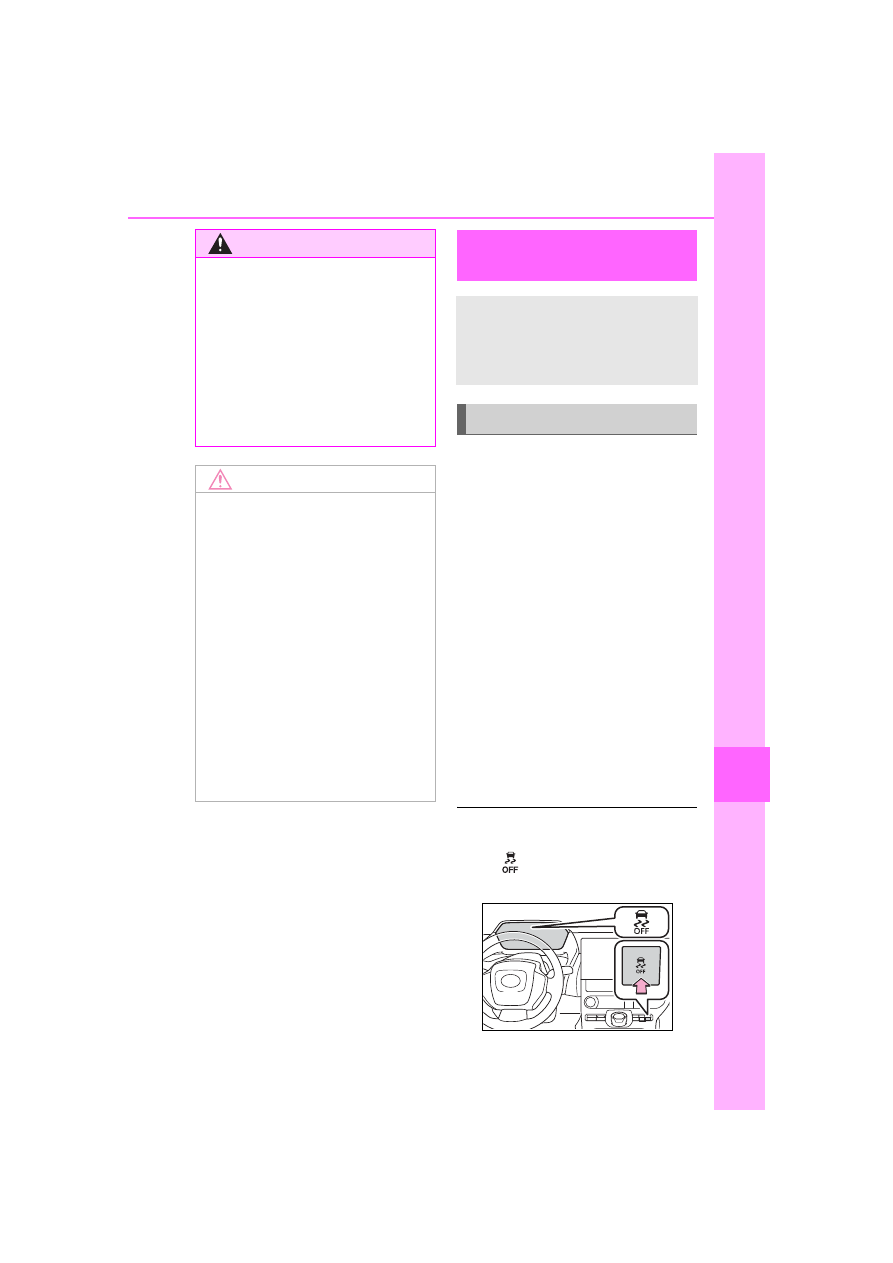
Press 

 to turn off TRAC. 

(

P.388)

WARNING

Keep hands and clothing (espe-

cially a tie, a scarf or a muffler) 

away from the fan. Failure to do 

so may cause the hands or 

clothing to be caught, resulting 

in serious injury.

Do not loosen the coolant reser-

voir cap while the EV system 

and radiator are hot. High tem-

perature steam or coolant could 

spray out.

NOTICE

When adding coolant

Add coolant slowly after the EV 

system has cooled down suffi-

ciently. Adding cool coolant to a 

hot EV system too quickly can 

cause damage to the EV system.

To prevent damage to the 

cooling system

Observe the following precau-

tions:

Avoid contaminating the coolant 

with foreign matter (such as 

sand or dust, etc.).

Do not use water or any other 

coolant when refilling coolant. 

Also, do not use any additive 

agents for the coolant.

If the vehicle becomes 

stuck

Carry out the following pro-
cedures if the tires spin or 
the vehicle becomes stuck 
in mud, dirt or snow:

Recovering procedure

548

8-2. Steps to take in an emergency

WARNING

When attempting to free a 

stuck vehicle

If you choose to push the vehicle 

back and forth to free it, make 

sure the surrounding area is clear 

to avoid striking other vehicles, 

objects or people. The vehicle 

may also lunge forward or lunge 

back suddenly as it becomes free. 

Use extreme caution.

When shifting the shift posi-

tion

Be careful not to shift the shift 

position with the accelerator pedal 

depressed.
This may lead to unexpected 

rapid acceleration of the vehicle 

that may cause an accident 

resulting in death or serious injury.

NOTICE

To avoid damaging the trans-

mission and other compo-

nents

Avoid spinning the tires and 

depressing the accelerator 

pedal more than necessary.

If the vehicle remains stuck 

even after these procedures are 

performed, the vehicle may 

require towing to be freed.

549

9

9

Vehicle

 specifications

Vehicle specifications

9-1. Specifications

Maintenance data .......

550

Tire information ...........

556

9-2. Customization

Customizable features

566

9-3. Initialization

Items to initialize .........

577

550

9-1. Specifications

9-1.Specifications

*

: Unladen vehicle

Vehicle identification num-
ber

The vehicle identification num-
ber (VIN) is the legal identifier 
for your vehicle. This is the pri-
mary identification number for 
your Toyota. It is used in regis-
tering the ownership of your 
vehicle.
This number is on the top left of 
the instrument panel.

This number is also stamped 
under the right-hand front seat.

Maintenance data

Dimensions and weights

Overall length

184.6 in. (4690 mm)

Overall width

73.2 in. (1860 mm)

Overall height

*

65.0 in. (1650 mm)

Wheelbase

112.2 in. (2850 mm)

Tread

Front

63.0 in. (1600 mm)

Rear

63.4 in. (1610 mm)

Vehicle capacity weight (Occupants + luggage)

1045 lb. (475 kg)

Seating capacity

Seating capacity

5 (Front 2, Rear 3)

Vehicle identification

551

9-1. Specifications

9

Vehicle

 specifications

This number is also on the Certi-
fication Regulation Label.

Motor model type and 
motor number

The motor model type and the 
motor number are stamped on 

the motor as shown.

Front electric motor (traction 
motor)

Rear electric motor (traction 
motor) (AWD models)

Front electric motor (traction motor)

Model

2WD

1XM

AWD

1YM

Type

Permanent magnet synchronous motor

Maximum output

2WD

150 kW

AWD

80 kW

Maximum torque

2WD

196.4 ft•lbf (266.3 N•m, 27.2 kgf•m)

AWD

124.3 ft•lbf (168.5 N•m, 17.2 kgf•m)

552

9-1. Specifications

*1

:2WD models

*2

:AWD models

*1

:The coolant capacity is the quantity of reference.

If replacement is necessary, contact your Toyota dealer.

*2

:2WD models

*3

:AWD models

Rear electric motor (traction motor) (AWD models)

Model

1YM

Type

Permanent magnet synchronous motor

Maximum output

80 kW

Maximum torque

124.3 ft•lbf (168.5 N•m, 17.2 kgf•m)

Traction battery

Type

Lithium-ion battery

Voltage

3.7 V/cell

Capacity

201 Ah

*1

205 Ah

*2

Quantity

96 cells

Nominal voltage

355.2 V

Cooling system

Capacity

*1

6.2 qt. (5.9 L, 5.2 Imp. qt.)

*2

7.8 qt. (7.4 L, 6.5 Imp. qt.)

*3

Coolant type

Use either of the following:
• “Toyota Genuine Traction Battery Cool-

ant”

• Similar high-quality ethylene glycol-

based, low electric conductivity coolant, 
non-amine and non-borate coolant with 
azole additives.

Do not use plain water alone.

553

9-1. Specifications

9

Vehicle

 specifications

NOTICE

Cooling system coolant

In order to ensure maximum performance of the traction battery cooling 

system and limit risks of battery short-circuit and other damage to your 

vehicle, Toyota recommends using “Toyota Genuine Traction Battery 

Coolant” or similar high-quality ethylene glycol-based, low electric con-

ductivity coolant, non-amine and non-borate coolant with azole additives.
Toyota cannot guarantee that the use of a product other than “Toyota 

Genuine Traction Battery Coolant” will prevent risks of battery short-circuit 

or other damage.
Never use water as it will cause damage.
Do not reuse coolant that has been removed from the radiator.

Heater system

Capacity

4.2 qt. (4.0 L, 3.5 Imp. qt.)

Coolant type

Use either of the following:
• “Toyota Super Long Life Coolant”
• Similar high-quality ethylene glycol-

based non-silicate, non-amine, non-
nitrite, and non-borate coolant with long-
life hybrid organic acid technology

Do not use plain water alone.

Electrical system (12-volt battery)

Specific voltage reading at 
68°F (20°C):

12.0 V or More
In the case the voltage is less than stan-
dard, charge battery.
(Voltage is checked 20 minutes after the 
motor and all lights turned off.)

Charging rates

5 A max.

554

9-1. Specifications

*

: The fluid capacity is a reference quantity.

If replacement is necessary, contact your Toyota dealer.

*

: The fluid capacity is the quantity of reference.

If replacement is necessary, contact your Toyota dealer.

*1

:Minimum pedal clearance when depressed with a force of 66 lbf (300 N, 

31 kgf) while the EV system is operating.

Front eAxle

Fluid capacity

*

4.1 qt. (3.9 L, 3.4 Imp.qt.)

Fluid type

e-Transaxle Fluid TE

NOTICE

Front eAxle fluid type

Using transaxle fluid other than the above type may cause abnormal 

noise or vibration, or ultimately damage the front eAxle of your vehicle.

Rear eAxle (AWD models)

Fluid capacity

*

3.3 qt. (3.1 L, 2.7 Imp.qt.)

Fluid type

e-Transaxle Fluid TE

NOTICE

Rear eAxle fluid type

Using transaxle fluid other than the above type may cause abnormal 

noise or vibration, or ultimately damage the rear eAxle of your vehicle.

Brakes

Pedal clearance

*1

2.28 in. (58 mm) Min.

Pedal free play

0.04 - 0.24 in. (1.0 - 6.0 mm)

Parking brake indicator

*2

When pushing the parking brake switch for 
1 to 4 seconds: turns off
When pulling the parking brake switch for 
1 to 4 seconds: comes on

Fluid type

FMVSS No.116 DOT 3 or SAE J1703
FMVSS No.116 DOT 4 or SAE J1704

555

9-1. Specifications

9

Vehicle

 specifications

*2

:Make sure to confirm that the brake system warning light (yellow) does 

not illuminate. (If the brake system warning light illuminates, refer to 
P.513)

Vehicles with 18-inch wheels

Vehicles with 20-inch wheels

Steering

Free play

Less than 1.2 in. (30 mm)

Tires and wheels

Tire size

235/60R18 103V

Tire inflation pressure
(Recommended cold tire infla-
tion pressure)

Front:

38 psi (260 kPa, 2.6 kgf/cm

2

 or bar)

Rear:

38 psi (260 kPa, 2.6 kgf/cm

2

 or bar)

Wheel size

18 x 7 1/2J

Wheel bolt torque

103 ft•lbf (140 N•m, 14.3 kgf•m)

Tire size

235/50R20 100V

Tire inflation pressure
(Recommended cold tire infla-
tion pressure)

Front:

38 psi (260 kPa, 2.6 kgf/cm

2

 or bar)

Rear:

38 psi (260 kPa, 2.6 kgf/cm

2

 or bar)

Wheel size

20 x 7 1/2J

Wheel bolt torque

103 ft•lbf (140 N•m, 14.3 kgf•m)

556

9-1. Specifications

Location of treadwear indicators (

P.472)

Load limit at maximum cold tire inflation pressure (

P.560)

Maximum cold tire inflation pressure (

P.560)

This means the pressure to which a tire may be inflated.

Tire size (

P.557)

TUBELESS or TUBE TYPE

A tubeless tire does not have a tube and air is directly put into the tire. A 
tube type tire has a tube inside the tire and the tube maintains the air pres-
sure.

Radial tires or bias-ply tires

A radial tire has “RADIAL” on the sidewall. A tire not marked “RADIAL” is a 
bias-ply tire.

Summer tires or all season tires (

P.472)

An all season tire has “M+S” on the sidewall. A tire not marked “M+S” is a 
summer tire.

Tire ply composition and materials

Plies are layers of rubber-coated parallel cords. Cords are the strands 
which form the plies in a tire.

DOT and Tire Identification Number (TIN) (

P.557)

Tire information

Typical tire symbols

557

9-1. Specifications

9

Vehicle

 specifications

Uniform tire quality grading

For details, see “Uniform Tire Quality Grading” that follows.

Type A

DOT symbol

*

Tire Identification Number 
(TIN)

Tire manufacturer’s identifi-
cation mark

Tire size code

Manufacturer’s optional tire 
type code (3 or 4 letters)

Manufacturing week

Manufacturing year

*

: The DOT symbol certifies that the 

tire conforms to applicable Fed-
eral Motor Vehicle Safety Stan-
dards.

Type B

DOT symbol

*

Tire Identification Number 
(TIN)

Tire manufacturer’s identifi-
cation mark

Manufacturer’s code

Manufacturing week

Manufacturing year

*

: The DOT symbol certifies that the 

tire conforms to applicable Fed-
eral Motor Vehicle Safety Stan-
dards.

Typical tire size information

The illustration indicates typical 
tire size.

Typical DOT and Tire 
Identification Number 
(TIN)

Tire size

558

9-1. Specifications

Section width (millimeters)

Aspect ratio
(tire height to section width)

Tire construction code
(R = Radial, D = Diagonal)

Wheel diameter (inches)

Load index (2 digits or 3 dig-
its)

Speed symbol (alphabet with 
one letter)

Tire dimensions

Section width

Tire height

Wheel diameter

Bead

Sidewall

Shoulder

Tread

Belt

Inner liner

Reinforcing rubber

Carcass

Rim lines

Bead wires

Chafer

This information has been pre-
pared in accordance with regu-
lations issued by the National 
Highway Traffic Safety Adminis-
tration of the U.S. Department of 
Transportation.
It provides the purchasers 
and/or prospective purchasers 
of Toyota vehicles with informa-

Tire section names

Uniform Tire Quality 
Grading

559

9-1. Specifications

9

Vehicle

 specifications

tion on uniform tire quality grad-
ing.

Your Toyota dealer will help answer 
any questions you may have as you 
read this information.

DOT quality grades

All passenger vehicle tires must 
conform to Federal Safety 
Requirements in addition to 
these grades. Quality grades 
can be found where applicable 
on the tire sidewall between 
tread shoulder and maximum 
section width.

For example: Treadwear 200 Trac-
tion AA Temperature A

Treadwear

The treadwear grade is a com-
parative rating based on the 
wear rate of the tire when tested 
under controlled conditions on a 
specified government test 
course.

For example, a tire graded 150 
would wear one and a half (1 - 1/2) 
times as well on the government 
course as a tire graded 100.
The relative performance of tires 
depends upon the actual conditions 
of their use. Performance may differ 
significantly from the norm due to 
variations in driving habits, service 
practices and differences in road 
characteristics and climate.

Traction AA, A, B, C

The traction grades, from high-
est to lowest, are AA, A, B and 
C, and they represent the tire’s 
ability to stop on wet pavement 

as measured under controlled 
conditions on specified govern-
ment test surfaces of asphalt 
and concrete.

A tire marked C may have poor 
traction performance.
Warning: The traction grade 
assigned to this tire is based on 
braking (straight ahead) traction 
tests and does not include corner-
ing (turning) traction.

Temperature A, B, C

The temperature grades are A 
(the highest), B, and C, repre-
senting the tire’s resistance to 
the generation of heat and its 
ability to dissipate heat when 
tested under controlled condi-
tions on a specified indoor labo-
ratory test wheel.

Sustained high temperature can 
cause the material of the tire to 
degenerate and reduce tire life, and 
excessive temperature can lead to 
sudden tire failure.
Grade C corresponds to a level of 
performance which all passenger 
car tires must meet under the Fed-
eral Motor Vehicle Safety Standard 
No. 109.
Grades B and A represent higher 
levels of performance on the labo-
ratory test wheel than the minimum 
required by law.
Warning: The temperature grades 
of a tire assume that it is properly 
inflated and not overloaded.
Excessive speed, underinflation, or 
excessive loading, either sepa-
rately or in combination, can cause 

560

9-1. Specifications

heat buildup and possible tire fail-

ure.

Glossary of tire terminology

Tire related term

Meaning

Cold tire inflation pres-
sure

Tire pressure when the vehicle has been parked 
for three hours or more, or has not been driven 
more than 1 mile or 1.5 km under that condition

Maximum inflation pres-
sure

The maximum cold inflated pressure to which a 
tire may be inflated, shown on the sidewall of 
the tire

Recommended inflation 
pressure

Cold tire inflation pressure recommended by a 
manufacturer

Accessory weight

The combined weight (in excess of those stan-
dard items which may be replaced) of transmis-
sion, power steering, power brakes, power 
windows, power seats, radio and heater, to the 
extent that these items are available as factory-
installed equipment (whether installed or not)

Curb weight

The weight of a motor vehicle with standard 
equipment, including the maximum capacity of 
traction battery and coolant, and if so equipped, 
air conditioning and additional weight optional 
traction motor

Maximum loaded vehicle 
weight

The sum of:
(a) Curb weight
(b) Accessory weight
(c) Vehicle capacity weight
(d) Production options weight

Normal occupant weight

150 lb. (68 kg) times the number of occupants 
specified in the second column of Table 1

*

 that 

follows

Occupant distribution

Distribution of occupants in a vehicle as speci-
fied in the third column of Table 1

*

 below

561

9-1. Specifications

9

Vehicle

 specifications

Production options weight

The combined weight of installed regular pro-
duction options weighing over 5 lb. (2.3 kg) in 
excess of the standard items which they 
replace, not previously considered in curb 
weight or accessory weight, including heavy 
duty brakes, ride levelers, roof rack, heavy duty 
battery, and special trim

Rim

A metal support for a tire or a tire and tube 
assembly upon which the tire beads are seated

Rim diameter
(Wheel diameter)

Nominal diameter of the bead seat

Rim size designation

Rim diameter and width

Rim type designation

The industry manufacturer’s designation for a 
rim by style or code

Rim width

Nominal distance between rim flanges

Vehicle capacity weight 
(Total load capacity)

The rated cargo and luggage load plus 150 lb. 
(68 kg) times the vehicle’s designated seating 
capacity

Vehicle maximum load on 
the tire

The load on an individual tire that is determined 
by distributing to each axle its share of the max-
imum loaded vehicle weight, and dividing by two

Vehicle normal load on 
the tire

The load on an individual tire that is determined 
by distributing to each axle its share of curb 
weight, accessory weight, and normal occupant 
weight (distributed in accordance with Table 1

*


below), and dividing by two

Weather side

The surface area of the rim not covered by the 
inflated tire

Bead

The part of the tire that is made of steel wires, 
wrapped or reinforced by ply cords and that is 
shaped to fit the rim

Bead separation

A breakdown of the bond between components 
in the bead

Bias ply tire

A pneumatic tire in which the ply cords that 
extend to the beads are laid at alternate angles 
substantially less than 90 degrees to the center-
line of the tread

Tire related term

Meaning

562

9-1. Specifications

Carcass

The tire structure, except tread and sidewall 
rubber which, when inflated, bears the load

Chunking

The breaking away of pieces of the tread or 
sidewall

Cord

The strands forming the plies in the tire

Cord separation

The parting of cords from adjacent rubber com-
pounds

Cracking

Any parting within the tread, sidewall, or inner-
liner of the tire extending to cord material

CT

A pneumatic tire with an inverted flange tire and 
rim system in which the rim is designed with rim 
flanges pointed radially inward and the tire is 
designed to fit on the underside of the rim in a 
manner that encloses the rim flanges inside the 
air cavity of the tire

Extra load tire

A tire designed to operate at higher loads and at 
higher inflation pressures than the correspond-
ing standard tire

Groove

The space between two adjacent tread ribs

Innerliner

The layer(s) forming the inside surface of a 
tubeless tire that contains the inflating medium 
within the tire

Innerliner separation

The parting of the innerliner from cord material 
in the carcass

Intended outboard side-
wall

(a)The sidewall that contains a whitewall, bears 
white lettering, or bears manufacturer, brand, 
and/or model name molding that is higher or 
deeper than the same molding on the other 
sidewall of the tire, or
(b)The outward facing sidewall of an asymmetri-
cal tire that has a particular side that must 
always face outward when mounted on a vehi-
cle

Light truck (LT) tire

A tire designated by its manufacturer as primar-
ily intended for use on lightweight trucks or mul-
tipurpose passenger vehicles

Tire related term

Meaning


Content      ..     32      33      34      35     ..