Toyota Camry (2023 year). Manual in english - page 16
 

  Index      Toyota     Toyota Camry (2023 year). Manual in english


Search            copyright infringement  


Content      ..     14      15      16      17     ..


Toyota Camry (2023 year). Manual in english - page 16


259

4-5. Using the driving support systems

4

Drivin

g

Enabling/disabling the pre-collision system

The pre-collision system can be enabled/disabled on 

 (4.2-inch

display) or 

 (7-inch display) (

P. 103, 117) of the multi-informa-

tion display.

Vehicles  without  a  smart  key  system:  The  system  is  automatically
enabled each time the engine switch is turned to the “ON” position.
Vehicles with a smart key system: The system is automatically enabled
each time the engine switch is turned to IGNITION ON mode.

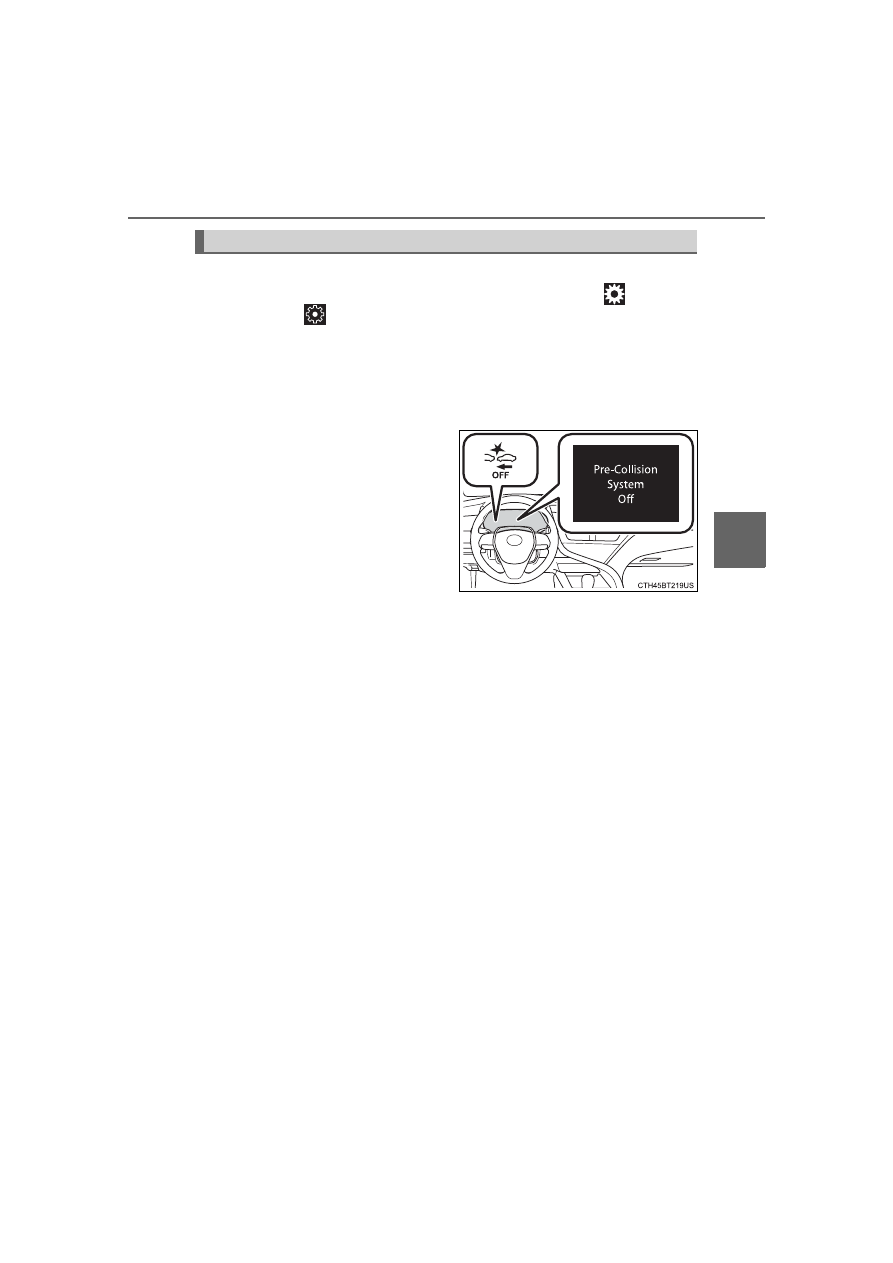
If  the  system  is  disabled,  the
PCS  warning  light  will  turn  on
and  a  message  will  be  dis-
played  on  the  multi-information
display.

Changing settings of the pre-collision system

260

4-5. Using the driving support systems

Changing the pre-collision warning timing

The pre-collision warning timing can be changed on 

 (4.2-inch

display) or 

 (7-inch display) (

P. 103, 117) of the multi-informa-

tion display.

The warning timing setting is retained when the engine switch is turned
off. However, if the pre-collision system is disabled and re-enabled, the
operation timing will return to the default setting (middle).

If the pre-collision warning timing is changed, emergency steering
assist timing will also be changed accordingly.
If late is selected, emergency steering assist would not operate in
case of an emergency.

Early
Middle

This is the default setting.

Late

1

2

3

261

4-5. Using the driving support systems

4

Drivin

g

Operational conditions for each pre-collision function

The pre-collision system is enabled and the system determines that the pos-
sibility of a frontal collision with a detected object is high.
The system may not operate in the following situations:

• If  a  battery  terminal  has  been  disconnected  and  reconnected  and  then

the vehicle has not been driven for a certain amount of time

• If the shift lever is in R
• When the VSC OFF indicator is illuminated (only the pre-collision warning

function will be operational)
The  operation  speeds  and  operation  cancellation  for  each  function  is
listed below.

Pre-collision warning

While the pre-collision warning function is operating, if the steering wheel is
operated heavily or suddenly, the pre-collision warning may be cancelled.

Pre-collision brake assist

Detectable objects

Vehicle speed

Relative speed 

between your vehicle 

and object

Preceding 

and

stopped vehicles

Approx. 7 to 110 mph (10 to
180 km/h)

Approx. 7 to 110 mph
(10 to 180 km/h)

Oncoming  vehi-
cles

Approx. 7 to 110 mph (10 to
180 km/h)

Approx.  13  to  110
mph (20 to 180 km/h)

Bicyclists 

and

pedestrians

Approx.  7  to  50  mph  (10  to
80 km/h)

Approx.  7  to  50  mph
(10 to 80 km/h)

Detectable objects

Vehicle speed

Relative speed 

between your vehicle 

and object

Preceding 

and

stopped vehicles

Approx.  20  to  110  mph  (30
to 180 km/h)

Approx.  20  to  110
mph (30 to 180 km/h)

Bicyclists 

and

pedestrians

Approx. 20 to 50 mph (30 to
80 km/h)

Approx. 20 to 50 mph
(30 to 80 km/h)

262

4-5. Using the driving support systems

Pre-collision braking

If  either  of  the  following  occur  while  the  pre-collision  braking  function  is
operating, it will be canceled:
• The accelerator pedal is depressed strongly.
• The steering wheel is turned sharply or abruptly.

Emergency steering assist
When the turn signal lights are flashing, emergency steering assist will not
operate in case of an emergency.

If any of the following occur while the emergency steering assist function is
operating, it will be canceled:
• The accelerator pedal is depressed strongly.
• The steering wheel is turned sharply or abruptly.
• The brake pedal is depressed.

Detectable objects

Vehicle speed

Relative speed 

between your vehicle 

and object

Preceding 

and

stopped vehicles

Approx. 7 to 110 mph (10 to
180 km/h)

Approx. 7 to 110 mph
(10 to 180 km/h)

Oncoming  vehi-
cles

Approx. 7 to 110 mph (10 to
180 km/h)

Approx.  13  to  110
mph (20 to 180 km/h)

Bicyclists 

and

pedestrians

Approx.  7  to  50  mph  (10  to
80 km/h)

Approx.  7  to  50  mph
(10 to 80 km/h)

Detectable objects

Vehicle speed

Relative speed 

between your vehicle 

and object

Preceding 

and

stopped  vehicles,
bicyclists 

and

pedestrians

Approx. 25 to 50 mph (40 to
80 km/h)

Approx. 25 to 50 mph
(40 to 80 km/h)

263

4-5. Using the driving support systems

4

Drivin

g

Intersection right/left turn assistance (pre-collision warning)
When the turn signal lights are not flashing, support for turning left or right
at an intersection which targets oncoming vehicles does not work.

Intersection right/left turn assistance (pre-collision braking)
When the turn signal lights are not flashing, support for turning left or right
at an intersection which targets oncoming vehicles does not work.

Object detection function

Detectable 

objects

Vehicle speed

Oncoming vehi-

cle speed

Relative speed 

between your 

vehicle and object

Oncoming
vehicles

Approx.  7  to  15
mph  (10  to  25
km/h)

Approx.  20  to  35
mph  (30  to  55
km/h)

Approx.  25  to  50
mph  (40  to  80
km/h)

Pedestrians

Approx.  7  to  15
mph  (10  to  25
km/h)

Approx.  7  to  15
mph  (10  to  25
km/h)

Detectable 

objects

Vehicle speed

Oncoming vehi-

cle speed

Relative speed 

between your 

vehicle and object

Oncoming
vehicles

Approx.  10  to  15
mph  (15  to  25
km/h)

Approx.  20  to  28
mph  (30  to  45
km/h)

Approx.  28  to  43
mph  (45  to  70
km/h)

Pedestrians

Approx.  7  to  15
mph  (10  to  25
km/h)

Approx.  7  to  15
mph  (10  to  25
km/h)

The  system  detects  objects  based  on
their  size,  profile,  motion,  etc.  However,
an object may not be detected depending
on  the  surrounding  brightness  and  the
motion,  posture,  and  angle  of  the
detected  object,  preventing  the  system
from operating properly. (

P. 266)

The illustration shows an image of detect-
able objects.

264

4-5. Using the driving support systems

Conditions under which the system may operate even if there is no pos-
sibility of a collision

In  some  situations  such  as  the  following,  the  system  may  determine  that
there is a possibility of a frontal collision and operate.
• When passing a detectable object, etc.
• When changing lanes while overtaking a detectable object, etc.

• When rapidly closing on a detectable object, etc.
• When approaching objects on the roadside, such as detectable objects,

guardrails, utility poles, trees, or walls

• When there are patterns or paint in front of your vehicle that may be mis-

taken for a detectable object

• When the front of your vehicle is hit by water, snow, dust, etc.

• When  approaching  a  detectable

object  in  an  adjacent  lane  or  on  the
roadside, such as when changing the
course of travel or driving on a wind-
ing road

• When  there  is  a  detectable  object  or

other  object  by  the  roadside  at  the
entrance of a curve

• When  overtaking  a  detectable  object

that  is  changing  lanes  or  making  a
right/left turn

• When  passing  a  detectable  object  in

an  oncoming  lane  that  is  stopped  to
make a right/left turn

265

4-5. Using the driving support systems

4

Drivin

g

• When a detectable object approaches very close and then stops before

entering the path of your vehicle

• If  the  front  of  your  vehicle  is  raised  or  lowered,  such  as  when  on  an

uneven or undulating road surface

• When driving on a road surrounded by a structure, such as in a tunnel or

on an iron bridge

• When there is a metal object (manhole cover, steel plate, etc.), steps, or a

protrusion in front of your vehicle

• When  approaching  an  electric  toll  gate  barrier,  parking  area  barrier,  or

other barrier that opens and closes

• When using an automatic car wash

• When driving through steam or smoke
• When  driving  near  an  object  that  reflects  radio  waves,  such  as  a  large

truck or guardrail

• When driving near a TV tower, broadcasting station, electric power plant,

radar equipped vehicles, etc., or other location where strong radio waves
or electrical noise may be present

• When  there  are  many  things  which  can  reflect  the  radio  waves  of  the

radar in the vicinity (tunnels, truss bridges, gravel roads, snow covered
road that have tracks, etc.)

• While  making  a  right/left  turn, when an  oncoming  vehicle  or a  crossing

pedestrian has already exited the path of your vehicle

• While making a right/left turn, closely in front of an oncoming vehicle or a

crossing pedestrian.

• While  making  a  right/left  turn, when an  oncoming  vehicle  or a  crossing

pedestrian stops before entering the path of your vehicle

• When  passing  under  an  object  (road

sign, billboard, etc.)

• When  driving  through  or  under

objects that may contact your vehicle,
such as thick grass, tree branches, or
a banner

266

4-5. Using the driving support systems

• While steering into the direction of oncoming traffic

Situations in which the system may not operate properly

In some situations such as the following, an object may not be detected by
the  radar  sensor  and  front  camera,  preventing  the  system  from  operating
properly:
• When a detectable object is approaching your vehicle
• When your vehicle or a detectable object is wobbling
• If a detectable object makes an abrupt maneuver (such as sudden swerv-

ing, acceleration or deceleration)

• When your vehicle approaches a detectable object rapidly

• When a detectable object is near a wall, fence, guardrail, manhole cover,

vehicle, steel plate on the road, etc.

• When a detectable object is under a structure
• When part of a detectable object is hidden by an object, such as  large

baggage, an umbrella, or guardrail

• When  there  are  many  things  which  can  reflect  the  radio  waves  of  the

radar in the vicinity (tunnels, truss bridges, gravel roads, snow covered
road that have tracks, etc.)

• When there is an effect on the radio waves to the radar that is installed on

another vehicle

• When multiple detectable objects are close together
• If the sun or other light is shining directly on a detectable object
• When a detectable object is a shade of white and looks extremely bright
• When a detectable object appears to be nearly the same color or bright-

ness as its surroundings

• If a detectable object cuts or suddenly emerges in front of your vehicle
• When the front of your vehicle is hit by water, snow, dust, etc.
• When  a  very  bright  light  ahead,  such  as  the  sun  or  the  headlights  of

oncoming traffic, shines directly into the front camera

• When approaching the side or front of a vehicle ahead
• If a vehicle ahead is a motorcycle

• While  making  a  right/left  turn,  when

an oncoming vehicle turns right/left in
front of your vehicle

• When  a  detectable  object  is  not

directly in front of your vehicle

267

4-5. Using the driving support systems

4

Drivin

g

• If a vehicle ahead is narrow, such as a personal mobility vehicle
• If a preceding vehicle has a small rear end, such as an unloaded truck

• If a vehicle ahead is carrying a load which protrudes past its rear bumper
• If a vehicle ahead is irregularly shaped, such as a tractor or side car
• If a vehicle ahead is a child sized bicycle, a bicycle that is carrying a large

load,  a  bicycle  ridden  by  more  than  one  person,  or  a  uniquely  shaped
bicycle (bicycle with a child seat, tandem bicycle, etc.)

• If  a  pedestrian/  or  the  riding  height  of  a  bicyclist  ahead  is  shorter  than

approximately 3.2 ft. (1 m) or taller than approximately 6.5 ft. (2 m)

• If  a  pedestrian/bicyclist  is  wearing  oversized  clothing  (a  rain  coat,  long

skirt, etc.), making their silhouette obscure

• If a pedestrian is bending forward or squatting or bicyclist is bending for-

ward

• If a pedestrian/bicyclist is moving fast
• If a pedestrian is pushing a stroller, wheelchair, bicycle or other vehicle
• When  driving  in  inclement  weather  such  as  heavy  rain,  fog,  snow  or  a

sandstorm

• When driving through steam or smoke
• When the surrounding area is dim, such as at dawn or dusk, or while at

night or in a tunnel, making a detectable object appear to be nearly the
same color as its surroundings

• When driving in a place where the surrounding brightness changes sud-

denly, such as at the entrance or exit of a tunnel

• After the engine has started the vehicle has not been driven for a certain

amount of time

• While making a left/right turn and for a few seconds after making a left/

right turn

• While driving on a curve and for a few seconds after driving on a curve
• If your vehicle is skidding

• If a preceding vehicle has a low rear

end, such as a low bed trailer

• If a vehicle ahead has extremely high

ground clearance

268

4-5. Using the driving support systems

• If the wheels are misaligned
• If a wiper blade is blocking the front camera
• The vehicle is being driven at extremely high speeds
• When driving on a hill
• If the radar sensor or front camera is misaligned
• When  driving  in  a  traffic  lane  separated  by  more  than  one  lane  where

oncoming vehicles are driving while making a right/left turn

In addition to the above, in some situations, such as the following, the emer-
gency steering assist may not operate.
• When the white (yellow) lane lines are difficult to see, such as when they

are faint, diverging/merging, or a shadow is cast upon them

• When the lane is wider or narrower than normal
• When there is a light and dark pattern on the road surface, such as due to

road repairs

• When the target is too close
• When there is insufficient safe or unobstructed space for the vehicle to be

steered into

• If oncoming vehicle is present
• If VSC function is operating

• If the front of  the vehicle  is  raised  or

lowered

• When  largely  out  of  place  with  the

opposite  facing  targeted  oncoming
vehicle during a right/left turn

• While making a right/left turn, when a

pedestrian  approaches  from  behind
or side of your vehicle

269

4-5. Using the driving support systems

4

Drivin

g

In some situations such as the following, sufficient braking force or steering
force may not be obtained, preventing the system from performing properly:
• If the braking functions cannot operate to their full extent, such as when

the brake parts are extremely cold, extremely hot, or wet

• If the vehicle is not properly maintained (brakes or tires are excessively

worn, improper tire inflation pressure, etc.)

• When the vehicle is being driven on a gravel road or other slippery sur-

face

• When the road surface has deep wheel tracks
• When driving on a hill road
• When driving on a road that has inclines to the left or right

If VSC is disabled

If VSC is disabled (

P. 324), the pre-collision brake assist and pre-collision

braking functions are also disabled.

The PCS warning light will turn on and “VSC Turned Off Pre-Collision Brake
System Unavailable” will be displayed on the multi-information display.

270

4-5. Using the driving support systems

While driving on a road with clear white (yellow) lane lines, the LTA
system  warns  the  driver  if  the  vehicle  may  deviate  from  the  current
lane or course

*

, and also can  slightly operate the steering wheel to

help avoid deviation from the lane or course

*

. Also, while the dynamic

radar cruise control with full-speed range or dynamic radar cruise con-
trol is operating, this system will operate the steering wheel to main-
tain the vehicle’s lane position.
The LTA system recognizes white
(yellow)  lane  lines  or  a  course

*

using  the  front  camera. Addition-
ally,  it  detects  preceding  vehicles
using the front camera and radar.

*

: Boundary between asphalt and the side of the road, such as grass, soil, or

a curb

LTA (Lane Tracing Assist)

Summary of functions

WARNING

Before using LTA system

Do not rely solely upon the LTA system. The LTA system does not auto-
matically drive the vehicle or reduce the amount of attention that must be
paid to the area in front of the vehicle. The driver must always assume full
responsibility for driving safely by paying careful attention to the surround-
ing conditions and operating the steering wheel to correct the path of the
vehicle. Also, the driver must take adequate breaks when fatigued, such
as from driving for a long period of time.

Failure to perform appropriate driving operations and pay careful attention
may lead to an accident, resulting in death or serious injury.

271

4-5. Using the driving support systems

4

D

riv

in

g

WARNING

Situations unsuitable for LTA system

In the following situations, use the LTA switch to turn the system off. Failure
to do so may lead to an accident, resulting in death or serious injury.

Vehicle is driven on a road surface which is slippery due to rainy weather,
fallen snow, freezing, etc.

Vehicle is driven on a snow-covered road.

White (yellow) lines are difficult to see due to rain, snow, fog, dust, etc.

Vehicle is driven in a temporary lane or restricted lane due to construction
work.

Vehicle is driven in a construction zone.

A spare tire, tire chains, etc. are equipped.

When the tires have been excessively worn, or when the tire inflation pres-
sure is low.

During emergency towing

Preventing  LTA  system  malfunctions  and  operations  performed  by
mistake

Do not modify the headlights or place stickers, etc. on the surface of the
lights.

Do  not  modify  the  suspension  etc.  If  the  suspension  etc.  needs  to  be
replaced, contact your Toyota dealer.

Do not install or place anything on the hood or grille. Also, do not install a
grille guard (bull bars, kangaroo bar, etc.).

If your windshield needs repairs, contact your Toyota dealer.

272

4-5. Using the driving support systems

WARNING

Conditions in which functions may not operate properly

In the following situations, the functions may not operate properly and the
vehicle  may  depart  from  its  lane.  Drive  safely  by  always  paying  careful
attention to your surroundings and operate the steering wheel to correct the
path of the vehicle without relying solely on the functions.

When  the  follow-up  cruising display is displayed (

P. 280)  and  the  pre-

ceding vehicle is swaying. (Your vehicle may sway accordingly and depart
from the lane.)

When  the  follow-up  cruising display is displayed (

P. 280)  and  the  pre-

ceding vehicle departs from its lane. (Your vehicle may follow the preced-
ing vehicle and depart from the lane.)

When  the  follow-up  cruising display is displayed (

P. 280)  and  the  pre-

ceding  vehicle  is  being  driven  extremely  close  to  the  left/right  lane  line.
(Your vehicle may follow the preceding vehicle and depart from the lane.)

Vehicle is being driven around a sharp curve.

When  the  follow-up  cruising  display  is
displayed (

P. 280) and the preceding

vehicle  changes  lanes.  (Your  vehicle
may  follow  the  preceding  vehicle  and
also change lanes.)

Objects  or  patterns  that  could  be  mis-
taken  for  white  (yellow)  lines  are  pres-
ent on the side of the road (guardrails,
reflective poles, etc.).

273

4-5. Using the driving support systems

4

D

riv

in

g

WARNING

There are shadows on the road that run parallel with, or cover, the white
(yellow) lines.

The  vehicle  is  driven  in  an  area  without  white  (yellow)  lines,  such  as  in
front of a tollgate or checkpoint, or at an intersection, etc.

The  white  (yellow)  lines  are  cracked,  “Botts’  dots”,  “Raised  pavement
marker” or stones are present.

The white (yellow) lines cannot be seen or are difficult to see due to sand,
etc.

The vehicle is driven on a road surface that is wet due to rain, puddles,
etc.

The traffic lines are yellow (which may be more difficult to recognize than
lines that are white).

The white (yellow) lines cross over a curb, etc.

The vehicle is driven on a bright surface, such as concrete.

If the edge of the road is not clear or straight.

The vehicle is driven on a surface that is bright due to reflected light, etc.

The vehicle is driven in an area where the brightness changes suddenly,
such as at the entrances and exits of tunnels, etc.

Vehicle  is  driven  where  the  road
diverges, merges, etc.

Repair marks of asphalt, white (yellow)
lines,  etc.  are  present  due  to  road
repair.

274

4-5. Using the driving support systems

WARNING

Light from the headlights of an oncoming vehicle, the sun, etc. enters the
camera.

The vehicle is driven on a slope.

The vehicle is driven on a road which tilts left or right, or a winding road.

The vehicle is driven on an unpaved or rough road.

The traffic lane is excessively narrow or wide.

The  vehicle  is  extremely  tilted  due  to  carrying  heavy  luggage  or  having
improper tire pressure.

The distance to the preceding vehicle is extremely short.

The vehicle is moving up and down a large amount due to road conditions
during driving (poor roads or road seams).

When driving in a tunnel or at night with the headlights off or when a head-
light is dim due to its lens being dirty or it being misaligned.

The vehicle is struck by a crosswind.

The vehicle is affected by wind from a vehicle driven in a nearby lane.

The vehicle has just changed lanes or crossed an intersection.

Tires  which  differ  by  structure,  manufacturer,  brand  or  tread  pattern  are
used.

When tires of a size other than specified are installed.

Snow tires, etc. are equipped.

The vehicle is being driven at extremely high speeds.


Content      ..     14      15      16      17     ..