Toyota Yaris Cross (2022 year). Manual in english - page 21
 

  Index      Toyota     Toyota Yaris Cross (2022 year). Manual in english


Search            copyright infringement  


Content      ..     19      20      21      22     ..


Toyota Yaris Cross (2022 year). Manual in english - page 21


338

n

5-4. Other interior features

1

To set the visor in the forward 
position, flip it down.

2

To set the visor in the side posi-
tion, flip down, unhook, and 
swing it to the side.

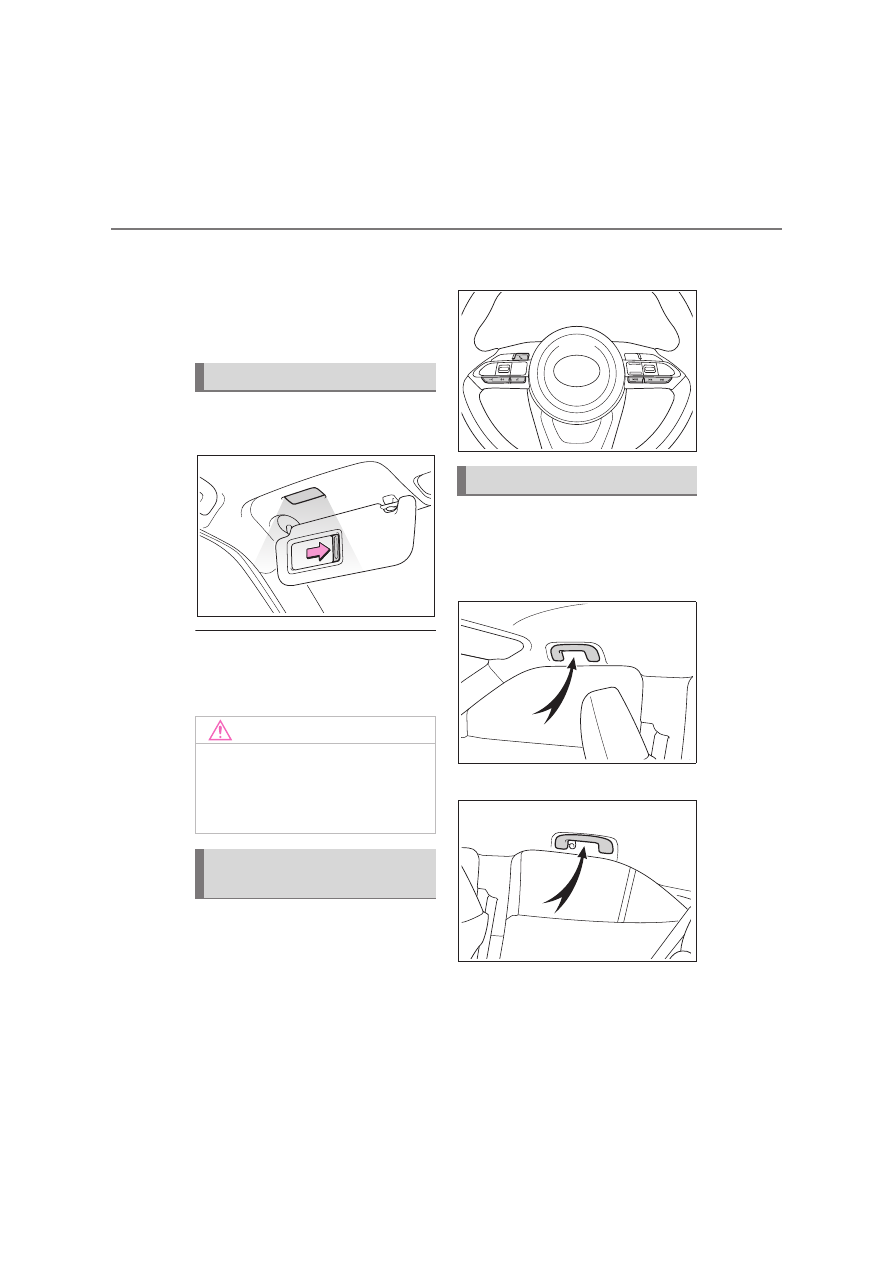
Slide the cover to open.

The vanity light turns on. (if equipped)

To prevent battery discharge

If the vanity lights remain on when the 
engine switch is OFF, the lights will go 

off automatically after 20 minutes.

Some audio features can be con-
trolled using the switches on the 
steering wheel.
Operation may differ depending on 
the type of audio system or naviga-
tion system. For details, refer to the 

manual provided with the audio 
system or navigation system.

An assist grip installed on the ceil-
ing can be used to support your 
body while sitting on the seat.

Front

Rear (if equipped)

Vanity mirrors (if equipped)

NOTICE

To prevent the battery from being 

discharged

Do not leave the vanity lights on for 
extended periods while the engine is 

stopped.

Using the steering wheel 
switches

Assist grips

339

5

n

5-4. Other interior features

Interior features

The coat hooks are provided with 
the rear assist grips. (type A only)

Type A

Type B

The panoramic roof shade can be 
opened and closed manually.

Opening the panoramic roof 
shade

Pushing the tabs will release the 
lock, and the shade can be opened.

Closing the panoramic roof 
shade

Pull the tabs to the lock position to 
close the shade.

WARNING

Assist grip

Do not use the assist grip when get-
ting in or out of the vehicle or rising 

from your seat.

NOTICE

To prevent damage to the assist 

grip

Do not hang any heavy object or put a 
heavy load on the assist grip.

Coat hooks

WARNING

Items that cannot be hung on the 

coat hook

Do not hang coat hangers or other 

hard or sharp objects on the hook. If 

the SRS curtain shield airbags deploy, 
these items may become projectiles, 

causing death or serious injury.

Panoramic roof shade (if 
equipped)

340

n

5-4. Other interior features

6

341

n

6

Mai
ntenanc

e and c

are

Maintenance and care

6-1. Maintenance and care

Cleaning and protecting the 

vehicle exterior ...............

342

Cleaning and protecting the 

vehicle interior ................

345

6-2. Maintenance

Maintenance requirements

348

6-3. Do-it-yourself maintenance

Do-it-yourself service precau-

tions................................

350

Hood .................................

351

Positioning a floor jack......

353

Engine compartment ........

354

Tires..................................

363

Tire inflation pressure .......

373

Wheels..............................

374

Air conditioning filter .........

376

Wireless remote control/elec-

tronic key battery ............

378

Checking and replacing fuses

.......................................

381

Light bulbs ........................

386

342

n

6-1. Maintenance and care

6-1.Maintenance and care

Working from top to bottom, lib-
erally apply water to the vehicle 
body, wheel wells and underside 
of the vehicle to remove any dirt 
and dust.

Wash the vehicle body using a 
sponge or soft cloth, such as a 
chamois.

For hard-to-remove marks, use 
car wash soap and rinse thor-
oughly with water.

Wipe away any water.

Wax the vehicle when the water-
proof coating deteriorates.

If water does not bead on a clean sur-
face, apply wax when the vehicle body 
is cool.

Automatic car washes

Before washing the vehicle:

• Fold the mirrors.
Start washing from the front of the vehi-
cle. Extend the mirrors before driving.

Turn off the power back door (if 

equipped).

Brushes used in automatic car 

washes may scratch the vehicle sur-
face, parts (wheel, etc.) and harm 

your vehicle’s paint.

In certain automatic car washes, the 

rear spoiler may interfere with 
machine operation. This may prevent 

the vehicle from being cleaned prop-

erly or result in damage to the rear 
spoiler.

High pressure car washes

As water may enter the cabin, do not 

bring the nozzle tip near the gaps 
around the doors or perimeter of the 

windows, or spray these areas continu-

ously.

When using a car wash (vehicles 
with a smart entry & start system)

If the door handle becomes wet while 

the electronic key is within the effective 
range, the door may lock and unlock 

repeatedly. In that case, follow the fol-

lowing correction procedures to wash 
the vehicle:

Place the key in a position 2 m (6 ft.) 
or more separate from the vehicle 

while the vehicle is being washed. 

(Take care to ensure that the key is 
not stolen.)

Set the electronic key to battery-sav-
ing mode to disable the smart entry & 

start system. (

P.137)

Wheels and wheel ornaments (if 

equipped)

Remove any dirt immediately by using 

a neutral detergent.

Wash detergent off with water immedi-

ately after use.

To protect the paint from damage, 

make sure to observe the following 
precautions.

• Do not use acidic, alkaline or abrasive 

detergent

• Do not use hard brushes

• Do not use detergent on the wheels 

when they are hot, such as after driv-
ing or parking in hot weather

Bumpers

Do not scrub with abrasive cleaners.

Plated portions (if equipped)

If dirt cannot be removed, clean the 
parts as follows:

Cleaning and protecting 

the vehicle exterior

Perform cleaning in a manner 
appropriate to each compo-
nent and its material.

Cleaning instructions

343

6

n

6-1. Maintenance and care

Mai
ntenanc

e and c

are

Use a soft cloth dampened with an 
approximately 5% solution of neutral 

detergent and water to clean the dirt 

off.

Wipe the surface with a dry, soft cloth 

to remove any remaining moisture.

To remove oily deposits, use alcohol 

wet wipes or a similar product.

WARNING

When washing the vehicle

Do not apply water to the inside of the 

engine compartment. Doing so may 
cause the electrical components, etc. 

to catch fire.

When cleaning the windshield 

(vehicles with rain-sensing wind-

shield wipers)

Set the wiper switch to off. If the wiper 

switch is in “AUTO”, the wipers may 

operate unexpectedly in the following 
situations, and may result in hands 

being caught or other serious injuries 

and cause damage to the wiper 
blades.

Off

AUTO

When the upper part of the wind-

shield where the raindrop sensor is 
located is touched by hand

When a wet rag or similar is held 
close to the raindrop sensor

If something bumps against the 
windshield

If you directly touch the raindrop 

sensor body or if something bumps 

into the raindrop sensor

Precautions regarding the 

exhaust pipe

Exhaust gasses cause the exhaust 

pipe to become quite hot.

When washing the vehicle, be careful 
not to touch the pipe until it has 

cooled sufficiently, as touching a hot 

exhaust pipe can cause burns.

Precaution regarding the rear 

bumper with Blind Spot Monitor 
(if equipped)

If the paint of the rear bumper is 

chipped or scratched, the system may 
malfunction. If this occurs, consult 

with any authorized Toyota retailer or 

Toyota authorized repairer, or any reli-
able repairer.

NOTICE

To prevent paint deterioration 

and corrosion on the body and 
components (aluminum wheels, 

etc.)

Wash the vehicle immediately in the 
following cases:

• After driving near the sea coast

• After driving on salted roads

• If coal tar or tree sap is present on 

the paint surface

• If dead insects, insect droppings or 

bird droppings are present on the 

paint surface

• After driving in an area contami-

nated with soot, oily smoke, mine 
dust, iron powder or chemical sub-

stances

• If the vehicle becomes heavily 

soiled with dust or mud

344

n

6-1. Maintenance and care

NOTICE

• If liquids such as benzene and gas-

oline are spilled on the paint sur-
face

If the paint is chipped or scratched, 
have it repaired immediately.

To prevent the wheels from corrod-
ing, remove any dirt and store in a 

place with low humidity when stor-

ing the wheels.

Cleaning the exterior lights

Wash carefully. Do not use organic 
substances or scrub with a hard 

brush.

This may damage the surfaces of 
the lights.

Do not apply wax to the surfaces of 
the lights.

Wax may cause damage to the 

lenses.

To prevent damage to the wind-

shield wiper arms

When lifting the wiper arms away 

from the windshield, pull the driver 

side wiper arm upward first, and 
repeat for the passenger side. When 

returning the wipers to their original 

position, do so from the passenger 
side first.

When using an automatic car 
wash (vehicles with rain-sensing 

windshield wipers)

Set the wiper switch to the off posi-
tion. If the wiper switch is in “AUTO”, 

the wipers may operate and the wiper 

blades may be damaged.

When using a high pressure car 

wash

Vehicles with rear view monitor sys-
tem: When washing the vehicle, do 

not spray the camera or its sur-

rounding area directly with a high 
pressure washer. Shock applied 

from high pressure water may 

cause the device to not operate 
normally.

Vehicles with Toyota Safety Sense: 
Do not spray water directly on the 

radar which is equipped behind the 

emblem. Otherwise it may cause 
the device to be damaged.

Do not bring the nozzle tip close to 
boots (rubber or resin manufac-

tured cover), connectors or the fol-

lowing parts. The parts may be 
damaged if they come into contact 

with high-pressure water.

• Traction related parts

• Steering parts

• Suspension parts

• Brake parts

Keep the cleaning nozzle at least 
30 cm (11.9 in.) away from the vehi-

cles body. Otherwise resin section, 

such as moldings and bumpers, 
may be deformed and damaged. 

Also, do not continuously hold the 

nozzle in the same place.

Do not spray the lower part of the 

windshield continuously. If water 
enters the air conditioning system 

intake located near the lower part of 

the windshield, the air conditioning 
system may not operate correctly.

Do not wash the underside of the 
vehicle using a high pressure car 

washer.

345

6

n

6-1. Maintenance and care

Mai
ntenanc

e and c

are

Remove dirt and dust using a 
vacuum cleaner. Wipe dirty sur-
faces with a cloth dampened with 
lukewarm water.

If dirt cannot be removed, wipe it 
off with a soft cloth dampened 
with neutral detergent diluted to 
approximately 1%.
Wring out any excess water from 
the cloth and thoroughly wipe off 
remaining traces of detergent 
and water.

Shampooing the carpets

There are several commercial foaming-
type cleaners available. Use a sponge 

or brush to apply the foam. Rub in over-

lapping circles. Do not use water. Wipe 
dirty surfaces and let them dry. Excellent 

results are obtained by keeping the car-

pet as dry as possible.

Handling the seat belts

Clean with mild soap and lukewarm 

water using a cloth or sponge. Also 

check the belts periodically for exces-
sive wear, fraying or cuts.

Cleaning and protecting 

the vehicle interior

Perform cleaning in a manner 
appropriate to each compo-
nent and its material.

Protecting the vehicle inte-
rior

WARNING

Water in the vehicle

Do not splash or spill liquid in the 
vehicle.

Doing so may cause electrical com-

ponents, etc. to malfunction or 
catch fire.

Do not get any of the SRS compo-
nents or wiring in the vehicle interior 

wet. (

P.38)

An electrical malfunction may 
cause the airbags to deploy or not 

function properly, resulting in death 

or serious injury.

Vehicles with wireless charger:

Do not let the wireless charger 
(

P.333) get wet. Failure to do so 

may cause the charger to become 

hot and cause burns or could cause 
electric shock resulting in death or 

serious injury.

Cleaning the interior (especially 

instrument panel)

Do not use a polish wax or polish 
cleaner. The instrument panel may 

reflect off the windshield, obstructing 

the driver’s view and leading to an 
accident, resulting in death or serious 

injury.

NOTICE

Cleaning detergents

Do not use the following types of 
detergent, as they may discolor the 

vehicle interior or cause streaks or 

damage to painted surfaces:

• Non-seat portions: Organic sub-

stances such as benzene or gaso-

line, alkaline or acidic solutions, 
dye, and bleach

• Seats: Alkaline or acidic solutions, 

such as thinner, benzene, and alco-
hol

346

n

6-1. Maintenance and care

Remove dirt using a water-
dampened soft cloth or synthetic 
chamois.

Wipe the surface with a dry, soft 
cloth to remove any remaining 
moisture.

Cleaning the areas with satin-finish 
metal accents

The metal areas use a layer of real 

metal for the surface. It is necessary to 
clean them regularly. If dirty areas are 

left uncleaned for long periods of time, 

they may be difficult to clean.

Remove dirt and dust using a 
vacuum cleaner.

Wipe off any excess dirt and dust 
with a soft cloth dampened with 
diluted detergent.

Use a diluted water solution of approxi-
mately 5% neutral wool detergent.

Wring out any excess water from 

NOTICE

Do not use a polish wax or polish 

cleaner. The instrument panel’s or 
other interior part’s painted surface 

may be damaged.

Preventing damage to leather 

surfaces

Observe the following precautions to 
avoid damage to and deterioration of 

leather surfaces:

Remove any dust or dirt from 
leather surfaces immediately.

Do not expose the vehicle to direct 
sunlight for extended periods of 

time. Park the vehicle in the shade, 

especially during summer.

Do not place items made of vinyl, 

plastic, or containing wax on the 
upholstery, as they may stick to the 

leather surface if the vehicle interior 

heats up significantly.

Water on the floor

Do not wash the vehicle floor with 
water.

Vehicle systems such as the audio 

system may be damaged if water 
comes into contact with electrical 

components such as the audio sys-

tem above or under the floor of the 
vehicle. Water may also cause the 

body to rust.

When cleaning the inside of the 

windshield (vehicles with Toyota 

Safety Sense)

Do not allow glass cleaner to contact 

the lens. Also, do not touch the lens. 

(

P.212)

Cleaning the inside of the rear 

window

Do not use glass cleaner to clean 
the rear window, as this may cause 

damage to the rear window defog-

ger heater wires or antenna. Use a 
cloth dampened with lukewarm 

water to gently wipe the window 

clean. Wipe the window in strokes 
running parallel to the heater wires 

or antenna.

Be careful not to scratch or damage 

the heater wires or antenna.

Cleaning the areas with 
satin-finish metal accents

Cleaning the leather areas

347

6

n

6-1. Maintenance and care

Mai
ntenanc

e and c

are

the cloth and thoroughly wipe off 
all remaining traces of detergent.

Wipe the surface with a dry, soft 
cloth to remove any remaining 
moisture. Allow the leather to dry 
in a shaded and ventilated area.

Caring for leather areas

Toyota recommends cleaning the inte-

rior of the vehicle at least twice a year to 
maintain the quality of the vehicle’s inte-

rior.

Remove dirt and dust using a 
vacuum cleaner.

Wipe it off with a soft cloth damp-
ened with neutral detergent 
diluted to approximately 1%.

Wring out any excess water from 
the cloth and thoroughly wipe off 
remaining traces of detergent 
and water.

Cleaning the synthetic 
leather areas

348

n

6-2. Maintenance

6-2.Maintenance

Where to go for maintenance ser-
vice?

In order to maintain your vehicle in the 

best possible condition, Toyota recom-
mends that maintenance service opera-

tions as well as other inspections and 

repairs be carried out by authorized 
Toyota retailers or Toyota authorized 

repairers, or any reliable repairers. For 

repairs and services covered by your 
warranty, please visit an authorized 

Toyota retailer or repairer, who will use 

genuine Toyota parts in repairing any 
difficulties you may encounter. There 

can also be advantages in utilizing 

authorized Toyota retailers or repairers 
for non-warranty repairs and services, 

as members of the Toyota network will 

be able to expertly assist you with any 
difficulties you may encounter.
Your Toyota retailer or Toyota authorized 
repairer, or any reliable repairer will per-

form all of the scheduled maintenance 

on your vehicle reliably and economi-
cally due to their experience with Toyota 

vehicles.

Scheduled maintenance should be 
performed at specified intervals 
according to the maintenance 
schedule.

For full details of your maintenance 
schedule, read the “Toyota Service 
Booklet” or “Toyota Warranty Booklet”.

What about do-it-yourself mainte-
nance?

Many of the maintenance items are 
easy to do yourself if you have a little 
mechanical ability and a few basic 
automotive tools.

Note, however, that some maintenance 
tasks require special tools and skills. 
These are best performed by qualified 
technicians. Even if you’re an experi-
enced do-it-yourself mechanic, we rec-
ommend that repairs and maintenance 
be conducted by any authorized Toyota 
retailer or Toyota authorized repairer, or 
any reliable repairer. Any authorized 
Toyota retailer or repairer will keep a 
record of maintenance, which could be 
useful should you ever require War-
ranty Service. Should you choose to 
select a qualified and equipped profes-
sional other than an authorized Toyota 
repairer to service or maintain your 
vehicle, we recommend that you 

Maintenance require-

ments

To ensure safe and economical 
driving, day-to-day care and 
regular maintenance are 
essential. Toyota recommends 
the maintenance below.

WARNING

If your vehicle is not properly 
maintained

Improper maintenance could result in 

serious damage to the vehicle and 
possible death or serious injury.

Handling of the battery

Battery posts, terminals and related 

accessories contain lead and lead 
compounds which are known to 

cause brain damage. Wash your 

hands after handling. (

P.358)

Scheduled maintenance

Do-it-yourself maintenance

349

6

n

6-2. Maintenance

Mai
ntenanc

e and c

are

request that a record of maintenance 
be kept.

Does your vehicle need repairs?

Be on the alert for changes in perfor-

mance and sounds, and visual tip-offs 
that indicate service is needed. Some 

important clues are:

Engine misses (misfire), stumbling or 

pinging

Appreciable loss of power

Strange engine noises

A fluid leak under the vehicle (How-

ever, water dripping from the air con-
ditioning system after use is normal.)

Change in exhaust sound (This may 
indicate a dangerous carbon monox-

ide leak. Drive with the windows open 

and have the exhaust system checked 
immediately.)

Flat-looking tires, excessive tire 
squeal when cornering, uneven tire 

wear

Vehicle pulls to one side when driven 

straight on a level road

Strange noises related to suspension 

movement

Loss of brake effectiveness, spongy 

feeling brake pedal or clutch pedal 

(vehicles with a manual transmission), 
pedal almost touches the floor, vehicle 

pulls to one side when braking

Engine coolant temperature continu-

ally higher than normal (

P.85, 89)

If you notice any of these clues, take 
your vehicle to any authorized Toyota 
retailer or Toyota authorized repairer, or 
any reliable repairer as soon as possi-
ble. Your vehicle may need adjustment 
or repair.

350

n

6-3. Do-it-yourself maintenance

6-3.Do-it-yourself maintenance

Do-it-yourself service 

precautions

If you perform maintenance by 
yourself, be sure to follow the 
correct procedure as given in 
these sections.

Maintenance

Items

Parts and tools

Battery con-
dition 
(

P.358)

• Warm water
• Baking soda
• Grease
• Conventional wrench 

(for terminal clamp 
bolts)

Engine cool-
ant level 
(

P.356)

• “Toyota Super Long 

Life Coolant” or a simi-
lar high quality eth-
ylene glycol-based 
non-silicate, non-
amine, non-nitrite and 
non-borate coolant 
with long-life hybrid 
organic acid technol-
ogy.
“Toyota Super Long 
Life Coolant” is pre-
mixed with 50% cool-
ant and 50% deionized 
water.

• Funnel (used only for 

adding coolant)

Engine oil 
level 
(

P.354)

• “Toyota Genuine Motor 

Oil” or equivalent

• Rag or paper towel
• Funnel (used only for 

adding engine oil)

Fuses 
(

P.381)

• Fuse with same 

amperage rating as 
original

Light bulbs 
(

P.386)

• Bulb with same num-

ber and wattage rating 
as original

• Flathead screwdriver
• Wrench

Radiator, 
condenser 
(

P.357)

Tire inflation 
pressure 
(

P.373)

• Tire pressure gauge
• Compressed air 

source

Washer fluid 
(

P.362)

• Water or washer fluid 

containing antifreeze 
(for winter use)

• Funnel (used only for 

adding water or 
washer fluid)

WARNING

The engine compartment contains 

many mechanisms and fluids that 
may move suddenly, become hot, or 

become electrically energized. To 

avoid death or serious injury, observe 
the following precautions.

When working on the engine 
compartment

Keep hands, clothing and tools 

away from the moving fan and 
engine drive belt.

Be careful not to touch the engine, 
radiator, exhaust manifold, etc. right 

after driving as they may be hot. Oil 

and other fluids may also be hot.

Do not leave anything that may 

burn easily, such as paper and 
rags, in the engine compartment.

Items

Parts and tools

351

6

n

6-3. Do-it-yourself maintenance

Mai
ntenanc

e and c

are

1

Pull the hood lock release lever.

The hood will pop up slightly.

2

Push the auxiliary catch lever to 
the left and lift the hood.

WARNING

Do not smoke, cause sparks or 

expose an open flame to fuel or the 
battery. Fuel and battery fumes are 

flammable.

Be extremely cautious when work-

ing on the battery. It contains poi-

sonous and corrosive sulfuric acid.

Take care because brake fluid can 

harm your hands or eyes and dam-
age painted surfaces. If fluid gets 

on your hands or in your eyes, flush 

the affected area with clean water 
immediately.

If you still experience discomfort, 

consult a doctor.

When working near the electric 

cooling fan or radiator grille

Be sure the engine switch is OFF.

With the engine switch in ON, the 

electric cooling fan may automatically 
start to run if the air conditioning is on 

and/or the coolant temperature is 

high. (

P.357)

Safety glasses

Wear safety glasses to prevent flying 
or falling material, fluid spray, etc. 

from getting in your eyes.

NOTICE

If you remove the air cleaner fil-

ter

Driving with the air cleaner filter 
removed may cause excessive 

engine wear due to dirt in the air.

If the fluid level is low or high

It is normal for the brake fluid level to 

go down slightly as the brake pads 
wear or when the fluid level in the 

accumulator is high.

If the reservoir needs frequent refill-
ing, it may indicate a serious problem.

Hood

Opening the hood

352

n

6-3. Do-it-yourself maintenance

3

Hold the hood open by inserting 
the support rod into the slot.

WARNING

Pre-driving check

Check that the hood is fully closed 
and locked.

If the hood is not locked properly, it 

may open while the vehicle is in 
motion and cause an accident, which 

may result in death or serious injury.

To prevent a injuries

The support rod may be hot after driv-

ing the vehicle. Touching the hot sup-
port rod may lead to burns or other 

serious injuries.

After installing the support rod 

into the slot

Make sure the rod supports the hood 
securely preventing it from falling 

down onto your head or body.

NOTICE

When closing the hood

Be sure to return the support rod to its 
clip before closing the hood. Closing 

the hood with the support rod not 

clipped could cause the hood to bend.

353

6

n

6-3. Do-it-yourself maintenance

Mai
ntenanc

e and c

are

Front

Rear

Positioning a floor jack

When using a floor jack, follow 
the instructions in the manual 
provided with the jack and per-
form the operation safely.
When raising your vehicle with 
a floor jack, position the jack 
correctly. Improper placement 
may damage your vehicle or 
cause injury.

Location of the jack point


Content      ..     19      20      21      22     ..