Toyota Prius (2022 year). Manual in english - page 25
 

  Index      Toyota     Toyota Prius (2022 year). Manual in english


Search            copyright infringement  


Content      ..     23      24      25      26     ..


Toyota Prius (2022 year). Manual in english - page 25


401

4-5. Using the driving support systems

4

Drivin

g

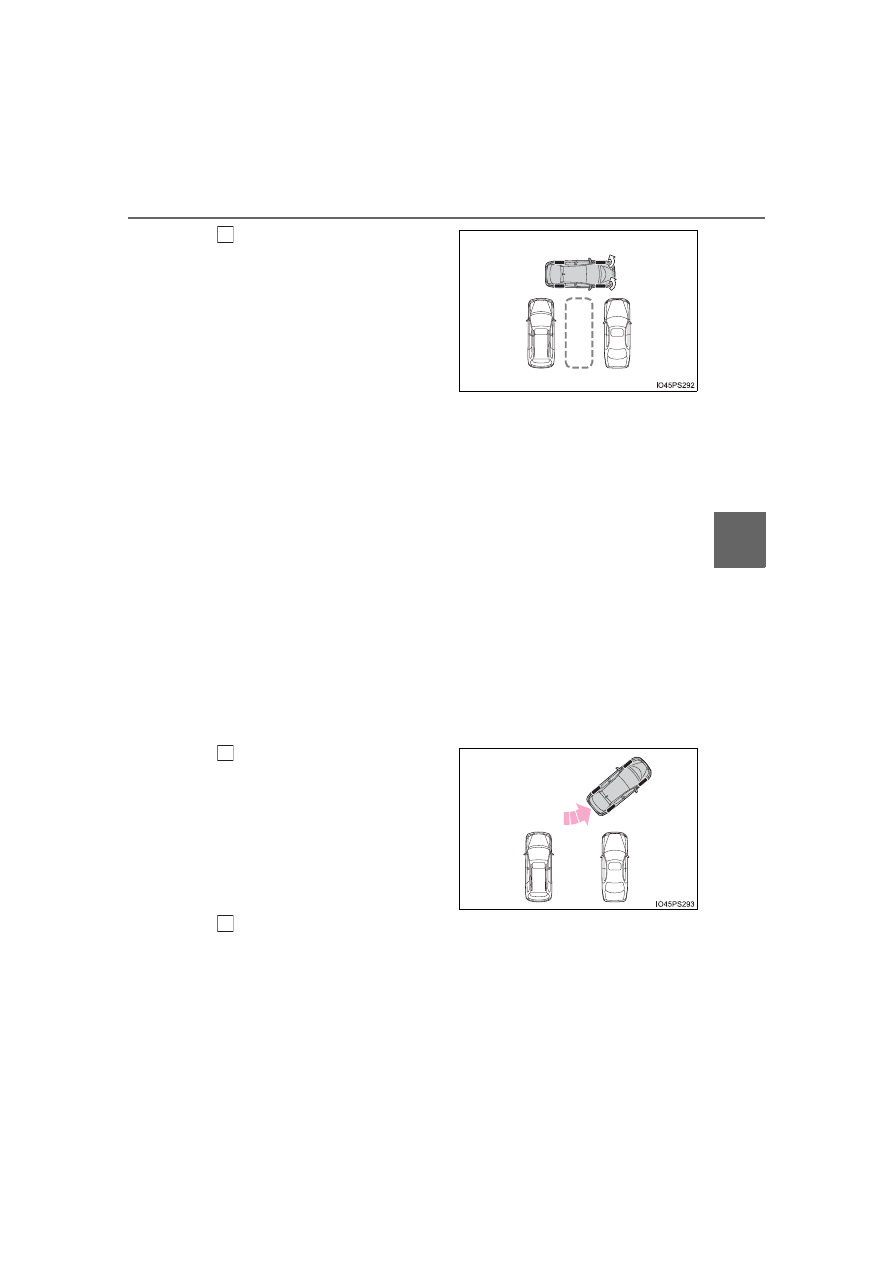
Assume  an  ordinary  driving
posture,  rest  your  hands
lightly  on  the  steering  wheel
without  applying  any  force,
directly  confirm  the  safety  of
the  area  to  the  front  and
around  the  vehicle  and
slowly proceed forward while
adjusting  your  speed  by
depressing  the  brake  pedal.
When  this  is  done,  a  high-
pitched  beep  is  emitted  and
an indicator on the meter illu-
minates  at  the  same  time,
after which assist control will
start.

When  the  steering  wheel  auto  operation  starts,  the  steering
wheel auto operation display (

P. 385)  and assistance level

indicator (

P. 385) will be shown in the display area.

To stop assist control, press the S-APGS switch.

When the vehicle speed is too high, a sharp beeping sound is
emitted and assist control is stopped. (

P. 386)

If  the  space  turns  out  to  be  too  narrow  after  assist  control
starts, a sharp beeping sound is emitted and assist control is
stopped.

When  a  beep  sounds  once
and the stop display (

P. 385)

is  shown  on  the  display,  stop
the vehicle.

Change the shift position to R.

2

3

4

402

4-5. Using the driving support systems

Assume  an  ordinary  posture  for  backing  up,  rest  your  hands
lightly on the steering wheel without applying any force, directly
confirm the safety of the area to the rear and around the vehicle,
confirm  that  there  are  no  obstacles  in  the  parking  space,  and
slowly  back  up  while  adjusting  your  speed  by  depressing  the
brake pedal.

When the vehicle cannot be cleanly entered within the target
parking spot on the first try and multi-turn maneuvering is nec-
essary, proceed to step 

.

When  multi-turn  maneuvering  is  not  necessary,  proceed  to
step 

. (

P. 403)

When  a  beep  sounds  once
and the stop display (

P. 385)

is  shown  on  the  display,  stop
the vehicle.

Change the shift position to D.

When  you  would  like  to  end  assist  control  at  your  current  position,
change the shift position to P.

Assume  an  ordinary  driving  posture,  rest  your  hands  lightly  on
the  steering  wheel  without  applying  any  force,  directly  confirm
the  safety  of  the  area  to  the  front  and  around  the  vehicle  and
slowly proceed forward while adjusting your speed by depressing
the brake pedal.
When  a  beep  sounds  once
and the stop display (

P. 385)

is  shown  on  the  display,  stop
the vehicle.

Change the shift position to R.

5

6

12

6

7

8

9

10

403

4-5. Using the driving support systems

4

Drivin

g

Assume  an  ordinary  posture  for  backing  up,  rest  your  hands
lightly on the steering wheel without applying any force, directly
confirm the safety of the area to the rear and around the vehicle
slowly  back  up  while  adjusting  your  speed  by  depressing  the
brake pedal.

Depending  on the condition of  the  parking space,  steps 

 to 

 may

need to be repeated.

When the vehicle is almost entirely within the target parking spot,
a high-pitched beep is emitted and the stop display is shown on
the display (

P. 385), stop the vehicle.

This completes the back-in parking assist mode.

For  safety,  the  buzzer  sounds  slightly  before  the  vehicle  is
completely  entered  within  the  target  parking  spot.  Further-
more,  at  that  point,  system  operation  will  also  finish.  Firmly
hold  the  steering  wheel  and  slowly  back  up  while  adjusting
your speed by depressing the brake pedal to reach the desired
parking spot.

Be  sure  to  back  up  while  checking  the  area  to  the  front  and
rear of the vehicle directly and by using the mirrors.

Back-in parking assist mode operating conditions

In order to operate the function correctly, drive slowly (at a speed at which
the vehicle can be quickly stopped).

In order to operate the function correctly, drive slowly (at a speed at which
the vehicle can be quickly stopped). Come to a full stop so that the center of
the parking space is nearly perpendicular to the vehicle, and then operate
the S-APGS switch.

The  function  cannot  be  used  when  the  vehicle  speed  is  approximately
19 mph (30 km/h) or higher.

The  front  side  sensors  and  rear  side  sensors  are  used  to  detect  parked
vehicles and determine the parking spot. Therefore, when detection is not
possible (

P. 414), guidance is not issued.

If  there  are  no  parked  vehicles,  the  parking  spot  cannot  be  determined.
Therefore, the back-in parking assist mode cannot be operated.

If  unable  to  detect  the  environment  surrounding  the  parking  space,  the
back-in parking assist mode may not be able to operate.

11

6

11

12

404

4-5. Using the driving support systems

Tips for using the back-in parking assist mode

Depending on the condition of the park-
ing  space,  if  there  is  not  enough  space
in front of the vehicle required to perform
the parking operation, the target parking
spot may not be reachable.

Intended parking spot
Wall

Leave  a  gap  of  approximately  3.3  ft.
(1 m)  from  any  parked  vehicles  and
approach  the  target  parking  spot.  If  the
gap  between  your  vehicle  and  any
parked  vehicles  is  too  large,  the  front
side sensors and rear side sensors may
not  be  able  to  detect  the  parked  vehi-
cles.

Stop  so  that  the  center  of  the  target
parking spot is perpendicular to the vehi-
cle. Furthermore, only push the S-APGS
switch when the vehicle is at a complete
stop.

NOTICE

If the road surface has any dips or inclines, the target parking spot cannot
be correctly set. Therefore, the vehicle may be parked at an angle or may
deviate from the parking spot. In these cases, do not use the back-in park-
ing assist mode.

When parking in a narrow space, the vehicle will come close to adjacent
vehicles.  If  it  seems  the  vehicle  may  make  contact,  stop  the  vehicle  by
depressing the brake pedal.

It may not be possible to detect objects that are low to the ground. Directly
confirm the safety of your surroundings and, if it seems the vehicle may
make contact with an obstacle, stop the vehicle by depressing the brake
pedal.

Depending  on  the  surrounding  environment,  such  as  other  parked  vehi-
cles, the vehicle may be parked at an angle or may deviate from the park-
ing spot. Manually adjust vehicle alignment as necessary.

1

2

3.3 ft. 
(1 m)

405

4-5. Using the driving support systems

4

Drivin

g

When  the  Simple  Advanced  Parking  Guidance  System  cannot  be
operated, or when operation is stopped, canceled, etc., the one of the
following message is displayed on the multi-information display. Take
appropriate action according to the display.

When it is not possible to operate

Multi-information display messages

Message

Situation/Handling method

The system may be malfunctioning.

Turn  the  power  switch  off  and  then  start  the
hybrid system.
Have  the  vehicle  inspected  by  your  Toyota
dealer if the message is displayed again.

There may be a system failure.

Power  steering  equipment  is  temporarily  overheat-
ing.

Turn  the  power  switch  off,  wait  for  a  little
while, and then start the hybrid system again.

The hybrid system is not operating.

Start the hybrid system.

Ice, snow, dirt, etc., has adhered to the sensor.

Remove any ice, snow, dirt, etc.

The sensor is frozen.

Once the sensor thaws, the system will return
to normal.

The  12-volt  battery  has  been  removed  and  rein-
stalled.

Drive the vehicle straight ahead for 5 seconds
or more at a speed of approximately 22 mph
(35 km/h) or higher.

The  S-APGS  switch  is  operated  when  the  vehicle
speed exceeds 19 mph (30 km/h).

Operate the switch when the vehicle speed is
approximately 19 mph (30 km/h) or less.

Assist control is started while the steering wheel is
held.

Rest  your  hands  on  the  steering  wheel  with-
out  applying  any  force.  Assist  control  will
start.

406

4-5. Using the driving support systems

The  vehicle  is  moved  and  assist  control  is  started
while the steering wheel is held.

Stop the vehicle and follow the guidance pro-
vided by the system to start assist control.

The  S-APGS  switch  is  operated  when  there  is  not
enough  space  to  the  front  and  rear  of  the  vehicle
when departing from a parallel parking spot.

The  vehicle  cannot  depart  using  assist  con-
trol as there is not enough space to the front
and rear of the vehicle. Confirm the safety of
your surroundings before departing.

The  S-APGS  switch  is  operated  in  an  area  where
there are no obstacles to the front of the vehicle, or
there are obstacles to the sides and the vehicle can-
not depart from the parallel parking spot.

Assist  control  cannot  be  used  for  departure,
as there are obstacles to the sides of the vehi-
cle or departure can easily be performed man-
ually. Confirm the safety of your surroundings
before departing.

The S-APGS switch is operated in an area with no
parking  spaces,  or  operated  in  an  area  where  the
road width for parking is narrow.

Assist control cannot be used, as there is no
parking  space.  Proceed  to  a  parking  space
which width is approximately 8.5 ft. (2.6 m) or
larger.

Assist  control  cannot  be  used,  as  the  road
width  is  narrow.  Proceed  to  a  parking  space
where  the  road  width  is  approximately  15  ft.
(4.5 m) or larger.

The  S-APGS  switch  is  operated  at  a  space  that  is
too narrow for the vehicle to park in.

Assist control cannot be used, as there is no
parking  space.  Proceed  to  a  parking  space
that is approximately 8.5 ft. (2.6 m) or larger.

Message

Situation/Handling method

407

4-5. Using the driving support systems

4

Drivin

g

When the operation is canceled

The  S-APGS  switch  is  operated  in  an  area  where
there are obstacles to the front, and the vehicle can-
not  move  forward  to  the  starting  point  for  backing
up.

Assist  control  cannot  be  used,  as  there  are
obstacles in front of the vehicle. Use parking
spaces  that  have  no  obstacles  in  front  of
them.

Message

Situation/Handling method

Message

Situation/Handling method

While assist control is operating, the driver changes
the  shift  position  to  P  or  operates  the  S-APGS
switch.

The vehicle speed exceeds 19 mph (30 km/h) when
searching for a parallel parking assist mode space.

Assist control is started in an area with narrow park-
ing spaces.

The  shift  position  is  changed  without  having  used
the turn signal lever to select a departure direction
when using the exit parallel parking assist mode.

Follow the guidance provided by the system.

When assist control starts, the vehicle proceeds in a
direction opposite to the guidance.

Follow  the  guidance  provided  by  the  system
to proceed forward.

408

4-5. Using the driving support systems

When the operation is suspended

The maximum number of movements for multi-turn
maneuvering is reached during assist control, or the
target  parking  spot  cannot  be  reached  due  to  the
control being used on a road with steep grade.

Follow  the  assist  control  guidance  and  use
the system in a wide space that does not have
a steep grade.

Message

Situation/Handling method

Message

Situation/Handling method

The  driver  holds  the
steering wheel during
assist control.

Stop  the  vehicle  and
rest  your  hands  on  the
steering  wheel  without
applying 

any 

force.

Then press the S-APGS
switch  to  restart  assist
control.

The  vehicle  speed
exceeds 

mph

(7 km/h) during assist
control.

The  S-APGS  switch
is 

pressed 

while

assist  control  is  tem-
porarily  stopped  and
the  steering  wheel  is
firmly held.

Rest your hands on the
steering  wheel  without
applying 

any 

force.

Then stop the vehicle to
restart assist control.

The  S-APGS  switch
is 

pressed 

while

assist  control  is  tem-
porarily  stopped  and
the vehicle is moving.

Assist control  is  tem-
porarily 

stopped

(able to be restarted)

Stop  the  vehicle  and
rest  your  hands  on  the
steering  wheel  without
applying 

any 

force.

Then press the S-APGS
switch  to  restart  assist
control.

409

4-5. Using the driving support systems

4

Drivin

g

The  vehicle  moved
too close to an obsta-
cle  in  front  of  the
vehicle.

Press 

the 

S-APGS

switch  after  changing
the shift position to R to
restart assist control.

The  vehicle  moved
too close to an obsta-
cle  to  the  rear  of  the
vehicle.

Press 

the 

S-APGS

switch  after  changing
the shift position to D to
restart assist control.

Message

Situation/Handling method

410

4-5. Using the driving support systems

Sensors

Detect the vehicle to help determine the parking spot. 

Front side sensors
Rear side sensors

Precautions during use

1

2

The sensor detection range when using
back-in parking assist mode

Intended parking spot

The sensor detection range when using
parallel parking assist mode

Intended parking spot

1

1

411

4-5. Using the driving support systems

4

Drivin

g

When there is a parked vehicle behind the target parking spot, it may not be
detected due to the distance. Also, depending on the shape of the vehicle
and  other  conditions,  the  detectable  range  may  shorten  or  detection  may
not be possible.

The Simple Advanced Parking Guidance System may not operate if grating,
diamond plates or similar materials are detected on the surface of the park-
ing space.

Objects other than parked vehicles, such
as poles and walls, may not be detected.
Also,  even  if  these  objects  can  be
detected,  the  target  parking  spot  may
deviate.

Poles
Wall

Also,  the  target  parking  spot  may  devi-
ate when a pedestrian, etc. is detected.

Pedestrian

1

2

1

412

4-5. Using the driving support systems

WARNING

Do not rely solely upon the Simple Advanced Parking Guidance System.
As  with  unequipped  vehicles,  move  forward  and  back  up  carefully  while
directly confirming the safety of your surroundings and the area to the rear
of the vehicle.

Do  not  back  up  while  viewing  the  multi-information  display.  Backing  up
while only viewing the monitor screen may cause a collision or lead to an
accident,  as  the  image  displayed  on  the  monitor  screen  may  differ  from
actual conditions. Make sure to visually check the surrounding areas and
the area to the rear of the vehicle with and without the mirror while backing
up.

Drive  slowly  while  adjusting  your  speed  by  depressing  the  brake  pedal
when backing up or moving forward.

If it seems the vehicle may make contact with a pedestrian, another vehi-
cle or any other obstacles, stop the vehicle by depressing the brake pedal,
and then press the S-APGS switch to turn off the system.

Use the system in a parking lot with a flat surface.

Observe  the  following  precautions,  as  the  steering  wheel  automatically
turns during use.
• There  is  risk  of  a  necktie,  scarf,  your  arm,  etc.  being  caught  on  the

steering wheel. Please do not allow your upper body to be close to the
steering wheel. Also, do not allow children close to the steering wheel.

• There is a possibility of injury when the steering wheel turns if you have

long fingernails.

• In case of emergency, stop the vehicle by depressing the brake pedal,

and then press the S-APGS switch to turn off the system.

Always confirm that there is appropriate space before attempting to park
the vehicle and operate the system.

413

4-5. Using the driving support systems

4

D

riv

in

g

WARNING

Do not use the system in the following situations, as the system may be
unable to correctly assist you in reaching the target parking spot and may
lead to an unexpected accident.
• In an area that is not a parking lot
• A parking lot that is not paved and has no parking space lines, such as

a sand or gravel parking lot

• A parking lot that has a slope or undulations in the road
• A frozen, snow-covered or slippery road
• The asphalt is melting due to hot weather
• There is an obstacle between the vehicle and the target parking spot
• Using tire chains or compact spare tire (if equipped)

Do not use tire other than that provided by the manufacturer. The system
may  not  operate  properly.  When  replacing  tires,  contact  your  Toyota
dealer.

The system may not be able position the vehicle in the set location in the
following situations.
• The tires are extremely worn or the tire pressure is low
• The vehicle is carrying very heavy load
• The vehicle is tilted due to having luggage, etc. located on one side of

the vehicle

• There are road heaters installed in the parking lot to prevent the road

surface from freezing.

In any other situations when the set position and vehicle position greatly
differ, have the vehicle inspected by your Toyota dealer.

Make sure to observe the following precautions regarding the exit parallel
parking assist mode.
Exit parallel parking assist mode is a function used when departing from a
parallel parking spot. However, this function may not be usable if obsta-
cles or people are detected in front of the vehicle. Only use this function
when departing from a parallel parking spot. In the event that the steering
control operates, either turn the system off using the S-APGS switch or
operate the steering wheel to stop the control.

If exit parallel parking assist mode is mistakenly used in the following situ-
ations, the vehicle may make contact with an obstacle.
The  departure  function  is  operated  in  a  direction  where  an  obstacle  is
present, but the obstacle is not detected by the side sensors (situations
such as when the vehicle is directly beside a pole).

414

4-5. Using the driving support systems

WARNING

Observe  the  following  precautions,  as  the  sensors  may  stop  functioning
properly which may lead to an accident.
• Do not subject the sensor to strong shocks by hitting it, etc. The sen-

sors may not function properly.

• When using a high-pressure washer to wash the vehicle, do not spray

water  directly  on  the  sensors.  Equipment  may  not  function  properly  if
subjected  to  an  impact  from  strong  water  pressure.  If  the  vehicle
bumper strikes something, equipment may not operate properly due to
a sensor malfunction. Have the vehicle inspected at your Toyota dealer.

In the following situations, the sensors may not operate normally and may
lead to an accident. Drive carefully.
• Obstacles cannot be detected in the side areas until a scan of the side

areas is completed. (

P. 364)

• Even after the scan of the side areas is completed, obstacles such as

other vehicles, people or animals that approach from the sides cannot
be detected.

• The sensor is frozen (if it thaws, the system returns to normal). 

A warning message may display at particularly low temperatures due to
the sensor freezing and it may not detect parked vehicles.

• The sensor is blocked by someone’s hand.
• The vehicle is tilted a large amount.
• The temperature is extremely hot or cold.
• The vehicle is driven on undulating roads, slopes, gravel roads, in areas

with tall grass, etc.

• An  ultrasonic  wave  source  is  nearby,  such  as  the  horn  or  sensors  of

another vehicle, a motorcycle engine or the air brake of a large vehicle.

• Heavy rain or a water strikes the vehicle.
• The  angle  of  the  sensor  may  be  deviated  when  assist  control  starts

even  if  there  is  a  parked  vehicle  in  the  target  parking  spot.  Have  the
vehicle inspected at your Toyota dealer.

• Do not install any accessories within the sensor detection range.

415

4-5. Using the driving support systems

4

Drivin

g

Driving assist systems

ECB (Electronically Controlled Brake System)

The electronically controlled system generates braking force corre-
sponding to the brake operation 

ABS (Anti-lock Brake System)

Helps to prevent wheel lock when the brakes are applied suddenly,
or if the brakes are applied while driving on a slippery road surface

Brake assist

Generates an increased level of braking force after the brake pedal
is depressed when the system detects a panic stop situation

VSC (Vehicle Stability Control)

Helps  the  driver  to  control  skidding  when  swerving  suddenly  or
turning on slippery road surfaces.

Enhanced VSC (Enhanced Vehicle Stability Control)

Provides cooperative control of the ABS, TRAC, VSC and EPS.
Helps  to  maintain  directional  stability  when  swerving  on  slippery
road surfaces by controlling steering performance.

TRAC (Traction Control) 

Helps  to  maintain  drive  power  and  prevent  the  drive  wheels  from
spinning when starting the vehicle or accelerating on slippery roads

Active Cornering Assist (ACA)

Helps to prevent the vehicle from drifting to the outer side by per-
forming  inner  wheel  brake  control  when  attempting  to  accelerate
while turning

To keep driving safety and performance, the following systems
operate automatically in response to various driving situations.
Be aware, however, that these systems are supplementary and
should not be relied upon too heavily when operating the vehi-
cle. 

416

4-5. Using the driving support systems

Hill-start assist control

Helps to reduce the backward movement of the vehicle when start-
ing on an uphill

EPS (Electric Power Steering) 

Employs an electric motor to reduce the amount of effort needed to
turn the steering wheel

E-Four (Electronic On-Demand AWD system) (AWD models)

Automatically  switches  from  front-wheel  drive  to  all-wheel  drive
(AWD)  according  to  the  driving  conditions,  helping  to  ensure  reli-
able handling and stability. Examples of conditions where the sys-
tem will switch to AWD are when cornering, going uphill, starting off
or accelerating, and when the road surface is slippery due to snow,
rain, etc.

The  slip  indicator  light  will  flash
while  the  TRAC/VSC/ABS  sys-
tems are operating.

When the TRAC/VSC/ABS systems are operating


Content      ..     23      24      25      26     ..