Toyota 86 (2023 year). Manual in english - page 3
 

  Index      Toyota     Toyota 86 (2023 year). Manual in english


Search            copyright infringement  


Content      ..     1      2      3      4      ..


Toyota 86 (2023 year). Manual in english - page 3


45

1-1. For safe use

1

For safety and secu

rity

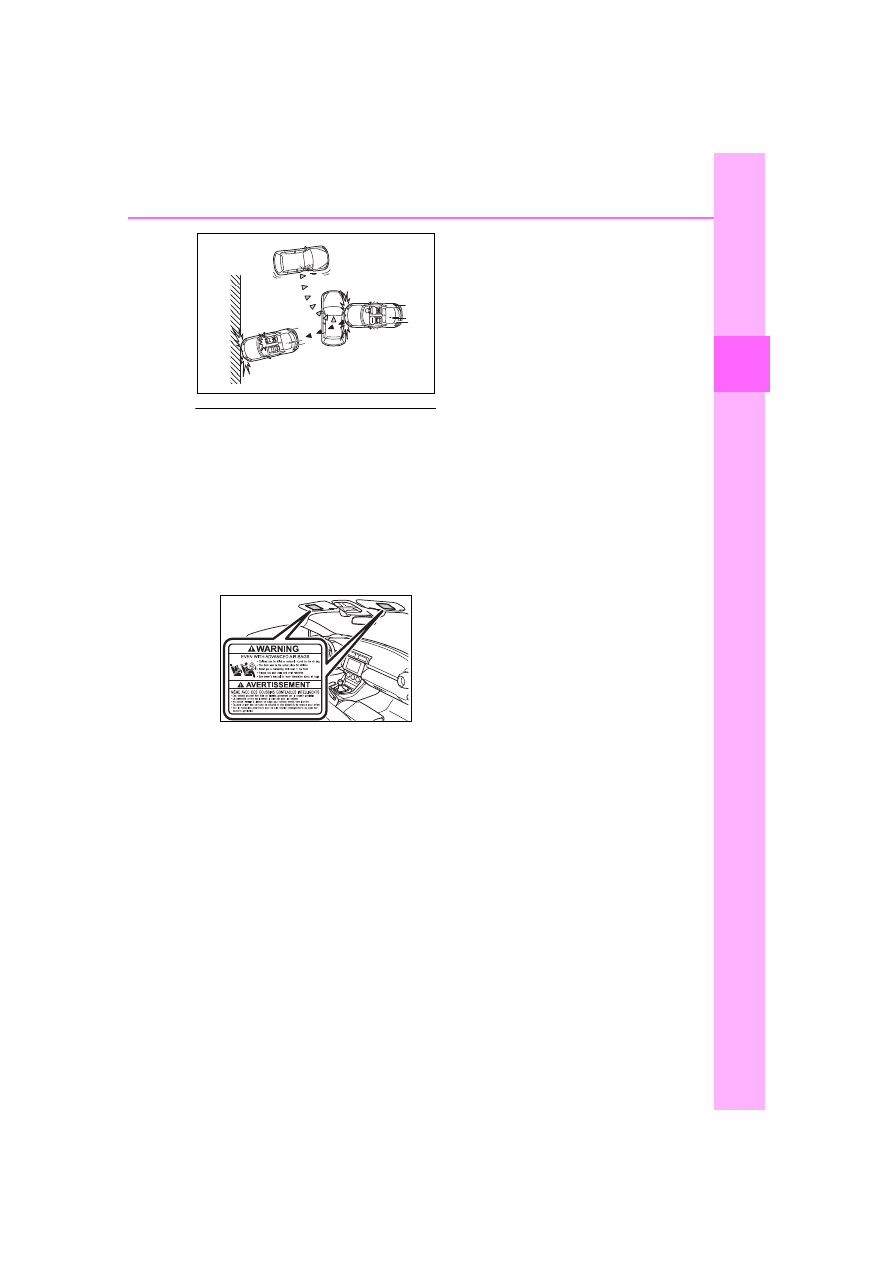
Warning labels and tag

This vehicle has warning labels on 

the driver’s and front passenger’s 

sun visors beginning with the 

phrase “EVEN WITH ADVANCED 

AIR BAGS” and a tag attached to 

the glove box lid beginning with the 

phrase “Even with Advanced Air 

Bags”. Make sure that you carefully 

read the instructions on the warning 

labels and tag.

Toyota advanced frontal airbag 

system

The SRS side airbag and seatbelt 

pretensioner are not controlled by 

the Toyota advanced frontal air-

bag system.

The front passenger’s SRS side 

airbag and SRS curtain shield air-

bag are not controlled by the Toy-

ota advanced frontal airbag 

system.

Conditions in which front pas-

senger’s SRS frontal airbag is 

not activated

The front passenger’s SRS frontal 

airbag will not be activated when 

any of the following conditions are 

met regarding the front passenger’s 

seat:

The seat is empty.

The seat is equipped with an 

appropriate child restraint system 

and an infant or a child is 

restrained in it. (See WARNING 

that follows.)

The front passenger’s occupant 

detection system is malfunction-

ing.

Conditions in which front pas-

senger’s SRS frontal airbag is 

activated

The front passenger’s SRS frontal 

airbag will be activated for deploy-

ment upon impact when any of the 

following conditions are met regard-

ing the front passenger’s seat.

When the seat is occupied by an 

adult.

When certain items (e.g. jug of 

water) are placed on the seat.

If the front passenger’s frontal 

airbag ON indicator illuminates 

and the OFF indicator turns off

If you think that the Front passen-

ger's frontal airbag ON/OFF indica-

tor is incorrect, take the following 

actions.

Ensure that no article is placed on 

the seat other than the occupant.

Ensure that the backward-forward 

position and seatback of front pas-

senger’s seat are locked into 

place securely by moving the seat 

back and forth.

If the ON indicator still remains illu-

minated while the OFF indicator 

turns off after taking relevant correc-

tive actions described above, imme-

diately contact your Toyota dealer 

for an inspection.
Even if the system has passed the 

dealer inspection, it is recom-

mended that on subsequent trips 

the small adult always take the rear 

seat.

46

1-1. For safe use

If the passenger’s frontal airbag 

OFF indicator illuminates and 

the ON indicator turns off even 

when the front passenger’s seat 

is occupied by an adult

This can be caused by the adult 

incorrectly sitting in the front pas-

senger’s seat.

1

Turn the engine switch off.

2

Ask the front passenger to set 

the seatback to the upright posi-

tion, sit up straight in the center 

of the seat cushion, correctly fas-

ten the seatbelt, position his/her 

legs out forward, and adjust the 

seat to the rearmost position.

3

Turn the engine switch to ON.

If the OFF indicator remains illumi-

nated while the ON indicator 

remains off, take the following 

actions.

1

Turn the engine switch off.

2

Make sure that the front passen-

ger does not use a blanket, extra 

seat cushion, seat cover, extra 

seat heater or massager, etc.

3

If wearing excessive layers of 

clothing, the front passenger 

should remove any unnecessary 

items before sitting in the front 

passenger’s seat, or should sit in 

a rear seat.

4

Turn the engine switch to ON 

and wait 6 seconds to allow the 

system to complete self-check-

ing. Following the system check, 

both indicators turn off for 2 sec-

onds. Now, the ON indicator 

should illuminate while the OFF 

indicator remains off.

If the OFF indicator still remains illu-

minated while the ON indicator 

remains off, ask the occupant to 

move to the rear seat and immedi-

ately contact your Toyota dealer for 

an inspection.

If the seatbelt buckle switch 

and/or front passenger’s occu-

pant detection system have 

failed

If the seatbelt buckle switch and/or 

front passenger’s occupant detec-

tion system have failed, the SRS 

warning light will illuminate. Have 

the system inspected by your Toyota 

dealer immediately if the SRS warn-

ing light illuminates.

When to contact your Toyota 

dealer

If your vehicle has sustained impact, 

this may affect the proper function of 

the Toyota advanced frontal airbag 

system. Have your vehicle 

inspected at your Toyota dealer. Do 

not use the front passenger’s seat 

while driving the vehicle to your Toy-

ota dealer.

WARNING

When using a child restraint 

system

NEVER INSTALL A CHILD 

RESTRAINT SYSTEM IN THE 

FRONT PASSENGER’S SEAT 

EVEN IF THE FRONT PASSEN-

GER’S SRS FRONTAL AIRBAG 

IS DEACTIVATED. Be sure to 

install it in the REAR seat in a cor-

rect manner. Also, it is strongly 

recommended that any forward 

facing child seat or booster seat 

be installed in the REAR seat, and 

that even children who have out-

grown a child restraint system be 

also seated in the REAR seat. 

This is because children sitting in 

the front passenger’s seat may be 

killed or severely injured should 

the front passenger’s SRS frontal 

airbag deploy. REAR seats are 

the safest place for children.

47

1-1. For safe use

1

For safety and secu

rity

WARNING

General Precautions regard-

ing front passenger’s SRS 

frontal airbag

When the front passenger's seat 

is occupied by an adult, observe 

the following precautions. Failure 

to do so may lessen the load on 

the front passenger's seat, deacti-

vating the front passenger's SRS 

frontal airbag despite the fact that 

the seat is occupied by an adult. 

This may result in personal injury.

Do not allow the rear seat occu-

pant to lift the front passenger's 

seat cushion using his/her feet.

Do not place any article under 

the front passenger's seat, or 

squeeze any article from behind 

and under the seat.

Do not squeeze any article 

between the front passenger's 

seat and side trim/pillar, door or 

center console box. This may lift 

the seat cushion.

When a small adult is seated 

in the front passenger’s seat

When a small adult is seated in 

the front passenger’s seat, the 

Toyota advanced frontal airbag 

system may or may not activate 

the front passenger’s SRS frontal 

airbag depending on the occu-

pant’s seating posture. If the OFF 

indicator remains illuminated 

while the ON indicator turns off 

when a small adult is seated in 

the front passenger's seat, refer to 

P.45.

General Precautions regard-

ing occupant detection sys-

tem

Do not kick the front passenger 

seat or subject it to severe impact. 

Otherwise, the SRS warning light 

may illuminate to indicate a mal-

function of the front passenger 

occupant detection system. In this 

case, contact your Toyota dealer 

immediately.

After deployment

Do not touch the SRS airbag sys-

tem components around the 

steering wheel and dashboard 

with bare hands right after deploy-

ment. Doing so can cause burns 

because the components can be 

very hot as a result of deploy-

ment.

NOTICE

Toyota advanced frontal air-

bag system precautions

Observe the following precau-

tions. Failure to do so may pre-

vent the Toyota advanced frontal 

airbag system from functioning 

correctly or cause the system to 

fail.

Do not apply any strong impact 

to the front passenger’s seat 

such as by kicking.

Do not let rear passengers rest 

their feet between the front 

seatback and seat cushion.

Do not spill liquid on the front 

passenger’s seat. If liquid is 

spilled, wipe it off immediately.

Do not remove or disassemble 

the front passenger’s seat.

48

1-1. For safe use

SRS side airbag

The SRS side airbag is stored in 
the door side of each front seat 
seatback, which bears an “SRS 
AIRBAG” mark.
In a moderate to severe side 
impact collision, the SRS side 
airbag on the impacted side of 
the vehicle deploys between the 
occupant and the door panel 
and supplements the seatbelt by 
reducing the impact on the 
occupant’s chest and waist. The 
SRS side airbag operates only 
for front seat occupants.

SRS curtain shield airbag

Your vehicle is equipped with a 
SRS curtain shield airbag sys-
tem that complies with the Fed-
eral Motor Vehicle Safety 
Standard (FMVSS) No. 226.
The SRS curtain shield airbag 

NOTICE

Do not install any accessory 

(such as an audio amplifier) 

other than a genuine Toyota 

accessory under the front pas-

senger’s seat.

Do not place anything (shoes, 

umbrella, etc.) under the front 

passenger’s seat.

Do not place any objects 

(books, etc.) around the front 

passenger’s seat.

Do not use the front passen-

ger’s seat with the head 

restraint removed.

Do not leave any articles on the 

front passenger’s seat or the 

seatbelt tongue and buckle 

engaged when you leave your 

vehicle.

Do not put sharp object(s) on 

the seat or pierce the seat 

upholstery.

Do not place a magnet near the 

seatbelt buckle and the seatbelt 

retractor.

Do not use front seats with their 

backward-forward position 

adjuster and seatback adjuster 

not being locked into place 

securely. If any of them are not 

locked securely, adjust them 

again. For adjusting procedure, 

refer to P.119.

When using the front passen-

ger’s seat

Observe the following precautions 

as it increase the load on the front 

passenger's seat and not work 

properly.

Do not install any accessory 

such as a table or TV onto the 

seatback.

Do not allow the rear seat occu-

pant to place his/her hands or 

legs on the front passenger's 

seatback, or allow him/her to 

pull the seatback.

SRS side airbag and SRS 
curtain shield airbag

49

1-1. For safe use

1

For safety and secu

rity

on each side of the cabin is 
stored in the roof side (between 
the front pillar and a point over 
the rear seat). An “SRS AIR-
BAG” mark is located at the top 
of each center pillar.
In a moderate to severe side 
impact collision, the SRS curtain 
shield airbag on the impacted 
side of the vehicle deploys 
between the occupant and the 
side window and supplements 
the seatbelt by reducing the 
impact on the occupant’s head.
In a rollover, SRS curtain shield 
airbags on both sides of the 
vehicle deploy between the 
occupant and the side window 
and supplement the seatbelt by 
reducing the impact to the occu-
pant’s head.
In an offset frontal collision, SRS 
curtain shield airbags on both 
sides of the vehicle deploy 
between the occupant and the 
side window and supplement 
the seatbelt by reducing the 
impact to the occupant’s head 
and chest.

Operation

The SRS side airbag and SRS 
curtain shield airbag can func-
tion only when the engine switch 
is in ON.
The following airbags deploy 
independently of each other 
since each has its own impact 
sensor.

Driver’s SRS side airbag

Front passenger’s SRS side 
airbag

SRS curtain shield airbag 
(right-hand side)

SRS curtain shield airbag 
(left-hand side)

Therefore, they may not both 
deploy in the same accident. 
Also, the SRS side airbag and 
SRS curtain shield airbag 
deploys independently of the 
driver’s and front passenger’s 
SRS frontal airbags in the steer-
ing wheel and instrument panel.
For the locations of the sensors 
and control modules, refer to 
P.29.

After deployment

After the deployment, the SRS 
side airbag immediately starts to 
deflate. The time required from 
detection of an impact to defla-
tion of an SRS side airbag after 
deployment is shorter than the 
blink of an eye.
The SRS curtain shield airbag 
remains inflated for a while fol-
lowing deployment then slowly 
deflates.
The SRS side airbag and SRS 
curtain shield airbag deploy 
even when no one occupies the 
seat on the side on which an 
impact is applied.
When the SRS side airbag and 
SRS curtain shield airbag 

50

1-1. For safe use

deploy, a sudden, fairly loud 
inflation noise will be heard and 
some smoke will be released. 
These occurrences are a normal 
result of the deployment. This 
smoke does not indicate a fire in 
the vehicle.

Example of the type of acci-
dent

The SRS side airbag and SRS 
curtain shield airbag are 
designed as follows:

To deploy in the event of an 
accident involving a moderate 
to severe side impact collision

To function on a one-time-only 
basis.

The SRS side airbag and SRS 
curtain shield airbag are not 
designed to deploy in the follow-
ing cases:

In most lesser side impact

In most frontal or most rear 
impacts (because the SRS 
side airbag and SRS curtain 
shield airbag deployment 
would not protect the occu-
pant in those situations)

The SRS curtain shield airbags 
are also designed to deploy 
when the vehicle is in an 
extremely inclined state such as 
during a rollover. They are not 
designed to deploy in most 
lesser inclined states.
SRS side airbag and SRS cur-
tain shield airbag deployment 

depend on the level of force 
experienced in the passenger 
compartment during a side 
impact collision. That level dif-
fers from one type of collision to 
another, and it may have no 
bearing on the visible damage 
done to the vehicle itself.

Example of the type of acci-
dent in which the SRS side 
airbag will most likely deploy.

A severe side impact near the front 
seat.

Examples of the types of acci-
dents in which the SRS cur-
tain shield airbag will most 
likely deploy.

• The vehicle is involved in a 

severe side impact near the front 
seat or the rear seat.

• The vehicle rolls onto its side or 

the roof.

51

1-1. For safe use

1

For safety and secu

rity

• The angle of vehicle tip-up is 

marginal or the skidding vehicle’s 
tires hit a curbstone laterally.

• An offset frontal collision that is 

severe enough to deploy the front 
airbag.

Examples of the types of acci-
dents in which it is possible 
that the SRS side airbag and 
the SRS curtain shield airbag 
will deploy.

It is possible that the SRS side and 
curtain shield airbags will deploy if 
a serious impact occurs to the 

underside of your vehicle. Some 
examples are shown in the illustra-
tion.
• Hitting a curb, edge of pavement 

or hard surface

• Falling into or jumping over a 

deep hole

• Landing hard or vehicle falling

Examples of the types of acci-
dents in which the SRS side 
airbag is unlikely to deploy.

There are many types of collisions 
which might not necessarily require 
SRS side airbag deployment. In the 

52

1-1. For safe use

event of accidents like those illus-
trated, the SRS side airbag may not 
deploy depending on the level of 
accident forces involved.
• The vehicle is involved in an 

oblique side-on impact.

• The vehicle is involved in a 

side-on impact in an area outside 
the vicinity of the passenger com-
partment.

• The vehicle strikes a telephone 

pole or similar object.

• The vehicle is involved in a 

side-on impact from a motorcycle.

• The vehicle rolls onto its side or 

the roof.

Examples of the types of acci-
dents in which the SRS cur-
tain shield airbag is unlikely to 
deploy.

There are many types of collisions 
which might not necessarily require 
SRS curtain shield airbag deploy-
ment. In the event of accidents like 
those illustrated, the SRS curtain 
shield airbag may not deploy 
depending on the level of accident 
forces involved.
• The vehicle is involved in an 

oblique side-on impact.

53

1-1. For safe use

1

For safety and secu

rity

• The vehicle is involved in a 

side-on impact in an area outside 
the vicinity of the passenger com-
partment.

• The vehicle strikes a telephone 

pole or similar object.

• The vehicle is involved in a 

side-on impact from a motorcycle.

Examples of the types of acci-
dents in which the SRS side 
airbag and SRS curtain shield 
airbag are not designed to 
deploy in most cases

In the event of accidents like those 
illustrated, the SRS side airbag and 
SRS curtain shield airbag are not 
designed to deploy in most cases.
• The vehicle is involved in frontal 

collision with another vehicle 
(moving or stationary).

• The vehicle is struck from behind.

• The vehicle pitches end over end.

54

1-1. For safe use

In an accident where the vehicle 
is struck from the side more 
than once, the SRS side airbag 
and SRS curtain shield airbag 
deploy only once on the first 
impact.
Example: In the case of a dou-
ble side impact collision, first 
with one vehicle and immedi-
ately followed by another from 
the same direction, once the 
SRS side airbag and SRS cur-
tain shield airbag are activated 
on the first impact, they will not 
be activated on the second.

SRS curtain shield airbag
SRS side airbag

1

First impact

2

Second impact

A diagnostic system continually 
monitors the readiness of the 
SRS airbag system (including 
seatbelt pretensioners) with the 
engine switch is in ON. The 
SRS warning light will show nor-
mal system operation by illumi-
nating for approximately 6 
seconds when the engine switch 
is turned to ON.

The following components are 
monitored by the indicator:

A

WARNING

After deployment

Do not touch the SRS side air-

bag system components around 

the front seat seatback with 

bare hands right after deploy-

ment. Doing so can cause burns 

because the components can 

be very hot as a result of 

deployment.

After deployment, do not touch 

any part of the SRS curtain 

shield airbag system (from the 

front pillar to the part of the roof 

side over the rear seat). Doing 

so can cause burns because 

the components can be very hot 

as a result of deployment.

SRS Airbag System Moni-
tors

55

1-1. For safe use

1

For safety and secu

rity

Front impact sensor

• Right-hand side
• Left-hand side

Airbag control module (includ-
ing impact sensor and rollover 
sensor)

Frontal airbag module

• Driver’s side
• Front passenger’s side

Knee airbag module

• Driver’s side

Side impact sensor

• Center pillar left-hand side
• Center pillar right-hand side
• Forward of rear wheel house 

left-hand side

• Forward of rear wheel house 

right-hand side

• Door left-hand side
• Door right-hand side

Side airbag module

• Driver’s side
• Front passenger’s side

Curtain shield airbag module

• Right-hand side
• Left-hand side

Seatbelt pretensioner

• Driver’s side

Seatbelt pretensioner and 
adaptive force limiter

• Front passenger’s side

Seatbelt buckle switch

• Front passenger’s side

Front passenger’s occupant 

detection system sensors

Front passenger’s frontal air-
bag ON and OFF indicator

All related wiring

SRS warning light

Have the system inspected by your 

Toyota dealer immediately if the 

SRS warning light illuminates.

WARNING

SRS warning light

If the warning light exhibits any of 

the following conditions, immedi-

ately stop the vehicle in a safe 

place, and consult a Toyota 

dealer. Unless a technician 

checks and repairs the system as 

needed, the seatbelt pretension-

ers and/or the SRS airbag may 

not operate properly in the event 

of a collision, which may result in 

injury.

Flashing or flickering of the 

warning light

No illumination of the warning 

light when the engine switch is 

first turned to ON

Continuous illumination of the 

warning light

Illumination of the warning light 

while driving

56

1-1. For safe use

The front passenger’s frontal airbag ON and OFF indicators show 
you the status of the front passenger’s SRS frontal airbag. When the 
engine switch is turned to ON, both the ON and OFF indicators illu-
minate while the system is checked, after which both indicators turn 
off.
After that, one of the indicators illuminates depending on the status 
of the front passenger’s SRS frontal airbag determined by the Toyota 
advanced frontal airbag monitoring system.

SRS warning light
Front passenger’s seat belt reminder light
“AIR BAG OFF” indicator light
“AIR BAG ON” indicator light

Front passenger occupant classification system

Your vehicle is equipped with a front passenger occupant 
classification system. This system detects the conditions of 
the front passenger seat and activates or deactivates the front 
passenger airbag.

System components

A

C
D

57

1-1. For safe use

1

For safety and secu

rity

WARNING

Front passenger occupant 

classification system precau-

tions

Observe the following precautions 

regarding the front passenger 

occupant classification system.

Failure to do so may cause the 

occupant classification system to 

not function correctly, resulting in 

death or serious injury.

Wear the seat belt properly.

Do not apply excessive force to 

the seat.

Do not put sharp object(s) on 

the seat or pierce the seat 

upholstery.

Do not put objects under the 

front passenger seat.

Do not use a seat accessory, 

such as a cushion or seat cover, 

that covers the seat cushion 

surface.

Do not spill liquid on the front 

passenger seat. If liquid is 

spilled, wipe it off immediately 

and dry the seat. If the SRS 

warning light illuminates, dry the 

seat until the warning light turns 

off. If the SRS warning light 

stays on even when the seat 

has dried, do not allow anyone 

to sit on the front passenger 

seat and have the system 

checked by your Toyota dealer. 

If the SRS warning light does 

not illuminate, check that the 

airbag ON/OFF indicator light 

works properly. If the indicator 

light does not work properly, do 

not allow anyone to sit in the 

front passenger’s seat and have 

the system inspected by your 

Toyota dealer.

Do not remove or disassemble 

the front passenger seat. Also, 

do not replace or modify the 

seat upholstery or foam inside 

the seat.

Do not install any accessory 

(such as an audio amplifier) 

other than a genuine Toyota 

accessory under the front pas-

senger’s seat.

Do not place a magnetized 

items near the seat belt buckle.

Never install a rearward facing 

child seat in the front passen-

ger’s seat even if the front pas-

senger’s SRS frontal airbag is 

deactivated. Be sure to install it 

in the rear seat in a correct 

manner. Also, it is strongly rec-

ommended that any forward 

facing child seat or booster seat 

be installed in the rear seat, and 

that even children who have 

outgrown a child restraint sys-

tem be also seated in the rear 

seat. This is because children 

sitting in the front passenger’s 

seat may be killed or severely 

injured should the front passen-

ger’s SRS frontal airbag deploy. 

Toyota believes that the rear 

seats are the safest place for 

children.

If luggage or electronic devices 

are placed on the front passen-

ger seat, the OFF indicator may 

turn off and the ON indicator 

may illuminate. If this occurs, 

the front passenger’s airbag 

may deploy during a collision. If 

this is not desirable, remove the 

luggage or electronic devices 

from the front passenger seat.

58

1-1. For safe use

Adult

*2

Child

*5, *6

WARNING

Modifications for persons with 

disabilities that may affect the 

front passenger occupant clas-

sification system. (U.S. only) 

Removing, replacing or modify-

ing any parts of the front seats, 

seat belts, front bumper, front 

side frame, instrument panel, 

meter, steering wheel, steering 

column, tires, suspension or 

floor panel can affect the opera-

tion of the Toyota front passen-

ger occupant classification 

system.

Condition and operation in the front passenger occupant 
classification system

*1

Indicator/warning 

light

“AIR BAG ON” and “AIR BAG 

OFF” indicator lights

“AIR BAG ON”

SRS warning light

Off

Front passenger’s seat belt 

reminder light

Flashing

*3

Devices

Front passenger airbag

On

Front side airbag

*4

Front curtain shield airbag

*4

Front passenger’s seat belt preten-

sioner

*4

Indicator/warning 

light

“AIR BAG ON” and “AIR BAG 

OFF” indicator lights

“AIR BAG OFF”

*5

SRS warning light

Off

Front passenger’s seat belt 

reminder light

Flashing

*3

59

1-1. For safe use

1

For safety and secu

rity

Child restraint system with infant

*6, *7, *8

Unoccupied

Devices

Front passenger airbag

Off

Front side airbag

*4

On

Front curtain shield airbag

*4

Front passenger’s seat belt preten-

sioner

*4

Indicator/warning 

light

“AIR BAG ON” and “AIR BAG 

OFF” indicator lights

“AIR BAG OFF”

*9

SRS warning light

Off

Front passenger’s seat belt 

reminder light

Devices

Front passenger airbag

Off

Front side airbag

*4

On

Front curtain shield airbag

*4

Front passenger’s seat belt preten-

sioner

*4

Indicator/warning 

light

“AIR BAG ON” and “AIR BAG 

OFF” indicator lights

“AIR BAG OFF”

SRS warning light

Off

Front passenger’s seat belt 

reminder light

Devices

Front passenger airbag

Off

Front side airbag

*4

On

Front curtain shield airbag

*4

Front passenger’s seat belt preten-

sioner

*4

60

1-1. For safe use

There is a malfunction in the system

*1

:The occupant classification system does not operate during selfcheck-

ing.

*2

:The system judges a person of adult size as an adult. When a smaller 

adult sits in the front passenger seat, the system may not recognize 
him/her as an adult depending on his/her physique and posture.

*3

:In the event the front passenger does not wear a seat belt.

*4

:The front passenger’s SRS side airbag, SRS curtain shield airbag and 

seat belt pretensioner are not controlled by the occupant classification 
system.

*5

:For some children, child in seat, child in booster seat or child in convert-

ible seat, the system may not recognize him/her as a child. Factors 
which may affect this can be the physique or posture.
Children who have outgrown a child restraint system should always wear 
the seat belt when sitting in the seat irrespective of whether the airbag is 
deactivated or activated.

*6

:Do not place more than one child on the front passenger seat.

Failure to do so may prevent the front passenger occupant classification 
system from functioning correctly.

*7

:When a child restraint system is installed on the front passenger seat, do 

not place any article on the seat other than the child occupant and a child 
restraint system.
Failure to do so may prevent the front passenger occupant classification 
system from functioning correctly or cause the system to fail.

*8

:Never install a rear-facing child restraint system on the front passenger 

seat. See the caution that follows regarding installation of a child restraint 
system. (

P.64)

Indicator/warning 

light

“AIR BAG ON” and “AIR BAG 

OFF” indicator lights

“AIR BAG OFF”

SRS warning light

On

Front passenger’s seat belt 

reminder light

Off

Devices

Front passenger airbag

Off

Front side airbag

*4

On

Front curtain shield airbag

*4

Front passenger’s seat belt preten-

sioner

*4


Content      ..     1      2      3      4      ..