Toyota Corolla Hatchback (2022 year). Manual in english - page 25
 

  Index      Toyota     Toyota Corolla Hatchback (2022 year). Manual in english


Search            copyright infringement  


Content      ..     23      24      25      26     ..


Toyota Corolla Hatchback (2022 year). Manual in english - page 25


405

6-3. Using the storage features

6

Interior

 featur

es

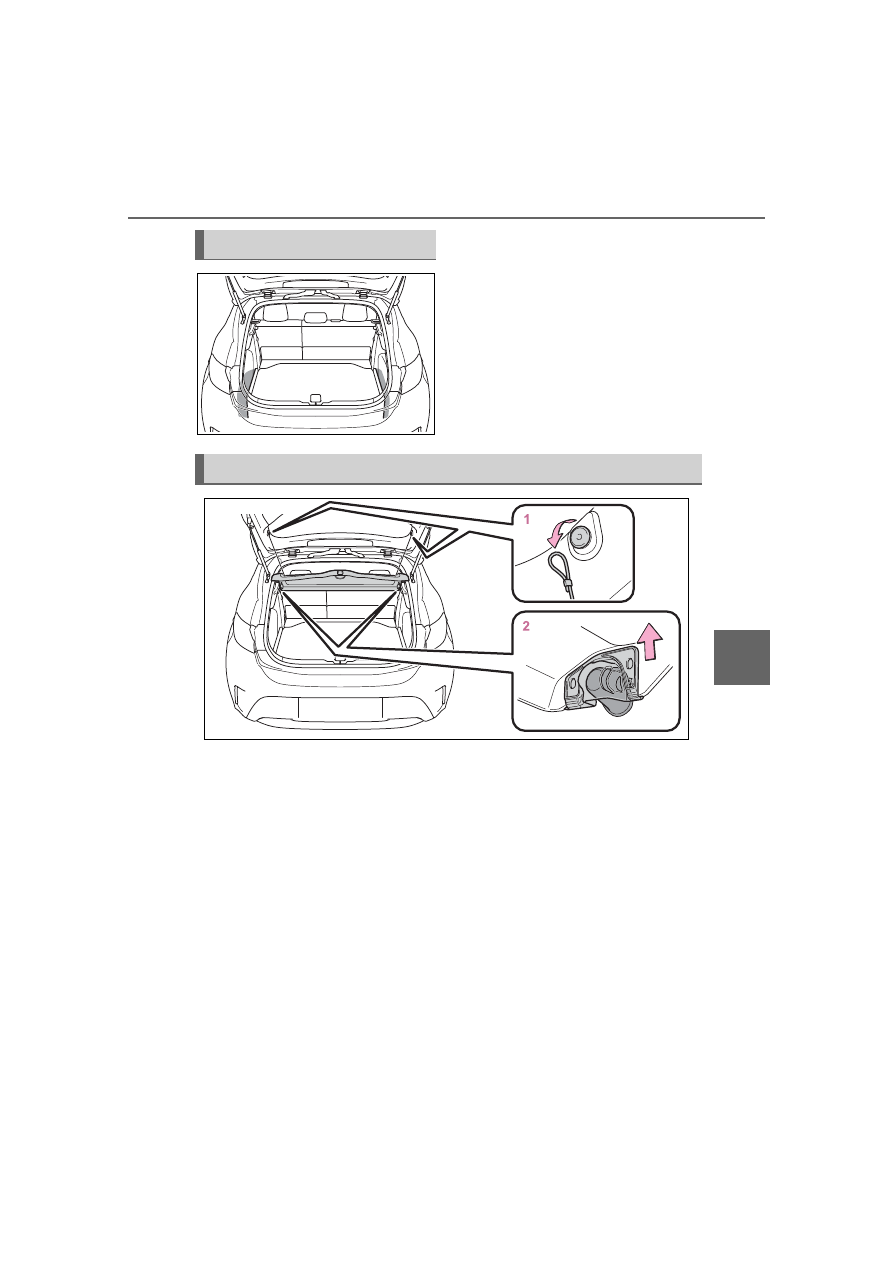
1

Unhook the cords.

2

Remove the cover from the anchors.

Side tray (if equipped)

Removing the luggage cover

406

6-4. Other interior features

6-4.Other interior features

The USB charging port are used 
to supply 2.1 A of electricity at 5 
V to external devices.
The USB charging port are for 
charging only. They are not 
designed for data transfer or 
other purposes.
Depending on the external 
device, it may not charge prop-
erly. Refer to the manual 
included with the device before 
using a USB charging port.

Using the USB charging 
port

Open the console box lid.

The USB charging port can be 

used when

The engine switch is in ACC or ON.

Situations in which the USB 

charging port may not operate 

correctly

If a device which consumes more 

than 2.1 A at 5 V is connected

If a device designed to communi-

cate with a personal computer, 

such as a USB memory device, is 

connected

If the connected external device is 

turned off (depending on device)

If the temperature inside the vehi-

cle is high, such as after the vehi-

cle has been parked in the sun

About connected external 

device

Depending on the connected exter-

nal device, charging may occasion-

ally be suspended and then start 

again. This is not a malfunction.

The power outlet can be used 

Other interior features

USB charging port

NOTICE

To prevent damage to the 

USB charging port

Do not insert foreign objects into 

the port.

Do not spill water or other liq-

uids into the port.

Do not apply excessive force to 

or impact the USB charging 

port.

Do not disassemble or modify 

the USB charging port.

To prevent damage to exter-

nal devices

Do not leave external devices in 

the vehicle. The temperature 

inside the vehicle may become 

high, resulting in damage to an 

external device.

Do not push down on or apply 

unnecessary force to an exter-

nal device or the cable of an 

external device while it is con-

nected.

To prevent battery discharge

Do not use the USB charging port 

for a long period of time with the 

engine stopped.

Power outlets

407

6-4. Other interior features

6

Interior

 featur

es

for 12 V accessories that run on 
less than 10 A.
Open the console box lid and 
open the lid.

The power outlet can be used 

when

The engine switch is in ACC or ON.

When turning the engine switch 

off

Disconnect electrical devices with 

charging functions, such as mobile 

battery packs.

If such devices are left connected, 

the engine switch may not be turned 

off normally.

A portable device, such as a 
smartphone or mobile battery, 
can be charged by just placing it 
on the charging area, provided 
the device is compatible with the 
Qi wireless charging standard 
created by the Wireless Power 
Consortium.
The wireless charger cannot be 
used with a portable device that 
is larger than the charging area. 
Additionally, depending on the 
portable device, the wireless 
charger may not operate prop-
erly. Refer to the operation man-
ual of the portable device.

The “Qi” symbol

The “Qi” symbol is a trademark 
of the Wireless Power Consor-
tium.

NOTICE

To prevent the fuse from 

being blown

Do not use an accessory that 

uses more than 12 V 10 A.

To avoid damaging the power 

outlet

Close the power outlet lid when 

the power outlet is not in use. 

Foreign objects or liquids that 

enter the power outlet may cause 

a short circuit.

To prevent the battery from 

being discharged

Do not use the power outlet lon-

ger than necessary when the 

engine is not running.

Wireless charger (if 
equipped)

408

6-4. Other interior features

Name for all parts

Power supply switch
Operation indicator light
Charge area

Using the wireless charger

1

Press the power supply 
switch of the wireless char-
ger.

Pressing the switch again turns the 

wireless charger off.

When turned on, the operation indi-

cator light (green) comes on. 

When the engine switch is turned 

off, the on/off state of the wireless 

charger will be memorized.

2

Place a portable device on 
the charging area with its 
charging surface facing 
down.

While charging, the operation indi-

cator light (orange) will be illumi-

nated.

If charging does not begin, move 

the portable device as close to the 

center of the charging area as pos-

sible.

When charging is complete, the 

operation indicator light (green) will 

illuminate.

Recharging function

If a certain amount of time has 
elapsed since charging com-
pleted and the portable device 
has not been moved, the 
wireless charger will restart 
charging.

If the portable device is 
moved within the charging 
area, charging will stop tem-
porarily then restart.

409

6-4. Other interior features

6

Interior

 featur

es

Operation indicator light status

*

: Depending on the portable device, the operation indicator light may stay 

illuminated (orange) after charging has completed.

If the operation indicator light blinks

If an error is detected, the operation indicator light will blink (orange). Take 
the appropriate measures according to the table below.

The wireless charger can be 

operated when

The engine switch is in ACC or ON.

Portable devices that can be 

charged

Portable devices compatible with 

the Qi wireless charging standard 

can be charged by the wireless 

charger. However, compatibility 

with all devices which meet the Qi 

wireless charging standard is not 

guaranteed.

The wireless charger is designed 

to supply low power electricity (5 

W or less) to a cellular phone, 

smartphone, or other portable 

device.

Operation indicator light

State

Off

The Wireless charger is off

Green (illuminated)

Standby (charging is possible)

Charging is complete

*

Orange (illuminated)

A portable device has been placed on the 
charging area (identifying the portable 
device)

Charging in progress

Operation indicator light Suspected cause

Measure

Blinks (orange) at a one 
second interval continu-
ously

Vehicle to charger com-
munication failure.

Contact your Toyota 
dealer.

Blinks (orange) 3 times 
repeatedly

A foreign object exists 
between the portable 
device and charging 
area.

Remove the foreign 
object.

Portable device is not 
positioned properly on 
the charging area.

Move the portable 
device toward the cen-
ter of the charging area.

Blinks (orange) 4 times 
repeatedly

The temperature of the 
wireless charger is 
excessively high.

Stop charging immedi-
ately and continue 
charging after a while.

410

6-4. Other interior features

If a cover or accessory is 

attached to the portable device

Do not charge a portable device if a 

cover or accessory which is not Qi 

compatible is attached. Depending 

on the type of cover and/or acces-

sory attached, it may not be possi-

ble to charge the portable device. If 

the portable device is placed on the 

charging area and does not charge, 

remove the cover and/or accesso-

ries.

If interference is heard in AM 

radio broadcasts while 

charging

Turn off the wireless charger and 

check if the noise is reduced. If 

noise is reduced, press and hold the 

power supply switch of the wireless 

charger for 2 seconds. The fre-

quency of the wireless charger is 

changed and noise may be 

reduced. When the frequency is 

changed, the operation indicator 

light will blink (orange) 2 times.

Charging precautions

If the electronic key cannot be 

detected in the cabin, charging 

cannot be performed. When a 

door is opened and closed, 

charging may be temporarily sus-

pended.

While charging, the wireless char-

ger and the portable device will 

become warm. 

This is not a malfunction.If a porta-

ble device becomes warm while 

charging and charging stops due 

to the protection function of the 

portable device, wait until the por-

table device cools down and 

charge it again.

Sound generated during opera-

tion

When the power supply switch is 

turned on or while a portable device 

is being identified, operation sounds 

may be heard. This is not a malfunc-

tion.

Cleaning the wireless charger

P.421

Certification for the wireless charger

413

6-4. Other interior features

6

Interior

 featur

es

WARNING

Caution while driving

When charging a portable device 

while driving, for safety reasons, 

the driver should not operate the 

portable device.

Caution regarding interfer-

ence with electronic devices

People with implantable cardiac 

pacemakers, cardiac resynchroni-

zation therapy pacemakers or 

implantable cardioverter defibrilla-

tors, as well as any other electri-

cal medical device, should consult 

their physician about the usage of 

the wireless charger.

Operations of the wireless char-

ger may have an affect on medi-

cal devices.

To prevent damage or burns

Observe the following precau-

tions. 

Failure to do so may result in the 

possibility of fire, equipment fail-

ure or damage, or burns due to 

heat.

Do not put any metallic objects 

between the charging area and 

the portable device while 

charging.

Do not attach metallic objects, 

such as aluminum stickers, to 

the charging area.

Do not cover the wireless char-

ger with a cloth or other object 

while charging.

Do not attempt to charge porta-

ble devices which are not com-

patible with the Qi wireless 

charging standard.

Do not disassemble, modify or 

remove the wireless charger.

Do not apply force or impact to 

the wireless charger.

NOTICE

Conditions in which the wire-

less charger may not operate 

correctly

In the following situations, the 

wireless charger may not operate 

correctly:

When a portable device is fully 

charged

When there is a foreign object 

between the charging area and 

portable device

When a portable device 

becomes hot while charging

When a portable device is 

placed on the wireless area with 

its charging surface facing up

When a portable device is not 

centered on the charging area

When the vehicle is near a TV 

tower, electric power plant, gas 

station, radio station, large dis-

play, airport or other facility that 

generates strong radio waves or 

electrical noise

When the portable device is in 

contact with, or is covered by 

any of the following metallic 

objects:

• Cards to which aluminum foil is 

attached

• Cigarette boxes that have alu-

minum foil inside

• Metallic wallets or bags

• Coins

• Metal hand warmers

• Media such as CDs and DVDs

414

6-4. Other interior features

1

To set the visor in the forward 
position, flip it down.

2

To set the visor in the side 
position, flip down, unhook, 
and swing it to the side.

3

To use the side extender, 
place the visor in the side 
position, then slide it back-
ward.

Slide the cover to open.

The vanity light turns on.

To prevent battery discharge

If the vanity lights remain on when 

the engine switch is OFF, the lights 

will go off automatically after 20 min-

utes.

NOTICE

When wireless keys (that emit 

radio waves) other than those of 

your vehicle are being used 

nearby.

If in situations other than above 
the wireless charger does not 
operate properly or the operation 
indicator light is blinking, the wire-
less charger may be malfunction-
ing. Contact your Toyota dealer.

To prevent failure or damage 

to data

Do not bring magnetic cards, 

such as a credit card, or mag-

netic recording media, close to 

the wireless charger while 

charging. Otherwise, data may 

be erased due to the influence 

of magnetism.

Additionally, do not bring preci-

sion instruments such as wrist 

watches, close to the wireless 

charger, as such objects may 

malfunction.

Do not leave portable devices in 

the cabin. The temperature 

inside the cabin may become 

high when parked in the sun, 

and cause damage to the 

device.

To prevent battery discharge

Do not use the wireless charger 

for a long period of time with the 

engine stopped.

Sun visors

Vanity mirrors

415

6-4. Other interior features

6

Interior

 featur

es

Fold down the armrest for use.

An assist grip installed on the 
ceiling can be used to support 
your body while sitting on the 
seat.

The coat hooks are provided 
with the rear assist grips.

NOTICE

To prevent the battery from 

being discharged

Do not leave the vanity lights on 

for extended periods while the 

engine is stopped.

Armrest

NOTICE

To prevent damage to the 

armrest

Do not apply too much load on the 

armrest.

Assist grips

WARNING

Assist grip

Do not use the assist grip when 

getting in or out of the vehicle or 

rising from your seat.

NOTICE

To prevent damage to the 

assist grip

Do not hang any heavy object or 

put a heavy load on the assist 

grip.

Coat hooks

WARNING

Items that cannot be hung on 

the coat hook

Do not hang coat hangers or 

other hard or sharp objects on the 

hook. If the SRS curtain shield air-

bags deploy, these items may 

become projectiles, causing death 

or serious injury.

416

6-4. Other interior features

417

7

7

Maintena

nce
 a

nd ca

re

Maintenance and care

.

7-1. Maintenance and care

Cleaning and protecting the 

vehicle exterior ..........

418

Cleaning and protecting the 

vehicle interior ...........

420

7-2. Maintenance

Maintenance requirements

..................................

423

General maintenance..

424

Emission inspection and 

maintenance (I/M) pro-
grams ........................

427

7-3. Do-it-yourself mainte-

nance

Do-it-yourself service pre-

cautions.....................

429

Hood ...........................

431

Positioning a floor jack

..................................

432

Engine compartment...

433

Tires ............................

440

Tire inflation pressure..

447

Wheels ........................

449

Air conditioning filter....

451

Electronic key battery..

452

Checking and replacing 

fuses..........................

454

Light bulbs...................

457

418

7-1. Maintenance and care

7-1.Maintenance and care

Working from top to bottom, 
liberally apply water to the 
vehicle body, wheel wells and 
underside of the vehicle to 
remove any dirt and dust.

Wash the vehicle body using 
a sponge or soft cloth, such 
as a chamois.

For hard-to-remove marks, 
use car wash soap and rinse 
thoroughly with water.

Wipe away any water.

Wax the vehicle when the 
waterproof coating deterio-
rates.

If water does not bead on a clean 
surface, apply wax when the vehi-
cle body is cool.

Automatic car washes

Fold the mirrors before washing 

the vehicle. Start washing from the 

front of the vehicle. Make sure to 

extend the mirrors before driving.

Brushes used in automatic car 

washes may scratch the vehicle 

surface, parts (wheel, etc.) and 

harm your vehicle’s paint.

In certain automatic car washes, 

the rear spoiler may interfere with 

machine operation. This may pre-

vent the vehicle from being 

cleaned properly or result in dam-

age to the rear spoiler.

High pressure car washes

As water may enter the cabin, do 

not bring the nozzle tip near the 

gaps around the doors or perimeter 

of the windows, or spray these 

areas continuously.

When using a car wash

If the door handle becomes wet 

while the electronic key is within the 

effective range, the door may lock 

and unlock repeatedly. In that case, 

follow the following correction pro-

cedures to wash the vehicle:

Place the key in a position 6 ft. (2 

m) or more separate from the 

vehicle while the vehicle is being 

washed. (Take care to ensure that 

the key is not stolen.)

Set the electronic key to bat-

tery-saving mode to disable the 

smart key system. (

P.109)

Wheels and wheel ornaments

Remove any dirt immediately by 

using a neutral detergent.

Wash detergent off with water 

immediately after use.

To protect the paint from damage, 

make sure to observe the follow-

ing precautions.

• Do not use acidic, alkaline or 

abrasive detergent

• Do not use hard brushes

• Do not use detergent on the 

wheels when they are hot, such 

as after driving or parking in hot 

weather

Brake pads and calipers

Rust may form if the vehicle is 

parked with wet brake pads or disc 

rotors, causing them to stick. Before 

parking the vehicle after it is 

washed, drive slowly and apply the 

brakes several times to dry the 

parts.

Cleaning and protect-

ing the vehicle exte-

rior

Perform cleaning in a man-
ner appropriate to each 
component and its material.

Cleaning instructions

419

7-1. Maintenance and care

7

Maintena

nce
 a

nd ca

re

Bumpers

Do not scrub with abrasive cleaners.

Plated portions

If dirt cannot be removed, clean the 

parts as follows:

Use a soft cloth dampened with an 

approximately 5% solution of neu-

tral detergent and water to clean 

the dirt off.

Wipe the surface with a dry, soft 

cloth to remove any remaining 

moisture.

To remove oily deposits, use alco-

hol wet wipes or a similar product.

WARNING

When washing the vehicle

Do not apply water to the inside of 

the engine compartment. Doing 

so may cause the electrical com-

ponents, etc. to catch fire.

Precautions regarding the 

exhaust pipe

Exhaust gasses cause the 

exhaust pipe to become quite hot.

When washing the vehicle, be 

careful not to touch the pipe until it 

has cooled sufficiently, as touch-

ing a hot exhaust pipe can cause 

burns.

Precaution regarding the rear 

bumper with Blind Spot Moni-

tor (if equipped)

If the paint of the rear bumper is 

chipped or scratched, the system 

may malfunction. If this occurs, 

consult your Toyota dealer.

NOTICE

To prevent paint deteriora-

tion and corrosion on the 

body and components (alumi-

num wheels, etc.)

Wash the vehicle immediately in 

the following cases:

• After driving near the sea coast

• After driving on salted roads

• If coal tar or tree sap is present 

on the paint surface

• If dead insects, insect droppings 

or bird droppings are present on 

the paint surface

• After driving in an area contami-

nated with soot, oily smoke, 

mine dust, iron powder or chem-

ical substances

• If the vehicle becomes heavily 

soiled with dust or mud

• If liquids such as benzene and 

gasoline are spilled on the paint 

surface

If the paint is chipped or 

scratched, have it repaired 

immediately.

To prevent the wheels from cor-

roding, remove any dirt and 

store in a place with low humid-

ity when storing the wheels.

Cleaning the exterior lights

Wash carefully. Do not use 

organic substances or scrub 

with a hard brush.

This may damage the surfaces 

of the lights.

Do not apply wax to the sur-

faces of the lights.

Wax may cause damage to the 

lenses.

420

7-1. Maintenance and care

Remove dirt and dust using a 
vacuum cleaner. Wipe dirty 
surfaces with a cloth damp-
ened with lukewarm water.

If dirt cannot be removed, 
wipe it off with a soft cloth 
dampened with neutral deter-
gent diluted to approximately 
1%.
Wring out any excess water 
from the cloth and thoroughly 
wipe off remaining traces of 
detergent and water.

Shampooing the carpets

There are several commercial foam-

ing-type cleaners available. Use a 

sponge or brush to apply the foam. 

Rub in overlapping circles. Do not 

use water. Wipe dirty surfaces and 

let them dry. Excellent results are 

obtained by keeping the carpet as 

dry as possible.

Handling the seat belts

Clean with mild soap and lukewarm 

water using a cloth or sponge. Also 

check the belts periodically for 

excessive wear, fraying or cuts.

NOTICE

When using a high pressure 

car wash

When washing the vehicle, do 

not spray the camera or its sur-

rounding area directly with a 

high pressure washer. Shock 

applied from high pressure 

water may cause the device to 

not operate normally.

Do not spray water directly on 

the radar which is equipped 

behind the emblem. Otherwise 

it may cause the device to be 

damaged.

Do not bring the nozzle tip close 

to boots (rubber or resin manu-

factured cover), connectors or 

the following parts. The parts 

may be damaged if they come 

into contact with high-pressure 

water.

• Traction related parts

• Steering parts

• Suspension parts

• Brake parts

Keep the cleaning nozzle at 

least 11.9 in. (30 cm) away from 

the vehicles body. Otherwise 

resin section, such as moldings 

and bumpers, may be deformed 

and damaged. Also, do not con-

tinuously hold the nozzle in the 

same place.

Do not spray the lower part of 

the windshield continuously. If 

water enters the air conditioning 

system intake located near the 

lower part of the windshield, the 

air conditioning system may not 

operate correctly.

Do not wash the underside of 

the vehicle using a high pres-

sure car washer.

Cleaning and protect-

ing the vehicle interior

Perform cleaning in a man-
ner appropriate to each 
component and its material.

Protecting the vehicle 
interior

421

7-1. Maintenance and care

7

Maintena

nce
 a

nd ca

re

WARNING

Water in the vehicle

Do not splash or spill liquid in 

the vehicle.

Doing so may cause electrical 

components, etc. to malfunc-

tion or catch fire.

Do not get any of the SRS com-

ponents or wiring in the vehicle 

interior wet. (

P.31)

An electrical malfunction may 

cause the airbags to deploy or 

not function properly, resulting 

in death or serious injury.

Vehicles with wireless charger:

Do not let the wireless charger 

(

P.407) get wet. Failure to do 

so may cause the charger to 

become hot and cause burns or 

could cause electric shock 

resulting in death or serious 

injury.

Cleaning the interior (espe-

cially instrument panel)

Do not use polish wax or polish 

cleaner. The instrument panel 

may reflect off the windshield, 

obstructing the driver’s view and 

leading to an accident, resulting in 

death or serious injury.

NOTICE

Cleaning detergents

Do not use the following types 

of detergent, as they may dis-

color the vehicle interior or 

cause streaks or damage to 

painted surfaces:

• Non-seat portions: Organic sub-

stances such as benzene or 

gasoline, alkaline or acidic solu-

tions, dye, and bleach

• Seats: Alkaline or acidic solu-

tions, such as thinner, benzene, 

and alcohol

Do not use polish wax or polish 

cleaner. The instrument panel’s 

or other interior part’s painted 

surface may be damaged.

Preventing damage to leather 

surfaces

Observe the following precautions 

to avoid damage to and deteriora-

tion of leather surfaces:

Remove any dust or dirt from 

leather surfaces immediately.

Do not expose the vehicle to 

direct sunlight for extended peri-

ods of time. Park the vehicle in 

the shade, especially during 

summer.

Do not place items made of 

vinyl, plastic, or containing wax 

on the upholstery, as they may 

stick to the leather surface if the 

vehicle interior heats up signifi-

cantly.

Water on the floor

Do not wash the vehicle floor with 

water.

Vehicle systems such as the 

audio system may be damaged if 

water comes into contact with 

electrical components such as the 

audio system above or under the 

floor of the vehicle. Water may 

also cause the body to rust.

When cleaning the inside of 

the windshield

Do not allow glass cleaner to con-

tact the lens. Also, do not touch 

the lens. (

P.169)

422

7-1. Maintenance and care

Remove dirt using a 
water-dampened soft cloth or 
synthetic chamois.

Wipe the surface with a dry, 
soft cloth to remove any 
remaining moisture.

Cleaning the areas with 

satin-finish metal accents

The metal areas use a layer of real 

metal for the surface. It is necessary 

to clean them regularly. If dirty areas 

are left uncleaned for long periods 

of time, they may be difficult to 

clean.

Remove dirt and dust using a 
vacuum cleaner.

Wipe off any excess dirt and 
dust with a soft cloth damp-
ened with diluted detergent.

Use a diluted water solution of 
approximately 5% neutral wool 
detergent.

Wring out any excess water 
from the cloth and thoroughly 
wipe off all remaining traces 
of detergent.

Wipe the surface with a dry, 
soft cloth to remove any 
remaining moisture. Allow the 
leather to dry in a shaded and 
ventilated area.

Caring for leather areas

Toyota recommends cleaning the 

interior of the vehicle at least twice a 

year to maintain the quality of the 

vehicle’s interior.

Remove dirt and dust using a 
vacuum cleaner.

Wipe it off with a soft cloth 
dampened with neutral deter-
gent diluted to approximately 
1%.

Wring out any excess water 
from the cloth and thoroughly 
wipe off remaining traces of 
detergent and water.

NOTICE

Cleaning the inside of the rear 

window

Do not use glass cleaner to 

clean the rear window, as this 

may cause damage to the rear 

window defogger heater wires 

or antenna. Use a cloth damp-

ened with lukewarm water to 

gently wipe the window clean. 

Wipe the window in strokes run-

ning parallel to the heater wires 

or antenna.

Be careful not to scratch or 

damage the heater wires or 

antenna.

Cleaning the areas with 
satin-finish metal accents

Cleaning the leather areas

Cleaning the synthetic 
leather areas


Content      ..     23      24      25      26     ..