Toyota Highlander (2022 year). Manual in english - page 11
 

  Index      Toyota     Toyota Highlander (2022 year). Manual in english


Search            copyright infringement  


Content      ..     9      10      11      12     ..


Toyota Highlander (2022 year). Manual in english - page 11


174

3-5. Opening, closing the windows and moon roof

The panoramic moon roof can 

be operated when

The engine switch is in ON.

Operating the panoramic moon 

roof after turning the engine off

The panoramic moon roof and elec-

tronic sunshade can be operated for 

approximately 45 seconds after the 

engine switch is turned to ACC or 

turned off. It cannot, however, be 

operated once either front door is 

opened.

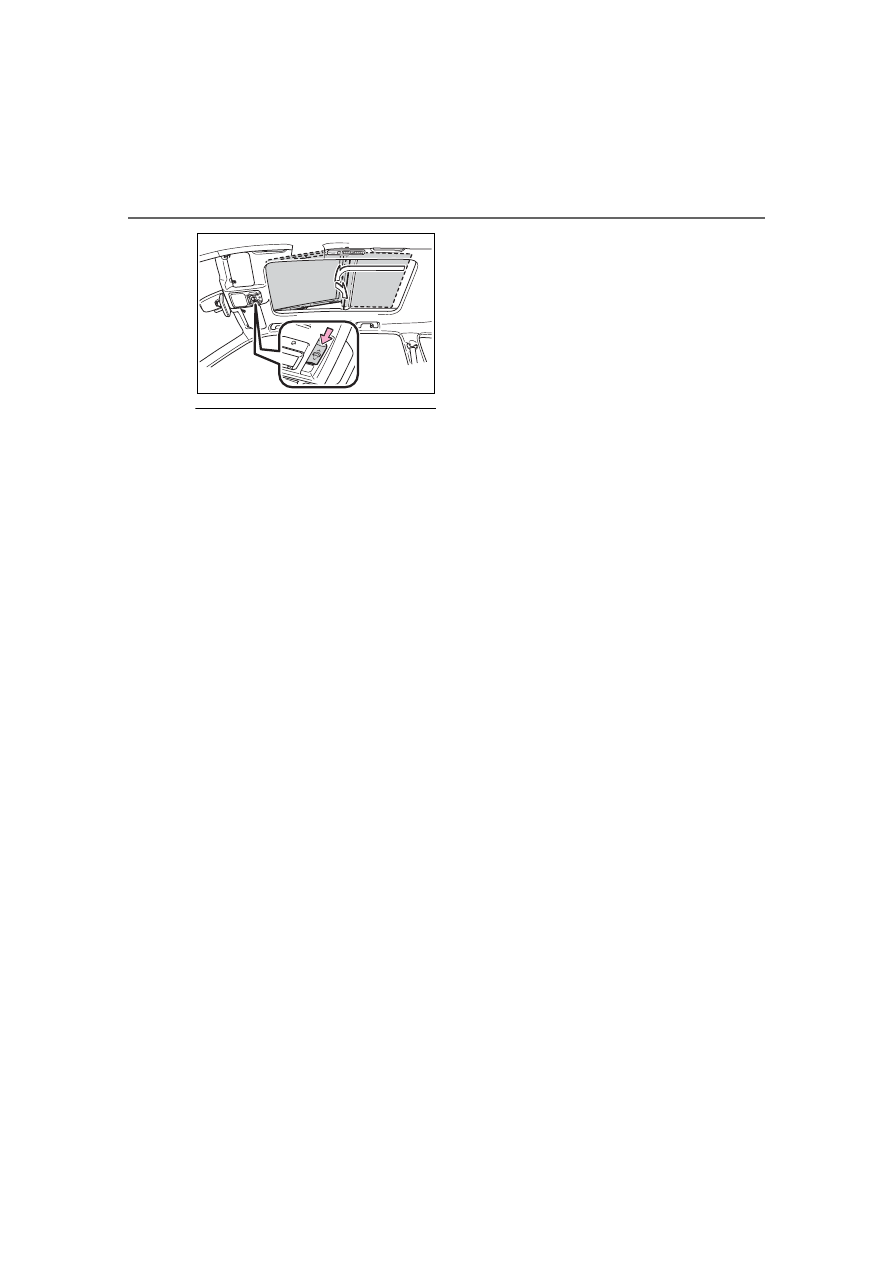
Closing the shade when the 

panoramic moon roof is open

1

Slide the shade switch forward.

The shade closes up to its 

half-closed position and then the 

panoramic moon roof closes up to 

the tilt-up position.

2

Slide and hold the shade switch 

again.

The panoramic moon roof closes as 

long as the switch is being held. 

After the panoramic moon roof is 

fully closed, the shade will fully 

close automatically.

Jam protection function

If an object is detected between the 

panoramic moon roof and the frame 

in the following situations, travel is 

stopped and the panoramic moon 

roof opens slightly:

The panoramic moon roof is clos-

ing or tilting down.

The electronic sunshade is clos-

ing.

When the panoramic moon roof 

does not close normally

Perform the following procedure:

If the panoramic moon roof closes 

but then re-opens slightly

1

Stop the vehicle.

2

Slide the panoramic moon roof 
switch forward and hold it.

*

The panoramic moon roof will close 

then reopen and pause for approxi-

mately 10 seconds. Then it will 

close up to the tilt-up position.

3

Release the switch and then 

slide it forward and hold it again.

The panoramic moon roof will close 

as long as the switch is being held.

4

Check to make sure that the pan-

oramic moon roof is completely 

closed and then release the 

switch.

If the panoramic moon roof tilts 

down but then tilts back up

1

Stop the vehicle.

2

Slide the panoramic moon roof 
switch forward and hold it.

*

The panoramic moon roof will tilt 

down then tilt up and pause for 

approximately 10 seconds. Then it 

will close.

3

Check to make sure that the pan-

oramic moon roof is completely 

closed and then release the 

switch.

*

: If the switch is released at the 

incorrect time, the procedure will 
have to be performed again from 
the beginning.

If the panoramic moon roof does not 

fully close even after performing the 

above procedure correctly, have the 

vehicle inspected by your Toyota 

dealer.

When the shade does not close 

normally

Perform the following procedure:

1

Stop the vehicle.

2

Close the panoramic moon roof.

175

3-5. Opening, closing the windows and moon roof

3

Before driv

ing

3

Slide the shade switch forward 
and hold it.

*

The shade will close then reopen 

and pause for approximately 10 sec-

onds. Then it will close.

4

Check to make sure that the 

shade is completely closed and 

then release the switch.

*

: If the switch is released at the 

incorrect time, the procedure will 
have to be performed again from 
the beginning.

If the shade continues to close but 

then reopens slightly even after per-

forming the above procedure cor-

rectly, have the vehicle inspected by 

your Toyota dealer.

Panoramic moon roof open 

warning buzzer

A buzzer sounds and a message is 

shown on the multi-information dis-

play when the engine switch is 

turned off and the driver’s door is 

opened with the panoramic moon 

roof open.

WARNING

Observe the following precau-

tions.

Failing to do so may cause death 

or serious injury.

Opening and closing the elec-

tronic sunshade

Check to make sure that all pas-

sengers do not have any part of 

their body in a position where it 

could be caught when the elec-

tronic sunshade is being oper-

ated.

Do not let a child operate the 

electronic sunshade. Closing 

the electronic sunshade on 

someone can cause death or 

serious injury.

Opening the panoramic moon 

roof

Do not allow any passengers to 

put their hands or heads outside 

the vehicle while it is moving.

Do not sit on top of the pan-

oramic moon roof.

Opening and closing the pan-

oramic moon roof

The driver is responsible for 

panoramic moon roof opening 

and closing operations. In order 

to prevent accidental operation, 

especially by a child, do not let a 

child operate the panoramic 

moon roof. It is possible for chil-

dren and other passengers to 

have body parts caught in the 

panoramic moon roof.

176

3-5. Opening, closing the windows and moon roof

WARNING

Check to make sure that all pas-

sengers do not have any part of 

their body in a position where it 

could be caught when the pan-

oramic moon roof is being oper-

ated.

When exiting the vehicle, turn 

the engine switch off, carry the 

key and exit the vehicle along 

with the child. There may be 

accidental operation, due to 

mischief, etc., that may possibly 

lead to an accident.

Jam protection function

Never use any part of your body 

to intentionally activate the jam 

protection function.

The jam protection function may 

not work if something gets 

caught just before the pan-

oramic moon roof or electronic 

sunshade is fully closed. Also, 

the jam protection function is 

not designed to operate while 

the switch is being pressed. 

Take care so that your fingers, 

etc. do not get caught.

To prevent burns or injuries

Do not touch the area between 

the underside of the panoramic 

moon roof and the electronic sun-

shade. Your hand may get caught 

and you could injure yourself. 

Also, if the vehicle is left in direct 

sunlight for a long time, the under-

side of the panoramic moon roof 

could become very hot and could 

cause burns.

NOTICE

To prevent damage to the 

panoramic moon roof

Before opening the panoramic 

moon roof, make sure that there 

are no foreign objects, such as 

stones or ice, around the open-

ing.

Do not hit the surface or edge of 

the panoramic moon roof with 

hard objects.

After the vehicle has been 

washed or rained on

Before opening the panoramic 

moon roof, wipe any water off the 

panoramic moon roof. Otherwise, 

water may enter the cabin when 

the panoramic moon roof is 

opened.

177

4

4

Dr

iv

ing

Driving

.

4-1. Before driving

Driving the vehicle.......

179

Cargo and luggage .....

186

Vehicle load limits .......

189

Trailer towing...............

190

Dinghy towing .............

201

4-2. Driving procedures

Engine (ignition) switch

..................................

202

Automatic transmission

..................................

206

Turn signal lever..........

209

Parking brake..............

210

Brake Hold ..................

213

4-3. Operating the lights and 

wipers

Headlight switch..........

216

Automatic High Beam .

219

Fog light switch ...........

222

Windshield wipers and 

washer.......................

222

Rear windshield wiper and 

washer.......................

225

4-4. Refueling

Opening the fuel tank cap

..................................

227

4-5. Using the driving support 

systems

Toyota Safety Sense 2.5 +

..................................

229

PCS (Pre-Collision System)

..................................

235

LTA (Lane Tracing Assist)

..................................

246

Dynamic radar cruise con-

trol with full-speed range

..................................

257

RSA (Road Sign Assist)

..................................

269

Stop & Start system ....

272

BSM (Blind Spot Monitor)

..................................

278

Intuitive parking assist.

284

RCTA (Rear Cross Traffic 

Alert) function ............

293

PKSB (Parking Support 

Brake)........................

300

Parking Support Brake func-

tion (static objects) ....

307

Parking Support Brake func-

tion (rear-crossing vehi-
cles)...........................

310

Driving mode select switch

..................................

311

Multi-terrain Select ......

312

Snow mode switch ......

315

Downhill assist control sys-

tem ............................

316

Driving assist systems

..................................

318

4-6. Driving tips

Winter driving tips........

324

179

4-1. Before driving

4

Dr

iv

ing

4-1.Before driving

Starting the engine

P.202

Driving

1

With the brake pedal 
depressed, shift the shift 
lever to D. (

P.206)

2

Release the parking brake. 
(

P.210)

If the parking brake is in automatic 

mode, the parking brake is 

released automatically when shift-

ing the shift lever to any position 

other than P. (

P.211)

3

Gradually release the brake 
pedal and gently depress the 
accelerator pedal to acceler-
ate the vehicle.

Stopping

1

With the shift lever in D, 
depress the brake pedal.

Vehicles with a Stop & Start system: 

If the Stop & Start system is 

enabled, depressing the brake 

pedal will stop the engine.

2

If necessary, set the parking 
brake. (

P.210)

If the vehicle is to be stopped for an 

extended period of time, shift the 

shift lever to P or N. (

P.206)

Parking the vehicle

1

With the shift lever in D, 
depress the brake pedal.

2

Set the parking brake 
(

P.210), and shift the shift 

lever to P (

P.206).

3

Press the engine switch to 
stop the engine.

4

Lock the door, making sure 
that you have the electronic 
key on your person.

If parking on a hill, block the wheels 

as needed.

Starting off on a steep 
uphill

1

With the brake pedal 
depressed, shift the shift 
lever to D. (

P.207)

2

Pull the parking brake switch 
and parking brake is set man-
ually. (

P.210)

3

Release the brake pedal and 
gently depress the accelera-
tor pedal to accelerate the 
vehicle.

4

Push the parking brake 
switch and parking brake is 
released manually.

When starting off on a uphill

The hill-start assist control will acti-

vate. (

P.318)

Driving in the rain

Drive carefully when it is raining, 

because visibility will be reduced, 

the windows may become 

fogged-up, and the road will be 

slippery.

Drive carefully when it starts to 

Driving the vehicle

The following procedures 
should be observed to 
ensure safe driving:

Driving procedure

180

4-1. Before driving

rain, because the road surface will 

be especially slippery.

Refrain from high speeds when 

driving on an expressway in the 

rain, because there may be a 

layer of water between the tires 

and the road surface, preventing 

the steering and brakes from 

operating properly.

Engine speed while driving

In the following conditions, the 

engine speed may become high 

while driving. This is due to auto-

matic up-shifting control or 

down-shifting implementation to 

meet driving conditions. It does not 

indicate sudden acceleration.

The vehicle is judged to be driving 

uphill or downhill

When the accelerator pedal is 

released

When the brake pedal is 

depressed while sport mode is 

selected

Restraining the engine output 

(Brake Override System)

When the accelerator and brake 

pedals are depressed at the same 

time, the engine output may be 

restrained.

A warning message is displayed 

on the multi-information display 

and head-up display (if equipped) 

while the system is operating.

Restraining sudden start 

(Drive-Start Control)

When the following unusual oper-

ation is performed, the engine out-

put may be restrained.

• When the shift lever is shifted from 

R to D, D to R, N to R, P to D, or P 

to R (D includes M) with the accel-

erator pedal depressed, a warning 

message appears on the 

multi-information display and 

head-up display (if equipped). If a 

warning message is shown on the 

multi-information display and 

head-up display (if equipped), 

read the message and follow the 

instructions.

• When the accelerator pedal is 

depressed too much while the 

vehicle is in reverse.

While Drive-Start Control is being 

activated, your vehicle may have 

trouble escaping from the mud or 

fresh snow. In such case, deacti-

vate TRAC (

P.319) to cancel 

Drive-Start Control so that the 

vehicle may become able to 

escape from the mud or fresh 

snow.

AWD models: Drive-Start Control 

does not work when Mud & Sand 

or Rock & Dirt mode is selected 

for Multi-terrain Select.

Breaking in your new Toyota

To extend the life of the vehicle, 

observing the following precautions 

is recommended:

For the first 200 miles (300 km):

Avoid sudden stops.

For the first 500 miles (800 km):

Do not tow a trailer.

For the first 600 miles (1000 km):

• Do not drive at extremely high 

speeds.

• Avoid sudden acceleration.

• Do not drive continuously in low 

gears.

• Do not drive at a constant speed 

for extended periods.

Operating your vehicle in a for-

eign country

Comply with the relevant vehicle 

registration laws and confirm the 

availability of the correct fuel. 

(

P.501)

Eco-friendly driving

P.86, 95

181

4-1. Before driving

4

Dr

iv

ing

WARNING

Observe the following precau-

tions.

Failure to do so may result in 

death or serious injury.

When starting the vehicle

Always keep your foot on the 

brake pedal while stopped with 

the engine running. This prevents 

the vehicle from creeping.

When driving the vehicle

Do not drive if you are unfamil-

iar with the location of the brake 

and accelerator pedals to avoid 

depressing the wrong pedal.

• Accidentally depressing the 

accelerator pedal instead of the 

brake pedal will result in sudden 

acceleration that may lead to an 

accident.

• When backing up, you may twist 

your body around, leading to a 

difficulty in operating the pedals. 

Make sure to operate the pedals 

properly.

• Make sure to keep a correct 

driving posture even when mov-

ing the vehicle only slightly. This 

allows you to depress the brake 

and accelerator pedals properly.

• Depress the brake pedal using 

your right foot. Depressing the 

brake pedal using your left foot 

may delay response in an emer-

gency, resulting in an accident.

Do not drive the vehicle over or 

stop the vehicle near flammable 

materials.

The exhaust system and 

exhaust gases can be 

extremely hot. These hot parts 

may cause a fire if there is any 

flammable material nearby.

During normal driving, do not 

turn off the engine. Turning the 

engine off while driving will not 

cause loss of steering or brak-

ing control, but the power assist 

to these systems will be lost. 

This will make it more difficult to 

steer and brake, so you should 

pull over and stop the vehicle as 

soon as it is safe to do so.

However, in the event of an 

emergency, such as if it 

becomes impossible to stop the 

vehicle in the normal way: 

P.448

Use engine braking (downshift) 

to maintain a safe speed when 

driving down a steep hill.

Using the brakes continuously 

may cause the brakes to over-

heat and lose effectiveness. 

(

P.206)

Do not adjust the positions of 

the steering wheel, the seat, or 

the inside or outside rear view 

mirrors while driving.

Doing so may result in a loss of 

vehicle control.

Always check that all passen-

gers’ arms, heads or other parts 

of their body are not outside the 

vehicle.

AWD models: This is not an 

AWD vehicle designed for 

off-road driving. Proceed with all 

due caution if it becomes 

unavoidable to drive off-road.

Do not drive across a river or 

through other bodies of water.

This may cause electric/elec-

tronic components to short cir-

cuit, damage the engine or 

cause other serious damage to 

the vehicle.

182

4-1. Before driving

WARNING

Do not drive in excess of the 

speed limit. Even if the legal 

speed limit permits it, do not 

drive over 85 mph (140 km/h) 

unless your vehicle has 

high-speed capability tires. Driv-

ing over 85 mph (140 km/h) 

may result in tire failure, loss of 

control and possible injury. Be 

sure to consult a tire dealer to 

determine whether the tires on 

your vehicle are high-speed 

capability tires or not before 

driving at such speeds.

When driving on slippery 

road surfaces

Sudden braking, acceleration 

and steering may cause tire 

slippage and reduce your ability 

to control the vehicle.

Sudden acceleration, engine 

braking due to shifting, or 

changes in engine speed could 

cause the vehicle to skid.

After driving through a puddle, 

lightly depress the brake pedal 

to make sure that the brakes 

are functioning properly. Wet 

brake pads may prevent the 

brakes from functioning prop-

erly. If the brakes on only one 

side are wet and not functioning 

properly, steering control may 

be affected.

When shifting the shift lever

Do not let the vehicle roll back-

ward while the shift lever is in a 

driving position, or roll forward 

while the shift lever is in R.

Doing so may cause the engine 

to stall or lead to poor brake and 

steering performance, resulting 

in an accident or damage to the 

vehicle.

Do not shift the shift lever to P 

while the vehicle is moving.

Doing so can damage the trans-

mission and may result in a loss 

of vehicle control.

Do not shift the shift lever to R 

while the vehicle is moving for-

ward.

Doing so can damage the trans-

mission and may result in a loss 

of vehicle control.

Do not shift the shift lever to a 

driving position while the vehicle 

is moving backward.

Doing so can damage the trans-

mission and may result in a loss 

of vehicle control.

Shifting the shift lever to N while 

the vehicle is moving will disen-

gage the engine. Engine brak-

ing is not available when N is 

selected.

Be careful not to shift the shift 

lever with the accelerator pedal 

depressed. Shifting the shift 

lever to any position other than 

P or N may lead to unexpected 

rapid acceleration of the vehicle 

that may cause an accident and 

result in death or serious injury.

If you hear a squealing or 

scraping noise (brake pad 

wear limit indicators)

Have the brake pads checked and 

replaced by your Toyota dealer as 

soon as possible.

Rotor damage may result if the 

pads are not replaced when 

needed.
It is dangerous to drive the vehicle 

when the wear limits of the brake 

pads and/or those of the brake 

discs are exceeded.

183

4-1. Before driving

4

Dr

iv

ing

WARNING

When the vehicle is stopped

Do not race the engine.

If the shift lever is in any posi-

tion other than P or N, the vehi-

cle may accelerate suddenly 

and unexpectedly, causing an 

accident.

In order to prevent accidents 

due to the vehicle rolling away, 

always keep depressing the 

brake pedal while the engine is 

running, and apply the parking 

brake as necessary.

If the vehicle is stopped on an 

incline, in order to prevent acci-

dents caused by the vehicle roll-

ing forward or backward, always 

depress the brake pedal and 

securely apply the parking 

brake as needed.

Avoid revving or racing the 

engine.

Running the engine at high 

speed while the vehicle is 

stopped may cause the exhaust 

system to overheat, which could 

result in a fire if combustible 

material is nearby.

When the vehicle is parked

Do not leave glasses, cigarette 

lighters, spray cans, or soft 

drink cans in the vehicle when it 

is in the sun.

Doing so may result in the fol-

lowing:

• Gas may leak from a cigarette 

lighter or spray can, and may 

lead to a fire.

• The temperature inside the 

vehicle may cause the plastic 

lenses and plastic material of 

glasses to deform or crack.

• Soft drink cans may fracture, 

causing the contents to spray 

over the interior of the vehicle, 

and may also cause a short cir-

cuit in the vehicle’s electrical 

components.

Do not leave cigarette lighters in 

the vehicle. If a cigarette lighter 

is in a place such as the glove 

box or on the floor, it may be lit 

accidentally when luggage is 

loaded or the seat is adjusted, 

causing a fire.

Do not attach adhesive discs to 

the windshield or windows. Do 

not place containers such as air 

fresheners on the instrument 

panel or dashboard. Adhesive 

discs or containers may act as 

lenses, causing a fire in the 

vehicle.

Do not leave a door or window 

open if the curved glass is 

coated with a metallized film 

such as a silver-colored one. 

Reflected sunlight may cause 

the glass to act as a lens, caus-

ing a fire.

Always apply the parking brake, 

shift the shift lever to P, stop the 

engine and lock the vehicle.

Do not leave the vehicle unat-

tended while the engine is run-

ning.

If the vehicle is parked with the 

shift lever in P but the parking 

brake is not set, the vehicle may 

start to move, possibly leading 

to an accident.

Do not touch the exhaust pipes 

while the engine is running or 

immediately after turning the 

engine off.

Doing so may cause burns.

184

4-1. Before driving

WARNING

When taking a nap in the vehi-

cle

Always turn the engine off. Other-

wise, if you accidentally move the 

shift lever or depress the acceler-

ator pedal, this could cause an 

accident or fire due to engine 

overheating. Additionally, if the 

vehicle is parked in a poorly venti-

lated area, exhaust gases may 

collect and enter the vehicle, lead-

ing to death or a serious health 

hazard.

When braking

When the brakes are wet, drive 

more cautiously.

Braking distance increases 

when the brakes are wet, and 

this may cause one side of the 

vehicle to brake differently than 

the other side. Also, the parking 

brake may not securely hold the 

vehicle.

If the brake booster device does 

not operate, do not follow other 

vehicles closely and avoid hills 

or sharp turns that require brak-

ing.

In this case, braking is still pos-

sible, but the brake pedal 

should be depressed more 

firmly than usual. Also, the brak-

ing distance will increase. Have 

your brakes fixed immediately.

Do not pump the brake pedal if 

the engine stalls.

Each push on the brake pedal 

uses up the reserve for the 

power-assisted brakes.

The brake system consists of 2 

individual hydraulic systems; if 

one of the systems fails, the 

other will still operate. In this 

case, the brake pedal should be 

depressed more firmly than 

usual and the braking distance 

will increase. Have your brakes 

fixed immediately.

If the vehicle becomes stuck 

(AWD models)

Do not spin the wheels exces-

sively when any of the tires is up 

in the air, or the vehicle is stuck in 

sand, mud, etc. This may damage 

the driveline components or pro-

pel the vehicle forward or back-

ward, causing an accident.

NOTICE

When driving the vehicle

Do not depress the accelerator 

and brake pedals at the same 

time during driving, as this may 

restrain the engine output.

Do not use the accelerator 

pedal or depress the accelera-

tor and brake pedals at the 

same time to hold the vehicle on 

a hill.

When parking the vehicle

Always set the parking brake and 

shift the shift lever to P. Failure to 

do so may cause the vehicle to 

move or the vehicle may acceler-

ate suddenly if the accelerator 

pedal is accidentally depressed.

Avoiding damage to vehicle 

parts

Do not turn the steering wheel 

fully in either direction and hold 

it there for an extended period 

of time.

Doing so may damage the 

power steering motor.

185

4-1. Before driving

4

Dr

iv

ing

NOTICE

When driving over bumps on 

the road, drive as slowly as pos-

sible to avoid damaging the 

wheels, underside of the vehi-

cle, etc.

If you get a flat tire while driv-

ing

A flat or damaged tire may cause 

the following situations. Hold the 

steering wheel firmly and gradu-

ally depress the brake pedal to 

slow down the vehicle.

It may be difficult to control your 

vehicle.

The vehicle will make abnormal 

sounds or vibrations.

The vehicle will lean abnor-

mally.

Information on what to do in case 

of a flat tire (

P.471)

When encountering flooded 

roads

Do not drive on a road that has 

flooded after heavy rain etc. 

Doing so may cause the following 

serious damage to the vehicle:

Engine stalling

Short in electrical components

Engine damage caused by 

water immersion

In the event that you drive on a 

flooded road and the vehicle is 

flooded, be sure to have your Toy-

ota dealer check the following:

Brake function

Changes in quantity and quality 

of oil and fluid used for the 

engine, transaxle, transfer 

(AWD models), rear differential 

(AWD models), etc.

Lubricant condition for the pro-

peller shaft (AWD models), 

bearings and suspension joints 

(where possible), and the func-

tion of all joints, bearings, etc.

186

4-1. Before driving

Cargo capacity depends on the 
total weight of the occupants.
(Cargo capacity) = (Total load 
capacity) — (Total weight of 
occupants)
Steps for Determining Correct 
Load Limit —
(1) Locate the statement “The 
combined weight of occupants 
and cargo should never exceed 
XXX kg or XXX lbs.” on your 
vehicle’s placard.
(2) Determine the combined 
weight of the driver and passen-
gers that will be riding in your 
vehicle.
(3) Subtract the combined 
weight of the driver and passen-
gers from XXX kg or XXX lbs.
(4) The resulting figure equals 
the available amount of cargo 
and luggage load capacity.
For example, if the “XXX” 
amount equals 1400 lbs. and 
there will be five 150 lb passen-
gers in your vehicle, the amount 
of available cargo and luggage 
load capacity is 650 lbs. (1400 − 

750 (5 

 150) = 650 lbs.)

(5) Determine the combined 
weight of luggage and cargo 
being loaded on the vehicle. 
That weight may not safely 
exceed the available cargo and 
luggage load capacity calcu-
lated in Step 4.
(6) If your vehicle will be towing 
a trailer, load from your trailer 
will be transferred to your vehi-
cle. Consult this manual to 
determine how this reduces the 
available cargo and luggage 
load capacity of your vehicle. 
(

P.189)

Cargo capacity
Total load capacity (vehicle 
capacity weight) (

P.500)

When 2 people with the com-
bined weight of A lb. (kg) are rid-
ing in your vehicle, which has a 
total load capacity (vehicle 
capacity weight) of B lb. (kg), 
the available amount of cargo 
and luggage load capacity will 

Cargo and luggage

Take notice of the following 
information about storage 
precautions, cargo capacity 
and load.

Capacity and distribution

Calculation formula for 
your vehicle

187

4-1. Before driving

4

Dr

iv

ing

be C lb. (kg) as follows:

B

*2

 lb. (kg) - A

*1

 lb. (kg) = C

*3

 lb. 

(kg)

*1

:A =Weight of people

*2

:B =Total load capacity

*3

:C =Available cargo and luggage 

load

In this condition, if 3 more passen-
gers with the combined weight of D 
lb. (kg) get on, the available cargo 
and luggage load will be reduced E 
lb. (kg) as follows:

C lb. (kg) - D

*4

 lb. (kg) = E

*5

 lb. 

(kg)

*4

:D =Additional weight of people

*5

:E =Available cargo and luggage 

load

As shown in the example above, 
if the number of occupants 
increases, the cargo and lug-
gage load will be reduced by an 
amount that equals the 
increased weight due to the 
additional occupants. In other 
words, if an increase in the num-
ber of occupants causes an 
excess of the total load capacity 
(combined weight of occupants 
plus cargo and luggage load), 
you must reduce the cargo and 
luggage on your vehicle.

WARNING

Things that must not be car-

ried in the luggage compart-

ment

The following things may cause a 

fire if loaded in the luggage com-

partment:

Receptacles containing gaso-

line

Aerosol cans

Storage precautions

Observe the following precau-

tions.

Failure to do so may prevent the 

pedals from being depressed 

properly, may block the driver’s 

vision, or may result in items hit-

ting the driver or passengers, pos-

sibly causing an accident.

Stow cargo and luggage in the 

luggage compartment when-

ever possible.

Do not stack cargo and luggage 

in the luggage compartment 

higher than the seatbacks.

When you fold down the rear 

seats, long items should not be 

placed directly behind the front 

seats.

Never allow anyone to ride in 

the luggage compartment. It is 

not designed for passengers. 

They should ride in their seats 

with their seat belts properly 

fastened.

Do not place cargo or luggage 

in or on the following locations.

• At the feet of the driver

• On the front passenger or rear 

seats (when stacking items)

• On the luggage cover

• On the instrument panel

• On the dashboard

Secure all items in the occupant 

compartment.

Capacity and distribution

Do not exceed the maximum 

axle weight rating or the total 

vehicle weight rating.

188

4-1. Before driving

WARNING

Even if the total load of occu-

pant’s weight and the cargo 

load is less than the total load 

capacity, do not apply the load 

unevenly. Improper loading may 

cause deterioration of steering 

or braking control which may 

cause death or serious injury.

When using a roof luggage 

carrier (vehicles with roof 

rails)

Observe the following precau-

tions: 

Place the cargo so that its 

weight is distributed evenly 

between the front and rear 

axles.

If loading long or wide cargo, 

never exceed the vehicle overall 

length or width. (

P.500)

Before driving, make sure the 

cargo is securely fastened on 

the roof luggage carrier.

Loading cargo on the roof lug-

gage carrier will make the cen-

ter of gravity of the vehicle 

higher. Avoid high speeds, sud-

den starts, sharp turns, sudden 

braking or abrupt maneuvers, 

otherwise it may result in loss of 

control or vehicle rollover due to 

failure to operate this vehicle 

correctly and result in death or 

serious injury.

If driving for a long distance, on 

rough roads, or at high speeds, 

stop the vehicle now and then 

during the trip to make sure the 

cargo remains in its place.

Do not exceed 165 lb. (75 kg) 

cargo weight on the roof lug-

gage carrier.

NOTICE

When loading cargo

Be careful not to scratch the sur-

face of the moon roof or pan-

oramic moon roof.

189

4-1. Before driving

4

Dr

iv

ing

Total load capacity and seating 

capacity

These details are also described on 

the tire and loading information 

label. (

P.429)

Vehicle load limits

Vehicle load limits include 
total load capacity, seating 
capacity, trailer weight rat-
ing and cargo capacity.

Total load capacity (vehicle 
capacity weight): 

P.500

Total load capacity means the 
combined weight of occupants, 
cargo and luggage.

Seating capacity: 

P.500

Seating capacity means the max-
imum number of occupants 
whose estimated average weight 
is 150 lb. (68 kg) per person.

TWR (Trailer Weight Rat-
ing): 

P.195, 500

TWR means the maximum gross 
trailer weight (trailer weight plus 
its cargo weight) that your vehicle 
is able to tow.

Cargo capacity

Cargo capacity may increase or 
decrease depending on the 
weight and the number of occu-
pants.

WARNING

Overloading the vehicle

Do not overload the vehicle.

It may not only cause damage to 

the tires, but also degrade steer-

ing and braking ability, resulting in 

an accident.

190

4-1. Before driving

Matching trailer ball height to 

trailer coupler height

No matter which class of tow hitch 

applies, for a more safe trailer 

hookup, the trailer ball setup must 

be the proper height for the coupler 

on the trailer.

Coupler
Trailer ball

Before towing

Check that the following conditions 

are met:

Ensure that your vehicle’s tires 

are properly inflated. (

P.505)

Trailer tires are inflated according 

to the trailer manufacturer’s rec-

ommendation.

Trailer towing

Your vehicle is designed pri-
marily as a passen-
ger-and-load-carrying 
vehicle. Towing a trailer can 
have an adverse impact on 
handling, performance, 
braking, durability, and fuel 
consumption. For your 
safety and the safety of oth-
ers, you must not overload 
your vehicle or trailer. You 
must also ensure that you 
are using appropriate tow-
ing equipment, that the tow-
ing equipment has been 
installed correctly and used 
properly, and that you 
employ the requisite driv-
ing habits.

Vehicle-trailer stability and 
braking performance are 
affected by trailer stability, 
brake performance and set-
ting, trailer brakes, the hitch 
and hitch systems (if 
equipped).

To tow a trailer safely, use 
extreme care and drive the 
vehicle in accordance with 
your trailer’s characteris-
tics and operating condi-
tions.

Toyota warranties do not 
apply to damage or mal-
function caused by towing a 
trailer for commercial pur-
poses.

Contact your Toyota dealer 
for further information 
about additional require-
ments such as a towing kit, 
etc.


Content      ..     9      10      11      12     ..