Suzuki Grand Vitara JB416 / JB420 / JB419. Manual - part 227
 

  Index      Suzuki     Suzuki Grand Vitara JB416 / JB420 / JB419 - service repair manual 2007 year


Search            


Content   ..  225  226  227  228   ..


Suzuki Grand Vitara JB416 / JB420 / JB419. Manual - part 227


2D-1 Wheels and Tires: 

Suspension

Wheels and Tires

General Description

Tires Description

S6JB0A2401001

The tire is of tubeless type. The tire is designed to 
operate satisfactorily with loads up to the full rated load 
capacity when inflated to the recommended inflation 
pressures.
Correct tire pressures and driving habits have an 
important influence on tire life. Heavy cornering, 
excessively rapid acceleration, and unnecessary sharp 
braking increase tire wear.

Tire Placard
The “Tire Placard” is located on the left or right door lock 
pillar and should be referred to tire information.
The placard lists the maximum load, tire size and cold 
tire pressure where applicable.

NOTE
Whether rim size and/or maximum load are 
listed or not depends on regulations of each 
country.


Inflation of Tires
The pressure recommended for any model is carefully 
calculated to give a satisfactory ride, stability, steering, 
tread wear, tire life and resistance to bruises.
Tire pressure, with tires cold, (after vehicle has set for 3 
hours or more, or driven less than one mile) should be 
checked monthly or before any extended trip. Set to the 
specifications on the “Tire Placard” located on the left or 
right door lock pillar.
It is normal for tire pressure to increase when the tires 
become hot during driving.
Do not bleed or reduce tire pressure after driving. 
Bleeding reduces the “Cold Inflation Pressure”.

Higher than recommended pressure can cause:
• Hard ride
• Tire bruising or carcass damage
• Rapid tread wear at center of tire

Unequal pressure on same axle can cause:
• Uneven braking
• Steering lead
• Reduced handling
• Swerve on acceleration

Lower than recommended pressure can cause:
• Tire squeal on turns
• Hard Steering
• Rapid and uneven wear on the edges of the tread
• Tire rim bruises and rupture
• Tire cord breakage
• High tire temperature
• Reduced handling
• High fuel consumption

Matched Tires and Wheels (Steel Type)
Tires and wheels are match mounted at the assembly 
plant.
This means that the radially stiffest part of the tire, or 
“high spot”, is matched to the smallest radius or “low 
spot” of the wheel.
This is done to provide the smoothest possible ride.
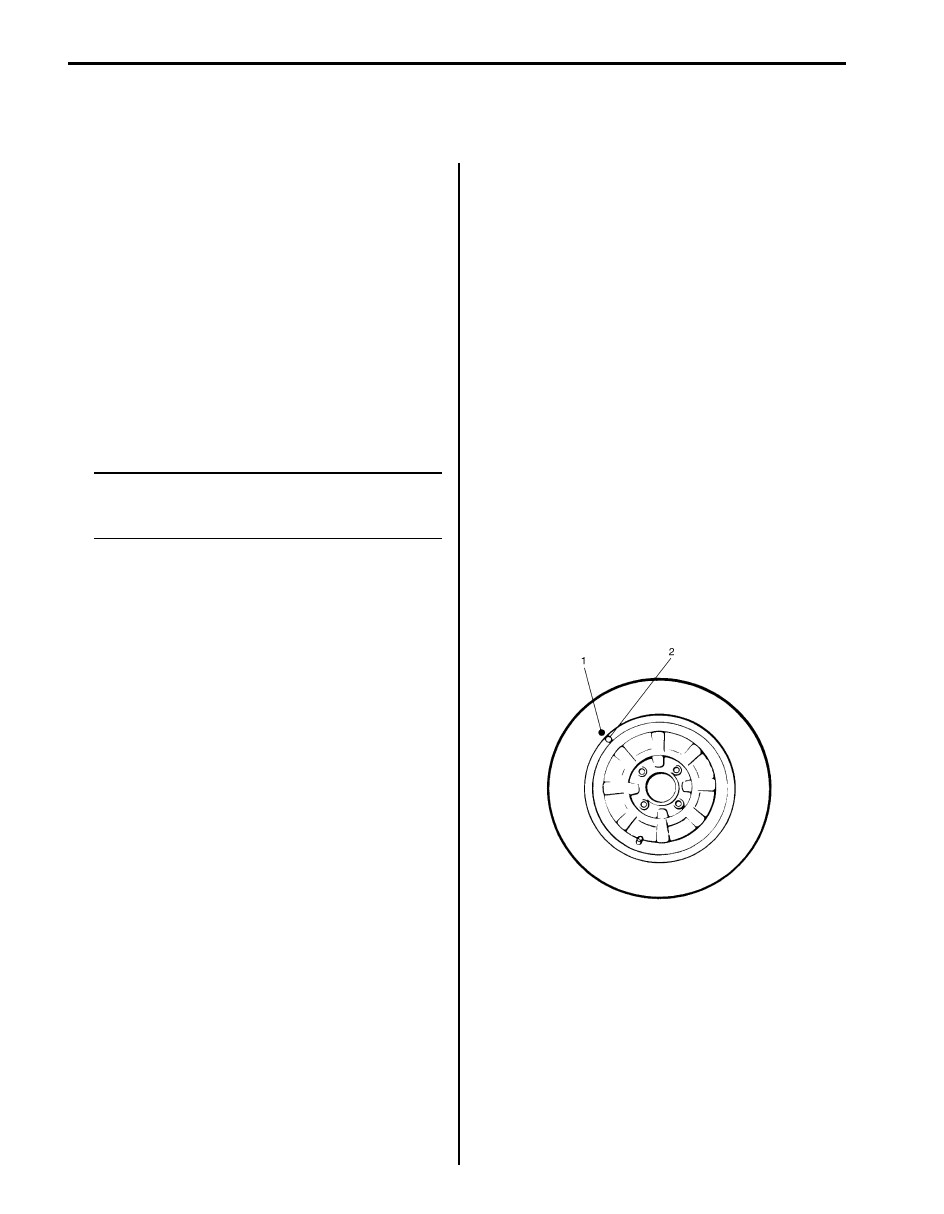
The “high spot” of the tire is originally marked by paint 
dot (1) on the outboard sidewall. This paint dot will 
eventually wash off the tire.
The “low spot” of the wheel is originally marked by paint 
dot (2) on the wheel rim-flange. Properly assembled, the 
wheel rims’ paint dot should be aligned with the tires’ 
paint dot as shown in figure.

Whenever a tire is dismounted from its wheel, it should 
be remounted so that the tire and wheel are matched. If 
the tire’s paint dot cannot be located, a line should be 
scribed on the tire and wheel before dismounting to 
assure that it is remounted in the same position.

I2RH01240001-01

Wheels and Tires:  2D-2

Replacement Tires
When replacement is necessary, the original equipment 
type tire should be used. Refer to the “Tire Placard”. 
Replacement tires should be of the same size, load 
range and construction as those originally on the vehicle. 
Use of any other size or type tire may affect ride, 
handling, speedometer / odometer calibration, vehicle 
ground clearance and tire or snow chain clearance to the 
body and chassis.
It is recommended that new tires be installed in pairs on 
the same axle. If necessary to replace only one tire, it 
should be paired with the tire having the most tread, to 
equalize braking traction.

WARNING

!


Do not mix different types of tires on the 
same vehicle such as radial, bias and bias-
belted tires except in emergencies, because 
handling may be seriously affected and may 
result in loss of control.


The metric term for tire inflation pressure is the kilo 
pascal (kPa). Tire pressures is usually printed in both 
kPa and kgf/cm

2

 on the “Tire Placard”.

Metric tire gauges are available from tool suppliers.
The chart, shown the table, converts commonly used 
inflation pressures from kPa to kgf/cm

2

 and psi.

Wheels Description

S6JB0A2401002

Wheel Maintenance
Wheel repairs that use welding, heating, or peening are 
not approved. All damaged wheels should be replaced.

Replacement Wheels
Wheels must be replaced if they are bent, dented, have 
excessive lateral or radial runout, air leak through welds, 
have elongated bolt holes, if lug nuts won’t stay tight, or 
if they are heavily rusted. Wheels with greater runout 
than shown in the following may cause objectional 
vibrations.
Replacement wheels must be equivalent to the original 
equipment wheels in load capacity, diameter, rim with 
offset and mounting configuration. A wheel of improper 
size or type may affect wheel and bearing life, brake 
cooling, speedometer / odometer calibration, vehicle 
ground clearance and tire clearance to body and 
chassis.

How to Measure Wheel Runout
To measure the wheel runout, it is necessary to use an 
accurate dial indicator. The tire may be on or off the 
wheel. The wheel should be installed to the wheel 
balancer of the like for proper measurement.
Take measurements of both lateral runout “a” and radial 
runout “b” at both inside and outside of the rim flange. 
With the dial indicator set in place securely, turn the 
wheel one full revolution slowly and record every reading 
of the indicator.
When the measured runout exceeds the specification 
and correction by the balancer adjustment is impossible, 
replace the wheel. If the reading is affected by welding, 
paint or scratch, it should be ignored.

Wheel Runout

Metric Lug Nuts and Wheel Studs
All models use metric lug nuts and wheel studs.

Metric lug nuts and wheel studs size
M12 x 1.25

If a broken stud is found, see “Front Wheel Hub, Disc, 
Nut and Bearing Check in Section 2B”, 
“Rear Wheel 
Disc, Nut and Bearing Check in Section 2C”, “
Front 
Wheel Hub Assembly Removal and Installation in 
Section 2B” an
d/or “Rear Wheel Hub Assembly Removal 
and Installation in Section 2C”, fo
r Note and 
Replacement procedure.

kPa

kgf/cm

2

psi

bar

Conversion:
1 psi = 
6.895 kPa
1 kgf/cm

2

 = 

98.066 kPa
1bar = 
100 kpa

160

1.6

23

1.6

180

1.8

26

1.8

200

2.0

29

2.0

220

2.2

32

2.2

240

2.4

35

2.4

260

2.6

38

2.6

280

2.8

41

2.8

300

3.0

44

3.0

Lateral runout 

limit

Radial runout 

limit

Steel wheel

1.20 mm 

(0.047 in.)

0.70 mm 

(0.027 in.)

Aluminum wheel

0.30 mm 

(0.011 in.)

0.30 mm 

(0.011 in.)

I4RS0A240001-01

I2RH01240003-01

2D-3 Wheels and Tires: 

Irregular and/or Premature Wear Description

S6JB0A2401003

Irregular and premature wear has many causes. Some 
of them are as follows: incorrect inflation pressures, lack 
of tire rotation, driving habits, improper alignment.
If the following conditions are noted, rotation is 
necessary:
• Front tire wear is different from rear.
• Uneven wear exists across the tread of any tire.
• Both side of front tire wears are not even.
• Both side of rear tire wears are not even.
• There is cupping, flat spotting, etc.
A wheel alignment check is necessary if following 
conditions are noted:
• Both side of front tire wears are not even.
• Wear is uneven across the tread of any front tire.
• Front tire treads have scuffed appearance with 

“feather” edges on one side of tread ribs or blocks.

Wear Indicators Description

S6JB0A2401004

Original equipment tires have built-in tread wear 
indicators (1) to show when they need replacement.
These indicators (1) will appear as 12 mm (0.47 in) wide 
bands when the tire tread depth becomes 1.6 mm (0.063 
in).
When the indicators (1) appear in 3 or more grooves at 6 
locations, tire replacement is recommended.

[A]: Hard Cornering, under inflation or lack of tire rotation
[B]: Incorrect wheel alignment, tire construction not uniform or wheel 

heavy acceleration

I3RH0A240002-01

I2RH01240005-01

Wheels and Tires:  2D-4

Radial Tire Waddle Description

S6JB0A2401005

Waddle is side to side movement at the front and/or rear of the vehicle. It is caused by the steel belt not being straight 
within the tire. It is most noticeable at a low speed, 8 to 48 kph (5 to 30 mph).
It is possible to locate the faulty tire by road testing the vehicle. If it is on the rear, the rear end of the vehicle shakes 
from side to side or “waddles”. To the driver in the seat, it feels as though someone is pushing on the side of vehicle.
If the faulty tire is on the front, waddling is more visual. The front sheet metal appears to be moving back and forth and 
the driver feels as though he is at the pivot point in vehicle.
Waddle can be quickly diagnosed by using Tire Problem Detector (TPD) and following the equipment manufacture’s 
recommendations.
If TPD is not available, an alternative method of substituting known-good tire / wheel assemblies can be used as 
follows, although it takes a longer time.

1) Ride vehicle to determine whether the front or rear waddles.
2) Install tires and wheels that are known to be good (on similar vehicle) in place of those on waddling end of vehicle. 

If waddling end cannot be identified, substitute rear ones.

3) Road test again. If improvement is noted, reinstall originals one at a time till waddle causal tire is found. If no 

improvement is noted, install known-good tires in place of all four. Then reinstall originals in the same manner.

Equipment manufacture’s recommendations

I2RH01240006-01

Inflate tires to recommended pressure

Road test vehicle on level unrouned road in both directions

Switch front tires side to side and road test again

Lead corrected,

if roughness results, replace tires

Leads in same direction

Leads reverses direction

Put tires back in original position 
and check alignment

Install a known-good tire on one front side

Lead remains install a known-good
tire in place of other front tire

Lead remains known-good tires are not good

Lead corrected replace tire

Lead corrected replace tire

I2RH01240007-01


Content   ..  225  226  227  228   ..