Suzuki Grand Vitara JB416 / JB420 / JB419. Manual - part 206
 

  Index      Suzuki     Suzuki Grand Vitara JB416 / JB420 / JB419 - service repair manual 2007 year


Search            


Content   ..  204  205  206  207   ..


Suzuki Grand Vitara JB416 / JB420 / JB419. Manual - part 206


1J-14 Charging System: For Petrol Engine Model

Stator
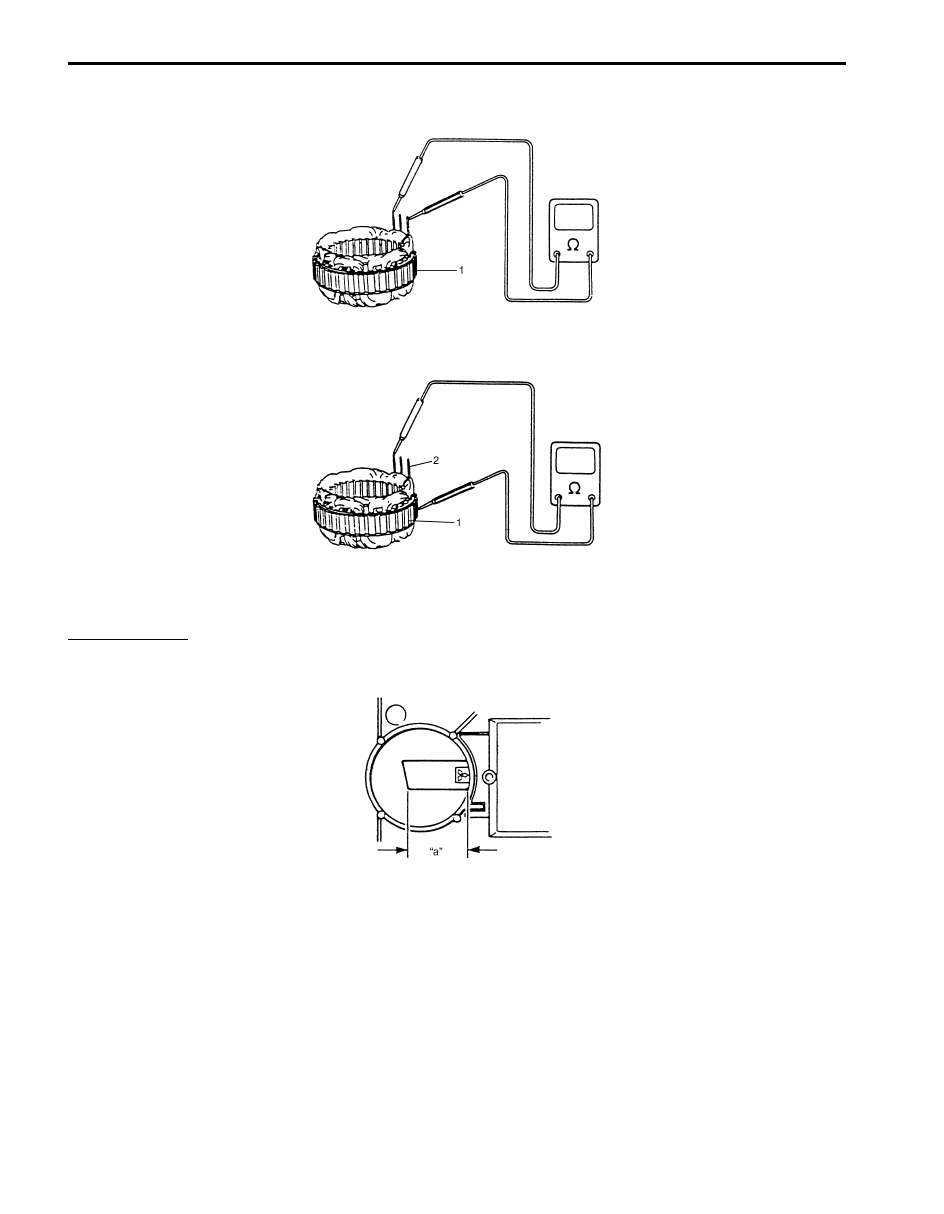
• Using ohmmeter, check all leads for continuity. If there is no continuity, replace stator (1).

• Using ohmmeter, check that there is no continuity between coil leads (2) and stator core (1). If there is continuity, 

replace stator.

Brush and brush holder
Check each brush for wear by measuring its length. If brush is found worn down to service limit, replace brush.

Brush length “a”
Standard: 16 mm (0.63 in.)
Limit: 5 mm (0.20 in.)

IYSQ011A0037-01

IYSQ011A0038-01

IYSQ011A0039-01

Charging System: For Petrol Engine Model 1J-15

Rectifier

1) Using ohmmeter, check continuity between each of upper and lower rectifier bodies and each diode lead (2).

Check both directions by reversing probes of ohmmeter and there should be only one-way continuity in each case.
If check result is not satisfactory, replace rectifier (1).

2) In the same manner as described in above Step 1), check that there is only one-way continuity between both leads 

of diode trio.

Condenser
Check condenser capacity.

Condenser capacity
0.5 

µF

IYSQ011A0040-01

1. Rectifier
2. Condenser

IYSQ011A0041-01

1J-16 Charging System: For Petrol Engine Model

Specifications

Charging System Specifications

S6JB0A1A17001

Battery

NOTE
The battery used in each vehicle is one of the following two types, depending on specification.


Battery
: 55B24R (S) (36AH/5HR), 55D23L (48AH/5HR) 12 V

Generator

Tightening Torque Specifications

S6JB0A1A17002

NOTE
The specified tightening torque is also described in the following.
“Generator Dismounting and Remounting: For Petrol Engine Model”
“Generator Components: For Petrol Engine Model”


Reference:
For the tightening torque of fastener not specified in this section, refer to “Fastener Information in Section 0A”.

Battery type

55B24R (S)

55D23L

Rated Capacity 
AH/5HR, 12 Volts

36

48

Electrolyte 
L (US/Imp. pt)

3.1 

(6.55/5.46)

3.9 

(8.24/6.86)

Electrolyte S.G.

1.28 when fully charged at 20 

°C (68 °F)

Type

80 A type

Rated voltage

12 V

Nominal output

80 A

Permissible max. speed

18000 r/min (rpm)

No-load speed

1200 r/min (rpm)

Setting voltage

14.2 to 14.8 V

Permissible ambient 
temperature

–30 to 100 

°C (–22 to 212 °F)

Polarity

Negative ground

Rotation

Clockwise viewed from pulley side

Fastening part

Tightening torque

Note

N

m

kgf-m

lb-ft

Generator adjusting bolt

25

2.5 

18.5

)

Generator pivot bolt

52.5

5.25 

38.0

)

Generator adjuster bolt

7.0

0.7 

5.0

)

Charging System: For Diesel Engine Model 1J-17

For Diesel Engine Model

General Description

Battery Description

S6JB0A1A21001

The battery has three major functions in the electrical 
system.
• It is a source of electrical energy for cranking the 

engine.

• It acts as a voltage stabilizer for the electrical system.
• It can, for a limited time, provide energy when the 

electrical load exceeds the output of the generator.

Carrier and Hold-Down
The battery carrier should be in good condition so that it 
will support the battery securely and keep it level. 
Before installing the battery, the battery carrier and hold-
down clamp should be clean and free from corrosion and 
make certain there are no parts in carrier.
To prevent the battery from shaking in its carrier, the 
hold-down bolts should be tight enough but not over-
tightened.

Electrolyte Freezing
The freezing point of electrolyte depends on its specific 
gravity. Since freezing may ruin a battery, it should be 
protected against freezing by keeping it in a fully 
charged condition. If a battery is frozen accidentally, it 
should not be charged until it is warmed.

Sulfation
If the battery is allowed to stand for a long period in 
discharged condition, the lead sulfate becomes 
converted into a hard, crystalline substance, which will 
not easily turn back to the active material again during 
the subsequent recharging. “Sulfation” means the result 
as well as the process of that reaction. 
Such a battery can be revived by very slow charging and 
may be restored to usable condition but its capacity is 
lower than before.

Care of battery

WARNING

!


• Never expose battery to open flame or 

electric spark because of battery generate 
gas which is flammable and explosive.

• Do not allow battery fluid to contact eyes, 

skin, fabrics, or painted surfaces as fluid is 
a corrosive acid. Flush any contacted area 
with water immediately and thoroughly.

• Batteries should always be kept out of 

reach of children.


1) The battery is a very reliable component, but needs 

periodical attentions.
• Keep the battery carrier clean.
• Prevent rust formation on the terminal posts.
• Keep the electrolyte up to the upper level 

uniformly in all cells.

• When keeping battery on vehicle over a long 

period of time, follow instructions given below.
– Weekly, start the engine and run it until it 

reaches normal operating temperature with 
engine speed of 2000 to 3000 rpm. Make sure 
all electric switches are off before storing the 
vehicle.

– Recharge the battery twice a month to prevent 

it from discharging excessively. This is 
especially important when ambient temperature 
is low.
The battery discharges even when it is not 
used, while vehicles are being stored. Battery 
electrolyte can freeze and battery case can 
crack at cold ambient condition if battery is not 
properly charged.

2) Keep the battery cable connections clean.

The cable connections, particularly at the positive (+) 
terminal post, tend to become corroded. The product 
of corrosion, or rust, on the mating faces of 
conductors resists the flow of current.
Clean the terminals and fittings periodically to 
ensure good metal-to-metal contact, and grease the 
connections after each cleaning to protect them 
against rusting.

3) Be always in the know as to the state of charge of 

the battery. The simplest way to tell the state of 
charge is to carry out a hydrometer test. The 
hydrometer is an instrument for measuring the 
specific gravity (S.G.) of the battery electrolyte. The 
S.G. of the electrolyte is indicative of the state of 
charge. Refer to “Hydrometer Test” in “Battery 
Inspection: For Diesel Engine Model”.


Content   ..  204  205  206  207   ..