Subaru Forester (2023 year). Manual in english - page 31
 

  Index      Manuals     Subaru Forester (2023 year). Manual in english


Search            copyright infringement  


Content      ..     29      30      31      32     ..


Subaru Forester (2023 year). Manual in english - page 31


(498,1)

!

Alternative engine oil

If the SUBARU approved oil is unavailable, the following alternative oil can be used.

NOTE

Each quantity indicated here is only a guideline. The necessary quantity for replacement may differ slightly depending on the
temperature and other factors.

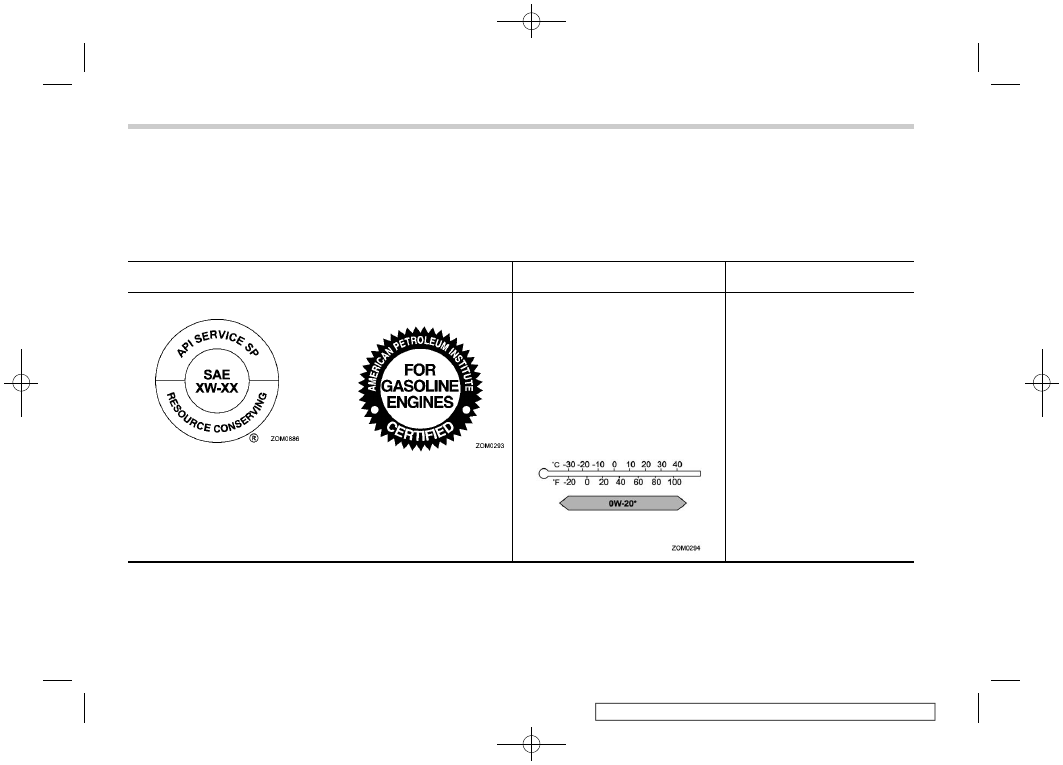
Oil grade

SAE viscosity No. and

applicable temperature

Engine oil capacity

API (American Petroleum Insti-
tute) classification

SN

with the

words “RESOURCE CONSER-
VING”,

SN PLUS

with the words

“RESOURCE CONSERVING” or

SP

with the words “RESOURCE

CONSERVING”

or

ILSAC (International Lubricant
Specification Advisory Commit-
tee)

GF-5

or

GF-6A

, which can

be identified with the ILSAC
certification mark (Starburst
mark)

0W-20 synthetic

oil is the required oil

for optimum engine performance and
protection. Conventional oil may be
used if synthetic oil is unavailable.

*: If 0W-20 synthetic oil is not available,

5W-30 conventional oil may be used
if replenishment is needed but should
be changed to 0W-20 synthetic oil at
the next oil change.

– Adding the oil from low level to

full level:
1.1 US qt (1.0 liters, 0.9 Imp qt)

– Changing the oil and oil filter:

4.4 US qt (4.2 liters, 3.7 Imp qt)

Specifications

496

(499,1)

&

Front differential and rear differential gear oil

Oil

Front differential gear oil

Rear differential gear oil

Oil grade

.

SUBARU Extra MT*

3

.

API classification GL-5 (75W-90)

API classification GL-5 (75W-90)

Oil capacity*

1

1.4 US qt (1.3 liters, 1.1 Imp qt)

0.8 US qt (0.8 liters, 0.7 Imp qt)

Remarks*

2

“Front differential gear oil and rear differential gear oil”

P463

*1: The indicated oil quantity is only a guideline. The necessary quantity for replacement may differ slightly depending on the temperature and other

factors. After refilling the gearbox with oil, the oil level should be checked.

*2: For more details about maintenance and service, refer to the indicated section.
*3: The vehicle is filled at the factory with this oil.

&

Fluids

Fluid

Fluid type*

1

Fluid capacity*

2

Remarks*

3

Continuously variable
transmission fluid

Consult your SUBARU dealer.

Except for Subaru Forester Wilderness models: 12.7 US qt (12.0
liters, 10.6 Imp qt)
For Subaru Forester Wilderness models: 12.4 US qt (11.7 liters,
10.3 Imp qt)

“Continuously variable

transmission fluid”

P462

Brake fluid

FMVSS No. 116, DOT 3
or DOT 4 brake fluid

“Brake fluid”

P463

*1: Use one of the indicated types of fluid.
*2: The indicated fluid quantity is only a guideline. The necessary quantity for replacement may differ slightly depending on the temperature and other

factors.

*3: For more details about maintenance and service, refer to the indicated section.

– CONTINUED –

Specifications

497

12

Specifications

(500,1)

&

Engine coolant

Coolant capacity

Coolant type

9.0 US qt (8.5 liters, 7.5 Imp qt)

SUBARU SUPER COOLANT

The indicated coolant quantity is only a guideline. The necessary quantity for replacement may differ slightly depending on the temperature and other
factors. For more details about maintenance and service, refer to “Cooling system”

P458.

&

Electrical system

Battery type

Q-85

Alternator

12 V-150 A

Spark plugs

DILKAR7Q8 (NGK)

&

Tires

Item

Forester

Subaru Forester Wilderness

Tire size

225/60R17 99H

225/55R18 98H

225/60R17 99T

Wheel size

17

6

7 J

18

6

7 J

17

6

7 J

Pressure

Front

36 psi (250 kPa, 2.5 kgf/cm

2

)

35 psi (240 kPa, 2.4 kgf/cm

2

)

33 psi (230 kPa, 2.3 kgf/cm

2

)

Rear

35 psi (240 kPa, 2.4 kgf/cm

2

)

33 psi (230 kPa, 2.3 kgf/cm

2

)

32 psi (220 kPa, 2.2 kgf/cm

2

)

Wheel nut tightening torque

89 lbf·ft (120 N·m, 12 kgf·m)*

1

*1: This torque is equivalent to applying approximately 88 to 110 lbf (40 to 50 kgf) at the end of the wheel nut wrench. If you have tightened the wheel nuts

by yourself, have the tightening torque checked at the nearest automotive service facility as soon as possible. For the wheel nut tightening procedure,
refer to “Changing a flat tire”

P420.

Specifications

498

(501,1)

&

Temporary spare tires

Temporary spare tire size

T145/80 D17

Temporary spare tire inflation pressure
(recommended cold tire inflation pressure)

60 psi (420 kPa, 4.2 kgf/cm

2

)

&

Brake pedal

in (mm)

Pedal clearance

2.56 (65)*

Pedal free play

0.02 - 0.11 (0.5 - 2.7)

*: Minimum value when pedal is operated with a force of 110 lbf (490 N, 50 kgf)

&

Brake disc

If you need information on the usage limit value of brake discs and the method for measuring them, we recommend that you consult your
SUBARU dealer.

&

Brake pad

in (mm)

Brake pad wear limit

0.06 (1.5)

Specifications

499

12

Specifications

(502,1)

12-2. Bulb chart

&

Safety precautions

WARNING

Bulbs may become very hot while
illuminated. Before replacing bulbs,
turn off the lights and wait until the
bulbs cool down. Otherwise, there is
a risk of sustaining a burn injury.

CAUTION

Replace any bulb only with a new
bulb of the specified wattage. Using
a bulb of different wattage could
result in a fire.

Bulb chart

500

(503,1)

&

Bulb chart

NOTE

Lights indicated by letters are the LED (Light Emitting Diode) type. Consult your SUBARU dealer for replacement.

– CONTINUED –

Bulb chart

501

12

Specifications

(504,1)

Wattage

Bulb No.

1

Front turn signal light

12 V-21 W

WY21W

2

Vanity mirror light

12 V-2 W

3

Cargo area light (models without rear gate light)

12 V-13 W

4

Door step light

12 V-5 W

W5W

5

Rear turn signal light

12 V-21 W

WY21W

6

Backup light

12 V-16 W

W16W

7

Front side marker light (if equipped)

12 V-5 W

W5W

8

Front fog light (if equipped)

12 V-19 W

H16

A

Low/High beam headlight

Daytime running light

B

Map light

C

Dome light

D

Side turn signal light (if equipped)

E

High-mounted stop light

F

Cargo area light (models with rear gate light)

G

Tail light

H

Stop light

Tail light

I

Rear side marker light

J

Rear gate light (if equipped)

K

License plate light

L

Front side marker light (if equipped)

Bulb chart

502

(505,1)

Wattage

Bulb No.

M

Front position light/Accessory lamp (if equipped)

N

Front fog light (if equipped)

Bulb chart

503

12

Specifications

(506,1)

12-3. Vehicle identification

1

Vehicle identification number (under the
floor carpet of the right-hand front seat)

2

Emission control label

3

Tire inflation pressure label (vehicle
placard)

4

Certification label

5

Vehicle identification number

6

Model number label

7

Fuel label

8

Air conditioner label

Vehicle identification

504

(509,1)

13-1. For U.S.A. ...................................................... 508
13-2. Tire information ............................................ 508

Tire labeling ....................................................... 508
Recommended tire inflation pressure.................. 510
Glossary of tire terminology ............................... 511
Tire care – maintenance and safety practices ...... 516
Determining compatibility of tire and vehicle

load capacities ................................................. 516

Adverse safety consequences of overloading

on handling and stopping and on tires.............. 516

Steps for Determining Correct Load Limit ........... 517

13-3. Vehicle load limit – how to determine .........517

Calculating total and load capacities varying

seating configurations...................................... 518

13-4. Uniform tire quality grading standards .......520

TREADWEAR ..................................................... 521
TRACTION AA, A, B, C ....................................... 521
TEMPERATURE A, B, C ...................................... 521

13-5. Reporting safety defects (U.S.A.).................522
13-6. How to contact Transport Canada in

order to report a safety concern relating
to the vehicle (Canada).................................522

Consumer information and reporting safety defects

13

Consumer

information

and

reporting

safety

defects

(510,1)

13-1. For U.S.A.

The following information has been
compiled according to Code of
Federal Regulations “Title 49, Part
575”.

13-2. Tire information

&

Tire labeling

Many markings (e.g. Tire size, Tire
Identification Number or TIN) are
placed on the sidewall of a tire by
tire manufacturers. These markings
can provide you with useful infor-
mation on the tire.

!

Tire size

Your vehicle comes equipped with
P-Metric tire size. It is important to
understand the sizing system in
selecting the proper tire for your
vehicles. Here is a brief review of
the tire sizing system with a break-
down of its individual elements.

!

P Metric

With the P-Metric system, Section
Width is measured in millimeters.
To convert millimeters into inches,
divide by 25.4. The Aspect Ratio
(Section Height divided by Section
Width) helps provide more dimen-
sional information about the tire
size.

Example:

(1)

P = Certain tire type used on
light duty vehicles such as
passenger cars

(2)

Section Width in millimeters

(3)

Aspect Ratio (= section height

7

section width).

(4)

R = Radial Construction

(5)

Rim diameter in inches

!

Load and Speed Rating
Descriptions

The load and speed rating descrip-
tions will appear following the size
designation.
They provide two important facts
about the tire. First, the number
designation is its load index. Sec-
ond, the letter designation indicates
the tire’s speed rating.

For U.S.A.

508

(511,1)

Example:

(6)

Load Index: A numerical code
which specifies the maximum
load a tire can carry at the
speed indicated by its speed
symbol, at maximum inflation
pressure.

For example, “90” means 1,323 lbs
(600 kg), “89” means 1,278 lbs (580
kg).

WARNING

Load indices apply only to the
tire, not to the vehicle. Putting
a load rated tire on any vehicle
does not mean the vehicle can
be loaded up to the tire’s rated
load.

(7)

Speed Rating: An alphabetical
system describing a tire’s cap-
ability to travel at established
and predetermined speeds.

For example, “V” means 149 mph
(240 km/h)

WARNING

.

Speed ratings apply only to

the tire, not to the vehicle.
Putting a speed rated tire on
any vehicle does not mean
the vehicle can be operated
at the tire’s rated speed.

.

The speed rating is void if

the tires are worn out, da-
maged, repaired, retreaded,
or otherwise altered from
their original condition. If
t i r e s a r e r e p a i r e d , r e -
treaded, or otherwise al-
tered, they may not be sui-
table for original equipment
tire designed loads and
speeds.

!

Tire Identification Number
(TIN)

Tire Identification Number (TIN) is
marked on the intended outboard
sidewall. Here is a brief review of

the TIN with a breakdown of its
individual elements.

Type A

(1)

DOT symbol*

(2)

Manufacturer’s Identification
Mark

(3)

Tire Size Code

(4)

Tire Type Code

(5)

Date of Manufacture

The first two figures identify the
week, starting with “01” to represent
the first full week of the calendar
year; the second two figures repre-
sent the year. For example, 0101
means the 1st week of 2001.
*: The DOT symbol certifies that the

tire conforms to applicable Fed-
eral Motor Vehicle Safety Stan-
dards.

– CONTINUED –

Tire information

509

13

Consumer

information

and

reporting

safety

defects

(512,1)

Type B

(1)

DOT symbol*

(2)

Plant Code

(3)

Manufacturer’s Code

(4)

Date of Manufacture

The first two figures identify the
week, starting with “01” to represent
the first full week of the calendar
year; the second two figures repre-
sent the year. For example, 0101
means the 1st week of 2001.
*: The DOT symbol certifies that the

tire conforms to applicable Fed-
eral Motor Vehicle Safety Stan-
dards.

!

Other markings

The following makings are also
placed on the sidewall.

!

Maximum permissible infla-
tion pressure

The maximum cold inflation pres-
sure to which this tire may be
inflated. For example, “300 kPa

(44 PSI) MAX. PRESS”

!

Maximum load rating

The load rating at the maximum
permissible weight load for this tire.
For example, “MAX. LOAD 580 kg
(1279 LBS) @ 300 kPa (44 PSI)
MAX. PRESS.”

WARNING

Maximum load rating applies
only to the tire, not to the
vehicle. Putting a load rated
tire on any vehicle does not
mean the vehicle can be
loaded up to the tire’s rated
load.

!

Construction type

Applicable construction of this tire.
For example, “TUBELESS STEEL
BELTED RADIAL”

!

Construction

The generic name of each cord
material used in the plies (both
sidewall and tread area) of this tire.

For example, “PLIES: TREAD 2
STEEL + 2 POLYESTER SIDE-
WALL 2 POLYESTER”

!

Uniform Tire Quality Grad-
ing (UTQG)

For details, refer to 

Uniform tire

quality grading standards”

P520.

&

Recommended tire inflation
pressure

!

Recommended cold tire in-
flation pressure

For recommended cold tire inflation
pressure for your vehicle’s tires,
refer to “

Tires”

P498.

Tire information

510

(513,1)

!

Vehicle placard

The vehicle placard is attached to
the driver’s side door pillar.

Example:

The vehicle placard shows original
tire size, recommended cold tire
inflation pressure on each tire at
maximum loaded vehicle weight,
seating capacity and loading infor-
mation.

!

Adverse safety conse-
quences of under-inflation

Driving at high speeds with exces-
sively low tire pressures can cause
the tires to flex severely and to
rapidly become hot. A sharp in-
crease in temperature could cause
tread separation, and failure of the
tire(s). Possible resulting loss of
vehicle control could lead to an
accident.

!

Measuring and adjusting air
pressure to achieve proper
inflation

Check and, if necessary, adjust the
pressure of each tire (including the
spare) at least once a month and
before any long journey. Check the
tire pressures when the tires are
cold. Use a pressure gauge to

adjust the tire pressures to the
specific values. Driving even a short
distance warms up the tires and
increases the tire pressures. Also,
the tire pressures are affected by
the outside temperature. It is best to
check tire pressure outdoors before
driving the vehicle. When a tire
becomes warm, the air inside it
expands, causing the tire pressure
to increase. Be careful not to mis-
takenly release air from a warm tire
to reduce its pressure.

&

Glossary of tire terminology

.

Accessory weight

The combined weight (in excess of
those standard items which may be
replaced) of automatic transmis-
sion, power steering, power brakes,
power windows, power seats, radio,
and heater, to the extent that these
items are available as factory-in-
stalled equipment (whether in-
stalled or not).

.

Bead

The part of the tire that is made of

– CONTINUED –

Tire information

511

13

Consumer

information

and

reporting

safety

defects

(514,1)

steel wires, wrapped or reinforced
by ply cords and that is shaped to fit
the rim.

.

Bead separation

A breakdown of the bond between
components in the bead.

.

Bias ply tire

A pneumatic tire in which the ply
cords that extend to the beads are
laid at alternate angles substantially
less than 90 degrees to the center-
line of the tread.

.

Carcass

The tire structure, except tread and
sidewall rubber which, when in-
flated, bears the load.

.

Chunking

The breaking away of pieces of the
tread or sidewall.

.

Cold tire pressure

The pressure in a tire that has been
driven less than 1 mile or has been
standing for three hours or more.

.

Cord

The strands forming the plies in the
tire.

.

Cord separation

The parting of cords from adjacent
rubber compounds.

.

Cracking

Any parting within the tread, side-
wall, or inner liner of the tire
extending to cord material.

.

Curb weight

The weight of a motor vehicle with
standard equipment including the
maximum capacity of fuel, oil and
coolant, and if so equipped, air
conditioning and additional weight
optional engine.

.

Extra load tire

A tire designed to operate at higher
loads and higher inflation pressure
than the corresponding standard
tire.

.

Groove

The space between two adjacent
tread ribs.

.

Innerliner

The layer(s) forming the inside sur-
face of a tubeless tire that contains
the inflating medium within the tire.

.

Innerliner separation

The parting of the innerliner from
cord material in the carcass.

.

Intended outboard sidewall

(1)

The sidewall that contains a
whitewall, bears white letter-
ing or bears manufacturer,
brand, and/or model name
molding that is higher or
deeper than the same mold-
ing on the other sidewall of
the tire, or

(2)

The outward facing sidewall
of an asymmetrical tire that
has a particular side that
must always face outward
when mounting on a vehicle.

.

Light truck (LT) tire

A tire designated by its manufac-
turer as primarily intended for use
on lightweight trucks or multipur-
pose passenger vehicles.

.

Load rating

The maximum load that a tire is
rated to carry for a given inflation
pressure.

Tire information

512

(515,1)

.

Maximum inflation pressure

The maximum cold inflation pres-
sure to which a tire may be inflated.

.

Maximum load rating

The load rating for a tire at the
maximum permissible inflation
pressure for that tire.

.

Maximum loaded vehicle weight

The sum of:

(a)

Curb weight

(b)

Accessory weight

(c)

Vehicle capacity weight

(d)

Production options weight

.

Maximum permissible inflation
pressure

The maximum cold inflation pres-
sure to which a tire may be inflated.

.

Measuring rim

The rim on which a tire is fitted for
physical dimension requirements.

.

Normal occupant weight

150 lbs (68 kg) times the number of
occupants specified in the second
column of Table 1 that is appended
to the end of this section.

.

Occupant distribution

Distribution of occupants in a vehi-

cle as specified in the third column
of Table 1 that is appended to the
end of this section.

.

Open splice

Any parting at any junction of tread,
sidewall, or innerliner that extends
to cord material.

.

Outer diameter

The overall diameter of an inflated
new tire.

.

Overall width

The linear distance between the
exteriors of the sidewalls of an
inflated tire, including elevations
due to labeling, decorations, or
protective bands or ribs.

.

Passenger car tire

A tire intended for use on passen-
ger cars, multipurpose passenger
vehicles, and trucks, that have a
gross vehicle weight rating (GVWR)
of 10,000 lbs (4,535 kg) or less.

.

Ply

A layer of rubber-coated parallel
cords.

.

Ply separation

A parting of rubber compound

between adjacent plies.

.

Pneumatic tire

A mechanical device made of rub-
ber, chemicals, fabric and steel or
o t h e r m a t e r i a l s , t h a t , w h e n
mounted on an automotive wheel,
provides the traction and contains
the gas or fluid that sustains the
load.

.

Production options weight

The combined weight of those
installed regular production options
weighing over 5.1 lbs (2.3 kg) in
excess of those standard items
which they replace, not previously
considered in curb weight or acces-
sory weight, including heavy duty
brakes, ride levelers, roof rack,
heavy duty battery, and special trim.

.

Radial ply tire

A pneumatic tire in which the ply
cords that extend to the beads are
laid at substantially 90 degrees to
the centerline of the tread.

.

Recommended inflation pres-
sure

The cold inflation pressure recom-

– CONTINUED –

Tire information

513

13

Consumer

information

and

reporting

safety

defects


Content      ..     29      30      31      32     ..