Renault Megane Electric (2022 year). Manual in english - page 3
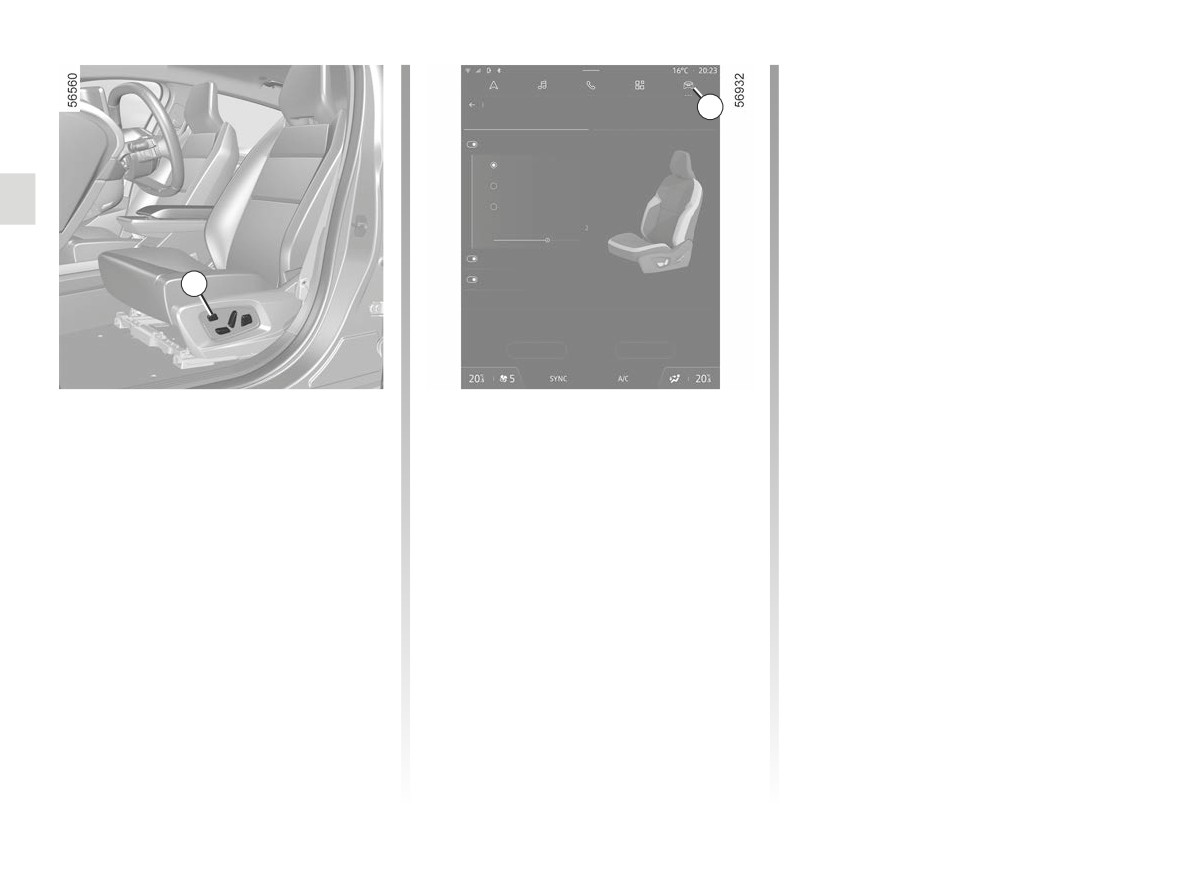
FRONT SEATS: Functions (1/2)
Settings
Seats
Refer to the multimedia instructions for
2
Driver
Passenger
information on accessing the settings.
Massage
You can activate or deactivate the fol-
Lumbar
lowing elements:
Relaxing
Dynamic
- easy driver/passenger access;
Intensity
- visual feedback of current move-
Seat Easy access
ment.
Visual feedback
1
Note: if the user profile is “Guest”, the
automatic adjustment functions will not
Driving posture
be available.
Seat and driving equipment
Save
Recall
Easy driver/passenger access
When this function is activated, the seat
A number of seat functions are avail-
With the ignition on, from the multime-
automatically moves back when the
able from the multifunction screen, de-
dia screen select “Vehicle” 2, “Seats”
driver and/or passenger leaves the ve-
pending on the vehicle.
world, then “Massage”.
hicle, and returns to its position the next
On equipped vehicles, the switch 1 pro-
Browse menu “Driver” or “Passenger”
time the vehicle starts.
vides direct access to the “Seats” menu
to:
Note:
on the multimedia screen.
- select the massage type (“Lumbar”,
- deactivate this function when fitting
“Relaxing”, “Dynamic”);
a child seat in the front passenger
Massage seats
- adjust the intensity;
seat;
You can activate the “Massage” func-
- activate/deactivate the massage
- the function is deactivated if one of
tion on the driver’s seat or the front pas-
seat.
the adjustment buttons is pressed
senger seat.
while the seat is moving.
Pressing and holding the switch 1 of the
desired seat activates the “Massage”
function directly according to the set-
tings defined.
1.42
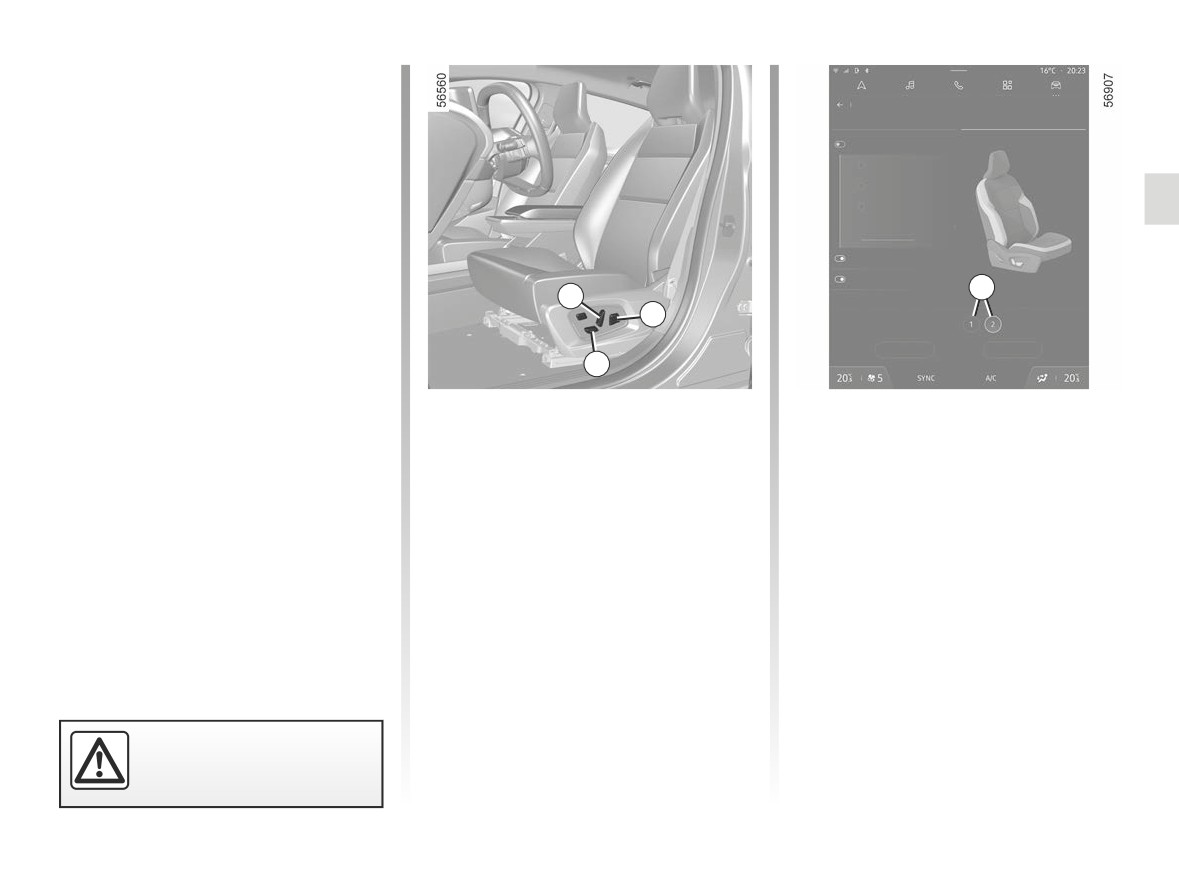
FRONT SEATS: Functions (2/2)
Position
It is possible to save the driving posi-
Seats
Driver
Passenger
tion for the driver’s seat and/or passen-
ger seat.
Massage
Lumbar
The driving position includes the set-
Relaxing
tings for the seat base and seatback as
Dynamic
well as the door mirrors.
Intensity
The driving position can be stored and
Seat Easy access
recalled by pressing the buttons:
Visual feedback
6
- by changing the user profile;
3
4
Seat position
- by pressing the “Recall” button for
the driver’s seat;
Save
Recall
5
- by pressing the 6 buttons for the pas-
senger seat.
Storing your driving position
Recalling the driving position
- Adjust the driver seat
using
For more information on storing the
switches 3, 4 and 5 (refer to previous
driving position, please refer to the mul-
page);
timedia instructions.
– adjust the door mirrors.
Note: recall of the stored driving po-
sition is interrupted if one of the seat
Refer to the multimedia instructions for
adjustment buttons is pressed during
information on accessing the stored
recall.
driving position.
The positions of the exterior rear view
mirrors when driving forwards, in re-
verse and of the driver seat are saved.
For safety reasons, carry
out any adjustments when
the vehicle is stationary.
1.43
SEAT BELTS (1/5)
Always wear your seat belt when trav-
Adjusting your driving
elling in your vehicle. You must also
position
comply with the legislation of the par-
-
Sit well back in your seat (having
ticular country you are in.
first removed your coat or jacket).
Before starting, first adjust your driv-
This is essential to ensure your back
ing position, then ask all occupants
is positioned correctly;
to adjust their seat belts to ensure
optimum protection.
-
adjust the distance between the
seat and the pedals. Your seat
should be as far back as possible
while still allowing you to fully de-
press the pedals. The seatback
Make sure that the rear bench seat
should be adjusted so that your arms
is locked in position correctly so that
are slightly bent when you hold the
the rear seat belts will operate cor-
steering wheel;
rectly. ➥ 3.33.
-
adjust the position of your head-
rest. For maximum safety, your head
must be as close as possible to the
Incorrectly adjusted or
headrest;
twisted seat belts may
-
adjust the height of the seat. This
cause injuries in the event
adjustment allows you to select the
of an accident.
seat position which offers you the
Use one seat belt per person,
best possible view;
whether child or adult.
-
adjust the position of the steering
Even pregnant women should wear
wheel.
a seat belt. In this case, ensure that
the lap belt is not exerting too much
pressure on the abdomen, but do
not allow any slack.
1.44
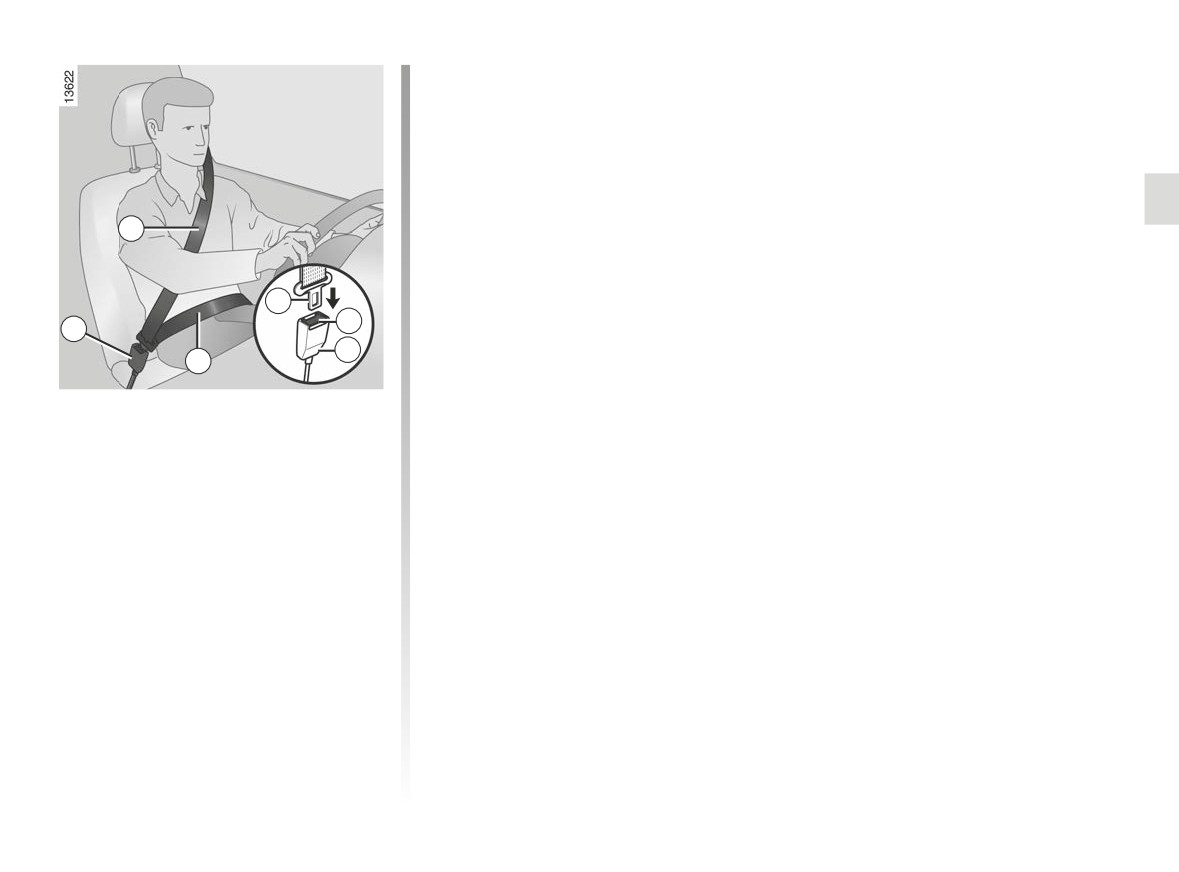
SEAT BELTS (2/5)
Locking
Unwind the belt slowly and smoothly
and ensure that buckle 3 locks into
catch 5 (check that it is locked by pull-
ing on buckle 3).
If the belt jams, allow it to return slightly
before attempting to unwind it again.
1
If your seat belt is completely jammed,
pull slowly, but firmly, so that just over
3 cm unwinds. Allow it to return slightly
3
before attempting to unwind it again.
4
5
If there is still a problem, contact an ap-
5
2
proved dealer.
Adjusting the seat belts
Unlocking
Sit with your back firmly against the
Press button 4 and the seat belt will be
seatback.
rewound by the inertia reel. Guide the
Shoulder strap 1 should be as close as
belt.
possible to the base of the neck but not
on it.
Lap belt 2 should be worn flat over the
thighs and against the pelvis.
The belt should be worn so that it is
as close as possible to your body, i.e.:
avoid wearing heavy clothing or keep-
ing bulky objects under the belts, etc.
1.45
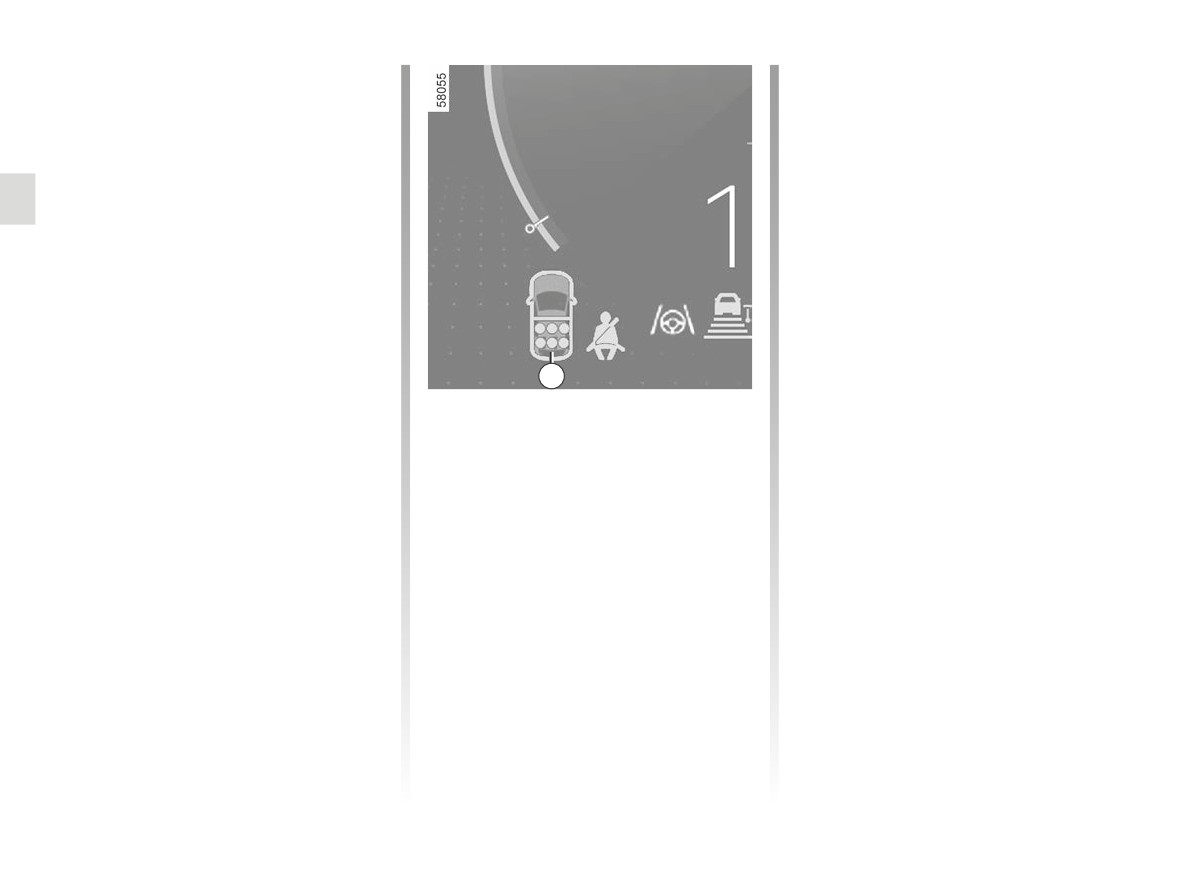
SEAT BELTS (3/5)
Driver’s seat belt reminder
It is accompanied by the 6 symbol which
ß
and, depending on the vehi-
appears for approximately 60 seconds
cle, front passenger seat belt re-
each time one of the rear seat belts is
minder
fastened or unfastened.
This appears on the central display
When the vehicle speed exceeds ap-
when the ignition is switched on and if
proximately 12 mph (20 km/h), if one of
the driver’s or front passenger’s seat
the rear seat belts is or becomes unfas-
belt (as long as the passenger seat is
tened during the journey:
occupied) is not fastened.
- the ß
warning light flashes on
Depending on the vehicle, if the seat is
the central display;
occupied and one of these seat belts is
and
not fastened or becomes unfastened
- a beep sounds for around 120 sec-
while the vehicle is moving at a speed
onds;
over approximately 12 mph (20 km/h),
and
6
the ß
warning light flashes and a
- the 6 symbol is displayed for approx-
beep sounds for approximately
Understanding the graphic 6:
imately 180 seconds and the symbol
120 seconds.
- indicator green: seatbelt fastened;
for the seat concerned changes to
- indicator in red: the seat is occupied
red.
Note: an object placed on the passen-
and the seat belt is not fastened;
ger seat may activate the warning light
Always make sure that the rear pas-
- indicator grey: seat not occupied.
in some cases, depending on the ve-
sengers are properly fastened and that
hicle.
The ß
warning light on the central
the number of fastened seat belts in-
display also appears when the ignition
dicated corresponds to the number of
Rear seat belt reminder (depending
is switched on, if a rear seat is occupied
rear seats occupied.
on vehicle)
The 6 graphic is displayed on the in-
and the seat belt is not fastened.
Note: in some cases the alerts may be
strument panel when the ignition is
When the vehicle speed is less than
activated if an object is placed on one
switched on. This informs the driver of
approximately 12 mph (20 km/h), the
of the rear seats, depending on the ve-
the fastening status of each of the rear
hicle.
seat belts every time:
ß
warning light on the central dis-
- the ignition is switched on;
play appears if a rear seat is occupied
- a door is opened;
and the seat belt is not fastened.
- fastening or unfastening of a rear
seat belt.
1.46
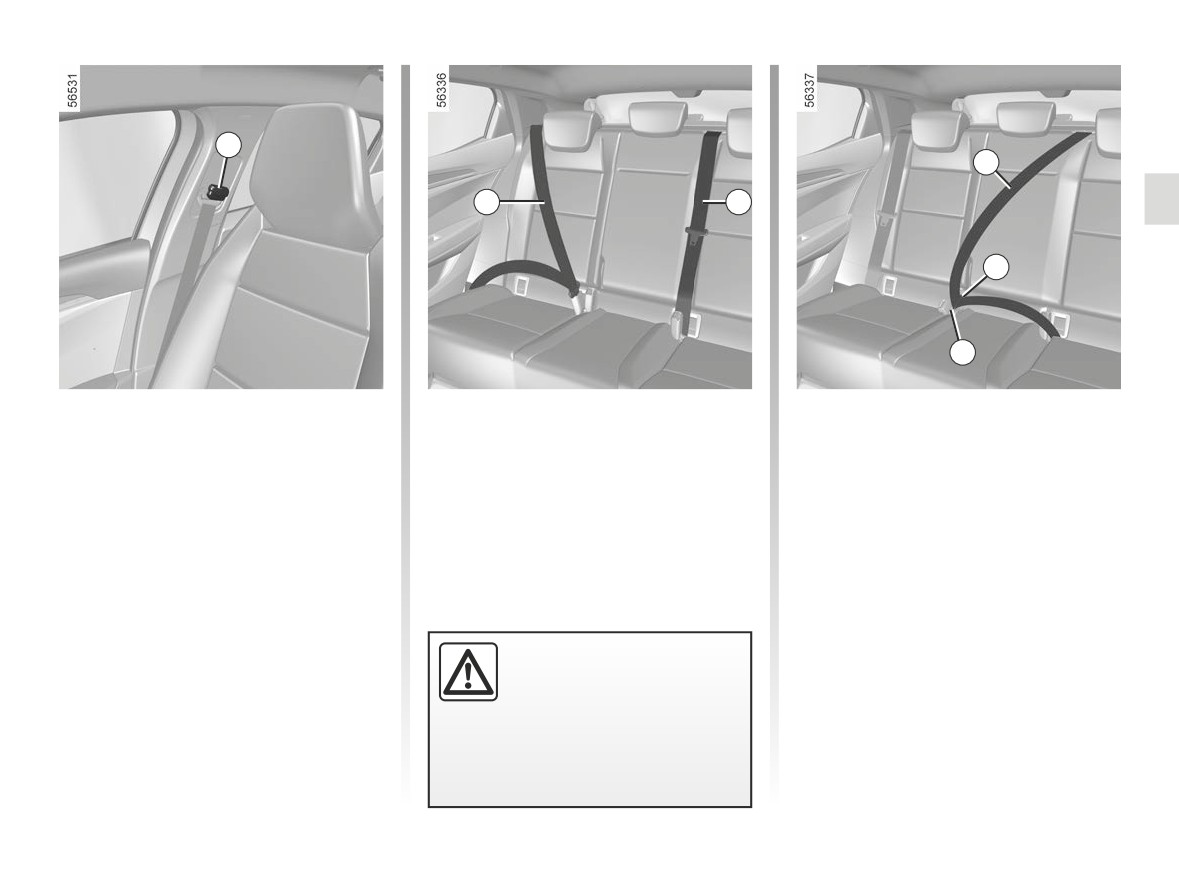
SEAT BELTS (4/5)
7
9
8
9
10
11
Adjusting the height of the
Rear side seat belts 8
Rear centre seat belt 9
front seat belts
The belts are locked, unlocked and
Slowly unwind belt 9.
Use button 7 to adjust the seat belt
adjusted in the same way as the front
Fasten the tongue
10 in the red
height so that the shoulder strap is worn
belts.
buckle 11.
as shown previously. Press the button 7
and raise or lower the seat belt. Make
sure that the seat belt is locked in posi-
tion correctly after you have adjusted it.
Check that the rear seat
belts are positioned and
operating correctly each
time the rear bench seat is
moved.
1.47
SEAT BELTS (5/5)
The following information applies to the vehicle’s front and rear seat belts.
- No modification may be made to the component parts of the originally fitted restraint system: seat belts, seats and
their mountings. For special operations (e.g. fitting child seats), contact an authorised dealer.
- Do not use devices which allow any slack in the belts (e.g. clothes pegs, clips, etc.): a seat belt which is worn too
loosely may cause injury in the event of an accident.
-
Never wear the shoulder strap under your arm or behind your back.
–
Never use the same belt for more than one person and never hold a baby or child on your lap with your seat belt around
them.
- The belt should never be twisted.
–
Following an accident, have the seat belts checked and replaced if necessary. Always replace your seat belts as soon as
they show any signs of wear.
-
When the rear bench seat is being put back, make sure that the seat belts and buckles are correctly positioned so that they
can be used properly.
-
Make sure that the buckle is inserted into the appropriate catch.
–
Ensure that no objects are placed in the area around the seat belt catch as they could prevent it from being properly se-
cured.
-
Make sure the seat belt catch is properly positioned (it should not be hidden away, crushed or flattened by people or ob-
jects).
1.48
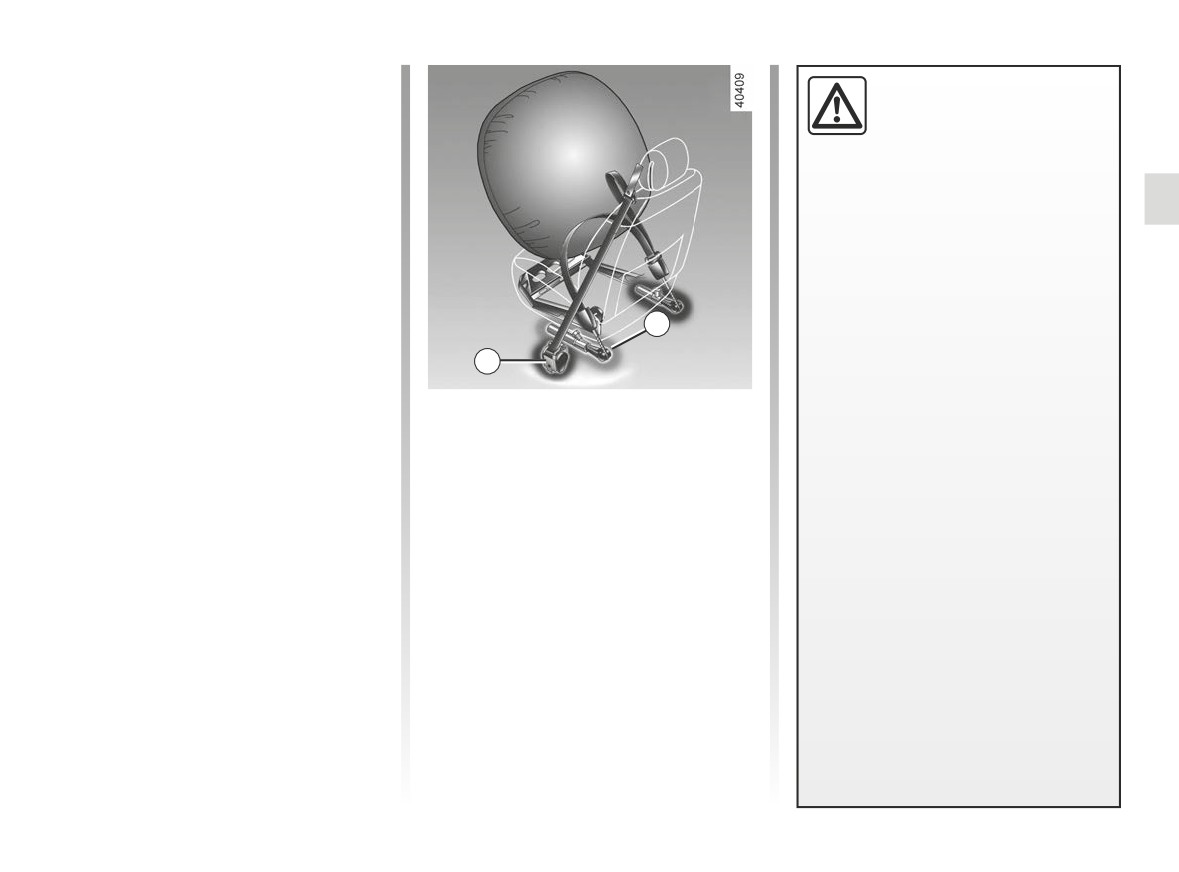
METHODS OF RESTRAINT IN ADDITION TO THE FRONT SEAT BELTS (1/6)
These are made up of:
- Have the entire restraint
- seat belt inertia reel pretension-
system checked following
ers;
an accident.
– central seat belt pretensioners;
- No operation whatso-
- chest-level load limiters;
ever is permitted on any part
of the system
(pretensioners,
- airbags driver and passenger
airbags, computers, wiring) and
front.
the system components must not
These systems are designed to act in-
be reused on any other vehicle,
dependently or together when the vehi-
even if identical.
cle is subjected to a frontal impact.
-
Only qualified personnel from our
2
Depending on the severity of the
Network may work on the airbags;
impact, the system can trigger:
otherwise the system may trigger
1
accidentally and cause injury.
-
seat belt locking;
Pretensioners
-
The electric trigger system may
–
the seat belt inertia reel pretensioner
only be tested by a specially
(which engages to correct seat belt
The pretensioners hold the seat belt
trained technician using special
slack);
against the body, holding the occupant
equipment.
-
lap seat belt pretensioners to hold
more securely against the seat, thus in-
-
When the vehicle is scrapped,
the occupant in their seat;
creasing the seat belt’s efficiency.
contact an approved dealer for
–
the front airbag.
In the event of a severe frontal impact
disposal of the pretensioner and
and if the ignition is switched on, the
airbags gas generators.
system may engage the following de-
pending on the force of the impact:
- the seat belt inertia reel preten-
sioner 1 which instantly retracts the
seat belt;
- the lap seat belt inertia reel preten-
sioner 2 on the front seats.
1.49
METHODS OF RESTRAINT IN ADDITION TO THE FRONT SEAT BELTS (2/6)
Load limiter
driver and passenger front
Above a certain severity of impact, this
Airbags
mechanism is used to limit the force of
Fitted to the driver and passenger
the belt against the body so that it is at
sides.
an acceptable level.
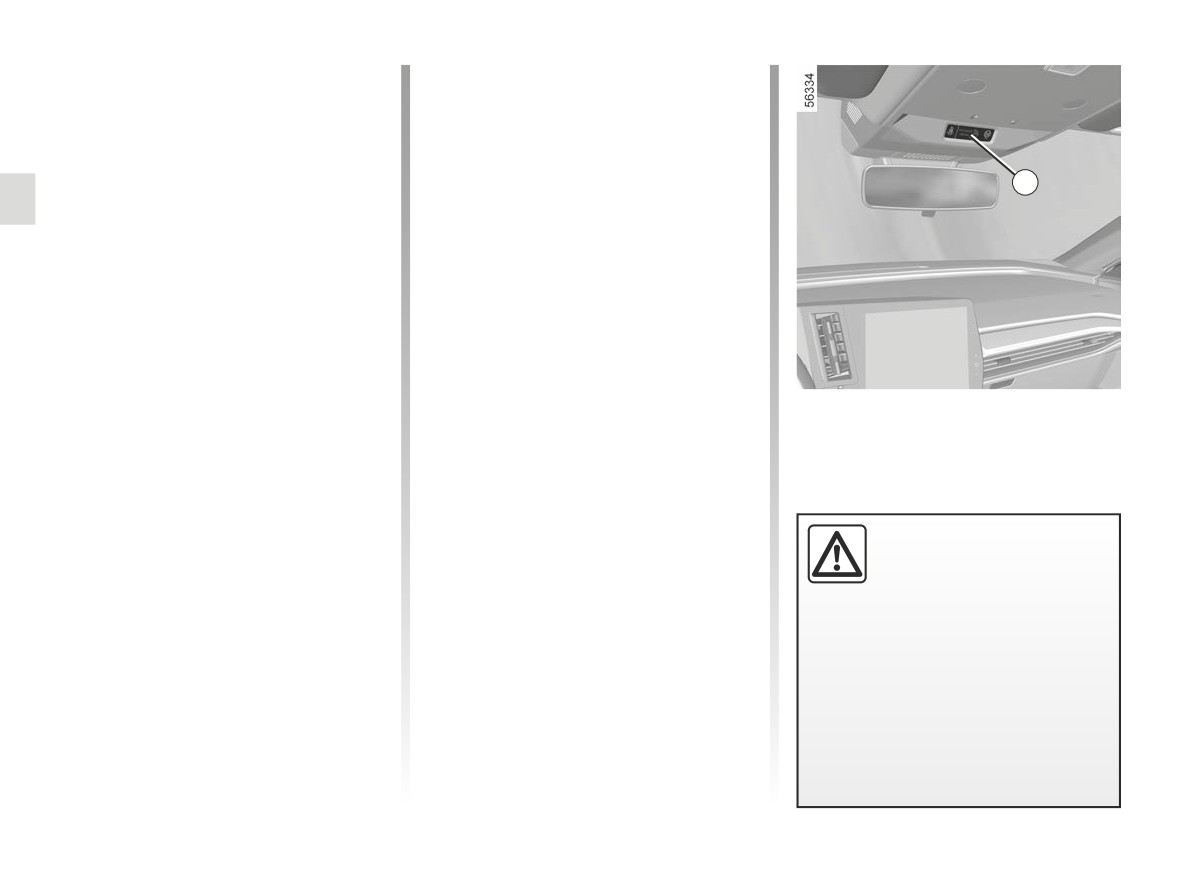
A symbol on the lower section of the
3
windscreen indicates if this equipment
is present (depending on the vehicle).
Each airbag system consists of:
-
an airbag and gas generator fitted on
the steering wheel for the driver and
in the dashboard for the passenger;
-
an electronic unit for monitoring the
system controlling the gas generator
electrical trigger;
-
remote sensors;
–
control warning lights, displayed on
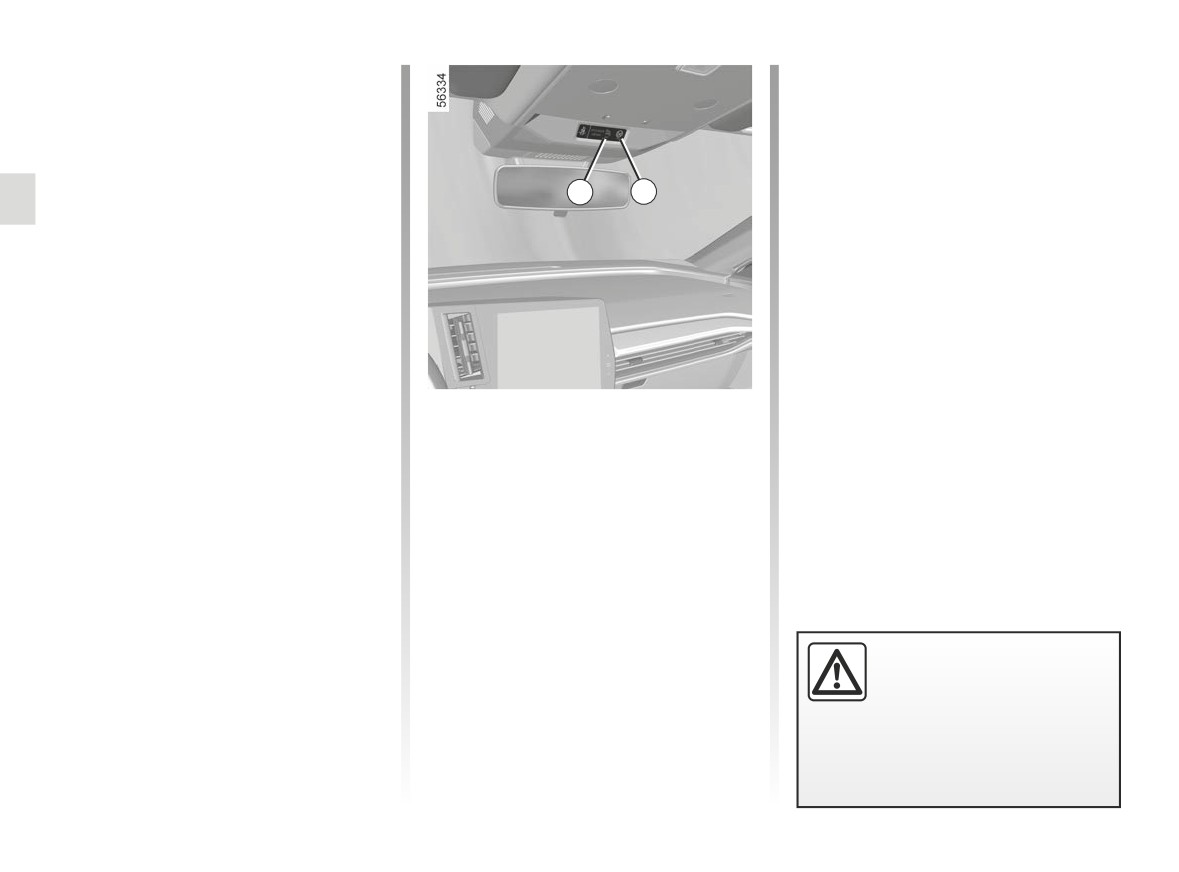
the roof console 3:
-
lit up, passenger airbag
activated;
The airbag system uses py-
rotechnic principles. This
explains why, when the
- ¹
lit up, passenger airbag
airbag inflates, it will gener-
disabled.
ate heat, produce smoke (this does
not mean that a fire is about to start)
and make a banging noise. In a situ-
ation where an airbag is required, it
will inflate immediately and this may
cause some minor, superficial graz-
ing to the skin or other problems.
1.50
METHODS OF RESTRAINT IN ADDITION TO THE FRONT SEAT BELTS (3/6)
Operating faults
å
This warning light comes on
when the engine is started and then
goes out after approximately 65 sec-
onds.
If it does not come on when the ignition
is switched on or if it stays on, there is a
fault in the system.
Contact your approved Dealer as soon
as possible.
Your protection will be reduced until this
fault is rectified.
Operation
This system is only operational when
the ignition is switched on.
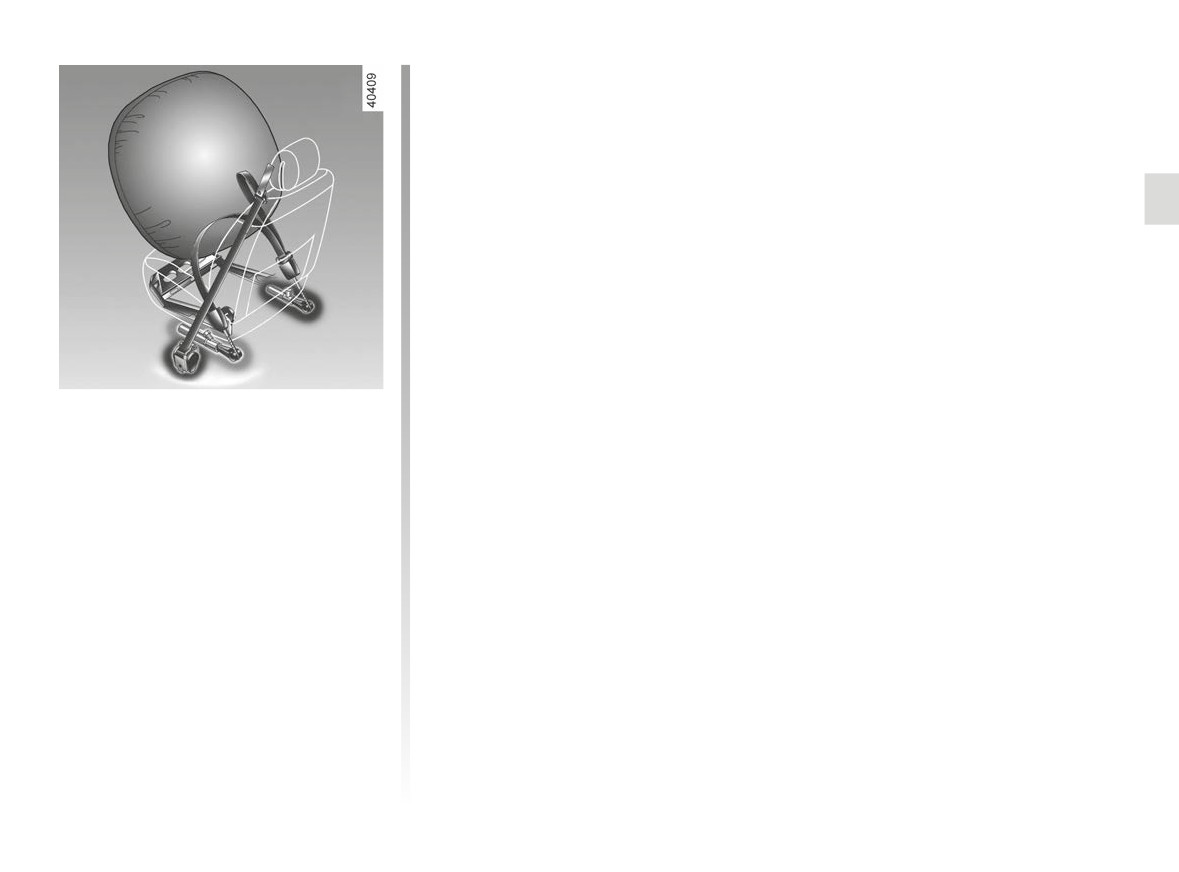
In a severe frontal impact, the airbags
inflate rapidly, cushioning the impact
of the driver's head and chest against
the steering wheel and of the front pas-
senger against the dashboard. The air
bags then deflate immediately so that
the passengers are not in any way hin-
dered from leaving the vehicle.
1.51
METHODS OF RESTRAINT IN ADDITION TO THE FRONT SEAT BELTS (4/6)
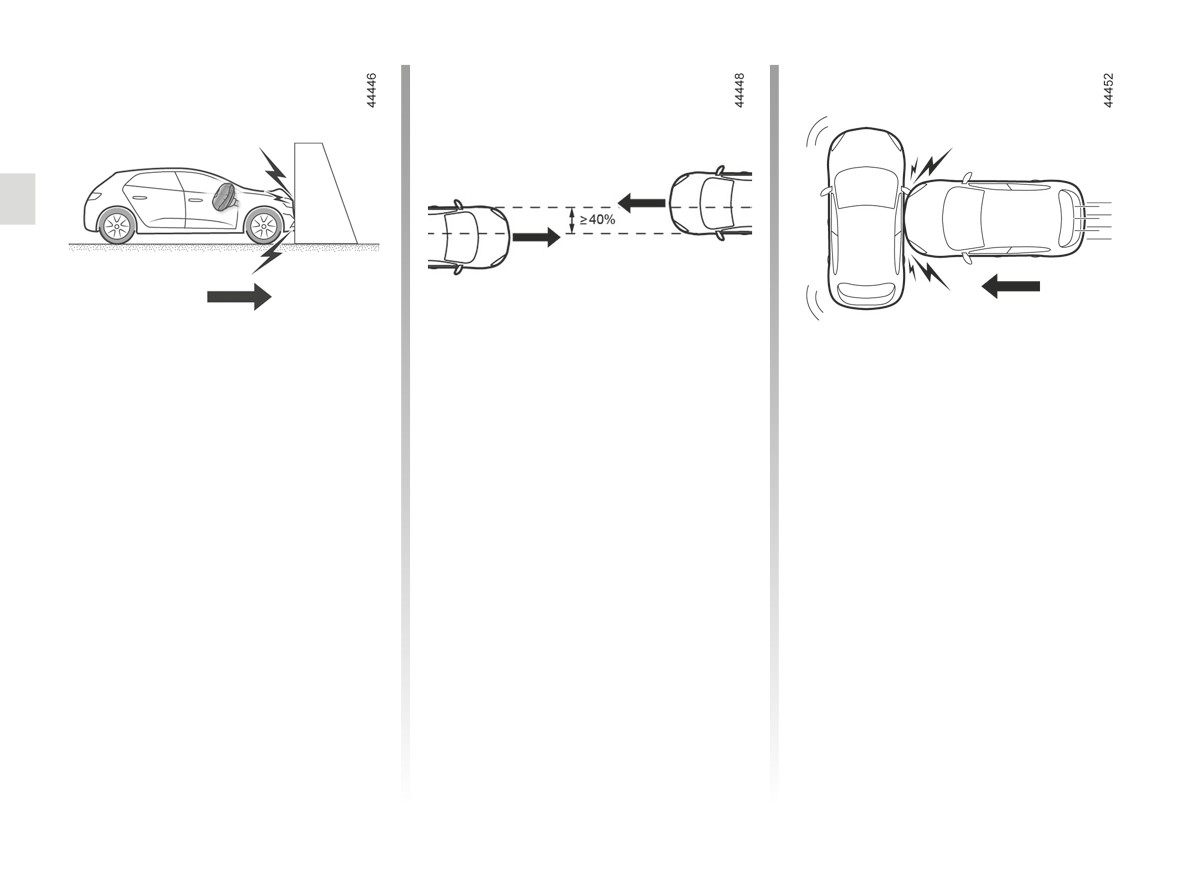
The following conditions will trigger
In a frontal impact with another vehi-
In a side impact with another vehicle
the pretensioners or airbags.
cle of an equivalent or higher category,
of an equivalent or higher category, at
with an impact area equal to or greater
an impact speed equal to or greater
In a frontal impact against a rigid
than 40%, where the speed of both ve-
than 31 mph (50 km/h).
(non-deformable) surface at an impact
hicles is equal to or greater than
speed equal to or greater than 16 mph
25 mph (40 km/h).
(25 km/h).
1.52
METHODS OF RESTRAINT IN ADDITION TO THE FRONT SEAT BELTS (5/6)
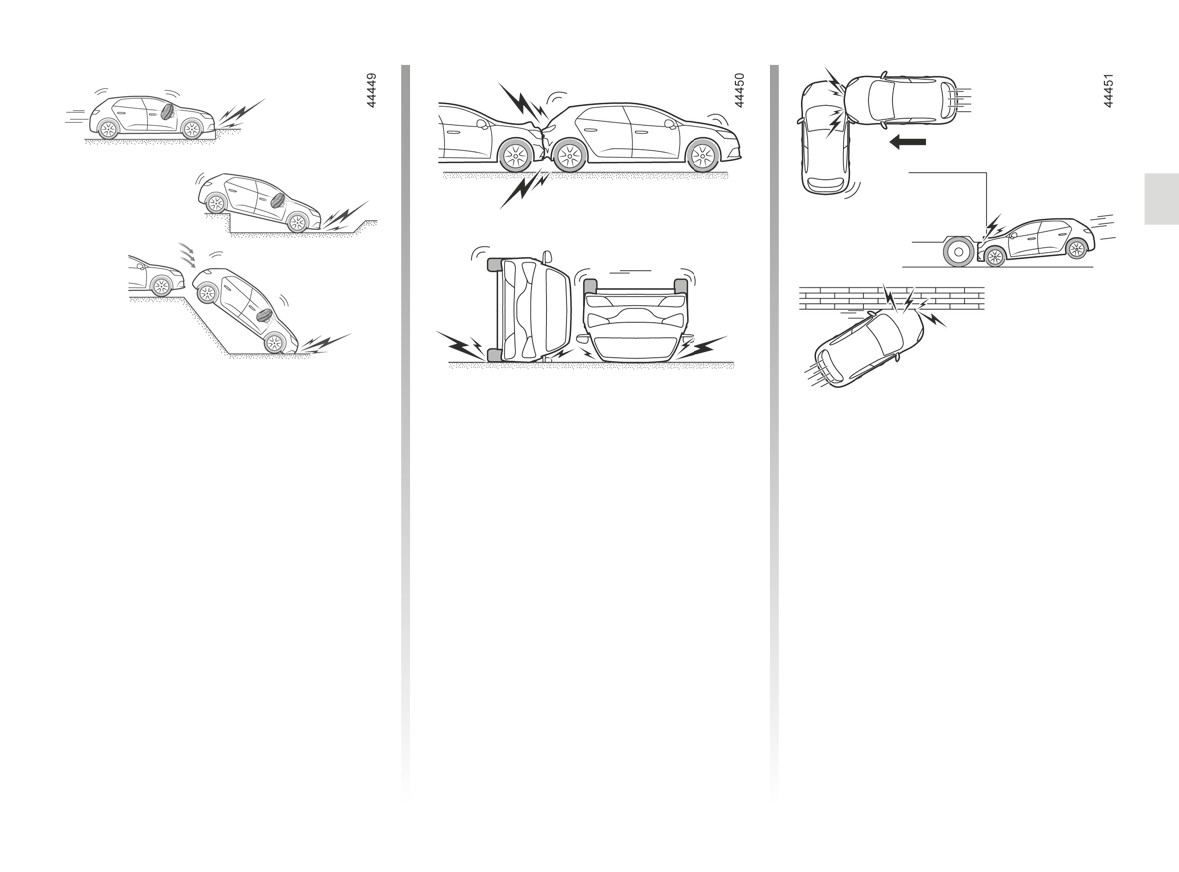
In the following examples, the pre-
In the following examples, the pre-
- side impact to the front or rear of the
tensioners or the airbags could op-
tensioners or airbags might not op-
vehicle;
erate:
erate:
- frontal impact, under the tail of a
- impact under vehicle such as pave-
- rear impact, however severe;
lorry;
ment;
– the vehicle overturning;
- frontal impact against an obstacle
- potholes;
with a sharp angle;
- drop or hard landing;
- ...
- stones;
– ...
1.53
METHODS OF RESTRAINT IN ADDITION TO THE FRONT SEAT BELTS (6/6)
All of the warnings below are given so that the airbag is not obstructed in any way when it is inflated and also to prevent
the risk of serious injuries caused by items which may be dislodged when it inflates.
Warnings concerning the driver’s airbag
- Do not modify the steering wheel or the steering wheel boss.
- Do not cover the steering wheel boss under any circumstances.
- Do not attach any objects (badge, logo, clock, telephone holder, etc.) to the steering wheel boss.
- The steering wheel must not be removed (except by qualified personnel from our Network).
- Do not sit too close to the steering wheel when driving: sit with your arms slightly bent (see “Adjusting your driving position”
➥ 1.44). This will allow sufficient space for the airbag to deploy correctly and be fully effective.
Warnings concerning the passenger airbag
- Fitting seat covers is prohibited in the front seats as this could affect the operation of the airbag passenger.
- Do not attach or glue any objects (badge, logo, clock, telephone holder, etc.) to the dashboard on or near the airbag.
- Do not place anything between the dashboard and the passenger (pet, umbrella, walking stick, parcels, etc.).
- The passenger must not put his or her feet on the dashboard or seat as there is a risk that serious injuries may occur. In
general, parts of the body should be kept away from the dashboard (knees, hands, head, etc.).
1.54
METHODS OF RESTRAINT IN ADDITION TO THE REAR SEAT BELTS
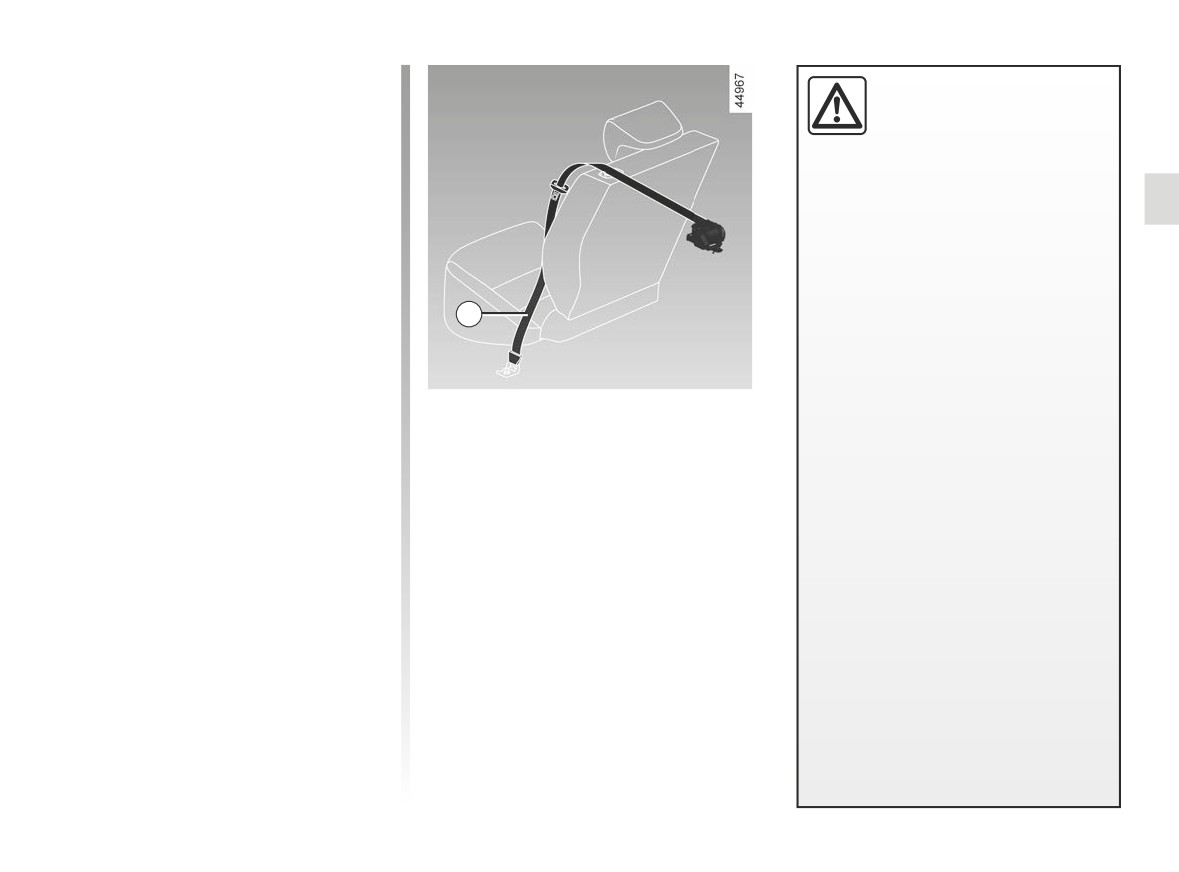
These are made up of:
- Have the entire restraint
- side seat belt inertia reel preten-
system checked following
sioners;
an accident.
- chest force limiters.
- No operation whatso-
These systems are designed to act in-
ever is permitted on any part
dependently or together when the vehi-
of the system
(pretensioners,
cle is subjected to a frontal impact.
airbags, computers, wiring) and
the system components must not
Depending on the severity of the
be reused on any other vehicle,
impact, the system can trigger:
even if identical.
- seat belt locking;
1
-
Only qualified personnel from our
- the seat belt inertia reel pretensioner
Network may work on the airbags;
(which engages to correct seat belt
otherwise the system may trigger
slack).
accidentally and cause injury.
Side seat belt pretensioners
-
The electric trigger system may
Force limiter
only be tested by a specially
The pretensioners hold the seat belt
trained technician using special
Above a certain severity of impact, this
against the body, holding the occupant
equipment.
mechanism is used to limit the force of
more securely against the seat, thus in-
-
When the vehicle is scrapped,
the belt against the body so that it is at
creasing the seat belt’s efficiency.
contact an approved dealer for
an acceptable level.
With the ignition on, following a signif-
disposal of the pretensioner and
icant frontal impact and depending on
airbags gas generators.
the severity of the impact, the system
may trigger the seat belt inertia reel
pretensioner 1, which instantly retracts
the seat belt.
1.55
SIDE PROTECTION DEVICES
Side Airbag
Warning regarding the side airbag and central airbag
This airbag is fitted to each of the front
- Fitting seat covers is prohibited in the front seats as this could
seats and is activated at the sides of
affect the operation of the airbag passenger.
the seats (door side) to protect the oc-
cupants in the event of a severe side
-
Do not place any accessories, objects or even pets between the seatback, the
impact.
door and the internal fittings. Do not cover the seatback with objects such as
clothes or accessories. This may prevent the airbag from operating correctly or
cause injury when the airbag is deployed.
Curtain Airbag
-
Do not drive with the central armrest in the open position, this could affect the
These are airbags fitted along the sides
correct operation of the central airbag and/or cause injury when it is deployed.
of the vehicle in the ceiling which trigger
-
Do not place any objects on the cover of the central armrest storage compart-
along the front and rear door side win-
ment, this could affect the correct operation of the central airbag and/or cause
dows to protect the passengers in case
injury when it is deployed.
of a severe side impact.
-
Do let any objects hang out of the central armrest storage compartment, this
could affect the correct operation of the central airbag and/or cause injury
Central Airbag
when it is deployed.
This airbag is fitted to the driver's seat
-
No work or modification whatsoever may be carried out on the seat or internal
and is deployed between the driver's
fittings, except by qualified personnel from an approved dealer.
seat and the passenger seat in order to
protect the driver and their passenger
-
The airbags deploys through the slits in the front seatbacks (door side and
in the event of a severe side impact.
centre console side): never insert any objects into these slits.
It also spreads out to protect the driver,
if they are the only one in the front, in
the event of a severe side impact.
1.56
ADDITIONAL METHODS OF RESTRAINT
All of the warnings below are given so that the airbag is not obstructed in any way when it is inflated and also to prevent
the risk of serious injuries caused by items which may be dislodged when it inflates.
The airbag is designed to complement the action of the seat belt. Both the airbag and the seat belt are integral parts
of the same protection system. It is therefore essential to wear seat belts at all times. If seat belts are not worn, the oc-
cupants are exposed to the risk of serious injury in the event of an accident. It may also increase the risk of minor su-
perficial injuries occurring when the airbag is deployed, although such minor injuries are always possible with airbags.
If the vehicle should overturn or suffer a rear impact, however severe, the pretensioners and airbags are not always triggered.
Shocks to the underbody of the vehicle, from pavements, potholes, stones etc. can all trigger these systems.
- Work and modifications on the complete airbag system (airbags, pretensioners, ECU, wiring harness, etc.), are strictly pro-
hibited (except by qualified Network personnel).
- To ensure that the system is in good working order and to avoid accidental triggering of the system which may cause injury,
only qualified Network personnel may work on the airbag system.
- As a safety precaution, have the airbag system checked if your vehicle has been involved in an accident, or is stolen or
broken into.
- When selling or lending the vehicle, inform the user of these points and hand over this driver’s handbook with the vehicle.
- When scrapping your vehicle, contact your approved dealer for disposal of the gas generator(s).
1.57
PASSENGER DETECTION SYSTEM (1/4)
Depending on the vehicle, the pas-
After the initialisation phase, if the
senger detection system automatically
system detects a change of status (e.g.
manages the activation and deactiva-
passenger seat occupied when the ig-
tion of the passenger airbag according
nition is switched on, then not occu-
to whether the front passenger seat is
pied), the following messages are dis-
occupied.
played on the instrument panel:
1
2
The passenger airbag is automatically
-
“Passenger airbag on” accompanied
disabled if a child seat is fitted in the
by the
warning light;
front passenger seat or if the seat is not
occupied.
or
Before fitting a child seat on the front
-
“Passenger airbag off” accompanied
passenger seat, consult the different
types of seats ➥ 1.64 and fitting meth-
by the ¹
warning light.
ods ➥ 1.68.
To find out the type of child seat author-
ised for use on the front passenger seat
Operation
➥ 1.70 ➥ 1.73.
After an initialisation phase of approxi-
mately 5 seconds, the 1 and 2 warning
lights let you check the activation status
of the passenger airbag:
- ¹
1 warning light on, the pas-
senger airbag is disabled. In this
case, the warning light stays on con-
tinuously;
-
2 warning light on, the pas-
DANGER
senger airbag is activated. In this
After fitting a rear-facing
case, the warning light stays on for
child seat, check that the
approximately 65 seconds.
airbag is disabled (1 warn-
ing light on).
1.58
PASSENGER DETECTION SYSTEM (2/4)
3
A
A
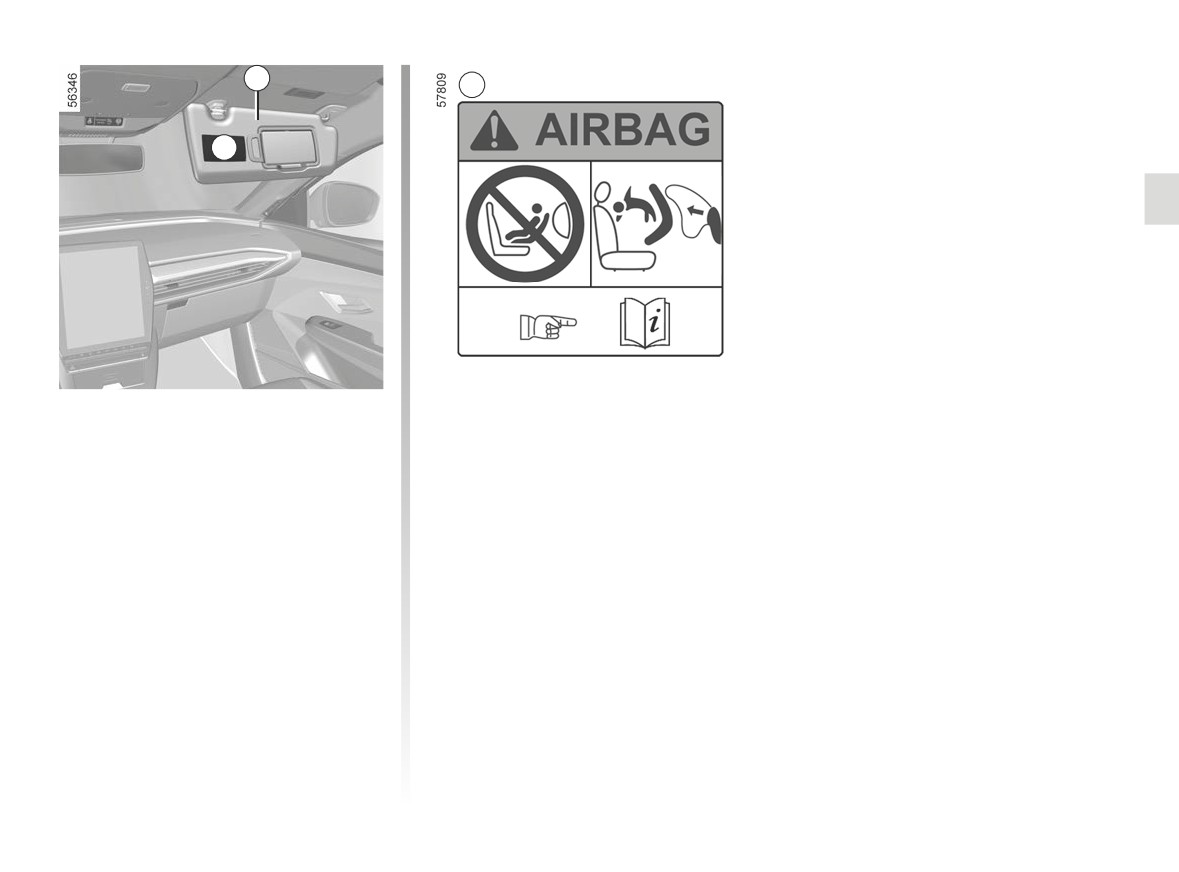
The markings on the dashboard and
the labels A on each side of the pas-
senger sun visor 3 (such as the label
above) remind you that you must not
place a child in a rear-facing seat when
the passenger airbag is activated.
1.59
PASSENGER DETECTION SYSTEM (3/4)
If the
activation warning light is
If the ¹
deactivation warning light
on when a rear-facing child seat is
is on while an adult passenger is
fitted:
seated in the front passenger seat, it
may not be correctly fitted.
- switch off the ignition;
Perform the following actions to allow
- remove the child seat from the pas-
the system to detect the passenger:
senger seat;
- remove any additional elements
- remove any additional elements that
from the seat base, such as beach
may be located between the child
towels, seat covers, etc.;
seat and the passenger seat;
- make sure that the seat back is not
- refit the child seat according to the
tilted too far back;
instructions of the child seat manu-
facturer;
- have the passenger sit straight on
the seat, centred on the seat cush-
- start the vehicle.
ion, with their legs comfortably ex-
If the problem persists, position the
tended;
child seat at the rear and contact an ap-
- leave the passenger seated in this
proved dealer.
position for two to three minutes after
the activation warning light comes
on.
If the problem persists, have the pas-
senger sit in the rear and contact an ap-
Never switch off the igni-
proved dealer.
tion before the vehicle has
stopped completely. Once
the engine has stopped, the
DANGER
brake servo, power-assisted steer-
After fitting a rear-facing
ing, etc., and the passive safety de-
child seat, check that the
vices such as the airbags and pre-
airbag is disabled (1 warn-
tensioners will no longer operate.
ing light on).
1.60
PASSENGER DETECTION SYSTEM (4/4)
Additional factors affecting
A wet seat may affect the effectiveness
of the passenger detection system. If
the operation of the system
the front passenger seat is wet, dry it
Seat belts help keeping the passenger
immediately.
in position on the seat during vehicle
manoeuvring and braking. This helps
the passenger detection system main-
tain the passenger airbag status.
A thick layer of additional material (thick
coat, cushion, large object placed in
the passenger’s rear pocket, heating or
massage device) may hinder the cor-
rect operation of the passenger detec-
tion system.
Note: an object placed on the passen-
ger seat base may activate the warning
light in some cases.
Warning concerning the
passenger airbag: fitting
of seat covers prohibited
in the front seats.
1.61
CHILD SAFETY: General information (1/2)
Carrying children
Please ensure that you comply with the
legislation of your country.
Children, and adults, must be correctly
seated and strapped in for all journeys.
The children being carried in your vehi-
cle are your responsibility.
Driver’s responsibility
A child is not a miniature adult. Children
when parking or stopping
are at risk of specific injuries as their
the vehicle
muscles and bones have not yet fin-
ished growing. The seat belt alone
Never leave an animal,
would not provide suitable protection.
child or adult who is not self-suffi-
Use an approved child seat and ensure
cient alone on your vehicle, even for
you use it correctly.
a short time.
A collision
at
31
mph
(50 km/h) is the same
They may pose a risk to themselves
as falling a distance of
or to others by starting the engine,
10 metres.
activating equipment such as the
electric windows or by locking the
Transporting a child without
doors.
a restraint is the equivalent of allow-
ing him or her to play on a fourth-
Also, in hot and/or sunny weather,
floor balcony without railings.
please remember that the tempera-
ture inside the passenger compart-
Never travel with a child held in your
ment increases very quickly.
arms.
RISK OF DEATH OR SERIOUS
In the event of an accident, you will
INJURY.
not be able to keep hold of the child,
even if you yourself are wearing a
seat belt.
To prevent the doors being
If your vehicle has been involved in
opened, use the “Child lock”
a road accident, replace the child
feature. ➥ 1.30.
seat and have the seat belts and
ISOFIX anchorage points checked.
1.62