Peugeot 4008 (2017 year). Instruction - part 14
 

  Index      Peugeot     Peugeot 4008 - instruction 2017 year in english


Search            copyright infringement  


Content   ..  12  13  14  15   ..


Peugeot 4008 (2017 year). Instruction - part 14


207

8

In the event of a breakdown

4008_en_Chap08_en-cas-de panne_ed01-2016

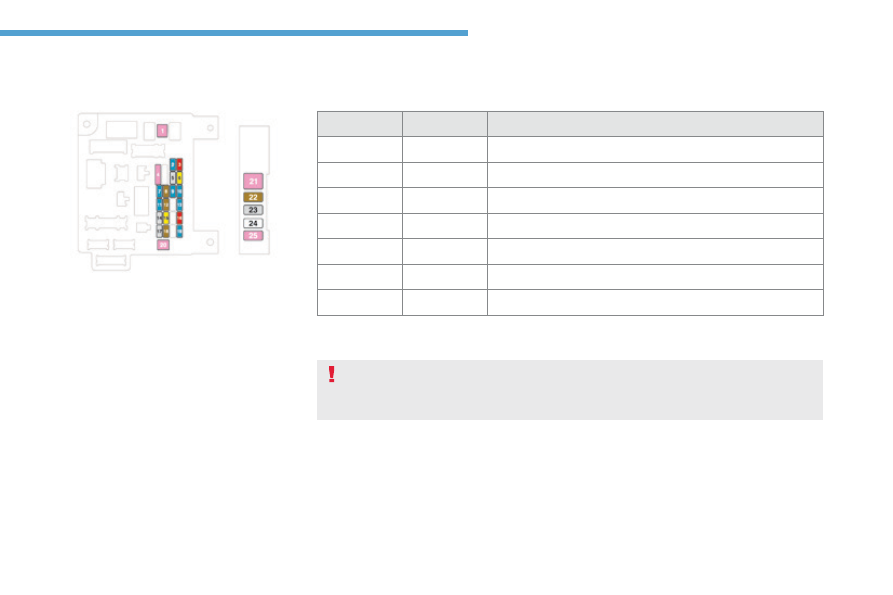
*  the maxi-fuses provide additional protection for the electrical systems. All work on the 

maxi-fuses must be carried out by a PeugeOt dealer or a qualified workshop.

Fuse N°

Rating

Functions

18

7.5 A

Reversing lamp(s).

19

15 A

Accessory socket.

20*

30 A

electric window controls.

21*

30 A

Heated rear screen.

22

7.5 A

Heated door mirrors.

24

25 A

Driver's and passenger's electric seats.

25

30 A

Heated seats.

208

In the event of a breakdown

4008_en_Chap08_en-cas-de panne_ed01-2016

Engine compartment fuses

Access to the fuses

F  unclip the cover and remove it completely.

Fuse N°

Rating

Functions

1

15 A

Front foglamps.

4

10 A

Horn.

5

7.5 A

Alternator.

6

20 A

Headlamp wash.

7

10 A

Air conditioning.

9

20 A

Alarm.

10

15 A

Demisting, wipers.

11

-

Not used.

12

-

Not used.

the fusebox is placed in the engine 
compartment (left-hand side).

209

8

In the event of a breakdown

4008_en_Chap08_en-cas-de panne_ed01-2016

Fuse N°

Rating

Functions

13

10 A

Daytime running lamps.

14

10 A

Left-hand main beam headlamp.

15

10 A

Right-hand main beam headlamp.

16

20 A

Left-hand dipped beam headlamp (xenon).

17

20 A

Right-hand dipped beam headlamp (xenon).

18

10 A

Left-hand dipped beam headlamp (halogen), manual and 
automatic headlamp adjustment.

19

10 A

Right-hand dipped beam headlamp (halogen).

31

30 A

Audio amplifier.

the maxi-fuses provide additional 
protection for the electrical systems. All 
work on the maxi-fuses must be carried 
out by a PeugeOt dealer or a qualified 
workshop.

Carefully close the cover after replacing 
a fuse so as to ensure the correct 
sealing of the fusebox.

210

In the event of a breakdown

4008_en_Chap08_en-cas-de panne_ed01-2016

Spare fuses

the spare fuses are located under the engine 
compartment fusebox cover.

the cover does not contain spare 
fuses with an amperage of 7.5 A, 25 A 
or 30 A. If one of the fuses with these 
amperages develops a fault, replace it 
with the following fuse:
7.5 A fuse must be replaced with the 
10 A spare fuse, a 25 A fuse with the 

20 A spare fuse and a 30 A fuse with 
the 

audio system fuse (N° 31).

Fuse N°

Rating

33

10 A

34

15 A

35

20 A

211

8

In the event of a breakdown

4008_en_Chap08_en-cas-de panne_ed01-2016

12 V battery

the battery is located under the bonnet.
to gain access to it:
F  open the bonnet using the interior release 

lever, then the exterior catch,

F  secure the bonnet stay,

Access to the battery

Procedure for charging your battery when it is flat or for starting the engine using another battery and jump leads.

F  remove the retaining pins A,
F  remove the protective cover B,

F  remove the retaining pins C,
F  remove the air duct D.

General

If your vehicle has an automatic 
gearbox, do not try to start the engine 
by pushing the vehicle.

the batteries contain harmful 
substances such as sulphuric acid and 
lead.
they must be disposed of in 
accordance with regulations and must 
not, in any circumstances, be discarded 
with household waste.
take used remote control batteries and 
vehicle batteries to a special collection 
point.

Before handling the battery, protect 
your eyes and face.
All work on the battery must be carried 
out in a ventilated area and away from 
naked flames or sources of sparks, to 
avoid any risk of explosion and fire.
Wash your hands when you have 
finished.

212

In the event of a breakdown

4008_en_Chap08_en-cas-de panne_ed01-2016

Check the electrolyte level and top up if 
necessary.
For more information on Checking levels
refer to the corresponding section.

Starting using another 
battery

F  Connect the red cable to the (+) terminal of 

the flat battery A, then to the (+) terminal of 
the slave battery B.

F  Connect one end of the green or black 

cable to the (-) terminal of the slave 
battery B.

F  Connect the other end of the green or black 

cable to the earth point C on your vehicle 
(engine mounting).

F  Operate the starter, let the engine run.
F  Wait until the engine returns to idle and 

disconnect the cables.

F  Raise the protective cover on the (+) 

terminal.

Some functions are not available if the 
battery is not sufficiently charged.

213

8

In the event of a breakdown

4008_en_Chap08_en-cas-de panne_ed01-2016

If you intend to charge your vehicle's 
battery yourself, use only a charger 
compatible with lead batteries, with a 
nominal voltage of 12 V.

F  Disconnect the battery from the vehicle, if 

necessary.

F  Follow the instructions for use provided by 

the manufacturer of the charger.

F  Reconnect, starting with the (-) terminal.
F  Check that the terminals and connectors 

are clean. If they are covered with sulphate 
(whitish or greenish deposit), remove them 
and clean them.

Charging the battery using 
a battery charger

Follow the instructions for use provided 
by the manufacturer of the charger.
Never invert the polarities.

Never start the engine by connecting a 
battery charger.
Never use a battery booster of 24 V or 
higher.
Check first that the slave battery has a 
nominal voltage of 12 V and a capacity 
at least equal to that of the discharged 
battery.
the two vehicles must not touch.
Switch off all power-consuming 
equipment on the two vehicles (audio 
system, wipers, lamps, etc.).
ensure that the slave cables do not 
pass near the moving parts of the 
engine (fan, belt, etc.).
Do not disconnect the (+) terminal while 
the engine is running.

214

In the event of a breakdown

4008_en_Chap08_en-cas-de panne_ed01-2016

Do not invert the polarities and use only a 12 V charger.
Do not disconnect the terminals while the engine is running.
Do not charge the batteries without disconnecting the terminals first.
Do not push the vehicle to start the engine if it is fitted with a CVt gearbox.

Disconnecting the battery

to maintain a sufficient level of charge 
to start the engine, it is advisable to 
disconnect the battery if the vehicle is not 
going to be used for a very long period.
Before disconnecting the battery:
F  Close all the doors and windows, the 

tailgate and the roof.

F  Switch off all power-consuming 

equipment (audio system, wipers, 
lamps, etc.).

F  Switch off the ignition and wait 

4 minutes.

Once you have gained access to the 
battery, start by disconnecting the (-) 
terminal.

Following reconnection of the 
battery

Following reconnection of the battery, 
switch on the ignition and wait 1 minute 
before starting to permit initialisation of the 
electronic systems.
However, if problems remain following this 
operation, contact a PeugeOt dealer or a 
qualified workshop.
Referring to the corresponding section, you 
must reinitialise certain equipment yourself, 
such as:

the remote control key or the electronic 
key (depending on version).

the electric blind(s).

the electric windows.

the date and time.

the stored radio stations.

Some functions are not available if the 
battery is not sufficiently charged.

Never try to charge a frozen battery.
If the battery has been frozen, have it 
checked by a PeugeOt dealer or a 
qualified workshop, who will check that 
the internal components have not been 
damaged and the casing is not cracked, 
which could cause a leak of toxic and 
corrosive acid.

the Stop & Start system may not be 
operational during the trip following the 
first engine start.
In this case, the system will only be 
available again after a continuous 
period of immobilisation of the vehicle, 
a period which depends on the exterior 
temperature and the state of charge of 
the battery (up to about 8 hours).

215

8

In the event of a breakdown

4008_en_Chap08_en-cas-de panne_ed01-2016

towing the vehicle

Towing your vehicle

2 wheel drive (2WD) versions: towing 

with the wheels on the ground

General recommendations

towing with the wheels on the ground 
is only possible on 2 wheel drive (2WD) 
versions.

F  Fit the towing bar to the towing eye on the 

chassis, located under the front bumper.

Observe the legislation in force in your 
country.
ensure that the weight of the towing vehicle is 
higher than that of the towed vehicle.
the driver must remain at the wheel of the 
towed vehicle and must have a valid driving 
licence.
When towing a vehicle with all four wheels on 
the ground, always use an approved towing 
bar; rope and straps are prohibited.
When towing a vehicle with the engine off, 
there is no longer any power assistance for 
braking or steering.
In the following cases, you must always call 
on a professional recovery service:

vehicle broken down on a motorway or 
fast road,

4 wheel drive vehicle,

when it is not possible to put the gearbox 
into neutral, unlock the steering, or 
release the parking brake,

towing with only two wheels on the 
ground,

where there is no approved towing bar 
available...

F  Put the gear lever into neutral (position N 

for the CVt gearbox).

F  unlock the steering by turning the ignition 

switch to the "ON" position (or to "ON
mode for vehicles fitted with the "Keyless 
entry and Starting" system).

F  Release the parking brake.
F  Switch on the hazard warning lamps on 

both vehicles.

F  Move off gently and travel slowly for a short 

distance only.

216

In the event of a breakdown

4008_en_Chap08_en-cas-de panne_ed01-2016

Vehicles fitted with the 4 wheel drive 
system must always be
 

towed on a flatbed.

Never have the vehicle towed with the 
four wheels on the ground, this could 
damage the transmission.
the vehicle must not be towed with 
the front or rear wheels on the ground 
evenif it is in front "2WD" (2 wheel 
drive) mode.

4 wheel drive (4WD) versions: towing on a flatbed

217

8

In the event of a breakdown

4008_en_Chap08_en-cas-de panne_ed01-2016

Towing another vehicle

F  On the rear bumper, remove the cover 

by pulling at the bottom using the jack 
handle 

1.

F  Screw in the towing eye 

2 fully using the 

wheelbrace 3.

F  Install the towing bar.
F  Switch on the hazard warning lamps on 

both vehicles.

F  Move off gently and travel slowly for a short 

distance only.

Access to the tooling

the towing eye and the tools are stored under 
the boot floor.
to gain access to them:
F  open the boot,
F  lift and remove the boot floor,
F  take out the towing eye and the tools 

required.

List of tools
1.
  Jack handle.

2.  towing eye.
3. Wheelbrace.

218

In the event of a breakdown

4008_en_Chap08_en-cas-de panne_ed01-2016

Running out of fuel (Diesel)

On vehicles fitted with the 1.6 litre HDi 115 
engine, the fuel system must be manually 
primed if you run out of fuel; refer to the 
corresponding Diesel engine compartment 
view.

1.6 litre HDi engine

F  Fill the fuel tank with at least five litres of 

Diesel.

F  Open the bonnet.
F  If necessary, unclip the cover for access to 

the priming pump.

F  Squeeze and release the priming pump 

repeatedly until resistance is felt (there 
may be resistance at the first press).

F  Operate the starter until the engine starts 

(if the engine does not start at the first 
attempt, wait around 15 seconds before 
trying again).

F  If the engine does not start after a few 

attempts, operate the priming pump again 
then start the engine.

F  Clip the cover back in place.
F  Close the bonnet.

9

219

Technical data

4008_en_Chap09_caracteristiques-techniques_ed01-2016

*  the maximum power corresponds to the value type-approved on a test bed, under conditions defined in european legislation 

(Directive 1999/99/eC).

engines and gearboxes

.../S: model fitted with the Stop & Start (AS&g) function.

PETROL ENGINES

1.6 litre 115

2.0 litre 150

GEARBOXES

Manual

(5-speed)

CVt

(6-speed)

Manual

(5-speed)

CVt

(6-speed)

Model codes: BU...

NKZ0 

NKZ0/S

NKZ9

NKZ9/S

AFYR 

AFZ7

AFYV
AFZM

AFYT 
AFZH

AFZ9

AFYW 

AFZP
AFZC

Transmission mode

2WD

2WD

2WD

4WD

2WD

4WD

Cubic capacity (cc)

1 590

1 998

Bore x stroke (mm)

75 x 90

86 x 86

Max power*: eu standard (kW)

86

113

Max power engine speed (rpm)

6 000

6 000

Max torque: eu standard (Nm)

154

199

Max torque engine speed (rpm)

4 000

4 200

Fuel

unleaded

unleaded

Catalytic converter

Yes

Yes

OIL CAPACITY (in litres)

engine (with filter replacement)

4.2

4.3

220

Technical data

4008_en_Chap09_caracteristiques-techniques_ed01-2016

Petrol weights and towed loads (kg)

the values for approved towed weights vary 
according to the sales zone (see the tables on 
the following pages).
the exact values are given in your vehicle's 
registration document as well as on the 
manufacturer's plate.
they are also mentioned in sales brochures.
For more details, contact a PeugeOt dealer 
or a qualified workshop.

the kerb weight is equal to the unladen 
weight + driver (75 kg).

the gtW and towed load values indicated are 
valid up to a maximum altitude of 1 000 metres; 
the towed load mentioned must be reduced 
by 10 % for each additional 1 000 metres of 
altitude.
the speed of a towing vehicle must not exceed 
62 mph (100 km/h) (comply with the legislation 
in force in your country).
High exterior temperatures may result in a 
reduction in the performance of the vehicle to 
protect the engine; if the exterior temperature is 
above 37 °C, limit the towed load.

the weight of the braked trailer can be 
increased, within the gtW limit, if the 
gVW of the towing vehicle is reduced 
by an equal amount. Please note that 
towing using a lightly loaded towing 

vehicle may have an adverse effect 

on its road holding.

9

221

Technical data

4008_en_Chap09_caracteristiques-techniques_ed01-2016

For: Russia, Ukraine, Morocco, Argentina, Chile, French overseas territories.

PETROL ENGINES

1.6 litre 115

2.0 litre 150

Gearboxes

Manual 

(5-speed)

Manual (5-speed)

CVT (6-speed)

Model codes: BU...

NKZ7 
NKZ0

AFZ7

AFZM

AFZH 

AFZ9

AFZP 
AFZC

Transmission mode

2WD

2WD

4WD

2WD

4WD

unladen weight

1 310

1 355

1 420

1 385

1 450

Kerb weight

1 385

1 430

1 495

1 460

1 525

gross vehicle weight (gVW)

1 870

1 970

1 970

1 970

1 970

gross vehicle weight (gVW) when towing

1 925

2 035

2 035

2 035

2 035

gross train weight (gtW)


on a 12% gradient

3 025

3 335

3 335

3 335

3 335

Braked trailer (within gtW limit)


on a 10% or 12% gradient

1 100

1 300

1 300

1 300

1 300

unbraked trailer

685

715

745

725

750

Recommended nose weight

55

65

65

65

65

222

Technical data

4008_en_Chap09_caracteristiques-techniques_ed01-2016

For: Australia, New Zealand.

PETROL ENGINES

2.0 litre 150

Gearboxes

CVT (6-speed)

Model codes: BU...

AFZH

AFZP

Transmission mode

2WD

4WD

unladen weight

1 380

1 445

Kerb weight

1 455

1 520

gross vehicle weight (gVW)

1 970

1 970

gross vehicle weight (gVW) when towing

2 035

2 035

gross train weight (gtW)


on a 12% gradient

3 020

3 020

Braked trailer (within gtW limit)


on a 10% or 12% gradient

1 050

1 050

unbraked trailer

750

750

Recommended nose weight

65

65


Content   ..  12  13  14  15   ..