Peugeot 307 Dag (2007.5). Instruction - part 10
 

  Index      Peugeot     Peugeot 307 Dag 2007.5 - instruction in english


Search            


Content   ..  8  9  10  11   ..


Peugeot 307 Dag (2007.5). Instruction - part 10


10

PRACTICAL INFORMATION

130

  Engine compartment 
fuses 

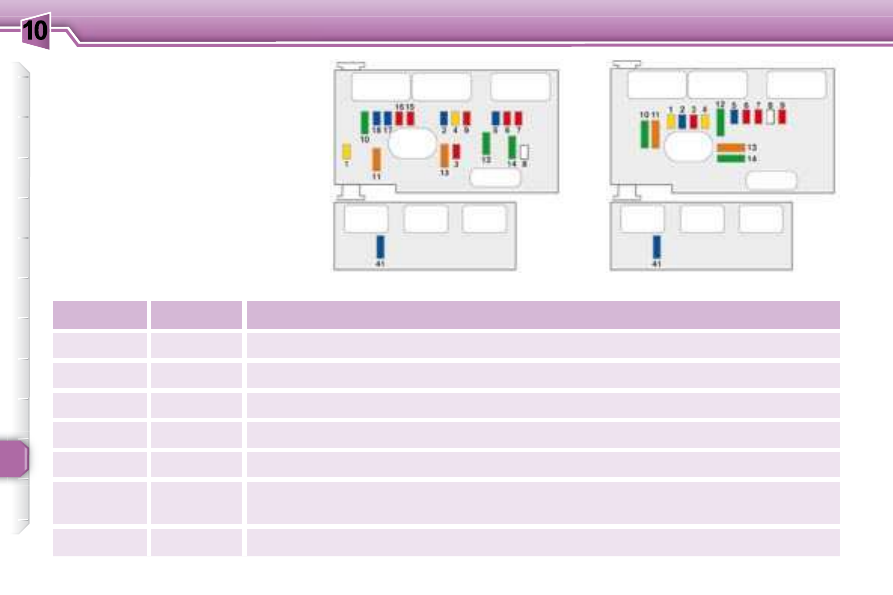
 To access the fuse box in the engine 
compartment  (next  to  the  battery), 
unclip the cover. 
 Close  the  cover  carefully  when  you 

have i nished to guarantee the seal-

ing of the fuse box. 

  Fuse box 2   

  or  

  Fuse box 1  

  Fuse N°  

  Rating  

  Functions  

  F1  

  20 A  

 Engine control unit and fan assembly high speed relay supply. 

  F2  

  15 A  

 Horn. 

  F3  

  10 A  

 Front and rear wash-wipe. 

  F4  

  20 A  

 Headlamp wash. 

  F5  

  15 A  

 Fuel pump and purge canister solenoid valve (2 litre petrol). 

  F6  

  10 A  

 Four  speed  automatic  gearbox  control  unit,  automatic  gearbox  lever  locking  control,  push 
control switch, fan assembly high speed relay, right and left xenon headlamps. 

  F7  

  10 A  

 ABS/ESP control unit, power steering electro-pump unit control unit. 

10

PRACTICAL INFORMATION

131

  *    For fuse box 1 only.  

  Fuse N°  

  Rating  

  Functions  

  F8  

  25 A  

 Starter control.  

  F9  

  10 A  

 Additional heating unit (Diesel), coolant level switch. 

  F10  

  30 A  

 Engine  control  unit  actuators  (ignition  coil,  solenoid  valves,  oxygen  sensors,  control  units, 
injectors, heaters), purge canister solenoid valve (1.4 litre petrol and 1.6 litre petrol). 

  F11  

  40 A  

 Air conditioning blower. 

  F12  

  30 A  

 Windscreen wipers low/high speed. 

  F13  

  40 A  

 Built-in systems interface supply (ignition positive). 

  F14  

  30 A  

 Air pump (2 litre petrol). 

  F15 *   

  10 A  

 Right main beam headlamp. 

  F16 *   

  10 A  

 Left main beam headlamp. 

  F17 *   

  15 A  

 Left dipped headlamp. 

  F18 *   

  15 A  

 Right dipped headlamp. 

  F41  

  15 A  

 Six speed automatic gearbox control unit. 

10

PRACTICAL INFORMATION

132

 The electrical system of your vehicle is designed to operate with standard or optional equipment. 
 Before installing other electrical equipment or accessories on your vehicle, contact a PEUGEOT dealer. 
 PEUGEOT will not accept responsibility for the cost incurred in repairing your vehicle or for rectifying the malfunctions 
resulting from the installation of accessories not supplied and not recommended by PEUGEOT and not installed in 

accordance with its instructions, in particular where the equipment in question consumes more than 10 milliamperes.   

  **   The maxi-fuses provide additional protection for the electrical systems. All work on the maxi-fuses must be carried out by 

a PEUGEOT dealer.  

  Fuse N°  

  Rating  

  Functions  

  MF1 **   

  30 A  

 200 W fan unit. 

  50 A  

 400 W and 460 W fan unit. 

  MF2**    

  30 A  

 ABS/ESP pump. 

  MF3 **   

  30 A  

 ABS/ESP solenoid valves. 

  MF4 **   

  80 A  

 Built-in systems interface supply. 

  MF5 **   

  80 A  

 Built-in systems interface supply. 

  MF6 **   

  80 A  

 Passenger compartment fuse box. 

  MF8 **   

  70 A  

 Power steering electro-pump unit. 

10

PRACTICAL INFORMATION

   Special front windscreen 
wiper position 

      Within one minute of switching off 

the  ignition,  operate  the  wipers 
stalk to position the wiper blades 
in  the  centre  of  the  windscreen 
(maintenance position).    

   Changing a wiper blade 

      Lift the wiper arm, then unclip the 

blade and remove it. 

     Fit the new blade and push back 

the arm.  

  Note:

  the shortest blade is i tted on 

the  vehicle's  right-hand  windscreen 
wiper arm. 
  To  return  the  windscreen  wipers 
to their normal position, switch on 
the ignition and operate the wiper 
stalk.
    

  BATTERY  

  To charge the battery using a 
battery charger: 

   -  

Disconnect  the  battery  starting 
with the negative (-) terminal, 

  -  

Follow  the  instructions  for  use 
given by the battery charger man-
ufacturer, 

  -  

Check  that  the  terminals  and  con-
nectors are clean; if they are covered 
with sulphate (white or greenish de-
posit),  disconnect  them  and  clean 
them, 

  -  

Reconnect  the  battery  starting 
with the negative (-) terminal.    

 Before disconnecting the bat-
tery, you must wait for 2 min-
utes  after  switching  off  the 
ignition. 

 Never  disconnect  a  terminal  when 
the engine is running. 
 Never  charge  a  battery  without  i rst 

disconnecting the terminals. 
 Close  the  windows  and  sunroof  be-
fore disconnecting the battery. If they 
do not operate normally following re-
connection  of  the  battery,  they  must 
be  reinitialised  (see  sections  "Reini-
tialisation  of  the  electric  windows" 
and "Sunroof"). 
 After  every  reconnection  of  the  bat-
tery,  switch  on  the  ignition  and  wait 
1 minute before starting to allow the 
electronic systems to be initialised. If 

slight difi culties are experienced af-

ter this, please contact a PEUGEOT 
dealer. 
 Following  disconnection  of  the  bat-
tery,  the  remote  control  key  and  the 
GPS satellite navigation system must 
be  reinitialised  (see  corresponding 
section). 

      It is advisable to disconnect the 
battery if the vehicle is not to be 
used  for  a  period  of  more  than 
one month. 

   To start the vehicle from another 
battery: 
   -  

Connect the red cable to the posi-
tive  (+)  terminals  of  the  two  bat-
teries, 

  -  

Connect one end of the green or 
black cable to the negative (-) ter-
minal of the slave battery, 

  -  

Connect the other end of the green 
or black cable to an earth point on 
the broken down vehicle as far as 
possible from the battery, 

  -  

Operate the starter, let the engine 
run, 

  -  

Wait  for  the  engine  to  return  to 
idle, then disconnect the cables.

 The batteries contain harmful 
substances such as sulphuric 
acid and lead. They must be 
disposed  of  in  accordance 

with  regulations  and  must  never  be 
discarded with household waste. 
 Take used remote control and vehicle 
batteries  to  an  approved  collection 
point.    

  CHANGING A WINDSCREEN 
WIPER BLADE  

10

PRACTICAL INFORMATION

134

  ECONOMY MODE 
FUNCTION 

 After the engine has stopped, certain 
functions (windscreen  wiper, electric 
windows,  sunroof,  courtesy  lights, 
audio  equipment,  telephone,  dipped 
headlamps, etc.) can only be used for 
a combined duration of approximately 
thirty minutes, to prevent discharging 
the battery. 
 Once  the  thirty  minutes  are  over,  a 
switching to economy mode message 
appears on the multi-function display 
and  the  active  functions  are  put  on 
standby. 
 These  functions  are  reactivated 
automatically next time the vehicle is 
driven. 
 In  order  to  resume  the  use  of  these 
functions  immediately,  the  engine 
must  be  started  and  left  to  run  for  a 
few minutes. 
 The  time  available  to  you  will  then 
be double the duration for which the 
engine  is  left  running.  However,  this 

period  will  always  be  between  i ve 

and thirty minutes. 

  A  l at  battery  prevents  the 

engine from starting.  

  LOAD REDUCTION 
FUNCTION 

 When  driving,  certain  functions  (air 
conditioning, heated rear screen, heating 
system  for  passenger  compartment  of 
diesel  vehicles,  etc.)  may  be  switched 
off  temporarily,  depending  on  the  level 
of battery charge. 
 Reactivation of these functions is au-
tomatic,  once  the  battery  charge  is 

sufi cient. 
  Note:   at  the  risk  of  discharging  the 
battery, the functions that have been 
switched off may be reactivated man-
ually.  

  Note:   if  the  telephone  is 
being  used  when  economy 
mode  starts,  it  will  still  be 

possible to i nish the call. 

10

PRACTICAL INFORMATION

   Without lifting (4 wheels on 
the ground) 

 You must always use a tow bar. 
 The  removable  towing  eye  is  inside 
the spare wheel. 
  Estate :  the removable towing eye is 
inside the right-hand boot trim.  

   From the front: 
      Unclip the cover, by pressing the 

bottom part,  

     Screw in the towing eye as far as 

it will go.    

   Lifting (2 wheels only on the 
ground) 

 It  is  preferable  to  raise  the  vehicle 
with a professional lifting device.   

 When towing with the engine 
switched off, there is no brak-
ing or steering assistance.   

  TOWING YOUR VEHICLE  

   From the rear: 
      Unclip the top of the cover using 

a coin, 

     Screw in the towing eye as far as 

it will go.     

   Special features of the 
automatic gearbox 

 When towing with four wheels on the 
ground,  the  following  rules  must  be 
obeyed: 
   -  

lever in position  N , 

  -  

tow the vehicle at less than 30 mph 
(50  km/h)  up  to  a  maximum  dis-
tance of 30 miles (50 km). 

  -  

do not add oil to the gearbox.  

10

PRACTICAL INFORMATION

136

   Driving advice  

   Distribution of loads: 
 Distribute  the  load  in  the  trailer  so 
that  the  heaviest  items  are  as  close 
as possible to the axle and the nose 
weight  approaches  the  maximum 
permitted without exceeding it.   

   Cooling:    towing  a  trailer  on  a  slope 
increases  the  temperature  of  the 
coolant.  
 As  the  fan  is  electrically  controlled, 
its cooling capacity is not dependent 
on the engine speed. 
 To  lower  the  engine  speed,  reduce 
your speed. 
 The maximum towing load on a long 
slope  depends  on  the  gradient  and 
the outside temperature. 
 In all cases, pay attention to the cool-
ant temperature. 
 If  the  warning  light  comes  on,  stop 
the vehicle and switch off the engine 
as soon as possible.   

   Tyres: 
 check the tyre pressures of the tow-
ing vehicle and of the trailer, observ-
ing the recommended pressures.   

   Braking:   towing increases the brak-
ing distance.    

   Lights:    check  the  electrical  signal-
ling on the trailer.   

   Side wind:   take into account the in-
creased sensitivity to side wind.     

A CARAVAN, A BOAT, 
ETC. 

 Your  vehicle  is  primarily  designed 
for  transporting  people  and  luggage 
but it may also be used for towing a 
trailer. 
 We  recommend  the  use  of  original 
PEUGEOT  towbars  and  their  har-
nesses  that  have  been  tested  and 
approved  from  the  design  stage  of 

your vehicle and that the i tting of the 

towbar  is  entrusted  to  a  PEUGEOT 
dealer. 
 If  the  towbar  is  not  i tted  by  a 

PEUGEOT  dealer,  it  is  imperative 

that  it  is  i tted  using  the  electrical 

pre-equipment located at the rear of 
the  vehicle  in  accordance  with  the 
manufacturer's instructions. 
 Driving with a trailer subjects the tow-

ing vehicle to more signii cant stress 

and  its  driver  must  be  particularly 
careful. 
 Air  density  decreases  with  altitude, 
thus  reducing  engine  performance. 
Above  1 000  metres,  the  maximum 
towing load must be reduced by 10 % 
and so on for every 1 000 metres of 
altitude. 
 The rear parking assistance function 
will be disarmed automatically when 

a towbar is i tted.  

10

PRACTICAL INFORMATION

  Saloon:

  when i tting transverse roof 

bars,  use  the  four  threads  provided 
for  this  purpose.  To  access  these, 

push  the  concealing  l aps  in  the 

direction of the arrow. 
  Estate:

   when  i tting  transverse  roof 

bars,  observe  their  positioning.  This 
is indicated by marks on each of the 
longitudinal bars. 
 Use  accessories  approved  by 
PEUGEOT  and  follow  the  manufac-

turer's i tting instructions. 

  Maximum authorised weight 
on the roof rack, for a load-
ing  height  not  exceeding 
40  cm  (with  the  exception 

of  bicycle  carriers):  80  kg  (saloon), 
100 kg (estate).
  
  If the height exceeds 40 cm, adapt 
the  speed  of  the  vehicle  to  the 

proi le  of  the  road  to  avoid  da

maging the roof bars and the i x-

ings on the roof.   

  FITTING ROOF BARS 

 VERY COLD CLIMATE SCREEN *  

 The  very  cold  climate  screen  is  in-
stalled  on  the  lower  part  of  the  front 
bumper to prevent the accumulation 
of snow at the radiator cooling fan. 
  When  the  snow  has  cleared  (tem-
perature above 10 °C), remove the 
very cold climate screen.
  

  FITTING 

      Offer  up  the  very  cold  climate 

screen facing the front bumper  . 

     Put it in place by pressing at each 

clip  .   

  REMOVAL 

      Insert a screwdriver into   the hole 

located near each of the clips. 

     Use the screwdriver as a lever to 

unclip each clip in turn.   

  *    According to country.  

10

PRACTICAL INFORMATION

138

      ACCESSORIES FOR 
YOUR 307 

 A  wide  range  of  accessories  recom-
mended  by  PEUGEOT  and  original 
parts are offered by the network. 
 They  all  benei t  from  PEUGEOT's 

recommendation. 
 These accessories and parts, having 
been  tested  and  approved  for  reli-
ability  and  safety,  are  all  adapted  to 
your PEUGEOT vehicle. 
 The 

product 

range 

offered 

by 

PEUGEOT Accessories  is  structured 
around 5 categories: PROTECTION - 
TOURING - IN-CAR TECHNOLOGY - 
STYLING  -  UNIVERSAL,  it  is  dedi-
cated to:   

   "Touring": 
 mats, boot tray, luggage net, 

i xed coat hook on head re-

straint,  aluminium  or  PVC 
door sills. 
 For  leisure  pursuits:  roof 
bars, tailgate bicycle carrier *  

(estate),  bicycle  carrier  on  roof  bars, 
ski carrier, roof box, booster seats and 
child seats, side blinds and rear blind, 
front centre armrest, CD storage, un-
der shelf storage (saloon). 
 Trailer towbar which must be i tted by 

the PEUGEOT network.    

 The i tting of electrical equip-

ment  or  accessories  which 
are  not  recommended  by 
PEUGEOT  may  result  in  a 

failure  of  your  vehicle's  electronic 
system.  
 Please  note  this  specii c  warning. 

You  are  advised  to  contact  a  repre-
sentative of the Marque to be shown 
the  range  of  recommended  equip-
ment and accessories.    

   "Universal": 
 screenwash,  interior  and  ex-
terior maintenance and clean-
ing products. 

   "Protection": 
 anti-theft alarm, window en-

graving,  wheel  locks,  i rst 

aid  kit,  warning  triangle, 
safety jacket, stolen vehicle 
tracking system, dog guard, 
snow chains. 

      "In-car technology": 
 audio  systems,  audio/tel-

ephone, amplii ers, satellite 

navigation systems, hands-
free kit, entertainment screen 
kit,  CD  changer,  speakers, 
DVD  player,  connection  kit 

for MP3 player or portable CD player, 
rear parking assistance    

   "Styling": 
 seat  covers  compatible  with 
side air bags, aluminium gear 
lever  knob,  fog  lamps,  door 

del ectors,  spoiler  (saloon), 

styling  strips,  alloy  wheels, 
trims, sport exhaust.   

   *    When using a tailgate bicycle carrier, 

deactivate  the  rear  wiper  via  the 

multifunction  display  coni guration 

menu.   

   Note 

 To  avoid  any  risk  of  jamming  of  the 
pedals: 
   -  

ensure that the mat is positioned 
and secured correctly, 

  -   never i t one mat on top of another.

 Depending  on  the  country 
in  which  the  vehicle  is  sold, 
it  is  compulsory  to  have  a 
high visibility safety jacket, a 

warning  triangle  and  a  set  of  spare 
bulbs available in the vehicle.   

11

TECHNICAL DATA

139

ENGINES AND GEARBOXES

MODELS:
Model codes:
3A... 3C... 3E...

KFUC
KFUC

NFUC

NFUL

NFUF

NFUC/FF

3G...

PETROL ENGINES

1.4 litre 16V 90 bhp

1.6 litre 16V 110 bhp

1.6 litre 16V BioFlex

Cubic capacity (cm

3

)

1 360

1 587

1 587

Bore x stroke (mm)

75 x 77

78.5 x 82

78.5 x 82

EU standard max power (kW/bhp)

65/90

80/110

80

82

Max power engine speed (rpm)

5 250

5 800

5 800

EU standard max torque (Nm)

133

147

147

153

Max torque engine speed (rpm)

3 250

4 000

4 000

Fuel

Unleaded

Unleaded

Unleaded

E85

Catalytic converter

Yes

Yes

Yes

GEARBOX

Manual

(5-speed)

Manual

 (5-speed)

Auto

(4-speed)

Manual

(5-speed)

OIL CAPACITIES (in litres)

Engine (with cartridge replacement)

3.05

3.25

3.25

Gearbox-Final drive

2

2

-

2

11

TECHNICAL DATA

140

ENGINES AND GEARBOXES

MODELS:
Model codes:
3A... 3C... 3E...

RFJC

RFJF

PETROL ENGINES

2 litre 16V 143 bhp

Cubic capacity (cm

3

)

1 997

Bore x stroke (mm)

85 x 88

EU standard max power (kW)

103

Max power engine speed (rpm)

6 000

EU standard max torque (Nm)

200

Max torque engine speed (rpm)

4 000

Fuel

Unleaded

Catalytic converter

Yes

GEARBOX

Manual

(5-speed)

Automatic

(4-speed)

OIL CAPACITIES (in litres) 

Engine (with cartridge replacement)

5

Gearbox-Final drive

1.9

11

TECHNICAL DATA

  ENGINES AND GEARBOXES  

  MODELS:  
  Model codes:  
  3A... 3C... 3E...  

   9HXC   
 9HVC   

   9HZC   

  9HYB   
 9HYC  

  3G...  

   9HXC   

   9HZC   

  9HYB   
 9HYC  

  DIESEL ENGINES  

   1.6 l. Turbo HDI 16V  

 90 bhp   

   1.6 l. Turbo HDI 16V 110 bhp   

 Cubic capacity (cm

3

  1 560  

  1 560  

 Bore x stroke (mm) 

  75 x 88.3  

  75 x 88.3  

 EU standard max power (kW/bhp) 

  66/90  

  80/110  

 Max power engine speed (rpm) 

  4 000  

  4 000  

 EU standard max torque (Nm) 

  215  

  240  

 Max torque engine speed (rpm) 

  1 750  

  1 750  

 Fuel 

  Diesel  

  Diesel  

 Catalytic converter 

  Yes  

  Yes  

 Particle emission i lter 

  No  

  Yes  

  No  

  GEARBOX  

  Manual  

 (5-speed)  

  Manual  

 (5-speed)  

  OIL CAPACITIES (in litres)  


 Engine (with cartridge replacement) 

  3.75  

  3.75  

 Gearbox-Final drive 

  1.9  

  1.9  

11

TECHNICAL DATA

142

   ENGINES AND GEARBOXES   

  MODELS:  
  Model codes:  
  3A... 3C... 3E...  

   RHRH   

   RHRJ   

  DIESEL ENGINES  

   2 litre turbo HDI 16V 136 bhp   

 Cubic capacity (cm

3

  1 997  

 Bore x stroke (mm) 

  85 x 88  

 EU standard max power (kW/bhp) 

  100/136  

 Max power engine speed (rpm) 

  4 000  

 EU standard max torque (Nm) 

  320  

 Max torque engine speed (rpm) 

  2 000  

 Fuel 

  Diesel  

 Catalytic converter 

  Yes  

 Particle emission i lter 

  Yes  

  Yes  

  GEARBOX  

  Manual  

 (6-speed)  

  Automatic  

 (6-speed)  

  OIL CAPACITIES (in litres)  


 Engine (with cartridge replacement) 

  5.25  

 Gearbox-Final drive 

  2.4  

11

TECHNICAL DATA

143

 The consumption values presented here correspond to the values communicated at the time of printing. These consumption 
values were established in accordance with EC Directive 80/1268 (as amended). They may vary depending on the style of 
driving, driving conditions, weather conditions, the vehicle load, the maintenance of the vehicle and the use of the acces-
sories.  
(1) Unleaded. - (2) E85. 

  SALOON CONSUMPTION  

   In accordance with EC Directive 80/1268 (as amended)   

  Engine  

  Gearbox  

  Model 

codes: 

3A... 3C...  

   Urban 

Circuit mpg 

(litres/100 km)   

   Inter-urban 

Circuit mpg  

 (litres/100 km)   

   Mixed 

Circuit mpg 

(litres/100 km)   

   Emission of 

codes CO

2

 by 

weight (g/km)   

  1.4 litre 16V  

 Manual 

  KFUC  

  32.4 (8.7)  

  53.3 (5.3)  

  43.5 (6.5)  

  155  

  1.6 litre 16V  

 Manual 

  NFUC  

  28.2 (10.0)  

  48.7 (5.8)  

  38.1 (7.4)  

  174  

  NFUL  

  28.2 (10.0)  

  48.7 (5.8)  

  38.1 (7.4)  

  174  

 Automatic 

  NFUF  

  25.3 (11.2)  

  47.1 (6.0)  

  35.8 (7.9)  

  189  

  1.6 l. 16V BioFlex  

 Manual 

  NFUC/FF  

  28.2 (10.0) (1) 
 20.6 (13.7) (2)  

  48.7 (5.8) (1) 
 35.7 (8.0) (2)  

  38.1 (7.4) (1) 

 28.0 (10.1) (2)  

  174 (1) 
 165 (2)  

  2 litre 16V 143 bhp  

 Manual 

  RFJC  

  26.4 (10.7)  

  47.1 (6.0)  

  36.7 (7.7)  

  184  

 Automatic 

  RFJF  

  23.9 (11.8)  

  45.6 (6.2)  

  34.4 (8.2)  

  195  

  1.6 l. Turbo HDI 
16V 90 bhp
  

 Manual 

  9HXC  

  46.3 (6.1)  

  65.7 (4.3)  

  57.6 (4.9)  

  129  

  9HVC  

  46.3 (6.1)  

  65.7 (4.3)  

  57.6 (4.9)  

  129  

  1.6 litre Turbo HDI 
16V 110 bhp
  

 Manual 

  9HZC  

  46.3 (6.1)  

  65.7 (4.3)  

  57.6 (4.9)  

  129  

  9HYB   

  47.1 (6.0)  

  67.2 (4.2)  

  60.0 (4.8)  

  126  

  9HYC  

  45.6 (6.2)  

65  .7 (4.3)  

  56.5 (5.0)  

  132  

  2 litre Turbo HDI 16V  

 Manual 

  RHRH  

  39.8 (7.1)  

  62.8 (4.5)  

  52.4 (5.4)  

  142  

 Automatic 

  RHRJ  

  30.4 (9.3)  

  54.3 (5.2)  

  42.2 (6.7)  

  178  

11

TECHNICAL DATA

144

 The consumption values presented here correspond to the values communicated at the time of printing. These consumption 
values were established in accordance with EC Directive 80/1268 (as amended). They may vary depending on the style of 
driving, driving conditions, weather conditions, the vehicle load, the maintenance of the vehicle and the use of the acces-
sories. 

  VAN CONSUMPTION  

   In accordance with EC Directive 80/1268 (as amended)   

  Engine  

  Gearbox  

  Model 
codes   

 3G...  3X...  

   Urban 

circuit mpg 

(litres/100 km)   

   Inter-urban 

circuit mpg  

 (litres/100 km)   

   Mixed 

circuit mpg 

(litres/100 km)   

   Emission 
of CO

2

 by 

weight (g/km)   

  1.4 litre 16V  

 Manual 

  KFUC  

  32.4 (8.7)  

  53.3 (5.3)  

  43.5 (6.5)  

  155  

  1.6 litre Turbo HDI 
16V 90 bhp
  

 Manual 

  9HXC  

  46.3 (6.1) 
 46.3 (6.1)  

  65.7 (4.3) 
 65.7 (4.3)  

  57.6 (4.9) 
 57.6 (4.9)  

  129 
 129  

  1.6 litre Turbo HDI 
16V 110 bhp
  

 Manual 

  9HZC  

  46.3 (6.1)  

  65.7 (4.3)  

  57.6 (4.9)  

  129  

  9HYB  

  47.1 (6.0) 
 45.6 (6.2)  

  67.3 (4.2) 
 65.7 (4.3)  

  60.1 (4.8) 
 57.6 (4.9)  

  126 
 132  

  9HYC  

  45.6 (6.2) 
 45.6 (6.2)  

  65.7 (4.3) 
 65.7 (4.3)  

  56.5 (5.0) 
 57.6 (4.9)  

  132 
 132  

11

TECHNICAL DATA

145

  ESTATE CONSUMPTION  

   In accordance with EC Directive 80/1268 (as amended)   

  Engine  

  Gearbox  

  Model 
codes   

 3E...  

   Urban 

circuit mpg 

(litres/100 km)   

   Inter-urban 

circuit mpg  

 (litres/100 km)   

   Mixed 

circuit mpg 

(litres/100 km)   

   Emission 
of CO

2

 by 

weight (g/km)   

  1.4 litre 16V  

 Manual 

  KFUC  

  32.1 (8.8)  

  51.4 (5.5)  

  42.2 (6.7)  

  159  

  1.6 litre 16V  

 Manual 

  NFUC  

  28.5 (9.9)  

  44.8 (6.3)  

  36.7 (7.7)  

  178  

 Automatic 

  NFUF  

  24.8 (11.4)  

  44.8 (6.3)  

  34.0 (8.3)  

  194  

  1.6 l. 16V BioFlex  

 Manual 

  NFUC/FF  

  28.5 (9.9) (1) 

 20.3 (13.9) (2)  

  44.8 (6.3) (1) 
 33.2 (8.5) (2)  

  36.7 (7.7) (1) 

 27.2 (10.4) (2)  

  178 (1) 
 169 (2)  

  2 litre16V 143 bhp  

 Manual 

  RFJC  

  25.7 (11.0)  

  46.3 (6.1)  

  35.8 (7.9)  

  188  

 Automatic 

  RFJF  

  23.2 (12.2)  

  44.8 (6.3)  

  33.4 (8.4)  

  199  

  1.6 litre Turbo HDI 
16V 90 bhp
  

 Manual 

  9HXC  

  45.6 (6.2)  

  64.2 (4.4)  

  56.5 (5.0)  

  131  

  9HVC  

  45.6 (6.2)  

  64.2 (4.4)  

  56.5 (5.0)  

  131  

  1.6 litre Turbo HDI 
16V 110 bhp
  

 Manual 

  9HZC  

  45.6 (6.2)  

  64.2 (4.4)  

  56.5 (5.0)  

  131  

  9HYB   

  46.3 (6.1)  

  65.7 (4.3)  

  57.6 (4.9)  

  128  

  9HYC  

  44.8 (6.3)  

  64.2 (4.4)  

  55.4 (5.1)  

  134  

  2 litre Turbo HDI 16V  

 Manual 

  RHRH  

  38.7 (7.3)  

  60.1 (4.7)  

  50.4 (5.6)  

  148  

 Automatic 

  RHRJ  

  29.7 (9.5)  

  52.4 (5.4)  

  40.9 (6.9)  

  183  

 The consumption values presented here correspond to the values communicated at the time of printing. These consumption 
values were established in accordance with EC Directive 80/1268 (as amended). They may vary depending on the style of 
driving, driving conditions, weather conditions, the vehicle load, the maintenance of the vehicle and the use of the acces-
sories.  
(1) Unleaded. - (2) E85.   


Content   ..  8  9  10  11   ..