Nissan Pathfinder (2024 year). Manual in english - page 14
 

  Index      Manuals     Nissan Pathfinder (2024 year). Manual in english


Search            copyright infringement  


Content      ..     12      13      14      15     ..


Nissan Pathfinder (2024 year). Manual in english - page 14


Normally when controlling the distance to
a vehicle ahead, the system automatically
accelerates or decelerates your vehicle ac-
cording to the speed of the vehicle ahead.

Depress the accelerator to properly accel-
erate your vehicle when acceleration is re-
quired for a lane change. Depress the brake
pedal when deceleration is required to
maintain a safe distance to the vehicle
ahead due to sudden braking or if a vehicle
cuts in. Always stay alert when using the
ICC system.

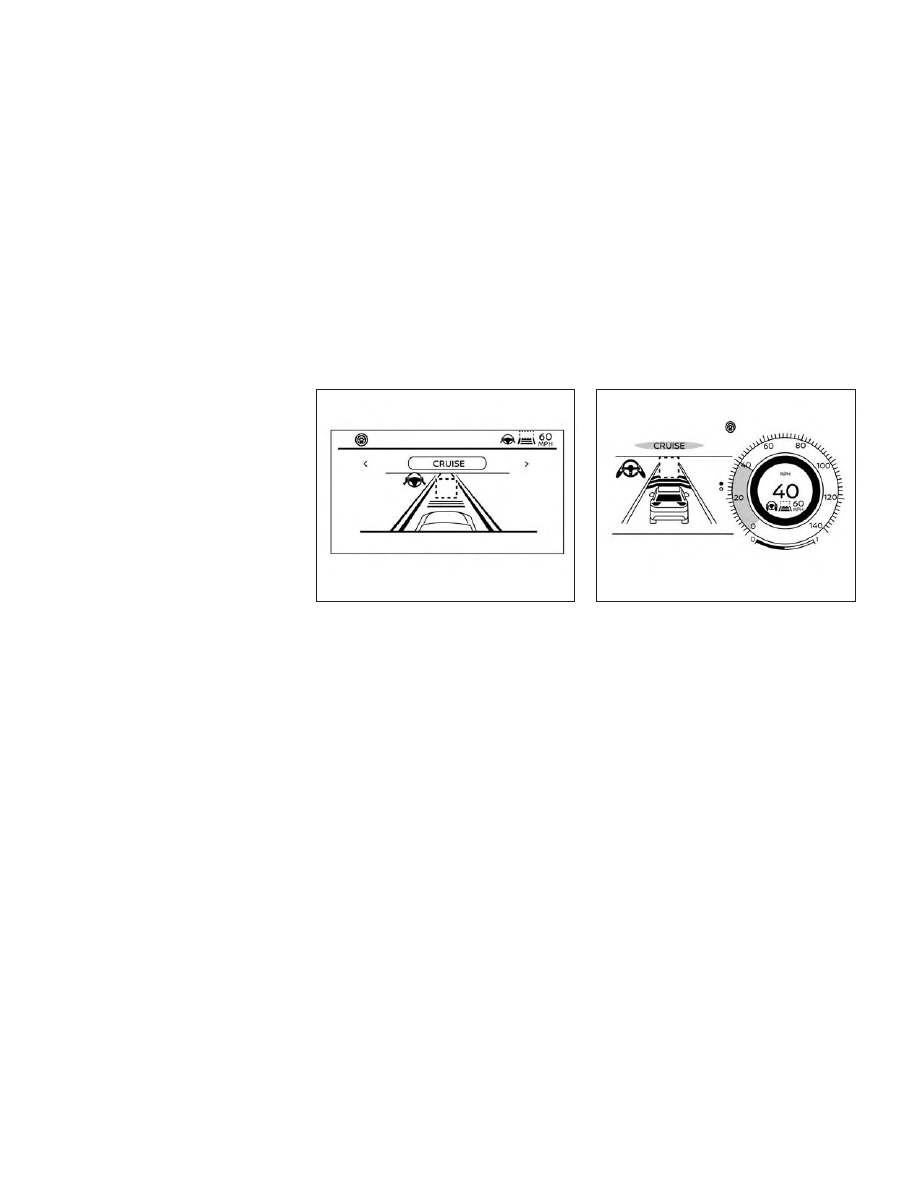
No vehicle detected ahead

The driver sets the desired vehicle speed
based on the road conditions. The ICC sys-
tem maintains the set vehicle speed, simi-
lar to standard cruise control, as long as no
vehicle is detected in the lane ahead. The
ICC system displays the set speed.

LSD4322

System set display with no vehicle

detected ahead (7 inch (18 cm) display)

LSD4323

System set display with no vehicle

detected ahead (12.3 inch (31.2 cm)

display)

5-106

Starting and driving

Vehicle detected ahead

When a vehicle is detected in the lane
ahead, the ICC system decelerates the ve-
hicle by controlling the throttle and apply-
ing the brakes to match the speed of a
slower vehicle ahead. The ICC system then
controls the vehicle speed based on the
speed of the vehicle ahead to maintain the
driver selected distance.

NOTE:
• The stop lights of the vehicle come on

when braking is performed by the ICC
system.

• When the brake is applied by the sys-

tem, a noise may be heard. This is not a
malfunction.

When the ICC system detects a vehicle
ahead, the vehicle ahead detection indica-
tor is displayed and the speed control sta-
tus indicator

illuminates in green.

Vehicle ahead stops

When the vehicle ahead decelerates to
stop, your vehicle decelerates to a stand-
still. Once your vehicle stops, the ICC sys-
tem automatically applies the brakes to
keep the vehicle stopped. When your ve-
hicle is at a standstill, the “(RES+) Press to
start” message is displayed on the vehicle
information display.

NOTE:

When your vehicle stops for less than 3
seconds, your vehicle will automatically
follow the vehicle as it accelerates from a
stop.

LSD4324

System set display with vehicle ahead

(7 inch (18 cm) display)

LSD4220

System set display with vehicle ahead

(12.3 inch (31.2 cm))

Starting and driving

5-107

Vehicle ahead accelerates

• When your vehicle is stopped for less than

approximately 3 seconds and the vehicle
ahead begins to move, your vehicle will
start moving again automatically.

• When your vehicle is at a standstill for

more than approximately 3 seconds and
the vehicle ahead begins to accelerate,
push up the RES+ switch or lightly de-
press the accelerator pedal. The ICC sys-
tem starts to follow the vehicle ahead.

• Always check surroundings before re-

starting the vehicle.

• For vehicles equipped with ProPILOT As-

sist with Navi-link and only when on a
limited access freeway (as identified in
the navigation map data):

– The

time

the

vehicle

can

remain

stopped and automatically restart is ex-
tended from 3 seconds to 30 seconds.

– If a vehicle ahead cuts in or out of the

lane ahead, the vehicle may not auto-
matically start when the traffic ahead
begins to move. You need to push up
the RES+ switch or lightly depress the
accelerator pedal to follow the vehicle
directly ahead when it is safe to do so.

Vehicle ahead not detected

When a vehicle is no longer detected
ahead, the ICC system gradually acceler-
ates your vehicle to resume the previously
set vehicle speed. The ICC system then
maintains the set speed.

When a vehicle is no longer detected, the
vehicle ahead detection indicator and
speed control status indicator (maintain
speed control mode) turn off.

The ICC system gradually accelerates to
the set speed, but you can depress the
accelerator pedal to quickly accelerate.
When a vehicle is no longer detected and
your vehicle is traveling under approxi-
mately 15 mph (24 km/h), the ICC system
automatically cancels.

When passing another vehicle, the set
speed indicator

O

A

flashes when the ve-

hicle speed exceeds the set speed. The ve-
hicle ahead detection indicator turns off
when the area ahead of the vehicle is open.
When the pedal is released, the vehicle re-
turns to the previously set speed. Even
though your vehicle speed is set in the ICC
system, you can depress the accelerator
pedal when it is necessary to accelerate
your vehicle rapidly.

LSD4237

5-108

Starting and driving

Cut-in detection

If a vehicle moves into your traveling lane
near your vehicle, the ICC system may in-
form the driver by flashing the vehicle
ahead detection indicator.

Approach warning

If your vehicle comes closer to the vehicle
ahead due to rapid deceleration of that ve-
hicle or if another vehicle cuts in, the sys-
tem warns the driver with the chime and
ICC system display. Decelerate by depress-
ing the brake pedal to maintain a safe ve-
hicle distance if:
• The chime sounds.
• The vehicle ahead detection indicator

blinks.

• You judge it necessary to maintain a safe

distance.

The warning chime may not sound in
some cases when there is a short distance
between vehicles. Some examples are:
• When the vehicles are traveling at the

same speed and the distance between
vehicles is not changing.

• When the vehicle ahead is traveling faster

and the distance between vehicles is
increasing.

• When a vehicle cuts in near your vehicle.

The warning chime will not sound when:
• Your vehicle approaches other vehicles

that are parked or moving slowly.

• The accelerator pedal is depressed, over-

riding the system.

NOTE:

The approach warning chime may sound
and the system display may flash when
the radar sensor detects objects on the
side of the vehicle or on the side of the
road. This may cause the ICC system to
decelerate or accelerate the vehicle. The
radar sensor may detect these objects
when the vehicle is driven on winding, nar-
row, or hilly roads or when the vehicle is
entering or exiting a curve. In these cases,
you will have to manually control the
proper distance ahead of your vehicle.

Also, the sensor sensitivity can be af-
fected by vehicle operation (steering
maneuver or driving position in the lane)
or traffic or vehicle conditions (for ex-
ample, if a vehicle is being driven with
some damage).

Acceleration when passing

When the ICC system is engaged above 44
mph and following a slower vehicle (below
ICC set speed), and the turn signal is acti-
vated to the left, the ICC system will auto-
matically start to accelerate the vehicle to
help initiate passing on the left and will
begin to reduce the distance to vehicle di-
rectly ahead. Only the left side turn signal
operates this feature. As the driver steers
the vehicle and moves into the passing
lane, if no vehicle is detected ahead the ICC
system will continue to accelerate to the
ICC system set speed. If another vehicle is
detected ahead, then the vehicle will accel-
erate up to the following speed of that ve-
hicle. If the vehicle is not steered into the
left lane to pass, the acceleration will stop
after a short time and regain the set follow-
ing distance. Acceleration can be stopped
at any point by depressing the brake pedal
or the CANCEL switch on the steering
wheel.

Starting and driving

5-109

WARNING

In order to reduce the risk of a collision
that may result in serious injury or
death, please be aware of the following:

This function is only activated with
the left turn signal and will briefly ac-
celerate the vehicle even if a lane
change is not initiated. This can in-
clude non-passing situations such as
left side exits.

Ensure that when passing another
vehicle, the adjacent lane is clear be-
fore

initiating

the

pass.

Sudden

changes in traffic may occur while
passing- always manually steer or
brake as needed- never solely rely on
the system.

Speed Limit Assist - a feature of
ProPILOT Assist with Navi-link
(if so equipped)

When the ProPILOT Assist with Navi-link is
active and it detects a change of the speed
limit, the new speed limit is indicated and it
can be applied to the vehicle set speed
automatically or manually.

The Speed Limit Assist operates:
• When the detected speed limit is 20 mph

(30 km/h) and above.

• The “Spd. Limit Assist” is enabled in the

settings menu of the vehicle information
display.

NOTE:

While the accelerator pedal is operated
with AUTO mode selected, the Speed
Limit Assist will function (automatically
adjusts the vehicle set speed) only
when the detected speed limit is faster
than the vehicle set speed.

In the following situations, the Speed
Limit Assist will not operate:

When an increase in the posted
speed limit is detected, but the ve-
hicle set speed is already faster than
the new speed limit.

When a decrease in the posted
speed limit is detected, but the ve-
hicle set speed is already lower than
the new speed limit.

5-110

Starting and driving

System display and indicators

1. Detected speed limit indicator

Displays the currently detected speed
limit. For additional information, see
“Traffic Sign Recognition (TSR)” (P. 5-35).

2. Applied speed limit indicator (green

frame)

Indicates the detected speed limit can
be applied to vehicle set speed.

3. Speed Limit Assist indicator

Indicates the system activation mode or
system operation.

“ : Manual mode is activated and a

new speed limit (faster speed value) is
indicated.

“ : Manual mode is activated and a

new speed limit (lower speed value) is
indicated.

“A” : Auto mode is activated.

Operating the system

When the system detects a different speed
limit, the new speed value is indicated. The
vehicle set speed can be changed to the
indicated speed limit automatically or
manually.

When Manual mode is selected on set-
tings menu (factory default setting):

• To accept the newly indicated speed limit,

operate the RES+ switch (in case of speed
limit up) or SET- switch (in case of speed
limit down).

• The Speed Limit Assist indicator (

or

) will turn off after approximately 10

seconds if the RES+ or SET- switch is not
operated. (The Speed Limit Assist indica-
tor can be turned off immediately by op-
erating the opposite switch from the di-
rection indicated by the Speed Limit
Assist indicator.)

LSD4326

Example (7 inch [18 cm] display)

LSD4325

Example (12.3 inch [31.2 cm] display)

Starting and driving

5-111

The system will not activate if a speed limit
change is not detected.

When Auto mode is selected on the set-
tings menu:

• The indicated speed limit is applied to the

vehicle set speed automatically when on
a limited access freeway as identified in
the navigation map data. Also, if the Pro-
PILOT Assist with Navi-link system is on,
but not set (active), and a new speed limit
is detected, the vehicle set speed is auto-
matically updated.

• The Auto mode may not be available in

some regions or on roads other than lim-
ited access freeways. In this case, the sys-
tem operates as the Manual mode.

NOTE:

Auto mode will not function in Hawaii or
US island territories.

How to activate or deactivate the
system:

1. Press the

button on the steering

wheel until “Settings” appears in the ve-
hicle information display, and press the
OK button

2. Use the scroll dial to select “Driver Assis-

tance” and then press the OK button.

3. Select “Spd. Limit Assist”, and press the

OK button to select “Auto” or “Manual” to
enable (not activate) the system. To de-
activate the system, select “OFF”.

NOTE:

The system will retain current settings in
the vehicle information display even if
the engine is restarted.

Speed Adjust by Route - a feature
of ProPILOT Assist with Navi-link
(if so equipped)

When the ProPILOT Assist with Navi-link is
active on a limited access freeway (as iden-
tified in the navigation map data), the
Speed Adjust by Route uses road informa-
tion provided by the navigation system
and can adjust the vehicle speed depend-
ing on curves, junctions or exits and the
driver may need to apply additional brak-
ing at any time.

When the vehicle is through the curve or
junction, the vehicle will accelerate again to
the set speed. When exiting the limited ac-
cess freeway, the driver will need to apply
braking at the end of the exit.

NOTE:

The system does not operate when the
accelerator pedal is depressed.

The system may not operate depend-
ing on the set distance to the vehicle
ahead and vehicles detected ahead.

5-112

Starting and driving

System display and indicators

1. Road information indicator

Appears when the system adjusts the
speed depending on turns or exits.

Curves and junctions

Exits

How to activate or deactivate the
system:

1. Press the

button on the steering

wheel until “Settings” appears in the ve-
hicle information display, and press the
OK button

2. Use the scroll dial to select “Driver Assis-

tance” and then press the OK button.

3. Select “Speed Adjust by Route”, and

press the OK button to turn the system
on or off.

NOTE:

The system will retain current settings in
the vehicle information display even if
the engine is restarted.

LSD4328

Example (7 inch [18 cm] display)

LSD4327

Example (12.3 inch [31.2 cm] display)

Starting and driving

5-113

ICC system limitations

WARNING

Listed below are the system limitations
for the ICC system. Failure to operate
the vehicle in accordance with these
system limitations could result in seri-
ous injury or death:

The ICC system is primarily intended
for use on straight, dry, open roads
with light traffic. It is not advisable to
use the ICC system in city traffic or
congested areas.

The ICC system will not adapt auto-
matically to road conditions. This
system should be used in evenly
flowing traffic. Do not use the system
on roads with sharp curves or on icy
roads, in heavy rain or in fog.

As there is a performance limit to the
distance control function, never rely
solely on the ICC system. This system
does not correct careless, inattentive
or absent-minded driving or over-
come poor visibility in rain, fog, or
other bad weather. Decelerate the
vehicle speed by depressing the
brake pedal, depending on the dis-
tance to the vehicle ahead and the
surrounding circumstances in order
to maintain a safe distance between
vehicles.

When the ICC system automatically
brings the car to a stop, your vehicle
can automatically accelerate if the
vehicle is stopped for less than ap-
proximately 3 seconds. Be prepared
to stop your vehicle if necessary.

Always check surroundings before
restarting the vehicle.

Always pay attention to the opera-
tion of the vehicle and be ready to
manually control the proper follow-
ing distance. The ICC system may not
be able to maintain the selected dis-
tance between vehicles (following
distance) or selected vehicle speed
under some circumstances.

The system may not detect the ve-
hicle in front of you in certain road or
weather conditions. To avoid acci-
dents, never use the ICC system un-
der the following conditions:

On roads with heavy, high-speed

traffic or sharp curves

On slippery road surfaces such as

on ice or snow, etc.

During bad weather (rain, fog,

snow, etc.)

When rain, snow or dirt adhere to

the bumper around the distance
sensor

On steep downhill roads (the ve-

hicle may go beyond the set ve-
hicle speed and frequent braking
may result in overheating the
brakes)

On repeated uphill and downhill

roads

When traffic conditions make it dif-

ficult to keep a proper distance be-
tween vehicles because of frequent
acceleration or deceleration

Interference by other radar sources.

5-114

Starting and driving

Do not use the ICC system if you are
towing a trailer. The system may not
detect a vehicle ahead.

In some road or traffic conditions, a
vehicle or object can unexpectedly
come into the sensor detection zone
and cause automatic braking. Al-
ways stay alert and avoid using the
ICC system where not recommended
in this warning section.

The ICC system will not detect the following
objects:
• Stationary or slow moving vehicles
• Pedestrians or objects in the roadway
• Oncoming vehicles in the same lane
• Motorcycles traveling offset in the travel

lane

The following are some conditions in which
the radar sensor cannot properly detect a
vehicle ahead and the system may not op-
erate properly:
• When the sensor detection is reduced

(conditions such as rain, snow, fog, dust
storms, sandstorms, and road spray from
other vehicles)

• Driving on a steep downhill slope or roads

with sharp curves

• Driving on a bumpy road surface, such as

an uneven dirt road

• If dirt, ice, snow or other material is cover-

ing the radar sensor area

• A complicated-shaped vehicle such as a

car carrier trailer or flatbed truck/trailer is
near the vehicle ahead.

• Interference by other radar sources
• When your vehicle is towing a trailer, etc.
• When excessively heavy baggage is

loaded in the rear seat or cargo area of
your vehicle.

The ICC system is designed to automati-
cally check the radar sensor’s operation
within the limitations of the system.

The detection zone of the radar sensor is
limited. A vehicle ahead must be in the de-
tection zone for the ICC system to maintain
the selected distance from the vehicle
ahead. A vehicle ahead may move outside
of the detection zone due to its position
within the same lane of travel. Motorcycles
may not be detected in the same lane
ahead if they are traveling offset from the
center line of the lane. A vehicle that is en-
tering the lane ahead may not be detected
until the vehicle has completely moved into
the lane.

If this occurs, the ICC system may warn you
by blinking the system indicator and
sounding the chime. The driver may have
to manually control the proper distance
away from the vehicle traveling ahead.

The ICC system (with ProPILOT Assist) uses
a multi-sensing front camera. The follow-
ing are some conditions in which the cam-
era may not properly detect a vehicle and
detection of a vehicle ahead may be de-
layed:
• Poor visibility (conditions such as rain,

snow, fog, dust storms, sandstorms, and
road spray from other vehicles)

• The camera area of the windshield is

fogged up or covered with dirt, water
drops, ice, snow, etc.

• Strong light (for example, sunlight or high

beams from oncoming vehicles) enters
the front camera

• A sudden change in brightness occurs

(for example, when the vehicle enters or
exits a tunnel or shaded area or lightning
flashes)

Starting and driving

5-115

SSD0252

5-116

Starting and driving

When driving on some roads, such as wind-
ing, hilly, curved, narrow roads, or roads
which are under construction, the radar
sensor may detect vehicles in a different
lane, or may temporarily not detect a ve-
hicle traveling ahead. This may cause the
radar system to decelerate or accelerate
the vehicle.

The detection of vehicles may also be af-
fected by vehicle operation (steering ma-
neuver or traveling position in the lane, etc.)
or vehicle condition.

If this occurs, the ICC system may warn you
by blinking the system indicator and
sounding the chime unexpectedly. You will
have to manually control the proper dis-
tance away from the vehicle traveling
ahead.

System Temporarily Unavailable

The following are conditions in which the
ICC system may be temporarily unavail-
able. In these instances, the ICC system
may not cancel and may not be able to
maintain the selected following distance
from the vehicle ahead.

Condition A

Under the following conditions, the ICC sys-
tem is automatically canceled. A chime will
sound and the system will not be able to be
set:
• Any door is open.
• The driver’s seat belt is not fastened.
• The vehicle ahead is not detected and

your vehicle is traveling below the speed
of 15 mph (24 km/h). For ProPILOT Assist
with Navi-link equipped vehicles on a lim-
ited access freeway as identified in the
navigation map data, the ICC system
cancels and a warning chime sounds if
your vehicle is at a standstill for more
than approximately 3 seconds and a ve-
hicle is not detected ahead.

• Your vehicle has been stopped by the ICC

system for approximately 3 minutes or
longer.

• The shift lever is not in the D (Drive) posi-

tion or manual shift mode.

• The electronic parking brake is applied.
• The VDC system is turned off.
• The AEB with Pedestrian Detection ap-

plies harder braking.

• VDC (including the traction control sys-

tem) operates.

SSD0253

Starting and driving

5-117

• The SNOW mode, or MUD/RUT or SAND

mode (4WD models) is selected.

• A wheel slips.
• When the front radar is impaired due to

dirt or another obstruction blocking the
radar sensor.

• When the radar signal is temporarily

interrupted.

Action to take:

When the conditions listed above are no
longer present, turn the system off using
the ProPILOT Assist switch. Turn the ProPI-
LOT Assist system back on to use the
system.

NOTE:
When the ICC system is canceled un-
der the following conditions at a
standstill, the electronic parking brake
is automatically activated:
• Any door is open.
• The driver’s seat belt is not fastened.
• Your vehicle has been stopped by the

ICC system for approximately 3 min-
utes or longer.

• The shift lever is not in the D (Drive)

position or manual shift mode.

• The VDC system is turned off.

• When

distance

measurement

be-

comes impaired due to adhesion of dirt
or obstruction to the sensor.

• When the radar signal is temporarily

interrupted.

Condition B

When there is inclement weather (rain, fog,
snow, etc.) blocking the front radar sensor,
the ICC system will automatically be can-
celed, the chime will sound and the “For-
ward Driving Aids temporarily disabled
Front Sensor Blocked See Owner’s Manual”
warning message will appear in the vehicle
information display.

Action to take:

When the conditions listed above are no
longer present, the warning message will
no longer be available in the vehicle infor-
mation display and the system will operate
normally. If the “Forward Driving Aids tem-
porarily disabled Front Sensor Blocked See
Owner’s Manual” warning message contin-
ues to be displayed, have the system
checked. It is recommended that you visit a
NISSAN dealer for this service.

Condition C

When the radar sensor of the front bumper
is covered with dirt or is obstructed, the ICC
system will automatically be canceled.

The chime will sound and the “Forward
Driving Aids temporarily disabled Front
Sensor

Blocked

See

Owner’s

Manual”

warning message will appear in the vehicle
information display.

Action to take:

If the warning message appears, stop the
vehicle in a safe place, press the park but-
ton to engage the P (Park) position, and
turn the engine off. When the radar signal is
temporarily interrupted, clean the sensor
area of the front bumper and restart the
engine. If the “Forward Driving Aids tempo-
rarily disabled Front Sensor Blocked See
Owner’s Manual” warning message contin-
ues to be displayed, have the system
checked. It is recommended that you visit a
NISSAN dealer for this service.

Condition D

When driving on roads with limited road
structures or buildings (for example, long
bridges, deserts, snow fields, driving next to
long walls), the system may display the
“Forward Driving Aids temporarily disabled
Front Sensor Blocked See Owner’s Manual”
warning message and a chime will sound.

Action to take:

When the above driving conditions no lon-
ger exist, turn the system back on.

5-118

Starting and driving

ICC system malfunction

If the ICC system malfunctions, it will be
turned off automatically, a chime will
sound, and the speed control status
warning (orange) will illuminate.

Action to take:

If the warning light comes on, stop the ve-
hicle in a safe place. Turn the engine off,
restart the engine and set the ICC system
again. If it is not possible to set the ICC
system or the indicator stays on, it may be
a malfunction. Although the normal driving
can be continued, the ICC system should

be inspected. It is recommended that you
visit a NISSAN dealer for this service.

NOTE:

If the ICC system is temporarily unavail-
able, the conventional cruise control
mode may still be used. For additional
information, see “Conventional (fixed
speed) cruise control mode” (P. 5-127).

ICC sensor maintenance

The radar sensor is located on the front of
the vehicle.

To keep the ICC system operating properly,
be sure to observe the following:
• Always keep the sensor area of the front

bumper/emblem clean.

• Do not strike or damage the areas

around the sensor.

• Do not attach a sticker (including trans-

parent material) or install an accessory
near the sensor. This could cause failure
or malfunction.

• Do not attach metallic objects near the

sensor area (brush guard, etc.). This could
cause failure or malfunction.

• Do not alter, remove, or paint the front

bumper.

Before customizing or restoring the front
bumper, it is recommended that you visit a
NISSAN dealer.

The camera sensor is located above the
inside mirror.

To keep the proper operation of the sys-
tems and prevent a system malfunction,
be sure to observe the following:
• Always keep the windshield clean.
• Do not attach a sticker (including trans-

parent material) or install an accessory
near the camera unit.

• Do not place reflective materials, such as

white paper or a mirror, on the instru-
ment panel. The reflection of sunlight
may adversely affect the camera unit’s
capability of detecting the lane markers.

• Do not strike or damage the areas

around the camera unit. Do not touch the
camera lens or remove the screw located
on the camera unit.

If the camera unit is damaged due to an
accident, it is recommended that you visit a
NISSAN dealer.

LSD4329

Starting and driving

5-119

STEERING ASSIST

WARNING

Failure to follow the warnings and in-
structions for proper use of the Steer-
ing Assist could result in serious injury
or death.

The Steering Assist is not a replace-
ment for proper driving procedures
and is not designed to correct care-
less, inattentive or absent-minded
driving. The Steering Assist will not
always steer the vehicle to keep it in
the lane. It is not designed to prevent
loss of control. It is the driver’s re-
sponsibility to stay alert, drive safely,
keep the vehicle in the traveling lane,
and be in control of the vehicle at all
times.

As there is a performance limit to the
Steering Assist’s capability, never
rely solely on the system. The Steer-
ing Assist does not function in all
driving, traffic, weather, and road
conditions. Always drive safely, pay
attention to the operation of the ve-
hicle, and manually control your ve-
hicle appropriately.

The Steering Assist is intended for
use on well-developed freeways or
highways with gentle (moderate)
curves. To avoid risk of an accident,
do not use this system on local or
non-highway roads.

The Steering Assist only steers the
vehicle to maintain its position in the
center of a lane. The vehicle will not
steer to avoid objects in the road in
front of the vehicle or to avoid a ve-
hicle moving into your lane.

It is the driver’s responsibility to stay
alert, drive safely, keep the vehicle in
the traveling lane, and be in control of
the vehicle at all times. Never take
your hands off the steering wheel
when driving. Always keep your
hands on the steering wheel and
drive your vehicle safely.

Always drive carefully and atten-
tively when using the Steering Assist.
Read and understand the Owner’s
Manual thoroughly before using the
Steering Assist. To avoid serious in-
jury or death, do not rely on the sys-
tem to prevent accidents or to con-
trol the vehicle’s speed in emergency
situations. Do not use the Steering
Assist except in appropriate road and
traffic conditions.

Steering Assist operation

The Steering Assist controls the steering
system to help keep your vehicle near the
center of the lane when driving. The Steer-
ing Assist is combined with the Intelligent
Cruise Control (ICC) system. For additional
information, see “Intelligent Cruise Control
(ICC) (for vehicles with ProPILOT Assist)”
(P. 5-104).

The Steering Assist can be activated when
the following conditions are met:
• The ICC system is activated.
• Lane markers on both sides are clearly

detected.

• A vehicle ahead is detected (when the

vehicle is driven at speeds under 37 mph
[60 km/h]).

• The driver grips the steering wheel.
• The vehicle is driven at the center of the

lane.

• The turn signals are not operated.
• The windshield wiper is not operated in

the high (HI) speed operation (the Steering
Assist function is disabled after the wiper
operates for approximately 10 seconds).

5-120

Starting and driving

Steering Assist display and
indicators

1

Steering Assist status indicator/

warning

Displays the status of the Steering Assist by
the color of the indicator/warning
• Steering Assist indicator (gray): Steering

Assist standby

• Steering Assist indicator (green): Steering

Assist active

• Steering Assist indicator (orange): Steer-

ing Assist malfunction

• Steering Assist status indicator (red):

Hands off detected

The Steering Assist status indicator illumi-
nates or blinks when Hands Off operation
is made.

2

Steering Assist indicator

Indicates the status of the Steering Assist
by the color of the indicator
• Steering Assist indicator (gray): Steering

Assist standby

• Steering Assist indicator (green): Steering

Assist active

3

Lane marker indicator

Indicates whether the system detects the
lane marker
• Lane marker indicator (gray): Lane mark-

ers not detected

• Lane marker indicator (green): Lane

markers detected

• Lane marker indicator (orange): Lane de-

parture is detected

When the Steering Assist is in operation,
the Steering Assist status indicator

O

1

, the

Steering Assist indicator

O

2

, and the lane

marker indicator

O

3

on the vehicle infor-

mation display turn green. A chime sounds
when the Steering Assist initially activates.

When the Steering Assist deactivates, the
Steering Assist status indicator

O

1

, the

Steering Assist indicator

O

2

, and the lane

marker indicator

O

3

on the vehicle infor-

mation display turn gray and a chime
sounds.

LSD4330

For vehicles with the 7 inch (18 cm)

display

LSD4221

For vehicles with the 12.3 inch (31.2 cm)

display

Starting and driving

5-121

Intelligent Lane Intervention (I-LI)

When a curve or strong cross wind exceeds
the capabilities of the Steering Assist and
your vehicle approaches either the left or
the right side of the traveling lane, a
warning chime sounds, the I-LI indicator
(orange) on the instrument panel flashes
and a steering wheel vibration is provided
to alert the driver. Then, the I-LI system au-
tomatically applies the brakes for a short
period of time to help assist the driver to
return the vehicle to the center of the trav-
eling lane. This action is in addition to any
Steering Assist actions.

Hands on detection

When the Steering Assist is activated, it moni-
tors the driver’s steering wheel operation.

LSD4331

For vehicles with the 7 inch (18 cm) display

5-122

Starting and driving

If the steering wheel is not operated or the
driver takes his/her hands off the steering
wheel for a period of time, the warning

O

1

appears in the vehicle information display
and the hands OFF warning light illumi-
nates.

If the driver does not operate the steering
wheel after the warning has been dis-
played, an audible alert sounds and both
the warning and the warning light flash,
followed by a quick brake application to
request the driver to take control of the
vehicle again.

If the driver still does not respond, the Pro-
PILOT Assist turns on the hazard flasher
and slows the vehicle to a complete stop.

The driver can cancel the deceleration at
any time by steering, braking, accelerating,
or operating the ProPILOT Assist switch.

WARNING

Steering Assist is not a system for
hands-free driving. Always keep your
hands on the steering wheel and drive
your vehicle safely. Failure to do so
could cause a collision resulting in seri-
ous personal injury or death.

LSD4223

For vehicles with the 12.3 inch (31.2 cm) display

Starting and driving

5-123

NOTE:

If the driver lightly touches (instead of
firmly grips) the steering wheel, the
steering torque sensor may not detect
the driver’s hand(s) on the wheel and a
sequence of warnings may occur. When
the driver holds and operates the steer-
ing wheel again, the warnings turn off.

Steering Assist limitations

WARNING

In the following situations, the cam-
era may not detect lane markers cor-
rectly or may detect lane markers in-
correctly and the Steering Assist may
not operate properly:

When driving on roads where

there are multiple parallel lane
markers, lane markers that are
faded or not painted clearly, non-
standard lane markers, or lane
markers covered with water, dirt,
snow, etc.

When driving on roads with dis-

continued lane markers

When driving on roads with a wid-

ening or narrowing lane width

When driving on roads where

there are multiple lanes or unclear
lane

markers

due

to

road

construction

When driving on roads where

there are sharply contrasting ob-
jects, such as shadows, snow, wa-
ter, wheel ruts, seams, or lines re-
maining after road repairs (the
Steering Assist could detect these
items as lane markers)

When driving on roads where the

traveling lane merges or separates

Do not use the Steering Assist under
the following conditions because the
system may not properly detect lane
markers. Doing so could cause a loss
of vehicle control and result in an ac-
cident.

During bad weather (rain, fog,

snow, dust, etc.)

When rain, snow, sand, etc., is

thrown up by the wheels of other
vehicles

When dirt, oil, ice, snow, water, or

another object adheres to the
camera unit

When the lens of the camera unit

is foggy

When strong light (for example,

sunlight or high beams from on-
coming vehicles) shines on the
camera

When

the

headlights

are

not

bright due to dirt on the lens or
the headlights are off in tunnels or
darkness

When a sudden change in bright-

ness occurs (for example, when
the vehicle enters or exits a tunnel
or is under a bridge)

When driving on roads where the

traveling lane merges or sepa-
rates or where there are tempo-
rary lane markers because of road
construction

When there is a lane closure due to

road repairs

When driving on a bumpy road

surface, such as an uneven dirt
road

When driving on sharp curves or

winding roads

When driving on repeated uphill

and downhill roads

5-124

Starting and driving

Do not use the Steering Assist under
the following conditions because the
system will not operate properly:

When driving with a tire that is

not within normal tire conditions
(for example, tire wear, abnormal
tire pressure, installation of a
spare tire, tire chains, nonstan-
dard wheels)

When the vehicle is equipped with

non-original brake or suspension
parts

When an object such as a sticker

or cargo obstructs the camera

When excessively heavy baggage

is loaded in the rear seat or lug-
gage area of your vehicle

When the vehicle load capacity is

exceeded

When towing a trailer or other

vehicle

Excessive noise will interfere with the
warning chime sound, and the beep
may not be heard.

For the ProPILOT Assist system to op-
erate properly, the windshield in
front of the camera must be clean.
Replace worn wiper blades. The cor-
rect size wiper blades must be used

to help make sure the windshield is
kept clean. Only use Genuine NISSAN
wiper blades, or equivalent wiper
blades, that are specifically designed
for use on your vehicle model and
model year. It is recommended that
you visit a NISSAN dealer for the cor-
rect parts for your vehicle.

Steering Assist temporary standby

Automatic

standby

due

to

driving

operation:

When the driver activates the turn signal,
the Steering Assist is temporarily placed in
a standby mode. (The Steering Assist re-
starts automatically when the operating
conditions are met again.)

Automatic standby:

In the following cases, a chime sounds and
the Steering Assist is placed in a temporary
standby mode. (The Steering Assist re-
starts automatically when the operating
conditions are met again.)
• When lane markers on both sides are no

longer detected

• When a vehicle ahead is no longer de-

tected under approximately 37 mph
(60 km/h)

• When strong light enters the camera unit.

(For example, the light directly shines on
the front of the vehicle at sunrise or
sunset.)

• When the temperature of the camera is

too high.

Steering Assist cancel

Under the following conditions, the Steering
Assist cancels, a warning message is dis-
played and the Steering Assist status indica-
tor and the Steering Assist indicator turn off:
• When unusual lane markers appear in

the traveling lane or when the lane
marker cannot be correctly detected for
some time due to certain conditions (for
example, a snow rut, the reflection of light
on a rainy day, the presence of several
unclear lane markers)

• When the windshield wiper operates in

the high (HI) speed operation (the Steer-
ing Assist is disabled when the wiper op-
erates for more than approximately 10
seconds)

Action to take:

Turn the ICC system off using the CANCEL
switch. When the conditions listed above
are no longer present, turn the ICC system
on again.

Starting and driving

5-125

Steering Assist malfunction

When

the

system

malfunctions,

the

warning message is displayed and it turns
off automatically. The Steering Assist sta-
tus warning illuminates (orange). A chime
may sound depending on the situation.

Action to take:

Stop the vehicle in a safe location, place the
vehicle in the P (Park) position, turn the en-
gine off, restart the engine, resume driving,
and set the Intelligent Cruise Control sys-
tem again. If the warning (orange) contin-
ues to illuminate, the Steering Assist is mal-
functioning. Although the vehicle is still
drivable under normal conditions, have the
system checked. It is recommended that
you visit a NISSAN dealer for this service.

Steering Assist maintenance

The camera sensor is located above the
inside mirror.

To keep the proper operation of the system
and prevent a system malfunction, be sure
to observe the following:
• Always keep the windshield clean.
• Do not attach a sticker (including trans-

parent material) or install an accessory
near the camera unit.

• Do not place reflective materials, such as

white paper or a mirror, on the instru-
ment panel. The reflection of sunlight
may adversely affect the camera unit’s
capability of detecting the lane markers.

• Do not strike or damage the areas

around the camera unit. Do not touch the
camera lens or remove the screw located
on the camera unit.

If the camera unit is damaged due to an
accident, it is recommended that you visit a
NISSAN dealer.

Radio frequency statement

For USA

This device complies with Part 15 of the FCC
Rules.

Operation is subject to the following two
conditions:

1. this device may not cause harmful inter-

ference, and

2. this device must accept any interfer-

ence received, including interference
that may cause undesired operation.

Changes or modifications made to this
equipment not expressly approved by Rob-
ert Bosch GmbH may void the FCC autho-
rization to operate this equipment.

This equipment has been tested and found
to comply with the limits for a Class A digi-
tal device, pursuant to Part 15 of the FCC
Rules. These limits are designed to provide
reasonable protection against harmful in-
terference when the equipment is oper-
ated in a commercial environment. This
equipment generates, uses, and can radi-
ate radio frequency energy and, if not in-
stalled and used in accordance with the
instruction manual, may cause harmful in-
terference to radio communications. Op-
eration of this equipment in a residential
area is likely to cause harmful interference
in which case the user will be required to
correct

the

interference

at

his

own

expense.

RF Exposure Information according 2.1091/
2.1093/OET bulletin 65:

Radiofrequency

radiation

exposure

information:

This equipment complies with FCC radia-
tion exposure limits set forth for an uncon-
trolled

environment.

This

equipment

should be installed and operated with
minimum distance of 20 cm between the
radiator and your body.

5-126

Starting and driving

The transmitter must not be co-located or
operating in conjunction with any other an-
tenna or transmitter.

For Canada

Legal warning for RF equipment:

This

device

contains

licence-exempt

transmitter(s)/receiver(s) that comply with
Innovation, Science and Economic Devel-
opment Canada’s licence-exempt RSS(s).
Operation is subject to the following two
conditions: (1) This device may not cause
interference. (2) This device must accept
any interference, including interference
that may cause undesired operation of the
device.

L’émetteur/récepteur exempt de licence
contenu dans le présent appareil est con-
forme aux CNR d’Innovation, Sciences et
Développement économique Canada ap-
plicables aux appareils exempts de licence.
L’éxploitation est autorisée aux deux condi-
tions suivantes: (1) L’appareil ne doit pas
produire de brouillage; (2) L’appareil doit ac-
cepter tout brouillage radioélectrique subi,
même si le brouillage est susceptible d’en
compromettre le fonctionnement.

CONVENTIONAL (fixed speed)
CRUISE CONTROL MODE

NOTE:

ProPILOT Assist provides no approach
warnings, automatic braking, or steering
assist in the conventional (fixed speed)
cruise control mode.

This mode allows driving at a speed be-
tween 25 to 90 mph (40 to 144 km/h) with-
out keeping your foot on the accelerator
pedal.

WARNING

In the conventional (fixed speed)
cruise

control

mode,

a

warning

chime does not sound to warn you if
you are too close to the vehicle
ahead, as neither the presence of the
vehicle ahead nor the vehicle-to-
vehicle distance is detected.

Pay special attention to the distance
between your vehicle and the vehicle
ahead of you or a collision could
occur.

Always confirm the setting in the ICC
system display.

Do not use the conventional (fixed
speed) cruise control mode when
driving under the following condi-
tions:

When it is not possible to keep the

vehicle at a set speed

In heavy traffic or in traffic that

varies in speed

On winding or hilly roads

On slippery roads (rain, snow, ice,

etc.)

In very windy areas

Doing so could cause a loss of vehicle
control and result in an accident.

Starting and driving

5-127

Conventional (fixed speed) cruise
control switches

1

RES+ switch:
Resumes set speed or increases speed
incrementally

2

CANCEL switch:
Deactivates the system without eras-
ing the set speed

3

ProPILOT Assist switch:
Turns the ProPILOT Assist system on or
off

4

SET- switch:
Sets desired cruise speed or reduces
speed incrementally

Conventional (fixed speed) cruise
control mode display and
indicators

The display is located in the vehicle infor-
mation display.

1. Cruise indicator:

This indicator indicates the condition of
the Cruise Control system depending on
a color.

• Cruise control ON indicator (gray): Indi-

cates that the ProPILOT Assist switch is
on

LSD4224

LSD4239

5-128

Starting and driving

• Cruise control SET indicator (green): Indi-

cates that the cruising speed is set

• Cruise control warning (yellow): Indicates

that there is a malfunction in the Cruise
Control system

2. Set vehicle speed indicator:

This indicator indicates the set vehicle
speed. For Canadian models, the speed
is displayed in km/h.

Operating conventional (fixed
speed) cruise control mode

To turn on the conventional (fixed speed)
cruise control mode, push and hold the
ProPILOT Assist switch

O

A

for longer than

about 1.5 seconds.

When pushing the ProPILOT Assist switch
on, the ICC system display turns on. After
you hold the ProPILOT Assist switch on for
longer than about 1.5 seconds, the ICC sys-
tem display turns off. The cruise indicator
appears. You can now set your desired
cruising speed. Pushing the ProPILOT As-
sist switch again will turn the system com-

pletely off. When the ignition switch is
placed in the OFF position, the system is
also automatically turned off.

To use the ICC system again, quickly push
and release the ProPILOT Assist switch
(vehicle-to vehicle distance control mode)
or push and hold it (conventional cruise
control mode) again to turn it on.

CAUTION

To avoid accidentally engaging cruise
control, make sure to turn the ProPILOT
Assist switch off when not using the ICC
system.

LSD4225

Starting and driving

5-129

To set cruising speed, accelerate your ve-
hicle to the desired speed, push the SET-

O

C

switch and release it. (The color of the
cruise indicator changes to green and set
vehicle speed indicator comes on.) Take
your foot off the accelerator pedal. Your
vehicle will maintain the set speed.
• To pass another vehicle, depress the ac-

celerator pedal. When you release the
pedal, the vehicle will return to the previ-
ously set speed.

• The vehicle may not maintain the set

speed when going up or down steep hills.
If this happens, manually maintain ve-
hicle speed.

To cancel the preset speed, use any of the
following methods:

1. Push the CANCEL switch. The vehicle

speed indicator and the cruise indicator
will turn grey.

2. Tap the brake pedal. The vehicle set

speed indicator and the cruise indicator
will turn grey.

3. Turn the ProPILOT Assist switch off. Both

the cruise indicator and vehicle speed
indicator will turn off.

To reset at a faster cruising speed, use one
of the following three methods:

1. Depress the accelerator pedal. When the

vehicle attains the desired speed, push
and release the SET- switch.

2. Push and hold the RES+ switch. When

the vehicle attains the desired speed,
release the switch.

3. Push, then quickly release the RES+

switch. Each time you do this, the set
speed will increase by about 1 mph
(1 km/h).

To reset at a slower cruising speed, use one
of the following three methods:

1. Lightly tap the brake pedal. When the

vehicle attains the desired speed, push
the SET- switch and release it.

2. Push and hold the SET- switch. Release

the switch when the vehicle slows down
to the desired speed.

3. Push, then quickly release the SET-

switch. Each time you do this, the set
speed will decrease by about 1 mph
(1 km/h).

LSD4226

5-130

Starting and driving

System Temporarily Unavailable

A chime sounds under the following condi-
tions and the conventional (fixed speed)
cruise control mode is automatically can-
celed.
• When the shift lever is not in the D (Drive)

position

• When the parking brake is applied
• When the VDC system (including the trac-

tion control system) operates

• When the VDC system is turned off
• When a wheel slips
• When the vehicle speed decreases to less

than 20 mph (30 km/h)

Warning

When the system is not operating properly,
the chime sounds and the color of the
cruise indicator will change in yellow.

Action to take:

If the color of the cruise indicator changes
to yellow (cruise control warning), park the
vehicle in a safe place. Turn the engine off,
restart the engine, resume driving and then
perform the setting again.

If it is not possible to set or the indicator
stays on, it may indicate that the system is
malfunctioning. Although the vehicle is still
drivable under normal conditions, have the
vehicle checked. It is recommended you
visit a NISSAN dealer for this service.

WARNING

Failure to follow the warnings and in-
structions for proper use of the RAB
system could result in serious injury or
death.

The RAB system is a supplemental
aid to the driver. It is not a replace-
ment for proper driving procedures.
Always use the side and rear mirrors
and turn and look in the direction you
will move before and while backing
up. Never rely solely on the RAB sys-
tem. It is the driver’s responsibility to
stay alert, drive safely, and be in con-
trol of the vehicle at all times.

There is a limitation to the RAB sys-
tem capability. The RAB system is not
effective in all situations.

Inclement

weather

or

ultrasonic

sources such as an automatic car
wash,

a

truck’s

compressed-air

brakes or a pneumatic drill may af-
fect the function of the system; this
may include reduced performance or
a false activation.

The RAB system can assist the driver when
the vehicle is backing up and approaching
objects directly behind the vehicle.

LSD6054

REAR AUTOMATIC BRAKING (RAB)

Starting and driving

5-131

The RAB system detects obstacles behind
the vehicle using the parking sensors

O

1

located on the rear bumper.

NOTE:

You can temporarily cancel the sonar
function and the RAB system in the ve-
hicle. For additional information, see
“Front and Rear Sonar System” (P. 5-184).

RAB SYSTEM OPERATION

LSD4176

LSD4332

For vehicles with the 7 inch (18 cm) display

5-132

Starting and driving

1

RAB system warning light

2

RAB system warning indicator

3

Center display

4

Steering-wheel-mounted controls (left
side)

When the shift lever is in the R (Reverse)
position and the vehicle speed is less than
approximately 9 mph (15 km/h), the RAB
system operates.

If a risk of a collision with an obstacle is
detected when your vehicle is backing up,
the RAB system warning indicator will flash
in the vehicle information display, a red
frame will appear in the center display (for
vehicles with the Intelligent Around View®
Monitor system), and the system will chime
three times. The system will then auto-
matically apply the brakes. After the auto-
matic brake application, the driver must
depress the brake pedal to maintain brake
pressure.

NOTE:
• The brake lights of the vehicle come on

when braking is performed by the RAB
system.

• When the brakes operate, a noise may

be heard. This is not a malfunction.

LSD4333

For vehicles with the 12.3inch (31.2 cm) display

Starting and driving

5-133

TURNING THE RAB SYSTEM
ON/OFF

Perform the following steps to turn the RAB
system ON or OFF.

1. Press the

button until “Settings” dis-

plays in the vehicle information display.
Use the scroll dial to select “Driver Assis-
tance.” Then press the OK button.

2. Select “Emergency Assist” and press the

OK button.

3. Select “Rear Auto Braking” and press the

OK button to turn the system on or off.

When the RAB system is turned off and when
the vehicle is in the R (Reverse) position, the
RAB system warning light illuminates.

NOTE:

The RAB system will be automatically
turned on when the engine is restarted.

LSD6014

For vehicles with the 7 inch (18 cm) display

5-134

Starting and driving

RAB SYSTEM LIMITATIONS

WARNING

Listed below are the system limitations
for the RAB system. Failure to follow the
warnings and instructions for proper
use of the RAB system could result in
serious injury or death.

When the vehicle approaches an ob-
stacle while the accelerator or brake
pedal is depressed, the function may
not operate or the start of operation
may be delayed. The RAB system may
not operate or may not perform suffi-
ciently due to vehicle conditions, driv-
ing conditions, the traffic environment,
the weather, road surface conditions,
etc. Do not wait for the system to oper-
ate. Operate the brake pedal by your-
self as soon as necessary.

If it is necessary to override RAB op-
eration, strongly press the accelera-
tor pedal.

Always check your surroundings and
turn to check what is behind you be-
fore and while backing up. The RAB
system detects stationary objects be-
hind the vehicle. The RAB system does
not detect the following objects:

Moving objects

LSD6015

For vehicles with the 12.3 inch (31.2 cm) display

Starting and driving

5-135

Low objects

Narrow objects

Wedge-shaped objects

Objects close to the bumper (less

than approximately 1 ft [30 cm])

Objects that suddenly appear

Thin objects such as rope, wire,

chain, etc.

The RAB system may not operate for
the following obstacles:

Obstacles located high off the

ground

Obstacles in a position offset from

your vehicle

Obstacles, such as spongy materi-

als or snow, that have soft outer
surfaces and can easily absorb a
sound wave

The RAB system may not operate in
the following conditions:

There is rain, snow, ice, dirt, etc.,

attached to the sonar sensors.

A loud sound is heard in the area

around the vehicle.

The surface of the obstacle is di-

agonal to the rear of the vehicle.

The RAB system may unintentionally
operate in the following conditions:

There is overgrown grass in the

area around the vehicle.

There is a structure (e.g., a wall, toll

gate equipment, a narrow tunnel,
a parking lot gate) near the side of
the vehicle.

There are bumps, protrusions, or

manhole

covers

on

the

road

surface.

The

vehicle

drives

through

a

draped flag or a curtain.

There is an accumulation of snow

or ice behind the vehicle.

An ultrasonic wave source, such as

another vehicle’s sonar, is near
the vehicle.

Once the automatic brake control
operates, it does not operate again if
the vehicle approaches the same
obstacle.

The automatic brake control can only
operate for a short period of time.
Therefore, the driver must depress
the brake pedal.

In the following situations, the RAB
system may not operate properly or
may not function sufficiently:

The

vehicle

is

driven

in

bad

weather (rain, fog, snow, etc.).

The vehicle is driven on a steep

hill.

The vehicle’s posture is changed

(e.g., when driving over a bump).

The vehicle is driven on a slippery

road.

The vehicle is turned sharply by

turning the steering wheel fully.

Snow chains are used.

Wheels or tires other than NISSAN

recommended are used.

The brakes are cold at low ambi-

ent temperatures or immediately
after driving has started.

The braking force becomes poor

due to wet brakes after driving
through a puddle or washing the
vehicle.

5-136

Starting and driving

Turn the RAB system off in the follow-
ing conditions to prevent the occur-
rence of an unexpected accident
resulting from sudden system op-
eration:

The vehicle is towed.

The vehicle is carried on a flatbed

truck.

The vehicle is on the chassis

dynamometer.

The vehicle drives on an uneven

road surface.

The vehicle is towing an object (if

so equipped).

Suspension

parts

other

than

those

designated

as

Genuine

NISSAN parts are used. (If the ve-
hicle height or the vehicle body in-
clination is changed, the system
may

not

detect

an

obstacle

correctly.)

If the vehicle is using an accessory

like a bike rack, or cargo carrier
that blocks the sensors.

Excessive noise (e.g., audio system
volume, an open vehicle window) will
interfere with the chime sound, and it
may not be heard.

SYSTEM MALFUNCTION

If the RAB system malfunctions, it will be
turned off automatically, the RAB system
warning light will illuminate, and the “Mal-
function: See Owner’s Manual” warning
message will appear in the vehicle infor-
mation display.

Action to take

If the warning light illuminates, park the ve-
hicle in a safe location, turn the engine off,
and restart the engine. If the warning light
continues to illuminate, have the RAB sys-
tem checked. It is recommended that you
visit a NISSAN dealer for this service.

NOTE:

If the RAB system cannot be operated
temporarily, the RAB system warning
light blinks.

SYSTEM MAINTENANCE

Observe the following items to ensure
proper operation of the system:
• Always keep the parking sensors

O

1

clean.

• If the parking sensors are dirty, wipe them

off with a soft cloth while being careful to
not damage them.

LSD4176

Starting and driving

5-137


Content      ..     12      13      14      15     ..