Lexus NX450H+ (2022 year). Manual in english - page 8
 

  Index      Manuals     Lexus NX450H+ (2022 year). Manual in english


Search            copyright infringement  


Content      ..     6      7      8      9     ..


Lexus NX450H+ (2022 year). Manual in english - page 8


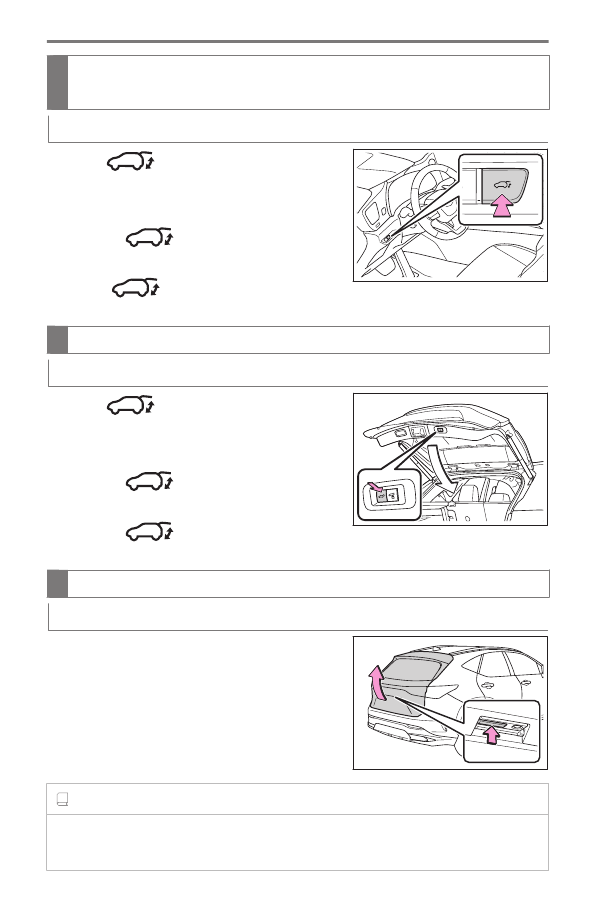
Back door operations using the back door operation switch inside the vehi-
cle

Opening/closing the back door from the inside

Press the 

 for 1 second.

A buzzer sounds and the back door automatical-
ly opens and closes.

Pressing the 

 while the back door is

opening/closing stops the operation.

When the 

 is pressed again during the

halted operation, the back door will perform the reverse operation.

Back door operations using the back door switch

Opening/closing the back door using the back door switch

Press the 

 .

A buzzer sounds and the back door automatical-
ly closes.

Pressing the 

 while the back door is clos-

ing stops the operation.

Pressing the 

 again will reverse the oper-

ation.

Back door operations using the back door opener switch

Open the back door automatically using the back door opener switch

Press the back door opener switch with the back
door unlocked.
A buzzer sounds and the back door automatical-
ly opens.

Pressing the switch while the back door is opening
stops the operation.

INFORMATION

Open the back door with the back door opener switch when the back door is locked

While carrying the electronic key on your person, press the back door opener switch.

1-6. Entering/exiting the vehicle and loading luggage

136

A buzzer sounds and the back door automatically opens.

Back door operations using the back door handle

Closing the back door automatically using the back door handle

WARNING

Observe the following when closing the back door.

When closing the back door, take extra care to prevent your fingers, etc., from being
caught.

When closing the back door, make sure to press it lightly on its outer surface.
If the back door handle is used to fully close the back door, it may result in hands or
arms being caught.

Do not pull on the back door spindle to close the back door, and do not hang on the
back door spindle.
Doing so may cause hands to be caught or the back door spindle to break, causing an
accident.

Pull the back door downward using the back
door handle.
A buzzer sounds and the back door automatical-
ly closes.

Back door operations using the kick sensor

*7

NOTICE

The kick sensor is located behind lower center part of the rear bumper.
Observe the following to ensure that the power back door operates properly:

Keep the lower center part of the rear bumper clean at all times.
If the lower center part of the rear bumper is dirty or covered with snow, the kick
sensor may not operate.
In this situation, clean off the dirt or snow, move the vehicle from the current position
and then check if the kick sensor operates.
If it does not operate, have the vehicle inspected by your Lexus dealer.

*7 : 

Vehicles with Hands Free Power Back Door

1-6. Entering/exiting the vehicle and loading luggage

137

1

Befor

e driving

NOTICE

Do not apply coatings that have a rain clearing (hydrophilic) effect, or other coatings,
to the lower center part of the rear bumper.

Do not park the vehicle near objects that may move and contact the lower center part
of the rear bumper, such as grass or trees.
If the vehicle has been parked for a while near objects that may move and contact the
lower center part of the rear bumper, such as grass or trees, the kick sensor may not
operate.
In this situation, move the vehicle from the current position and then check if the kick
sensor operates.
If it does not operate, have the vehicle inspected by your Lexus dealer.

Do not subject the kick sensor or its surrounding area to a strong impact.
If the kick sensor or its surrounding area has been subjected to a strong impact, the
kick sensor may not operate properly.
If the kick sensor does not operate in the following situations, have the vehicle
inspected by your Lexus dealer.

The kick sensor or its surrounding area has been subjected to a strong impact.

The lower center part of the rear bumper is scratched or damaged.

Do not disassemble the rear bumper.

Do not attach stickers to the rear bumper.

Do not paint the rear bumper.

If a bicycle carrier or similar heavy object is attached to the power back door, disable
the kick sensor.

INFORMATION

Kick sensor operating conditions

When the kick sensor operation setting is turned on

The electronic key is within the operational range

Situations in which the kick sensor does not operate properly

In the following situations, the kick sensor may not operate properly:

When a foot remains under the rear bumper

If the rear bumper is strongly hit with a foot or is touched for a while
If the rear bumper has been touched for a while, wait for a short time before attempt-
ing to operate the back door again.

When operated while a person is too close to the rear bumper

1-6. Entering/exiting the vehicle and loading luggage

138

When an external radio wave source interferes with the communication between the
vehicle and electronic key

When the vehicle is parked near an electrical noise source which affects the sensitivity
of the kick sensor, such as a pay parking spot, gas station, electrically heated road, or
fluorescent light

When the vehicle is near a TV tower, electric power plant, radio station, large display,
airport or other facility that generates strong radio waves or electrical noise

When a large amount of water is applied to the rear bumper, such as when the vehicle
is being washed or in heavy rain

When mud, snow or ice is attached to the rear bumper

When the vehicle has been parked for a while near objects that may move and contact
the rear bumper, such as plants

When an accessory is installed to the rear bumper
If an accessory has been installed, turn the kick sensor operation setting off.

Situations in which the kick sensor may operate unintentionally

When an electronic key is in the operation range, the kick sensor may operate uninten-
tionally, so be careful in the following situations.

When a large amount of water is applied to the rear bumper, such as when the vehicle
is being washed or in heavy rain

When dirt is wiped off the rear bumper

When a small animal or small object, such as a ball, moves under the rear bumper

When an object is moved from under the rear bumper

If someone is swinging their legs while sitting on the rear bumper

If the legs or another part of someone’s body contacts the rear bumper while passing
by the vehicle

When the vehicle is parked near an electrical noise source which affects the sensitivity
of the kick sensor, such as a pay parking spot, gas station, electrically heated road, or
fluorescent light

When the vehicle is near a TV tower, electric power plant, radio station, large display,
airport or other facility that generates strong radio waves or electrical noise

When the vehicle is parked in a place where objects such as plants are near the rear
bumper

If luggage is set near the rear bumper

If accessories or a vehicle cover is installed/removed near the rear bumper

When the vehicle is being towed

To prevent unintentional operation, turn the kick sensor operation setting off.

1-6. Entering/exiting the vehicle and loading luggage

139

1

Befor

e driving

Open/close the back door using the kick sensor(vehicles with Hands Free
Power Back Door)

WARNING

Observe the following precautions when operating the power back door.

Check the safety of the surrounding area to make sure there are no obstacles or
anything that could cause any of your belongings to get caught.

When putting your foot near the lower center part of the rear bumper and moving it
from the rear bumper, be careful not to touch the exhaust pipes until they have cooled
down sufficiently.
If the exhaust pipes are hot, they can cause burns.

Do not operate the Hands Free Power Back Door if there is little space under the rear
bumper.


A

Kick sensor

B

Kick sensor detection area

C

Smart access system with push-button start
operation detection area

1

While carrying an electronic key, stand with-
in the smart access system with push-button
start operation range, approximately 19.7 to
27.6 in. (50 to 70 cm) from the rear bumper.

2

Move your foot to approximately 3.9 in. (10
cm) from the rear bumper.

Operate the back door without contacting the rear
bumper with your foot.

3

When a buzzer sounds, move your foot back. A buzzer will sound and the back
door will automatically fully open or close.

Perform the entire kick operation within 1 second.

The back door will not start operating while a foot is detected under the rear
bumper.

If another electronic key is in the cabin or luggage compartment, it may take slightly
longer than normal for the operation to occur.

If the buzzer sounds twice, perform a kick operation again.

If a kick operation is performed while the power back door is operating, the power
back door will stop.

1-6. Entering/exiting the vehicle and loading luggage

140

INFORMATION

When all of the doors are locked, if a kick operation is detected by the kick sensor, all
of the doors will unlock.

Adjusting the open position of the back door

The open position of the power back door can be adjusted.

1

Stop the back door in the desirable position.

2

Press and hold the

 switch on the lower part of the back door for

approximately 2 seconds.

When the settings are completed, the buzzer sounds 4 times.
When opening the back door the next time, the back door will stop at that position.

Canceling the adjusted open position of the back door

Press and hold the

 switch on the lower part of the back door for

approximately 7 seconds.

After the buzzer sounds 4 times, it sounds twice more.
When the power back door does the opening operation the next time, the door will
open to the initial settings position.

Rear seat seatbacks

Folding the seat backs can be done with ther lever operations.

WARNING

When operating the rear seatback

Observe the following precautions.

Do not operate the rear seat if it is occupied.

After adjusting the seat, make sure that the seat is locked in position. If the seatback is
not securely locked, the red marking will be visible. Make sure that the red marking is
not visible.

1-6. Entering/exiting the vehicle and loading luggage

141

1

Befor

e driving

WARNING

When a rear seatback is folded

Observe the following precautions.

Do not fold down the rear seatbacks while driving.

Stop the vehicle on level ground, apply the parking brake and change the shift position
to P.

Do not allow anyone to sit on a folded rear seatback or in the luggage compartment
while driving.

Do not allow children to enter the luggage compartment.

After adjusting the rear seats

Observe the following precautions.

Make sure that the rear seatback is securely locked in position by lightly pushing it
back and forth.
If the seatback is not securely locked, the red marking will be visible. Make sure that
the red marking is not visible.

Check that the seat belts are not twisted or caught between or behind in the rear
seatback.

NOTICE

The seat belt for the rear center seat, seat belt buckles and armrest must be stowed
before you fold down the rear seatbacks.

Fold the rear seatbacks

1

Stow the rear center seat belt, seat belt buckles and armrest.

2

Lower the head restraint of the rear seat.

1-6. Entering/exiting the vehicle and loading luggage

142

3

Pull the seatback angle adjustment lever and
fold down the seatback.

Return the rear seatbacks

1

Raise the rear seatback until it locks.

2

Check that the plate for each seat belt is on
the front side of the seat.

1-6. Entering/exiting the vehicle and loading luggage

143

1

Befor

e driving

Trailer towing (vehicles with towing package)

Trailer towing

Your vehicle is designed primarily as a passenger-and-load-carrying vehicle. Tow-
ing a trailer can have an adverse impact on handling, performance, braking,
durability, and fuel consumption. For your safety and the safety of others, you must
not overload your vehicle or trailer. You must also ensure that you are using appro-
priate towing equipment, that the towing equipment has been installed correctly
and used properly, and that you employ the requisite driving habits.Vehicle-trailer
stability and braking performance are affected by trailer stability, brake perform-
ance and setting, trailer brakes, the hitch and hitch systems (if equipped).To tow
a trailer safely, use extreme care and drive the vehicle in accordance with your
trailer's characteristics and operating conditions.Lexus warranties do not apply to
damage or malfunction caused by towing a trailer for commercial purposes.
Contact your Lexus dealer for further information about additional requirements
such as a towing kit, etc.

INFORMATION

Matching trailer ball height to trailer coupler height

No matter which class of tow hitch applies, for a more safe trailer hookup, the trailer ball
setup must be the proper height for the coupler on the trailer.


A

Coupler

B

Trailer ball

Before towing

Check that the following conditions are met:

Ensure that your vehicle's tires are properly inflated.

Trailer tires are inflated according to the trailer manufacturer's recommendation.

1-6. Entering/exiting the vehicle and loading luggage

144

All trailer lights work as required by law.

All lights work each time you connect them.

The trailer ball is set at the proper height for the coupler on the trailer.

The trailer is level when it is hitched.
Do not drive if the trailer is not level, and check for improper tongue weight, overload-
ing, worn suspension, or other possible causes.

The trailer cargo is securely loaded.

The rear view mirrors conform to all applicable federal, state/provincial or local
regulations. If they do not, install rear view mirrors appropriate for towing purposes.

Adaptive Variable Suspension System (if equipped)

The suspension can be switched for improvement in driveability.

Break-in schedule

If your vehicle is new or equipped with any new power train components (such as an
engine, transmission, differential or wheel bearing), Lexus recommends that you do not
tow a trailer until the vehicle has been driven for over 500 miles (800 km).
After the vehicle has been driven for over 500 miles (800 km), you can start towing.
However, for the next 500 miles (800 km), drive the vehicle at a speed of less than 50
mph (80 km/h) when towing a trailer, and avoid full throttle acceleration.

Maintenance

Retighten the fixing bolts of the towing ball and bracket after approximately 600 miles
(1000 km) of trailer towing.

If trailer sway occurs

One or more factors (crosswinds, passing vehicles, rough roads, etc.) can adversely
affect handling of your vehicle and trailer, causing instability.

If trailer swaying occurs:

Firmly grip the steering wheel. Steer straight ahead.
Do not try to control trailer swaying by turning the steering wheel.

Begin releasing the accelerator pedal immediately but very gradually to reduce
speed.
Do not increase speed. Do not apply vehicle brakes.

If you make no extreme correction with the steering or brakes, your vehicle and trailer
should stabilize. (if enabled, Trailer Sway Control can also help to stabilize the vehicle and
trailer.)

1-6. Entering/exiting the vehicle and loading luggage

145

1

Befor

e driving

After the trailer swaying has stopped:

Stop in a safe place. Get all occupants out of the vehicle.

Check the tires of the vehicle and the trailer.

Check the load in the trailer.
Make sure the load has not shifted. Make sure the tongue weight is appropriate, if
possible.

Check the load in the vehicle.
Make sure the vehicle is not overloaded after occupants get in.

If you cannot find any problems, the speed at which trailer swaying occurred is beyond
the limit of your particular vehicle-trailer combination. Drive at a lower speed to prevent
instability. Remember that swaying of the towing vehicle-trailer increases as speed
increases.

WARNING

Trailer towing precautions

To tow a trailer safely, use extreme care and drive the vehicle in accordance with the
trailer's characteristics and operating conditions. Failure to do so could cause an accident
resulting in death or serious injury. Vehicle stability and braking performance are affected
by trailer stability, brake setting and performance, and the hitch. Your vehicle will handle
differently when towing a trailer.

To avoid accident or injury

Do not exceed the TWR, unbraked TWR, GCWR, GVWR or GAWR.

Adjust the tongue weight within the appropriate range. Place heavier loads as close to
the trailer axle as possible.

Do not exceed 65 mph (104 km/h), the posted towing speed limit or the speed limit
for your trailer as set forth in your trailer owner's manual, whichever is lowest. Slow
down sufficiently before making a turn, in cross winds, on wet or slippery surface, etc.
to help avoid an accident. If you experience a vehicle-trailer instability from reducing
a certain speed, slow down and make sure you keep your vehicle speed under the
speed of which you experience the instability.

Do not make jerky, abrupt or sharp turns.

Do not apply the brakes suddenly as you may skid, resulting in jackknifing and loss of
vehicle control. This is especially true on wet or slippery surfaces.

Do not exceed the trailer hitch assembly weight, gross vehicle weight, gross axle
weight and trailer tongue weight capacities.

Do not use the following systems when trailer towing.

Dynamic radar cruise control

1-6. Entering/exiting the vehicle and loading luggage

146

WARNING

LTA (Lane Tracing Assist)

LDA (Lane Departure Alert)

PCS (Pre-Collision System)

BSM (Blind Spot Monitor)

Slow down and downshift before descending steep or long downhill grades. Do not
make sudden downshifts while descending steep or long downhill grades.

Vehicle-trailer instability is more likely on steep long downhills. Before descending
steep or long downhill grades, slow down and downshift. Do not make sudden
downshifts when descending steep or long downhill grades. Avoid holding the brake
pedal down too long or applying the brakes too frequently. This could cause the brakes
to overheat and result in reduced braking efficiency.

When towing a trailer

Lexus recommends trailers with brakes that conform to any applicable federal and state/
provincial regulations.

If the gross trailer weight exceeds unbraked TWR, trailer brakes are required. Lexus
recommends trailers with brakes that conform to all applicable federal and state/
provincial regulations.

Never tap into your vehicle's hydraulic system, as this will lower the vehicle's braking
effectiveness.

Never tow a trailer without using a safety chain securely attached to both the trailer
and the vehicle. If damage occurs to the coupling unit or hitch ball, there is danger of
the trailer wandering into another lane.

Towing related terms

GCWR (Gross Combination Weight Rating)

The maximum allowable gross combination
weight. The gross combination weight is the sum
of the total vehicle weight (including the occu-
pants, cargo and any optional equipment instal-
led on the vehicle) and the weight of the trailer
being towed (including the cargo in the trailer).

1-6. Entering/exiting the vehicle and loading luggage

147

1

Befor

e driving

GVWR (Gross Vehicle Weight Rating)

The maximum allowable gross vehicle weight.
The gross vehicle weight is the total weight of
the vehicle. When towing a trailer, it is the sum
of the vehicle weight (including the occupants,
cargo and any optional equipment installed on
the vehicle) and the tongue weight.

GAWR (Gross Axle Weight Rating)

The maximum allowable gross axle weight. The gross axle weight is the load placed
on each axle (front and rear).


A

Front GAWR

B

Rear GAWR

TWR (Trailer Weight Rating)

The maximum allowable gross trailer weight. The gross trailer weight is the sum of
the trailer weight and the weight of the cargo in the trailer.
TWR is calculated assuming base vehicle with one driver, one front passenger,
towing package (if available), hitch and hitch systems (if required).

Additional optional equipment, passengers and cargo in the vehicle will reduce the trailer
weight rating so as not to exceed GCWR, GVWR and GAWR.


A

With brakes

Unbraked TWR (Unbraked Trailer Weight Rating)

The trailer weight rating for towing a trailer without a trailer service brake system.

1-6. Entering/exiting the vehicle and loading luggage

148


A

Without brakes

Tongue Weight

The load placed on the trailer hitch ball.

Weight limits

The gross trailer weight must never exceed 2000 lb. (910 kg).

The gross combination weight must never ex-
ceed 6600 lb. (2995 kg)

The gross vehicle weight must never exceed the GVWR indicated on the
Certification Label.

The gross axle weight on each axle must never exceed the GAWR indicated on
the Certification Label.

If the gross trailer weight is over the unbraked TWR, trailer service brakes are
required.

GCWR, TWR and Unbraked TWR

Confirm that the gross trailer weight, gross combination weight, gross vehicle
weight, gross axle weight and tongue weight are all within the limits.

GCWR

*1

6600 lb. (2995 kg)

1-6. Entering/exiting the vehicle and loading luggage

149

1

Befor

e driving

TWR

*1

2000 lb. (910 kg)

Unbraked TWR

*1

1000 lb. (450 kg)

Trailer Tongue Weight

A recommended tongue weight varies in accordance with the types of trailers
or towing as described below.

To ensure the recommended values shown below, the trailer must be loaded by
referring to the following instructions.

Tongue Weight
The gross trailer weight should be distributed so that the tongue weight is 9% to 11%.
(Tongue weight /Gross trailer weight x 100 = 9% to 11%)
The gross trailer weight, gross axle weight and tongue weight can be measured
with platform scales found at a highway weighing station, building supply company,
trucking company, junk yard, etc.


A

Gross trailer weight

B

Tongue weight

Hitch

Trailer hitch assemblies have different weight capacities. Lexus recommends the
use of Lexus hitch/bracket for your vehicle. For details, contact your Lexus dealer.

If you wish to install a trailer hitch, contact your Lexus dealer.

Use only a hitch that conforms to the gross trailer weight requirement of your
vehicle.

Follow the directions supplied by the hitch manufacturer.

Lubricate the hitch ball with a light coating of grease.

Remove the hitch ball whenever you are not towing a trailer. Remove the trailer
hitch if you do not need it. After removing the hitch, seal any mounting hole in
the vehicle body to prevent entry of any substances into the vehicle.

*1 : 

These models meet the tow-vehicle trailering requirement of SAE International per

SAE J2807.

1-6. Entering/exiting the vehicle and loading luggage

150

WARNING

Trailer hitch assemblies have different weight capacities established by the hitch manufac-
turer. Even though the vehicle may be physically capable of towing a higher weight, the
operator must determine the maximum weight rating of the particular hitch assembly
and never exceed the maximum weight rating specified for the trailer-hitch. Exceeding
the maximum weight rating set by the trailer-hitch manufacturer can cause an accident
resulting in death or serious personal injuries.

NOTICE

When installing a trailer hitch, use only the position recommended by your Lexus dealer.
Do not install the trailer hitch on the bumper; this may cause body damage.

Positions for towing hitch receiver and hitch ball


A

Weight carrying ball position: 43.0 in.
(1093.0 mm)

B

Hitch receiver pin hole position: 34.6 in.
(880.0 mm)

Connecting trailer lights

Please consult your dealer when installing trailer lights, as incorrect installation may
cause damage to the vehicle's lights. Please take care to comply with your state's
laws when installing trailer lights.

NOTICE

Do not directly splice trailer lights. Directly splicing trailer lights may damage your
vehicle's electrical system and cause a malfunction.

Trailer towing tips

Your vehicle will handle differently when towing a trailer. Help to avoid an accident,
death or serious injury, keep the following in mind when towing:

Speed limits for towing a trailer vary by state or province. Do not exceed the
posted towing speed limit.

Lexus recommends that the vehicle-trailer speed limit is 65 mph (104 km/h)
on a flat, straight, dry road. Do not exceed this limit, the posted towing speed
limit or the speed limit for your trailer as set forth in your trailer owner's manual,

1-6. Entering/exiting the vehicle and loading luggage

151

1

Befor

e driving


Content      ..     6      7      8      9     ..