Lexus LX600 (2022 year). Manual in english - page 32
 

  Index      Manuals     Lexus LX600 (2022 year). Manual in english


Search            copyright infringement  


Content      ..     30      31      32      33     ..


Lexus LX600 (2022 year). Manual in english - page 32


526

7-2. Steps to take in an emergency

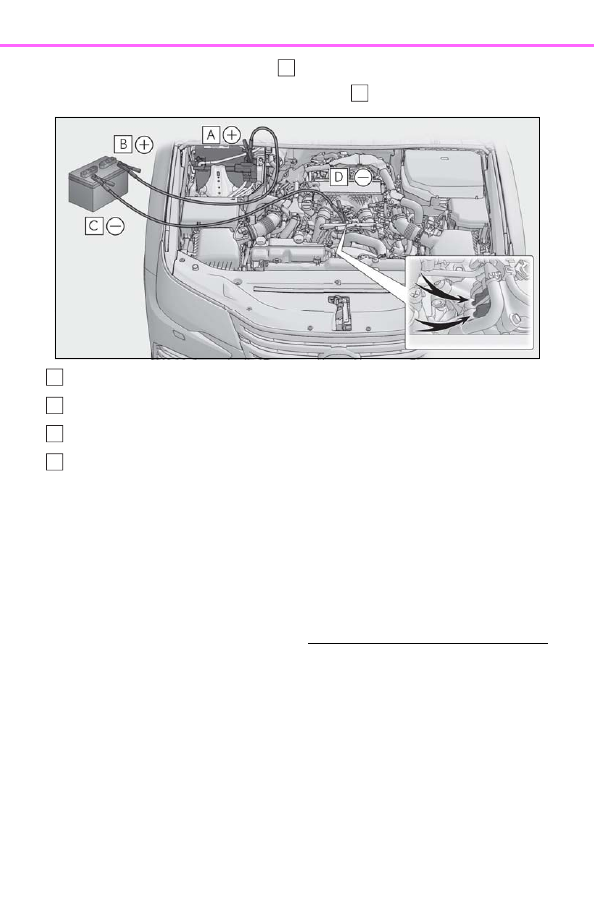
connect a negative cable clamp to 

 on the second vehicle and connect the 

clamp at the other end of the negative cable to 

.

Positive (+) battery terminal (your vehicle)

Positive (+) battery terminal (second vehicle)

Negative (-) battery terminal (second vehicle)

Solid, stationary, unpainted metallic point away from the battery and any mov-
ing parts as shown in the illustration

6

Start the engine of the second vehi-
cle. Increase the engine speed 
slightly and maintain at that level for 
approximately 5 minutes to 
recharge the battery of your vehi-
cle.

7

Open and close any of the doors of 
your vehicle with the engine switch 
off.

8

Maintain the engine speed of the 
second vehicle and start the engine 
of your vehicle by turning the 
engine switch to ON.

9

Once the vehicle’s engine has 
started, remove the jumper cables 
in the exact reverse order from 
which they were connected.

To install the engine cover, conduct the 

removal procedure in reverse. After 

installing, check that the fixed pins are 

inserted securely.

Once the engine starts, have the vehi-
cle inspected at your Lexus dealer as 
soon as possible.

Starting the engine when the battery is 

discharged

The engine cannot be started by push-start-

ing.

To prevent battery discharge

Turn off the headlights, the air condition-

ing system, the audio system, etc. while 

the engine is off.

Turn off any unnecessary electrical com-

ponents when the vehicle is running at a 

low speed for an extended period, such 

as in heavy traffic.

C

D

A
B
C
D

527

7-2. Steps to take in an emergency

7

W

hen t
ro

ub

le

 ar

ises

When the battery is removed or dis-

charged

Information stored in the ECU is cleared. 

When the battery is depleted, have the 

vehicle inspected at your Lexus dealer.

Some systems may require initialization. 

(

P.567)

When removing the battery terminals

When the battery terminals are removed, 

the information stored in the ECU is 

cleared. Before removing the battery termi-

nals, contact your Lexus dealer.

Charging the battery

The electricity stored in the battery will dis-

charge gradually even when the vehicle is 

not in use, due to natural discharge and the 

draining effects of certain electrical appli-

ances. If the vehicle is left for a long time, 

the battery may discharge, and the engine 

may be unable to start. (The battery 

recharges automatically during driving.)

Replacing the battery

Use a genuine battery specifically 

designed for use with the Stop & Start 

system or a battery with equivalent speci-

fications to a genuine battery. If an unsup-

ported battery is used, Stop & Start 

system functions may be restricted to 

protect the battery. Also, battery perfor-

mance may decrease and the engine may 

not be able to restart. Contact your 

Lexus dealer for details.

Use a battery that conforms to European 

regulations.

Use a battery that the case size is same as 

the previous one (LN4), 20 hours rate 

capacity (20HR) is equivalent (75Ah) or 

greater, and performance rating (CCA) 

is equivalent (776A) or greater.

• If the sizes differ, the battery cannot be 

properly secured.

• If the 20 hour rate capacity is low, even if 

the time period where the vehicle is not 

used is a short time, the battery may dis-

charge and engine may not be able to 

start.

For details, consult your Lexus dealer.

When recharging or replacing the bat-

tery

The Stop & Start system may not automati-

cally stop the engine for up to an hour.

WARNING

When removing the battery termi-

nals

Always remove the negative (-) terminal 

first. If the positive (+) terminal contacts 

any metal in the surrounding area when 

the positive (+) terminal is removed, a 

spark may occur, leading to a fire in addi-

tion to electrical shocks and death or 

serious injury.

Avoiding battery fires or explosions

Observe the following precautions to 

prevent accidentally igniting the flamma-

ble gas that may be emitted from the bat-

tery:

Make sure each jumper cable is con-

nected to the correct terminal and that 

it is not unintentionally in contact with 

any other than the intended terminal.

Do not allow the other end of the 

jumper cable connected to the “+” ter-

minal to come into contact with any 

other parts or metal surfaces in the 

area, such as brackets or unpainted 

metal.

Do not allow the + and - clamps of the 

jumper cables to come into contact 

with each other.

Do not smoke, use matches, cigarette 

lighters or allow open flame near the 

battery.

528

7-2. Steps to take in an emergency

1

Stop the vehicle in a safe place and 
turn off the air conditioning system, 
and then stop the engine.

2

If you see steam:
Carefully lift the hood after the 
steam subsides.
If you do not see steam:
Carefully lift the hood.

WARNING

Battery precautions

The battery contains poisonous and cor-

rosive acidic electrolyte, while related 

parts contain lead and lead compounds. 

Observe the following precautions when 

handling the battery:

When working with the battery, always 

wear safety glasses and take care not 

to allow any battery fluids (acid) to 

come into contact with skin, clothing 

or the vehicle body.

Do not lean over the battery.

In the event that battery fluid comes 

into contact with the skin or eyes, 

immediately wash the affected area 

with water and seek medical attention.

Place a wet sponge or cloth over the 

affected area until medical attention 

can be received.

Always wash your hands after han-

dling the battery support, terminals, 

and other battery-related parts.

Do not allow children near the battery.

When replacing the battery

For information regarding battery 

replacement, contact your Lexus dealer.

NOTICE

When handling jumper cables

When connecting the jumper cables, 

ensure that they do not become entan-

gled in the cooling fan or engine drive 

belt.

If your vehicle overheats

The following may indicate that 
your vehicle is overheating.

The needle of the engine coolant 
temperature gauge (

P.78) 

enters the red zone or a loss of 
engine power is experienced. 
(For example, the vehicle speed 
does not increase.)

“Engine Coolant Temp High Stop 
in a Safe Place See Owner’s 
Manual” is shown on the multi-
information display.

Steam comes out from under the 
hood.

Correction procedures

529

7-2. Steps to take in an emergency

7

W

hen tro

ub

le

 ar

ises

3

After the engine has cooled down 
sufficiently, inspect the hoses and 
radiator core (radiator) for any 
leaks.

Engine radiator

Cooling fan

Intercooler radiators

If a large amount of coolant leaks, immedi-

ately contact your Lexus dealer.

4

The coolant level is satisfactory if it 
is between the “F” and “L” lines on 
the reservoir.

Engine coolant

Reservoir

“F” line

“L” line

Intercooler coolant

Reservoir

“F” line

“L” line

5

Add coolant if necessary.

Water can be used in an emergency if 

coolant is unavailable.

Engine coolant

Intercooler coolant

6

Start the engine to check that the 
radiator cooling fan operates and 

A
B
C

A
B
C

A
B
C

530

7-2. Steps to take in an emergency

to check for coolant leaks from the 
radiators or hoses.

7

If the fans are not operating:
Stop the engine immediately and 
contact your Lexus dealer.
If the fans are operating:
Have the vehicle inspected at the 
nearest Lexus dealer.

8

Check if “Engine Coolant Temp 
High Stop in a Safe Place See 
Owner’s Manual” is shown on the 
multi-information display.

If the message does not disappear: Stop 

the engine and contact your Lexus dealer.
If the message is not displayed: Have the 

vehicle inspected at the nearest Lexus 

dealer.

WARNING

When inspecting under the hood of 

your vehicle

Observe the following precautions.
Failure to do so may result in serious 

injury such as burns.

If steam is seen coming from under the 

hood, do not open the hood until the 

steam has subsided. The engine com-

partment may be very hot.

Keep hands and clothing (especially a 

tie, a scarf or a muffler) away from the 

fans and belts. Failure to do so may 

cause the hands or clothing to be 

caught, resulting in serious injury.

Do not loosen the engine coolant res-

ervoir cap while the engine and engine 

radiator are hot. High temperature 

steam or coolant could spray out.

NOTICE

When adding engine coolant

Add coolant slowly after the engine has 

cooled down sufficiently. Adding cool 

coolant to a hot engine too quickly can 

cause damage to the engine.

To prevent damage to the cooling 

system

Observe the following precautions:

Avoid contaminating the coolant with 

foreign matter (such as sand or dust 

etc.).

Do not use any coolant additive.

531

7-2. Steps to take in an emergency

7

W

hen t
ro

ub

le

 ar

ises

1

Stop the engine. Set the parking 
brake and shift the shift lever to P.

2

Remove the mud, snow or sand 
from around the rear wheels.

3

Place wood, stones or some other 
material under the rear wheels to 
help provide traction.

4

Restart the engine.

5

Shift the shift lever to D or R and 
release the parking brake. Then, 
while exercising caution, depress 
the accelerator pedal.

When it is difficult to free the vehicle

Try the followings.

Turn off the Active TRAC (

P.366)

Switching the four-wheel drive control 

switch (

P.354)

Using the center differential lock 

(

P.354)

Using Crawl Control (with Turn Assist 

function) (

P.356)

Using Multi-terrain Select (

P.360)

If the vehicle becomes stuck

Carry out the following procedures 
if the tires spin or the vehicle 
becomes stuck in mud, dirt or snow:

Recovering procedure

WARNING

When attempting to free a stuck vehi-

cle

If you choose to push the vehicle back 

and forth to free it, make sure the sur-

rounding area is clear to avoid striking 

other vehicles, objects or people. The 

vehicle may also lunge forward or lunge 

back suddenly as it becomes free. Use 

extreme caution.

When shifting the shift lever

Be careful not to shift the shift lever with 

the accelerator pedal depressed.
This may lead to unexpected rapid accel-

eration of the vehicle that may cause an 

accident resulting in death or serious 

injury.

NOTICE

To avoid damaging the transmission 

and other components

Avoid spinning the wheels and 

depressing the accelerator pedal 

more than necessary.

If the vehicle remains stuck even after 

these procedures are performed, the 

vehicle may require towing to be 

freed.

When a warning message for the 

automatic transmission fluid tempera-

ture is displayed while attempting to 

free a stuck vehicle, immediately 

remove your foot from the accelerator 

pedal and wait until the warning mes-

sage disappears. Otherwise, the trans-

mission may become damaged. 

(

P.506)

533

8

8

Veh
icl

e spe

cific

ations

Vehicle specifications

8-1. Specifications

Maintenance data (fuel, oil level, 

etc.) ..............................................

534

Fuel information.........................

542

Tire information..........................

544

8-2. Customization

Customizable features............

552

8-3. Initialization

Items to initialize ........................

567

534

8-1. Specifications

8-1.Specifications

*1

: Vehicles with 18-inch tires or 20-inch tires

*2

: Vehicles with 22-inch tires

*3

: Vehicles with AHC

*4

: Vehicles without AHC

Maintenance data (fuel, oil level, etc.)

Dimensions and weights

Overall length

Vehicles without sports 
package

200.6 in. (5095 mm)

Vehicles with sports pack-
age

200.2 in. (5085 mm)

Overall width

78.3 in. (1990 mm)

Overall height

Vehicles without roof 
antenna

73.0 in. (1855 mm)

*1, 3

73.4 in. (1865 mm)

*2, 3

74.2 in. (1885 mm)

*1, 4

74.6 in. (1895 mm)

*2, 4

Vehicles with roof antenna

74.2 in. (1885 mm)

*1, 3

74.6 in. (1895 mm)

*2, 3

75.4 in. (1915 mm)

*1, 4

75.8 in. (1925 mm)

*2, 4

Wheelbase

112.2 in. (2850 mm)

Tread

Front

66.0 in. (1675 mm)

Rear

66.0 in. (1675 mm)

Vehicle capacity weight (Occupants + luggage)

1285 lb. (580 kg)

TWR (trailer weight + 
cargo weight)

With brake

8000 lb. (3630 kg)

Without brake

1650 lb. (750 kg)

535

8-1. Specifications

8

Veh
icl

e spe

cific

ations

Vehicle identification number

The vehicle identification number 
(VIN) is the legal identifier for your 
vehicle. This is the primary identifica-
tion number for your Lexus. It is used in 
registering the ownership of your vehi-
cle.
This number is stamped on the front 
right frame.

On some models, this number is also 
on the top left of the instrument panel.

This number is also on the Certification 
Label.

Engine number

The engine number is stamped on the 
engine block as shown.

Seating capacity

Seating capacity

4-passenger models

4 (Front 2, Rear 2)

5-passenger models

5 (Front 2, Rear 3)

7-passenger models

7 (Front 2, Rear 5)

Vehicle identification

536

8-1. Specifications

Oil capacity (Drain and refill [Ref-
erence

*

])

*

: The engine oil capacity is a reference 

quantity to be used when changing the 
engine oil. Warm up and turn off the 
engine, wait more than 5 minutes, and 
check the oil level on the dipstick.

Engine oil selection

“Toyota Genuine Motor Oil” is used in 
your Lexus vehicle. Use Lexus 
approved “Toyota Genuine Motor 
Oil” or equivalent to satisfy the follow-
ing grade and viscosity.

Oil grade:
ILSAC GF-6A multigrade engine oil
Recommended viscosity:
SAE 0W-20
SAE 0W-20 is the best choice for 
good fuel economy and good starting 
in cold weather.
If SAE 0W-20 is not available, SAE 
5W-20 oil may be used. However, it 
must be replaced with SAE 0W-20 at 
the next oil change.

Engine

Model

V35A-FTS

Type

6-cylinder V type, 4-cycle, gasoline 
(with turbocharger)

Bore and stroke

3.37 

 3.94 in. (85.5 

 100.0 mm)

Displacement

210.2 cu.in. (3445 cm

3

)

Valve clearance

Automatic adjustment

Drive belt tension

Automatic adjustment

Fuel

Fuel type

Unleaded gasoline only

Octane rating

91 (Research Octane Number 96) or higher

Fuel tank capacity (Reference)

21.1 gal. (80 L, 17.6 Imp. gal.)

Lubrication system

With filter

7.7 qt. (7.3 L, 6.4 
Imp. qt.)

Without filter

7.4 qt. (7.0 L, 6.2 
Imp. qt.)

537

8-1. Specifications

8

Veh
icl

e spe

cific

ations

Outside temperature

Oil viscosity (0W-20 is explained here 
as an example):
• The 0W in 0W-20 indicates the 

characteristic of the oil which allows 
cold startability. Oils with a lower 
value before the W allow for easier 
starting of the engine in cold 
weather.

• The 20 in 0W-20 indicates the vis-

cosity characteristic of the oil when 
the oil is at high temperature. An oil 

with a higher viscosity (one with a 
higher value) may be better suited if 
the vehicle is operated at high 
speeds, or under extreme load con-
ditions.

How to read oil container label:
The International Lubricant Specifica-
tion Advisory Committee (ILSAC) 
Certification Mark is added to some oil 
containers to help you select the oil 
you should use.

*

: The coolant capacity is the quantity of reference. If replacement is necessary, contact 

your Lexus dealer.

A

Cooling system

Capacity

*

Intercooler coolant

4.0 qt. (3.8 L, 3.3 Imp. qt.)

Engine coolant

15.5 qt. (14.7 L, 12.9 Imp. qt.)

Coolant type

Use either of the following:
• “Toyota Super Long Life Coolant”
• Similar high-quality ethylene glycol-based non-

silicate, non-amine, non-nitrite, and non-borate 
coolant with long-life hybrid organic acid technol-
ogy

Do not use plain water alone.

538

8-1. Specifications

Spark plug

Battery

Charging rates

Your Lexus vehicle is filled with “Toyota Genuine Differential Gear Oil” at the fac-
tory.

Ignition system

Make

DENSO EC22HPR-D7

Gap

0.028 in. (0.7 mm)

NOTICE

Iridium-tipped spark plugs

Use only iridium-tipped spark plugs. Do not adjust gap when tuning engine.

Electrical system

Open voltage at 68°F (20°C):

12.3 V or higher
(Voltage is checked 20 minutes after the engine 
and all lights are turned off.)
If the voltage is lower than the standard value, 
charge the battery.

5 A max.

Differential

Oil capacity

Front

1.23 qt. (1.16 L, 1.02 Imp. qt.)

Rear

Without rear Limited-slip differential:
5.76 qt. (5.45 L, 4.80 Imp. qt.)
With rear Limited-slip differential:
5.55 qt. (5.25 L, 4.62 Imp. qt.)

Oil type and vis-
cosity

Without Lim-
ited-slip differ-
ential

Toyota Genuine Differential Gear Oil LT 75W-85 
GL-5 or equivalent

With Limited-
slip differential

Toyota Genuine Differential Gear Oil LX 75W-85 
GL-5 or equivalent

539

8-1. Specifications

8

V

eh

icle

 sp

ec

ific

atio

ns

Use Lexus approved “Toyota Genuine Differential Gear Oil” or an equivalent of 
matching quality to satisfy the above specification. Please contact your Lexus 
dealer for further details.

The fluid capacity is the quantity of reference. If replacement is necessary, contact 
your Lexus dealer.

*

: Your Lexus vehicle is filled with “Toyota Genuine Transfer Gear oil LF” at the factory. 

Use Lexus approved “Toyota Genuine Transfer Gear oil LF” or an equivalent of match-
ing quality to satisfy the above specification. Please contact your Lexus dealer for further 
details.

Automatic transmission

Fluid capacity (Reference)

12.13 qt. (11.48 L, 10.10 Imp. qt.)

Fluid type

Toyota Genuine ATF WS

NOTICE

Automatic transmission fluid type

Using transmission fluid other than the above type may cause abnormal noise or vibra-

tion, or damage the transmission of your vehicle.

Transfer

Oil capacity

1.89 qt. (1.79 L, 1.58 Imp. qt.)

Oil type

*

Toyota Genuine Transfer Gear oil LF or equivalent

Recommended oil viscosity

SAE 75W

Suspension (vehicles with AHC)

Fluid type

Suspension fluid AHC

Brakes

Pedal clearance

*

5.08 in. (129 mm)

Pedal free play

0.04 

 0.24 in. (1 

 6 mm)

540

8-1. Specifications

*

: Minimum pedal clearance when depressed with a force of 67 lbf (300 N, 31 kgf) while 

the engine is running

Front

Rear

22-inch tires

Brake pad wear limit

0.04 in. (1 mm)

Fluid type

SAE J1703 or FMVSS No. 116 DOT 3
SAE J1704 or FMVSS No. 116 DOT 4

Chassis lubrication (propeller shafts)

Spider

Lithium base chassis grease, NLGI No.2

Slide yoke

Molybdenum-disulfide lithium base chassis grease, NLGI 
No.2 or lithium base chassis grease, NLGI No.2

Spider

Lithium base chassis grease, NLGI No.2

Steering

Free play

Less than 1.18 in. (30 mm)

Tires and wheels

Tire size

265/50R22 112V

Tire inflation pressure (Recom-
mended cold tire inflation pressure)

Normal driving
Front: 
33 psi (230 kPa, 2.3 kgf/cm

2

 or bar)

Rear: 
33 psi (230 kPa, 2.3 kgf/cm

2

 or bar)

Spare: 
33 psi (230 kPa, 2.3 kgf/cm

2

 or bar)

Trailer towing

Add 6 psi (40 kPa, 0.4 kgf/cm

2

 or bar) to the rear 

tires.

541

8-1. Specifications

8

Veh
icl

e spe

cific

ations

20-inch tires

18-inch tires

Wheel size

22 

 8 J

Wheel nut torque

97 ft•lbf (131 N•m, 13.4 kgf•m)

Tire size

265/55R20 113V

Tire inflation pressure (Recom-
mended cold tire inflation pressure)

Normal driving
Front: 
33 psi (230 kPa, 2.3 kgf/cm

2

 or bar)

Rear: 
33 psi (230 kPa, 2.3 kgf/cm

2

 or bar)

Spare: 
33 psi (230 kPa, 2.3 kgf/cm

2

 or bar)

Trailer towing

Add 5 psi (30 kPa, 0.3 kgf/cm

2

 or bar) to the rear 

tires.

Wheel size

20 

 8 J

Wheel nut torque

97 ft•lbf (131 N•m, 13.4 kgf•m)

Tire size

265/65R18 114V

Tire inflation pressure (Recom-
mended cold tire inflation pressure)

Front: 
33 psi (230 kPa, 2.3 kgf/cm

2

 or bar)

Rear: 
33 psi (230 kPa, 2.3 kgf/cm

2

 or bar)

Spare: 
33 psi (230 kPa, 2.3 kgf/cm

2

 or bar)

Wheel size

18 

 7 1/2J

Wheel nut torque

97 ft•lbf (131 N•m, 13.4 kgf•m)

542

8-1. Specifications

Gasoline quality

In very few cases, driveability problems may 

be caused by the brand of gasoline you are 

using. If driveability problems persist, try 

changing the brand of gasoline. If this does 

not correct the problem, consult your Lexus 

dealer.

Recommendation of the use of gasoline 

containing detergent additives

Lexus recommends the use of gasoline 

that contains detergent additives to avoid 

the build-up of engine deposits.

All gasoline sold in the U.S.A. contains 

minimum detergent additives to clean 

and/or keep clean intake systems, per 

EPA’s lowest additives concentration 

program.

Lexus strongly recommends the use of 

Top Tier Detergent Gasoline. For more 

information on Top Tier Detergent Gas-

oline and a list of marketers, please go to 

the official website www.toptiergas.com.

Recommendation of the use of low 

emissions gasoline

Gasolines containing oxygenates such as 

ethers and ethanol, as well as reformulated 

gasolines, are available in some cities. 

These fuels are typically acceptable for use, 

providing they meet other fuel require-

ments.
Lexus recommends these fuels, since the 

formulations allow for reduced vehicle 

emissions.

Non-recommendation of the use of 

blended gasoline

Use only gasoline containing up to 15% 

ethanol.

DO NOT use any flex-fuel or gasoline 

that could contain more than 15% etha-

nol, including from any pump labeled 
E30 (30% ethanol 

), E50 (50% eth-

anol 

), E85 (85% ethanol 

(which are only some examples of fuel 

containing more than 15% ethanol).

If you use gasohol in your vehicle, be sure 

that it has an octane rating no lower than 

91.

Lexus does not recommend the use of 

gasoline containing methanol.

Non-recommendation of the use of gas-

oline containing MMT

Some gasoline contains an octane enhanc-

ing additive called MMT (Methylcyclopen-

tadienyl Manganese Tricarbonyl).
Lexus does not recommend the use of gas-

oline that contains MMT. If fuel containing 

MMT is used, your emission control system 

may be adversely affected.
The malfunction indicator lamp on the 

instrument cluster may come on. If this hap-

pens, contact your Lexus dealer for service.

If your engine knocks

Consult your Lexus dealer.

You may occasionally notice light knock-

ing for a short time while accelerating or 

driving uphill. This is normal and there is 

Fuel information

You must only use unleaded gaso-
line.
Select premium unleaded gasoline 
with an octane rating of 91 
(Research Octane Number 96) or 
higher required for optimum engine 
performance and fuel economy. If 
the octane rating is less than 91, 
damage to the engine may occur 
and may void the vehicle warranty.
At minimum, the gasoline you use 
should meet the specifications of 
ASTM D4814 in the U.S.A..

A

B

C


Content      ..     30      31      32      33     ..