Lexus LX600 (2022 year). Manual in english - page 11
 

  Index      Manuals     Lexus LX600 (2022 year). Manual in english


Search            copyright infringement  


Content      ..     9      10      11      12     ..


Lexus LX600 (2022 year). Manual in english - page 11


187

4-1. Before driving

4

D

riv

ing

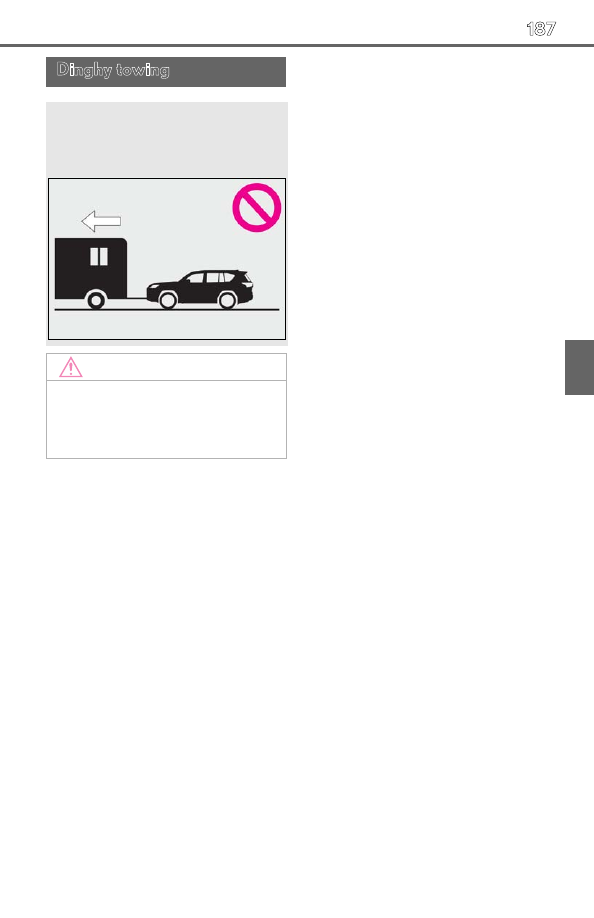
Dinghy towing

Your vehicle is not designed to be 
dinghy towed (with 4 wheels on the 
ground) behind a motor home.

NOTICE

To avoid serious damage to your vehi-

cle

Do not tow your vehicle with the four 

wheels on the ground.

188

4-2. Driving procedures

4-2.Driving procedures

1

Pull the parking brake switch to 
check that the parking brake is set. 
(

P.197)

The parking brake indicator will come on.

2

Check that the shift lever is set in P.

3

Firmly depress the brake pedal.

 and a message will be displayed on 

the multi-information display.
If it is not displayed, the engine cannot be 

started.

4

Press the engine switch quickly but 
fully.

When operating the engine switch, one 

short, firm press is enough. It is not neces-

sary to press and hold the switch.
The engine will crank until it starts or for up 

to 30 seconds, whichever is less.
Continue depressing the brake pedal until 

the engine is completely started.
The engine can be started from any engine 

switch mode.

Engine switch illumination

According to the situation, the engine 

switch illumination operates as follows.

When driver’s door or front passenger’s 

door is opened, the engine switch illumi-

nation illuminates.

When depressing the brake pedal with 

carrying the electronic key on your per-

son, the engine switch illumination illumi-

nates brighter.

When the engine switch is in ACC or 

ON, the engine switch illumination illumi-

nates.

When the engine switch mode is 

changed from ACC or ON to OFF, the 

engine switch illumination illuminates for 

a certain amount of time. Afterwards, the 

engine switch illumination turns off.

If the engine does not start

The engine immobilizer system may not 

have been deactivated. (

P.66)

Contact your Lexus dealer.

If a message related to start-up is shown 

on the multi-information display, read the 

message and follow the instructions.

If the door is unlocked with the mechani-

cal key, the engine cannot be started 

using the smart access system with push-

button start. Refer to P.524 to start the 

engine. However, if the electronic key is 

carried inside the vehicle and the doors 

are locked (

P.100), the engine can be 

started.

If the battery is discharged

The engine cannot be started using the 

smart access system with push-button start. 

Refer to P.525 to restart the engine.

Electronic key battery depletion

P.94

Conditions affecting operation

P.118

Note for the entry function

P.119

Steering lock function

After turning the engine switch to OFF 

Engine (ignition) switch

Performing the following opera-
tions when carrying the electronic 
key on your person starts the 
engine or changes engine switch 
modes.

Starting the engine

189

4-2. Driving procedures

4

D

riv

ing

and opening and closing the doors, the 

steering wheel will be locked due to the 

steering lock function. Operating the 

engine switch again automatically can-

cels the steering lock.

When the steering lock cannot be 

released, “Push Engine Switch While 

Turning Steering Wheel in Either Direc-

tion” will be displayed on the multi-infor-

mation display.

Check that the shift lever is set in P.

Press the engine switch shortly and firmly 

while turning the steering wheel left and 

right.

To prevent the steering lock motor from 

overheating, operation of the motor may 

be suspended if the engine is turned on 

and off repeatedly in a short period of 

time. In this case, refrain from running the 

engine. After about 10 seconds, the 

steering lock motor will resume function-

ing.

If there is a malfunction in the smart 

access system with push-button start

If “Access System with Elec. Key Malfunc-

tion See Owner’s Manual” is displayed on 

the multi-information display, the system 

may be malfunctioning. Have the vehicle 

inspected by your Lexus dealer immedi-

ately.

Electronic key battery

P.479

Operation of the engine switch

If the switch is not pressed shortly and 

firmly, the engine switch mode may not 

change or the engine may not start.

If attempting to restart the engine imme-

diately after turning the engine switch to 

OFF, the engine may not start in some 

cases. After turning the engine switch to 

OFF, please wait a few seconds before 

restarting the engine.

Customization

If the smart access system with push-button 

start has been deactivated in a customized 

setting, refer to P.524.

1

Stop the vehicle completely.

2

If the parking brake is in manual 
mode, set the parking brake. 
(

P.197)

WARNING

When starting the engine

Always start the engine while sitting in 

the driver’s seat. Do not depress the 

accelerator pedal while starting the 

engine under any circumstances.

Doing so may cause an accident result-

ing in death or serious injury.

Caution while driving

If engine failure occurs while the vehicle 

is moving, do not lock or open the doors 

until the vehicle reaches a safe and com-

plete stop. Activation of the steering lock 

in this circumstance may lead to an acci-

dent, resulting in death or serious injury.

NOTICE

When starting the engine

Do not race a cold engine.

If the engine becomes difficult to start 

or stalls frequently, have your vehicle 

checked by your Lexus dealer imme-

diately.

Symptoms indicating a malfunction 

with the engine switch

If the engine switch seems to be operat-

ing somewhat differently than usual, such 

as the switch sticking slightly, there may 

be a malfunction. Contact your Lexus 

dealer immediately.

Stopping the engine

190

4-2. Driving procedures

Check the parking brake indicator is illu-

minated.

3

Shift the shift lever to P. (

P.193)

4

Press the engine switch shortly and 
firmly.

The engine will stop, and the meter display 

will be extinguished.
Release the shift lever when pressing the 

engine switch.

5

Release the brake pedal and check 
that “ACCESSORY” or “IGNI-
TION ON” is not shown on the 
multi-information display.

Automatic engine shut off feature

The vehicle is equipped with a feature 

that automatically shuts off the engine 

when the shift lever is in P with the engine 

running for an extended period.

The engine will automatically shut off 

after approximately 1 hour if it has been 

left running while the shift lever is in P.

The timer for the automatic engine shut 

off feature will reset if the brake pedal is 

depressed or if the shift lever is in a posi-

tion other than P.

After the vehicle is parked, if the door is 

locked with the door lock switch 

(

P.100) from the inside or the mechan-

ical key from the outside, the automatic 

engine shut off feature will be disabled. 

The timer for the automatic engine shut 

off feature will be re-enabled if the 

driver’s door is opened.

WARNING

Stopping the engine in an emergency

If you want to stop the engine in an 

emergency while driving the vehicle, 

press and hold the engine switch for 

more than 2 seconds, or press it briefly 

3 times or more in succession. 

(

P.488)

However, do not touch the engine 

switch while driving except in an emer-

gency. Turning the engine off while 

driving will not cause loss of steering 

or braking control. However, power 

assist for these systems may be lost 

making it difficult to steer or brake 

before stopping the vehicle depending 

on the remaining charge in the battery 

or usage conditions. In this situation, 

you should pull over and stop the vehi-

cle as soon as it is safe to do so.

If the engine switch is operated while 

the vehicle is running, a warning mes-

sage will be shown on the multi-infor-

mation display and a buzzer sounds.

When restarting the engine after an 

emergency shutdown, shift the shift 

lever to N and press the engine switch 

shortly and firmly.

When parking

Exhaust gases include harmful carbon 

monoxide (CO), which is colorless and 

odorless. Observe the following precau-

tions.
Failure to do so may cause exhaust gases 

to enter the vehicle and may lead to an 

accident caused by light-headedness, or 

may lead to death or a serious health 

hazard.

If the vehicle is in a poorly ventilated 

area or a closed area, such as a 

garage, stop the engine.

Do not leave the vehicle with the 

engine running for a long time. If such 

a situation cannot be avoided, park the 

vehicle in an open space and ensure 

that exhaust fumes do not enter the 

vehicle interior.

191

4-2. Driving procedures

4

D

riv

ing

Modes can be changed by pressing 
the engine switch with the brake pedal 
released. (The mode changes each 
time the switch is pressed.)

1

OFF

*

The emergency flashers can be used.
The multi-information display will not be 
displayed.

2

ACC

Some electrical components such as the 
audio system can be used.
“ACCESSORY” will be displayed on the 
multi-information display.

3

ON

All electrical components can be used.
“IGNITION ON” will be displayed on the 
multi-information display.

*

: If the shift lever is in a position other than 

P when turning off the engine, the engine 
switch will remain ON, will not turn to 
OFF.

Auto power off function

If the vehicle is left in ACC or ON (the 

engine is not running) for more than 20 

minutes with the shift lever in P, the engine 

switch will automatically turn to OFF.
However, this function cannot entirely pre-

vent battery discharge. Do not leave the 

vehicle with the engine switch in ACC or 

ON for long periods of time when the 

engine is not running.

If the engine is stopped with the shift 
lever in a position other than P, the 
engine switch will not be turned to 
OFF. Perform the following proce-
dure to turn the switch to OFF:

1

Check that the parking brake is set.

2

Shift the shift lever to P.

3

Check that “IGNITION ON” is 
displayed on the multi-information 
display and press the engine switch 
shortly and firmly.

WARNING

Do not leave the engine running in an 

area with snow build-up, or where it is 

snowing. If snowbanks build up around 

the vehicle while the engine is running, 

exhaust gases may collect and enter 

the vehicle.

Changing engine switch modes

NOTICE

To prevent battery discharge

Do not leave the engine switch in 

ACC or ON for long periods of time 

without the engine running.

If “ACCESSORY” or “IGNITION 

ON” is displayed on the multi-informa-

tion display, the engine switch is not in 

OFF. Exit the vehicle after turning the 

engine switch to OFF.

When stopping the engine with 
the shift lever in a position other 
than P

192

4-2. Driving procedures

4

Check that “ACCESSORY” or 
“IGNITION ON” on the multi-
information display is off.

*1

: Shifting to the D position allows the sys-

tem to select a gear suitable for the 
driving conditions. Setting the shift lever 
to the D position is recommended for 
normal driving.

*2

: Selecting gear steps using the M posi-

tion achieves suitable engine braking 
forces by operating the shift lever or 
paddle shift switches.

Driving on a downhill

On declines, there may be case where the 

vehicle shifts down automatically to obtain 

engine braking. As a result of the downshift-

ing, the engine speed may increase.

To protect the automatic transmission

If the tires spin continually when the vehi-

cle becomes stuck in mud, dirt or snow, 

or if the accelerator pedal is depressed 

and released repeatedly while driving, 

the automatic transmission temperature 

NOTICE

To prevent battery discharge

Do not stop the engine when the shift 

lever is in a position other than P. If the 

engine is stopped in another shift lever 

position, the engine switch will not be 

turned to OFF but instead remain ON. If 

the vehicle is left in ON, battery dis-

charge may occur.

Automatic transmission

Select the shift position depending 
on your purpose and situation.

Shift position purpose and func-
tions

Shift posi-

tion

Objective or function

P

Parking the vehicle/starting 

the engine

R

Reversing

N

Neutral

(Condition in which the 

power is not transmitted)

D

Normal driving

*1

M

M mode driving

*2

 (

P.195)

193

4-2. Driving procedures

4

D

riv

ing

may become too high and the automatic 

transmission may be damaged. 

To avoid damaging the automatic trans-

mission, the system may temporarily lock 

the gear. 

If the automatic transmission tempera-

ture falls, the gear locking is canceled 

and the automatic transmission is 

returned to the normal operation.

If the automatic transmission fluid tem-

perature is high, “Transmission Oil Temp. 

High Stop in a safe place and See 

owner’s manual” will be displayed on the 

multi-information display. Immediately 

stop the vehicle in a safe place, shift the 

shift lever to P and wait until the warning 

message goes off. If the warning message 

goes off, you may start the vehicle again. 

If the warning message do not go off, 

contact your Lexus dealer.

When driving with dynamic radar cruise 

control with full-speed range

Even when switching the driving mode to 
sport mode

*

, SPORT S mode

*

 or SPORT 

S+

*

 mode while driving in D position 

(

P.344) with the intent of enabling 

engine braking, engine braking will not acti-

vate because dynamic radar cruise control 

with full-speed range will not be canceled.

*

: If equipped

Restraining sudden start (Drive-Start 

Control)

P.171

AI-SHIFT

The AI-SHIFT automatically selects the suit-

able gear according to driver performance 

and driving conditions.

The AI-SHIFT automatically operates when 

the shift lever is in D position. (Shifting the 

shift lever to the M position cancels the 

function.)

 While the engine switch is in 

ON and the brake pedal depressed

*

shift the shift lever while pushing the 
shift release button on the shift knob.

 Shift the shift lever while push-

ing the shift release button on the shift 
knob.

 Shift the shift lever normally.

When shifting the shift lever between P 

WARNING

When driving on slippery road sur-

faces

Do not accelerate or shift gears sud-

denly.

Sudden changes in engine braking may 

cause the vehicle to spin or skid, resulting 

in an accident.

Shifting the shift lever

194

4-2. Driving procedures

and D, make sure that the vehicle is com-
pletely stopped.

*

: For the vehicle to be able to be shifted 

from P, the brake pedal must be 
depressed before the shift release but-
ton is pushed. If the shift release button is 
pushed first, the shift lock will not be 
released.

Shift lock system

The shift lock system is a system to prevent 

accidental operation of the shift lever in 

starting.

The shift lever can be shifted from P only 

when the engine switch is in ON, the brake 

pedal is depressed and the shift release but-

ton is pushed.

If the shift lever cannot be shifted from P

First, check whether the brake pedal is 

being depressed.

If the shift lever cannot be shifted even 

though the brake pedal is depressed and 

the shift release button is pushed, there may 

be a problem with the shift lock system. 

Have the vehicle inspected by your Lexus 

dealer immediately. 

The following steps may be used as an 

emergency measure to ensure that the shift 

lever can be shifted.
Releasing the shift lock:

1

Set the parking brake.

2

Turn the engine switch off.

3

Depress the brake pedal.

4

Pry the cover up with a flathead screw-

driver or equivalent tool.

To prevent damage to the cover, cover 

the tip of the screwdriver with a rag.

5

Press and hold the shift lock override 

button and then push the button on the 

shift knob.

The shift lever can be shifted while both 

buttons are pressed.

P.344

To drive using temporary gear step 
selection, operate the “-” or “+” paddle 
shift switch when driving with the shift 
lever in D.
Changing the gear step allows restric-
tion of the highest gear, preventing 
unnecessary upshifting and enabling 
the level of engine braking force to be 
selected.

WARNING

To prevent an accident when releas-

ing the shift lock

Before pressing the shift lock override 

button, make sure to set the parking 

brake and depress the brake pedal.

If the accelerator pedal is accidentally 

depressed instead of the brake pedal 

when the shift lock override button is 

pressed and the shift lever is shifted out 

of P, the vehicle may suddenly start, pos-

sibly leading to an accident resulting in 

death or serious injury.

Selecting the driving mode

Selecting gear steps in the D 
position

195

4-2. Driving procedures

4

D

riv

ing

1

Upshifting

2

Downshifting

The selected gear step, from D1 to D10, will 
be displayed in the meter.
To return to normal D position driving, the 
“+” paddle shift switch must be held down 
for a period of time.

Gear step functions

10 levels of accelerating force and engine 

braking can be selected.

A lower gear step will provide greater 

accelerating force and engine braking 

force than a higher gear step, and the 

engine revolutions will also increase.

Automatic deactivation of gear step 

selection in the D position

Gear step selection in the D position will be 

deactivated in the following situations:

When the vehicle comes to a stop

If the accelerator pedal is depressed for 

more than a certain period of time

When the shift lever is shifted to a posi-

tion other than D

When the “+” paddle shift switch is 

pressed and held

Downshifting restriction warning 

buzzer

To help ensure safety and driving perfor-

mance, downshifting operation may some-

times be restricted. In some circumstances, 

downshifting may not be possible even 

when the paddle shift switch is operated. (A 

buzzer will sound twice.)

To enter M mode, shift the shift lever to 
M. Gears can be selected by operating 
the shift lever or paddle shift switches 
or paddle shift switches, allowing you 
to drive in the gear of your choosing.

1

Upshifting

2

Downshifting

The gear changes once every time the shift 
lever or paddle shift switch is operated.
The selected gear, from M1 to M10, will be 
fixed and displayed on the meter.
When in the M position, the gear will not 
change unless the shift lever or paddle shift 
switch is operated.
However, even when in the M position, the 
gears will be automatically changed in the 
following situations:

When vehicle speed drops (down-
shift only).

When it is necessary to protect the 
engine or automatic transmission 

Selecting gears in M mode

196

4-2. Driving procedures

when the engine coolant tempera-
ture is low, the automatic transmis-
sion fluid temperature is high or low, 
or other reasons.

Also, the gear will not shift when the vehi-
cle speed is low, even if an upshift opera-
tion is performed.

Downshifting restriction warning 

buzzer

To help ensure safety and driving perfor-

mance, downshifting operation may some-

times be restricted. In some circumstances, 

downshifting may not be possible even 

when the shift lever or paddle shift switch is 

operated. (A buzzer will sound twice.)

If the “M” indicator does not come on 

even after shifting the shift lever to M

This may indicate a malfunction in the auto-

matic transmission system. Have the vehicle 

inspected by your Lexus dealer immedi-

ately.

The turn signal lever can be used to 
show the following intentions of the 
driver:

1

Right turn

2

Lane change to the right (move the 
lever partway and release it)

The right hand signals will flash 3 times.

3

Lane change to the left (move the 
lever partway and release it)

The left hand signals will flash 3 times.

4

Left turn

Turn signals can be operated when

The engine switch is in ON.

If the indicator flashes faster than usual

Have the vehicle inspected by your Lexus 

dealer.

Turn signal lever

Operating instructions

197

4-2. Driving procedures

4

D

riv

ing

Using the manual mode

The parking brake can be set and 
released manually.

U.S.A.

Canada

1

Pull the switch to set the parking 
brake.

The parking brake indicator light will turn 
on.
Pull and hold the parking brake switch if an 
emergency occurs and it is necessary to 
operate the parking brake while driving.

2

Push the switch to release the park-

ing brake.

• Operate the parking brake switch while 

depressing the brake pedal or the accel-
erator pedal. When using this function, 
slowly depress the accelerator pedal.

• Parking brake automatic release func-

tion (

P.198)

Make sure that the parking brake indicator 
light turns off.

If the parking brake indicator light 
flashes, operate the switch again. 
(

P.502)

Turning the automatic mode on

While the vehicle is stopped, pull and 
hold the parking brake switch until a 
buzzer sounds and “EPB Shift Interlock 
Function Activated” is displayed on the 
multi-information display.

When the automatic mode is turned 
on, the parking brake operates as fol-
lows.

When the shift lever is shifted from 
P, the parking brake will be 
released, and the parking brake 
indicator light will turn off.

When the shift lever is shifted to P, 
the parking brake will be set, and 
the parking brake indicator light will 
turn on.

Operate the shift lever with the vehicle 

Parking brake

The parking brake can be set or 
released automatically or manually. 
In automatic mode, the parking 
brake can be set or released auto-
matically according to shift lever 
operation. Also, even in automatic 
mode, the parking brake can be set 
or released manually.

Operating instructions

A
B

198

4-2. Driving procedures

stopped and the brake pedal 
depressed.

Turning the automatic mode off

While the vehicle is stopped and 
depressing the brake pedal, press and 
hold the parking brake switch until a 
buzzer sounds and “EPB Shift Interlock 
Function Deactivated” is displayed on 
the multi-information display.

Parking brake operation

When the engine switch is not in ON, the 

parking brake cannot be released using 

the parking brake switch.

When the engine switch is not in ON, 

automatic mode (automatic brake setting 

and releasing) is not available.

Parking brake automatic release func-

tion

The parking brake will be released auto-

matically when the accelerator pedal is 

slowly depressed under the following con-

ditions:

The driver’s door is closed

The driver is wearing the seat belt

The shift lever is in a forward or reverse 

position.

The malfunction indicator lamp or brake 

system warning light is not illuminated

If the automatic release function does not 
operate, release the parking brake manu-
ally.

Parking brake automatic lock function

The parking brake will be set automatically 

under the following conditions:

The driver does not operate the brake 

pedal

The driver’s door is not closed

The driver is not wearing the seat belt

The shift lever position is not in P or N

The malfunction indicator lamp or brake 

system warning light is not illuminated

If “Parking Brake Temporarily Unavail-

able” is displayed on the multi-informa-

tion display

If the parking brake is operated repeatedly 

over a short period of time, the system may 

restrict operation to prevent overheating. If 

this happens, refrain from operating the 

parking brake. Normal operation will return 

after about 1 minute.

If “EPB Activation Stopped Incom-

pletely” or “Parking Brake Unavailable” 

is displayed on the multi-information 

display

Operate the parking brake switch. If the 

message does not disappear after operat-

ing the switch several times, the system may 

be malfunctioning. Have the vehicle 

inspected by your Lexus dealer.

Parking brake operation sound

When the parking brake operates, a motor 

sound (whirring sound) may be heard. This 

does not indicate a malfunction.

Parking brake indicator light

Depending on the engine switch mode, 

the parking brake indicator light will turn 

on and stay on as described below:

ON: Comes on until the parking brake is 

released.

Not in ON: Stays on for approximately 15 

seconds.

When the engine switch is turned to OFF 

with the parking brake set, the parking 

brake indicator light will stay on for about 

15 seconds. This does not indicate a mal-

function.

199

4-2. Driving procedures

4

D

riv

ing

When the parking brake switch mal-

functions

Automatic mode (automatic brake setting 

and releasing) will be turned on automati-

cally.

Parking the vehicle

P.166

Parking brake engaged warning buzzer

A buzzer will sound if the vehicle is driven 

with the parking brake engaged. “Parking 

Brake ON” is displayed on the multi-infor-

mation display (with the vehicle reaching a 

speed of 3 mph [5 km/h]).

If the brake system warning light comes 

on

P.496

Usage in winter time

P.374

WARNING

When parking the vehicle

Do not leave a child in the vehicle alone. 

The parking brake may be released unin-

tentionally by a child and there is the dan-

ger of the vehicle moving that may lead 

to an accident resulting in death or seri-

ous injury.

Parking brake switch

Do not set any objects near the parking 

brake switch. Objects may interfere with 

the switch and may lead the parking 

brake to unexpectedly operate.

NOTICE

When parking the vehicle

Before you leave the vehicle, shift the 

shift lever to P, set the parking brake and 

make sure that the vehicle does not 

move.

When the system malfunctions

Stop the vehicle in a safe place and 

check the warning messages.

When the parking brake cannot be 

released due to a malfunction

Driving the vehicle with the parking 

brake set will lead to brake components 

overheating, which may affect braking 

performance and increase brake wear. 

Have the vehicle inspected by your 

Lexus dealer immediately if this occurs.

200

4-2. Driving procedures

Turns the brake hold system on

The brake hold standby indicator (green) 

 comes on. While the system is holding 

the brake, the brake hold operated indica-
tor (yellow) 

 comes on.

Brake hold system operating conditions

The brake hold system cannot be turned on 

in the following conditions:

The driver’s door is not closed.

The driver is not wearing the seat belt.

The parking brake is engaged.

If any of the conditions above are detected 

when the brake hold system is enabled, the 

system will turn off and the brake hold 

standby indicator light will go off. In addi-

tion, if any of the conditions are detected 

while the system is holding the brake, a 

warning buzzer will sound and a message 

will be shown on the multi-information dis-

play. The parking brake will then be set 

automatically.

Brake hold function

If the brake pedal is left released for a 

period of about 3 minutes after the sys-

tem has started holding the brake, the 

parking brake will be set automatically. In 

this case, a warning buzzer sounds and a 

message is shown on the multi-informa-

tion display.

To turn the system off while the system is 

holding the brake, firmly depress the 

brake pedal and press the button again.

The brake hold function may not hold the 

vehicle when the vehicle is on a steep 

incline. In this situation, it may be neces-

sary for the driver to apply the brakes. A 

warning buzzer will sound and the multi-

information display will inform the driver 

of this situation. If a warning message is 

shown on the multi-information display, 

read the message and follow the instruc-

tions.

When the parking brake is set automati-

cally while the system is holding the 

brakes

Perform any of the following operations to 

release the parking brake:

Depress the accelerator pedal. (The 

parking brake will not be released auto-

matically if the seat belt is not fastened.)

Operate the parking brake switch with 

the brake pedal depressed.

Make sure that the parking brake indicator 

light goes off. (

P.197)

When an inspection at your Lexus 

dealer is necessary

When the brake hold standby indicator 

(green) does not illuminate even when the 

brake hold switch is pressed with the brake 

hold system operating conditions met, the 

system may be malfunctioning. Have the 

vehicle inspected at your Lexus dealer.

Brake Hold

The brake hold system keeps the 
brake applied when the shift lever is 
in D, M or N with the system on and 
the brake pedal has been 
depressed to stop the vehicle. The 
system releases the brake when the 
accelerator pedal is depressed with 
the shift lever in D or M to allow 
smooth start off.

Enabling the system

A

B

201

4-2. Driving procedures

4

D

riv

ing

If “Brake Hold Malfunction Press Brake 

to Deactivate Visit Your Dealer” or 

“Brake Hold Malfunction Visit Your 

Dealer” is displayed on the multi-infor-

mation display

The system may be malfunctioning. Have 

the vehicle inspected by your Lexus dealer.

Warning messages and buzzers

Warning messages and buzzers are used to 

indicate a system malfunction or to inform 

the driver of the need for caution. If a warn-

ing message is shown on the multi-informa-

tion display, read the message and follow 

the instructions.

When another control activates with 

the brake hold system

A message is displayed on the multi-infor-

mation display in any of the following cases.

“Brake Hold Unavailable See the 

Owner’s Manual”

• When the brake hold switch is pressed 

while the downhill assist control system is 

activated.

• When the brake hold switch is pressed 

while the four-wheel drive control switch 

is turned to L4 mode.

“Brake Hold Unavailable Press Brake to 

Deactive”

• When the DAC/CRAWL switch is oper-

ated while the brake hold system is acti-

vated.

• When the four-wheel drive control 

switch is turned to L4 mode while the 

brake hold system is activated.

The brake hold system and downhill assist 
control system or transfer L4 mode cannot 
be activated at the same time.
Please press the brake hold switch with the 
brake pedal depressed to turn off the brake 
hold system.

If the brake hold operated indicator 

flashes

P.502

WARNING

When the vehicle is on a steep incline

Take care when using the brake hold sys-

tem on a steep incline, exercise caution. 

The brake hold function may not hold 

brakes in such situations.
Also, the system may not activate 

depending on the angle of the slope.

When stopped on a slippery road

The system cannot stop the vehicle when 

the gripping ability of the tires has been 

exceeded. Do not use the system when 

stopped on a slippery road.

NOTICE

When parking the vehicle

The brake hold system is not designed 

for use when parking the vehicle for a 

long period of time. Turning the engine 

switch off while the system is holding the 

brake may release the brake, which 

would cause the vehicle to move. When 

operating the engine switch, depress the 

brake pedal, shift the shift lever to P and 

set the parking brake.

202

4-3. Operating the lights and wipers

4-3.Operating the lights and wipers

Operating the 

 switch turns on 

the lights as follows:

For the U.S.A.

For Canada

1

 The side marker, parking, tail, 

license plate, instrument panel 
lights, and daytime running lights 
(

P.202) turn on.

2

 The headlights and all lights 

listed above (except daytime run-
ning lights) turn on.

3

 The headlights, daytime run-

ning lights (

P.202) and all lights 

listed above turn on and off auto-
matically.

4

 (U.S.A.) Off

AUTO mode can be used when

The engine switch is in ON.

Daytime running light system

The daytime running lights illuminate the 

parking lights and illuminate brighter than 

the parking lights.

To make your vehicle more visible to 

other drivers during daytime driving, the 

daytime running lights turn on automati-

cally when all of the following conditions 

are met. (The daytime running lights are 

not designed for use at night.)

• The engine is running

• The parking brake is released
• The headlight switch is in the 

 or 


(when the surroundings are bright) posi-

tion

The daytime running lights remain on after 
they illuminate due to the conditions above, 
even if the parking brake is set again.

For the U.S.A.: Daytime running lights 

can be turned off by operating the head-
light switch to 

 position.

Compared to turning on the headlights, 

the daytime running light system offers 

greater durability and consumes less 

electricity, so it can help improve fuel 

economy.

Headlight control sensor

The sensor may not function properly if an 

object is placed on the sensor, or anything 

that blocks the sensor is affixed to the wind-

shield. Doing so interferes with the sensor 

detecting the level of ambient light and may 

cause the automatic headlight system to 

malfunction.

Headlight switch

The headlights can be operated 
manually or automatically.

Turning on the headlights

A
B


Content      ..     9      10      11      12     ..