Lexus RX L (2022 year). Manual in english - page 7
133
3
3-2. Opening, closing and locking the doors
Be
fore
driving
■
If “Key Left inside Vehicle” is shown on
the multi-information display
An attempt was made to lock the doors
using the smart entry & start system while
the electronic key was still inside the vehi-
cle. Retrieve the electronic key from the
vehicle and lock the doors again.
■
Battery-saving function
The battery-saving function will be acti-
vated in order to prevent the electronic key
battery and the battery from being dis-
charged while the vehicle is not in operation
for a long time.
●
In the following situations, the smart entry
& start system may take some time to
unlock the doors.
• The electronic key has been left in an
area of approximately 2 m (6 ft.) of the
outside of the vehicle for 10 minutes or
longer.
• The smart entry & start system has not
been used for 5 days or longer.
●
If the smart entry & start system has not
been used for 14 days or longer, the
doors cannot be unlocked at any doors
except the driver’s door. In this case, take
hold of the driver’s door handle, or use
the wireless remote control or the
mechanical key, to unlock the doors.
■
Turning an electronic key to bat-
tery-saving mode
When battery-saving mode is set, battery
depletion is minimized by stopping the elec-
tronic key from receiving radio waves.
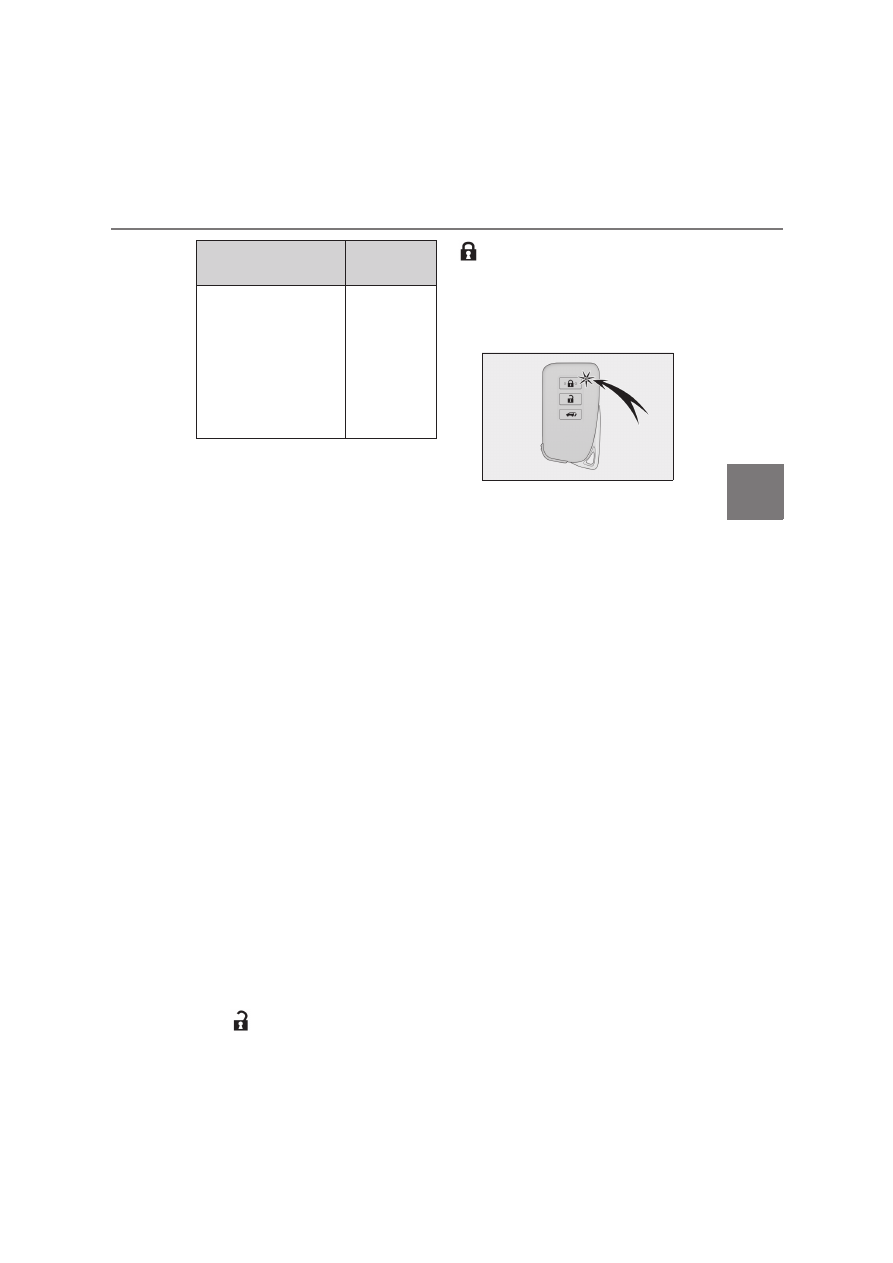
Press
twice while pressing and holding
. Confirm that the electronic key indica-
tor flashes 4 times.
While the battery-saving mode is set, the
smart entry & start system cannot be used.
To cancel the function, press any of the elec-
tronic key buttons.
■
Conditions affecting operation
The smart entry & start system, wireless
remote control and engine immobilizer sys-
tem use weak radio waves. In the following
situations, the communication between the
electronic key and the vehicle may be
affected, preventing the smart entry & start
system, wireless remote control and engine
immobilizer system from operating prop-
erly. (Ways of coping:
P.570)
●
When the electronic key battery is
depleted
●
Near a TV tower, electric power plant,
gas station, radio station, large display,
airport or other facility that generates
strong radio waves or electrical noise
●
When the electronic key is in contact
with, or is covered by the following metal-
lic objects
• Cards to which aluminum foil is attached
• Cigarette boxes that have aluminum foil
inside
• Metallic wallets or bags
• Coins
• Hand warmers made of metal
• Media such as CDs and DVDs
●
When other wireless keys (that emit radio
waves) are being used nearby
●
When carrying the electronic key
together with the following devices that
emit radio waves
• Portable radio, cellular phone, cordless
phone or other wireless communication
devices
Situation
Correction
procedure
The engine switch was
turned to ACCESSORY
mode while the driver’s
door was open (The
driver’s door was opened
when the engine switch
was in ACCESSORY
mode).
Turn the engine
switch off and
close the
driver’s door.