Lexus LC (2021 year). Manual in english - page 23
 

  Index      Manuals     Lexus LC (2021 year). Manual in english


Search            copyright infringement  


Content      ..     21      22      23      24     ..


Lexus LC (2021 year). Manual in english - page 23


467

7

7-2. Steps to take in an emergency

Wh
en

 troubl
e ar
ises

2

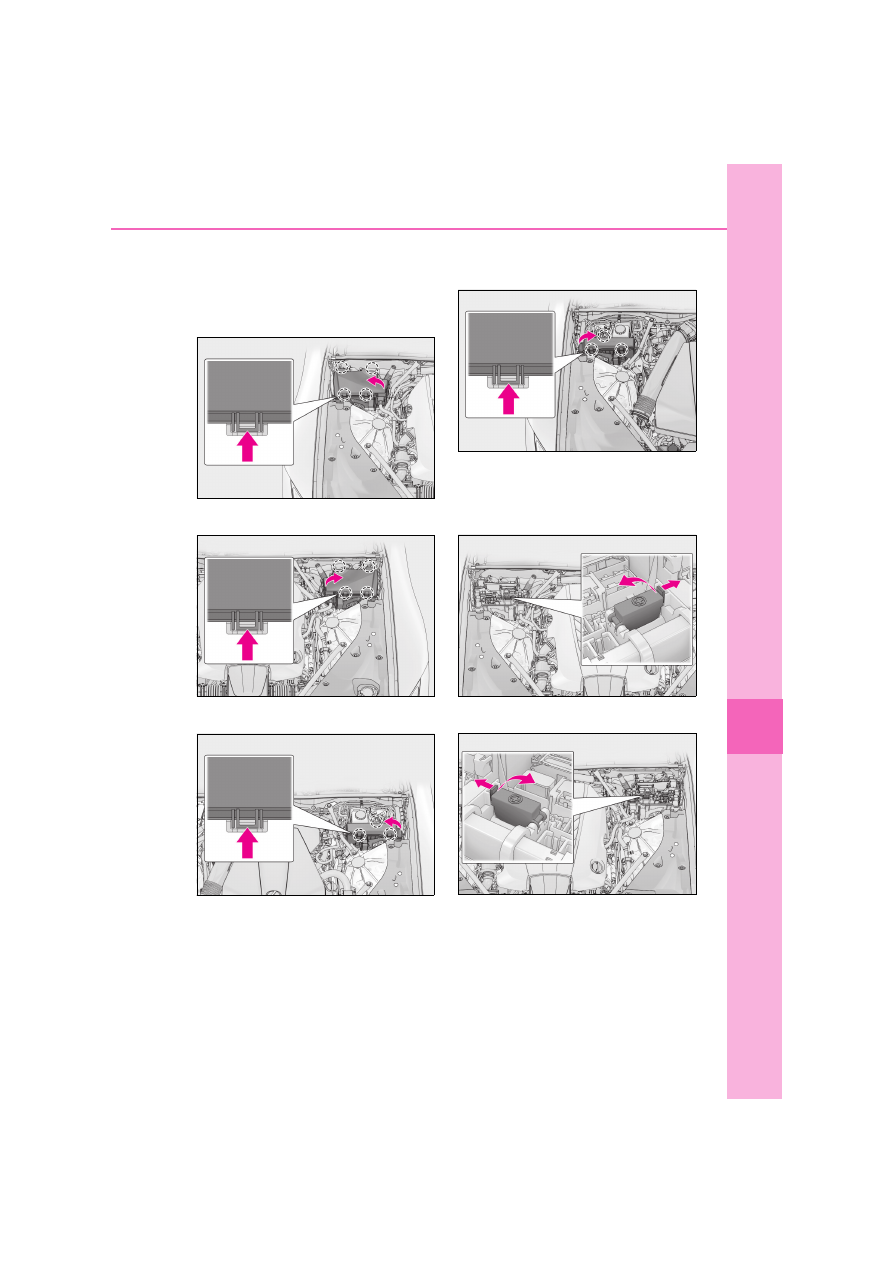
Open the hood (

P.385) and 

open the fuse box cover.

Push the tab in and lift the lid off.

LC500 (Left-hand drive vehicles)

LC500 (Right-hand drive vehicles)

LC500h (Left-hand drive vehicles)

LC500h (Right-hand drive vehi-
cles)

3

Open the exclusive jump starting 
terminal cover.

LC500 (Left-hand drive vehicles)

LC500 (Right-hand drive vehicles)

468

7-2. Steps to take in an emergency

LC500h (Left-hand drive vehicles)

LC500h (Right-hand drive vehi-
cles)

4

Remove the engine cover.

LC500

LC500h

5

Connect a positive jumper cable clamp to 

 on your vehicle and connect the 

clamp on the other end of the positive cable to 

 on the second vehicle.

Then, connect a negative cable clamp to 

 on the second vehicle and con-

nect the clamp at the other end of the negative cable to 

.

A

B

C

D

469

7

7-2. Steps to take in an emergency

Wh
en

 troubl
e ar
ises

LC500 (Left-hand drive vehicles)

LC500 (Right-hand drive vehicles)

470

7-2. Steps to take in an emergency

LC500h (Left-hand drive vehicles)

LC500h (Right-hand drive vehicles)

Exclusive jump starting terminal (your vehicle)

Positive (+) battery terminal (second vehicle)

Negative (-) battery terminal (second vehicle)

Solid, stationary, unpainted metallic point away from the exclusive jump starting 
terminal and any moving parts as shown in the illustration

6

Start the engine of the second vehi-
cle. Increase the engine speed 
slightly and maintain at that level for 
approximately 5 minutes to 

recharge the 12-volt battery of your 
vehicle.

A
B
C
D

471

7

7-2. Steps to take in an emergency

Wh
en

 troubl
e ar
ises

7

Open and close any of the door of 
your vehicle with the engine switch 
<power switch> off.

8

Maintain the engine speed of the 
second vehicle and start the engine 
<hybrid system> of your vehicle by 
turning the engine switch <power 
switch> to IGNITION ON mode 
<ON mode>.

9

Once the vehicle’s engine <hybrid 
system> has started, remove the 
jumper cables in the exact reverse 
order from which they were con-
nected.

10

Close the exclusive jump starting 
terminal cover, and reinstall the fuse 
box cover and engine cover to its 
original position.

Once the engine <hybrid system> starts, 

have the vehicle inspected at any autho-

rized Lexus retailer or Lexus authorized 

repairer, or any reliable repairer as soon as 

possible.

Q

Starting the engine <hybrid system> 

when the 12-volt battery is discharged

The engine <hybrid system> cannot be 

started by push-starting.

Q

To prevent 12-volt battery discharge

O

Turn off the headlights and the audio sys-

tem while the engine <hybrid system> is 

stopped.

O

Turn off any unnecessary electrical com-

ponents when the vehicle is running at a 

low speed for an extended period, such 

as in heavy traffic.

Q

When the 12-volt battery is removed or 

discharged

O

Information stored in the ECU is cleared. 

When the 12-volt battery is depleted, 

have the vehicle inspected at any autho-

rized Lexus retailer or Lexus authorized 

repairer.

O

Some systems may require initialization. 

(

P.508)

Q

When removing the 12-volt battery ter-

minals

When the 12-volt battery terminals are 

removed, the information stored in the 

ECU is cleared. Before removing the 12-

volt battery terminals, contact any autho-

rized Lexus retailer or Lexus authorized 

repairer.

Q

Charging the 12-volt battery

The electricity stored in the 12-volt battery 

will discharge gradually even when the 

vehicle is not in use, due to natural dis-

charge and the draining effects of certain 

electrical appliances. If the vehicle is left for 

a long time, the 12-volt battery may dis-

charge, and the engine <hybrid system> 

may be unable to start. (The 12-volt battery 

recharges automatically during driving.)

Q

When recharging or replacing the 12-

volt battery

O

In some cases, it may not be possible to 

unlock the doors using the smart entry & 

start system when the 12-volt battery is 

discharged. Use the wireless remote 

control or the mechanical key to lock or 

unlock the doors.

O

The engine <hybrid system> may not start 

on the first attempt after the 12-volt bat-

tery has recharged but will start normally 

after the second attempt. This is not a 

malfunction.

O

The engine switch <power switch> mode 

is memorized by the vehicle. When the 

12-volt battery is reconnected, the system 

will return to the mode it was in before 

the 12-volt battery was discharged. 

Before disconnecting the 12-volt battery, 

turn the engine switch <power switch> off. 

If you are unsure what mode the engine 

switch <power switch> was in before the 

12-volt battery discharged, be especially 

careful when reconnecting the 12-volt 

battery.

O

If the 12-volt battery discharges, it may 

not be possible to shift the shift position to 

472

7-2. Steps to take in an emergency

other positions. In this case, the vehicle 

cannot be towed without lifting both rear 

wheels because the rear wheels will be 

locked. (

P.436)

Q

When replacing the 12-volt battery

O

Use a Central Degassing type 12-volt 

battery (European Regulations).

O

LC500: Use a 12-volt battery that the 

case size is same as the previous one 

(LN4), 20 hour rate capacity (20HR) is 

equivalent (80Ah) or greater, and per-

formance rating (CCA) is equivalent 

(685A) or greater.

LC500h: Use a 12-volt battery that the 

case size is same as the previous one 

(LN3), 20 hour rate capacity (20HR) is 

equivalent (70Ah) or greater, and perfor-

mance rating (CCA) is equivalent 

(600A) or greater.

• If the sizes differ, the 12-volt battery can-

not be properly secured.

• If the 20 hour rate capacity is low, even if 

the time period where the vehicle is not 

used is a short time, the 12-volt battery 

may discharge and engine <hybrid sys-

tem> may not be able to start.

O

Use a 12-volt battery with a handle. If a 

12-volt battery without a handle is used, 

removal is more difficult.

O

After exchanging, firmly attach the fol-

lowing items to the exhaust hole of the 12-

volt battery.

• Use the exhaust hose that was attached 

to the 12-volt battery before exchanging.

• Use the exhaust hole plug included with 

the 12-volt battery exchanged or the one 

installed on the battery prior to the 

exchange. (Depending on the 12-volt 

battery to be exchanged, the exhaust 

hole may be plugged.)

Exhaust hole plug

Exhaust hole

Exhaust hose

For details, consult any authorized Lexus 
retailer or Lexus authorized repairer.

WARNING

Q

When removing the 12-volt battery 

terminals

Always remove the negative (-) terminal 

first. If the positive (+) terminal contacts 

any metal in the surrounding area when 

the positive (+) terminal is removed, a 

spark may occur, leading to a fire in addi-

tion to electrical shocks and death or 

serious injury.

Q

Avoiding 12-volt battery fires or 

explosions

Observe the following precautions to 

prevent accidentally igniting the flamma-

ble gas that may be emitted from the 12-

volt battery:

O

Make sure each jumper cable is con-

nected to the correct terminal and that 

it is not unintentionally in contact with 

any other than the intended terminal.

A

B

C

473

7

7-2. Steps to take in an emergency

Wh
en

 troubl
e ar
ises

WARNING

O

Do not allow the other end of the 

jumper cable connected to the “+” ter-

minal to come into contact with any 

other parts or metal surfaces in the 

area, such as brackets or unpainted 

metal.

O

Do not allow the + and - clamps of the 

jumper cables to come into contact 

with each other.

O

Do not smoke, use matches, cigarette 

lighters or allow open flame near the 

12-volt battery.

O

If the 12-volt battery fluid level is exces-

sively low (

P.395), do not use the 

12-volt battery.

Q

12-volt battery precautions

The 12-volt battery contains poisonous 

and corrosive acidic electrolyte, while 

related parts contain lead and lead com-

pounds. Observe the following precau-

tions when handling the 12-volt battery:

O

When working with the 12-volt battery, 

always wear safety glasses and take 

care not to allow any 12-volt battery 

fluids (acid) to come into contact with 

skin, clothing or the vehicle body.

O

Do not lean over the 12-volt battery.

O

In the event that 12-volt battery fluid 

comes into contact with the skin or 

eyes, immediately wash the affected 

area with water and seek medical 

attention.

Place a wet sponge or cloth over the 

affected area until medical attention 

can be received.

O

Always wash your hands after handling 

the 12-volt battery support, terminals, 

and other battery-related parts.

O

Do not allow children near the 12-volt 

battery.

Q

After recharging the 12-volt battery

Have the 12-volt battery inspected at any 

authorized Lexus retailer or Lexus 

authorized repairer, or any reliable 

repairer as soon as possible. If the 12-volt 

battery is deteriorating, continued use 

may cause the 12-volt battery to emit a 

malodorous gas, which may be detri-

mental to the health of passengers.

Q

When exchanging the 12-volt battery

After exchanging, securely attach the 

exhaust hose and exhaust hole plug to 

the exhaust hole of the exchanged 12-

volt battery. If not properly installed, 

gases (hydrogen) may leak into the vehi-

cle interior, and there is the possible dan-

ger of the gas igniting and exploding.

NOTICE

Q

When handling jumper cables

When connecting the jumper cables, 

ensure that they do not become entan-

gled in the cooling fan or engine drive 

belt.

Q

To prevent damaging the vehicle

The exclusive jump starting terminal is to 

be used when charging the 12-volt bat-

tery from another vehicle in an emer-

gency. It cannot be used to jump start 

another vehicle.

474

7-2. Steps to take in an emergency

1

Stop the vehicle in a safe place and 
turn off the air conditioning system, 
and then stop the engine.

2

If you see steam:
Carefully lift the hood after the 
steam subsides.
If you do not see steam:
Carefully lift the hood.

3

After the engine has cooled down 
sufficiently, inspect the hoses and 

radiator core (radiator) for any 
leaks.

Radiator

Cooling fan

If a large amount of coolant leaks, immedi-
ately contact any authorized Lexus retailer 
or Lexus authorized repairer, or any reli-
able repairer.

4

The coolant level is satisfactory if it 
is between the “F” and “L” lines on 
the reservoir.

Reservoir

“F” line

“L” line

Coolant inlet cap

5

Add coolant if necessary.

Water can be used in an emergency if 

If your vehicle overheats 
(LC500)

The following may indicate that 
your vehicle is overheating.

The engine coolant temperature 
gauge (

P.102) is in the red zone 

or a loss of engine power is expe-
rienced. (For example, the vehicle 
speed does not increase.)

“Engine Coolant Temp High Stop 
in a Safe Place See Owner’s 
Manual” is shown on the multi-
information display.

Steam comes out from under the 
hood.

Correction procedures

A
B

A
B
C
D

475

7

7-2. Steps to take in an emergency

Wh
en

 troubl
e ar
ises

coolant is unavailable.

6

Start the engine and turn the air 
conditioning system on to check 
that the radiator cooling fan oper-
ates and to check for coolant leaks 
from the radiator or hoses.

The fan operates when the air conditioning 

system is turned on immediately after a 

cold start. Confirm that the fan is operating 

by checking the fan sound and air flow. If it 

is difficult to check these, turn the air con-

ditioning system on and off repeatedly. 

(The fan may not operate in freezing tem-

peratures.)

7

If the fan is not operating:
Stop the engine immediately and 
contact any authorized Lexus 
retailer or Lexus authorized 
repairer, or any reliable repairer.
If the fan is operating:
Have the vehicle inspected at the 
nearest authorized Lexus retailer 
or Lexus authorized repairer, or any 
reliable repairer.

Q

When adding coolant

Add coolant in accordance with the follow-

ing procedure.

1

Remove the service cover.

2

Remove the engine cover.

3

Remove the caps 

 and 

.

4

Add coolant through the inlet of the cap 

 up to the “F” line 

, and then 

replace the cap 

.

5

Add coolant through the inlet of the cap 

 until it is full, and then replace the 

cap .

A

B

A

C

A

B

B

476

7-2. Steps to take in an emergency

If the engine coolant temperature 
gauge enters the red zone or 
“Engine Coolant Temp High Stop in 
a Safe Place See Owner’s Manual” 
is shown on the multi-information 
display

1

Stop the vehicle in a safe place and 
turn off the air conditioning system, 
and then stop the hybrid system.

2

If you see steam:
Carefully lift the hood after the 
steam subsides.
If you do not see steam:
Carefully lift the hood.

WARNING

Q

When inspecting under the hood of 

your vehicle

Observe the following precautions.

Failure to do so may result in serious 

injury such as burns.

O

If steam is seen coming from under the 

hood, do not open the hood until the 

steam has subsided. The engine com-

partment may be very hot.

O

Keep hands and clothing (especially a 

tie, a scarf or a muffler) away from the 

fan and belts. Failure to do so may 

cause the hands or clothing to be 

caught, resulting in serious injury.

O

While the engine and radiator are hot, 

do not loosen or remove the coolant 

inlet cap or coolant reservoir cap. 

High temperature steam or coolant 

could spray out.

NOTICE

Q

When adding engine coolant

Add coolant slowly after the engine has 

cooled down sufficiently. Adding cool 

coolant to a hot engine too quickly can 

cause damage to the engine.

Q

To prevent damage to the cooling sys-

tem

Observe the following precautions:

O

Avoid contaminating the coolant with 

foreign matter (such as sand or dust 

etc.).

O

Do not use any coolant additive.

If your vehicle overheats 
(LC500h)

The following may indicate that 
your vehicle is overheating.

The engine coolant temperature 
gauge (

P.102) enters the red 

zone or a loss of hybrid system 
power is experienced. (For exam-
ple, the vehicle speed does not 
increase.)

“Engine Coolant Temp High Stop 
in a Safe Place See Owner’s 
Manual” or “Hybrid System 
Overheated Output Power 
Reduced” is shown on the multi-
information display.

Steam comes out from under the 
hood.

Correction procedures

477

7

7-2. Steps to take in an emergency

Wh
en

 troubl
e ar
ises

3

After the hybrid system has cooled 
down sufficiently, inspect the hoses 
and cooling system for leaks.

Radiator

Cooling fan

If a large amount of coolant leaks, immedi-
ately contact any authorized Lexus retailer 
or Lexus authorized repairer, or any reli-
able repairer.

4

The coolant level is satisfactory if it 
is between the “F” and “L” lines on 
the reservoir.

Reservoir

“F” line

“L” line

Coolant inlet cap

5

Add coolant if necessary.

Water can be used in an emergency if 

engine coolant is unavailable.

6

Start the hybrid system and turn the 
air conditioning system on to check 
that the radiator cooling fan oper-
ates and to check for coolant leaks 
from the radiator or hoses.

The fan operates when the air conditioning 

system is turned on immediately after a 

cold start. Confirm that the fan is operating 

by checking the fan sound and air flow. If it 

is difficult to check these, turn the air con-

ditioning system on and off repeatedly. 

(The fan may not operate in freezing tem-

peratures.)

7

If the fan is not operating:
Stop the hybrid system immediately 
and contact any authorized Lexus 
retailer or Lexus authorized 
repairer, or any reliable repairer.
If the fan is operating:
Have the vehicle inspected at the 
nearest authorized Lexus retailer 
or Lexus authorized repairer, or any 
reliable repairer.

A
B

A
B
C
D

478

7-2. Steps to take in an emergency

If “Hybrid System Overheated Out-
put Power Reduced” is shown on the 
multi-information display

1

Stop the vehicle in a safe place.

2

Stop the hybrid system and care-
fully lift the hood.

3

After the hybrid system has cooled 
down, inspect the hoses and radia-
tor core (radiator) for any leaks.

Radiator

Cooling fan

If a large amount of coolant leaks, immedi-
ately contact any authorized Lexus retailer 
or Lexus authorized repairer, or any reli-
able repairer.

4

The coolant level is satisfactory if it 
is between the “F”/“FULL” and 
“L”/“LOW” lines on the reservoir.

Reservoir

“F”/“FULL” line

“L”/“LOW” line

5

Add coolant if necessary.

Water can be used in an emergency if 

power control unit coolant is unavailable.

6

After stopping the hybrid system 
and waiting for 5 minutes or more, 
start the hybrid system again and 
check if “Hybrid System Over-
heated Output Power Reduced” is 
shown on the multi-information dis-
play.

If the message does not disappear:
Stop the hybrid system and contact any 

authorized Lexus retailer or Lexus autho-

rized repairer, or any reliable repairer.
If the message is not displayed:
The hybrid system temperature has 

dropped and the vehicle may be driven 

normally.
However, if the message appears again fre-

quently, contact any authorized Lexus 

retailer or Lexus authorized repairer, or 

any reliable repairer.

Q

When adding engine coolant

Add coolant in accordance with the follow-

ing procedure.

1

Remove the service cover.

A
B

A

B
C

479

7

7-2. Steps to take in an emergency

Wh
en

 troubl
e ar
ises

2

Remove the engine cover.

3

Remove caps 

 and 

.

4

Add coolant through the inlet of the cap 

 up to the “F” line 

, and then 

replace the cap 

.

5

Add coolant through the inlet of cap 

 until it is full, and then replace the 

cap .

A

B

A

C

A

B

B

WARNING

Q

When inspecting under the hood of 

your vehicle

Observe the following precautions. 

Failure to do so may result in serious 

injury such as burns.

O

If steam is seen coming from under the 

hood, do not open the hood until the 

steam has subsided. The engine com-

partment may be very hot.

O

After the hybrid system has been 

turned off, check that the “READY” 

indicator is off.

When the hybrid system is operating, 

the gasoline engine may automatically 

start, or the cooling fan may suddenly 

operate even if the gasoline engine 

stops. Do not touch or approach rotat-

ing parts such as the fan, which may 

lead to fingers or clothing (especially a 

tie, a scarf or a muffler) getting caught, 

resulting in serious injury.

O

Do not loosen the coolant inlet cap or 

coolant reservoir caps while the hybrid 

system and radiator are hot.

High temperature steam or coolant 

could spray out.

NOTICE

Q

When adding engine/power control 

unit coolant

Add coolant slowly after the hybrid sys-

tem has cooled down sufficiently. Adding 

cool coolant to a hot hybrid system too 

quickly can cause damage to the hybrid 

system.

Q

To prevent damage to the cooling sys-

tem

Observe the following precautions:

O

Avoid contaminating the coolant with 

foreign matter (such as sand or dust 

etc.).

O

Do not use any coolant additive.

480

7-2. Steps to take in an emergency

1

Stop the engine <hybrid system>. 
Set the parking brake and shift the 
shift position to P.

2

Remove the mud, snow or sand 
from around the rear wheels.

3

Place wood, stones or some other 
material under the rear wheels to 
help provide traction.

4

Restart the engine <hybrid system>.

5

Shift the shift position to D or R and 
release the parking brake. Then, 
while exercising caution, depress 
the accelerator pedal.

Q

When it is difficult to free the vehicle

Press the 

 switch to turn off TRC.

If the vehicle becomes stuck

Carry out the following proce-
dures if the tires spin or the vehicle 
becomes stuck in mud, dirt or snow:

Recovering procedure

WARNING

Q

When attempting to free a stuck vehi-

cle

If you choose to push the vehicle back 

and forth to free it, make sure the sur-

rounding area is clear to avoid striking 

other vehicles, objects or people. The 

vehicle may also lunge forward or lunge 

back suddenly as it becomes free. Use 

extreme caution.

Q

When shifting the shift position

Be careful not to shift the shift position 

with the accelerator pedal depressed.

This may lead to unexpected rapid accel-

eration of the vehicle that may cause an 

accident resulting in death or serious 

injury.

NOTICE

Q

To avoid damaging the transmission 

and other components

O

Avoid spinning the rear wheels and 

depressing the accelerator pedal 

more than necessary.

O

If the vehicle remains stuck even after 

these procedures are performed, the 

vehicle may require towing to be freed.

8

481

8

Vehic

le spe

cif

ic

at

ion
s

Vehicle specifications

8-1. Specifications

Maintenance data (fuel, oil level, 

etc.) ..............................................

482

Fuel information.........................

493

8-2. Customization

Customizable features ...........

495

8-3. Items to initialize

Items to initialize ........................

508

482

8-1. Specifications

8-1.Specifications

*1

: Unladen vehicle

*2

: LC500

*3

: LC500h

Q

Vehicle identification number

The vehicle identification number 
(VIN) is the legal identifier for your 
vehicle. This is the primary identifica-
tion number for your Lexus. It is used in 
registering the ownership of your vehi-
cle.
This number is stamped on the top left 
of the instrument panel.

This number is also stamped under the 
right-hand front seat.

Maintenance data (fuel, oil level, etc.)

Dimensions and weights

Overall length

4760 mm (187.4 in.)

Overall width

1920 mm (75.6 in.)

Overall height

*1

1345 mm (53.0 in.)

Wheelbase

2870 mm (113.0 in.)

Tread

*1

Front

1630 mm (64.2 in.)

Rear

1635 mm (64.4 in.)

Gross vehicle mass

2375 kg (5236 lb.)

*2

2445 kg (5390 lb.)

*3

Maximum permissi-
ble axle capacity

Front

1420 kg (3131 lb.)

Rear

1550 kg (3417 lb.)

Vehicle identification


Content      ..     21      22      23      24     ..